Occupational Health and
Safety Management Systems
•ISO 45001: 2018
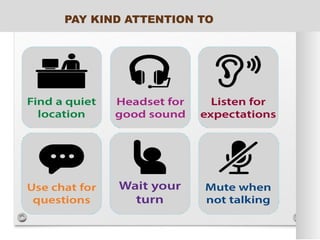
PAY KIND ATTENTION TO
Learning Objectives
1. Introduction to ISO
2. ISO 45001:2018 OHSMS
3. Benefits ISO 45001:2018 OHSMS
4. ISO 45001: 2018 OHSMS Clauses
5. Internal Audit System
Background of ISO Standards
= International Organization for
Standardization
Why not IOS :
bc Derived from ISOS
meaning equal
ISO is a worldwide federation of national standards
bodies.
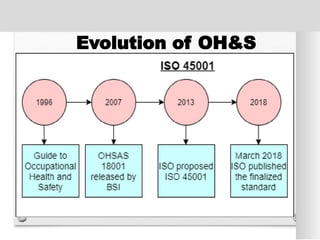
Evolution of OH&S
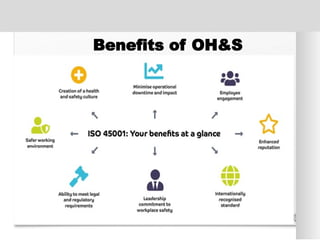
Benefits of OH&S
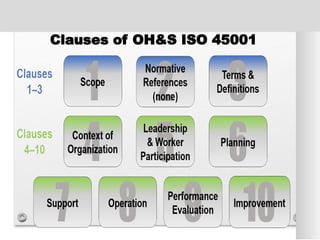
Clauses of OH&S ISO 45001
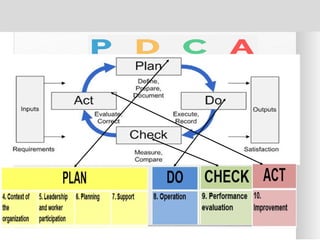
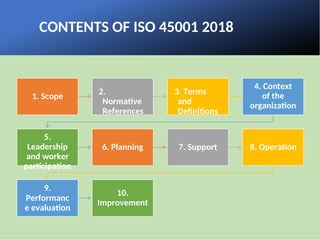
CONTENTS OF ISO 45001 2018
1. Scope
2.
Normative
References
3. Terms
and
Definitions
4. Context
of the
organization
5.
Leadership
and worker
participation
6. Planning 7. Support 8. Operation
9.
Performanc
e evaluation
10.
Improvement
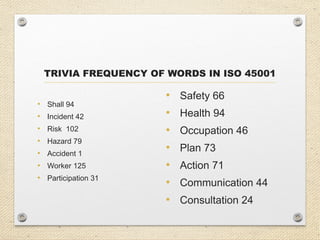
TRIVIA FREQUENCY OF WORDS IN ISO 45001
• Shall 94
• Incident 42
• Risk 102
• Hazard 79
• Accident 1
• Worker 125
• Participation 31
• Safety 66
• Health 94
• Occupation 46
• Plan 73
• Action 71
• Communication 44
• Consultation 24
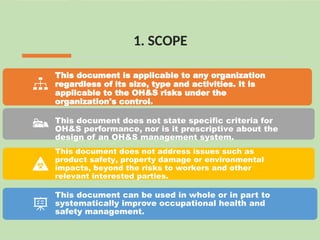
1. SCOPE
This document is applicable to any organization
regardless of its size, type and activities. It is
applicable to the OH&S risks under the
organization's control.
This document does not state specific criteria for
OH&S performance, nor is it prescriptive about the
design of an OH&S management system.
This document does not address issues such as
product safety, property damage or environmental
impacts, beyond the risks to workers and other
relevant interested parties.
This document can be used in whole or in part to
systematically improve occupational health and
safety management.
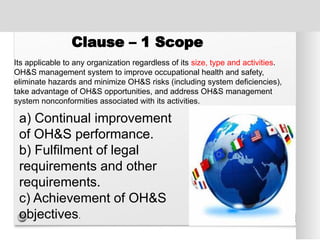
Clause – 1 Scope
Its applicable to any organization regardless of its size, type and activities.
OH&S management system to improve occupational health and safety,
eliminate hazards and minimize OH&S risks (including system deficiencies),
take advantage of OH&S opportunities, and address OH&S management
system nonconformities associated with its activities.
a) Continual improvement
of OH&S performance.
b) Fulfilment of legal
requirements and other
requirements.
c) Achievement of OH&S
objectives.
Clause 2. Normative references
There are no normative references in
this document.
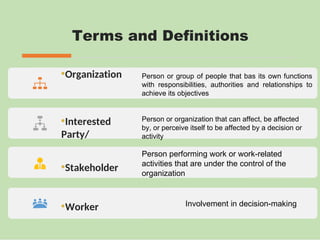
Terms and Definitions
•Organization
•Interested
Party/
•Stakeholder
•Worker
Person or group of people that bas its own functions
with responsibilities, authorities and relationships to
achieve its objectives
Person or organization that can affect, be affected
by, or perceive itself to be affected by a decision or
activity
Person performing work or work-related
activities that are under the control of the
organization
Involvement in decision-making
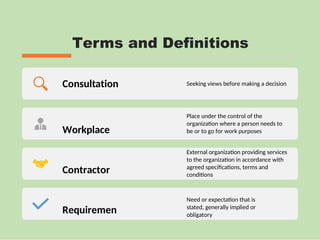
Terms and Definitions
Consultation
Workplace
Contractor
Requiremen
Seeking views before making a decision
Place under the control of the
organization where a person needs to
be or to go for work purposes
External organization providing services
to the organization in accordance with
agreed specifications, terms and
conditions
Need or expectation that is
stated, generally implied or
obligatory
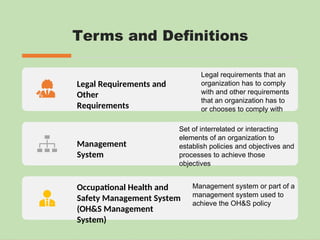
Terms and Definitions
Legal Requirements and
Other
Requirements
Legal requirements that an
organization has to comply
with and other requirements
that an organization has to
or chooses to comply with
Management
System
Set of interrelated or interacting
elements of an organization to
establish policies and objectives and
processes to achieve those
objectives
Occupational Health and
Safety Management System
(OH&S Management
System)
Management system or part of a
management system used to
achieve the OH&S policy
Terms and Definitions
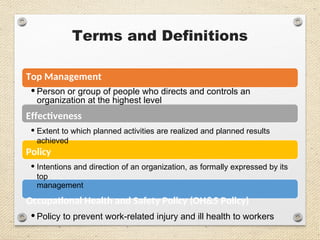
Top Management
• Person or group of people who directs and controls an
organization at the highest level
Effectiveness
• Extent to which planned activities are realized and planned results
achieved
Policy
• Intentions and direction of an organization, as formally expressed by its
top
management
Occupational Health and Safety Policy (OH&5 Policy)
• Policy to prevent work-related injury and ill health to workers
Terms and Definitions
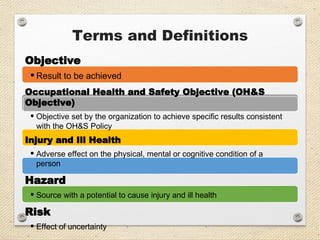
Objective
• Result to be achieved
Occupational Health and Safety Objective (OH&S
Objective)
• Objective set by the organization to achieve specific results consistent
with the OH&S Policy
Injury and Ill Health
• Adverse effect on the physical, mental or cognitive condition of a
person
Hazard
• Source with a potential to cause injury and ill health
Risk
• Effect of uncertainty
Terms and Definitions
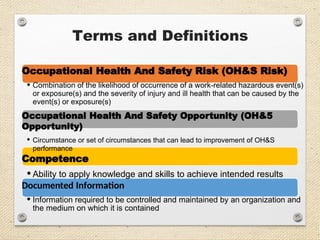
Occupational Health And Safety Risk (OH&S Risk)
• Combination of the likelihood of occurrence of a work-related hazardous event(s)
or exposure(s) and the severity of injury and ill health that can be caused by the
event(s) or exposure(s)
Occupational Health And Safety Opportunity (OH&5
Opportunity)
• Circumstance or set of circumstances that can lead to improvement of OH&S
performance
Competence
• Ability to apply knowledge and skills to achieve intended results
Documented Information
• Information required to be controlled and maintained by an organization and
the medium on which it is contained
Terms and Definitions
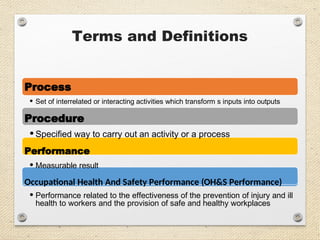
Process
• Set of interrelated or interacting activities which transform s inputs into outputs
Procedure
• Specified way to carry out an activity or a process
Performance
• Measurable result
Occupational Health And Safety Performance (OH&S Performance)
• Performance related to the effectiveness of the prevention of injury and ill
health to workers and the provision of safe and healthy workplaces
Terms and Definitions
Outsource
• Make an arrangement where an external organization performs part of an
organization's function or process
Monitoring
• Determining the status of a system, a process or an activity
Measurement
• Process to determine a value
Audit
• Systematic. independent and documented process for obtaining audit
evidence and evaluating it objectively to determine the extent to which
the audit criteria are fulfilled
Terms and Definitions
Conformity
• Fulfilment of a requirement
Nonconformity
• Non-fulfilment of a requirement
Incident
• Occurrence arising out of, or in the course of. work that could or does result in injury
and ill health
Corrective Action
• Action to eliminate the cause(s) of a nonconformity or an incident and to prevent
recurrence
Continual Improvement
• Recurring activity to enhance performance
Terms and Definitions:
Who is a Worker?
Brainstorming
Session
“Person performing work or work-
related activities that are under the
control of the organization”.
Examples:
• Worker could be paid or unpaid,
temporarily, etc.
• Workers include top management.
• Workers include contractors,
individuals, agency workers, and by
other persons.
Terms and Definitions:
Difference Between
Nonconformity & Incidents?
Brainstorming Session
Nonconformity:
- non-fulfilment of a requirement.
(standard and company’s OH&S MS.
Although there can be one or more nonconformity related to an
incident, an incident can also occur when there is no
nonconformity.
Incident:
- occurrence arising out of, or in the
course of, work that could or does
result in injury and ill health.
Terms and Definitions:
Difference Between
Participation &
Consultation?
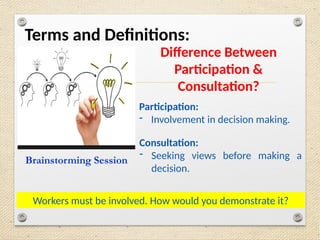
Brainstorming Session
Participation:
- Involvement in decision making.
Workers must be involved. How would you demonstrate it?
Consultation:
- Seeking views before making a
decision.
Health: Absence of disease or illness or the protection of the bodies
and minds of people from illness resulting from the materials,
processes or procedures used in the workplace”. For example,
exposure to hazardous chemical can result in physical ill health
(asthma), verbal abuse or work-related stress can result in
psychological ill-health.
Safety: The protection of people from physical injury”. For example,
working at height on an unprotected edge is unsafe, because there
is a potential to fall from height resulting in serious injury or death.
Hence provision of safe working platform prevent physical injury is
considered as safety.
Clause 3. Terms and definitions
Consultation: seeking views before making a decision
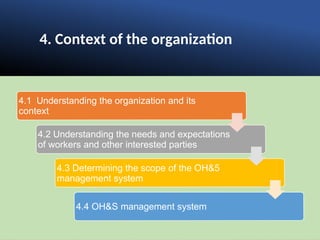
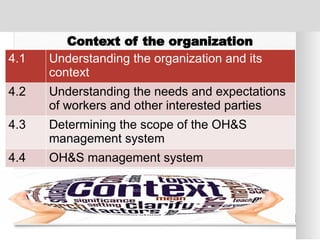
4. Context of the organization
4.1 Understanding the organization and its
context
4.2 Understanding the needs and expectations
of workers and other interested parties
4.3 Determining the scope of the OH&5
management system
4.4 OH&S management system
Context of the organization
4.1 Understanding the organization and its
context
4.2 Understanding the needs and expectations
of workers and other interested parties
4.3 Determining the scope of the OH&S
management system
4.4 OH&S management system
Context of the organization:
The Goal of this clause is to:
• Determine why the organization exists;
• Identify any internal and externa influences that will
affect desired outcomes.
• Document the scope of the management system
that’s implemented.
• Determine the processes, control, monitoring
measurements of the OH & S management system
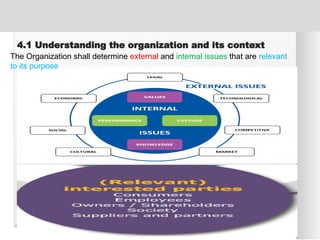
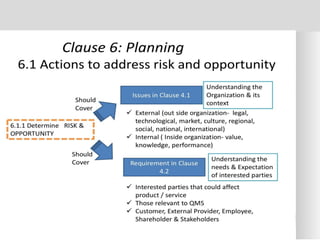
4.1 Understanding the organization and its context
The Organization shall determine external and internal issues that are relevant
to its purpose
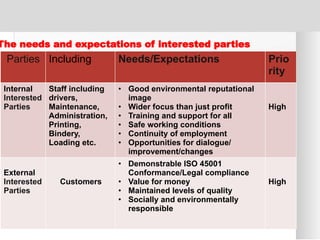
Parties Including Needs/Expectations Prio
rity
Internal
Interested
Parties
Staff including
drivers,
Maintenance,
Administration,
Printing,
Bindery,
Loading etc.
• Good environmental reputational
image
• Wider focus than just profit
• Training and support for all
• Safe working conditions
• Continuity of employment
• Opportunities for dialogue/
improvement/changes
High
External
Interested
Parties
Customers
• Demonstrable ISO 45001
Conformance/Legal compliance
• Value for money
• Maintained levels of quality
• Socially and environmentally
responsible
High
The needs and expectations of interested parties
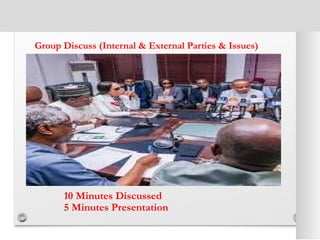
Group Discuss (Internal & External Parties & Issues)
10 Minutes Discussed
5 Minutes Presentation
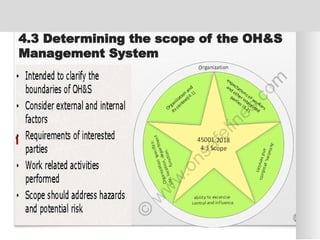
4.3 Determining the scope of the OH&S
Management System
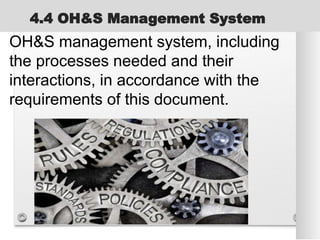
4.4 OH&S Management System
OH&S management system, including
the processes needed and their
interactions, in accordance with the
requirements of this document.
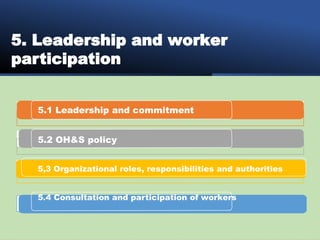
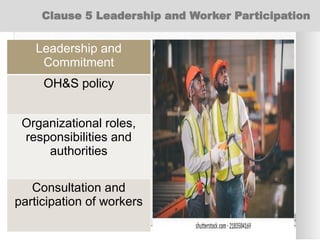
5. Leadership and worker
participation
5.1 Leadership and commitment
5.2 OH&S policy
5,3 Organizational roles, responsibilities and authorities
5.4 Consultation and participation of workers
Leadership and
Commitment
OH&S policy
Organizational roles,
responsibilities and
authorities
Consultation and
participation of workers
Clause 5 Leadership and Worker Participation
Leadership and Commitment
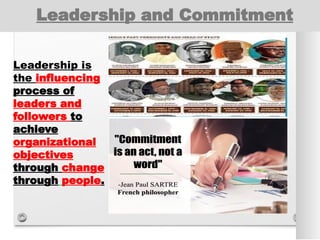
Leadership is
the influencing
process of
leaders and
followers to
achieve
organizational
objectives
through change
through people.
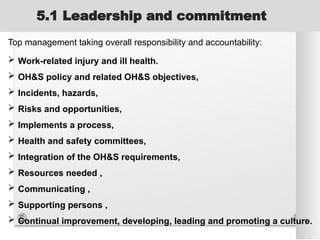
5.1 Leadership and commitment
Top management taking overall responsibility and accountability:
 Work-related injury and ill health.
 OH&S policy and related OH&S objectives,
 Incidents, hazards,
 Risks and opportunities,
 Implements a process,
 Health and safety committees,
 Integration of the OH&S requirements,
 Resources needed ,
 Communicating ,
 Supporting persons ,
 Continual improvement, developing, leading and promoting a culture.
5.2 OH&S Policy
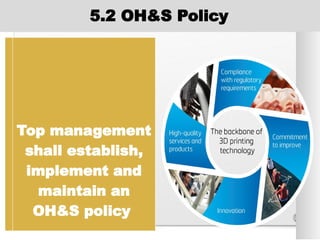
Top management
shall establish,
implement and
maintain an
OH&S policy
Clause 5.3 Organizational roles, responsibilities and
Authorities
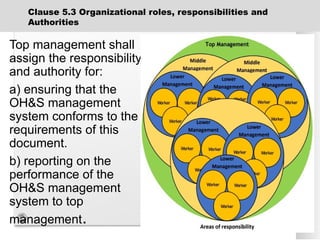
Top management shall
assign the responsibility
and authority for:
a) ensuring that the
OH&S management
system conforms to the
requirements of this
document.
b) reporting on the
performance of the
OH&S management
system to top
management.
45001
Clause 5.4
“Leadership and Worker
Participation”
Summary (key changes):
• Similar requirements were in OHSAS
18001; however there is a much greater
emphasizes on Management and
employees involvement in all aspects of
the management system.
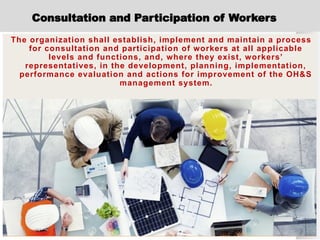
Consultation and Participation of Workers
The organization shall establish, implement and maintain a process
for consultation and participation of workers at all applicable
levels and functions, and, where they exist, workers’
representatives, in the development, planning, implementation,
performance evaluation and actions for improvement of the OH&S
management system.
6.Planning
6.1 Actions To Address
Risks And Opportunities
6.2 OH&S Objectives
And Planning To
Achieve Them
Clause 6.0 Planning
6.1 Actions to address risks and
opportunities
6.1.2 Hazard identification and
assessment of risks and opportunities
6.1.3 Determination of legal
requirements and other requirements
6.1.4 Planning action
6.2 OH&S objectives and planning to
achieve them
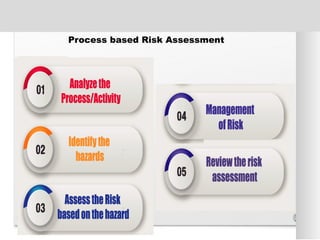
Process based Risk Assessment
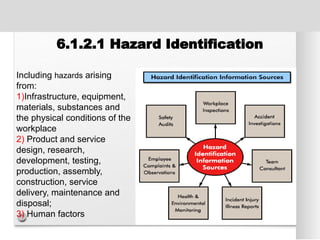
Including hazards arising
from:
1)Infrastructure, equipment,
materials, substances and
the physical conditions of the
workplace
2) Product and service
design, research,
development, testing,
production, assembly,
construction, service
delivery, maintenance and
disposal;
3) Human factors
6.1.2.1 Hazard Identification
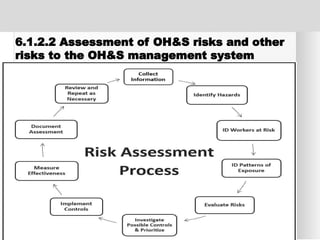
6.1.2.2 Assessment of OH&S risks and other
risks to the OH&S management system
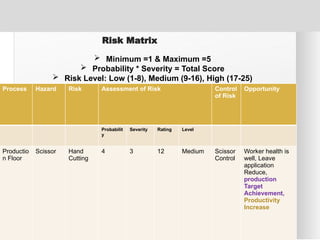
Risk Matrix
Process Hazard Risk Assessment of Risk Control
of Risk
Opportunity
Probabilit
y
Severity Rating Level
Productio
n Floor
Scissor Hand
Cutting
4 3 12 Medium Scissor
Control
Worker health is
well, Leave
application
Reduce,
production
Target
Achievement,
Productivity
Increase
 Minimum =1 & Maximum =5
 Probability * Severity = Total Score
 Risk Level: Low (1-8), Medium (9-16), High (17-25)
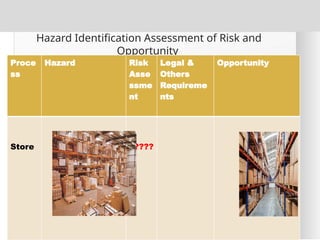
Hazard Identification Assessment of Risk and
Opportunity
Proce
ss
Hazard Risk
Asse
ssme
nt
Legal &
Others
Requireme
nts
Opportunity
Store ?????
10 Minutes Discussed+10 Minutes Presentation
Identify 5 hazards in a particular process and
establish controls for eliminating or minimizing them
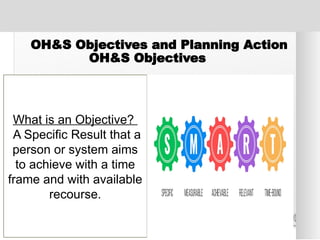
OH&S Objectives and Planning Action
OH&S Objectives
What is an Objective?
A Specific Result that a
person or system aims
to achieve with a time
frame and with available
recourse.
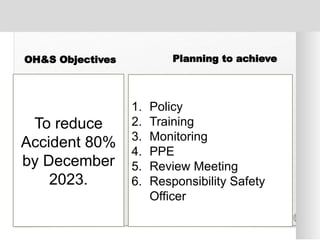
To reduce
Accident 80%
by December
2023.
OH&S Objectives
1. Policy
2. Training
3. Monitoring
4. PPE
5. Review Meeting
6. Responsibility Safety
Officer
Planning to achieve
Group Discussion
OH&S Objective & Planning to Achieve
10 Minutes Discussed+10 Minutes Presentation
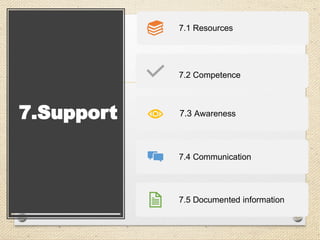
7.Support
7.1 Resources
7.2 Competence
7.3 Awareness
7.4 Communication
7.5 Documented information
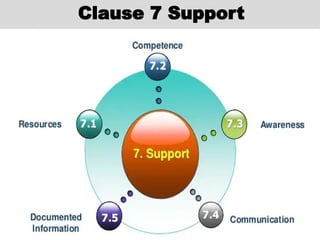
Clause 7 Support
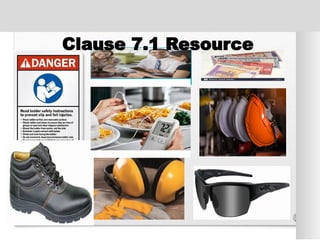
Clause 7.1 Resource
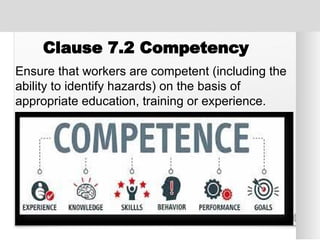
Clause 7.2 Competency
Ensure that workers are competent (including the
ability to identify hazards) on the basis of
appropriate education, training or experience.
Clause 7.3 Awareness
OH&S policy and OH&S
objectives
Effectiveness of the OH&S
management system,
Benefits of improved OH&S
performance.
Incidents and the outcomes
of investigations that are
relevant to them.
Hazards, OH&S risks and
actions determined that are
relevant to them.
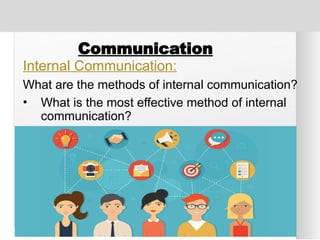
Communication
Internal Communication:
What are the methods of internal communication?
• What is the most effective method of internal
communication?
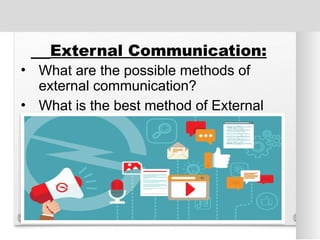
External Communication:
• What are the possible methods of
external communication?
• What is the best method of External
Communication?
7.5 Documented Information
 Documented information
required by local law
 Documented information
required by international
standard
 Documented information
required by the organization
 Documented information
required by the
Customer/supplier
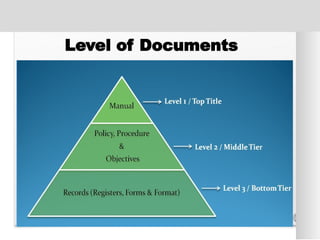
Level of Documents
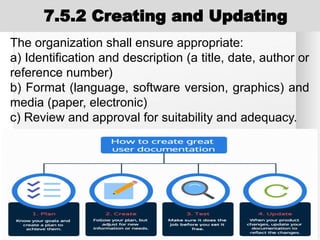
7.5.2 Creating and Updating
The organization shall ensure appropriate:
a) Identification and description (a title, date, author or
reference number)
b) Format (language, software version, graphics) and
media (paper, electronic)
c) Review and approval for suitability and adequacy.
7.5.3 Control of Documented Information
Document shall be controlled to ensure:
a) it is available and suitable for use, b) it is adequately
protected.
The following activities, as applicable:
— distribution, access, retrieval and use.
— storage and preservation,— control of changes (version
control).
— retention and disposition.
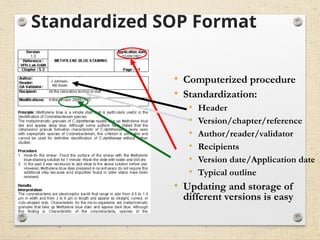
Standardized SOP Format
• Computerized procedure
• Standardization:
• Header
• Version/chapter/reference
• Author/reader/validator
• Recipients
• Version date/Application date
• Typical outline
• Updating and storage of
different versions is easy
J Johnson,
RB Smith
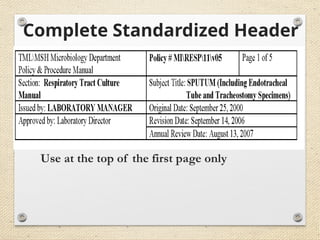
Complete Standardized Header
Use at the top of the first page only
8. Operation
8.1 Operational
planning and
control
8.2 Emergency
preparedness
and response
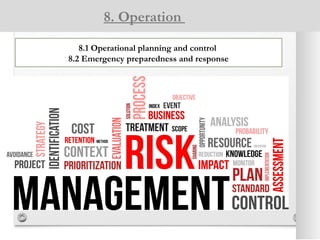
8. Operation
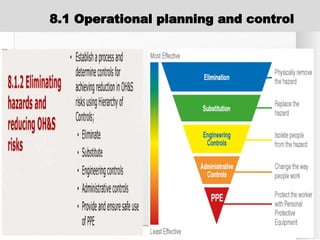
8.1 Operational planning and control
8.2 Emergency preparedness and response
8.1 Operational planning and control
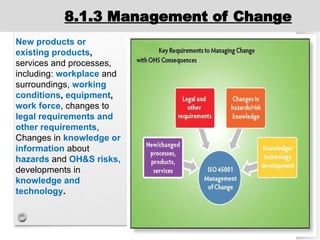
8.1.3 Management of Change
New products or
existing products,
services and processes,
including: workplace and
surroundings, working
conditions, equipment,
work force, changes to
legal requirements and
other requirements,
Changes in knowledge or
information about
hazards and OH&S risks,
developments in
knowledge and
technology.
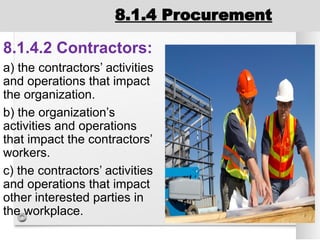
8.1.4 Procurement
8.1.4.2 Contractors:
a) the contractors’ activities
and operations that impact
the organization.
b) the organization’s
activities and operations
that impact the contractors’
workers.
c) the contractors’ activities
and operations that impact
other interested parties in
the workplace.
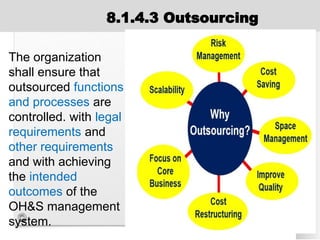
The organization
shall ensure that
outsourced functions
and processes are
controlled. with legal
requirements and
other requirements
and with achieving
the intended
outcomes of the
OH&S management
system.
8.1.4.3 Outsourcing
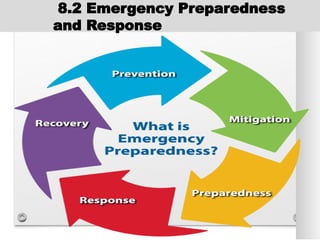
8.2 Emergency Preparedness
and Response
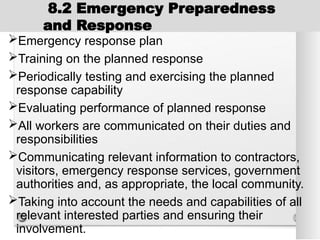
8.2 Emergency Preparedness
and Response
Emergency response plan
Training on the planned response
Periodically testing and exercising the planned
response capability
Evaluating performance of planned response
All workers are communicated on their duties and
responsibilities
Communicating relevant information to contractors,
visitors, emergency response services, government
authorities and, as appropriate, the local community.
Taking into account the needs and capabilities of all
relevant interested parties and ensuring their
involvement.
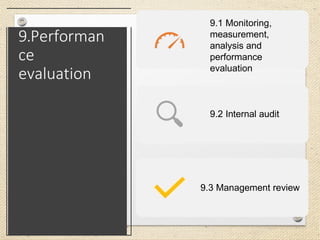
9.1 Monitoring,
measurement,
analysis and
performance
evaluation
9.2 Internal audit
9.3 Management review
9.Performan
ce
evaluation
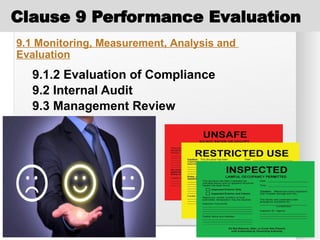
Clause 9 Performance Evaluation
9.1 Monitoring, Measurement, Analysis and
Evaluation
9.1.2 Evaluation of Compliance
9.2 Internal Audit
9.3 Management Review
Clause 9 Performance Evaluation
9.1 Monitoring, measurement,
analysis and evaluation
The organization must monitor, measure,
analyses and evaluate its OH&S
performance.
 Calibrated & Verified Monitoring and
Measuring Equipment's
 Result of OH&S Performance
 OH&S Objectives
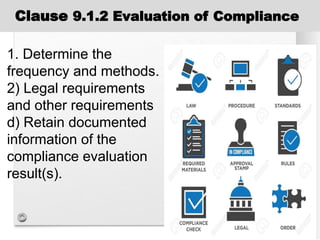
1. Determine the
frequency and methods.
2) Legal requirements
and other requirements
d) Retain documented
information of the
compliance evaluation
result(s).
Clause 9.1.2 Evaluation of Compliance
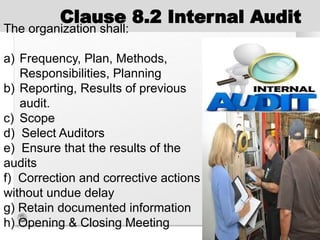
Clause 8.2 Internal Audit
The organization shall:
a) Frequency, Plan, Methods,
Responsibilities, Planning
b) Reporting, Results of previous
audit.
c) Scope
d) Select Auditors
e) Ensure that the results of the
audits
f) Correction and corrective actions
without undue delay
g) Retain documented information
h) Opening & Closing Meeting
9.3.2 Management review inputs
The management review shall include consideration of:
Previous management reviews, changes in external and internal
issues, needs and expectations, legal requirements and other
requirements, Risks and Opportunities, OH&S policy and the OH&S
objectives, OH&S performance, Incidents, Nonconformities, Corrective
actions and continual improvement, monitoring and measurement
results, Audit results, consultation and participation of workers.
9.3 Management Review
9.3.3 Management review Output
— the continuing suitability, adequacy and
effectiveness of the OH&S management
system in achieving its intended
outcomes.
— continual improvement opportunities.
— any need for changes to the OH&S
management system.
— resources needed.
— actions, if needed.
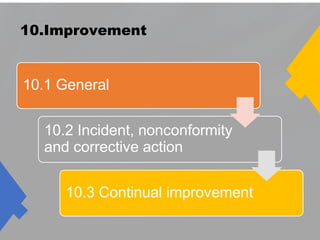
10.Improvement
10.1 General
10.2 Incident, nonconformity
and corrective action
10.3 Continual improvement
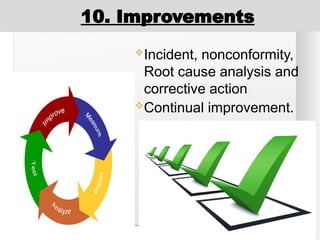
10. Improvements
Incident, nonconformity,
Root cause analysis and
corrective action
Continual improvement.
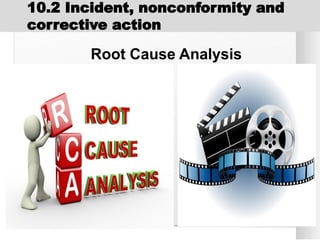
Root Cause Analysis
10.2 Incident, nonconformity and
corrective action
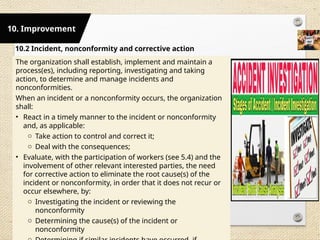
10.2 Incident, nonconformity and corrective action
The organization shall establish, implement and maintain a
process(es), including reporting, investigating and taking
action, to determine and manage incidents and
nonconformities.
When an incident or a nonconformity occurs, the organization
shall:
• React in a timely manner to the incident or nonconformity
and, as applicable:
o Take action to control and correct it;
o Deal with the consequences;
• Evaluate, with the participation of workers (see 5.4) and the
involvement of other relevant interested parties, the need
for corrective action to eliminate the root cause(s) of the
incident or nonconformity, in order that it does not recur or
occur elsewhere, by:
o Investigating the incident or reviewing the
nonconformity
o Determining the cause(s) of the incident or
nonconformity
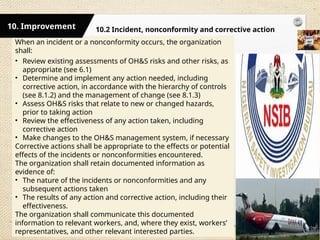
10. Improvement
10.2 Incident, nonconformity and corrective action
When an incident or a nonconformity occurs, the organization
shall:
• Review existing assessments of OH&S risks and other risks, as
appropriate (see 6.1)
• Determine and implement any action needed, including
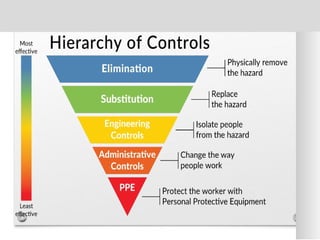
corrective action, in accordance with the hierarchy of controls
(see 8.1.2) and the management of change (see 8.1.3)
• Assess OH&S risks that relate to new or changed hazards,
prior to taking action
• Review the effectiveness of any action taken, including
corrective action
• Make changes to the OH&S management system, if necessary
Corrective actions shall be appropriate to the effects or potential
effects of the incidents or nonconformities encountered.
The organization shall retain documented information as
evidence of:
• The nature of the incidents or nonconformities and any
subsequent actions taken
• The results of any action and corrective action, including their
effectiveness.
The organization shall communicate this documented
information to relevant workers, and, where they exist, workers’
representatives, and other relevant interested parties.
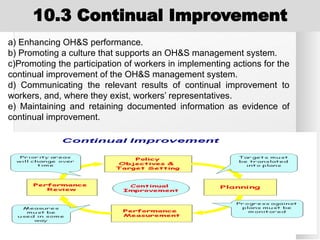
10. Improvement
10.3 Continual Improvement
a) Enhancing OH&S performance.
b) Promoting a culture that supports an OH&S management system.
c)Promoting the participation of workers in implementing actions for the
continual improvement of the OH&S management system.
d) Communicating the relevant results of continual improvement to
workers, and, where they exist, workers’ representatives.
e) Maintaining and retaining documented information as evidence of
continual improvement.
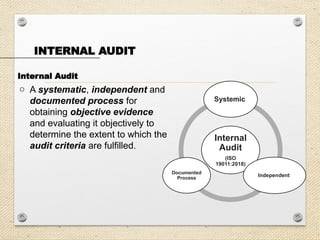
Audit Process
Internal Audit
o A systematic, independent and
documented process for
obtaining objective evidence
and evaluating it objectively to
determine the extent to which the
audit criteria are fulfilled.
Internal
Audit
(ISO
19011:2018)
Systemic
Independent
Documented
Process
INTERNAL AUDIT
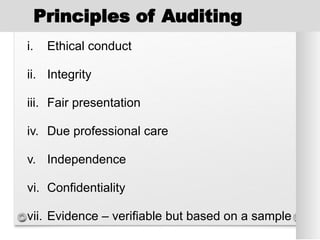
Principles of Auditing
i. Ethical conduct
ii. Integrity
iii. Fair presentation
iv. Due professional care
v. Independence
vi. Confidentiality
vii. Evidence – verifiable but based on a sample
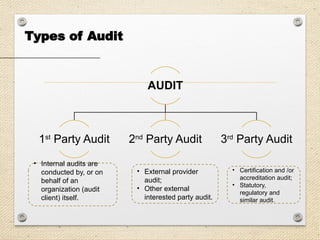
AUDIT
1st
Party Audit 2nd
Party Audit 3rd
Party Audit
Types of Audit
• Internal audits are
conducted by, or on
behalf of an
organization (audit
client) itself.
• External provider
audit;
• Other external
interested party audit.
• Certification and /or
accreditation audit;
• Statutory,
regulatory and
similar audit.
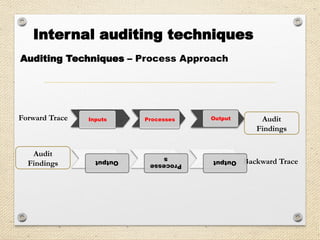
Forward Trace Inputs Processes Output
Backward Trace
Auditing Techniques – Process Approach
Output
Processe
s
Output
Audit
Findings
Audit
Findings
Internal auditing techniques
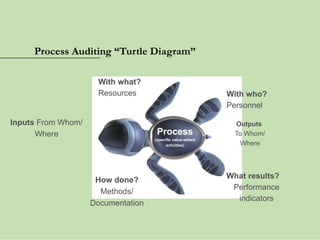
With what?
Resources With who?
Personnel
What results?
Performance
indicators
Outputs
To Whom/
Where
Inputs From Whom/
Where
How done?
Methods/
Documentation
Process
(specific value-added
activities)
Process Auditing “Turtle Diagram”
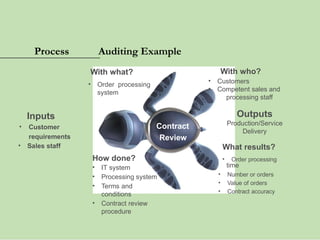
With what?
• Order processing
system
With who?
• Customers
• Competent sales and
processing staff
What results?
• Order processing
time
• Number or orders
• Value of orders
• Contract accuracy
Outputs
Production/Service
Delivery
Inputs
• Customer
requirements
• Sales staff
How done?
• IT system
• Processing system
• Terms and
conditions
• Contract review
procedure
Contract
Review
Process Auditing Example
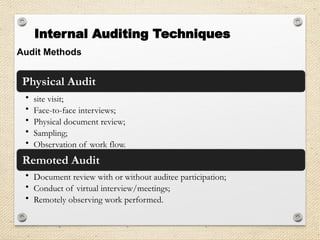
Audit Methods
Physical Audit
• site visit;
• Face-to-face interviews;
• Physical document review;
• Sampling;
• Observation of work flow.
Remoted Audit
• Document review with or without auditee participation;
• Conduct of virtual interview/meetings;
• Remotely observing work performed.
Internal Auditing Techniques
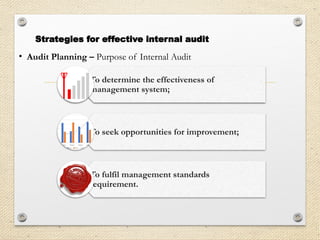
• Audit Planning – Purpose of Internal Audit
To determine the effectiveness of
management system;
To seek opportunities for improvement;
To fulfil management standards
requirement.
Strategies for effective internal audit
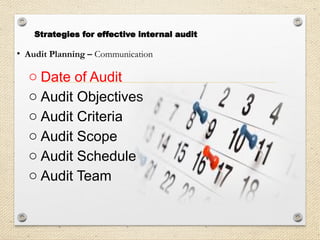
• Audit Planning – Communication
o Date of Audit
o Audit Objectives
o Audit Criteria
o Audit Scope
o Audit Schedule
o Audit Team
Strategies for effective internal audit
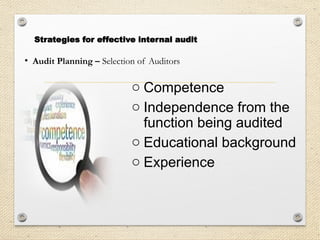
• Audit Planning – Selection of Auditors
o Competence
o Independence from the
function being audited
o Educational background
o Experience
Strategies for effective internal audit
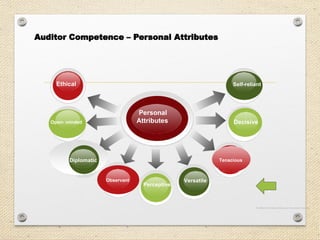
Personal
Attributes
Ethical
Diplomatic
Open- minded
Observant
Perceptive
2
Versatile
Tenacious
Decisive
Self-reliant
Auditor Competence – Personal Attributes
Facilitated by: Sonates Resources Investment Limited
Audit Planning – Information Gathering
o Understand the area/processes assigned;
o Understand customer, industry and sectoral
requirements/expectations;
o Compliance requirements;
o Review previous audit information;
o Product/service information;
o Company specific information.
Strategies for effective internal audit
Audit Planning – Checklist Preparation
o Provisions of procedures or work
instructions;
o Standard requirements;
o Product/service design specifications;
o Applicable laws and regulations.
Strategies for effective internal audit
Facilitated by: Sonates Resources Investment Limited
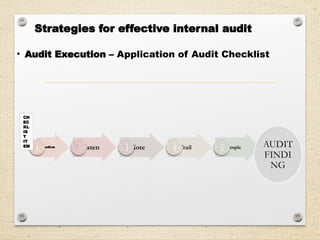
• Audit Execution – Application of Audit Checklist
Confirm
1 Listen
2 Note
3 Trail
4 Sample
5 AUDIT
FINDI
NG
CH
EC
KL
IS
T
IT
EM
Strategies for effective internal audit
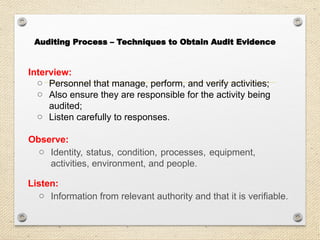
Interview:
o Personnel that manage, perform, and verify activities;
o Also ensure they are responsible for the activity being
audited;
o Listen carefully to responses.
Observe:
o Identity, status, condition, processes, equipment,
activities, environment, and people.
Listen:
o Information from relevant authority and that it is verifiable.
Auditing Process – Techniques to Obtain Audit Evidence
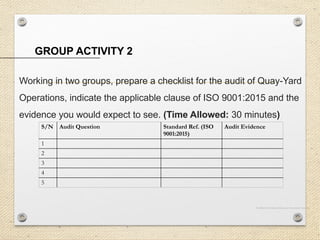
Working in two groups, prepare a checklist for the audit of Quay-Yard
Operations, indicate the applicable clause of ISO 9001:2015 and the
evidence you would expect to see. (Time Allowed: 30 minutes)
GROUP ACTIVITY 2
S/N Audit Question Standard Ref. (ISO
9001:2015)
Audit Evidence
1
2
3
4
5
Facilitated by: Sonates Resources Investment Limited
Practice of Closing Meeting
THE END ?
NO,
A NEW BEGINNING FOR
YOU…..
ISO 45001 2018 REQUIREMENTS COMPREHENSIVE.pptx

ISO 45001 2018 REQUIREMENTS COMPREHENSIVE.pptx

  • 1.
    Occupational Health and SafetyManagement Systems •ISO 45001: 2018
  • 2.
  • 3.
    Learning Objectives 1. Introductionto ISO 2. ISO 45001:2018 OHSMS 3. Benefits ISO 45001:2018 OHSMS 4. ISO 45001: 2018 OHSMS Clauses 5. Internal Audit System
  • 4.
    Background of ISOStandards = International Organization for Standardization Why not IOS : bc Derived from ISOS meaning equal ISO is a worldwide federation of national standards bodies.
  • 5.
  • 6.
  • 8.
    Clauses of OH&SISO 45001
  • 9.
    CONTENTS OF ISO45001 2018 1. Scope 2. Normative References 3. Terms and Definitions 4. Context of the organization 5. Leadership and worker participation 6. Planning 7. Support 8. Operation 9. Performanc e evaluation 10. Improvement
  • 10.
    TRIVIA FREQUENCY OFWORDS IN ISO 45001 • Shall 94 • Incident 42 • Risk 102 • Hazard 79 • Accident 1 • Worker 125 • Participation 31 • Safety 66 • Health 94 • Occupation 46 • Plan 73 • Action 71 • Communication 44 • Consultation 24
  • 11.
    1. SCOPE This documentis applicable to any organization regardless of its size, type and activities. It is applicable to the OH&S risks under the organization's control. This document does not state specific criteria for OH&S performance, nor is it prescriptive about the design of an OH&S management system. This document does not address issues such as product safety, property damage or environmental impacts, beyond the risks to workers and other relevant interested parties. This document can be used in whole or in part to systematically improve occupational health and safety management.
  • 12.
    Clause – 1Scope Its applicable to any organization regardless of its size, type and activities. OH&S management system to improve occupational health and safety, eliminate hazards and minimize OH&S risks (including system deficiencies), take advantage of OH&S opportunities, and address OH&S management system nonconformities associated with its activities. a) Continual improvement of OH&S performance. b) Fulfilment of legal requirements and other requirements. c) Achievement of OH&S objectives.
  • 13.
    Clause 2. Normativereferences There are no normative references in this document.
  • 14.
    Terms and Definitions •Organization •Interested Party/ •Stakeholder •Worker Personor group of people that bas its own functions with responsibilities, authorities and relationships to achieve its objectives Person or organization that can affect, be affected by, or perceive itself to be affected by a decision or activity Person performing work or work-related activities that are under the control of the organization Involvement in decision-making
  • 15.
    Terms and Definitions Consultation Workplace Contractor Requiremen Seekingviews before making a decision Place under the control of the organization where a person needs to be or to go for work purposes External organization providing services to the organization in accordance with agreed specifications, terms and conditions Need or expectation that is stated, generally implied or obligatory
  • 16.
    Terms and Definitions LegalRequirements and Other Requirements Legal requirements that an organization has to comply with and other requirements that an organization has to or chooses to comply with Management System Set of interrelated or interacting elements of an organization to establish policies and objectives and processes to achieve those objectives Occupational Health and Safety Management System (OH&S Management System) Management system or part of a management system used to achieve the OH&S policy
  • 17.
    Terms and Definitions TopManagement • Person or group of people who directs and controls an organization at the highest level Effectiveness • Extent to which planned activities are realized and planned results achieved Policy • Intentions and direction of an organization, as formally expressed by its top management Occupational Health and Safety Policy (OH&5 Policy) • Policy to prevent work-related injury and ill health to workers
  • 18.
    Terms and Definitions Objective •Result to be achieved Occupational Health and Safety Objective (OH&S Objective) • Objective set by the organization to achieve specific results consistent with the OH&S Policy Injury and Ill Health • Adverse effect on the physical, mental or cognitive condition of a person Hazard • Source with a potential to cause injury and ill health Risk • Effect of uncertainty
  • 19.
    Terms and Definitions OccupationalHealth And Safety Risk (OH&S Risk) • Combination of the likelihood of occurrence of a work-related hazardous event(s) or exposure(s) and the severity of injury and ill health that can be caused by the event(s) or exposure(s) Occupational Health And Safety Opportunity (OH&5 Opportunity) • Circumstance or set of circumstances that can lead to improvement of OH&S performance Competence • Ability to apply knowledge and skills to achieve intended results Documented Information • Information required to be controlled and maintained by an organization and the medium on which it is contained
  • 20.
    Terms and Definitions Process •Set of interrelated or interacting activities which transform s inputs into outputs Procedure • Specified way to carry out an activity or a process Performance • Measurable result Occupational Health And Safety Performance (OH&S Performance) • Performance related to the effectiveness of the prevention of injury and ill health to workers and the provision of safe and healthy workplaces
  • 21.
    Terms and Definitions Outsource •Make an arrangement where an external organization performs part of an organization's function or process Monitoring • Determining the status of a system, a process or an activity Measurement • Process to determine a value Audit • Systematic. independent and documented process for obtaining audit evidence and evaluating it objectively to determine the extent to which the audit criteria are fulfilled
  • 22.
    Terms and Definitions Conformity •Fulfilment of a requirement Nonconformity • Non-fulfilment of a requirement Incident • Occurrence arising out of, or in the course of. work that could or does result in injury and ill health Corrective Action • Action to eliminate the cause(s) of a nonconformity or an incident and to prevent recurrence Continual Improvement • Recurring activity to enhance performance
  • 23.
    Terms and Definitions: Whois a Worker? Brainstorming Session “Person performing work or work- related activities that are under the control of the organization”. Examples: • Worker could be paid or unpaid, temporarily, etc. • Workers include top management. • Workers include contractors, individuals, agency workers, and by other persons.
  • 24.
    Terms and Definitions: DifferenceBetween Nonconformity & Incidents? Brainstorming Session Nonconformity: - non-fulfilment of a requirement. (standard and company’s OH&S MS. Although there can be one or more nonconformity related to an incident, an incident can also occur when there is no nonconformity. Incident: - occurrence arising out of, or in the course of, work that could or does result in injury and ill health.
  • 25.
    Terms and Definitions: DifferenceBetween Participation & Consultation? Brainstorming Session Participation: - Involvement in decision making. Workers must be involved. How would you demonstrate it? Consultation: - Seeking views before making a decision.
  • 26.
    Health: Absence ofdisease or illness or the protection of the bodies and minds of people from illness resulting from the materials, processes or procedures used in the workplace”. For example, exposure to hazardous chemical can result in physical ill health (asthma), verbal abuse or work-related stress can result in psychological ill-health. Safety: The protection of people from physical injury”. For example, working at height on an unprotected edge is unsafe, because there is a potential to fall from height resulting in serious injury or death. Hence provision of safe working platform prevent physical injury is considered as safety. Clause 3. Terms and definitions Consultation: seeking views before making a decision
  • 27.
    4. Context ofthe organization 4.1 Understanding the organization and its context 4.2 Understanding the needs and expectations of workers and other interested parties 4.3 Determining the scope of the OH&5 management system 4.4 OH&S management system
  • 28.
    Context of theorganization 4.1 Understanding the organization and its context 4.2 Understanding the needs and expectations of workers and other interested parties 4.3 Determining the scope of the OH&S management system 4.4 OH&S management system
  • 29.
    Context of theorganization: The Goal of this clause is to: • Determine why the organization exists; • Identify any internal and externa influences that will affect desired outcomes. • Document the scope of the management system that’s implemented. • Determine the processes, control, monitoring measurements of the OH & S management system
  • 30.
    4.1 Understanding theorganization and its context The Organization shall determine external and internal issues that are relevant to its purpose
  • 31.
    Parties Including Needs/ExpectationsPrio rity Internal Interested Parties Staff including drivers, Maintenance, Administration, Printing, Bindery, Loading etc. • Good environmental reputational image • Wider focus than just profit • Training and support for all • Safe working conditions • Continuity of employment • Opportunities for dialogue/ improvement/changes High External Interested Parties Customers • Demonstrable ISO 45001 Conformance/Legal compliance • Value for money • Maintained levels of quality • Socially and environmentally responsible High The needs and expectations of interested parties
  • 32.
    Group Discuss (Internal& External Parties & Issues) 10 Minutes Discussed 5 Minutes Presentation
  • 33.
    4.3 Determining thescope of the OH&S Management System
  • 34.
    4.4 OH&S ManagementSystem OH&S management system, including the processes needed and their interactions, in accordance with the requirements of this document.
  • 35.
    5. Leadership andworker participation 5.1 Leadership and commitment 5.2 OH&S policy 5,3 Organizational roles, responsibilities and authorities 5.4 Consultation and participation of workers
  • 36.
    Leadership and Commitment OH&S policy Organizationalroles, responsibilities and authorities Consultation and participation of workers Clause 5 Leadership and Worker Participation
  • 37.
    Leadership and Commitment Leadershipis the influencing process of leaders and followers to achieve organizational objectives through change through people.
  • 38.
    5.1 Leadership andcommitment Top management taking overall responsibility and accountability:  Work-related injury and ill health.  OH&S policy and related OH&S objectives,  Incidents, hazards,  Risks and opportunities,  Implements a process,  Health and safety committees,  Integration of the OH&S requirements,  Resources needed ,  Communicating ,  Supporting persons ,  Continual improvement, developing, leading and promoting a culture.
  • 39.
    5.2 OH&S Policy Topmanagement shall establish, implement and maintain an OH&S policy
  • 40.
    Clause 5.3 Organizationalroles, responsibilities and Authorities Top management shall assign the responsibility and authority for: a) ensuring that the OH&S management system conforms to the requirements of this document. b) reporting on the performance of the OH&S management system to top management.
  • 41.
    45001 Clause 5.4 “Leadership andWorker Participation” Summary (key changes): • Similar requirements were in OHSAS 18001; however there is a much greater emphasizes on Management and employees involvement in all aspects of the management system.
  • 42.
    Consultation and Participationof Workers The organization shall establish, implement and maintain a process for consultation and participation of workers at all applicable levels and functions, and, where they exist, workers’ representatives, in the development, planning, implementation, performance evaluation and actions for improvement of the OH&S management system.
  • 43.
    6.Planning 6.1 Actions ToAddress Risks And Opportunities 6.2 OH&S Objectives And Planning To Achieve Them
  • 44.
    Clause 6.0 Planning 6.1Actions to address risks and opportunities 6.1.2 Hazard identification and assessment of risks and opportunities 6.1.3 Determination of legal requirements and other requirements 6.1.4 Planning action 6.2 OH&S objectives and planning to achieve them
  • 46.
  • 48.
    Including hazards arising from: 1)Infrastructure,equipment, materials, substances and the physical conditions of the workplace 2) Product and service design, research, development, testing, production, assembly, construction, service delivery, maintenance and disposal; 3) Human factors 6.1.2.1 Hazard Identification
  • 49.
    6.1.2.2 Assessment ofOH&S risks and other risks to the OH&S management system
  • 50.
    Risk Matrix Process HazardRisk Assessment of Risk Control of Risk Opportunity Probabilit y Severity Rating Level Productio n Floor Scissor Hand Cutting 4 3 12 Medium Scissor Control Worker health is well, Leave application Reduce, production Target Achievement, Productivity Increase  Minimum =1 & Maximum =5  Probability * Severity = Total Score  Risk Level: Low (1-8), Medium (9-16), High (17-25)
  • 51.
    Hazard Identification Assessmentof Risk and Opportunity Proce ss Hazard Risk Asse ssme nt Legal & Others Requireme nts Opportunity Store ?????
  • 52.
    10 Minutes Discussed+10Minutes Presentation Identify 5 hazards in a particular process and establish controls for eliminating or minimizing them
  • 53.
    OH&S Objectives andPlanning Action OH&S Objectives What is an Objective? A Specific Result that a person or system aims to achieve with a time frame and with available recourse.
  • 54.
    To reduce Accident 80% byDecember 2023. OH&S Objectives 1. Policy 2. Training 3. Monitoring 4. PPE 5. Review Meeting 6. Responsibility Safety Officer Planning to achieve
  • 55.
    Group Discussion OH&S Objective& Planning to Achieve 10 Minutes Discussed+10 Minutes Presentation
  • 56.
    7.Support 7.1 Resources 7.2 Competence 7.3Awareness 7.4 Communication 7.5 Documented information
  • 57.
  • 58.
  • 59.
    Clause 7.2 Competency Ensurethat workers are competent (including the ability to identify hazards) on the basis of appropriate education, training or experience.
  • 60.
    Clause 7.3 Awareness OH&Spolicy and OH&S objectives Effectiveness of the OH&S management system, Benefits of improved OH&S performance. Incidents and the outcomes of investigations that are relevant to them. Hazards, OH&S risks and actions determined that are relevant to them.
  • 61.
    Communication Internal Communication: What arethe methods of internal communication? • What is the most effective method of internal communication?
  • 62.
    External Communication: • Whatare the possible methods of external communication? • What is the best method of External Communication?
  • 63.
    7.5 Documented Information Documented information required by local law  Documented information required by international standard  Documented information required by the organization  Documented information required by the Customer/supplier
  • 64.
  • 65.
    7.5.2 Creating andUpdating The organization shall ensure appropriate: a) Identification and description (a title, date, author or reference number) b) Format (language, software version, graphics) and media (paper, electronic) c) Review and approval for suitability and adequacy.
  • 66.
    7.5.3 Control ofDocumented Information Document shall be controlled to ensure: a) it is available and suitable for use, b) it is adequately protected. The following activities, as applicable: — distribution, access, retrieval and use. — storage and preservation,— control of changes (version control). — retention and disposition.
  • 67.
    Standardized SOP Format •Computerized procedure • Standardization: • Header • Version/chapter/reference • Author/reader/validator • Recipients • Version date/Application date • Typical outline • Updating and storage of different versions is easy J Johnson, RB Smith
  • 68.
    Complete Standardized Header Useat the top of the first page only
  • 69.
    8. Operation 8.1 Operational planningand control 8.2 Emergency preparedness and response
  • 70.
    8. Operation 8.1 Operationalplanning and control 8.2 Emergency preparedness and response
  • 71.
  • 72.
    8.1.3 Management ofChange New products or existing products, services and processes, including: workplace and surroundings, working conditions, equipment, work force, changes to legal requirements and other requirements, Changes in knowledge or information about hazards and OH&S risks, developments in knowledge and technology.
  • 73.
    8.1.4 Procurement 8.1.4.2 Contractors: a)the contractors’ activities and operations that impact the organization. b) the organization’s activities and operations that impact the contractors’ workers. c) the contractors’ activities and operations that impact other interested parties in the workplace.
  • 74.
    The organization shall ensurethat outsourced functions and processes are controlled. with legal requirements and other requirements and with achieving the intended outcomes of the OH&S management system. 8.1.4.3 Outsourcing
  • 75.
  • 76.
    8.2 Emergency Preparedness andResponse Emergency response plan Training on the planned response Periodically testing and exercising the planned response capability Evaluating performance of planned response All workers are communicated on their duties and responsibilities Communicating relevant information to contractors, visitors, emergency response services, government authorities and, as appropriate, the local community. Taking into account the needs and capabilities of all relevant interested parties and ensuring their involvement.
  • 77.
    9.1 Monitoring, measurement, analysis and performance evaluation 9.2Internal audit 9.3 Management review 9.Performan ce evaluation
  • 78.
    Clause 9 PerformanceEvaluation 9.1 Monitoring, Measurement, Analysis and Evaluation 9.1.2 Evaluation of Compliance 9.2 Internal Audit 9.3 Management Review
  • 79.
    Clause 9 PerformanceEvaluation 9.1 Monitoring, measurement, analysis and evaluation The organization must monitor, measure, analyses and evaluate its OH&S performance.  Calibrated & Verified Monitoring and Measuring Equipment's  Result of OH&S Performance  OH&S Objectives
  • 80.
    1. Determine the frequencyand methods. 2) Legal requirements and other requirements d) Retain documented information of the compliance evaluation result(s). Clause 9.1.2 Evaluation of Compliance
  • 81.
    Clause 8.2 InternalAudit The organization shall: a) Frequency, Plan, Methods, Responsibilities, Planning b) Reporting, Results of previous audit. c) Scope d) Select Auditors e) Ensure that the results of the audits f) Correction and corrective actions without undue delay g) Retain documented information h) Opening & Closing Meeting
  • 82.
    9.3.2 Management reviewinputs The management review shall include consideration of: Previous management reviews, changes in external and internal issues, needs and expectations, legal requirements and other requirements, Risks and Opportunities, OH&S policy and the OH&S objectives, OH&S performance, Incidents, Nonconformities, Corrective actions and continual improvement, monitoring and measurement results, Audit results, consultation and participation of workers. 9.3 Management Review
  • 83.
    9.3.3 Management reviewOutput — the continuing suitability, adequacy and effectiveness of the OH&S management system in achieving its intended outcomes. — continual improvement opportunities. — any need for changes to the OH&S management system. — resources needed. — actions, if needed.
  • 84.
    10.Improvement 10.1 General 10.2 Incident,nonconformity and corrective action 10.3 Continual improvement
  • 85.
    10. Improvements Incident, nonconformity, Rootcause analysis and corrective action Continual improvement.
  • 86.
    Root Cause Analysis 10.2Incident, nonconformity and corrective action
  • 87.
    10.2 Incident, nonconformityand corrective action The organization shall establish, implement and maintain a process(es), including reporting, investigating and taking action, to determine and manage incidents and nonconformities. When an incident or a nonconformity occurs, the organization shall: • React in a timely manner to the incident or nonconformity and, as applicable: o Take action to control and correct it; o Deal with the consequences; • Evaluate, with the participation of workers (see 5.4) and the involvement of other relevant interested parties, the need for corrective action to eliminate the root cause(s) of the incident or nonconformity, in order that it does not recur or occur elsewhere, by: o Investigating the incident or reviewing the nonconformity o Determining the cause(s) of the incident or nonconformity 10. Improvement
  • 88.
    10.2 Incident, nonconformityand corrective action When an incident or a nonconformity occurs, the organization shall: • Review existing assessments of OH&S risks and other risks, as appropriate (see 6.1) • Determine and implement any action needed, including corrective action, in accordance with the hierarchy of controls (see 8.1.2) and the management of change (see 8.1.3) • Assess OH&S risks that relate to new or changed hazards, prior to taking action • Review the effectiveness of any action taken, including corrective action • Make changes to the OH&S management system, if necessary Corrective actions shall be appropriate to the effects or potential effects of the incidents or nonconformities encountered. The organization shall retain documented information as evidence of: • The nature of the incidents or nonconformities and any subsequent actions taken • The results of any action and corrective action, including their effectiveness. The organization shall communicate this documented information to relevant workers, and, where they exist, workers’ representatives, and other relevant interested parties. 10. Improvement
  • 89.
    10.3 Continual Improvement a)Enhancing OH&S performance. b) Promoting a culture that supports an OH&S management system. c)Promoting the participation of workers in implementing actions for the continual improvement of the OH&S management system. d) Communicating the relevant results of continual improvement to workers, and, where they exist, workers’ representatives. e) Maintaining and retaining documented information as evidence of continual improvement.
  • 91.
  • 92.
    Internal Audit o Asystematic, independent and documented process for obtaining objective evidence and evaluating it objectively to determine the extent to which the audit criteria are fulfilled. Internal Audit (ISO 19011:2018) Systemic Independent Documented Process INTERNAL AUDIT
  • 93.
    Principles of Auditing i.Ethical conduct ii. Integrity iii. Fair presentation iv. Due professional care v. Independence vi. Confidentiality vii. Evidence – verifiable but based on a sample
  • 94.
    AUDIT 1st Party Audit 2nd PartyAudit 3rd Party Audit Types of Audit • Internal audits are conducted by, or on behalf of an organization (audit client) itself. • External provider audit; • Other external interested party audit. • Certification and /or accreditation audit; • Statutory, regulatory and similar audit.
  • 95.
    Forward Trace InputsProcesses Output Backward Trace Auditing Techniques – Process Approach Output Processe s Output Audit Findings Audit Findings Internal auditing techniques
  • 96.
    With what? Resources Withwho? Personnel What results? Performance indicators Outputs To Whom/ Where Inputs From Whom/ Where How done? Methods/ Documentation Process (specific value-added activities) Process Auditing “Turtle Diagram”
  • 97.
    With what? • Orderprocessing system With who? • Customers • Competent sales and processing staff What results? • Order processing time • Number or orders • Value of orders • Contract accuracy Outputs Production/Service Delivery Inputs • Customer requirements • Sales staff How done? • IT system • Processing system • Terms and conditions • Contract review procedure Contract Review Process Auditing Example
  • 98.
    Audit Methods Physical Audit •site visit; • Face-to-face interviews; • Physical document review; • Sampling; • Observation of work flow. Remoted Audit • Document review with or without auditee participation; • Conduct of virtual interview/meetings; • Remotely observing work performed. Internal Auditing Techniques
  • 99.
    • Audit Planning– Purpose of Internal Audit To determine the effectiveness of management system; To seek opportunities for improvement; To fulfil management standards requirement. Strategies for effective internal audit
  • 100.
    • Audit Planning– Communication o Date of Audit o Audit Objectives o Audit Criteria o Audit Scope o Audit Schedule o Audit Team Strategies for effective internal audit
  • 101.
    • Audit Planning– Selection of Auditors o Competence o Independence from the function being audited o Educational background o Experience Strategies for effective internal audit
  • 102.
  • 103.
    Audit Planning –Information Gathering o Understand the area/processes assigned; o Understand customer, industry and sectoral requirements/expectations; o Compliance requirements; o Review previous audit information; o Product/service information; o Company specific information. Strategies for effective internal audit
  • 104.
    Audit Planning –Checklist Preparation o Provisions of procedures or work instructions; o Standard requirements; o Product/service design specifications; o Applicable laws and regulations. Strategies for effective internal audit Facilitated by: Sonates Resources Investment Limited
  • 105.
    • Audit Execution– Application of Audit Checklist Confirm 1 Listen 2 Note 3 Trail 4 Sample 5 AUDIT FINDI NG CH EC KL IS T IT EM Strategies for effective internal audit
  • 106.
    Interview: o Personnel thatmanage, perform, and verify activities; o Also ensure they are responsible for the activity being audited; o Listen carefully to responses. Observe: o Identity, status, condition, processes, equipment, activities, environment, and people. Listen: o Information from relevant authority and that it is verifiable. Auditing Process – Techniques to Obtain Audit Evidence
  • 107.
    Working in twogroups, prepare a checklist for the audit of Quay-Yard Operations, indicate the applicable clause of ISO 9001:2015 and the evidence you would expect to see. (Time Allowed: 30 minutes) GROUP ACTIVITY 2 S/N Audit Question Standard Ref. (ISO 9001:2015) Audit Evidence 1 2 3 4 5 Facilitated by: Sonates Resources Investment Limited
  • 108.
  • 109.
    THE END ? NO, ANEW BEGINNING FOR YOU…..

Editor's Notes

  • #87 Facilitator’s Notes: Explain in brief the importance of reviewing the existing OHSMS in intervals in the performance evaluation clause. Use examples and incidents wherever applicable, for better understanding. Ask for learners’ queries and resolve them.
  • #88 Facilitator’s Notes: Explain in brief the importance of reviewing the existing OHSMS in intervals in the performance evaluation clause. Use examples and incidents wherever applicable, for better understanding. Ask for learners’ queries and resolve them.