

Zubair Mughal Chief Executive Officer AlHuda : Centre of Islamic Banking & Economics Editor in Chief. Islamic Banking and Finance News ,  True Banking.  An Introduction to Islamic Micro Finance  Narowal Rural Development Program  8 th  August, 09
Outline of Presentation Introduction to Islamic Microfinance Riba ( Interest ) Difference between Islamic & Conventional Micro Finance Product of Islamic Micro Finance. Progress of Islamic Banking in Pakistan & Worldwide
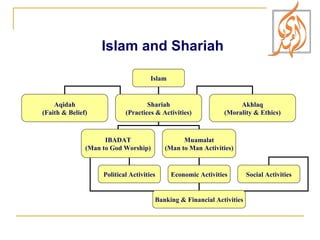
Islam and Shariah Islam Aqidah (Faith & Belief) Shariah (Practices & Activities) Akhlaq (Morality & Ethics) IBADAT (Man to God Worship) Muamalat (Man to Man Activities) Political Activities Economic Activities Social Activities Banking & Financial Activities
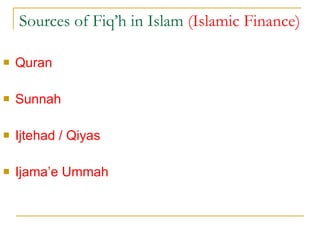
Sources of Fiq’h in Islam  (Islamic Finance) Quran  Sunnah  Ijtehad / Qiyas  Ijama’e Ummah
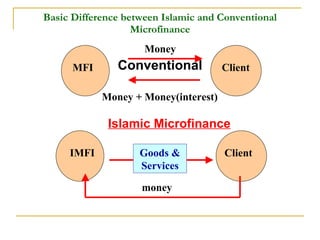
Basic Difference between Islamic and Conventional Microfinance Conventional MFI Client Money  Money + Money(interest) IMFI Client Islamic Microfinance Goods & Services money
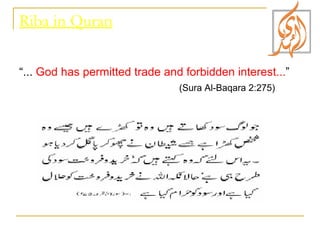
Riba in Quran “ ...  God has permitted trade and forbidden interest... ” (Sura Al-Baqara 2:275)
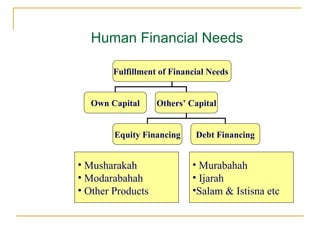
Murabahah Ijarah Salam & Istisna etc Musharakah Modarabahah Other Products Human Financial Needs Fulfillment of Financial Needs  Own Capital Others’ Capital Equity Financing Debt Financing
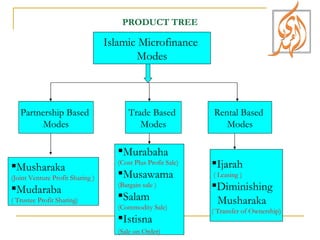
PRODUCT TREE Islamic Microfinance  Modes Trade Based  Modes Partnership Based  Modes Rental Based  Modes Musharaka (Joint Venture Profit Sharing ) Mudaraba ( Trustee Profit Sharing) Murabaha (Cost Plus Profit Sale) Musawama (Bargain sale ) Salam (Commodity Sale) Istisna (Sale on Order) Ijarah ( Leasing ) Diminishing  Musharaka ( Transfer of Ownership)
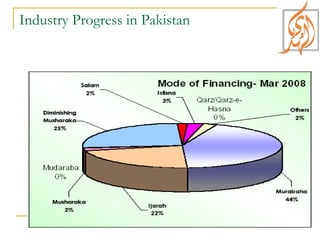
Industry Progress in Pakistan
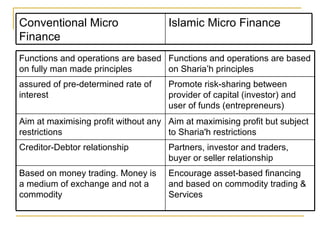
Encourage asset-based financing and based on commodity trading & Services Based on money trading. Money is a medium of exchange and not a commodity Partners, investor and traders, buyer or seller relationship Creditor-Debtor relationship Aim at maximising profit but subject to Sharia'h restrictions Aim at maximising profit without any restrictions Promote risk-sharing between provider of capital (investor) and user of funds (entrepreneurs) assured of pre-determined rate of interest Functions and operations are based on Sharia’h principles Functions and operations are based on fully man made principles Islamic Micro Finance Conventional Micro Finance
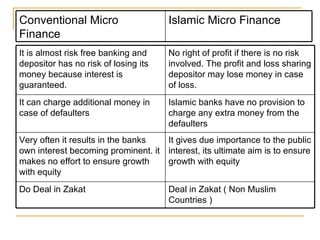
Deal in Zakat ( Non Muslim Countries ) Do Deal in Zakat It gives due importance to the public interest, its ultimate aim is to ensure growth with equity Very often it results in the banks own interest becoming prominent. it makes no effort to ensure growth with equity Islamic banks have no provision to charge any extra money from the defaulters  It can charge additional money in case of defaulters  No right of profit if there is no risk involved. The profit and loss sharing depositor may lose money in case of loss. It is almost risk free banking and depositor has no risk of losing its money because interest is guaranteed. Islamic Micro Finance  Conventional Micro Finance
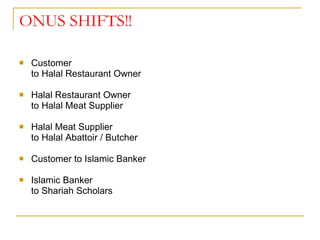
ONUS SHIFTS!! Customer  to Halal Restaurant Owner Halal Restaurant Owner  to Halal Meat Supplier Halal Meat Supplier  to Halal Abattoir / Butcher Customer to Islamic Banker Islamic Banker  to Shariah Scholars
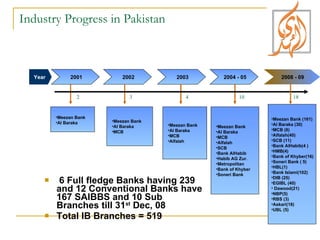
Industry Progress in Pakistan 6 Full fledge Banks having 239 and 12 Conventional Banks have 167 SAIBBS and 10 Sub Branches till 31 st  Dec, 08 Total IB Branches = 519 Year  2001 Meezan Bank Al Baraka Meezan Bank Al Baraka MCB Alfalah SCB Bank AlHabib Habib AG Zur. Metropolitan Bank of Khyber Soneri Bank 2002 2003 Meezan Bank Al Baraka MCB Meezan Bank Al Baraka MCB Alfalah 2 10 2008 - 09 Meezan Bank (161)  Al Baraka (30)  MCB (8)  Alfalah(40)  SCB (11)  Bank AlHabib(4 )  HMB(4)  Bank of Khyber(16)  Soneri Bank ( 5)  HBL(1)  Bank Islami(102)  DIB (25)  EGIBL (40)  Dawood(21)  NBP(5)  RBS (3)  Askari(18)  UBL (5)  2004 - 05 18 4 3
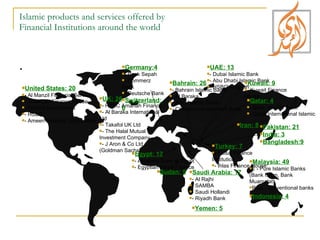
Islamic products and services offered by  Financial Institutions around the world . United States: 20 -  Al Manzil Financial Services - American Finance House - Failaka Investments - HSBC  - Ameen Housing Cooperative Germany:4 - Bank Sepah - Commerz Bank - Deutsche Bank Switzerland: 6 UK: 26 - HSBC Amanah Finance  - Al Baraka International Ltd - Takafol UK Ltd - The Halal Mutual Investment Company - J Aron & Co Ltd (Goldman Sachs) Bahrain: 26   - Bahrain Islamic Bank - Al Baraka - ABC Islamic Bank  - CitiIslamic Investment Bank Malaysia: 49 2 - Pure Islamic Banks (Bank Islam, Bank Muamalat) Rest - conventional banks Saudi Arabia: 17 - Al Rajhi  - SAMBA - Saudi Hollandi  - Riyadh Bank   UAE: 13 - Dubai Islamic Bank - Abu Dhabi Islamic Bank - HSBC Amanah Qatar: 4 - Qatar Islamic Bank - Qatar International Islamic Kuwait: 9 - Kuwait Finance House Iran: 8 Egypt: 12 - Alwatany Bank of Egypt - Egyptian Saudi Finance  Indonesia: 4 Sudan: 9 Pakistan: 21 India: 3 Bangladesh:9 Turkey: 7 - Faisal Finance Institution - Ihlas Finance House Yemen: 5
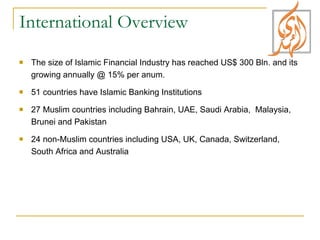
International Overview  The size of Islamic Financial Industry has reached US$ 300 Bln. and its growing annually @ 15% per anum. 51 countries have Islamic Banking Institutions  27 Muslim countries including Bahrain, UAE, Saudi Arabia,  Malaysia, Brunei and Pakistan 24 non-Muslim countries including USA, UK, Canada, Switzerland, South Africa and Australia
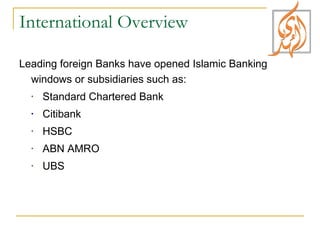
International Overview Leading foreign Banks have opened Islamic Banking windows or subsidiaries such as: Standard Chartered Bank  Citibank HSBC ABN AMRO UBS
International Overview In Feb 1999, Dow Jones introduced the Dow Jones Islamic Market Index (DJIM) of 600 companies world wide whose business complies with Islamic Shariah laws At present there are more than 105 Islamic Funds operational through out the world with a total fund base of over USD 3.50 billion
International Overview Governments of Bahrain ,Malaysia and now Pakistan have issued Islamic Bonds (Sukuk) in order to facilitate Islamic Banks in managing their liquidity.  Issuance of these bonds has also paved the way for Shariah compliant Government borrowings
International Overview Institutions like Accounting and Auditing Organization for Islamic Financial Institutions (AAOIFI) and Islamic Finance Services Board (IFSB) have been formed.  These institutions are playing a key role in setting up and standardizing Shariah , Financial and Accounting standards for Islamic Financial Institutions. Due to these collective efforts Islamic banking is now recognized by IMF, World Bank and Basel Committee.
Thank You.

Islamic micro financel for NRDP

  • 1.
  • 2.
    Zubair Mughal ChiefExecutive Officer AlHuda : Centre of Islamic Banking & Economics Editor in Chief. Islamic Banking and Finance News , True Banking. An Introduction to Islamic Micro Finance Narowal Rural Development Program 8 th August, 09
  • 3.
    Outline of PresentationIntroduction to Islamic Microfinance Riba ( Interest ) Difference between Islamic & Conventional Micro Finance Product of Islamic Micro Finance. Progress of Islamic Banking in Pakistan & Worldwide
  • 4.
    Islam and ShariahIslam Aqidah (Faith & Belief) Shariah (Practices & Activities) Akhlaq (Morality & Ethics) IBADAT (Man to God Worship) Muamalat (Man to Man Activities) Political Activities Economic Activities Social Activities Banking & Financial Activities
  • 5.
    Sources of Fiq’hin Islam (Islamic Finance) Quran Sunnah Ijtehad / Qiyas Ijama’e Ummah
  • 6.
    Basic Difference betweenIslamic and Conventional Microfinance Conventional MFI Client Money Money + Money(interest) IMFI Client Islamic Microfinance Goods & Services money
  • 7.
    Riba in Quran“ ... God has permitted trade and forbidden interest... ” (Sura Al-Baqara 2:275)
  • 8.
    Murabahah Ijarah Salam& Istisna etc Musharakah Modarabahah Other Products Human Financial Needs Fulfillment of Financial Needs Own Capital Others’ Capital Equity Financing Debt Financing
  • 9.
    PRODUCT TREE IslamicMicrofinance Modes Trade Based Modes Partnership Based Modes Rental Based Modes Musharaka (Joint Venture Profit Sharing ) Mudaraba ( Trustee Profit Sharing) Murabaha (Cost Plus Profit Sale) Musawama (Bargain sale ) Salam (Commodity Sale) Istisna (Sale on Order) Ijarah ( Leasing ) Diminishing Musharaka ( Transfer of Ownership)
  • 10.
  • 11.
    Encourage asset-based financingand based on commodity trading & Services Based on money trading. Money is a medium of exchange and not a commodity Partners, investor and traders, buyer or seller relationship Creditor-Debtor relationship Aim at maximising profit but subject to Sharia'h restrictions Aim at maximising profit without any restrictions Promote risk-sharing between provider of capital (investor) and user of funds (entrepreneurs) assured of pre-determined rate of interest Functions and operations are based on Sharia’h principles Functions and operations are based on fully man made principles Islamic Micro Finance Conventional Micro Finance
  • 12.
    Deal in Zakat( Non Muslim Countries ) Do Deal in Zakat It gives due importance to the public interest, its ultimate aim is to ensure growth with equity Very often it results in the banks own interest becoming prominent. it makes no effort to ensure growth with equity Islamic banks have no provision to charge any extra money from the defaulters It can charge additional money in case of defaulters No right of profit if there is no risk involved. The profit and loss sharing depositor may lose money in case of loss. It is almost risk free banking and depositor has no risk of losing its money because interest is guaranteed. Islamic Micro Finance Conventional Micro Finance
  • 13.
    ONUS SHIFTS!! Customer to Halal Restaurant Owner Halal Restaurant Owner to Halal Meat Supplier Halal Meat Supplier to Halal Abattoir / Butcher Customer to Islamic Banker Islamic Banker to Shariah Scholars
  • 14.
    Industry Progress inPakistan 6 Full fledge Banks having 239 and 12 Conventional Banks have 167 SAIBBS and 10 Sub Branches till 31 st Dec, 08 Total IB Branches = 519 Year 2001 Meezan Bank Al Baraka Meezan Bank Al Baraka MCB Alfalah SCB Bank AlHabib Habib AG Zur. Metropolitan Bank of Khyber Soneri Bank 2002 2003 Meezan Bank Al Baraka MCB Meezan Bank Al Baraka MCB Alfalah 2 10 2008 - 09 Meezan Bank (161) Al Baraka (30) MCB (8) Alfalah(40) SCB (11) Bank AlHabib(4 ) HMB(4) Bank of Khyber(16) Soneri Bank ( 5) HBL(1) Bank Islami(102) DIB (25) EGIBL (40) Dawood(21) NBP(5) RBS (3) Askari(18) UBL (5) 2004 - 05 18 4 3
  • 15.
    Islamic products andservices offered by Financial Institutions around the world . United States: 20 - Al Manzil Financial Services - American Finance House - Failaka Investments - HSBC - Ameen Housing Cooperative Germany:4 - Bank Sepah - Commerz Bank - Deutsche Bank Switzerland: 6 UK: 26 - HSBC Amanah Finance - Al Baraka International Ltd - Takafol UK Ltd - The Halal Mutual Investment Company - J Aron & Co Ltd (Goldman Sachs) Bahrain: 26 - Bahrain Islamic Bank - Al Baraka - ABC Islamic Bank - CitiIslamic Investment Bank Malaysia: 49 2 - Pure Islamic Banks (Bank Islam, Bank Muamalat) Rest - conventional banks Saudi Arabia: 17 - Al Rajhi - SAMBA - Saudi Hollandi - Riyadh Bank UAE: 13 - Dubai Islamic Bank - Abu Dhabi Islamic Bank - HSBC Amanah Qatar: 4 - Qatar Islamic Bank - Qatar International Islamic Kuwait: 9 - Kuwait Finance House Iran: 8 Egypt: 12 - Alwatany Bank of Egypt - Egyptian Saudi Finance Indonesia: 4 Sudan: 9 Pakistan: 21 India: 3 Bangladesh:9 Turkey: 7 - Faisal Finance Institution - Ihlas Finance House Yemen: 5
  • 16.
    International Overview The size of Islamic Financial Industry has reached US$ 300 Bln. and its growing annually @ 15% per anum. 51 countries have Islamic Banking Institutions 27 Muslim countries including Bahrain, UAE, Saudi Arabia, Malaysia, Brunei and Pakistan 24 non-Muslim countries including USA, UK, Canada, Switzerland, South Africa and Australia
  • 17.
    International Overview Leadingforeign Banks have opened Islamic Banking windows or subsidiaries such as: Standard Chartered Bank Citibank HSBC ABN AMRO UBS
  • 18.
    International Overview InFeb 1999, Dow Jones introduced the Dow Jones Islamic Market Index (DJIM) of 600 companies world wide whose business complies with Islamic Shariah laws At present there are more than 105 Islamic Funds operational through out the world with a total fund base of over USD 3.50 billion
  • 19.
    International Overview Governmentsof Bahrain ,Malaysia and now Pakistan have issued Islamic Bonds (Sukuk) in order to facilitate Islamic Banks in managing their liquidity. Issuance of these bonds has also paved the way for Shariah compliant Government borrowings
  • 20.
    International Overview Institutionslike Accounting and Auditing Organization for Islamic Financial Institutions (AAOIFI) and Islamic Finance Services Board (IFSB) have been formed. These institutions are playing a key role in setting up and standardizing Shariah , Financial and Accounting standards for Islamic Financial Institutions. Due to these collective efforts Islamic banking is now recognized by IMF, World Bank and Basel Committee.
  • 21.

Editor's Notes

  • #5 Source: Institute of Policy Studies
  • #6 Collective Ijtamaee Ijtehad at 4.5