1
CHAPTER 3: ASSEST LIABILITY
MANAGEMENT
By: Major Dr. Mohd Adib Abd Muin, IFP, CQIF (Wealth Management)
Senior Lecturer
Islamic Business School (IBS)
Universiti Utara Malaysia
BIBCJ2013 - ISLAMIC BANKING
OUTLINE
1. INTRODUCTION
2. SOURCES AND USES OF FUNDS IN ISLAMIC BANKS
3. LIQUIDITY MANAGEMENT OF ISLAMIC BANKS
4. ASSEST MANAGEMENT: FINANCING, INVESTMENT AND RESERVE
MANAGEMENT
5. LIABILITY MANAGEMENT: DEPOSIT, NON-DEPOSIT MANAGEMENT
6. GAP ANALYSIS & DURATION ANALYSIS
7. CONCLUSION
2
BIBCJ2013 - ISLAMIC BANKING 3
INTRODUCTION
 Asset-Liability Management (ALM) in Islamic banking is a strategic approach to managing a bank’s
financial health by balancing assets and liabilities within Shariah-compliant frameworks.
 Unlike conventional banks, Islamic banks must structure their ALM practices to avoid interest (riba),
uncertainty (gharar), and speculative transactions (maysir). This distinct approach requires the use of
profit-sharing contracts, leasing, and other permissible financial instruments that support risk-sharing,
transparency, and ethical financing.
 ALM in Islamic banks focuses on aligning asset and liability maturities, ensuring liquidity, managing
risks, and maximizing returns while maintaining Shariah compliance. Islamic banks rely on contracts
such as Mudharabah (profit-sharing), Murabaha (cost-plus financing), and Ijara (leasing) to manage
their balance sheets. These instruments allow for structured risk-sharing, reduce exposure to financial
instability, and ensure that financial activities adhere to Islamic ethical standards.
 Effective ALM is essential for Islamic banks to maintain financial stability, sustain growth, and enhance
trust with stakeholders by showcasing robust risk management that aligns with Islamic principles. As
Islamic banking continues to grow globally, ALM remains critical in helping these banks compete while
staying true to their ethical and operational values.
BIBCJ2013 - ISLAMIC BANKING 4
1. SOURCES AND USES OF FUNDS IN ISLAMIC BANKS
 In Islamic banks, the sources and uses of funds are distinct from
conventional banks as they are structured to comply with Shariah
principles, which prohibit interest (riba) and emphasize ethical
investment and risk-sharing.
BIBCJ2013 - ISLAMIC BANKING 5
Sources of Funds in Islamic Banks
1. Equity Financing:
1. Shareholders’ Equity: Equity contributions from shareholders are a primary source of capital for Islamic banks. This capital
is used for initial funding, operational expansion, and supporting capital adequacy requirements.
2. Retained Earnings: Profits earned from Shariah-compliant investments that are reinvested in the bank.
2. Investment Accounts:
1. Mudarabah (Profit-Sharing): Investment accounts where depositors provide funds that the bank invests in Shariah-
compliant projects. Profits are shared based on a pre-agreed ratio, while losses are borne by the investors, except in cases
of bank negligence.
2. Wakalah (Agency): Some Islamic banks operate as agents, managing funds on behalf of depositors and charging a fee for
their services.
3. Current Accounts (Qard):
1. Interest-Free Loans (Qard Hasan): Depositors provide funds to the bank as a trust loan, which the bank can utilize for its
operations without paying interest, although it may pay a discretionary gift (hiba) to account holders.
4. Sukuk (Islamic Bonds):
1. Islamic banks raise funds through Sukuk, which represents ownership in underlying assets rather than debt. Returns come
from asset-backed projects or leasing activities, compliant with Shariah principles.
BIBCJ2013 - ISLAMIC BANKING 6
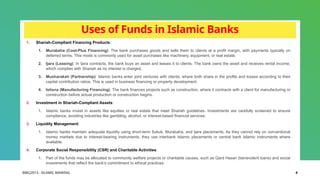
Uses of Funds in Islamic Banks
1. Shariah-Compliant Financing Products:
1. Murabaha (Cost-Plus Financing): The bank purchases goods and sells them to clients at a profit margin, with payments typically on
deferred terms. This mode is commonly used for asset purchases like machinery, equipment, or real estate.
2. Ijara (Leasing): In Ijara contracts, the bank buys an asset and leases it to clients. The bank owns the asset and receives rental income,
which complies with Shariah as no interest is charged.
3. Musharakah (Partnership): Islamic banks enter joint ventures with clients, where both share in the profits and losses according to their
capital contribution ratios. This is used in business financing or property development.
4. Istisna (Manufacturing Financing): The bank finances projects such as construction, where it contracts with a client for manufacturing or
construction before actual production or construction begins.
2. Investment in Shariah-Compliant Assets:
1. Islamic banks invest in assets like equities or real estate that meet Shariah guidelines. Investments are carefully screened to ensure
compliance, avoiding industries like gambling, alcohol, or interest-based financial services.
3. Liquidity Management:
1. Islamic banks maintain adequate liquidity using short-term Sukuk, Murabaha, and Ijara placements. As they cannot rely on conventional
money markets due to interest-bearing instruments, they use interbank Islamic placements or central bank Islamic instruments where
available.
4. Corporate Social Responsibility (CSR) and Charitable Activities:
1. Part of the funds may be allocated to community welfare projects or charitable causes, such as Qard Hasan (benevolent loans) and social
investments that reflect the bank’s commitment to ethical practices.
BIBCJ2013 - ISLAMIC BANKING 7
LIQUIDITY MANAGEMENT IN ISLAMIC BANKS
 Liquidity management in Islamic banks requires special
strategies to comply with Shariah principles, which prohibit
interest-based transactions and speculative practices.
 This necessitates the development of unique, interest-free
financial instruments and processes to effectively manage
liquidity while maintaining compliance with Islamic law.
BIBCJ2013 - ISLAMIC BANKING 8
1. Shariah-Compliant Liquidity Instruments
 Commodity Murabaha: A common tool in liquidity management, where the bank purchases
commodities and then sells them at a profit on a deferred payment basis to generate liquidity.
This short-term transaction meets Shariah principles since it involves tangible assets.
 Sukuk (Islamic Bonds): Sukuk are certificates representing ownership in tangible assets or
projects. Islamic banks use government or corporate Sukuk as a liquidity management tool,
as it provides a stable return through asset-backed securities rather than interest-based
bonds.
 Wakalah (Agency Agreement): Islamic banks use Wakalah agreements to place excess funds
with other banks or financial institutions. One bank (the principal) entrusts another (the
agent) to invest funds in Shariah-compliant ventures, with a profit-sharing mechanism that
aligns with Islamic values.
 Ijara (Leasing): Under Ijara, Islamic banks lease out assets and receive rental payments as a
form of liquidity. This aligns with Shariah as it does not involve interest payments and ensures
a stable cash flow from lease agreements.
BIBCJ2013 - ISLAMIC BANKING 9
2. Interbank Islamic Money Market
 Islamic Interbank Money Market (IIMM): IIMM enables Islamic banks to
manage short-term liquidity needs through Shariah-compliant financial
transactions with other Islamic banks. These transactions include placements
in short-term investments or Sukuk to balance surplus or shortfall in liquidity.
 Mudarabah Interbank Investment (MII): In MII, Islamic banks place funds
with other banks under Mudarabah (profit-sharing) contracts. This
agreement shares the profit, if any, based on pre-agreed ratios, allowing
banks to manage excess liquidity while avoiding interest.
 Commodity-based Interbank Placements: Islamic banks utilize interbank
placements involving commodity transactions (Commodity Murabaha) to
temporarily address short-term liquidity needs through non-interest-bearing
loans.
BIBCJ2013 - ISLAMIC BANKING 10
3. Central Bank Instruments
 Islamic Liquidity Facility: In some countries, central banks offer
Shariah-compliant liquidity facilities specifically for Islamic banks.
For example, Malaysia’s central bank, Bank Negara Malaysia,
provides instruments like the Murabaha-based Standing Facility,
offering a mechanism for Islamic banks to access liquidity in times
of need.
 Standing and Repo Facilities (using Sukuk): Certain central
banks allow Islamic banks to utilize standing facilities or
repurchase agreements involving Sukuk. In these structures, banks
sell Sukuk to the central bank and agree to repurchase them at a
later date to ensure short-term liquidity.
BIBCJ2013 - ISLAMIC BANKING 11
4. Cash Reserve Ratio and Liquidity Ratios
 Cash Reserve Ratio (CRR): Like conventional banks, Islamic
banks are required to maintain a minimum cash reserve ratio
to manage liquidity. This ratio serves as a cushion for
unforeseen liquidity needs.
 Liquidity Coverage Ratio (LCR) and Net Stable Funding
Ratio (NSFR): Islamic banks adhere to Basel III standards,
which set guidelines for liquidity coverage and stable funding,
ensuring banks have enough liquid assets to manage short-
term and long-term obligations.
BIBCJ2013 - ISLAMIC BANKING 12
5. Role of Technology in Liquidity Management
 Fintech and Islamic Banking Platforms: New digital solutions,
such as blockchain technology and fintech platforms, are being
leveraged to improve transparency, efficiency, and compliance in
Islamic liquidity management. These platforms support instant
transfers, real-time liquidity tracking, and enhanced reporting.
 Artificial Intelligence (AI) and Data Analytics: AI-driven
predictive analytics tools enable Islamic banks to forecast
liquidity requirements more accurately, optimize cash flow, and
anticipate market trends, enhancing liquidity management
strategies in real-time.
BIBCJ2013 - ISLAMIC BANKING 13
ASSET MANAGEMENT IN ISLAMIC BANKING: FINANCING,
INVESTMENT, AND RESERVE MANAGEMENT
 In Islamic banking, asset management is governed by Shariah
principles, emphasizing ethical finance, risk-sharing, and real
asset backing.
 Asset management is divided into three main areas: financing,
investment, and reserve management, each tailored to align
with Islamic values.
BIBCJ2013 - ISLAMIC BANKING 14
1. Financing Management
Financing in Islamic banking uses Shariah-compliant modes that avoid interest (Riba) and
speculative transactions (Gharar). The focus is on partnerships, leasing, and profit-sharing.
 Murabaha (Cost-Plus Financing): In Murabaha, the bank purchases goods and sells them
to clients with a profit margin. This is commonly used for asset acquisition like vehicles,
equipment, and real estate, allowing clients to repay without interest.
 Mudarabah (Profit-Sharing): In Mudarabah, the bank (financier) provides capital to
entrepreneurs for projects or business ventures. Profits are shared based on a pre-agreed
ratio, while losses are borne by the financier, fostering trust and risk-sharing.
 Musyarakah (Joint Venture): In Musyarakah, the bank and client jointly contribute capital
to a project or business, sharing profits based on contribution. This partnership model
enables mutual benefit and risk distribution.
 Ijara (Leasing): Ijara allows the bank to lease an asset to a client for a fixed rent, often
used in property and equipment financing. It complies with Islamic law by avoiding
interest, focusing on service use instead.
BIBCJ2013 - ISLAMIC BANKING 15
2. Investment Management
Investment management in Islamic banking focuses on Shariah-compliant securities, often
requiring tangible asset backing or ethical activities in compliance with Islamic law.
 Sukuk (Islamic Bonds): Sukuk are certificates representing ownership in assets or cash flow
from projects, used for investments in infrastructure or business ventures. Unlike conventional
bonds, Sukuk structures prevent interest-based returns, making them popular for ethical
investment.
 Shariah-Compliant Equities: Islamic banks invest in stocks of companies operating in halal
(permissible) industries, avoiding sectors like alcohol, gambling, and speculative trading.
Compliance is managed through regular Shariah screening.
 Commodity Murabaha: This short-term investment involves purchasing and selling
commodities at a profit, which is structured to provide liquidity or cash management without
engaging in interest-based activities.
 Real Estate Investment: Islamic banks frequently invest in real estate, allowing tangible asset
backing and rental income through Ijara. Real estate investments provide steady returns while
ensuring compliance with Shariah principles.
BIBCJ2013 - ISLAMIC BANKING 16
3. Reserve Management
Reserve management ensures that Islamic banks can meet liquidity needs while complying with
Shariah law, which requires balancing liquidity and return requirements without reliance on
interest.
 Cash Reserve Ratio (CRR): Islamic banks maintain a cash reserve ratio (CRR) in line with
regulatory requirements, keeping a portion of deposits in reserve for unforeseen liquidity
needs. This aligns with prudent risk management and deposit protection.
 Liquidity Management via Sukuk: Sukuk investments allow banks to hold Shariah-compliant
assets that can be liquidated when needed. Many central banks issue Sukuk specifically for
reserve and liquidity management in Islamic financial institutions.
 Central Bank Facilities: In countries with Islamic banking support, central banks offer Shariah-
compliant liquidity facilities, such as the Murabaha-based Standing Facility, allowing banks to
meet short-term needs without engaging in interest-based borrowing.
 Profit Equalization Reserves (PER): PER are set aside to stabilize the returns for depositors and
equity holders. It ensures that returns are competitive even during periods of lower profitability,
helping to balance payouts and attract investment.
BIBCJ2013 - ISLAMIC BANKING 17
LIABILITY MANAGEMENT IN ISLAMIC BANKING: DEPOSIT
AND NON-DEPOSIT MANAGEMENT
 Liability management in Islamic banking involves managing
sources of funds to ensure both operational liquidity and
compliance with Shariah principles.
 Unlike conventional banks, Islamic banks cannot rely on
interest-based loans; instead, they use Shariah-compliant
mechanisms for both deposits and non-deposit funding
sources.
BIBCJ2013 - ISLAMIC BANKING 18
1. Deposit Management
Deposit management in Islamic banks is based on profit-sharing or fee-based contracts that comply with
Shariah principles, allowing clients to invest their funds without accruing or paying interest.
 Wadiah (Safekeeping): In a Wadiah contract, depositors entrust their funds to the bank for
safekeeping. The bank has the discretion to reward the depositor with a discretionary bonus but is not
obligated to do so. This contract is commonly used for current accounts and safekeeping deposits.
 Mudarabah (Profit-Sharing Investment Account): Mudarabah deposits are investment accounts
where depositors act as capital providers (rabb-ul-mal) and the bank as the manager (mudarib). Profits
generated from the bank’s investments are shared with depositors based on a pre-agreed ratio, while
losses are borne by the capital provider. This is popular for savings and investment accounts.
 Qard (Loan): Under Qard, depositors lend funds to the bank as a loan without expecting returns. These
deposits are repayable on demand, and the bank may voluntarily give a gift (hiba) to the depositor as
appreciation. Qard is often used in demand deposits and current accounts.
 Wakala (Agency Agreement): In Wakala-based deposits, depositors appoint the bank as an agent to
invest their funds. The bank charges a fee for its services and the depositor receives returns generated
from the investments. This structure allows clients to benefit from investment opportunities without
direct management.
BIBCJ2013 - ISLAMIC BANKING 19
2. Non-Deposit Management
Non-deposit management in Islamic banking involves raising funds without reliance on deposits, using instruments
such as Sukuk or interbank placements that adhere to Shariah principles.
 Sukuk (Islamic Bonds): Sukuk issuance allows Islamic banks to raise funds through asset-backed securities.
Sukuk provides investors with ownership in a tangible asset or project, offering returns based on asset
performance rather than interest. Sukuk are widely used for long-term funding needs.
 Interbank Murabaha: Interbank Murabaha involves short-term funding through cost-plus sales between banks.
One bank sells a commodity to another bank at a marked-up price, with repayment on a future date. This
provides Islamic banks with Shariah-compliant liquidity support without accruing interest.
 Commodity Murabaha (Tawarruq): Tawarruq enables Islamic banks to raise liquidity by purchasing and
reselling commodities through multiple parties. This process allows the bank to gain cash while maintaining
Shariah compliance, as it involves real asset transactions rather than interest-based borrowing.
 Islamic Syndicated Financing: Islamic banks may participate in syndicated financing with other Islamic or
conventional banks to meet substantial funding needs for large projects. This involves pooling funds from
multiple financial institutions under Shariah-compliant contracts, such as Murabaha or Ijara.
 Central Bank Shariah-Compliant Facilities: In many Islamic jurisdictions, central banks provide Shariah-
compliant lending facilities to help banks meet liquidity requirements. These facilities may include Murabaha-
based lending or special Sukuk arrangements to maintain short-term liquidity.
BIBCJ2013 - ISLAMIC BANKING 20
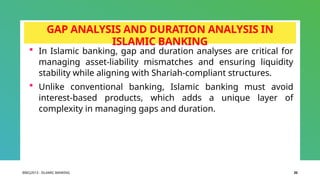
GAP ANALYSIS AND DURATION ANALYSIS IN
ISLAMIC BANKING
 In Islamic banking, gap and duration analyses are critical for
managing asset-liability mismatches and ensuring liquidity
stability while aligning with Shariah-compliant structures.
 Unlike conventional banking, Islamic banking must avoid
interest-based products, which adds a unique layer of
complexity in managing gaps and duration.
BIBCJ2013 - ISLAMIC BANKING 21
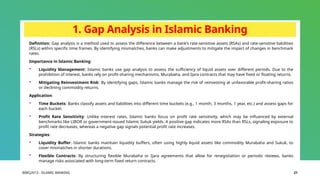
1. Gap Analysis in Islamic Banking
Definition: Gap analysis is a method used to assess the difference between a bank’s rate-sensitive assets (RSAs) and rate-sensitive liabilities
(RSLs) within specific time frames. By identifying mismatches, banks can make adjustments to mitigate the impact of changes in benchmark
rates.
Importance in Islamic Banking:
 Liquidity Management: Islamic banks use gap analysis to assess the sufficiency of liquid assets over different periods. Due to the
prohibition of interest, banks rely on profit-sharing mechanisms, Murabaha, and Ijara contracts that may have fixed or floating returns.
 Mitigating Reinvestment Risk: By identifying gaps, Islamic banks manage the risk of reinvesting at unfavorable profit-sharing ratios
or declining commodity returns.
Application:
 Time Buckets: Banks classify assets and liabilities into different time buckets (e.g., 1 month, 3 months, 1 year, etc.) and assess gaps for
each bucket.
 Profit Rate Sensitivity: Unlike interest rates, Islamic banks focus on profit rate sensitivity, which may be influenced by external
benchmarks like LIBOR or government-issued Islamic Sukuk yields. A positive gap indicates more RSAs than RSLs, signaling exposure to
profit rate decreases, whereas a negative gap signals potential profit rate increases.
Strategies:
 Liquidity Buffer: Islamic banks maintain liquidity buffers, often using highly liquid assets like commodity Murabaha and Sukuk, to
cover mismatches in shorter durations.
 Flexible Contracts: By structuring flexible Murabaha or Ijara agreements that allow for renegotiation or periodic reviews, banks
manage risks associated with long-term fixed return contracts.
BIBCJ2013 - ISLAMIC BANKING 22
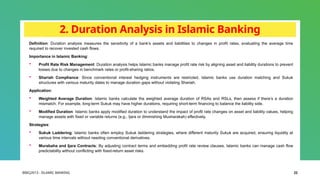
2. Duration Analysis in Islamic Banking
Definition: Duration analysis measures the sensitivity of a bank’s assets and liabilities to changes in profit rates, evaluating the average time
required to recover invested cash flows.
Importance in Islamic Banking:
 Profit Rate Risk Management: Duration analysis helps Islamic banks manage profit rate risk by aligning asset and liability durations to prevent
losses due to changes in benchmark rates or profit-sharing ratios.
 Shariah Compliance: Since conventional interest hedging instruments are restricted, Islamic banks use duration matching and Sukuk
structures with various maturity dates to manage duration gaps without violating Shariah.
Application:
 Weighted Average Duration: Islamic banks calculate the weighted average duration of RSAs and RSLs, then assess if there’s a duration
mismatch. For example, long-term Sukuk may have higher durations, requiring short-term financing to balance the liability side.
 Modified Duration: Islamic banks apply modified duration to understand the impact of profit rate changes on asset and liability values, helping
manage assets with fixed or variable returns (e.g., Ijara or diminishing Musharakah) effectively.
Strategies:
 Sukuk Laddering: Islamic banks often employ Sukuk laddering strategies, where different maturity Sukuk are acquired, ensuring liquidity at
various time intervals without needing conventional derivatives.
 Murabaha and Ijara Contracts: By adjusting contract terms and embedding profit rate review clauses, Islamic banks can manage cash flow
predictability without conflicting with fixed-return asset risks.
BIBCJ2013 - ISLAMIC BANKING 23
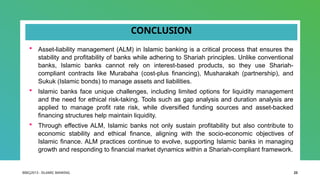
CONCLUSION
 Asset-liability management (ALM) in Islamic banking is a critical process that ensures the
stability and profitability of banks while adhering to Shariah principles. Unlike conventional
banks, Islamic banks cannot rely on interest-based products, so they use Shariah-
compliant contracts like Murabaha (cost-plus financing), Musharakah (partnership), and
Sukuk (Islamic bonds) to manage assets and liabilities.
 Islamic banks face unique challenges, including limited options for liquidity management
and the need for ethical risk-taking. Tools such as gap analysis and duration analysis are
applied to manage profit rate risk, while diversified funding sources and asset-backed
financing structures help maintain liquidity.
 Through effective ALM, Islamic banks not only sustain profitability but also contribute to
economic stability and ethical finance, aligning with the socio-economic objectives of
Islamic finance. ALM practices continue to evolve, supporting Islamic banks in managing
growth and responding to financial market dynamics within a Shariah-compliant framework.
BIBCJ2013 - ISLAMIC BANKING 24
Q & A

CHAPTER 3 - ASSEST LIABILITY MANAGEMENT.pptx

  • 1.
    1 CHAPTER 3: ASSESTLIABILITY MANAGEMENT By: Major Dr. Mohd Adib Abd Muin, IFP, CQIF (Wealth Management) Senior Lecturer Islamic Business School (IBS) Universiti Utara Malaysia BIBCJ2013 - ISLAMIC BANKING
  • 2.
    BIBCJ2013 - ISLAMICBANKING OUTLINE 1. INTRODUCTION 2. SOURCES AND USES OF FUNDS IN ISLAMIC BANKS 3. LIQUIDITY MANAGEMENT OF ISLAMIC BANKS 4. ASSEST MANAGEMENT: FINANCING, INVESTMENT AND RESERVE MANAGEMENT 5. LIABILITY MANAGEMENT: DEPOSIT, NON-DEPOSIT MANAGEMENT 6. GAP ANALYSIS & DURATION ANALYSIS 7. CONCLUSION 2
  • 3.
    BIBCJ2013 - ISLAMICBANKING 3 INTRODUCTION  Asset-Liability Management (ALM) in Islamic banking is a strategic approach to managing a bank’s financial health by balancing assets and liabilities within Shariah-compliant frameworks.  Unlike conventional banks, Islamic banks must structure their ALM practices to avoid interest (riba), uncertainty (gharar), and speculative transactions (maysir). This distinct approach requires the use of profit-sharing contracts, leasing, and other permissible financial instruments that support risk-sharing, transparency, and ethical financing.  ALM in Islamic banks focuses on aligning asset and liability maturities, ensuring liquidity, managing risks, and maximizing returns while maintaining Shariah compliance. Islamic banks rely on contracts such as Mudharabah (profit-sharing), Murabaha (cost-plus financing), and Ijara (leasing) to manage their balance sheets. These instruments allow for structured risk-sharing, reduce exposure to financial instability, and ensure that financial activities adhere to Islamic ethical standards.  Effective ALM is essential for Islamic banks to maintain financial stability, sustain growth, and enhance trust with stakeholders by showcasing robust risk management that aligns with Islamic principles. As Islamic banking continues to grow globally, ALM remains critical in helping these banks compete while staying true to their ethical and operational values.
  • 4.
    BIBCJ2013 - ISLAMICBANKING 4 1. SOURCES AND USES OF FUNDS IN ISLAMIC BANKS  In Islamic banks, the sources and uses of funds are distinct from conventional banks as they are structured to comply with Shariah principles, which prohibit interest (riba) and emphasize ethical investment and risk-sharing.
  • 5.
    BIBCJ2013 - ISLAMICBANKING 5 Sources of Funds in Islamic Banks 1. Equity Financing: 1. Shareholders’ Equity: Equity contributions from shareholders are a primary source of capital for Islamic banks. This capital is used for initial funding, operational expansion, and supporting capital adequacy requirements. 2. Retained Earnings: Profits earned from Shariah-compliant investments that are reinvested in the bank. 2. Investment Accounts: 1. Mudarabah (Profit-Sharing): Investment accounts where depositors provide funds that the bank invests in Shariah- compliant projects. Profits are shared based on a pre-agreed ratio, while losses are borne by the investors, except in cases of bank negligence. 2. Wakalah (Agency): Some Islamic banks operate as agents, managing funds on behalf of depositors and charging a fee for their services. 3. Current Accounts (Qard): 1. Interest-Free Loans (Qard Hasan): Depositors provide funds to the bank as a trust loan, which the bank can utilize for its operations without paying interest, although it may pay a discretionary gift (hiba) to account holders. 4. Sukuk (Islamic Bonds): 1. Islamic banks raise funds through Sukuk, which represents ownership in underlying assets rather than debt. Returns come from asset-backed projects or leasing activities, compliant with Shariah principles.
  • 6.
    BIBCJ2013 - ISLAMICBANKING 6 Uses of Funds in Islamic Banks 1. Shariah-Compliant Financing Products: 1. Murabaha (Cost-Plus Financing): The bank purchases goods and sells them to clients at a profit margin, with payments typically on deferred terms. This mode is commonly used for asset purchases like machinery, equipment, or real estate. 2. Ijara (Leasing): In Ijara contracts, the bank buys an asset and leases it to clients. The bank owns the asset and receives rental income, which complies with Shariah as no interest is charged. 3. Musharakah (Partnership): Islamic banks enter joint ventures with clients, where both share in the profits and losses according to their capital contribution ratios. This is used in business financing or property development. 4. Istisna (Manufacturing Financing): The bank finances projects such as construction, where it contracts with a client for manufacturing or construction before actual production or construction begins. 2. Investment in Shariah-Compliant Assets: 1. Islamic banks invest in assets like equities or real estate that meet Shariah guidelines. Investments are carefully screened to ensure compliance, avoiding industries like gambling, alcohol, or interest-based financial services. 3. Liquidity Management: 1. Islamic banks maintain adequate liquidity using short-term Sukuk, Murabaha, and Ijara placements. As they cannot rely on conventional money markets due to interest-bearing instruments, they use interbank Islamic placements or central bank Islamic instruments where available. 4. Corporate Social Responsibility (CSR) and Charitable Activities: 1. Part of the funds may be allocated to community welfare projects or charitable causes, such as Qard Hasan (benevolent loans) and social investments that reflect the bank’s commitment to ethical practices.
  • 7.
    BIBCJ2013 - ISLAMICBANKING 7 LIQUIDITY MANAGEMENT IN ISLAMIC BANKS  Liquidity management in Islamic banks requires special strategies to comply with Shariah principles, which prohibit interest-based transactions and speculative practices.  This necessitates the development of unique, interest-free financial instruments and processes to effectively manage liquidity while maintaining compliance with Islamic law.
  • 8.
    BIBCJ2013 - ISLAMICBANKING 8 1. Shariah-Compliant Liquidity Instruments  Commodity Murabaha: A common tool in liquidity management, where the bank purchases commodities and then sells them at a profit on a deferred payment basis to generate liquidity. This short-term transaction meets Shariah principles since it involves tangible assets.  Sukuk (Islamic Bonds): Sukuk are certificates representing ownership in tangible assets or projects. Islamic banks use government or corporate Sukuk as a liquidity management tool, as it provides a stable return through asset-backed securities rather than interest-based bonds.  Wakalah (Agency Agreement): Islamic banks use Wakalah agreements to place excess funds with other banks or financial institutions. One bank (the principal) entrusts another (the agent) to invest funds in Shariah-compliant ventures, with a profit-sharing mechanism that aligns with Islamic values.  Ijara (Leasing): Under Ijara, Islamic banks lease out assets and receive rental payments as a form of liquidity. This aligns with Shariah as it does not involve interest payments and ensures a stable cash flow from lease agreements.
  • 9.
    BIBCJ2013 - ISLAMICBANKING 9 2. Interbank Islamic Money Market  Islamic Interbank Money Market (IIMM): IIMM enables Islamic banks to manage short-term liquidity needs through Shariah-compliant financial transactions with other Islamic banks. These transactions include placements in short-term investments or Sukuk to balance surplus or shortfall in liquidity.  Mudarabah Interbank Investment (MII): In MII, Islamic banks place funds with other banks under Mudarabah (profit-sharing) contracts. This agreement shares the profit, if any, based on pre-agreed ratios, allowing banks to manage excess liquidity while avoiding interest.  Commodity-based Interbank Placements: Islamic banks utilize interbank placements involving commodity transactions (Commodity Murabaha) to temporarily address short-term liquidity needs through non-interest-bearing loans.
  • 10.
    BIBCJ2013 - ISLAMICBANKING 10 3. Central Bank Instruments  Islamic Liquidity Facility: In some countries, central banks offer Shariah-compliant liquidity facilities specifically for Islamic banks. For example, Malaysia’s central bank, Bank Negara Malaysia, provides instruments like the Murabaha-based Standing Facility, offering a mechanism for Islamic banks to access liquidity in times of need.  Standing and Repo Facilities (using Sukuk): Certain central banks allow Islamic banks to utilize standing facilities or repurchase agreements involving Sukuk. In these structures, banks sell Sukuk to the central bank and agree to repurchase them at a later date to ensure short-term liquidity.
  • 11.
    BIBCJ2013 - ISLAMICBANKING 11 4. Cash Reserve Ratio and Liquidity Ratios  Cash Reserve Ratio (CRR): Like conventional banks, Islamic banks are required to maintain a minimum cash reserve ratio to manage liquidity. This ratio serves as a cushion for unforeseen liquidity needs.  Liquidity Coverage Ratio (LCR) and Net Stable Funding Ratio (NSFR): Islamic banks adhere to Basel III standards, which set guidelines for liquidity coverage and stable funding, ensuring banks have enough liquid assets to manage short- term and long-term obligations.
  • 12.
    BIBCJ2013 - ISLAMICBANKING 12 5. Role of Technology in Liquidity Management  Fintech and Islamic Banking Platforms: New digital solutions, such as blockchain technology and fintech platforms, are being leveraged to improve transparency, efficiency, and compliance in Islamic liquidity management. These platforms support instant transfers, real-time liquidity tracking, and enhanced reporting.  Artificial Intelligence (AI) and Data Analytics: AI-driven predictive analytics tools enable Islamic banks to forecast liquidity requirements more accurately, optimize cash flow, and anticipate market trends, enhancing liquidity management strategies in real-time.
  • 13.
    BIBCJ2013 - ISLAMICBANKING 13 ASSET MANAGEMENT IN ISLAMIC BANKING: FINANCING, INVESTMENT, AND RESERVE MANAGEMENT  In Islamic banking, asset management is governed by Shariah principles, emphasizing ethical finance, risk-sharing, and real asset backing.  Asset management is divided into three main areas: financing, investment, and reserve management, each tailored to align with Islamic values.
  • 14.
    BIBCJ2013 - ISLAMICBANKING 14 1. Financing Management Financing in Islamic banking uses Shariah-compliant modes that avoid interest (Riba) and speculative transactions (Gharar). The focus is on partnerships, leasing, and profit-sharing.  Murabaha (Cost-Plus Financing): In Murabaha, the bank purchases goods and sells them to clients with a profit margin. This is commonly used for asset acquisition like vehicles, equipment, and real estate, allowing clients to repay without interest.  Mudarabah (Profit-Sharing): In Mudarabah, the bank (financier) provides capital to entrepreneurs for projects or business ventures. Profits are shared based on a pre-agreed ratio, while losses are borne by the financier, fostering trust and risk-sharing.  Musyarakah (Joint Venture): In Musyarakah, the bank and client jointly contribute capital to a project or business, sharing profits based on contribution. This partnership model enables mutual benefit and risk distribution.  Ijara (Leasing): Ijara allows the bank to lease an asset to a client for a fixed rent, often used in property and equipment financing. It complies with Islamic law by avoiding interest, focusing on service use instead.
  • 15.
    BIBCJ2013 - ISLAMICBANKING 15 2. Investment Management Investment management in Islamic banking focuses on Shariah-compliant securities, often requiring tangible asset backing or ethical activities in compliance with Islamic law.  Sukuk (Islamic Bonds): Sukuk are certificates representing ownership in assets or cash flow from projects, used for investments in infrastructure or business ventures. Unlike conventional bonds, Sukuk structures prevent interest-based returns, making them popular for ethical investment.  Shariah-Compliant Equities: Islamic banks invest in stocks of companies operating in halal (permissible) industries, avoiding sectors like alcohol, gambling, and speculative trading. Compliance is managed through regular Shariah screening.  Commodity Murabaha: This short-term investment involves purchasing and selling commodities at a profit, which is structured to provide liquidity or cash management without engaging in interest-based activities.  Real Estate Investment: Islamic banks frequently invest in real estate, allowing tangible asset backing and rental income through Ijara. Real estate investments provide steady returns while ensuring compliance with Shariah principles.
  • 16.
    BIBCJ2013 - ISLAMICBANKING 16 3. Reserve Management Reserve management ensures that Islamic banks can meet liquidity needs while complying with Shariah law, which requires balancing liquidity and return requirements without reliance on interest.  Cash Reserve Ratio (CRR): Islamic banks maintain a cash reserve ratio (CRR) in line with regulatory requirements, keeping a portion of deposits in reserve for unforeseen liquidity needs. This aligns with prudent risk management and deposit protection.  Liquidity Management via Sukuk: Sukuk investments allow banks to hold Shariah-compliant assets that can be liquidated when needed. Many central banks issue Sukuk specifically for reserve and liquidity management in Islamic financial institutions.  Central Bank Facilities: In countries with Islamic banking support, central banks offer Shariah- compliant liquidity facilities, such as the Murabaha-based Standing Facility, allowing banks to meet short-term needs without engaging in interest-based borrowing.  Profit Equalization Reserves (PER): PER are set aside to stabilize the returns for depositors and equity holders. It ensures that returns are competitive even during periods of lower profitability, helping to balance payouts and attract investment.
  • 17.
    BIBCJ2013 - ISLAMICBANKING 17 LIABILITY MANAGEMENT IN ISLAMIC BANKING: DEPOSIT AND NON-DEPOSIT MANAGEMENT  Liability management in Islamic banking involves managing sources of funds to ensure both operational liquidity and compliance with Shariah principles.  Unlike conventional banks, Islamic banks cannot rely on interest-based loans; instead, they use Shariah-compliant mechanisms for both deposits and non-deposit funding sources.
  • 18.
    BIBCJ2013 - ISLAMICBANKING 18 1. Deposit Management Deposit management in Islamic banks is based on profit-sharing or fee-based contracts that comply with Shariah principles, allowing clients to invest their funds without accruing or paying interest.  Wadiah (Safekeeping): In a Wadiah contract, depositors entrust their funds to the bank for safekeeping. The bank has the discretion to reward the depositor with a discretionary bonus but is not obligated to do so. This contract is commonly used for current accounts and safekeeping deposits.  Mudarabah (Profit-Sharing Investment Account): Mudarabah deposits are investment accounts where depositors act as capital providers (rabb-ul-mal) and the bank as the manager (mudarib). Profits generated from the bank’s investments are shared with depositors based on a pre-agreed ratio, while losses are borne by the capital provider. This is popular for savings and investment accounts.  Qard (Loan): Under Qard, depositors lend funds to the bank as a loan without expecting returns. These deposits are repayable on demand, and the bank may voluntarily give a gift (hiba) to the depositor as appreciation. Qard is often used in demand deposits and current accounts.  Wakala (Agency Agreement): In Wakala-based deposits, depositors appoint the bank as an agent to invest their funds. The bank charges a fee for its services and the depositor receives returns generated from the investments. This structure allows clients to benefit from investment opportunities without direct management.
  • 19.
    BIBCJ2013 - ISLAMICBANKING 19 2. Non-Deposit Management Non-deposit management in Islamic banking involves raising funds without reliance on deposits, using instruments such as Sukuk or interbank placements that adhere to Shariah principles.  Sukuk (Islamic Bonds): Sukuk issuance allows Islamic banks to raise funds through asset-backed securities. Sukuk provides investors with ownership in a tangible asset or project, offering returns based on asset performance rather than interest. Sukuk are widely used for long-term funding needs.  Interbank Murabaha: Interbank Murabaha involves short-term funding through cost-plus sales between banks. One bank sells a commodity to another bank at a marked-up price, with repayment on a future date. This provides Islamic banks with Shariah-compliant liquidity support without accruing interest.  Commodity Murabaha (Tawarruq): Tawarruq enables Islamic banks to raise liquidity by purchasing and reselling commodities through multiple parties. This process allows the bank to gain cash while maintaining Shariah compliance, as it involves real asset transactions rather than interest-based borrowing.  Islamic Syndicated Financing: Islamic banks may participate in syndicated financing with other Islamic or conventional banks to meet substantial funding needs for large projects. This involves pooling funds from multiple financial institutions under Shariah-compliant contracts, such as Murabaha or Ijara.  Central Bank Shariah-Compliant Facilities: In many Islamic jurisdictions, central banks provide Shariah- compliant lending facilities to help banks meet liquidity requirements. These facilities may include Murabaha- based lending or special Sukuk arrangements to maintain short-term liquidity.
  • 20.
    BIBCJ2013 - ISLAMICBANKING 20 GAP ANALYSIS AND DURATION ANALYSIS IN ISLAMIC BANKING  In Islamic banking, gap and duration analyses are critical for managing asset-liability mismatches and ensuring liquidity stability while aligning with Shariah-compliant structures.  Unlike conventional banking, Islamic banking must avoid interest-based products, which adds a unique layer of complexity in managing gaps and duration.
  • 21.
    BIBCJ2013 - ISLAMICBANKING 21 1. Gap Analysis in Islamic Banking Definition: Gap analysis is a method used to assess the difference between a bank’s rate-sensitive assets (RSAs) and rate-sensitive liabilities (RSLs) within specific time frames. By identifying mismatches, banks can make adjustments to mitigate the impact of changes in benchmark rates. Importance in Islamic Banking:  Liquidity Management: Islamic banks use gap analysis to assess the sufficiency of liquid assets over different periods. Due to the prohibition of interest, banks rely on profit-sharing mechanisms, Murabaha, and Ijara contracts that may have fixed or floating returns.  Mitigating Reinvestment Risk: By identifying gaps, Islamic banks manage the risk of reinvesting at unfavorable profit-sharing ratios or declining commodity returns. Application:  Time Buckets: Banks classify assets and liabilities into different time buckets (e.g., 1 month, 3 months, 1 year, etc.) and assess gaps for each bucket.  Profit Rate Sensitivity: Unlike interest rates, Islamic banks focus on profit rate sensitivity, which may be influenced by external benchmarks like LIBOR or government-issued Islamic Sukuk yields. A positive gap indicates more RSAs than RSLs, signaling exposure to profit rate decreases, whereas a negative gap signals potential profit rate increases. Strategies:  Liquidity Buffer: Islamic banks maintain liquidity buffers, often using highly liquid assets like commodity Murabaha and Sukuk, to cover mismatches in shorter durations.  Flexible Contracts: By structuring flexible Murabaha or Ijara agreements that allow for renegotiation or periodic reviews, banks manage risks associated with long-term fixed return contracts.
  • 22.
    BIBCJ2013 - ISLAMICBANKING 22 2. Duration Analysis in Islamic Banking Definition: Duration analysis measures the sensitivity of a bank’s assets and liabilities to changes in profit rates, evaluating the average time required to recover invested cash flows. Importance in Islamic Banking:  Profit Rate Risk Management: Duration analysis helps Islamic banks manage profit rate risk by aligning asset and liability durations to prevent losses due to changes in benchmark rates or profit-sharing ratios.  Shariah Compliance: Since conventional interest hedging instruments are restricted, Islamic banks use duration matching and Sukuk structures with various maturity dates to manage duration gaps without violating Shariah. Application:  Weighted Average Duration: Islamic banks calculate the weighted average duration of RSAs and RSLs, then assess if there’s a duration mismatch. For example, long-term Sukuk may have higher durations, requiring short-term financing to balance the liability side.  Modified Duration: Islamic banks apply modified duration to understand the impact of profit rate changes on asset and liability values, helping manage assets with fixed or variable returns (e.g., Ijara or diminishing Musharakah) effectively. Strategies:  Sukuk Laddering: Islamic banks often employ Sukuk laddering strategies, where different maturity Sukuk are acquired, ensuring liquidity at various time intervals without needing conventional derivatives.  Murabaha and Ijara Contracts: By adjusting contract terms and embedding profit rate review clauses, Islamic banks can manage cash flow predictability without conflicting with fixed-return asset risks.
  • 23.
    BIBCJ2013 - ISLAMICBANKING 23 CONCLUSION  Asset-liability management (ALM) in Islamic banking is a critical process that ensures the stability and profitability of banks while adhering to Shariah principles. Unlike conventional banks, Islamic banks cannot rely on interest-based products, so they use Shariah- compliant contracts like Murabaha (cost-plus financing), Musharakah (partnership), and Sukuk (Islamic bonds) to manage assets and liabilities.  Islamic banks face unique challenges, including limited options for liquidity management and the need for ethical risk-taking. Tools such as gap analysis and duration analysis are applied to manage profit rate risk, while diversified funding sources and asset-backed financing structures help maintain liquidity.  Through effective ALM, Islamic banks not only sustain profitability but also contribute to economic stability and ethical finance, aligning with the socio-economic objectives of Islamic finance. ALM practices continue to evolve, supporting Islamic banks in managing growth and responding to financial market dynamics within a Shariah-compliant framework.
  • 24.
    BIBCJ2013 - ISLAMICBANKING 24 Q & A