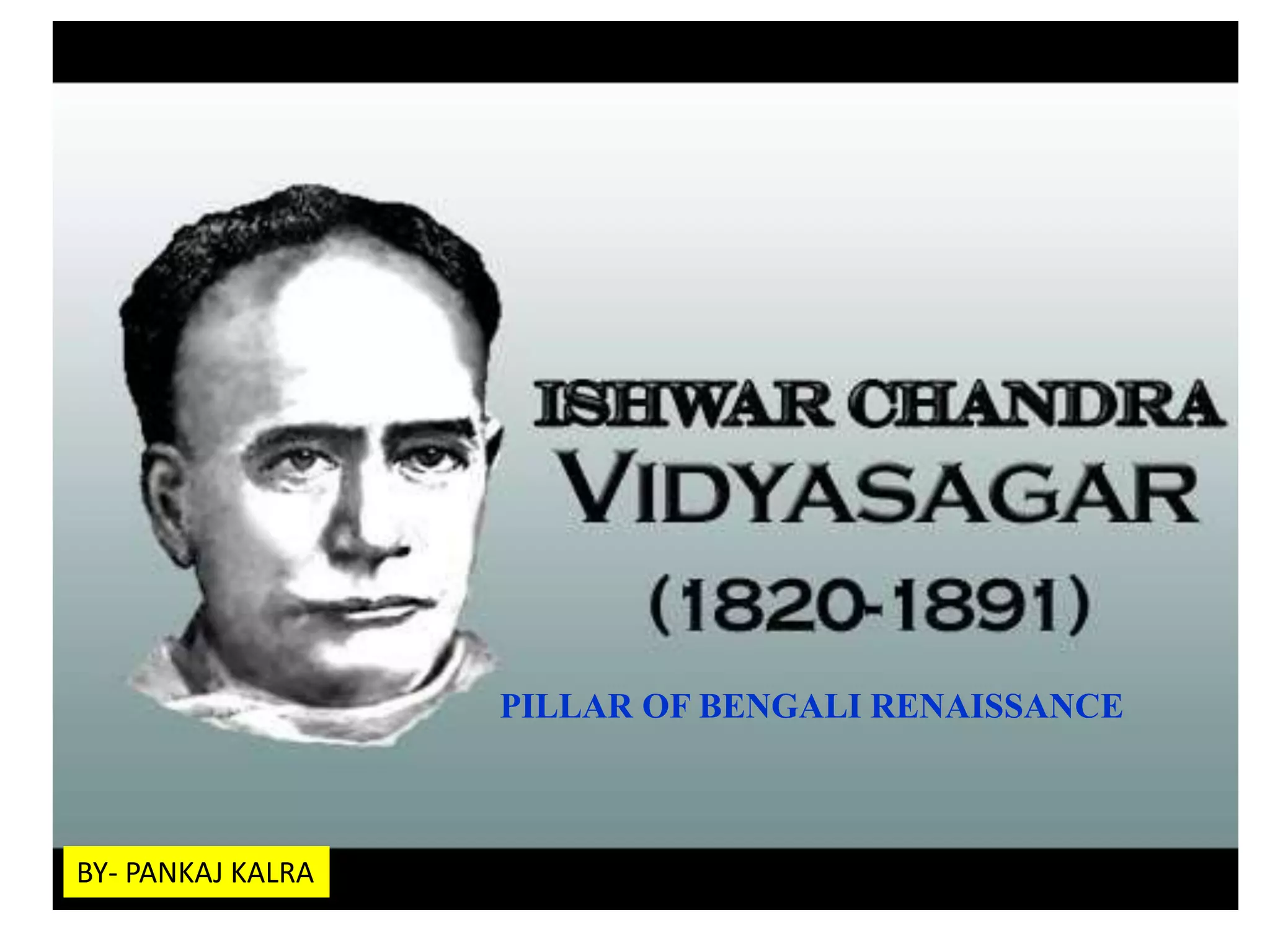
ISHWAR CHAND VIDYASAGAR
Pillars Of Bengal Renaissance
PILLAR OF BENGALI RENAISSANCE
BY- PANKAJ KALRA
EARLY LIFE
• Born on 26 Sep 1820
• Born in a Bengali Hindu Brahmin Family in Birsingha Vill ( West
Midnapore Distt)
• Father was Thakurdas Bandopadhyay and Mother was Bhagavati Devi
(Economically Backward)
• Age of Nine shifted to Calcutta with his Father(Nov 1828)
• He did his studies and earned scholarships
• 1829 to 1841 he studied Vedanta,Vyakran,Literature ,Smrirti and
Ethics- Sanskrit college
• The same yr he cleared his Law exam
• 1839- He Earned the Title “Vidyasagar” when he excelled in
competition testing knowledge in Sanskrit
• At the age of 14 he married Dinamani Devi
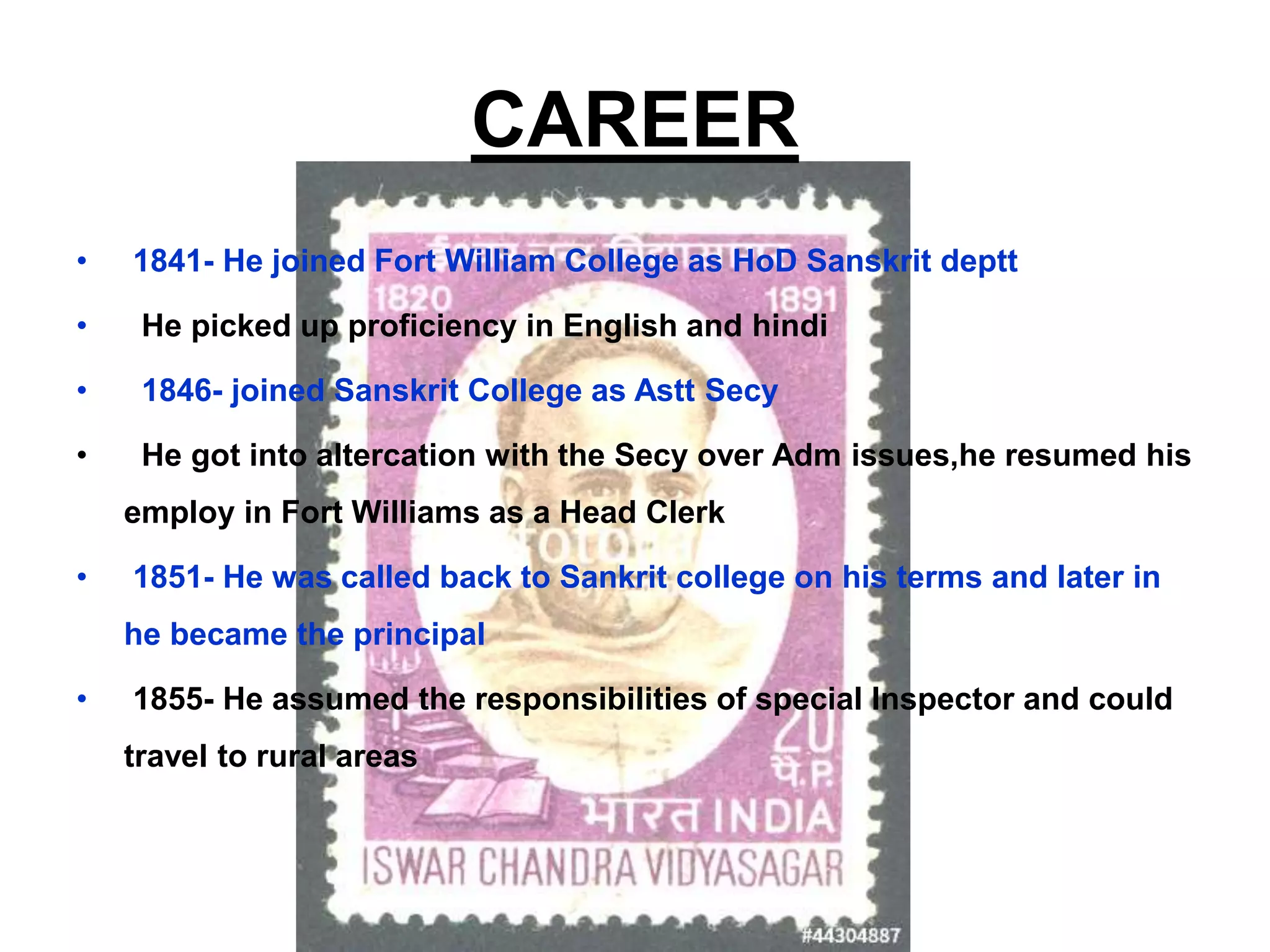
CAREER
• 1841- He joined Fort William College as HoD Sanskrit deptt
• He picked up proficiency in English and hindi
• 1846- joined Sanskrit College as Astt Secy
• He got into altercation with the Secy over Adm issues,he resumed his
employ in Fort Williams as a Head Clerk
• 1851- He was called back to Sankrit college on his terms and later in
he became the principal
• 1855- He assumed the responsibilities of special Inspector and could
travel to rural areas
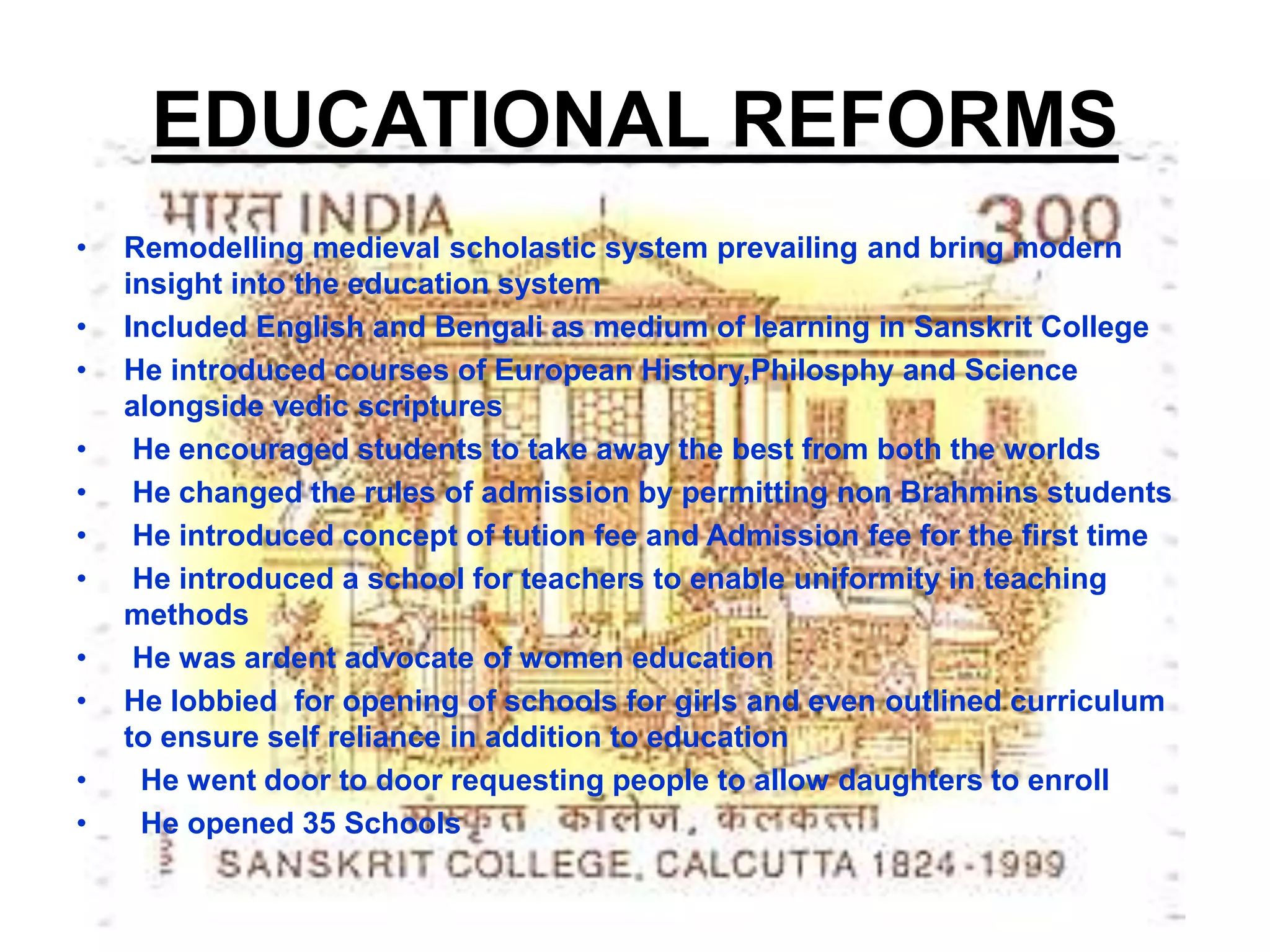
EDUCATIONAL REFORMS
• Remodelling medieval scholastic system prevailing and bring modern
insight into the education system
• Included English and Bengali as medium of learning in Sanskrit College
• He introduced courses of European History,Philosphy and Science
alongside vedic scriptures
• He encouraged students to take away the best from both the worlds
• He changed the rules of admission by permitting non Brahmins students
• He introduced concept of tution fee and Admission fee for the first time
• He introduced a school for teachers to enable uniformity in teaching
methods
• He was ardent advocate of women education
• He lobbied for opening of schools for girls and even outlined curriculum
to ensure self reliance in addition to education
• He went door to door requesting people to allow daughters to enroll
• He opened 35 Schools
SOCIAL REFORMS
• He was always vocal about the oppression of women
• He challenged Brahminical authorities and proved that widow remarriage
is sanctioned by vedic scriptures
• He contributed in getting the Hindu Widow Remarriage Act 1856 decreed
by the British Goverment(Act XV,1856)
• He Campaigned against Kulin Brahmin polygamy in his journal
Gananneshan(Search for knowledge)
• This led to mass prostitution as these wives landed up in Brothels
LITERATURE
• Pioneer in simplifying Bengali Language – Borno Parichay
• “Vetala Panchavingsati”- 1847 ,it was a translation from Sanskrit
• “Banglar Itihas”-1848 from John Marshal’s “ History of Bengal”
• He started writing in bengali periodicals- 1849
• “Jibana- Charita” -1850 , it was a translation of Chamber’s Biography
• “ Shakuntala” - 1854 ,
• “ Sitar Banabas”- 1860
• “ Bhrantibilas” – 1886 , it was translation of Shakespeare’s “ The Comedy of
Errors”
• “ Mahabharata” - 1860
• “ Oti Alpa Hoilo”- 1873
• “Aabaar Oti Alpa Hoilo “- 1873
• “ Braj Villas”- 1884
• “Bidhobabibaha”- 1855
• “ Bahu Bibaha”- 1871
• “Balya Bibaha”- 1873
• “ Borno Parichoy” -1851
TAKE AWAY

ISHWAR CHAND VIDYASAGAR

  • 1.
    ISHWAR CHAND VIDYASAGAR PillarsOf Bengal Renaissance PILLAR OF BENGALI RENAISSANCE BY- PANKAJ KALRA
  • 2.
    EARLY LIFE • Bornon 26 Sep 1820 • Born in a Bengali Hindu Brahmin Family in Birsingha Vill ( West Midnapore Distt) • Father was Thakurdas Bandopadhyay and Mother was Bhagavati Devi (Economically Backward) • Age of Nine shifted to Calcutta with his Father(Nov 1828) • He did his studies and earned scholarships • 1829 to 1841 he studied Vedanta,Vyakran,Literature ,Smrirti and Ethics- Sanskrit college • The same yr he cleared his Law exam • 1839- He Earned the Title “Vidyasagar” when he excelled in competition testing knowledge in Sanskrit • At the age of 14 he married Dinamani Devi
  • 3.
    CAREER • 1841- Hejoined Fort William College as HoD Sanskrit deptt • He picked up proficiency in English and hindi • 1846- joined Sanskrit College as Astt Secy • He got into altercation with the Secy over Adm issues,he resumed his employ in Fort Williams as a Head Clerk • 1851- He was called back to Sankrit college on his terms and later in he became the principal • 1855- He assumed the responsibilities of special Inspector and could travel to rural areas
  • 4.
    EDUCATIONAL REFORMS • Remodellingmedieval scholastic system prevailing and bring modern insight into the education system • Included English and Bengali as medium of learning in Sanskrit College • He introduced courses of European History,Philosphy and Science alongside vedic scriptures • He encouraged students to take away the best from both the worlds • He changed the rules of admission by permitting non Brahmins students • He introduced concept of tution fee and Admission fee for the first time • He introduced a school for teachers to enable uniformity in teaching methods • He was ardent advocate of women education • He lobbied for opening of schools for girls and even outlined curriculum to ensure self reliance in addition to education • He went door to door requesting people to allow daughters to enroll • He opened 35 Schools
  • 5.
    SOCIAL REFORMS • Hewas always vocal about the oppression of women • He challenged Brahminical authorities and proved that widow remarriage is sanctioned by vedic scriptures • He contributed in getting the Hindu Widow Remarriage Act 1856 decreed by the British Goverment(Act XV,1856) • He Campaigned against Kulin Brahmin polygamy in his journal Gananneshan(Search for knowledge) • This led to mass prostitution as these wives landed up in Brothels
  • 6.
    LITERATURE • Pioneer insimplifying Bengali Language – Borno Parichay • “Vetala Panchavingsati”- 1847 ,it was a translation from Sanskrit • “Banglar Itihas”-1848 from John Marshal’s “ History of Bengal” • He started writing in bengali periodicals- 1849 • “Jibana- Charita” -1850 , it was a translation of Chamber’s Biography • “ Shakuntala” - 1854 , • “ Sitar Banabas”- 1860 • “ Bhrantibilas” – 1886 , it was translation of Shakespeare’s “ The Comedy of Errors” • “ Mahabharata” - 1860 • “ Oti Alpa Hoilo”- 1873 • “Aabaar Oti Alpa Hoilo “- 1873 • “ Braj Villas”- 1884 • “Bidhobabibaha”- 1855 • “ Bahu Bibaha”- 1871 • “Balya Bibaha”- 1873 • “ Borno Parichoy” -1851
  • 7.

Editor's Notes

  • #3 EXTREME POVERTY PRIMARY EDUCATION IN VILL PATHSHALA FATHER WAS A CLK IN A SHOP IN CALCUTTA
  • #5 When he studied in sanskrit college he obseved the indian education system
  • #6 He married his son Narayan Chandra to an adplescent widow in 1870 to set an example His unshakeble courage was the mettle of his success in introducing the widow remarriage act in 1856 Kulins collected handsome dowries through multiple marriages ,almost became a profession(once or twice a lifetime) some married 60 Times Changing the society from within
  • #7 He took initiatives to simplify and modernise bengali language by “ Borno Parichay) 25 tales of Betaal and king Vikramaditya “Sarba Shuvankari”,Tattwabodhini Patrika, Somprakash Chambers biography- life history of many western scientist