
ISEO: MOBILE SEARCH ENGINE
OPTIMIZATION DONE RIGHT
Data-driven Mobile SEO for Smartphones


Bryson Meunier
Director, Content Solutions
Resolution Media
@brysonmeunier
+Bryson Meunier
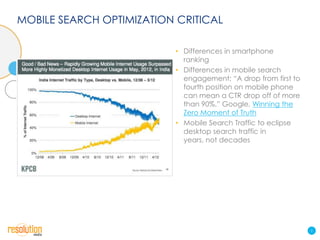
MOBILE SEARCH OPTIMIZATION CRITICAL

                          • Differences in smartphone
                            ranking
                          • Differences in mobile search
                            engagement: “A drop from first to
                            fourth position on mobile phone
                            can mean a CTR drop off of more
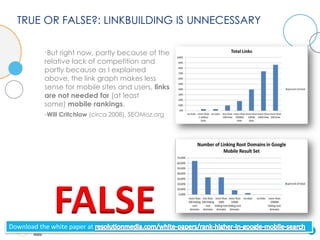
                            than 90%.” Google, Winning the
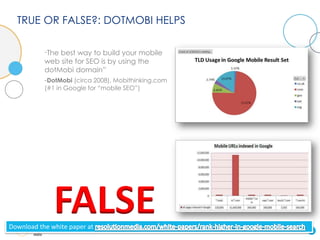
                            Zero Moment of Truth
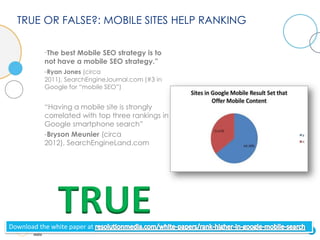
                          • Mobile Search Traffic to eclipse
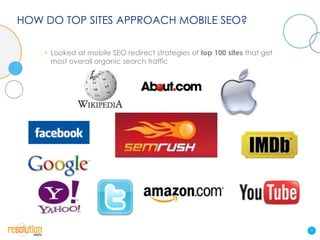
                            desktop search traffic in
                            years, not decades


                                                                2
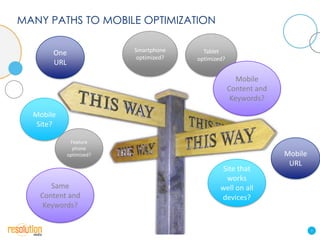
MANY PATHS TO MOBILE OPTIMIZATION

                          Smartphone      Tablet
       One
                           optimized?   optimized?
       URL

                                                        Mobile
                                                     Content and
                                                      Keywords?

  Mobile
   Site?

              Feature
               phone
             optimized?                                            Mobile
                                                                    URL
                                                Site that
                                                 works
      Same                                      well on all
   Content and                                  devices?
    Keywords?


                                                                            3
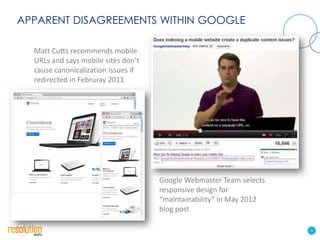
APPARENT DISAGREEMENTS WITHIN GOOGLE

  Matt Cutts recommends mobile
  URLs and says mobile sites don’t
  cause canonicalization issues if
  redirected in Februray 2011


                                     Google Webmaster Team selects
                                     responsive design for
                                     “maintainability” in May 2012
                                     blog post

                                                                     4
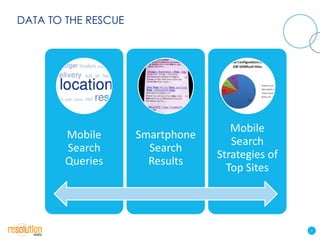
DATA TO THE RESCUE


                                     Mobile
        Mobile       Smartphone
                                     Search
        Search         Search
                                  Strategies of
        Queries        Results
                                    Top Sites


                                                  5
KEYWORD AND CONCEPT RESEARCH CRITICAL TO SEO

    • “Think about the words users would type to find your pages, and make sure
      that your site actually includes those words within it.”
         • Design and Content Guidelines, Google Webmaster Guidelines
    • “Anticipating these differences in search behavior and accounting for them
      while writing your content (using a good mix of keyword phrases) could
      produce positive results”
    • “Designing your site around your visitors' needs while making sure your site is
      easily accessible to search engines usually produces positive results.”
         • Google SEO Starter Guide


                                                                                        6
GOOGLE QUERIES REVEAL DIFFERENCES IN SEARCH BEHAVIOR

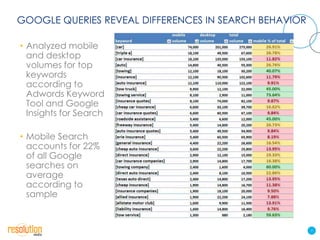
• Analyzed mobile
  and desktop
  volumes for top
  keywords
  according to
  Adwords Keyword
  Tool and Google
  Insights for Search

• Mobile Search
  accounts for 22%
  of all Google
  searches on
  average
  according to
  sample


                                                       7
GOOGLE QUERIES REVEAL DIFFERENCES IN SEARCH BEHAVIOR

            • Same Keywords, Different Frequencies


                                                                          Internet & Telecom
  Finance


                               Dining and Nightlife
            • 77% of total                            • 88% of                                 • 69% of [apps
              search volume                             searches for                             for android]
              for [atm] and                             [restaurants],                           and 73% of
              99% of volume                             97% of                                   [download
              from [atm                                 searches for                             ringtones]
              locations]                                [bars] and 80%                           searches come
              comes from                                of searches for                          from mobile
              mobile devices                            [restaurants                             devices
                                                        near me]
                                                        come from
                                                        mobile devices


                                                                                                                 8
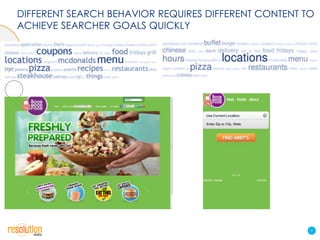
DIFFERENT SEARCH BEHAVIOR REQUIRES DIFFERENT CONTENT TO
ACHIEVE SEARCHER GOALS QUICKLY


                                                      9
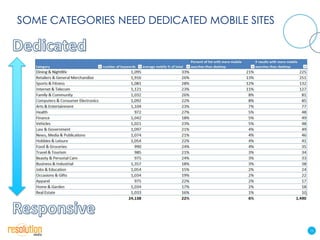
SOME CATEGORIES NEED DEDICATED MOBILE SITES


                                              10
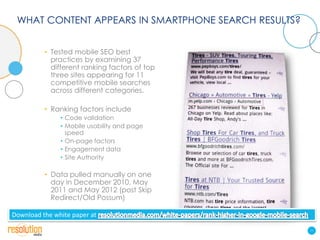
WHAT CONTENT APPEARS IN SMARTPHONE SEARCH RESULTS?


          • Tested mobile SEO best
            practices by examining 37
            different ranking factors of top
            three sites appearing for 11
            competitive mobile searches
            across different categories.

          • Ranking factors include
               • Code validation
               • Mobile usability and page
                 speed
               • On-page factors
               • Engagement data
               • Site Authority

          • Data pulled manually on one
            day in December 2010, May
            2011 and May 2012 (post Skip
            Redirect/Old Possum)

Download the white paper at

                                                      11
TRUE OR FALSE?: VALIDATION IS KEY

           “Use100% valid XHTML 1.0
           code. […]
           Many optimizers on the
           traditional WWW do not consider using
           valid code as a best practice. Mobile
           search engines however may have more
           trouble digesting invalid code.”
           -Andy Hagans, (circa 2005)
           MobileSearchMarketing.com (#4 in
           Google for “mobile SEO”)


              FALSE
Download the white paper at                        12
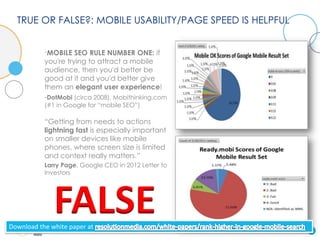
TRUE OR FALSE?: MOBILE USABILITY/PAGE SPEED IS HELPFUL


           “MOBILE   SEO RULE NUMBER ONE: if
           you're trying to attract a mobile
           audience, then you'd better be
           good at it and you'd better give
           them an elegant user experience!
           -DotMobi (circa 2008), Mobithinking.com
           (#1 in Google for “mobile SEO”)

           “Getting from needs to actions
           lightning fast is especially important
           on smaller devices like mobile
           phones, where screen size is limited
           and context really matters.”
           Larry Page, Google CEO in 2012 Letter to
           Investors


              FALSE
Download the white paper at                                13
TRUE OR FALSE?: LINKBUILDING IS UNNECESSARY

           “But  right now, partly because of the
           relative lack of competition and
           partly because as I explained
           above, the link graph makes less
           sense for mobile sites and users, links
           are not needed for (at least
           some) mobile rankings.
           -Will Critchlow (circa 2008), SEOMoz.org


              FALSE
Download the white paper at                           14
TRUE OR FALSE?: DOTMOBI HELPS

           “The best way to build your mobile
           web site for SEO is by using the
           dotMobi domain”
           -DotMobi (circa 2008), Mobithinking.com
           (#1 in Google for “mobile SEO”)


              FALSE
Download the white paper at                          15
TRUE OR FALSE?: MOBILE SITES HELP RANKING

           “The best Mobile SEO strategy is to
           not have a mobile SEO strategy.”
           -Ryan Jones (circa
           2011), SearchEngineJournal.com (#3 in
           Google for “mobile SEO”)


           “Having a mobile site is strongly
           correlated with top three rankings in
           Google smartphone search”
           -Bryson Meunier (circa
           2012), SearchEngineLand.com


               TRUE
Download the white paper at                        16
HOW DO TOP SITES APPROACH MOBILE SEO?

    • Looked at mobile SEO redirect strategies of top 100 sites that get
      most overall organic search traffic


                                                                           17
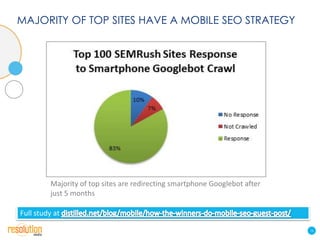
MAJORITY OF TOP SITES HAVE A MOBILE SEO STRATEGY


          Majority of top sites are redirecting smartphone Googlebot after
          just 5 months

Full study at

                                                                             18
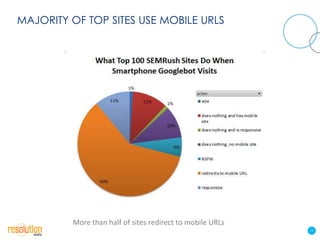
MAJORITY OF TOP SITES USE MOBILE URLS


         More than half of sites redirect to mobile URLs
                                                           19
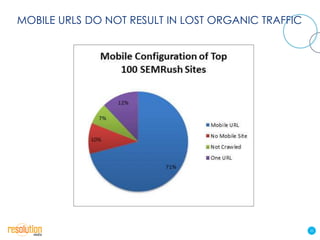
MOBILE URLS DO NOT RESULT IN LOST ORGANIC TRAFFIC


                                                    20
DATA-DRIVEN MOBILE SEO BEST PRACTICES

     1. Understand the differences between what your mobile user
        expects and what your desktop user expects and build your
        mobile site accordingly
     2. Build a mobile home page at m.domain.com that addresses the
        mobile user’s goals with link to full site and responsive duplicate
        pages OR build a mobile first responsive design driven site if goals
        are same.
     3. Do not block your mobile URLs with robots.txt. Use canonical tags
        for duplicate URLs and redirect smartphone URLs to smartphone
        Googlebot but make mobile homepage unique to appear for
        mobile navigational searches (i.e. [brand + “mobile site”])
     4. Market your mobile site externally in print and broadcast
        advertising and online. Links, authority and social shares still matter
        in mobile.
     5. Don’t believe everything you read. Many consultants are applying
        traditional SEO best practices to mobile, which doesn’t always
        translate. Trust but verify.

   For 25 more visit

                                                                                  21
THANK YOU!

    Bryson Meunier
    Director, Content Solutions
    Resolution Media
    bmeunier@resolutionmedia.com
    http://www.brysonmeunier.com
    http://www.resolutionmedia.com
    @brysonmeunier
    +Bryson Meunier

                                     Scan to visit
                                     m.brysonmeunier.com

iSEO Doing Mobile Search Optimization Right

  • 2.
    ISEO: MOBILE SEARCHENGINE OPTIMIZATION DONE RIGHT Data-driven Mobile SEO for Smartphones Bryson Meunier Director, Content Solutions Resolution Media @brysonmeunier +Bryson Meunier
  • 3.
    MOBILE SEARCH OPTIMIZATIONCRITICAL • Differences in smartphone ranking • Differences in mobile search engagement: “A drop from first to fourth position on mobile phone can mean a CTR drop off of more than 90%.” Google, Winning the Zero Moment of Truth • Mobile Search Traffic to eclipse desktop search traffic in years, not decades 2
  • 4.
    MANY PATHS TOMOBILE OPTIMIZATION Smartphone Tablet One optimized? optimized? URL Mobile Content and Keywords? Mobile Site? Feature phone optimized? Mobile URL Site that works Same well on all Content and devices? Keywords? 3
  • 5.
    APPARENT DISAGREEMENTS WITHINGOOGLE Matt Cutts recommends mobile URLs and says mobile sites don’t cause canonicalization issues if redirected in Februray 2011 Google Webmaster Team selects responsive design for “maintainability” in May 2012 blog post 4
  • 6.
    DATA TO THERESCUE Mobile Mobile Smartphone Search Search Search Strategies of Queries Results Top Sites 5
  • 7.
    KEYWORD AND CONCEPTRESEARCH CRITICAL TO SEO • “Think about the words users would type to find your pages, and make sure that your site actually includes those words within it.” • Design and Content Guidelines, Google Webmaster Guidelines • “Anticipating these differences in search behavior and accounting for them while writing your content (using a good mix of keyword phrases) could produce positive results” • “Designing your site around your visitors' needs while making sure your site is easily accessible to search engines usually produces positive results.” • Google SEO Starter Guide 6
  • 8.
    GOOGLE QUERIES REVEALDIFFERENCES IN SEARCH BEHAVIOR • Analyzed mobile and desktop volumes for top keywords according to Adwords Keyword Tool and Google Insights for Search • Mobile Search accounts for 22% of all Google searches on average according to sample 7
  • 9.
    GOOGLE QUERIES REVEALDIFFERENCES IN SEARCH BEHAVIOR • Same Keywords, Different Frequencies Internet & Telecom Finance Dining and Nightlife • 77% of total • 88% of • 69% of [apps search volume searches for for android] for [atm] and [restaurants], and 73% of 99% of volume 97% of [download from [atm searches for ringtones] locations] [bars] and 80% searches come comes from of searches for from mobile mobile devices [restaurants devices near me] come from mobile devices 8
  • 10.
    DIFFERENT SEARCH BEHAVIORREQUIRES DIFFERENT CONTENT TO ACHIEVE SEARCHER GOALS QUICKLY 9
  • 11.
    SOME CATEGORIES NEEDDEDICATED MOBILE SITES 10
  • 12.
    WHAT CONTENT APPEARSIN SMARTPHONE SEARCH RESULTS? • Tested mobile SEO best practices by examining 37 different ranking factors of top three sites appearing for 11 competitive mobile searches across different categories. • Ranking factors include • Code validation • Mobile usability and page speed • On-page factors • Engagement data • Site Authority • Data pulled manually on one day in December 2010, May 2011 and May 2012 (post Skip Redirect/Old Possum) Download the white paper at 11
  • 13.
    TRUE OR FALSE?:VALIDATION IS KEY “Use100% valid XHTML 1.0 code. […] Many optimizers on the traditional WWW do not consider using valid code as a best practice. Mobile search engines however may have more trouble digesting invalid code.” -Andy Hagans, (circa 2005) MobileSearchMarketing.com (#4 in Google for “mobile SEO”) FALSE Download the white paper at 12
  • 14.
    TRUE OR FALSE?:MOBILE USABILITY/PAGE SPEED IS HELPFUL “MOBILE SEO RULE NUMBER ONE: if you're trying to attract a mobile audience, then you'd better be good at it and you'd better give them an elegant user experience! -DotMobi (circa 2008), Mobithinking.com (#1 in Google for “mobile SEO”) “Getting from needs to actions lightning fast is especially important on smaller devices like mobile phones, where screen size is limited and context really matters.” Larry Page, Google CEO in 2012 Letter to Investors FALSE Download the white paper at 13
  • 15.
    TRUE OR FALSE?:LINKBUILDING IS UNNECESSARY “But right now, partly because of the relative lack of competition and partly because as I explained above, the link graph makes less sense for mobile sites and users, links are not needed for (at least some) mobile rankings. -Will Critchlow (circa 2008), SEOMoz.org FALSE Download the white paper at 14
  • 16.
    TRUE OR FALSE?:DOTMOBI HELPS “The best way to build your mobile web site for SEO is by using the dotMobi domain” -DotMobi (circa 2008), Mobithinking.com (#1 in Google for “mobile SEO”) FALSE Download the white paper at 15
  • 17.
    TRUE OR FALSE?:MOBILE SITES HELP RANKING “The best Mobile SEO strategy is to not have a mobile SEO strategy.” -Ryan Jones (circa 2011), SearchEngineJournal.com (#3 in Google for “mobile SEO”) “Having a mobile site is strongly correlated with top three rankings in Google smartphone search” -Bryson Meunier (circa 2012), SearchEngineLand.com TRUE Download the white paper at 16
  • 18.
    HOW DO TOPSITES APPROACH MOBILE SEO? • Looked at mobile SEO redirect strategies of top 100 sites that get most overall organic search traffic 17
  • 19.
    MAJORITY OF TOPSITES HAVE A MOBILE SEO STRATEGY Majority of top sites are redirecting smartphone Googlebot after just 5 months Full study at 18
  • 20.
    MAJORITY OF TOPSITES USE MOBILE URLS More than half of sites redirect to mobile URLs 19
  • 21.
    MOBILE URLS DONOT RESULT IN LOST ORGANIC TRAFFIC 20
  • 22.
    DATA-DRIVEN MOBILE SEOBEST PRACTICES 1. Understand the differences between what your mobile user expects and what your desktop user expects and build your mobile site accordingly 2. Build a mobile home page at m.domain.com that addresses the mobile user’s goals with link to full site and responsive duplicate pages OR build a mobile first responsive design driven site if goals are same. 3. Do not block your mobile URLs with robots.txt. Use canonical tags for duplicate URLs and redirect smartphone URLs to smartphone Googlebot but make mobile homepage unique to appear for mobile navigational searches (i.e. [brand + “mobile site”]) 4. Market your mobile site externally in print and broadcast advertising and online. Links, authority and social shares still matter in mobile. 5. Don’t believe everything you read. Many consultants are applying traditional SEO best practices to mobile, which doesn’t always translate. Trust but verify. For 25 more visit 21
  • 23.
    THANK YOU! Bryson Meunier Director, Content Solutions Resolution Media bmeunier@resolutionmedia.com http://www.brysonmeunier.com http://www.resolutionmedia.com @brysonmeunier +Bryson Meunier Scan to visit m.brysonmeunier.com

Editor's Notes

  • #3 Thanks, Barry, and thank you to my fellow panelists. I got into mobile SEO after watching Cindy at SES in 2006 or 7, so it’s an honor to be speaking again here today with her. And I know that a lot of us are looking forward to Pierre Far’s clarification around Skip Redirect/Old Possum and a number of issues that arise with mobile SEO. And of course, thank you Barry for having me on the panel even though you’re an advocate for responsive design. I officially take back what I said about your journalistic integrity. Today I’m going to talk about what data can teach us about mobile SEO for smartphones.
  • #4 My assumption is that all of you understand the opportunity, but since some of you may be advanced in many aspects but somewhat new to mobile SEO, know that there are many good reasons to pay attention to mobile search. This is a Mary Meeker slide from AllThingsD that shows mobile internet vs desktop internet in India today, and given the growth of the space, it’s likely that this phenomenon will occur in the United States in a few short years. There are also differences with ranking and engagement in mobile search that SEOs need to be aware of, because just paying attention to core search is not enough. Hopefully this advanced audience understands that better than most, so I’ll move on.
  • #5 If you’ve done any reading about mobile search, you know the issues that arise and how difficult it is to get a consensus, even among experts in the space. Some of the issues you see: one URL or mobile URLs for your mobile site? Do you need a mobile site at all, or one that just works well on multiple devices? If a mobile site, should you have three mobile sites optimized for all types of devices? Or more? And is it enough to just reformat your desktop site with the same content, or is it better to use mobile keywords and concepts on your mobile site? Is there really any difference between the two?
  • #6 And unfortunately Google hasn’t been all that helpful to date, as they’ve taken different positions at different times and muddied the waters. For example, Matt Cutts said in February 2011 that mobile URLs are better, and the Google Mobile (not mobile ads) Playbook from May 2012 says “Your #1 priority is to build a mobile web site”. But just last month the Google Webmaster Team wrote about how they prefer responsive design (one URL) for maintanability purposes. So is it better to use one or the other? Honestly sometimes it depends on who you ask. Hopefully we can get a clearer answer from Mr Far today, but I think we can also learn a lot from the data.
  • #7 In order to get a more accurate picture of what’s helpful for mobile SEO today, we looked examined three separate data sources. First we looked at mobile search queries and compared them with desktop search queries to see if mobile search behavior is in fact different from desktop search behavior, and how. Then we looked at characteristices of the smartphone search results to gauge which ranking factors were most important.Finally we crawled the top 100 SEMRush sites as smartphone Googlebot to see what the leaders are up to when it comes to mobile SEO. What we found is much different generally than what you may have read.
  • #8 It seems Google and the SEO community are in agreement that keyword and concept research are important for SEO, and that you need to include keywords your audience is looking for on your desktop web site. But how does that change, if at all, when the audience is not searching from a desktop computer or laptop, but from a smartphone on the go? Does the keyword usage on the desktop web site still apply to the queries users are typing or speaking on a smartphone?
  • #9 In many cases queries are the same, but in others there are important differences. To find those differences we took a sample of 24k keywords from the Google keyword tool (supplemented with high volume keywords in each category from Google Insights for Search) and measured mobile volume, desktop volume and the mobile % of the total volume. When we did we ended up with a large spreadsheet populated with categorized keywords that looked like this for each category.
  • #10 Overall what we found is that mobile searchers are often using the same keywords, but the frequencies are often wildly different. For example, in the finance category, 77% of the search volume for [atm] and 99% of the volume from [atm locations] comes from mobile devices. Likewise, according to Google volume estimates, 88% of searches for [restaurants] and 97% of searches for [bars] come from mobile devices. And in the Internet & Telecom category, 69% of the volume for [apps for android] and 73% of the volume for [download ringtones] come from mobile devices. So what does this mean for marketers?
  • #11 Well, if you know that your desktop searcher has different goals than your mobile searcher, you want to provide them an experience that will allow them to easily meet those goals.Here you can see Arby’s has a mobile site that’s strictly focused on providing the location of the nearest Arby’s, because that’s what restaurant searchers are looking for primarily, as you can see from the word clouds representing search behavior in the restaurant category above each site. Arby’s still has a link to their full site on their mobile site, and if they’re smart they’ll also make their desktop pages responsive so that those who find them through search engines won’t have a bad experience; but because they know that their mobile searcher has different goals, they’re serving a mobile site on an m dot subdomain with the content that the majority of their users need instead of providing printable coupons and job applications and other things mobile searchers don’t need on the homepage of their site.
  • #12 So that’s Arby’s and most local businesses, especially in the dining and nightlife category; but how do you know if your business needs a dedicated or responsive mobile site? The best way for business and for your users is to listen to what your users want, and do keyword research to discover what your audience is looking for using metrics like mobile % of total, and then give them the experience that most of them want. If you are lazy, or you don’t have time to do the work, you can get a good sense of what your audience might be looking for by looking at this category breakdown. Based on mobile variance, the dining and nightlife category is most likely to need a dedicated mobile site, followed by retailers and general merchandise, etc. If you have a real estate site, however, your mobile audience is mostly looking for what your desktop audience is looking for, so a responsive site makes sense.
  • #13 So that’s queries, but what can we learn from smartphone search results?Next we looked at the smartphone search results themselves to get a better sense of what attributes the sample set had.
  • #14 For example, the #4 result in Google currently for [mobile SEO] doesn’t say much, but lists validation and code type as important for mobile SEO. However, only one of the sites in our sample was valid code, and it was actually HTML4, not XHTML 1.0. When we looked at the most common code types in Google smartphone search, we found that they closely resemble code types across the web in general.
  • #15 The number one result for [mobile seo] says that you need to give a mobile searcher an elegant user experience, or else you won’t get traffic from mobile search. Similarly, Larry Page said page speed and context are especially important for mobile search. It would seem, then, that mobile usability is critical when doing mobile SEO.However, the fact of the matter is that by mobile usability standards, Google smartphone results are basically unusable. 65% of our sample failed the W3C’s mobile OK test, which includes page speed, and 78% of the listings failed the dotMobi Ready.mobi mobile usability test. It may help in general to have an elegant user experience for mobile searchers, but Google isn’t there yet according to our sample.
  • #16 In the past it’s been mentioned on SEOMoz that links aren’t a ranking factor for mobile search. That may have been the case then, but based on our sample, it’s not the case now. All listings had some links pointing to them, and most of them had more than 100 links and linking root domains. If you want to compete in mobile search today, you have to think about link equity to your mobile and your desktop site.
  • #17 This one has been out there since 2005 when dotMobi introduced their mobile top level domains. If you’re still on the fence about whether you should use a mobile domain or a subdomain option, there’s really no SEO reason to use dotMobi over any other domain or subdomain combination. DotMobi claims that their domain helps with indexing, but our sample showed that no dotMobis were ranking for our sample of competitive terms, and when we looked at indexing a year ago, m.*.com had 11.5 million pages indexed to dotMobi’s 226k, making the zone files indexing explanation pretty weak.
  • #18 Finally, this is something that you might not have heard, as there are plenty of people in our industry who believe that having a mobile web site is a waste of time and resources. Ryan Jones wrote in SearchEngineJournal.com that the best mobile SEO strategy is not to have a mobile SEO strategy. Our sample showed, however, that the number of sites that offered mobile content was much higher at 64% than Google’s largest advertiser sample at 29%. However, some sites are still missing out, as 65% of the sample did not redirect or reformat for mobile users, even though 65% of the sample had mobile content.
  • #19 Finally we looked at the mobile configuration strategies of the top 100 sites according to Google organic traffic via SEMRush. You can see the top 10 here are sites you probably know, and have found in a search engine. What’s popular is not always right, but if we saw that these sites that get a lot of organic traffic use one method or the other primarily, it could validate that method for mobile SEO.
  • #20 What we did was visit each site in a browser as smartphone Googlebot to see what each site did. We were surprised to see that only 10% of the sites crawled did nothing for smartphone Googlebot. A full 83% either redirected or reformatted content for smartphones. This was surprising because all of these sites get a lot of traffic, and some of them are enterprise sites without SEOs or with IT roadblocks that make implementation difficult, even for simple changes like this. It shows to us that these sites have prioritized smartphone searchers enough to make this simple fix. Out of curiosity how many of you are redirecting or reformatting when smartphone Googlebot visits?
  • #21 In terms of specifically how the sites responded to smartphone Googlebot’s request, the great majority of them (60%) redirected to a mobile URL, while 11% made their sites responsive. Overall we thought this demonstrated that smartphone Googlebot really can handle any type of mobile configuration, and that you should do what you think is best for your users, rather than what you think is best for SEO. Also, we noticed that 12% of the sites that we crawled offered mobile content but did nothing for smartphone Googlebot, which demonstrates that even the sites that get the most traffic from Google have the potential to get even more traffic from mobile devices.
  • #22 Finally, I think it’s time to put this notion that all mobile URLs split link equity and make a site less competitive to bed. These are, after all, the sites that get the most organic traffic from Google, and the great majority of them use mobile URLs. If lost link equity due to mobile URLs was really an issue for mobile SEO, we would see more responsive sites than this on the leaderboard.
  • #23 I know I’ve given you a lot in these 20 minutes and you may not remember all of it tomorrow. Of course this presentation will be available online, but if you just remember five things about mobile SEO, it should be these.
  • #24 Thanks. I hope this was interesting and educational. If you have any questions, you can contact me here, and I look forward to more discussion at the end of the presentations. Thanks!