Bizer: Is the Semantic Web what we Expected? ISWC 2016, 10/20/2016 Slide 1
15th International Semantic Web Conference (ISWC 2016)
Kobe, Japan, 10/20/2016
Is the Semantic Web what we Expected?
Deployment Patterns and Data-driven Challenges
Prof. Dr. Christian Bizer
Bizer: Is the Semantic Web what we Expected? ISWC 2016, 10/20/2016 Slide 2
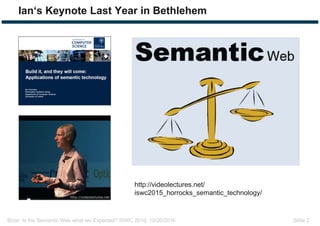
Ian‘s Keynote Last Year in Bethlehem
http://videolectures.net/
iswc2015_horrocks_semantic_technology/
Bizer: Is the Semantic Web what we Expected? ISWC 2016, 10/20/2016 Slide 3
This Year
Use cases
 on the public Web
 many data sources
 no central control
Bizer: Is the Semantic Web what we Expected? ISWC 2016, 10/20/2016 Slide 4
Outline
1. What did we expect the Semantic Web to be?
2. What does the Semantic Web actually look like?
1. Linked Data
2. HTML-embedded Data
3. Why is this the case?
4. What does this mean for Semantic Web applications?
Bizer: Is the Semantic Web what we Expected? ISWC 2016, 10/20/2016 Slide 5
1. What did we expect the Semantic Web to be?
Bizer: Is the Semantic Web what we Expected? ISWC 2016, 10/20/2016 Slide 6
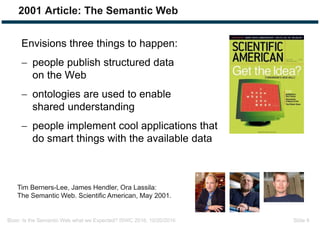
2001 Article: The Semantic Web
Envisions three things to happen:
 people publish structured data
on the Web
 ontologies are used to enable
shared understanding
 people implement cool applications that
do smart things with the available data
Tim Berners-Lee, James Hendler, Ora Lassila:
The Semantic Web. Scientific American, May 2001.
Bizer: Is the Semantic Web what we Expected? ISWC 2016, 10/20/2016 Slide 7
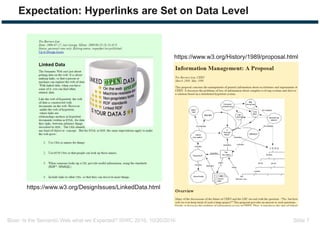
Expectation: Hyperlinks are Set on Data Level
https://www.w3.org/History/1989/proposal.html
https://www.w3.org/DesignIssues/LinkedData.html
Bizer: Is the Semantic Web what we Expected? ISWC 2016, 10/20/2016 Slide 8
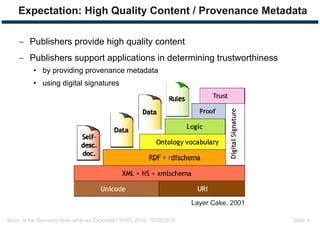
Expectation: High Quality Content / Provenance Metadata
 Publishers provide high quality content
 Publishers support applications in determining trustworthiness
• by providing provenance metadata
• using digital signatures
Layer Cake, 2001
Bizer: Is the Semantic Web what we Expected? ISWC 2016, 10/20/2016 Slide 9
Check List: Our Expectations about the Semantic Web
1. People publish structured data on the Web
2. Ontologies are used to enable shared understanding
3. Hyperlinks are set on data level
4. People publish high quality content / metadata
5. Cool applications do smart things with the data
Bizer: Is the Semantic Web what we Expected? ISWC 2016, 10/20/2016 Slide 10
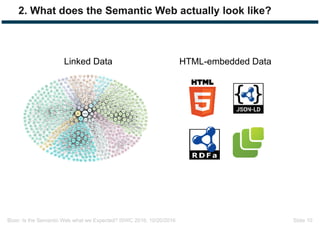
2. What does the Semantic Web actually look like?
Linked Data HTML-embedded Data
Bizer: Is the Semantic Web what we Expected? ISWC 2016, 10/20/2016 Slide 11
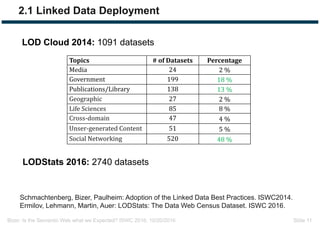
2.1 Linked Data Deployment
Schmachtenberg, Bizer, Paulheim: Adoption of the Linked Data Best Practices. ISWC2014.
Ermilov, Lehmann, Martin, Auer: LODStats: The Data Web Census Dataset. ISWC 2016.
Topics # of Datasets Percentage
Media 24 2	%
Government 199 18	%
Publications/Library 138 13	%
Geographic 27 2	%
Life	Sciences 85 8	%
Cross‐domain 47 4	%
Unser‐generated Content 51 5	%
Social Networking 520 48	%
LODStats 2016: 2740 datasets
LOD Cloud 2014: 1091 datasets
Bizer: Is the Semantic Web what we Expected? ISWC 2016, 10/20/2016 Slide 12
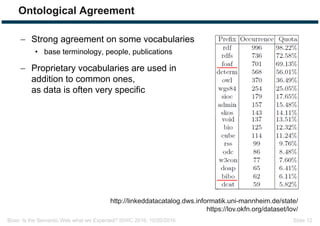
Ontological Agreement
 Strong agreement on some vocabularies
• base terminology, people, publications
 Proprietary vocabularies are used in
addition to common ones,
as data is often very specific
http://linkeddatacatalog.dws.informatik.uni-mannheim.de/state/
https://lov.okfn.org/dataset/lov/
Bizer: Is the Semantic Web what we Expected? ISWC 2016, 10/20/2016 Slide 13
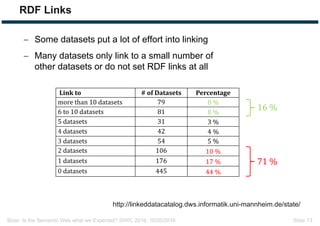
 Some datasets put a lot of effort into linking
 Many datasets only link to a small number of
other datasets or do not set RDF links at all
RDF Links
Link	to # of Datasets Percentage
more than 10	datasets 79 8	%
6	to	10	datasets 81 8	%
5	datasets 31 3	%
4	datasets 42 4	%
3	datasets 54 5	%
2	datasets 106 10	%
1	datasets 176 17	%
0	datasets 445 44	%
http://linkeddatacatalog.dws.informatik.uni-mannheim.de/state/
71	%
16	%
Bizer: Is the Semantic Web what we Expected? ISWC 2016, 10/20/2016 Slide 14
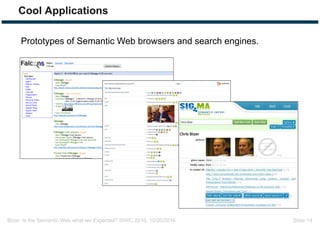
Cool Applications
Prototypes of Semantic Web browsers and search engines.
Bizer: Is the Semantic Web what we Expected? ISWC 2016, 10/20/2016 Slide 15
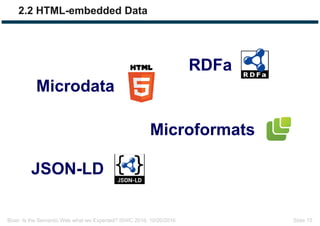
2.2 HTML-embedded Data
Microformats
Microdata
RDFa
JSON-LD
Bizer: Is the Semantic Web what we Expected? ISWC 2016, 10/20/2016 Slide 16
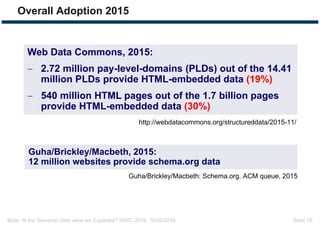
Overall Adoption 2015
Web Data Commons, 2015:
 2.72 million pay-level-domains (PLDs) out of the 14.41
million PLDs provide HTML-embedded data (19%)
 540 million HTML pages out of the 1.7 billion pages
provide HTML-embedded data (30%)
Guha/Brickley/Macbeth, 2015:
12 million websites provide schema.org data
Guha/Brickley/Macbeth: Schema.org. ACM queue, 2015
http://webdatacommons.org/structureddata/2015-11/
Bizer: Is the Semantic Web what we Expected? ISWC 2016, 10/20/2016 Slide 17
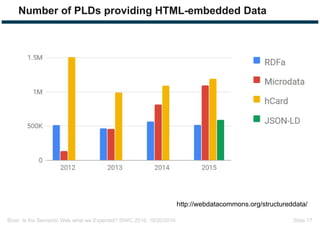
Number of PLDs providing HTML-embedded Data
http://webdatacommons.org/structureddata/
Bizer: Is the Semantic Web what we Expected? ISWC 2016, 10/20/2016 Slide 18
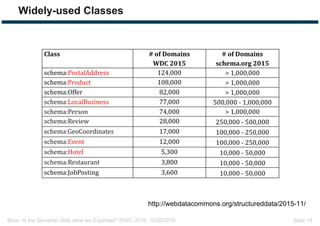
Widely-used Classes
Class # of Domains
WDC	2015
# of Domains
schema.org	2015
schema:PostalAddress 124,000 >	1,000,000
schema:Product 108,000 >	1,000,000
schema:Offer 82,000 >	1,000,000
schema:LocalBusiness 77,000 500,000	‐ 1,000,000
schema:Person 74,000 >	1,000,000
schema:Review 28,000 250,000	‐ 500,000
schema:GeoCoordinates 17,000 100,000	‐ 250,000
schema:Event 12,000 100,000	‐ 250,000
schema:Hotel 5,300 10,000	‐ 50,000
schema:Restaurant 3,800 10,000	‐ 50,000
schema:JobPosting 3,600 10,000	‐ 50,000
http://webdatacommons.org/structureddata/2015-11/
Bizer: Is the Semantic Web what we Expected? ISWC 2016, 10/20/2016 Slide 19
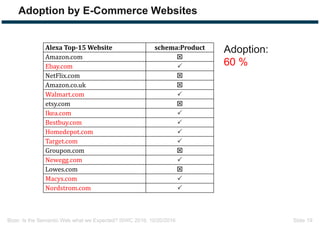
Adoption by E-Commerce Websites
Alexa	Top‐15	Website schema:Product
Amazon.com 
Ebay.com 
NetFlix.com 
Amazon.co.uk 
Walmart.com 
etsy.com 
Ikea.com 
Bestbuy.com 
Homedepot.com 
Target.com 
Groupon.com 
Newegg.com 
Lowes.com 
Macys.com 
Nordstrom.com 
Adoption:
60 %
Bizer: Is the Semantic Web what we Expected? ISWC 2016, 10/20/2016 Slide 20
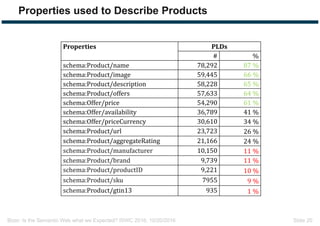
Properties used to Describe Products
Properties PLDs
# %
schema:Product/name 78,292 87	%
schema:Product/image 59,445 66	%
schema:Product/description 58,228 65	%
schema:Product/offers 57,633 64	%
schema:Offer/price 54,290 61	%
schema:Offer/availability 36,789 41	%
schema:Offer/priceCurrency 30,610 34	%
schema:Product/url 23,723 26	%
schema:Product/aggregateRating 21,166 24	%
schema:Product/manufacturer 10,150 11	%
schema:Product/brand 9,739 11	%
schema:Product/productID 9,221 10	%
schema:Product/sku 7955 9	%
schema:Product/gtin13 935 1	%
Bizer: Is the Semantic Web what we Expected? ISWC 2016, 10/20/2016 Slide 21
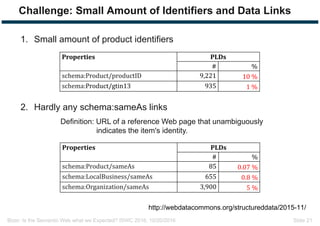
Challenge: Small Amount of Identifiers and Data Links
1. Small amount of product identifiers
2. Hardly any schema:sameAs links
Definition: URL of a reference Web page that unambiguously
indicates the item's identity.
Properties PLDs
# %
schema:Product/sameAs 85 0.07	%
schema:LocalBusiness/sameAs 655 0.8	%
schema:Organization/sameAs 3,900 5	%
Properties PLDs
# %
schema:Product/productID 9,221 10	%
schema:Product/gtin13 935 1	%
http://webdatacommons.org/structureddata/2015-11/
Bizer: Is the Semantic Web what we Expected? ISWC 2016, 10/20/2016 Slide 22
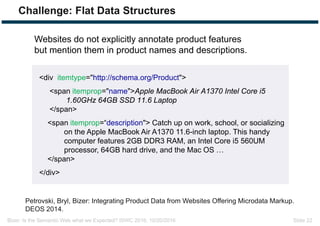
Challenge: Flat Data Structures
Websites do not explicitly annotate product features
but mention them in product names and descriptions.
<div itemtype="http://schema.org/Product">
<span itemprop="name">Apple MacBook Air A1370 Intel Core i5
1.60GHz 64GB SSD 11.6 Laptop
</span>
<span itemprop=“description"> Catch up on work, school, or socializing
on the Apple MacBook Air A1370 11.6-inch laptop. This handy
computer features 2GB DDR3 RAM, an Intel Core i5 560UM
processor, 64GB hard drive, and the Mac OS …
</span>
</div>
Petrovski, Bryl, Bizer: Integrating Product Data from Websites Offering Microdata Markup.
DEOS 2014.
Bizer: Is the Semantic Web what we Expected? ISWC 2016, 10/20/2016 Slide 23
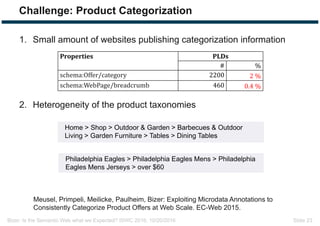
Challenge: Product Categorization
1. Small amount of websites publishing categorization information
2. Heterogeneity of the product taxonomies
Properties PLDs
# %
schema:Offer/category 2200 2	%
schema:WebPage/breadcrumb 460	 0.4	%
Home > Shop > Outdoor & Garden > Barbecues & Outdoor
Living > Garden Furniture > Tables > Dining Tables
Philadelphia Eagles > Philadelphia Eagles Mens > Philadelphia
Eagles Mens Jerseys > over $60
Meusel, Primpeli, Meilicke, Paulheim, Bizer: Exploiting Microdata Annotations to
Consistently Categorize Product Offers at Web Scale. EC-Web 2015.
Bizer: Is the Semantic Web what we Expected? ISWC 2016, 10/20/2016 Slide 24
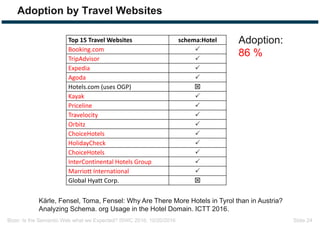
Adoption by Travel Websites
Top 15 Travel Websites schema:Hotel
Booking.com 
TripAdvisor 
Expedia 
Agoda 
Hotels.com (uses OGP) 
Kayak 
Priceline 
Travelocity 
Orbitz 
ChoiceHotels 
HolidayCheck 
ChoiceHotels 
InterContinental Hotels Group 
Marriott International 
Global Hyatt Corp. 
Adoption:
86 %
Kärle, Fensel, Toma, Fensel: Why Are There More Hotels in Tyrol than in Austria?
Analyzing Schema. org Usage in the Hotel Domain. ICTT 2016.
Bizer: Is the Semantic Web what we Expected? ISWC 2016, 10/20/2016 Slide 25
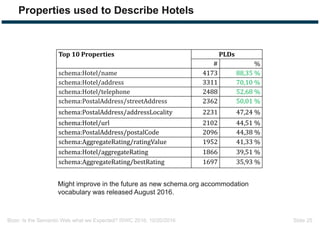
Properties used to Describe Hotels
Top	10	Properties PLDs
# %
schema:Hotel/name 4173 88,35	%
schema:Hotel/address 3311 70,10	%
schema:Hotel/telephone 2488 52,68	%
schema:PostalAddress/streetAddress 2362 50,01	%
schema:PostalAddress/addressLocality 2231 47,24	%
schema:Hotel/url 2102 44,51	%
schema:PostalAddress/postalCode 2096 44,38	%
schema:AggregateRating/ratingValue 1952 41,33	%
schema:Hotel/aggregateRating 1866 39,51	%
schema:AggregateRating/bestRating 1697 35,93	%
Might improve in the future as new schema.org accommodation
vocabulary was released August 2016.
Bizer: Is the Semantic Web what we Expected? ISWC 2016, 10/20/2016 Slide 26
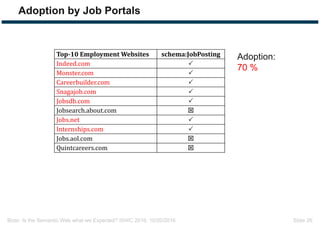
Adoption by Job Portals
Adoption:
70 %
Top‐10	Employment	Websites schema:JobPosting
Indeed.com 
Monster.com 
Careerbuilder.com 
Snagajob.com 
Jobsdb.com 
Jobsearch.about.com 
Jobs.net 
Internships.com 
Jobs.aol.com 
Quintcareers.com 
Bizer: Is the Semantic Web what we Expected? ISWC 2016, 10/20/2016 Slide 27
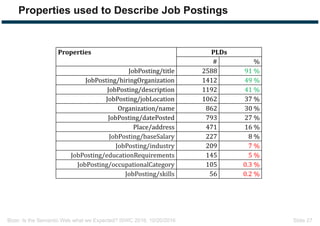
Properties used to Describe Job Postings
Properties PLDs
# %
JobPosting/title 2588 91	%
JobPosting/hiringOrganization 1412 49	%
JobPosting/description 1192 41	%
JobPosting/jobLocation 1062 37	%
Organization/name 862 30	%
JobPosting/datePosted 793 27	%
Place/address 471 16	%
JobPosting/baseSalary 227 8	%
JobPosting/industry 209 7	%
JobPosting/educationRequirements 145 5	%
JobPosting/occupationalCategory 105 0.3	%
JobPosting/skills 56 0.2	%
Bizer: Is the Semantic Web what we Expected? ISWC 2016, 10/20/2016 Slide 28
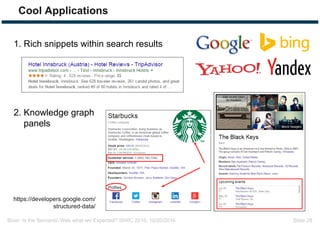
Cool Applications
1. Rich snippets within search results
2. Knowledge graph
panels
https://developers.google.com/
structured-data/
Bizer: Is the Semantic Web what we Expected? ISWC 2016, 10/20/2016 Slide 29
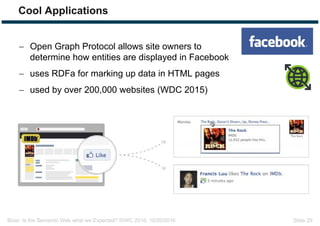
Cool Applications
 Open Graph Protocol allows site owners to
determine how entities are displayed in Facebook
 uses RDFa for marking up data in HTML pages
 used by over 200,000 websites (WDC 2015)
Bizer: Is the Semantic Web what we Expected? ISWC 2016, 10/20/2016 Slide 30
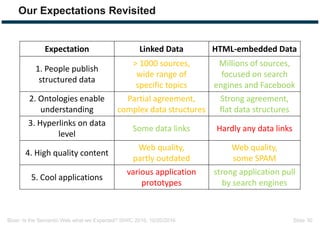
Our Expectations Revisited
Expectation Linked Data HTML‐embedded Data
1. People publish 
structured data
> 1000 sources,
wide range of 
specific topics
Millions of sources,
focused on search 
engines and Facebook
2. Ontologies enable 
understanding
Partial agreement,
complex data structures
Strong agreement,
flat data structures
3. Hyperlinks on data
level
Some data links Hardly any data links
4. High quality content
Web quality, 
partly outdated
Web quality, 
some SPAM
5. Cool applications
various application 
prototypes
strong application pull 
by search engines
Bizer: Is the Semantic Web what we Expected? ISWC 2016, 10/20/2016 Slide 31
3. Why is this the Case?
Expectation Linked Data HTML‐embedded Data
1. People publish 
structured data
> 1000 sources,
wide range of 
specific topics
Millions of sources,
focused on search 
engines and Facebook
2. Ontologies enable 
understanding
Partial agreement,
complex data structures
Strong agreement,
flat data structures
3. Hyperlinks on data
level
Some data links Hardly any data links
4. High quality content
Web quality, 
partly outdated
Web quality, 
some SPAM
5. Cool applications
various application 
prototypes
strong application pull 
by search engines
Bizer: Is the Semantic Web what we Expected? ISWC 2016, 10/20/2016 Slide 32
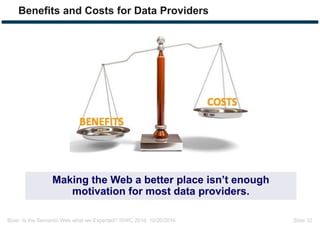
Benefits and Costs for Data Providers
Making the Web a better place isn’t enough
motivation for most data providers.
Bizer: Is the Semantic Web what we Expected? ISWC 2016, 10/20/2016 Slide 33
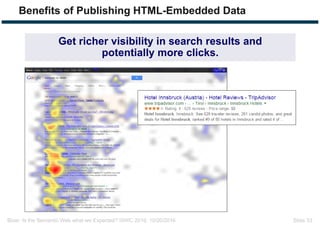
Benefits of Publishing HTML-Embedded Data
Get richer visibility in search results and
potentially more clicks.
Bizer: Is the Semantic Web what we Expected? ISWC 2016, 10/20/2016 Slide 34
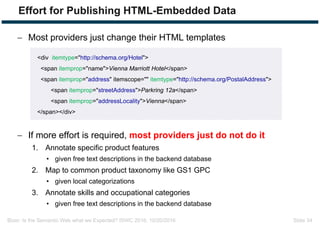
Effort for Publishing HTML-Embedded Data
 Most providers just change their HTML templates
 If more effort is required, most providers just do not do it
1. Annotate specific product features
• given free text descriptions in the backend database
2. Map to common product taxonomy like GS1 GPC
• given local categorizations
3. Annotate skills and occupational categories
• given free text descriptions in the backend database
<div itemtype="http://schema.org/Hotel">
<span itemprop="name">Vienna Marriott Hotel</span>
<span itemprop="address" itemscope="" itemtype="http://schema.org/PostalAddress">
<span itemprop="streetAddress">Parkring 12a</span>
<span itemprop="addressLocality">Vienna</span>
</span></div>
Bizer: Is the Semantic Web what we Expected? ISWC 2016, 10/20/2016 Slide 35
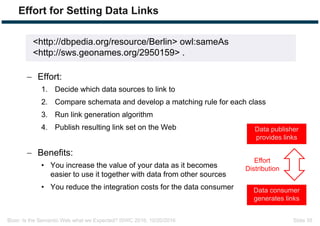
Effort for Setting Data Links
 Effort:
1. Decide which data sources to link to
2. Compare schemata and develop a matching rule for each class
3. Run link generation algorithm
4. Publish resulting link set on the Web
 Benefits:
• You increase the value of your data as it becomes
easier to use it together with data from other sources
• You reduce the integration costs for the data consumer
<http://dbpedia.org/resource/Berlin> owl:sameAs
<http://sws.geonames.org/2950159> .
Data publisher
provides links
Effort
Distribution
Data consumer
generates links
Bizer: Is the Semantic Web what we Expected? ISWC 2016, 10/20/2016 Slide 36
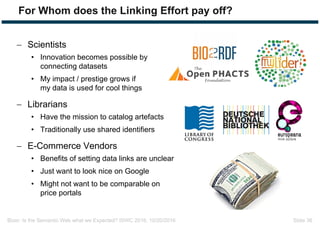
For Whom does the Linking Effort pay off?
 Scientists
• Innovation becomes possible by
connecting datasets
• My impact / prestige grows if
my data is used for cool things
 Librarians
• Have the mission to catalog artefacts
• Traditionally use shared identifiers
 E-Commerce Vendors
• Benefits of setting data links are unclear
• Just want to look nice on Google
• Might not want to be comparable on
price portals
Bizer: Is the Semantic Web what we Expected? ISWC 2016, 10/20/2016 Slide 37
Effort of Maintaining Links
 We want to be nice!
• we want to link to everybody
 We set instance- and schema-level links!
• created and collected 37 link sets
• over 20 million RDF links
• http://wiki.dbpedia.org/services-resources/interlinking
https://github.com/dbpedia/links
 We would likely need a full-time volunteer to maintain all these links
 Result: Many dead links
1. because target data source has changed
2. because we used bad linkage rules due to insufficient domain knowledge
Bizer: Is the Semantic Web what we Expected? ISWC 2016, 10/20/2016 Slide 38
Hypothesis
 Missing links and shared identifiers
 Flat data structures
 Heterogeneity of taxonomies
 Mixed data quality
We will keep on seeing similar adoption patterns,
as we need to be realistic about the effort
spent by data publishers
Bizer: Is the Semantic Web what we Expected? ISWC 2016, 10/20/2016 Slide 39
4. What does this mean for Semantic Web Applications?
Bizer: Is the Semantic Web what we Expected? ISWC 2016, 10/20/2016 Slide 40
Be happy about all semantic clues
(integration hints) provided
But do not expect the clues to be perfect
4. What does this mean for Semantic Web Applications?
Bizer: Is the Semantic Web what we Expected? ISWC 2016, 10/20/2016 Slide 41
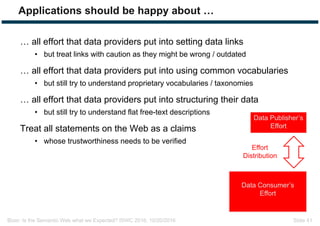
Applications should be happy about …
… all effort that data providers put into setting data links
• but treat links with caution as they might be wrong / outdated
… all effort that data providers put into using common vocabularies
• but still try to understand proprietary vocabularies / taxonomies
… all effort that data providers put into structuring their data
• but still try to understand flat free-text descriptions
Treat all statements on the Web as a claims
• whose trustworthiness needs to be verified
Data Publisher’s
Effort
Data Consumer’s
Effort
Effort
Distribution
Bizer: Is the Semantic Web what we Expected? ISWC 2016, 10/20/2016 Slide 42
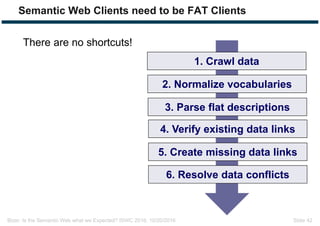
Semantic Web Clients need to be FAT Clients
There are no shortcuts!
1. Crawl data
2. Normalize vocabularies
6. Resolve data conflicts
3. Parse flat descriptions
4. Verify existing data links
5. Create missing data links
Bizer: Is the Semantic Web what we Expected? ISWC 2016, 10/20/2016 Slide 43
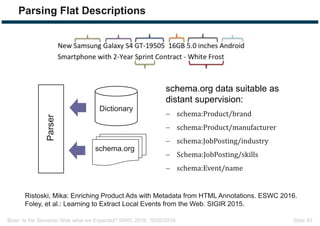
Parsing Flat Descriptions
Ristoski, Mika: Enriching Product Ads with Metadata from HTML Annotations. ESWC 2016.
Foley, et al.: Learning to Extract Local Events from the Web. SIGIR 2015.
Dictionary
Parser
schema.org
schema.org data suitable as
distant supervision:
 schema:Product/brand
 schema:Product/manufacturer
 schema:JobPosting/industry
 Schema:JobPosting/skills
 schema:Event/name
Bizer: Is the Semantic Web what we Expected? ISWC 2016, 10/20/2016 Slide 44
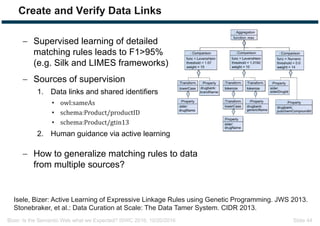
Create and Verify Data Links
 Supervised learning of detailed
matching rules leads to F1>95%
(e.g. Silk and LIMES frameworks)
 Sources of supervision
1. Data links and shared identifiers
• owl:sameAs
• schema:Product/productID
• schema:Product/gtin13
2. Human guidance via active learning
 How to generalize matching rules to data
from multiple sources?
Isele, Bizer: Active Learning of Expressive Linkage Rules using Genetic Programming. JWS 2013.
Stonebraker, et al.: Data Curation at Scale: The Data Tamer System. CIDR 2013.
Bizer: Is the Semantic Web what we Expected? ISWC 2016, 10/20/2016 Slide 45
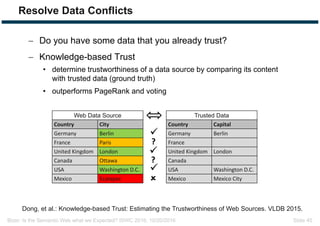
Resolve Data Conflicts
 Do you have some data that you already trust?
 Knowledge-based Trust
• determine trustworthiness of a data source by comparing its content
with trusted data (ground truth)
• outperforms PageRank and voting
Dong, et al.: Knowledge-based Trust: Estimating the Trustworthiness of Web Sources. VLDB 2015.
Web Data Source
Country City
Germany Berlin
France Paris
United Kingdom London
Canada Ottawa
USA Washington D.C.
Mexico Ecatepec




?
?
Trusted Data
Country Capital
Germany Berlin
France
United Kingdom London
Canada
USA Washington D.C.
Mexico Mexico City
Bizer: Is the Semantic Web what we Expected? ISWC 2016, 10/20/2016 Slide 46
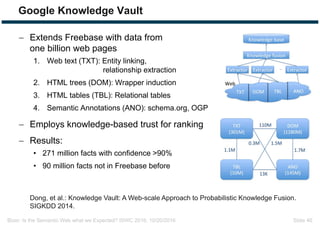
Google Knowledge Vault
 Extends Freebase with data from
one billion web pages
1. Web text (TXT): Entity linking,
relationship extraction
2. HTML trees (DOM): Wrapper induction
3. HTML tables (TBL): Relational tables
4. Semantic Annotations (ANO): schema.org, OGP
 Employs knowledge-based trust for ranking
 Results:
• 271 million facts with confidence >90%
• 90 million facts not in Freebase before
Dong, et al.: Knowledge Vault: A Web-scale Approach to Probabilistic Knowledge Fusion.
SIGKDD 2014.
Bizer: Is the Semantic Web what we Expected? ISWC 2016, 10/20/2016 Slide 47
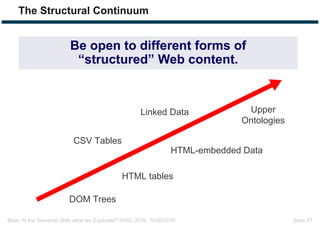
The Structural Continuum
Be open to different forms of
“structured” Web content.
HTML tables
DOM Trees
CSV Tables
HTML-embedded Data
Linked Data Upper
Ontologies
Bizer: Is the Semantic Web what we Expected? ISWC 2016, 10/20/2016 Slide 48
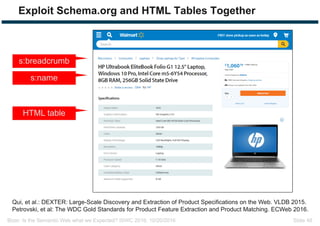
Exploit Schema.org and HTML Tables Together
Qui, et al.: DEXTER: Large-Scale Discovery and Extraction of Product Specifications on the Web. VLDB 2015.
Petrovski, et al: The WDC Gold Standards for Product Feature Extraction and Product Matching. ECWeb 2016.
s:name
HTML table
s:breadcrumb
Bizer: Is the Semantic Web what we Expected? ISWC 2016, 10/20/2016 Slide 49
Conclusions
Bizer: Is the Semantic Web what we Expected? ISWC 2016, 10/20/2016 Slide 50
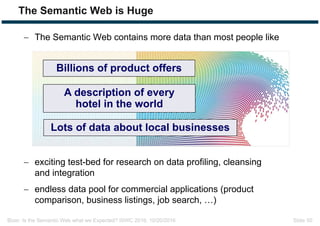
 The Semantic Web contains more data than most people like
 exciting test-bed for research on data profiling, cleansing
and integration
 endless data pool for commercial applications (product
comparison, business listings, job search, …)
The Semantic Web is Huge
Billions of product offers
A description of every
hotel in the world
Lots of data about local businesses
Bizer: Is the Semantic Web what we Expected? ISWC 2016, 10/20/2016 Slide 51
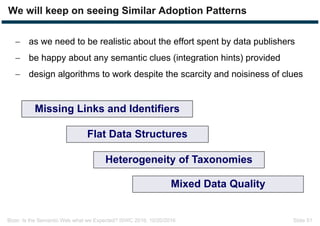
We will keep on seeing Similar Adoption Patterns
 as we need to be realistic about the effort spent by data publishers
 be happy about any semantic clues (integration hints) provided
 design algorithms to work despite the scarcity and noisiness of clues
Flat Data Structures
Missing Links and Identifiers
Mixed Data Quality
Heterogeneity of Taxonomies
Bizer: Is the Semantic Web what we Expected? ISWC 2016, 10/20/2016 Slide 52
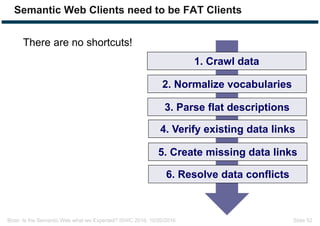
Semantic Web Clients need to be FAT Clients
There are no shortcuts!
1. Crawl data
2. Normalize vocabularies
6. Resolve data conflicts
3. Parse flat descriptions
4. Verify existing data links
5. Create missing data links
Bizer: Is the Semantic Web what we Expected? ISWC 2016, 10/20/2016 Slide 53
Thank you!

Is the Semantic Web what we expected? Adoption Patterns and Content-driven Challenges (ISWC 2016 Keynote)

  • 1.
    Bizer: Is theSemantic Web what we Expected? ISWC 2016, 10/20/2016 Slide 1 15th International Semantic Web Conference (ISWC 2016) Kobe, Japan, 10/20/2016 Is the Semantic Web what we Expected? Deployment Patterns and Data-driven Challenges Prof. Dr. Christian Bizer
  • 2.
    Bizer: Is theSemantic Web what we Expected? ISWC 2016, 10/20/2016 Slide 2 Ian‘s Keynote Last Year in Bethlehem http://videolectures.net/ iswc2015_horrocks_semantic_technology/
  • 3.
    Bizer: Is theSemantic Web what we Expected? ISWC 2016, 10/20/2016 Slide 3 This Year Use cases  on the public Web  many data sources  no central control
  • 4.
    Bizer: Is theSemantic Web what we Expected? ISWC 2016, 10/20/2016 Slide 4 Outline 1. What did we expect the Semantic Web to be? 2. What does the Semantic Web actually look like? 1. Linked Data 2. HTML-embedded Data 3. Why is this the case? 4. What does this mean for Semantic Web applications?
  • 5.
    Bizer: Is theSemantic Web what we Expected? ISWC 2016, 10/20/2016 Slide 5 1. What did we expect the Semantic Web to be?
  • 6.
    Bizer: Is theSemantic Web what we Expected? ISWC 2016, 10/20/2016 Slide 6 2001 Article: The Semantic Web Envisions three things to happen:  people publish structured data on the Web  ontologies are used to enable shared understanding  people implement cool applications that do smart things with the available data Tim Berners-Lee, James Hendler, Ora Lassila: The Semantic Web. Scientific American, May 2001.
  • 7.
    Bizer: Is theSemantic Web what we Expected? ISWC 2016, 10/20/2016 Slide 7 Expectation: Hyperlinks are Set on Data Level https://www.w3.org/History/1989/proposal.html https://www.w3.org/DesignIssues/LinkedData.html
  • 8.
    Bizer: Is theSemantic Web what we Expected? ISWC 2016, 10/20/2016 Slide 8 Expectation: High Quality Content / Provenance Metadata  Publishers provide high quality content  Publishers support applications in determining trustworthiness • by providing provenance metadata • using digital signatures Layer Cake, 2001
  • 9.
    Bizer: Is theSemantic Web what we Expected? ISWC 2016, 10/20/2016 Slide 9 Check List: Our Expectations about the Semantic Web 1. People publish structured data on the Web 2. Ontologies are used to enable shared understanding 3. Hyperlinks are set on data level 4. People publish high quality content / metadata 5. Cool applications do smart things with the data
  • 10.
    Bizer: Is theSemantic Web what we Expected? ISWC 2016, 10/20/2016 Slide 10 2. What does the Semantic Web actually look like? Linked Data HTML-embedded Data
  • 11.
    Bizer: Is theSemantic Web what we Expected? ISWC 2016, 10/20/2016 Slide 11 2.1 Linked Data Deployment Schmachtenberg, Bizer, Paulheim: Adoption of the Linked Data Best Practices. ISWC2014. Ermilov, Lehmann, Martin, Auer: LODStats: The Data Web Census Dataset. ISWC 2016. Topics # of Datasets Percentage Media 24 2 % Government 199 18 % Publications/Library 138 13 % Geographic 27 2 % Life Sciences 85 8 % Cross‐domain 47 4 % Unser‐generated Content 51 5 % Social Networking 520 48 % LODStats 2016: 2740 datasets LOD Cloud 2014: 1091 datasets
  • 12.
    Bizer: Is theSemantic Web what we Expected? ISWC 2016, 10/20/2016 Slide 12 Ontological Agreement  Strong agreement on some vocabularies • base terminology, people, publications  Proprietary vocabularies are used in addition to common ones, as data is often very specific http://linkeddatacatalog.dws.informatik.uni-mannheim.de/state/ https://lov.okfn.org/dataset/lov/
  • 13.
    Bizer: Is theSemantic Web what we Expected? ISWC 2016, 10/20/2016 Slide 13  Some datasets put a lot of effort into linking  Many datasets only link to a small number of other datasets or do not set RDF links at all RDF Links Link to # of Datasets Percentage more than 10 datasets 79 8 % 6 to 10 datasets 81 8 % 5 datasets 31 3 % 4 datasets 42 4 % 3 datasets 54 5 % 2 datasets 106 10 % 1 datasets 176 17 % 0 datasets 445 44 % http://linkeddatacatalog.dws.informatik.uni-mannheim.de/state/ 71 % 16 %
  • 14.
    Bizer: Is theSemantic Web what we Expected? ISWC 2016, 10/20/2016 Slide 14 Cool Applications Prototypes of Semantic Web browsers and search engines.
  • 15.
    Bizer: Is theSemantic Web what we Expected? ISWC 2016, 10/20/2016 Slide 15 2.2 HTML-embedded Data Microformats Microdata RDFa JSON-LD
  • 16.
    Bizer: Is theSemantic Web what we Expected? ISWC 2016, 10/20/2016 Slide 16 Overall Adoption 2015 Web Data Commons, 2015:  2.72 million pay-level-domains (PLDs) out of the 14.41 million PLDs provide HTML-embedded data (19%)  540 million HTML pages out of the 1.7 billion pages provide HTML-embedded data (30%) Guha/Brickley/Macbeth, 2015: 12 million websites provide schema.org data Guha/Brickley/Macbeth: Schema.org. ACM queue, 2015 http://webdatacommons.org/structureddata/2015-11/
  • 17.
    Bizer: Is theSemantic Web what we Expected? ISWC 2016, 10/20/2016 Slide 17 Number of PLDs providing HTML-embedded Data http://webdatacommons.org/structureddata/
  • 18.
    Bizer: Is theSemantic Web what we Expected? ISWC 2016, 10/20/2016 Slide 18 Widely-used Classes Class # of Domains WDC 2015 # of Domains schema.org 2015 schema:PostalAddress 124,000 > 1,000,000 schema:Product 108,000 > 1,000,000 schema:Offer 82,000 > 1,000,000 schema:LocalBusiness 77,000 500,000 ‐ 1,000,000 schema:Person 74,000 > 1,000,000 schema:Review 28,000 250,000 ‐ 500,000 schema:GeoCoordinates 17,000 100,000 ‐ 250,000 schema:Event 12,000 100,000 ‐ 250,000 schema:Hotel 5,300 10,000 ‐ 50,000 schema:Restaurant 3,800 10,000 ‐ 50,000 schema:JobPosting 3,600 10,000 ‐ 50,000 http://webdatacommons.org/structureddata/2015-11/
  • 19.
    Bizer: Is theSemantic Web what we Expected? ISWC 2016, 10/20/2016 Slide 19 Adoption by E-Commerce Websites Alexa Top‐15 Website schema:Product Amazon.com  Ebay.com  NetFlix.com  Amazon.co.uk  Walmart.com  etsy.com  Ikea.com  Bestbuy.com  Homedepot.com  Target.com  Groupon.com  Newegg.com  Lowes.com  Macys.com  Nordstrom.com  Adoption: 60 %
  • 20.
    Bizer: Is theSemantic Web what we Expected? ISWC 2016, 10/20/2016 Slide 20 Properties used to Describe Products Properties PLDs # % schema:Product/name 78,292 87 % schema:Product/image 59,445 66 % schema:Product/description 58,228 65 % schema:Product/offers 57,633 64 % schema:Offer/price 54,290 61 % schema:Offer/availability 36,789 41 % schema:Offer/priceCurrency 30,610 34 % schema:Product/url 23,723 26 % schema:Product/aggregateRating 21,166 24 % schema:Product/manufacturer 10,150 11 % schema:Product/brand 9,739 11 % schema:Product/productID 9,221 10 % schema:Product/sku 7955 9 % schema:Product/gtin13 935 1 %
  • 21.
    Bizer: Is theSemantic Web what we Expected? ISWC 2016, 10/20/2016 Slide 21 Challenge: Small Amount of Identifiers and Data Links 1. Small amount of product identifiers 2. Hardly any schema:sameAs links Definition: URL of a reference Web page that unambiguously indicates the item's identity. Properties PLDs # % schema:Product/sameAs 85 0.07 % schema:LocalBusiness/sameAs 655 0.8 % schema:Organization/sameAs 3,900 5 % Properties PLDs # % schema:Product/productID 9,221 10 % schema:Product/gtin13 935 1 % http://webdatacommons.org/structureddata/2015-11/
  • 22.
    Bizer: Is theSemantic Web what we Expected? ISWC 2016, 10/20/2016 Slide 22 Challenge: Flat Data Structures Websites do not explicitly annotate product features but mention them in product names and descriptions. <div itemtype="http://schema.org/Product"> <span itemprop="name">Apple MacBook Air A1370 Intel Core i5 1.60GHz 64GB SSD 11.6 Laptop </span> <span itemprop=“description"> Catch up on work, school, or socializing on the Apple MacBook Air A1370 11.6-inch laptop. This handy computer features 2GB DDR3 RAM, an Intel Core i5 560UM processor, 64GB hard drive, and the Mac OS … </span> </div> Petrovski, Bryl, Bizer: Integrating Product Data from Websites Offering Microdata Markup. DEOS 2014.
  • 23.
    Bizer: Is theSemantic Web what we Expected? ISWC 2016, 10/20/2016 Slide 23 Challenge: Product Categorization 1. Small amount of websites publishing categorization information 2. Heterogeneity of the product taxonomies Properties PLDs # % schema:Offer/category 2200 2 % schema:WebPage/breadcrumb 460 0.4 % Home > Shop > Outdoor & Garden > Barbecues & Outdoor Living > Garden Furniture > Tables > Dining Tables Philadelphia Eagles > Philadelphia Eagles Mens > Philadelphia Eagles Mens Jerseys > over $60 Meusel, Primpeli, Meilicke, Paulheim, Bizer: Exploiting Microdata Annotations to Consistently Categorize Product Offers at Web Scale. EC-Web 2015.
  • 24.
    Bizer: Is theSemantic Web what we Expected? ISWC 2016, 10/20/2016 Slide 24 Adoption by Travel Websites Top 15 Travel Websites schema:Hotel Booking.com  TripAdvisor  Expedia  Agoda  Hotels.com (uses OGP)  Kayak  Priceline  Travelocity  Orbitz  ChoiceHotels  HolidayCheck  ChoiceHotels  InterContinental Hotels Group  Marriott International  Global Hyatt Corp.  Adoption: 86 % Kärle, Fensel, Toma, Fensel: Why Are There More Hotels in Tyrol than in Austria? Analyzing Schema. org Usage in the Hotel Domain. ICTT 2016.
  • 25.
    Bizer: Is theSemantic Web what we Expected? ISWC 2016, 10/20/2016 Slide 25 Properties used to Describe Hotels Top 10 Properties PLDs # % schema:Hotel/name 4173 88,35 % schema:Hotel/address 3311 70,10 % schema:Hotel/telephone 2488 52,68 % schema:PostalAddress/streetAddress 2362 50,01 % schema:PostalAddress/addressLocality 2231 47,24 % schema:Hotel/url 2102 44,51 % schema:PostalAddress/postalCode 2096 44,38 % schema:AggregateRating/ratingValue 1952 41,33 % schema:Hotel/aggregateRating 1866 39,51 % schema:AggregateRating/bestRating 1697 35,93 % Might improve in the future as new schema.org accommodation vocabulary was released August 2016.
  • 26.
    Bizer: Is theSemantic Web what we Expected? ISWC 2016, 10/20/2016 Slide 26 Adoption by Job Portals Adoption: 70 % Top‐10 Employment Websites schema:JobPosting Indeed.com  Monster.com  Careerbuilder.com  Snagajob.com  Jobsdb.com  Jobsearch.about.com  Jobs.net  Internships.com  Jobs.aol.com  Quintcareers.com 
  • 27.
    Bizer: Is theSemantic Web what we Expected? ISWC 2016, 10/20/2016 Slide 27 Properties used to Describe Job Postings Properties PLDs # % JobPosting/title 2588 91 % JobPosting/hiringOrganization 1412 49 % JobPosting/description 1192 41 % JobPosting/jobLocation 1062 37 % Organization/name 862 30 % JobPosting/datePosted 793 27 % Place/address 471 16 % JobPosting/baseSalary 227 8 % JobPosting/industry 209 7 % JobPosting/educationRequirements 145 5 % JobPosting/occupationalCategory 105 0.3 % JobPosting/skills 56 0.2 %
  • 28.
    Bizer: Is theSemantic Web what we Expected? ISWC 2016, 10/20/2016 Slide 28 Cool Applications 1. Rich snippets within search results 2. Knowledge graph panels https://developers.google.com/ structured-data/
  • 29.
    Bizer: Is theSemantic Web what we Expected? ISWC 2016, 10/20/2016 Slide 29 Cool Applications  Open Graph Protocol allows site owners to determine how entities are displayed in Facebook  uses RDFa for marking up data in HTML pages  used by over 200,000 websites (WDC 2015)
  • 30.
    Bizer: Is theSemantic Web what we Expected? ISWC 2016, 10/20/2016 Slide 30 Our Expectations Revisited Expectation Linked Data HTML‐embedded Data 1. People publish  structured data > 1000 sources, wide range of  specific topics Millions of sources, focused on search  engines and Facebook 2. Ontologies enable  understanding Partial agreement, complex data structures Strong agreement, flat data structures 3. Hyperlinks on data level Some data links Hardly any data links 4. High quality content Web quality,  partly outdated Web quality,  some SPAM 5. Cool applications various application  prototypes strong application pull  by search engines
  • 31.
    Bizer: Is theSemantic Web what we Expected? ISWC 2016, 10/20/2016 Slide 31 3. Why is this the Case? Expectation Linked Data HTML‐embedded Data 1. People publish  structured data > 1000 sources, wide range of  specific topics Millions of sources, focused on search  engines and Facebook 2. Ontologies enable  understanding Partial agreement, complex data structures Strong agreement, flat data structures 3. Hyperlinks on data level Some data links Hardly any data links 4. High quality content Web quality,  partly outdated Web quality,  some SPAM 5. Cool applications various application  prototypes strong application pull  by search engines
  • 32.
    Bizer: Is theSemantic Web what we Expected? ISWC 2016, 10/20/2016 Slide 32 Benefits and Costs for Data Providers Making the Web a better place isn’t enough motivation for most data providers.
  • 33.
    Bizer: Is theSemantic Web what we Expected? ISWC 2016, 10/20/2016 Slide 33 Benefits of Publishing HTML-Embedded Data Get richer visibility in search results and potentially more clicks.
  • 34.
    Bizer: Is theSemantic Web what we Expected? ISWC 2016, 10/20/2016 Slide 34 Effort for Publishing HTML-Embedded Data  Most providers just change their HTML templates  If more effort is required, most providers just do not do it 1. Annotate specific product features • given free text descriptions in the backend database 2. Map to common product taxonomy like GS1 GPC • given local categorizations 3. Annotate skills and occupational categories • given free text descriptions in the backend database <div itemtype="http://schema.org/Hotel"> <span itemprop="name">Vienna Marriott Hotel</span> <span itemprop="address" itemscope="" itemtype="http://schema.org/PostalAddress"> <span itemprop="streetAddress">Parkring 12a</span> <span itemprop="addressLocality">Vienna</span> </span></div>
  • 35.
    Bizer: Is theSemantic Web what we Expected? ISWC 2016, 10/20/2016 Slide 35 Effort for Setting Data Links  Effort: 1. Decide which data sources to link to 2. Compare schemata and develop a matching rule for each class 3. Run link generation algorithm 4. Publish resulting link set on the Web  Benefits: • You increase the value of your data as it becomes easier to use it together with data from other sources • You reduce the integration costs for the data consumer <http://dbpedia.org/resource/Berlin> owl:sameAs <http://sws.geonames.org/2950159> . Data publisher provides links Effort Distribution Data consumer generates links
  • 36.
    Bizer: Is theSemantic Web what we Expected? ISWC 2016, 10/20/2016 Slide 36 For Whom does the Linking Effort pay off?  Scientists • Innovation becomes possible by connecting datasets • My impact / prestige grows if my data is used for cool things  Librarians • Have the mission to catalog artefacts • Traditionally use shared identifiers  E-Commerce Vendors • Benefits of setting data links are unclear • Just want to look nice on Google • Might not want to be comparable on price portals
  • 37.
    Bizer: Is theSemantic Web what we Expected? ISWC 2016, 10/20/2016 Slide 37 Effort of Maintaining Links  We want to be nice! • we want to link to everybody  We set instance- and schema-level links! • created and collected 37 link sets • over 20 million RDF links • http://wiki.dbpedia.org/services-resources/interlinking https://github.com/dbpedia/links  We would likely need a full-time volunteer to maintain all these links  Result: Many dead links 1. because target data source has changed 2. because we used bad linkage rules due to insufficient domain knowledge
  • 38.
    Bizer: Is theSemantic Web what we Expected? ISWC 2016, 10/20/2016 Slide 38 Hypothesis  Missing links and shared identifiers  Flat data structures  Heterogeneity of taxonomies  Mixed data quality We will keep on seeing similar adoption patterns, as we need to be realistic about the effort spent by data publishers
  • 39.
    Bizer: Is theSemantic Web what we Expected? ISWC 2016, 10/20/2016 Slide 39 4. What does this mean for Semantic Web Applications?
  • 40.
    Bizer: Is theSemantic Web what we Expected? ISWC 2016, 10/20/2016 Slide 40 Be happy about all semantic clues (integration hints) provided But do not expect the clues to be perfect 4. What does this mean for Semantic Web Applications?
  • 41.
    Bizer: Is theSemantic Web what we Expected? ISWC 2016, 10/20/2016 Slide 41 Applications should be happy about … … all effort that data providers put into setting data links • but treat links with caution as they might be wrong / outdated … all effort that data providers put into using common vocabularies • but still try to understand proprietary vocabularies / taxonomies … all effort that data providers put into structuring their data • but still try to understand flat free-text descriptions Treat all statements on the Web as a claims • whose trustworthiness needs to be verified Data Publisher’s Effort Data Consumer’s Effort Effort Distribution
  • 42.
    Bizer: Is theSemantic Web what we Expected? ISWC 2016, 10/20/2016 Slide 42 Semantic Web Clients need to be FAT Clients There are no shortcuts! 1. Crawl data 2. Normalize vocabularies 6. Resolve data conflicts 3. Parse flat descriptions 4. Verify existing data links 5. Create missing data links
  • 43.
    Bizer: Is theSemantic Web what we Expected? ISWC 2016, 10/20/2016 Slide 43 Parsing Flat Descriptions Ristoski, Mika: Enriching Product Ads with Metadata from HTML Annotations. ESWC 2016. Foley, et al.: Learning to Extract Local Events from the Web. SIGIR 2015. Dictionary Parser schema.org schema.org data suitable as distant supervision:  schema:Product/brand  schema:Product/manufacturer  schema:JobPosting/industry  Schema:JobPosting/skills  schema:Event/name
  • 44.
    Bizer: Is theSemantic Web what we Expected? ISWC 2016, 10/20/2016 Slide 44 Create and Verify Data Links  Supervised learning of detailed matching rules leads to F1>95% (e.g. Silk and LIMES frameworks)  Sources of supervision 1. Data links and shared identifiers • owl:sameAs • schema:Product/productID • schema:Product/gtin13 2. Human guidance via active learning  How to generalize matching rules to data from multiple sources? Isele, Bizer: Active Learning of Expressive Linkage Rules using Genetic Programming. JWS 2013. Stonebraker, et al.: Data Curation at Scale: The Data Tamer System. CIDR 2013.
  • 45.
    Bizer: Is theSemantic Web what we Expected? ISWC 2016, 10/20/2016 Slide 45 Resolve Data Conflicts  Do you have some data that you already trust?  Knowledge-based Trust • determine trustworthiness of a data source by comparing its content with trusted data (ground truth) • outperforms PageRank and voting Dong, et al.: Knowledge-based Trust: Estimating the Trustworthiness of Web Sources. VLDB 2015. Web Data Source Country City Germany Berlin France Paris United Kingdom London Canada Ottawa USA Washington D.C. Mexico Ecatepec     ? ? Trusted Data Country Capital Germany Berlin France United Kingdom London Canada USA Washington D.C. Mexico Mexico City
  • 46.
    Bizer: Is theSemantic Web what we Expected? ISWC 2016, 10/20/2016 Slide 46 Google Knowledge Vault  Extends Freebase with data from one billion web pages 1. Web text (TXT): Entity linking, relationship extraction 2. HTML trees (DOM): Wrapper induction 3. HTML tables (TBL): Relational tables 4. Semantic Annotations (ANO): schema.org, OGP  Employs knowledge-based trust for ranking  Results: • 271 million facts with confidence >90% • 90 million facts not in Freebase before Dong, et al.: Knowledge Vault: A Web-scale Approach to Probabilistic Knowledge Fusion. SIGKDD 2014.
  • 47.
    Bizer: Is theSemantic Web what we Expected? ISWC 2016, 10/20/2016 Slide 47 The Structural Continuum Be open to different forms of “structured” Web content. HTML tables DOM Trees CSV Tables HTML-embedded Data Linked Data Upper Ontologies
  • 48.
    Bizer: Is theSemantic Web what we Expected? ISWC 2016, 10/20/2016 Slide 48 Exploit Schema.org and HTML Tables Together Qui, et al.: DEXTER: Large-Scale Discovery and Extraction of Product Specifications on the Web. VLDB 2015. Petrovski, et al: The WDC Gold Standards for Product Feature Extraction and Product Matching. ECWeb 2016. s:name HTML table s:breadcrumb
  • 49.
    Bizer: Is theSemantic Web what we Expected? ISWC 2016, 10/20/2016 Slide 49 Conclusions
  • 50.
    Bizer: Is theSemantic Web what we Expected? ISWC 2016, 10/20/2016 Slide 50  The Semantic Web contains more data than most people like  exciting test-bed for research on data profiling, cleansing and integration  endless data pool for commercial applications (product comparison, business listings, job search, …) The Semantic Web is Huge Billions of product offers A description of every hotel in the world Lots of data about local businesses
  • 51.
    Bizer: Is theSemantic Web what we Expected? ISWC 2016, 10/20/2016 Slide 51 We will keep on seeing Similar Adoption Patterns  as we need to be realistic about the effort spent by data publishers  be happy about any semantic clues (integration hints) provided  design algorithms to work despite the scarcity and noisiness of clues Flat Data Structures Missing Links and Identifiers Mixed Data Quality Heterogeneity of Taxonomies
  • 52.
    Bizer: Is theSemantic Web what we Expected? ISWC 2016, 10/20/2016 Slide 52 Semantic Web Clients need to be FAT Clients There are no shortcuts! 1. Crawl data 2. Normalize vocabularies 6. Resolve data conflicts 3. Parse flat descriptions 4. Verify existing data links 5. Create missing data links
  • 53.
    Bizer: Is theSemantic Web what we Expected? ISWC 2016, 10/20/2016 Slide 53 Thank you!