IS AGILE TEAM
DYNAMICS
LIKE A HOUSE
OF CARDS
By Diana Kirkova
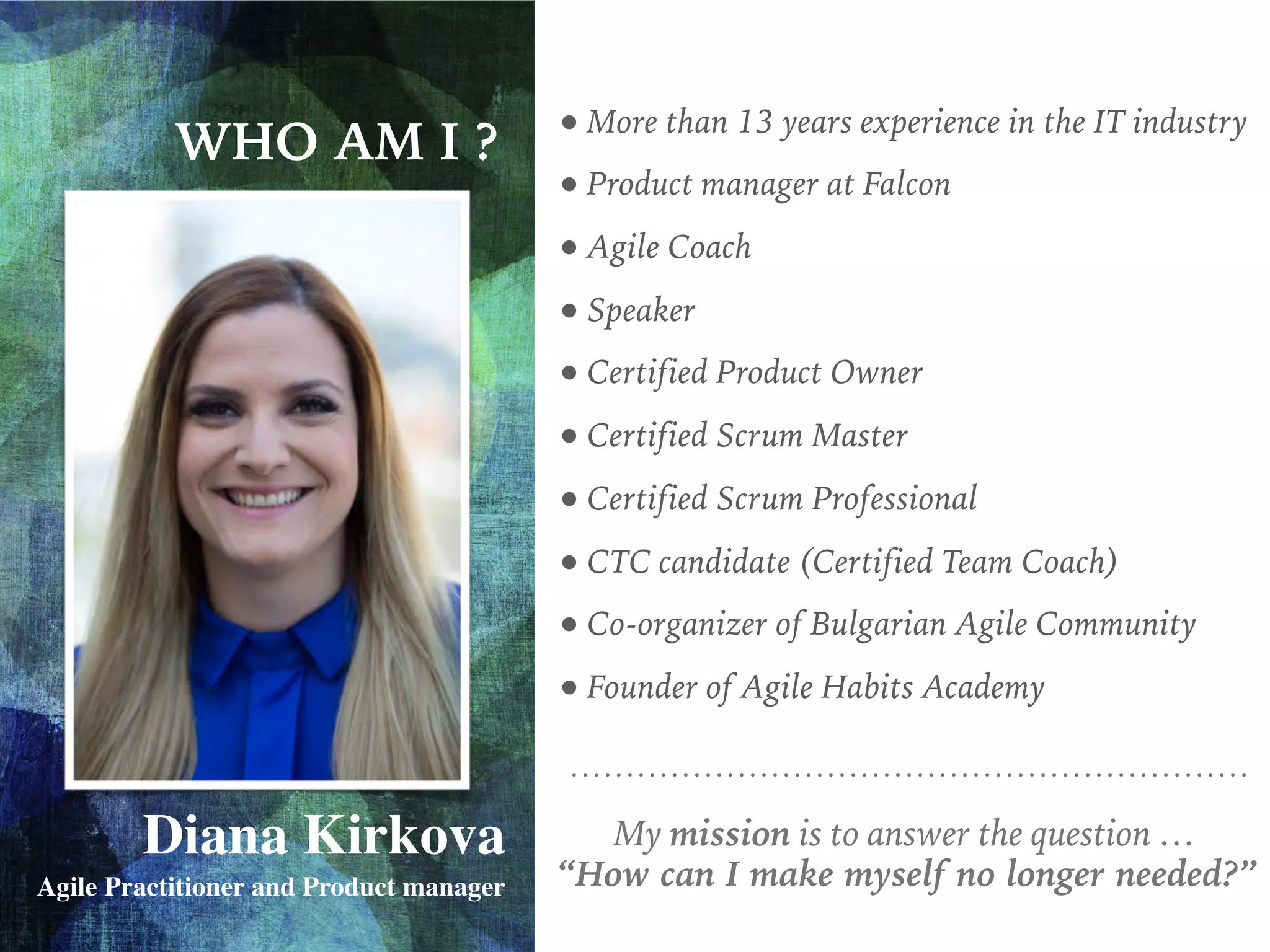
● More than 13 years experience in the IT industry
● Product manager at Falcon
● Agile Coach
● Speaker
● Certified Product Owner
● Certified Scrum Master
● Certified Scrum Professional 
● CTC candidate (Certified Team Coach)
● Co-organizer of Bulgarian Agile Community
● Founder of Agile Habits Academy
My mission is to answer the question …
“How can I make myself no longer needed?”
Diana Kirkova
Agile Practitioner and Product manager
WHO AM I ?
UNDERSTANDING TEAM DYNAMICS
‘[A team is a] group in which members work together intensively to achieve a common
group goal.’ (Lewis-McClear & Taylor, 1998)
‘A team is a small number of people with complementary skills who are committed to a
common purpose, performance goals, and approach for which they are mutually
accountable.’ (Katzenbach & Smith, 1993)
‘[A team is made up of people] working together in a committed way to achieve a common goal or
mission. The work is interdependent and team members share responsibility and hold themselves
accountable for attaining the results.’ (MIT Information Services and Technology, 2007)
Teams consist of a group of people who share a common
understanding of their goal and work together to accomplish it.
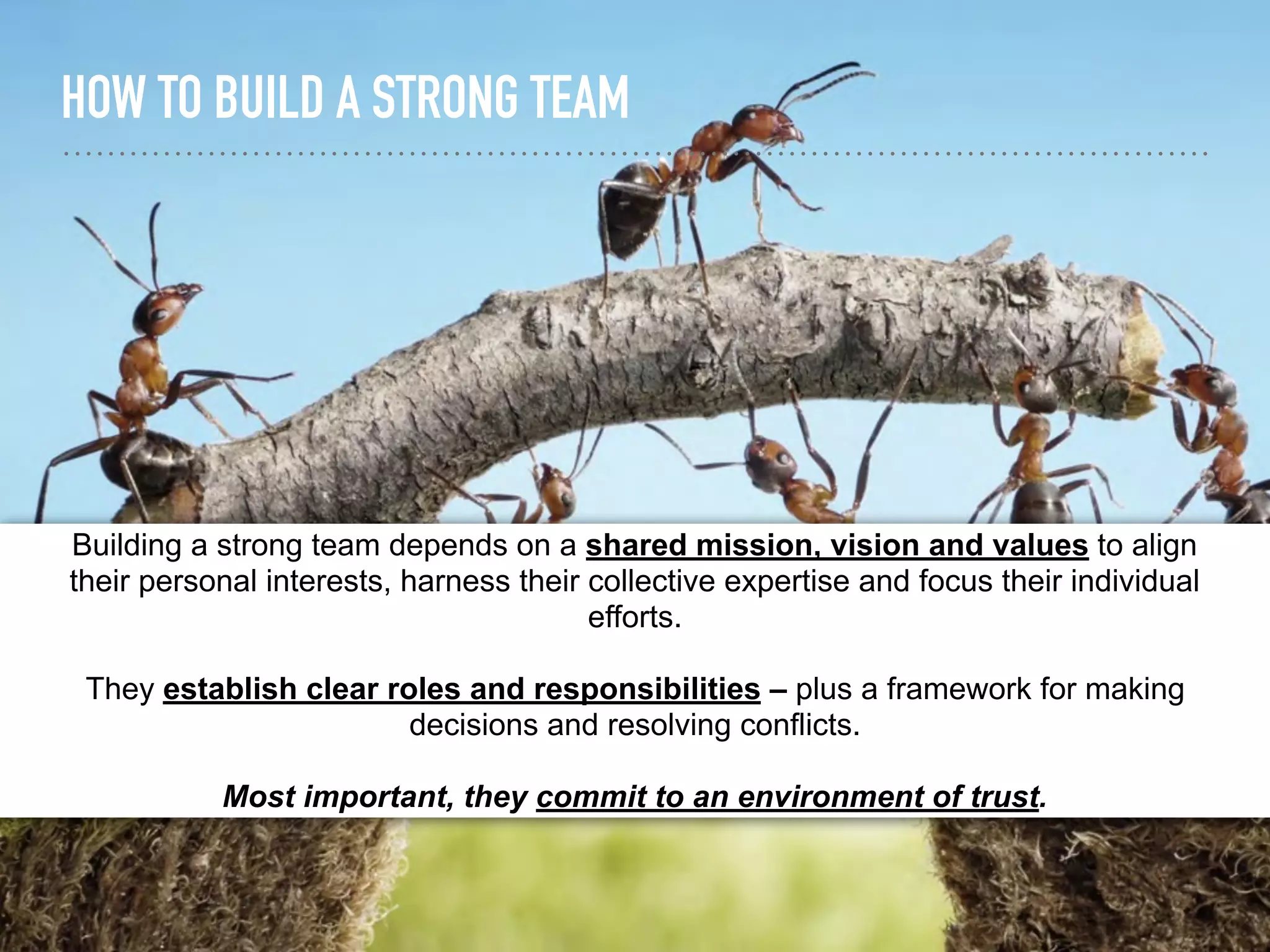
HOW TO BUILD A STRONG TEAM
Building a strong team depends on a shared mission, vision and values to align
their personal interests, harness their collective expertise and focus their individual
efforts.
They establish clear roles and responsibilities – plus a framework for making
decisions and resolving conflicts.
Most important, they commit to an environment of trust.
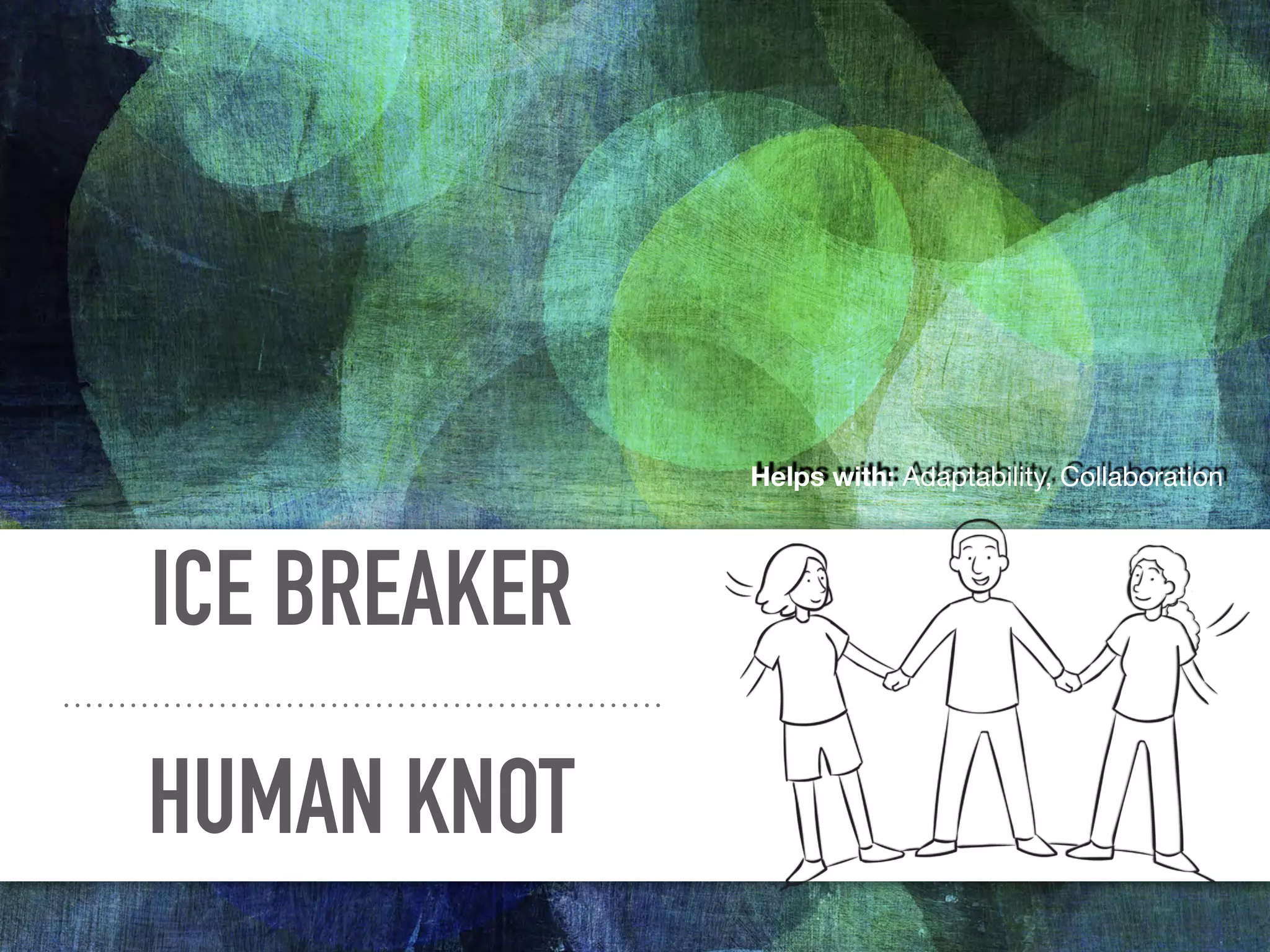
ICE BREAKER
HUMAN KNOT
Helps with: Adaptability, Collaboration
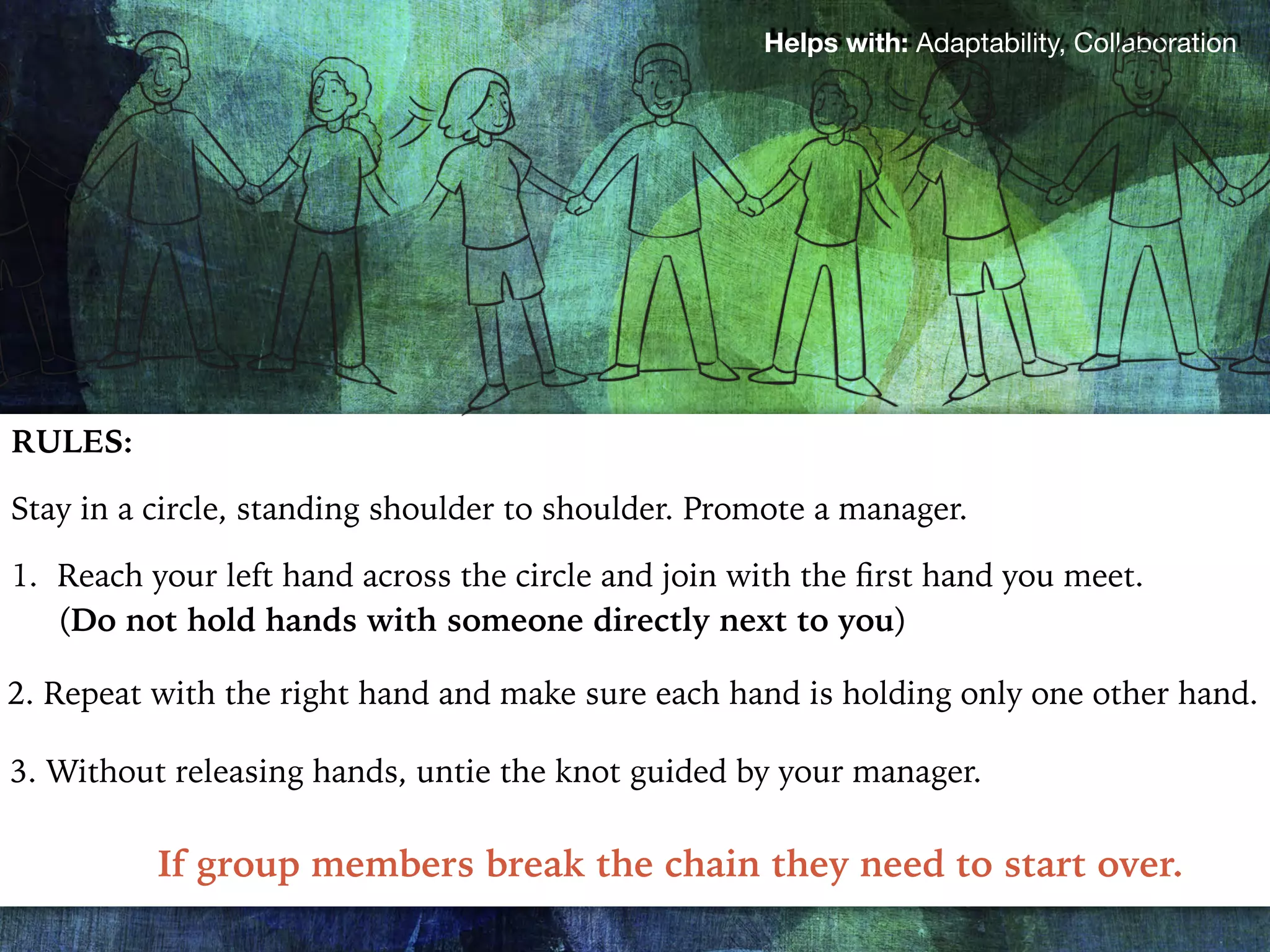
RULES:
Stay in a circle, standing shoulder to shoulder. Promote a manager.
1. Reach your left hand across the circle and join with the first hand you meet.
(Do not hold hands with someone directly next to you)
2. Repeat with the right hand and make sure each hand is holding only one other hand.
3. Without releasing hands, untie the knot guided by your manager.
If group members break the chain they need to start over.
GAMIFICATION: TEAM RESPONSIBILITY GAME
PART 1
INTENTION OF THE GAME
- experience sharing responsibility for a common
purpose
- discover unhealthy team dynamics
- reflect and think about better ways to work
together.
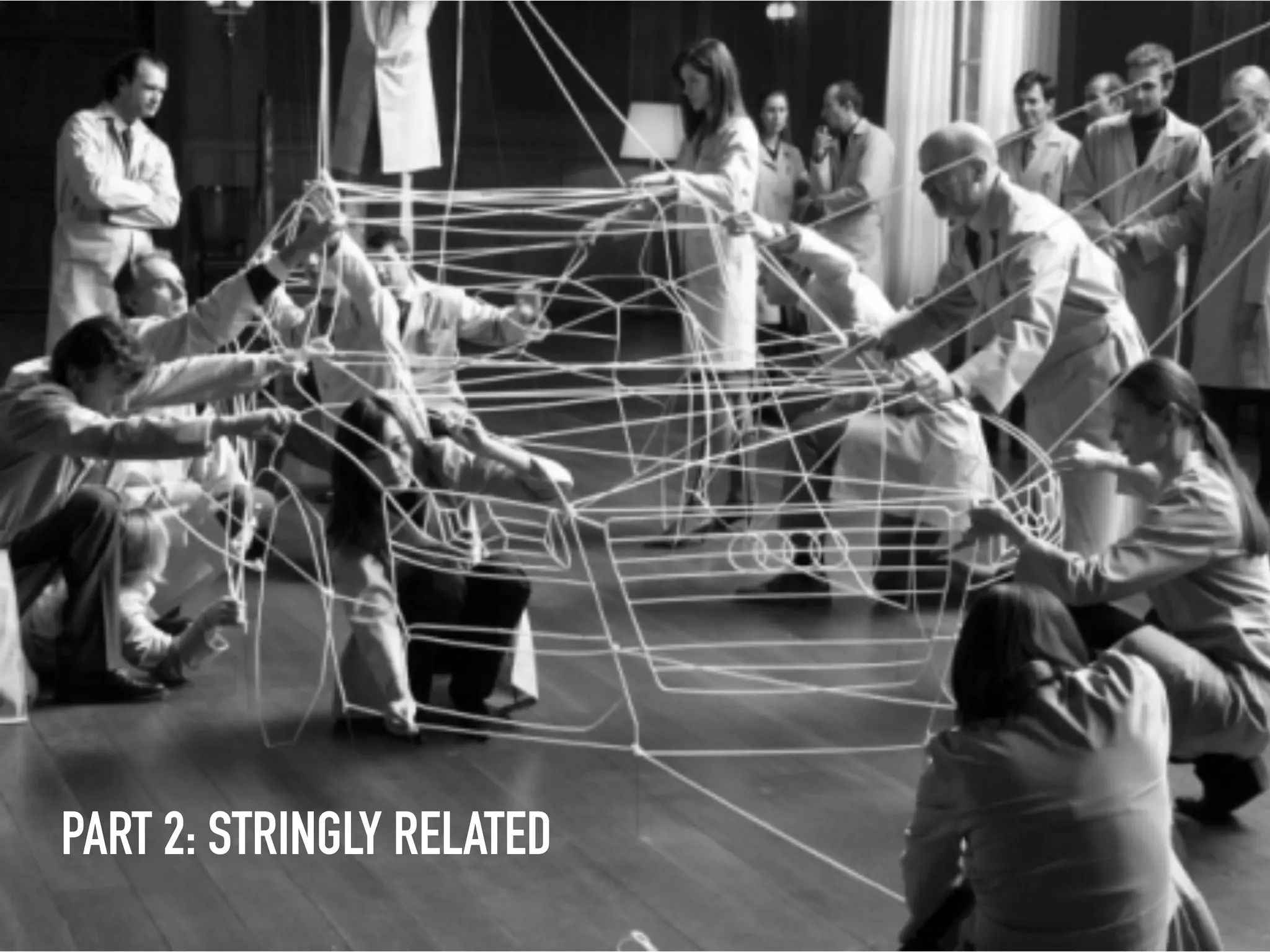
- Set up teams: Number of players between 7 and 10
- Members should count off: team member #1.. team
member #10
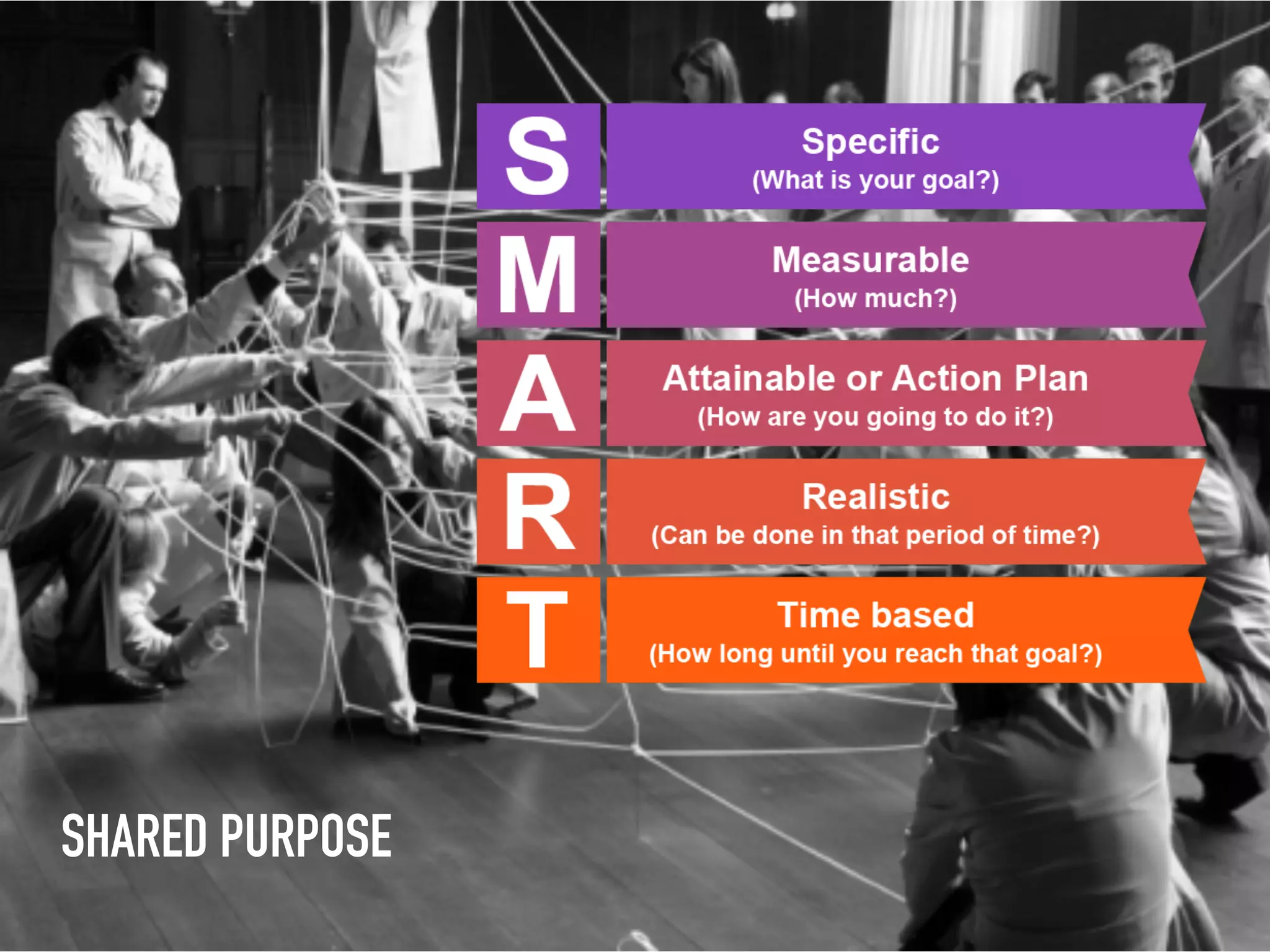
- Agree on shared purpose in the team
PART 2: STRINGLY RELATED
SHARED PURPOSE
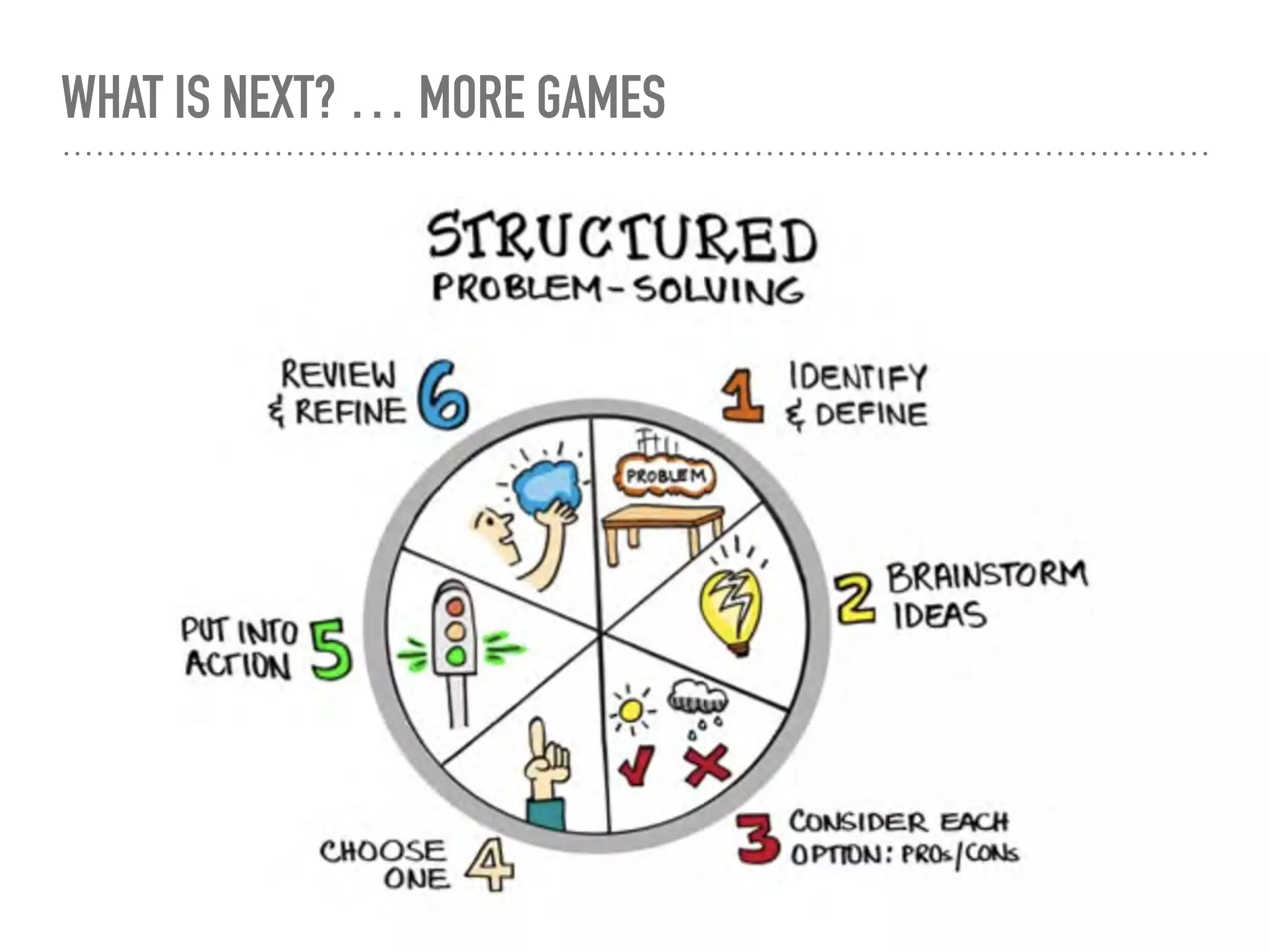
WHAT IS NEXT? … MORE GAMES
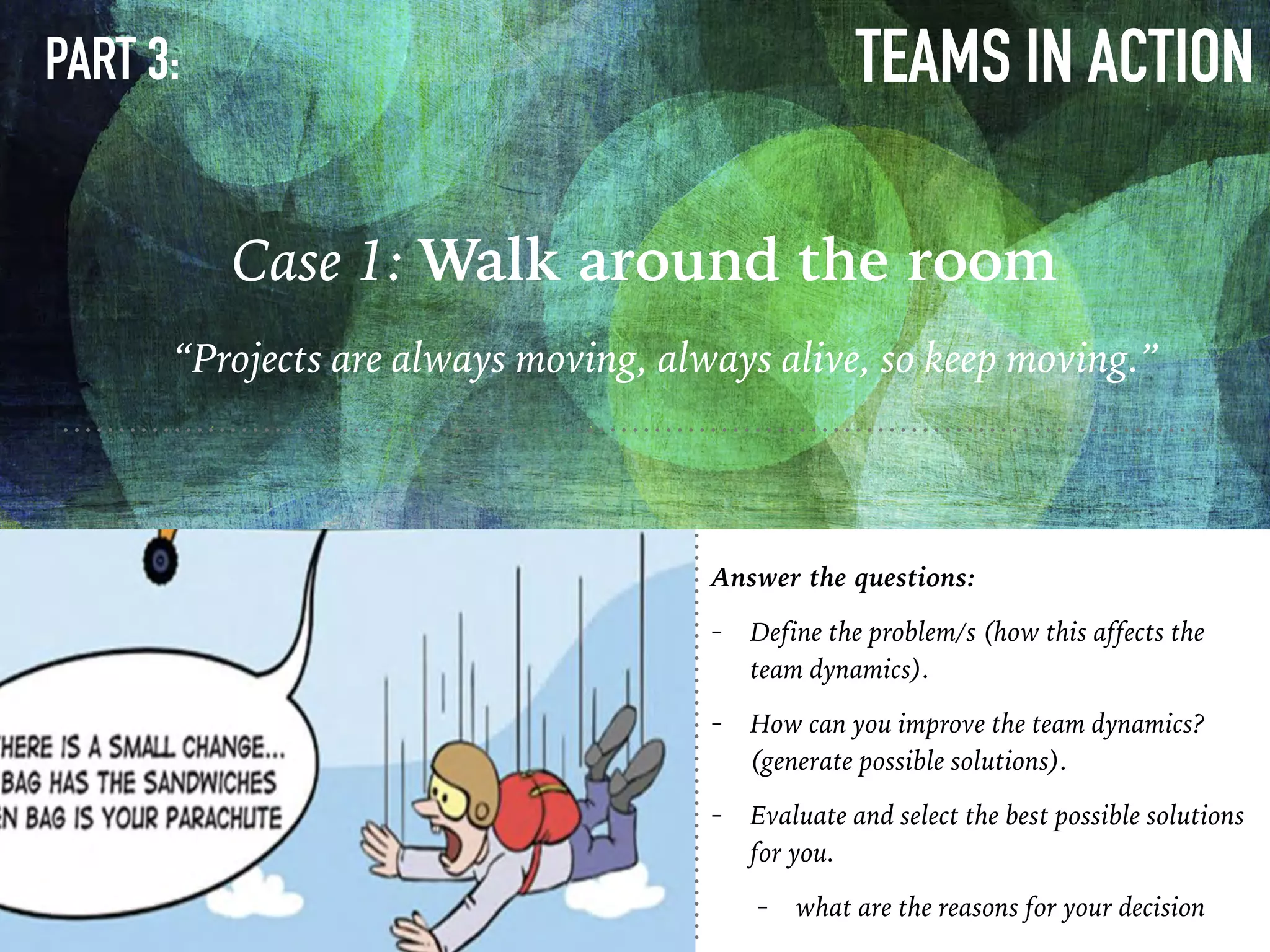
TEAMS IN ACTION
Case 1: Walk around the room
PART 3:
“Projects are always moving, always alive, so keep moving.”
Answer the questions:
- Define the problem/s (how this affects the
team dynamics).
- How can you improve the team dynamics?
(generate possible solutions).
- Evaluate and select the best possible solutions
for you.
- what are the reasons for your decision
PART 3:
“You think you have to do everything. Without you
everything will fall apart.”
Case 2: Team member 1 takes 130%
responsibility by pulling harder on the cord.
Answer the questions:
- Define the problem/s (how this affects the
team dynamics).
- How can you improve the team dynamics?
(generate possible solutions).
- Evaluate and select the best possible solutions
for you.
- what are the reasons for your decision
PART 3:
“You are tired of work, is has just become a nine-to-five job,
internally you have already resigned.”
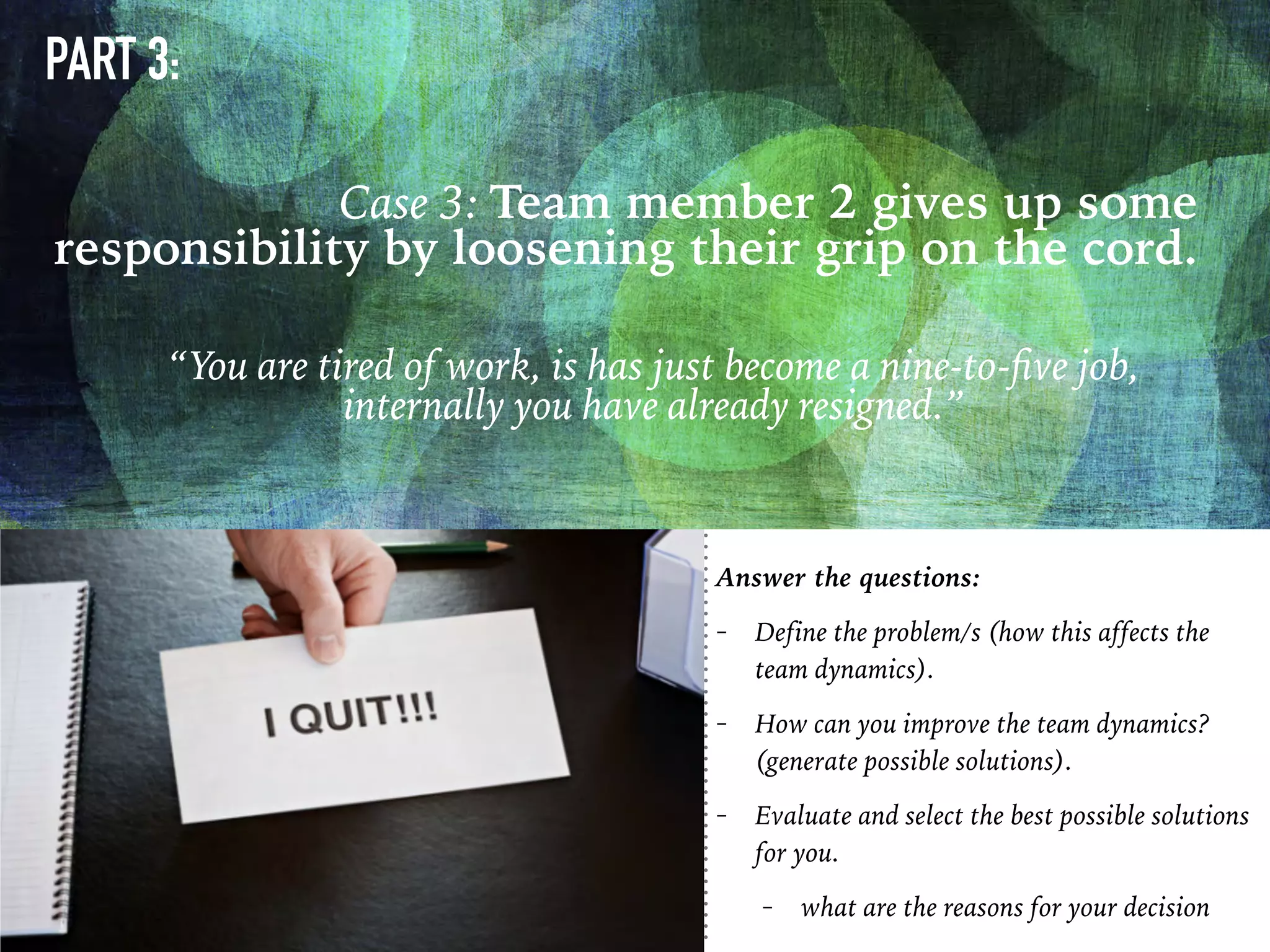
Case 3: Team member 2 gives up some
responsibility by loosening their grip on the cord.
Answer the questions:
- Define the problem/s (how this affects the
team dynamics).
- How can you improve the team dynamics?
(generate possible solutions).
- Evaluate and select the best possible solutions
for you.
- what are the reasons for your decision
PART 3:
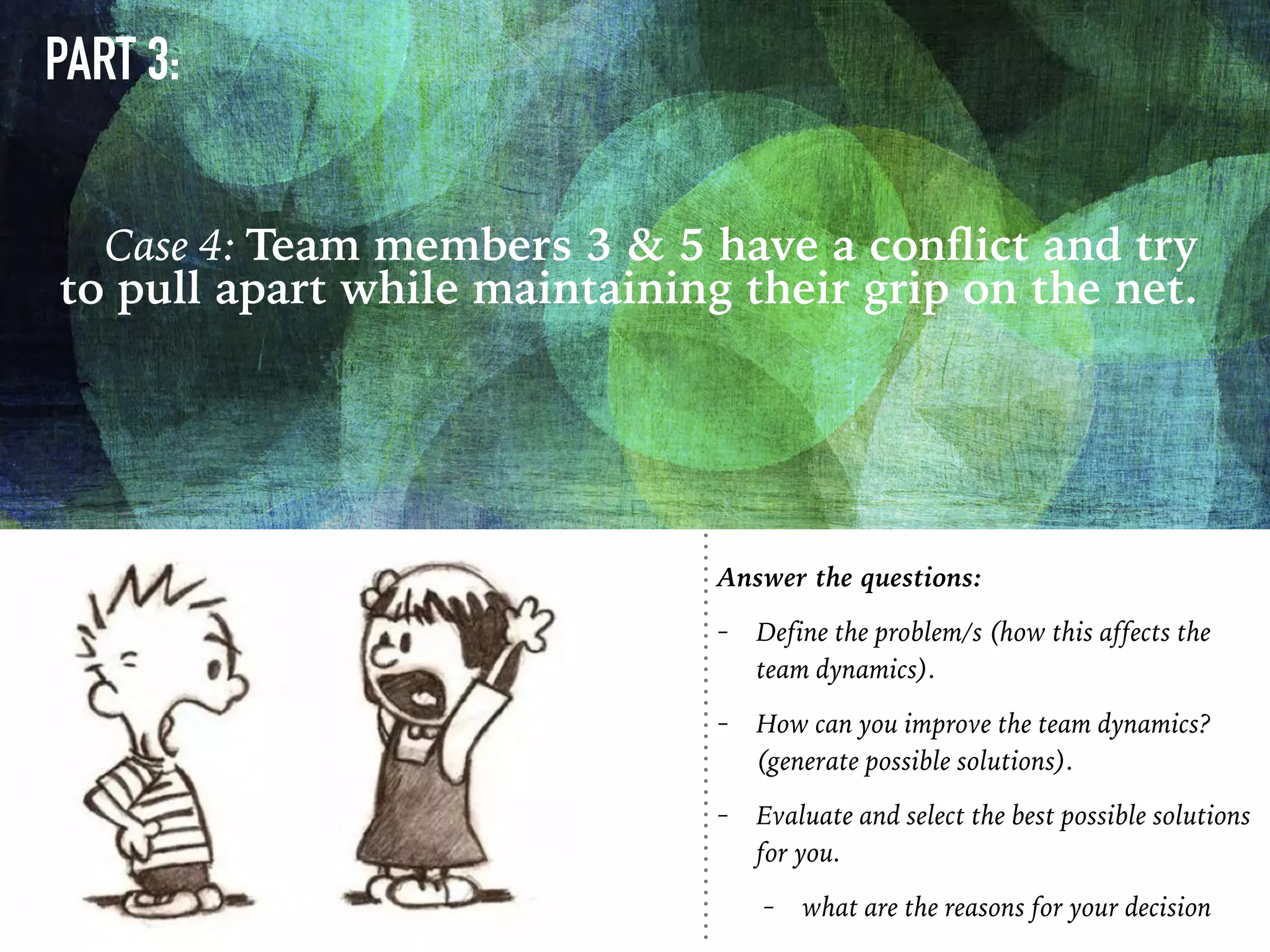
Case 4: Team members 3 & 5 have a conflict and try
to pull apart while maintaining their grip on the net.
Answer the questions:
- Define the problem/s (how this affects the
team dynamics).
- How can you improve the team dynamics?
(generate possible solutions).
- Evaluate and select the best possible solutions
for you.
- what are the reasons for your decision
PART 3:
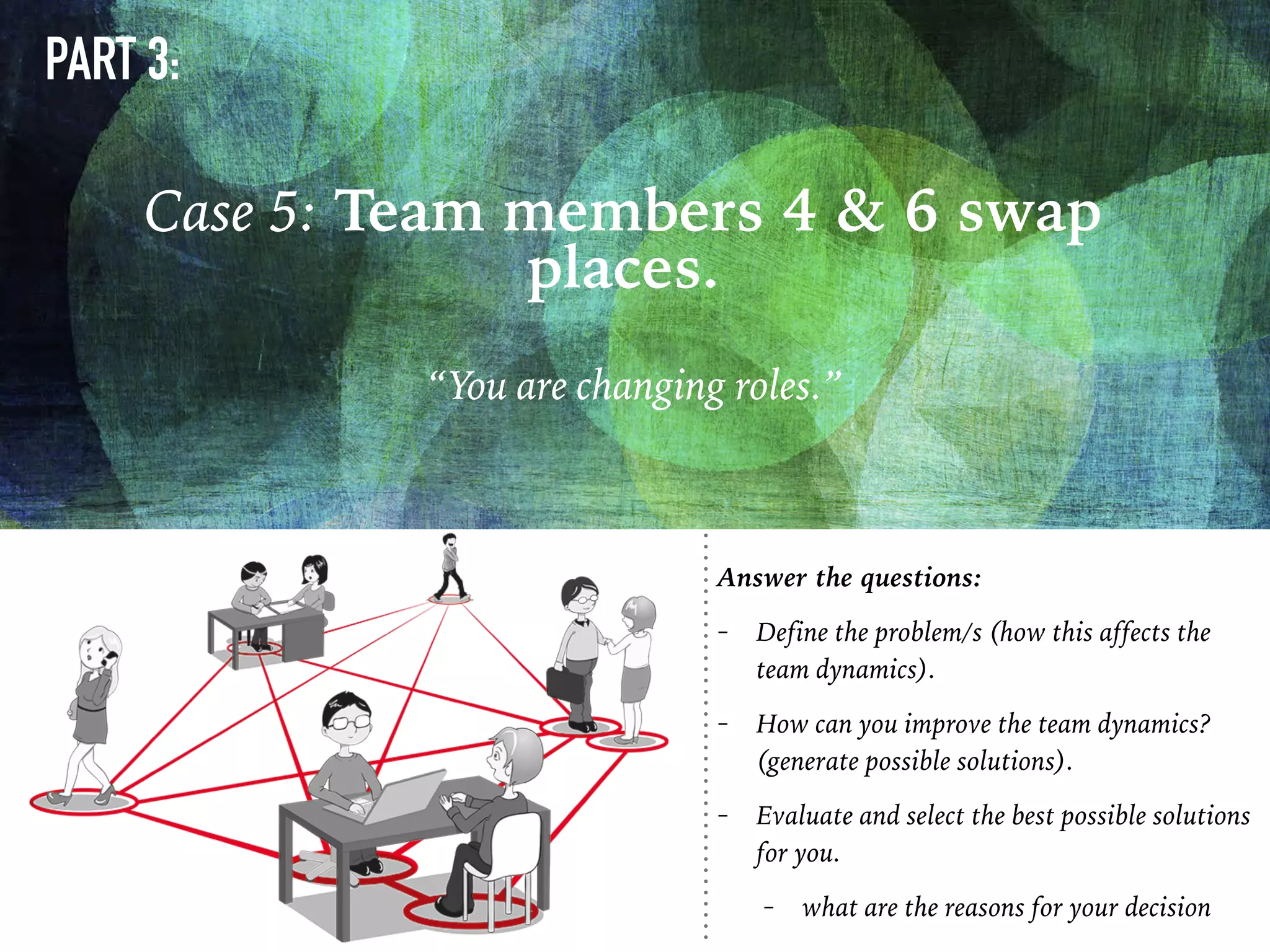
“You are changing roles.”
Case 5: Team members 4 & 6 swap
places.
Answer the questions:
- Define the problem/s (how this affects the
team dynamics).
- How can you improve the team dynamics?
(generate possible solutions).
- Evaluate and select the best possible solutions
for you.
- what are the reasons for your decision
PART 3:
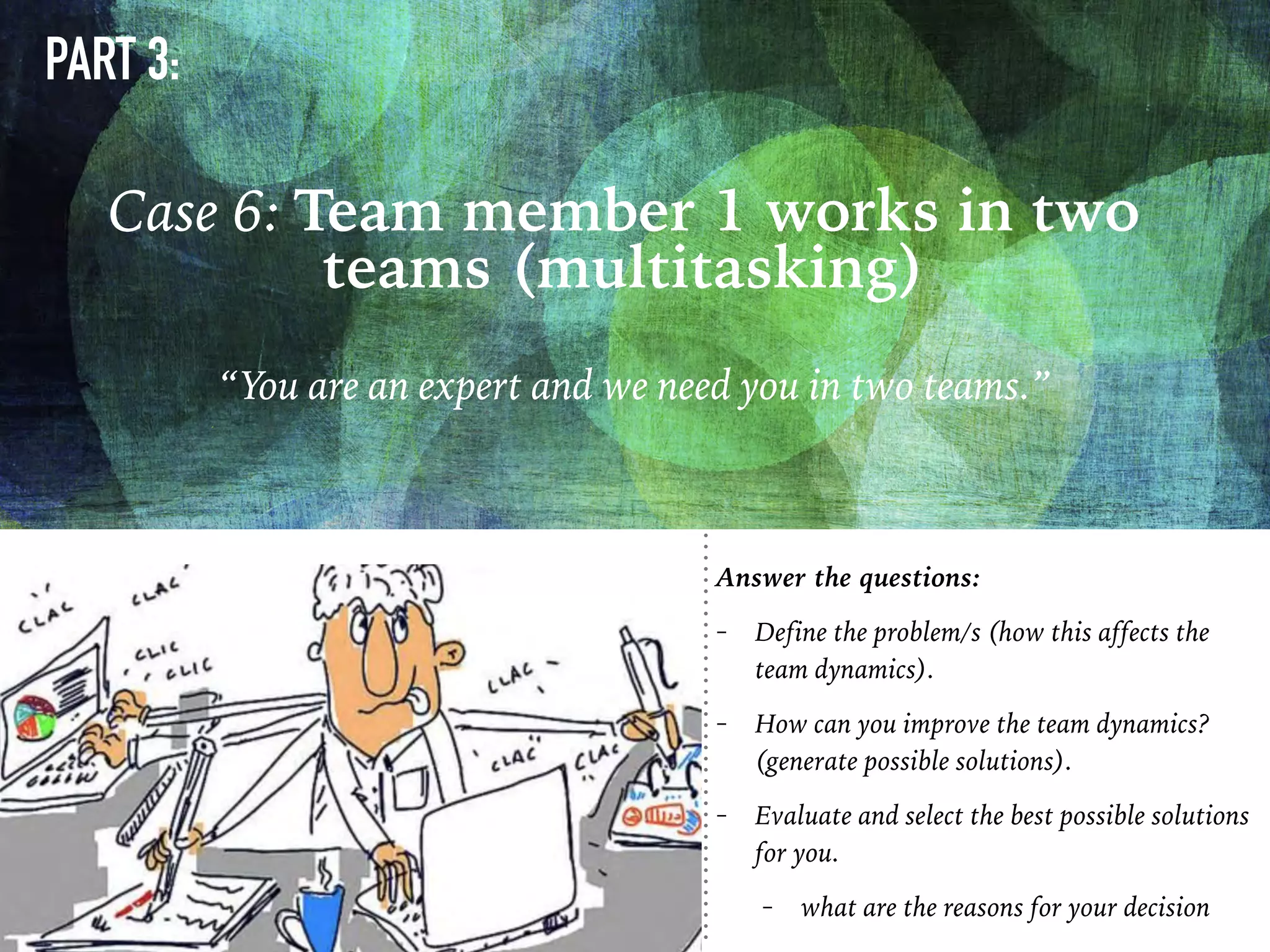
“You are an expert and we need you in two teams.”
Case 6: Team member 1 works in two
teams (multitasking)
Answer the questions:
- Define the problem/s (how this affects the
team dynamics).
- How can you improve the team dynamics?
(generate possible solutions).
- Evaluate and select the best possible solutions
for you.
- what are the reasons for your decision
PART 3:
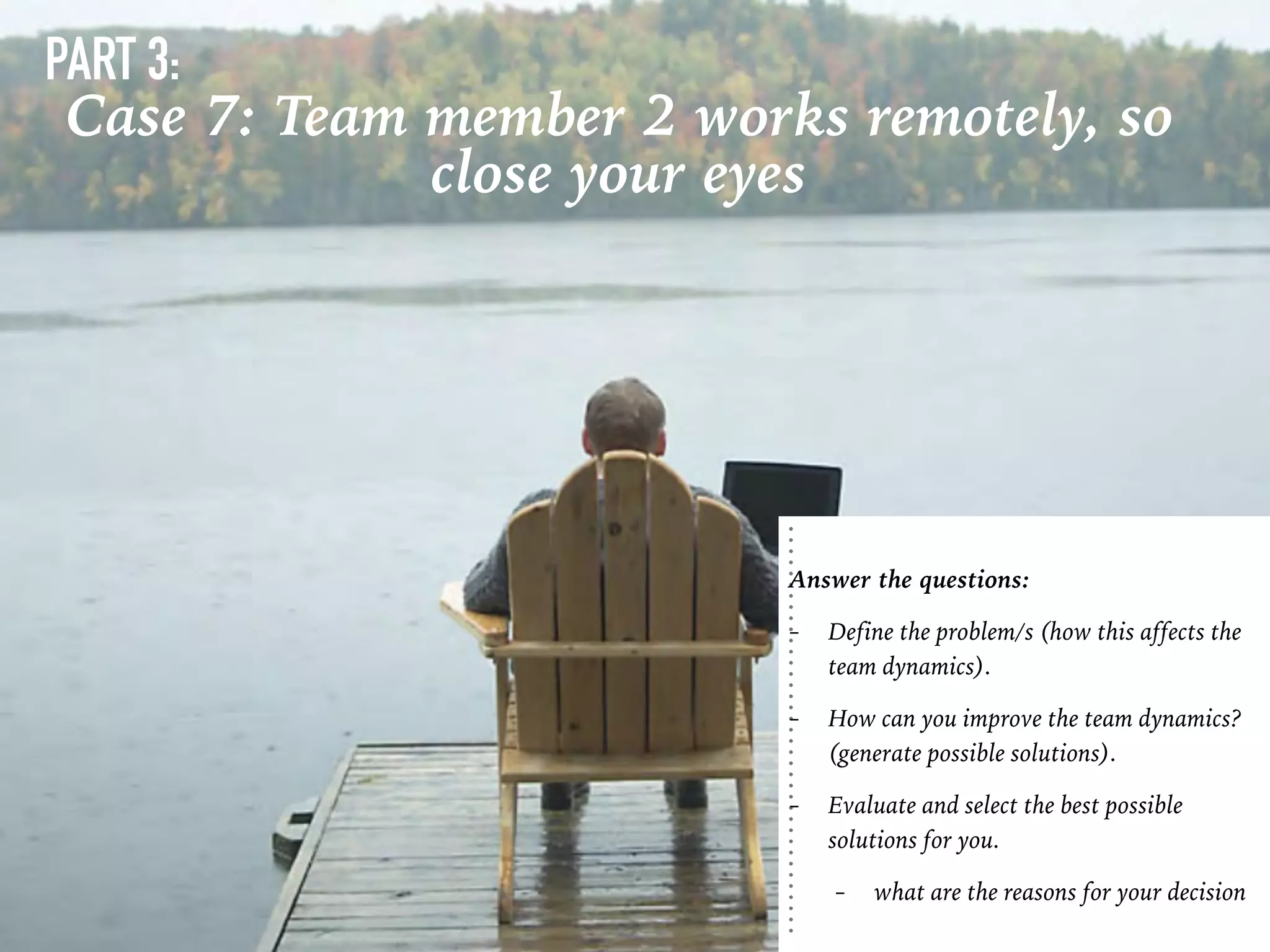
Case 7: Team member 2 works remotely, so
close your eyes
Answer the questions:
- Define the problem/s (how this affects the
team dynamics).
- How can you improve the team dynamics?
(generate possible solutions).
- Evaluate and select the best possible
solutions for you.
- what are the reasons for your decision
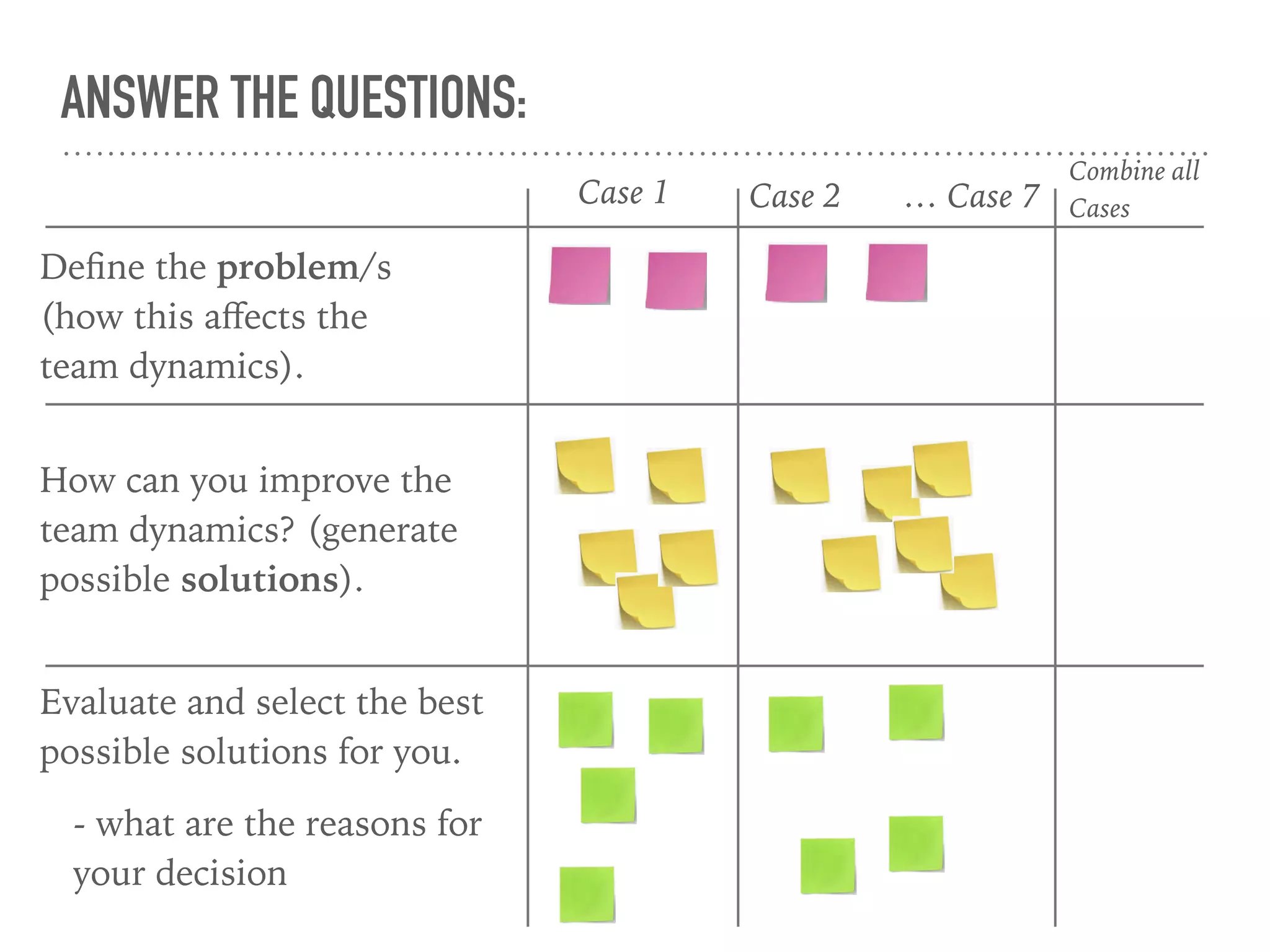
ANSWER THE QUESTIONS:
Evaluate and select the best
possible solutions for you.
- what are the reasons for
your decision
Define the problem/s
(how this affects the
team dynamics).
How can you improve the
team dynamics? (generate
possible solutions).
Case 1 Case 2
Combine all
Cases… Case 7
RESULT SHARING AND DISCUSSION
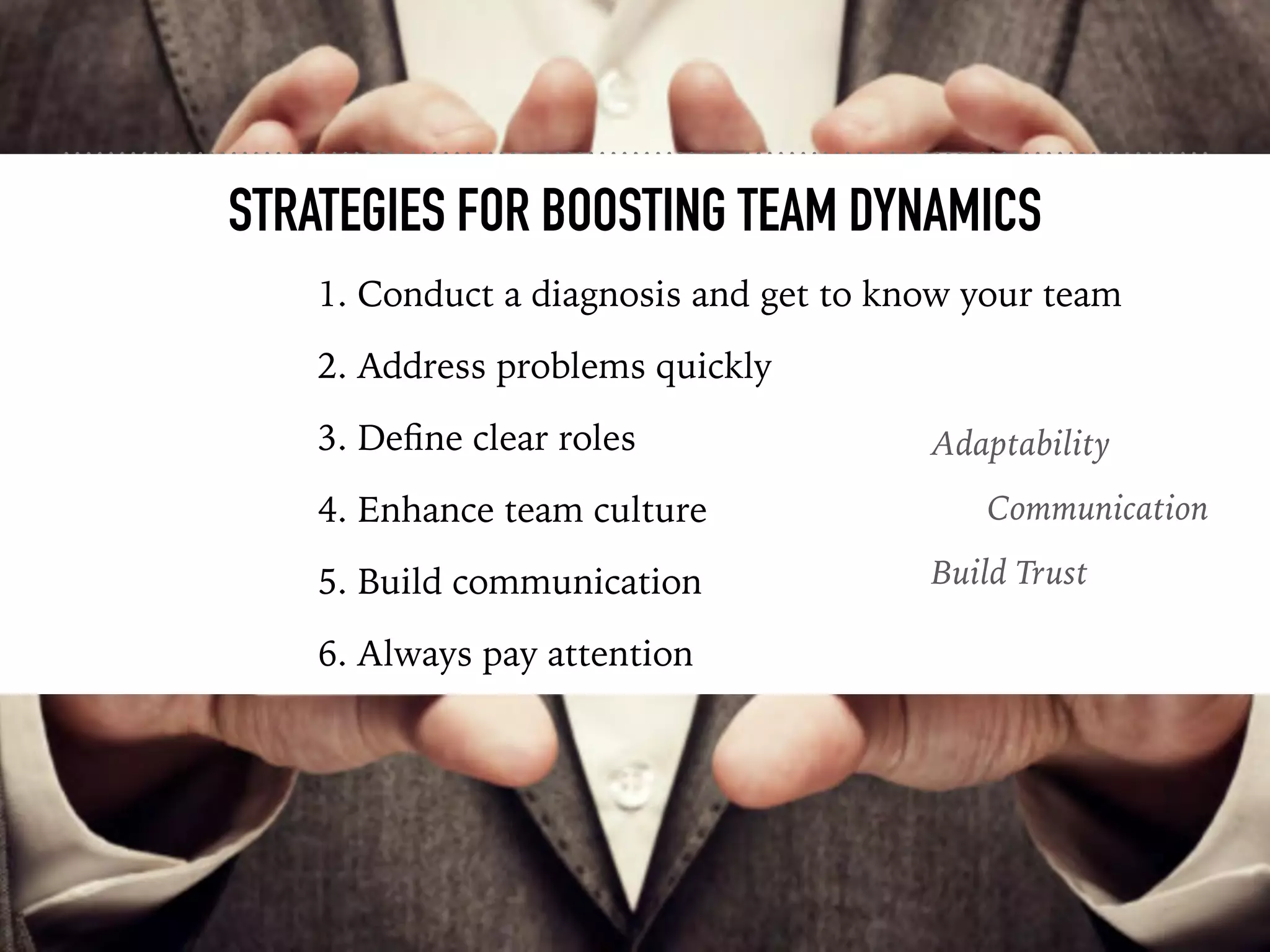
1. Conduct a diagnosis and get to know your team
2. Address problems quickly
3. Define clear roles
4. Enhance team culture
5. Build communication
6. Always pay attention
STRATEGIES FOR BOOSTING TEAM DYNAMICS
Adaptability
Communication
Build Trust
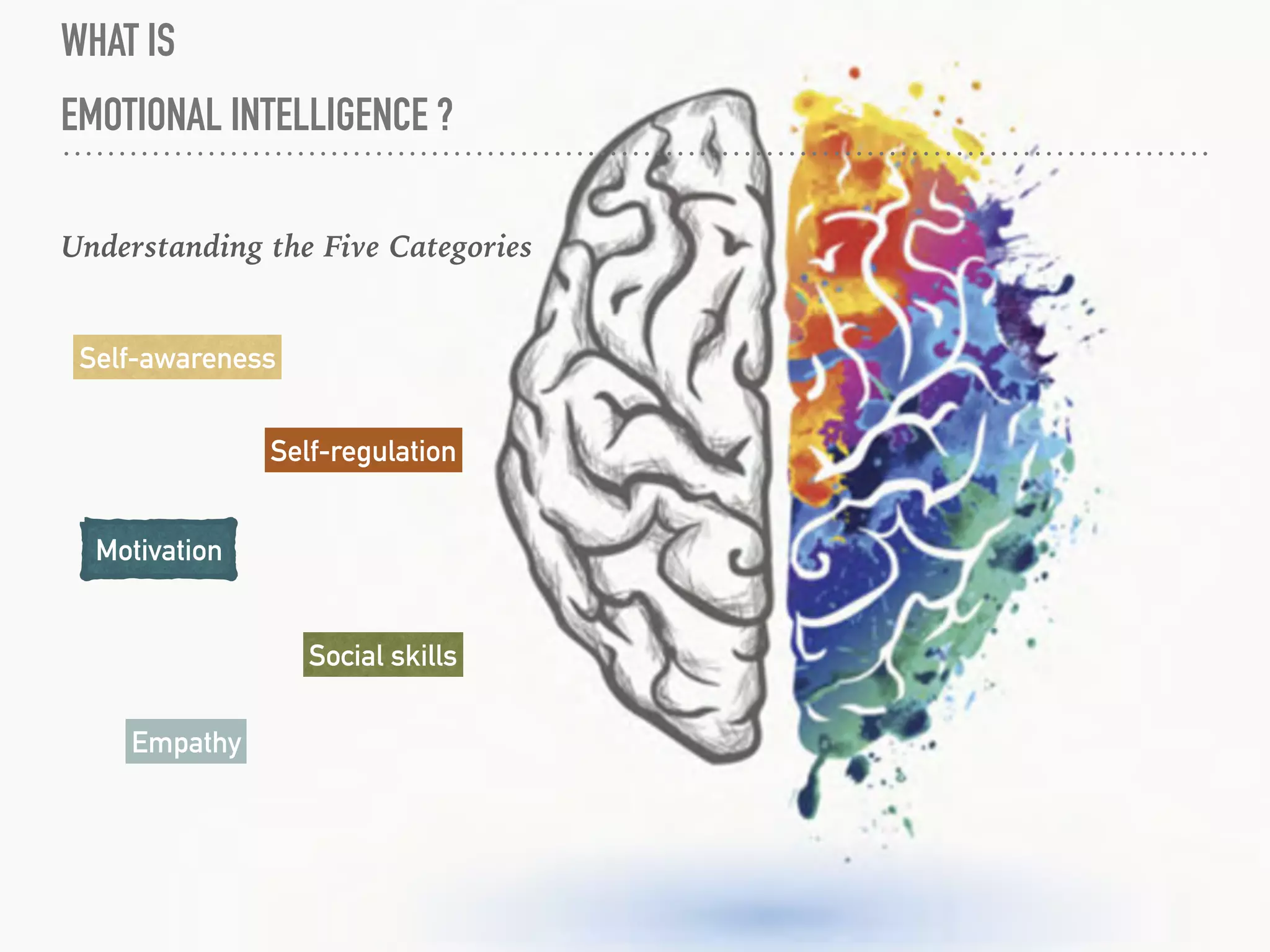
WHAT IS
EMOTIONAL INTELLIGENCE ?
Understanding the Five Categories
Self-awareness
Self-regulation
Motivation
Empathy
Social skills
THANK YOU!
@DianaKirkova | Twitter /dianakirkova | Linkedin

Is an Agile Team Dynamics like a House of Cards?

  • 1.
    IS AGILE TEAM DYNAMICS LIKEA HOUSE OF CARDS By Diana Kirkova
  • 2.
    ● More than13 years experience in the IT industry ● Product manager at Falcon ● Agile Coach ● Speaker ● Certified Product Owner ● Certified Scrum Master ● Certified Scrum Professional  ● CTC candidate (Certified Team Coach) ● Co-organizer of Bulgarian Agile Community ● Founder of Agile Habits Academy My mission is to answer the question … “How can I make myself no longer needed?” Diana Kirkova Agile Practitioner and Product manager WHO AM I ?
  • 3.
  • 5.
    ‘[A team isa] group in which members work together intensively to achieve a common group goal.’ (Lewis-McClear & Taylor, 1998) ‘A team is a small number of people with complementary skills who are committed to a common purpose, performance goals, and approach for which they are mutually accountable.’ (Katzenbach & Smith, 1993) ‘[A team is made up of people] working together in a committed way to achieve a common goal or mission. The work is interdependent and team members share responsibility and hold themselves accountable for attaining the results.’ (MIT Information Services and Technology, 2007) Teams consist of a group of people who share a common understanding of their goal and work together to accomplish it.
  • 6.
    HOW TO BUILDA STRONG TEAM Building a strong team depends on a shared mission, vision and values to align their personal interests, harness their collective expertise and focus their individual efforts. They establish clear roles and responsibilities – plus a framework for making decisions and resolving conflicts. Most important, they commit to an environment of trust.
  • 7.
    ICE BREAKER HUMAN KNOT Helpswith: Adaptability, Collaboration
  • 8.
    Helps with: Adaptability,Collaboration RULES: Stay in a circle, standing shoulder to shoulder. Promote a manager. 1. Reach your left hand across the circle and join with the first hand you meet. (Do not hold hands with someone directly next to you) 2. Repeat with the right hand and make sure each hand is holding only one other hand. 3. Without releasing hands, untie the knot guided by your manager. If group members break the chain they need to start over.
  • 9.
    GAMIFICATION: TEAM RESPONSIBILITYGAME PART 1 INTENTION OF THE GAME - experience sharing responsibility for a common purpose - discover unhealthy team dynamics - reflect and think about better ways to work together. - Set up teams: Number of players between 7 and 10 - Members should count off: team member #1.. team member #10 - Agree on shared purpose in the team
  • 10.
  • 11.
  • 12.
    WHAT IS NEXT?… MORE GAMES
  • 13.
    TEAMS IN ACTION Case1: Walk around the room PART 3: “Projects are always moving, always alive, so keep moving.” Answer the questions: - Define the problem/s (how this affects the team dynamics). - How can you improve the team dynamics? (generate possible solutions). - Evaluate and select the best possible solutions for you. - what are the reasons for your decision
  • 14.
    PART 3: “You thinkyou have to do everything. Without you everything will fall apart.” Case 2: Team member 1 takes 130% responsibility by pulling harder on the cord. Answer the questions: - Define the problem/s (how this affects the team dynamics). - How can you improve the team dynamics? (generate possible solutions). - Evaluate and select the best possible solutions for you. - what are the reasons for your decision
  • 15.
    PART 3: “You aretired of work, is has just become a nine-to-five job, internally you have already resigned.” Case 3: Team member 2 gives up some responsibility by loosening their grip on the cord. Answer the questions: - Define the problem/s (how this affects the team dynamics). - How can you improve the team dynamics? (generate possible solutions). - Evaluate and select the best possible solutions for you. - what are the reasons for your decision
  • 16.
    PART 3: Case 4:Team members 3 & 5 have a conflict and try to pull apart while maintaining their grip on the net. Answer the questions: - Define the problem/s (how this affects the team dynamics). - How can you improve the team dynamics? (generate possible solutions). - Evaluate and select the best possible solutions for you. - what are the reasons for your decision
  • 17.
    PART 3: “You arechanging roles.” Case 5: Team members 4 & 6 swap places. Answer the questions: - Define the problem/s (how this affects the team dynamics). - How can you improve the team dynamics? (generate possible solutions). - Evaluate and select the best possible solutions for you. - what are the reasons for your decision
  • 18.
    PART 3: “You arean expert and we need you in two teams.” Case 6: Team member 1 works in two teams (multitasking) Answer the questions: - Define the problem/s (how this affects the team dynamics). - How can you improve the team dynamics? (generate possible solutions). - Evaluate and select the best possible solutions for you. - what are the reasons for your decision
  • 19.
    PART 3: Case 7:Team member 2 works remotely, so close your eyes Answer the questions: - Define the problem/s (how this affects the team dynamics). - How can you improve the team dynamics? (generate possible solutions). - Evaluate and select the best possible solutions for you. - what are the reasons for your decision
  • 20.
    ANSWER THE QUESTIONS: Evaluateand select the best possible solutions for you. - what are the reasons for your decision Define the problem/s (how this affects the team dynamics). How can you improve the team dynamics? (generate possible solutions). Case 1 Case 2 Combine all Cases… Case 7
  • 21.
  • 22.
    1. Conduct adiagnosis and get to know your team 2. Address problems quickly 3. Define clear roles 4. Enhance team culture 5. Build communication 6. Always pay attention STRATEGIES FOR BOOSTING TEAM DYNAMICS Adaptability Communication Build Trust
  • 23.
    WHAT IS EMOTIONAL INTELLIGENCE? Understanding the Five Categories Self-awareness Self-regulation Motivation Empathy Social skills
  • 24.
    THANK YOU! @DianaKirkova |Twitter /dianakirkova | Linkedin