Objective:  To examine the culture of the tribes of the Eastern Woodlands.
Peoples of the Eastern Woodlands The people of the Eastern Woodlands hunted animals such as deer and moose. (left)  Iroquois hunter, 1950 They also planted crops such as corn, squash, and pumpkins. (above)  Iroquois women grinding corn or dried berries. 1664 engraving
The Iroquois live in present-day New York State. The League of the Iroquois
They lived in  long houses , which were about 150 feet long, 20 feet wide, and made of poles sided with bark. Housing:
While each family stayed in their own room, they shared a fireplace in the hallway. Many families lived in a single long house.
Iroquois man in traditional clothing near a reconstructed longhouse.
Iroquois Longhouse Interior, Gonondagan State Historical Site  Victor, New York
Role of Women: The Iroquois were a  matriarchal   society, or a society that is run by women . Women owned all of the property in the long house. They were also in charge of farming. Iroquois men moved into the homes of his wife’s family.
Iroquois women chose the  sachems , or tribal chiefs. "King  Hendrick " "Thoyanoguen" by Calvin Ashley, Jr. 58.4 x 46.7cm This watercolor portrays the hereditary Sachem of the Iroquois Confederacy and Chief of the Mohawk Nation, King Hendrick. As can best be determined, Hendrick was born between 1680 and 1690 and died during battle with the French in 1755.
Formation of the League: The League of the Iroquois was originally made up of  five  nations. C O S M O ayuga nondaga eneca ohawk neida "Hiawatha's Belt" was composed of five figures. In the center was what some have described as a heart, to others it was a great or sacred tree under which the Iroquois met in council. The five devices represent the five original tribes.
Mohawk leader Hiawatha, inspired by the religious leader Dekanawida, organized the five nations into a peaceful  alliance  known as the League of the Iroquois. The five nations fought frequently. A statue of Hiawatha stands in Ironwood, Michigan. Hiawatha helped Dekanawida unite the people of the five Iroquois nations  Alliance  - a union between nations for assistance and protection
A council of 50 members, chosen by women, made decisions for the League. Iroquois Government:   All of the nations had to agree before any action could be taken. Each nation had one vote. This is a meeting of the Iroquois Six Nations Council. Note the flags symbolizing the many clans among these tribes. Ontario Canada, 1914
Chief Frank McDonald Jacobs is wearing a wampum belt showing the unity of the original five Iroquois nations with linked squares representing the nations and their ties to each other. Ontario, Canada, 1914.
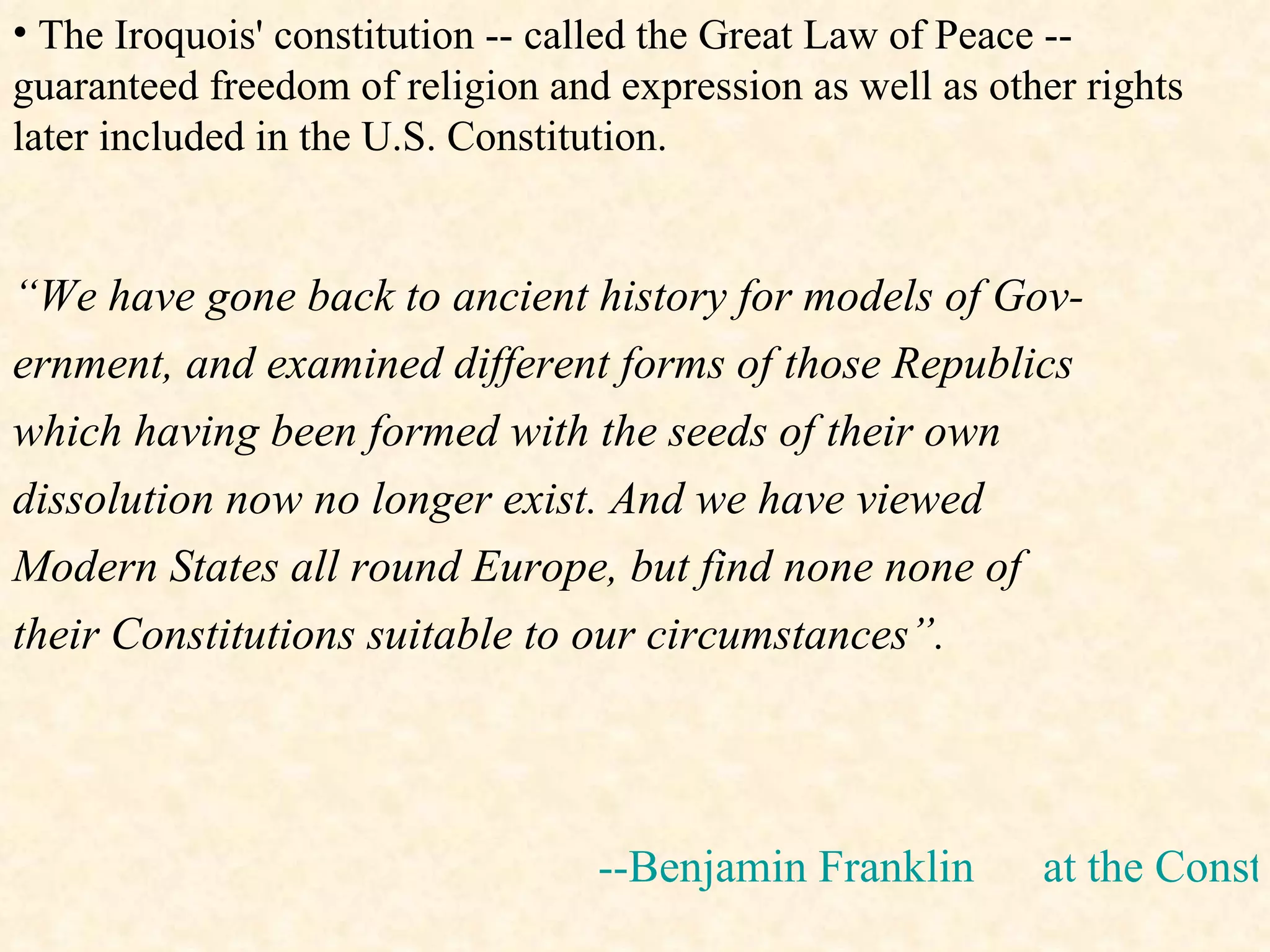
The Iroquois' constitution -- called the Great Law of Peace -- guaranteed freedom of religion and expression as well as other rights later included in the U.S. Constitution. --Benjamin Franklin      at the Constitutional      Convention, June 28, 1787                 their Constitutions suitable to our circumstances”.  Modern States all round Europe, but find none none of  dissolution now no longer exist. And we have viewed  which having been formed with the seeds of their own  ernment, and examined different forms of those Republics  “ We have gone back to ancient history for models of Gov-
 

Iroquois

  • 1.
    Objective: Toexamine the culture of the tribes of the Eastern Woodlands.
  • 2.
    Peoples of theEastern Woodlands The people of the Eastern Woodlands hunted animals such as deer and moose. (left) Iroquois hunter, 1950 They also planted crops such as corn, squash, and pumpkins. (above) Iroquois women grinding corn or dried berries. 1664 engraving
  • 3.
    The Iroquois livein present-day New York State. The League of the Iroquois
  • 4.
    They lived in long houses , which were about 150 feet long, 20 feet wide, and made of poles sided with bark. Housing:
  • 5.
    While each familystayed in their own room, they shared a fireplace in the hallway. Many families lived in a single long house.
  • 6.
    Iroquois man intraditional clothing near a reconstructed longhouse.
  • 7.
    Iroquois Longhouse Interior,Gonondagan State Historical Site Victor, New York
  • 8.
    Role of Women:The Iroquois were a matriarchal society, or a society that is run by women . Women owned all of the property in the long house. They were also in charge of farming. Iroquois men moved into the homes of his wife’s family.
  • 9.
    Iroquois women chosethe sachems , or tribal chiefs. "King Hendrick " "Thoyanoguen" by Calvin Ashley, Jr. 58.4 x 46.7cm This watercolor portrays the hereditary Sachem of the Iroquois Confederacy and Chief of the Mohawk Nation, King Hendrick. As can best be determined, Hendrick was born between 1680 and 1690 and died during battle with the French in 1755.
  • 10.
    Formation of theLeague: The League of the Iroquois was originally made up of five nations. C O S M O ayuga nondaga eneca ohawk neida "Hiawatha's Belt" was composed of five figures. In the center was what some have described as a heart, to others it was a great or sacred tree under which the Iroquois met in council. The five devices represent the five original tribes.
  • 11.
    Mohawk leader Hiawatha,inspired by the religious leader Dekanawida, organized the five nations into a peaceful alliance known as the League of the Iroquois. The five nations fought frequently. A statue of Hiawatha stands in Ironwood, Michigan. Hiawatha helped Dekanawida unite the people of the five Iroquois nations Alliance - a union between nations for assistance and protection
  • 12.
    A council of50 members, chosen by women, made decisions for the League. Iroquois Government: All of the nations had to agree before any action could be taken. Each nation had one vote. This is a meeting of the Iroquois Six Nations Council. Note the flags symbolizing the many clans among these tribes. Ontario Canada, 1914
  • 13.
    Chief Frank McDonaldJacobs is wearing a wampum belt showing the unity of the original five Iroquois nations with linked squares representing the nations and their ties to each other. Ontario, Canada, 1914.
  • 14.
    The Iroquois' constitution-- called the Great Law of Peace -- guaranteed freedom of religion and expression as well as other rights later included in the U.S. Constitution. --Benjamin Franklin      at the Constitutional      Convention, June 28, 1787                their Constitutions suitable to our circumstances”. Modern States all round Europe, but find none none of dissolution now no longer exist. And we have viewed which having been formed with the seeds of their own ernment, and examined different forms of those Republics “ We have gone back to ancient history for models of Gov-
  • 15.