International Research Journal of Engineering and Technology (IRJET) e-ISSN: 2395-0056
Volume: 06 Issue: 06 | June 2019 www.irjet.net p-ISSN: 2395-0072
© 2019, IRJET | Impact Factor value: 7.211 | ISO 9001:2008 Certified Journal | Page 3743
Milestones and Challenges of Fake News Detection using Digital
Forensic Approach
Govindraj Chittapur1, Pushpa H.2
1Assistant Professor, Department of Computer Applications, Basaveshwar Engineering College Bagalkot
Karnataka India
2Student, Department of Computer Applications, Basaveshwar Engineering College Bagalkot Karnataka India
---------------------------------------------------------------------***----------------------------------------------------------------------
Abstract – Every day million viewer is watching NEWS by
believing what they see in the media., unfortunately, whatthey
are seeing is believable, and trustworthiness is the
indispensable challenge for every viewer of the NEWS., Here
we are focusing some challenging issues and development era
of fake news detection techniques through common channel.
We also enlighted list of contributors in the recent trend of
tools and technologies available for identifying fake news
detection in social news media using digital forensic
approaches.
Key Words: NEWS, fake news, challenges,milestones,digital
forensic
1. INTRODUCTION
Fake news is false news, there news broadly includes
statements, speeches, posts, claims, and among other types
of information related to public figures and organizations,
and Fake news is initially false news published by the news.
Data set: Dataset is a collection of related, discrete items of
associated data that may be accessed individually or in
combination or managed a whole entity.
Forensic data set: Forensic Data Analysis is a branch of
digital forensics. It examines structureddata aboutincidents
of monetary crime. The aim is to determine and analyze
patterns of fake activities.
Digital forensic:
Digital forensics has exploded over the last several years. It
is used in a wide group of situations, including criminal and
civil litigation, intelligence, and administrative proceeding.
Digital forensic is the “application of computer science and
investigative procedures for a legal purpose involving the
analysis of digital evidence.”
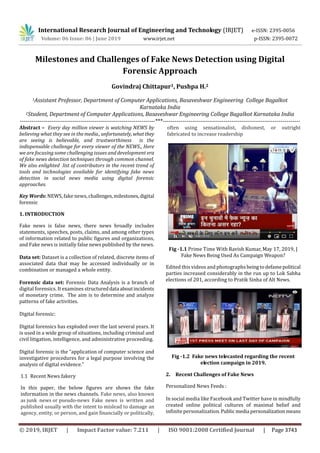
1.1 Recent News fakery
In this paper, the below figures are shows the fake
information in the news channels. Fake news, also known
as junk news or pseudo-news Fake news is written and
published usually with the intent to mislead to damage an
agency, entity, or person, and gain financially or politically,
often using sensationalist, dishonest, or outright
fabricated to increase readership
Fig -1.1 Prime Time With Ravish Kumar, May 17, 2019, |
Fake News Being Used As Campaign Weapon?
Edited this videos and photographs beingtodefamepolitical
parties increased considerably in the run up to Lok Sabha
elections of 201, according to Pratik Sinha of Alt News.
Fig -1.2 Fake news telecasted regarding the recent
election campaign in 2019.
2. Recent Challenges of Fake News
Personalized News Feeds :
In social media like Facebook and Twitter have in mindfully
created online political cultures of maximal belief and
infinite personalization.Publicmedia personalizationmeans
International Research Journal of Engineering and Technology (IRJET) e-ISSN: 2395-0056
Volume: 06 Issue: 06 | June 2019 www.irjet.net p-ISSN: 2395-0072
© 2019, IRJET | Impact Factor value: 7.211 | ISO 9001:2008 Certified Journal | Page 3744
that journalists essentially become content marketers
publishing information for a particular slot.
Declining Circulation:
In public News and local news, thechannel isbehindviewers
and readers as an increasing number of soure available.
HourNews Cycle:
The 24-hour news cycle puts reports in the awkward
position of having to publish stories without proper fact
checking according to the right website, the exponent.
Political promotion:
NEWS channel like While Fox News has always been an
openly right network; its programming directors made a
noticeable decision to give good coverage.
CNN has famously beenchallengedtothrowawayobjectivity
in its political coverage after being labeled “very fake news”
by president comparable during a press conference.
Fake- reports:
Major public networks have been criticizedforallowingfake
news stories to perforate on their platforms. According to
BBC, fake news is read most consistently by the right and
grownup that are most likely to vote.
3. Available Methods and Tools of News Fakery:
We are listing some of the tools available for identifying the
news fakery in the field of new security those are all gisted
as those are all some challenges and own limitations
currently those tools are only reference solution for
identifying NEWS forgery such as 1. NLPtechnique,artificial
intelligence Alg-Naive Bayes Classifier. Text Vectorization
along and NLTK (Natural Language Toolkit). 2. The
Optimization process of TriFN framework.3. Deep learning
models and CNN models. 4. Majority baseline, a regularized
LR, SVM, Bi-LSTMs, and CNN model. 5. Natural Language
Processing (NLP) methods in combination with machine
learning. 6. SVM Classifier and Naïve Bayesian models.
The following list of authors majorly contributed in the field
of fake news detection as follows, and those are listed in
most of the literature survey:
1) The “Liar, Liar Pants on Fire”: In thispaper,theyproposed
a New Benchmark Dataset for FakeNewsDetection. William
Yang Wang was suggested in the Department of Computer
Science, University of California, Santa Barbara. CA 93106,
USA. Published on 1 May 2017. The identify the Fake news
using datasets such as Liar: a New Benchmark, Benchmark
Evaluation, and proposed Algorithms or Classifiers Used
Such as a majority baseline, a regularizedLR,SVM,Bi-LSTMs
and CNN model. The result is the majority baseline on this
dataset gives about 0.204 and 0.208 accuracy on the
validation and test sets, respectively. Standardtextclassifier
such as SVMs and LR models obtained significant
improvements. From the CNN model with SVMs via a two-
tailed paired t-test, and CNN was significantly better (p <
.0001). This model achieved the best result in the test data.
2) The Fake News or Truth Using Satirical Cues to Detect
author Published Misleading Newspaper Potentially were
Victoria L. Rubin, Niall J. Conroy, Yimin Chen, and Sarah
Cornwell in the Language and Information Technology
Research Lab (LIT.RL) Faculty of Information and Media
Studies University of Western Ontario, London, Canada. The
purpose of this paper is used to identify the fake news using
some datasets such as we collected and analyzeda dataset of
360 news articles as a wide-ranginganddiversedata sample,
representative of the scope of US and Canadian national
newspapers. The dataset was collected in 2 sets. Thefirst set
was collected from 2 satirical news sites (The Onion and The
Beaverton) and 2 legitimate news sources (The Toronto Star
and The New York Times) in 2015 proposed algorithms or
methods Natural Language Processing (NLP) methods in
combination with machine learning deal with content
directly by detectinglanguagepatterns,topicality,sentiment,
rhetorical devices and word occurrenceswhicharecommon
to satire and irony. The resulting process is.
3) The Automatic Deception detection: Methods for Finding
Fake News by the researchers are Niall J. Conroy, Victoria L.
Rubin, and Yimin Chen in Language and Information
Technology Research Lab (LIT.RL), Canada. Proposed
Algorithms SVM ClassifierandNaïveBayesianmodelswill be
coming like Linguistic and network-based approaches have
shown high accuracy results in classification tasks within
limited domains[1].
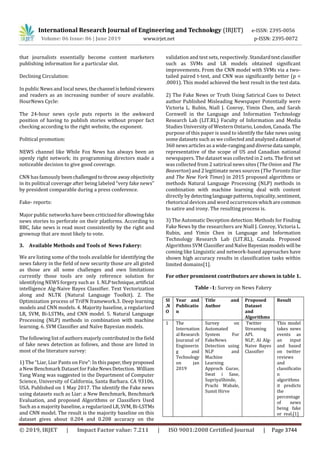
For other prominent contributors are shown in table 1.
Table -1: Survey on News Fakery
SI
.N
O
Year and
Publicatio
n
Title and
Author
Proposed
Dataset
and
Algorithms
Result
1 The
Internation
al Research
Jouranal of
Engineerin
g and
Technology
on jan
2019
Survey on
Automated
System For
FakeNews
Detection using
NLP and
Machine
Learning
Approch Gurav,
Swat i Sase,
SupriyaShinde,
Prachi Wabale,
Sumit Hirve
Twitter
Streaming
API.
NLP, AI Alg-
Naive Bayes
Classifier
This model
takes news
events as
an input
and based
on twitter
reviews
and
classificatio
n
algorithms
it predicts
the
percentage
of news
being fake
or real.[1]
International Research Journal of Engineering and Technology (IRJET) e-ISSN: 2395-0056
Volume: 06 Issue: 06 | June 2019 www.irjet.net p-ISSN: 2395-0072
© 2019, IRJET | Impact Factor value: 7.211 | ISO 9001:2008 Certified Journal | Page 3745
0
2
Arizona
State
University,
Penn State
University,
Huan Liu
on feb
2019
Beyond News
Content: The
Role of Social
Context for
FakeNews
Detection.ByKai
Shu, Suhang
Wang and Huar
Liu
FakeNewsNe
t dataset,
algorithms
are The
Optimization
process of
TriFN
framework
It worth to
explore
effective
features
and models
early fake
news
detection,
how to
extract
features to
model fake
news
intention
form
psychology
[3]
perspective
needs
further
investigatio
n.
0
3
On 3 june
2018 in
Beinhang
univerity
Beijin,Chin
a,Universit
y of Illinois
at Chicago
Chicago,
United
States,
Florida
State
university
united
States.
TI-CNN: CNN for
fake news
detection by
Yang Yang, Lei
Zheng, Jiawei
Zhang ingcai Cui
Kaggle
dataset
Deep
learning
models and
CNN models
The
experiment
al results
show that
the TI-CNN
can
successfully
identify the
fake news
based on
the explicit
features
and the
latent
features
learned
from the
convolution
al neurons.
Tools and Technology used for detecting the news fakery:
 Artificial Intelligence:
Components of AI
Applications Software/hardwarefor
training and models.
Image recognition GPUs
Speech recognition Parallel processing tools
Chatbots Cloud data storage and
computer platforms
Natural Language
generation
Programming
languages for building
models
Sentiment analysis Python, Tensor Flow,
Java, C
Types of models
 Deep learning: Deep learning is a breaking up
of machine learning. Deep learning algorithms
run data through several “layers” of neural
network algorithms.
 Machine learning: The knowledge of getting a
computer act without programming. In
Machine learning the used algorithms such as
Supervised learning, unsupervised learning
and Reinforcement learning
 Neural networks: Neural network algorithms
are a collection of models which are adept at
capturing non-linear patterns, or linear
patterns that are allowed to reuse.
4. Overview of News Fakery
Now we are seeing NEWS but not believing due to some
unhealthy and untruthfulness of the fake news publication
and telecasting in media. Making fake news is as easy as
news created by iconic personalities gossips. So now we
come across the end of the new technical century and
thinking of oldage scenario.,it causesmedia andsocial media
life.
5. Summery
After focusing milestones of fake news detection
technologies it indicates that there is a need for a believable
tool to test telecasted and publication of the news. All
technocrats and pioneer of modern digital engineer and
forensic expert together to identify the solution of existing
problem persist in the area of fake news detection.
6. CONCLUSION
We conclude that from the above summarization and look
backward towards challenges and milestones of the current
scenario, there is need of a powerful tool to identify fake
news detection before publication and make sense of social
welfare to build the ethical world. We look forward to all
what we are seeing is trustworthy news.
REFERENCES
[1] Gurav, Swat I Sase, SupriyaShinde, PrachiWabale,Sumit
Hirve by International Research Journal of Engineering
and Technology on Jan 2019
[2] Federico Monti, Fabrizio Frasca, Davide Eynard Damon
Mannion. Syracuse University,USA,SyracuseUniversity,
the USA on Dec 2018
[3] Kai Shu, Suhang Wang, and Huar Liu. Arizona State
University, Penn State University, Huan Liu on feb 2019
International Research Journal of Engineering and Technology (IRJET) e-ISSN: 2395-0056
Volume: 06 Issue: 06 | June 2019 www.irjet.net p-ISSN: 2395-0072
© 2019, IRJET | Impact Factor value: 7.211 | ISO 9001:2008 Certified Journal | Page 3746
[4] William Yang Wang in the Department of Computer
Science, University of California, Santa Barbara. CA
93106, USA. Published on 1 May 2017.
BIOGRAPHIES
Prof. GOVINDARAJ CHITTAPUR
Received the B.Sc. degree in
Computer Science from the
University of KUD, Darawad,
Karanatak, in 2002, the M.C.A
degree from VTU, Belgaum,
Karnataka, in 2005 and awarded
M.sc Technology by Research from
Mysore University in 2011. Has
Published 20 international journal
and a national journal has also
served as Reviewer and Editorial
Board Member of various
international journal and
conferences. His major research
area includes Image and Video
forensics. Machine learning and
Data Mining. He is a member of
many professional members like
IENG, CSTA, IEDRC as well as a
senior member of Asian society of
Researcher.
Miss. PUSHPA HANDARAGALL
received the BCA Degree from the
Ranichannamma University
Belgaum, Karnataka, in 2015, and
pursuing MCA degree under VTU,
Belgaum,Karnataka.2nd
Author
Photo
1’st
Author
Photo