International Research Journal of Engineering and Technology (IRJET) e-ISSN: 2395-0056
Volume: 05 Issue: 06 | June-2018 www.irjet.net p-ISSN: 2395-0072
© 2018, IRJET | Impact Factor value: 6.171 | ISO 9001:2008 Certified Journal | Page 1130
RELIABILITY ANALYSIS OF CFST COLUMNS BY USING FORM AND LATIN
HYPERCUBE METHOD
Prakruthi 1, Khalid Nayaz Khan2, N.S.Kumar3
1Final Year Student, Department of Civil Engineering, Ghousia college of Engineering, Karnataka, India
2Associate Professor, Department of Civil Engineering, Ghousia college of Engineering, Karnataka, India
3Professor and Director (R&D-Civil Engineering), Department of Civil Engineering, Ghousia college of Engineering,
Karnataka, India
---------------------------------------------------------------------***---------------------------------------------------------------------
Abstract- This thesis focus to study the behavior of axially
loaded concrete filled steel tube (CFST) segments under
monotonic loading by utilizing the finite element software
ANSYS. Modeling exactness is built up by using outcomes
obtained from BS 5400, Eurocode 4 and AS 3600 codes. It is
inferred that various parameters haveconsiderable impact on
the behavior of concrete filled steel columns, the prime
variables are cross sectional area, thickness, and diameter of
steel tube etc.., Most of the Researches on concrete filled steel
tube is limited to deterministic approach yet in this thesis it
also includes the reliability analysis of concrete filled steel
tubes using First Order Reliability method and Latin
Hypercube method utilizing 2R rel software.
KeyWords: CFST, ANSYS, Reliability, FORM, Latin
Hypercube, 2R rel
1. INTRODUCTION
Nowadays, the composite components are very much
effectively used in tall Buildings, Bridges and other various
types of structures because CFST columns have several
advantages over the conventional reinforced concrete and
structural steel columns. The first one is the concrete infill is
confined by the steel tube.
The second one is concrete infill delays local buckling of the
steel tube. And finally the combined capacity of the steel and
concrete significantly increases the stiffness and ultimate
strength of CFST columns which makes them very suitable
for columns and other compressive members. Finally, the
steel tube serves as longitudinal reinforcement and
permanent formwork for the concrete core.
1.1 CONCEPT OF RELIABILITY
Reliability is the ability to meet specific requirements under
a specified period. Structural reliability of thesystemcannot
be find through failure rates because
 the structure are unique in nature
 structure fails due to loads exceeding the
residual strength.
Therefore structural reliability models are built for
Resistance R and loads S independently and then structural
reliability is evaluated through probability of failure.
That is, Probability of failure, Pf = P(R-S< 0)
Reliability = 1-pf
 First order reliability method(FORM)
FORM was first developed by Hosfer st al (1974). It is fit for
handling non linear performance function using Taylor
series. FORM utilizes only mean and standard deviation of
variables.
Therefore, limit state function is given by Z= R-S
If both R & S are assumed as normal random variables, then
Z can also be referred as a random variables.
that is (𝜇𝑅−𝜇𝑠,√𝜎𝑅2+𝜎𝑠2). Then probabilityoffailurecan be
defined as
pf = P(Z<0)
pf =Φ[0-(μR-μS) ]
pf=1− Φ [𝜇𝑅−𝜇𝑆/ ]
Φ is the CFD of the standard normal variant
Thus, the probability of failure is a function of the mean
value of Z to its standard deviation.
𝛽 =𝜇𝑅−𝜇𝑆/(μR-μS) ]
The probability of failure can be expressed in terms of the
safety index as follows.
pf= Φ (−𝛽)=1−𝜑(𝛽)
 Latin hypercube method (LHM)
To increase the efficiency of monte carlo simulation
technique, a new sampling method is introduce called Latin
hypercube sampling. Latin hypercube sampling utilizes the
stratified sampling scheme to improve the coverage ofinput
space.
2. EXPERIMENTAL RESULTS
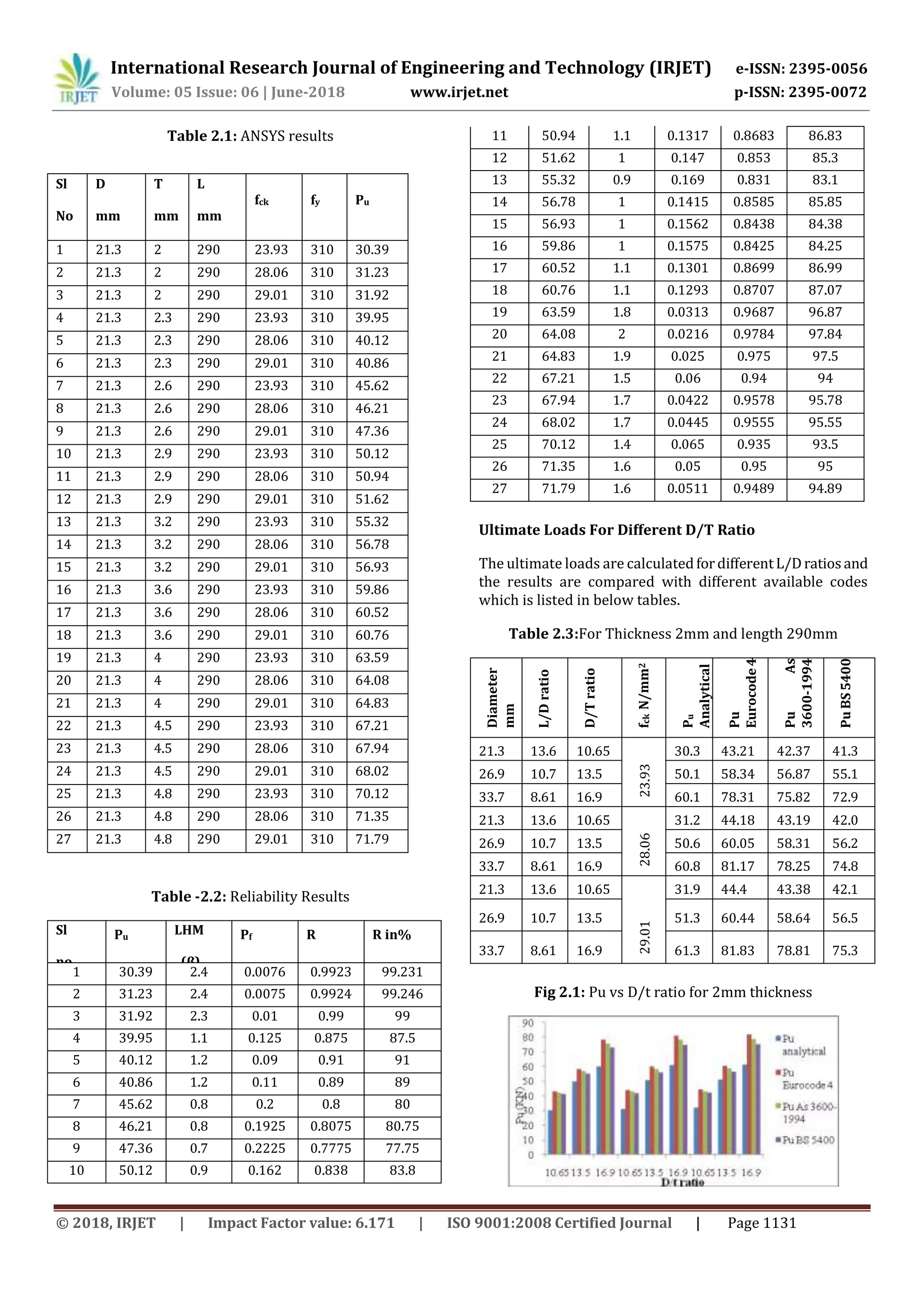
The ultimate loads are calculated by using ANSYS software
which are shown below table i.e. Table:2.1
International Research Journal of Engineering and Technology (IRJET) e-ISSN: 2395-0056
Volume: 05 Issue: 06 | June-2018 www.irjet.net p-ISSN: 2395-0072
© 2018, IRJET | Impact Factor value: 6.171 | ISO 9001:2008 Certified Journal | Page 1131
Table 2.1: ANSYS results
Table -2.2: Reliability Results
Sl
no
Pu
LHM
(β)
Pf R R in%
1 30.39 2.4 0.0076 0.9923 99.231
2 31.23 2.4 0.0075 0.9924 99.246
3 31.92 2.3 0.01 0.99 99
4 39.95 1.1 0.125 0.875 87.5
5 40.12 1.2 0.09 0.91 91
6 40.86 1.2 0.11 0.89 89
7 45.62 0.8 0.2 0.8 80
8 46.21 0.8 0.1925 0.8075 80.75
9 47.36 0.7 0.2225 0.7775 77.75
10 50.12 0.9 0.162 0.838 83.8
11 50.94 1.1 0.1317 0.8683 86.83
12 51.62 1 0.147 0.853 85.3
13 55.32 0.9 0.169 0.831 83.1
14 56.78 1 0.1415 0.8585 85.85
15 56.93 1 0.1562 0.8438 84.38
16 59.86 1 0.1575 0.8425 84.25
17 60.52 1.1 0.1301 0.8699 86.99
18 60.76 1.1 0.1293 0.8707 87.07
19 63.59 1.8 0.0313 0.9687 96.87
20 64.08 2 0.0216 0.9784 97.84
21 64.83 1.9 0.025 0.975 97.5
22 67.21 1.5 0.06 0.94 94
23 67.94 1.7 0.0422 0.9578 95.78
24 68.02 1.7 0.0445 0.9555 95.55
25 70.12 1.4 0.065 0.935 93.5
26 71.35 1.6 0.05 0.95 95
27 71.79 1.6 0.0511 0.9489 94.89
Ultimate Loads For Different D/T Ratio
The ultimate loads are calculatedfordifferentL/Dratiosand
the results are compared with different available codes
which is listed in below tables.
Table 2.3:For Thickness 2mm and length 290mm
Diameter
mm
L/Dratio
D/Tratio
fckN/mm2
Pu
Analytical
Pu
Eurocode4
PuAs
3600-1994
PuBS5400
21.3 13.6
2
10.65
23.93
30.3
9
43.21 42.37 41.3
26.9 10.7
8
13.5 50.1
2
58.34 56.87 55.1
33.7 8.61 16.9 60.1
5
78.31 75.82 72.9
21.3 13.6
2
10.65
28.06
31.2
3
44.18 43.19 42.0
26.9 10.7
8
13.5 50.6
8
60.05 58.31 56.2
33.7 8.61 16.9 60.8
7
81.17 78.25 74.8
21.3 13.6
2
10.65
29.01
31.9
2
44.4 43.38 42.1
26.9 10.7 13.5 51.3 60.44 58.64 56.5
33.7 8.61 16.9 61.3 81.83 78.81 75.3
Fig 2.1: Pu vs D/t ratio for 2mm thickness
Sl
No
D
mm
T
mm
L
mm
fck fy Pu
1 21.3 2 290 23.93 310 30.39
2 21.3 2 290 28.06 310 31.23
3 21.3 2 290 29.01 310 31.92
4 21.3 2.3 290 23.93 310 39.95
5 21.3 2.3 290 28.06 310 40.12
6 21.3 2.3 290 29.01 310 40.86
7 21.3 2.6 290 23.93 310 45.62
8 21.3 2.6 290 28.06 310 46.21
9 21.3 2.6 290 29.01 310 47.36
10 21.3 2.9 290 23.93 310 50.12
11 21.3 2.9 290 28.06 310 50.94
12 21.3 2.9 290 29.01 310 51.62
13 21.3 3.2 290 23.93 310 55.32
14 21.3 3.2 290 28.06 310 56.78
15 21.3 3.2 290 29.01 310 56.93
16 21.3 3.6 290 23.93 310 59.86
17 21.3 3.6 290 28.06 310 60.52
18 21.3 3.6 290 29.01 310 60.76
19 21.3 4 290 23.93 310 63.59
20 21.3 4 290 28.06 310 64.08
21 21.3 4 290 29.01 310 64.83
22 21.3 4.5 290 23.93 310 67.21
23 21.3 4.5 290 28.06 310 67.94
24 21.3 4.5 290 29.01 310 68.02
25 21.3 4.8 290 23.93 310 70.12
26 21.3 4.8 290 28.06 310 71.35
27 21.3 4.8 290 29.01 310 71.79
International Research Journal of Engineering and Technology (IRJET) e-ISSN: 2395-0056
Volume: 05 Issue: 06 | June-2018 www.irjet.net p-ISSN: 2395-0072
© 2018, IRJET | Impact Factor value: 6.171 | ISO 9001:2008 Certified Journal | Page 1132
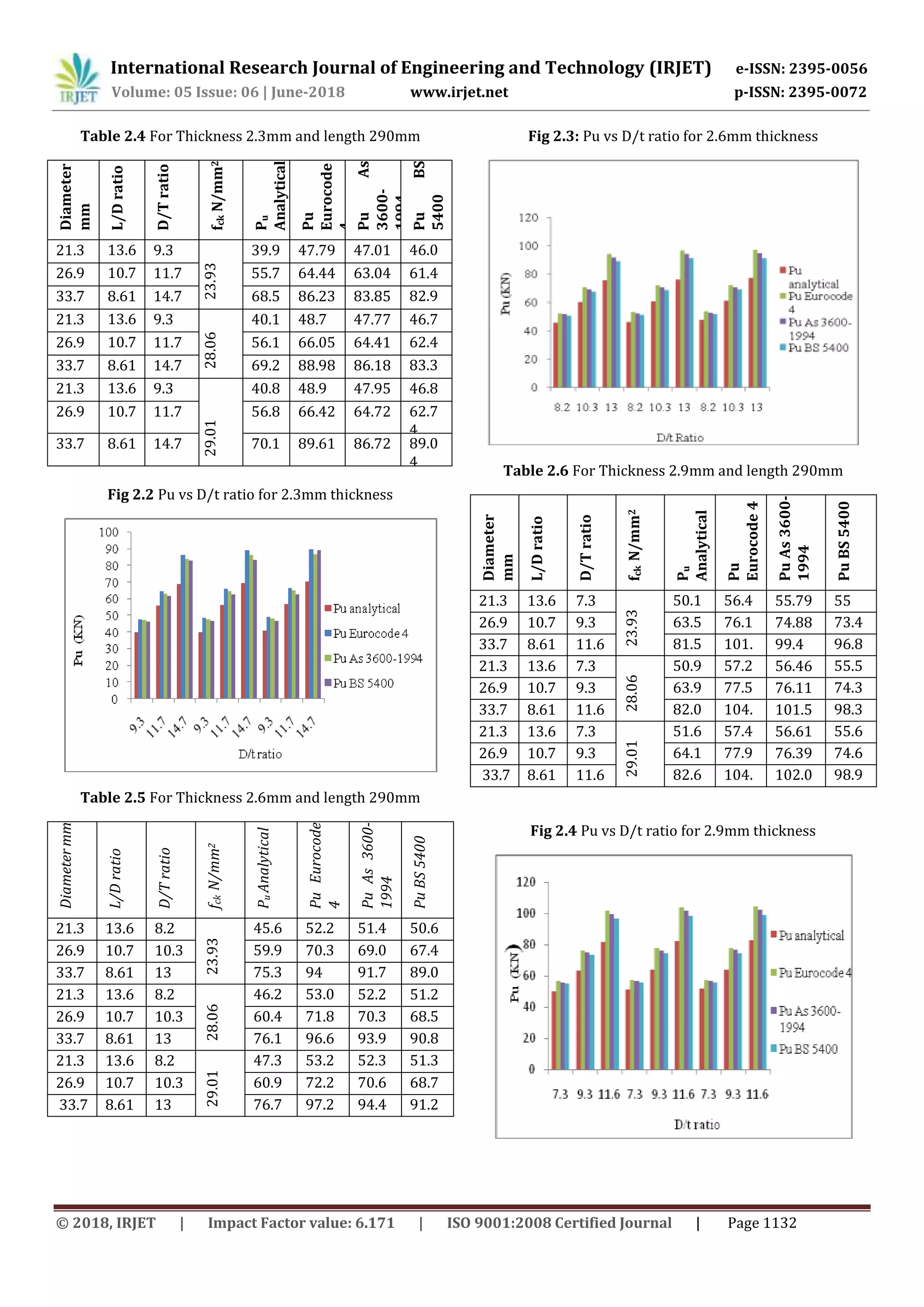
Table 2.4 For Thickness 2.3mm and length 290mm
Diameter
mm
L/Dratio
D/Tratio
fckN/mm2
Pu
Analytical
Pu
Eurocode
4
PuAs
3600-
1994
PuBS
5400
21.3 13.6
2
9.3
23.93
39.9 47.79 47.01 46.0
926.9 10.7
8
11.7 55.7 64.44 63.04 61.4
33.7 8.61 14.7 68.5 86.23 83.85 82.9
221.3 13.6
2
9.3
28.06
40.1 48.7 47.77 46.7
26.9 10.7
8
11.7 56.1 66.05 64.41 62.4
933.7 8.61 14.7 69.2 88.98 86.18 83.3
421.3 13.6
2
9.3
29.01
40.8 48.9 47.95 46.8
26.9 10.7 11.7 56.8 66.42 64.72 62.7
4
33.7 8.61 14.7 70.1 89.61 86.72 89.0
4
Fig 2.2 Pu vs D/t ratio for 2.3mm thickness
Table 2.5 For Thickness 2.6mm and length 290mm
Diametermm
L/Dratio
D/Tratio
fckN/mm2
PuAnalytical
PuEurocode
4
PuAs3600-
1994
PuBS5400
21.3 13.6 8.2
23.93
45.6
2
52.2
1
51.4
8
50.6
326.9 10.7 10.3 59.9
5
70.3
7
69.0
4
67.4
933.7 8.61 13 75.3
2
94 91.7
1
89.0
421.3 13.6 8.2
28.06
46.2
1
53.0
5
52.2 51.2
26.9 10.7 10.3 60.4
9
71.8
9
70.3
4
68.5
233.7 8.61 13 76.1
9
96.6
3
93.9
5
90.8
121.3 13.6 8.2
29.01
47.3
6
53.2
5
52.3
6
51.3
326.9 10.7 10.3 60.9
1
72.2
5
70.6
4
68.7
933.7 8.61 13 76.7
9
97.2
4
94.4
6
91.2
2
Fig 2.3: Pu vs D/t ratio for 2.6mm thickness
Table 2.6 For Thickness 2.9mm and length 290mm
Diameter
mm
L/Dratio
D/Tratio
fckN/mm2
Pu
Analytical
Pu
Eurocode4
PuAs3600-
1994
PuBS5400
21.3 13.6 7.3
23.93
50.1
2
56.4
7
55.79 55
26.9 10.7 9.3 63.5
2
76.1
4
74.88 73.4
233.7 8.61 11.6 81.5
6
101.
6
99.4 96.8
521.3 13.6 7.3
28.06
50.9
4
57.2
5
56.46 55.5
326.9 10.7 9.3 63.9
7
77.5
8
76.11 74.3
933.7 8.61 11.6 82.0
1
104.
1
101.5 98.3
521.3 13.6 7.3
29.01
51.6
2
57.4
2
56.61 55.6
526.9 10.7 9.3 64.1
2
77.9
1
76.39 74.6
233.7 8.61 11.6 82.6
8
104.
7
102.0
4
98.9
4
Fig 2.4 Pu vs D/t ratio for 2.9mm thickness
International Research Journal of Engineering and Technology (IRJET) e-ISSN: 2395-0056
Volume: 05 Issue: 06 | June-2018 www.irjet.net p-ISSN: 2395-0072
© 2018, IRJET | Impact Factor value: 6.171 | ISO 9001:2008 Certified Journal | Page 1133
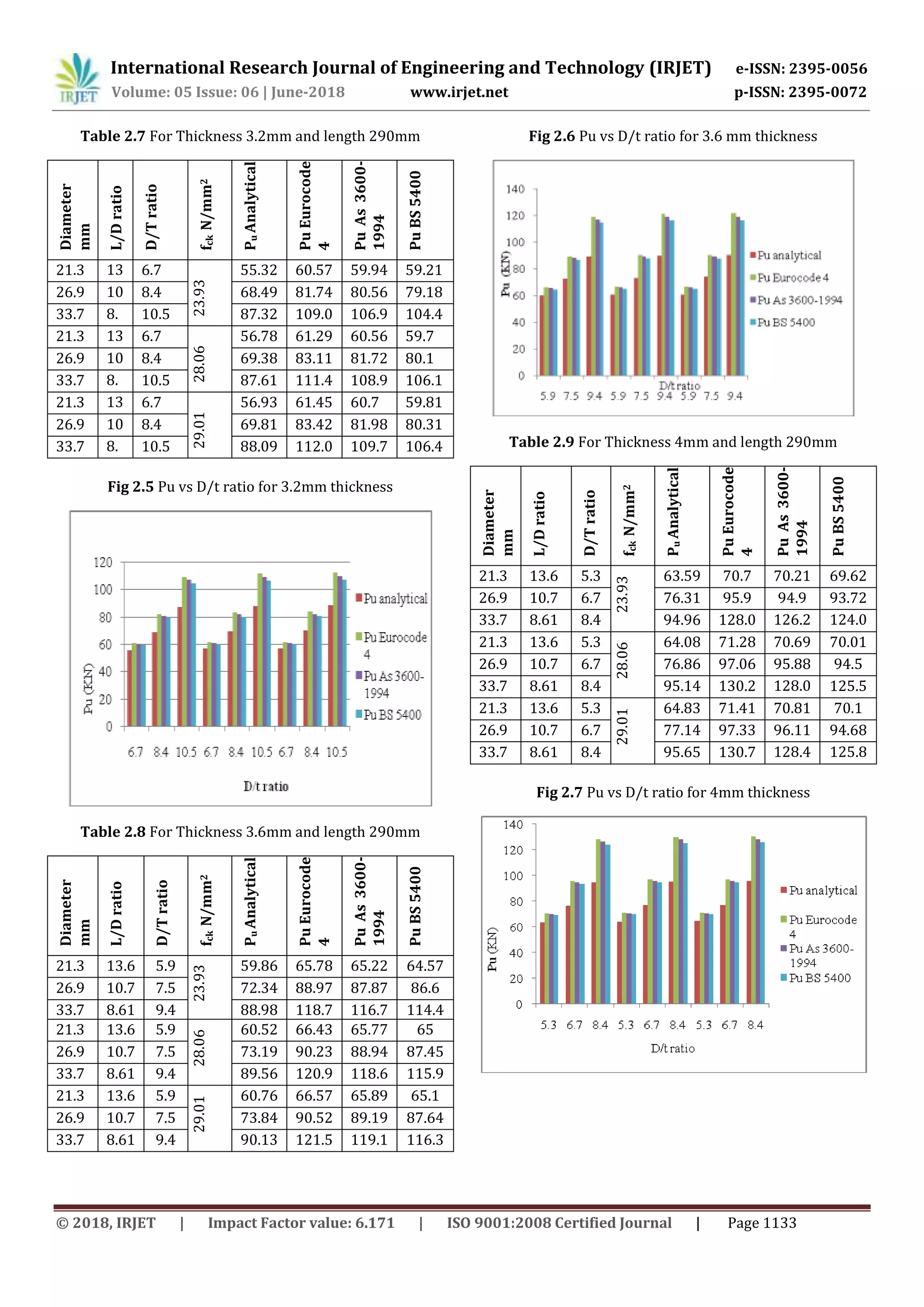
Table 2.7 For Thickness 3.2mm and length 290mm
Diameter
mm
L/Dratio
D/Tratio
fckN/mm2
PuAnalytical
PuEurocode
4
PuAs3600-
1994
PuBS5400
21.3 13
.6
6.7
23.93
55.32 60.57 59.94 59.21
26.9 10
.7
8.4 68.49 81.74 80.56 79.18
33.7 8.
61
10.5 87.32 109.0 106.9 104.4
21.3 13
.6
6.7
28.06
56.78 61.29 60.56 59.7
26.9 10
.7
8.4 69.38 83.11 81.72 80.1
33.7 8.
61
10.5 87.61 111.4 108.9 106.1
21.3 13
.6
6.7
29.01
56.93 61.45 60.7 59.81
26.9 10
.7
8.4 69.81 83.42 81.98 80.31
33.7 8.
61
10.5 88.09 112.0 109.7 106.4
Fig 2.5 Pu vs D/t ratio for 3.2mm thickness
Table 2.8 For Thickness 3.6mm and length 290mm
Diameter
mm
L/Dratio
D/Tratio
fckN/mm2
PuAnalytical
PuEurocode
4
PuAs3600-
1994
PuBS5400
21.3 13.6 5.9
23.93
59.86 65.78 65.22 64.57
26.9 10.7 7.5 72.34 88.97 87.87 86.6
33.7 8.61 9.4 88.98 118.7 116.7 114.4
21.3 13.6 5.9
28.06
60.52 66.43 65.77 65
26.9 10.7 7.5 73.19 90.23 88.94 87.45
33.7 8.61 9.4 89.56 120.9 118.6 115.9
21.3 13.6 5.9
29.01
60.76 66.57 65.89 65.1
26.9 10.7 7.5 73.84 90.52 89.19 87.64
33.7 8.61 9.4 90.13 121.5 119.1 116.3
Fig 2.6 Pu vs D/t ratio for 3.6 mm thickness
Table 2.9 For Thickness 4mm and length 290mm
Diameter
mm
L/Dratio
D/Tratio
fckN/mm2
PuAnalytical
PuEurocode
4
PuAs3600-
1994
PuBS5400
21.3 13.6 5.3
23.93
63.59 70.7 70.21 69.62
26.9 10.7 6.7 76.31 95.9 94.9 93.72
33.7 8.61 8.4 94.96 128.0 126.2
3
124.0
521.3 13.6 5.3
28.06
64.08 71.28 70.69 70.01
26.9 10.7 6.7 76.86 97.06 95.88 94.5
33.7 8.61 8.4 95.14 130.2 128.0
5
125.5
21.3 13.6 5.3
29.01
64.83 71.41 70.81 70.1
26.9 10.7 6.7 77.14 97.33 96.11 94.68
33.7 8.61 8.4 95.65 130.7 128.4
7
125.8
3
Fig 2.7 Pu vs D/t ratio for 4mm thickness
International Research Journal of Engineering and Technology (IRJET) e-ISSN: 2395-0056
Volume: 05 Issue: 06 | June-2018 www.irjet.net p-ISSN: 2395-0072
© 2018, IRJET | Impact Factor value: 6.171 | ISO 9001:2008 Certified Journal | Page 1134
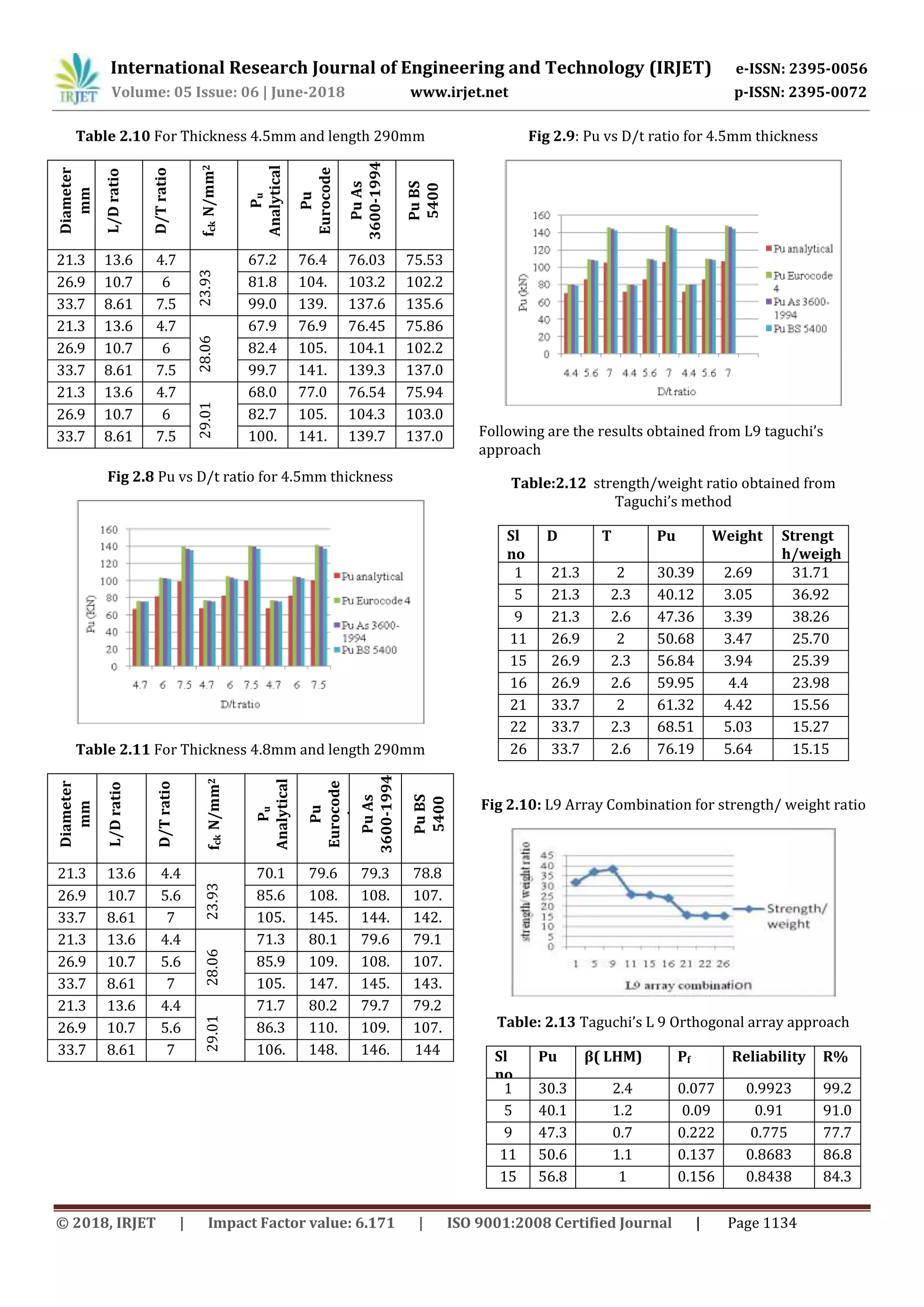
Table 2.10 For Thickness 4.5mm and length 290mm
Diameter
mm
L/Dratio
D/Tratio
fckN/mm2
Pu
Analytical
Pu
Eurocode
4
PuAs
3600-1994
PuBS
5400
21.3 13.6 4.7
23.93
67.2
1
76.4
6
76.03 75.53
26.9 10.7 6 81.8
2
104.
1
103.2
7
102.2
133.7 8.61 7.5 99.0
5
139.
4
137.6
9
135.6
821.3 13.6 4.7
28.06
67.9
4
76.9
5
76.45 75.86
26.9 10.7 6 82.4
2
105.
2
104.1
5
102.2
133.7 8.61 7.5 99.7
6
141.
3
139.3
7
137.0
221.3 13.6 4.7
29.01
68.0
2
77.0
6
76.54 75.94
26.9 10.7 6 82.7
3
105.
4
104.3
5
103.0
833.7 8.61 7.5 100.
5
141.
8
139.7
6
137.0
2
Fig 2.8 Pu vs D/t ratio for 4.5mm thickness
Table 2.11 For Thickness 4.8mm and length 290mm
Diameter
mm
L/Dratio
D/Tratio
fckN/mm2
Pu
Analytical
Pu
Eurocode
4
PuAs
3600-1994
PuBS
5400
21.3 13.6 4.4
23.93
70.1
2
79.6
9
79.3 78.8
526.9 10.7 5.6 85.6
3
108.
9
108.
0
107.
033.7 8.61 7 105.
2
145.
9
144.
3
142.
421.3 13.6 4.4
28.06
71.3
5
80.1
3
79.6
8
79.1
526.9 10.7 5.6 85.9
1
109.
8
108.
9
107.
733.7 8.61 7 105.
9
147.
8
145.
9
143.
721.3 13.6 4.4
29.01
71.7
9
80.2
4
79.7
7
79.2
226.9 10.7 5.6 86.3
2
110.
1
109.
0
107.
833.7 8.61 7 106.
3
148.
3
146.
3
144
Fig 2.9: Pu vs D/t ratio for 4.5mm thickness
Following are the results obtained from L9 taguchi’s
approach
Table:2.12 strength/weight ratio obtained from
Taguchi’s method
Sl
no
D
mm
T
mm
Pu Weight Strengt
h/weigh
t1 21.3 2 30.39 2.69 31.71
5 21.3 2.3 40.12 3.05 36.92
9 21.3 2.6 47.36 3.39 38.26
11 26.9 2 50.68 3.47 25.70
15 26.9 2.3 56.84 3.94 25.39
16 26.9 2.6 59.95 4.4 23.98
21 33.7 2 61.32 4.42 15.56
22 33.7 2.3 68.51 5.03 15.27
26 33.7 2.6 76.19 5.64 15.15
Fig 2.10: L9 Array Combination for strength/ weight ratio
Table: 2.13 Taguchi’s L 9 Orthogonal array approach
Sl
no
Pu β( LHM) Pf Reliability R%
1 30.3 2.4 0.077 0.9923 99.2
5 40.1 1.2 0.09 0.91 91.0
9 47.3 0.7 0.222 0.775 77.7
11 50.6 1.1 0.137 0.8683 86.8
15 56.8 1 0.156 0.8438 84.3
International Research Journal of Engineering and Technology (IRJET) e-ISSN: 2395-0056
Volume: 05 Issue: 06 | June-2018 www.irjet.net p-ISSN: 2395-0072
© 2018, IRJET | Impact Factor value: 6.171 | ISO 9001:2008 Certified Journal | Page 1135
16 59.9 1 0.157 0.8425 84.2
21 61.3 1.9 0.025 0.9750 97.5
22 68.5 1.5 0.06 0.94 94
26 76.1 1.6 0.05 0.95 95
Fig: 2.11Taguchi’s method vs Reliability
3. Conclusion
[1] The ultimate load Pu obtained from ANSYS result
shows that the ultimate load carrying capacity of
CFST tubes increases with increase in thickness.
[2] The ANSYS results shows that the ultimate load
carrying capacity of CFST columns increases with
decrease in D/t ratio.
[3] Ultimate load Pu obtained from ANSYS and various
codes like Eurocode, BS 5400 and AC3600-1999
shows that Pu obtained from ANSYS is higher than
the Pu obtained from codes.
[4] It is observed that as the L/D ratio decreases,
ultimate load Pu increases.
[5] The Reliability of member decreases with increases
in diameter.
[6] Maximum strength/ weight ratio is obtained for
model 9 having diameter 21.3mm and thickness
2.6mm.
[7] Maximum reliability of 99.23 % is obtained for
model 1 having diameter 21.3mm & thickness 2mm
4. References
[1] Structural Reliability Methods (2005) by O. Dittevsen
and H.O Madsen.
[2] Naveen Kumar S, Khalid Nayaz Khan and Dr N.S.
Kumar(2017) “Reliability analysis of concrete filled steel
Tube columns by FOSM & Subset simulation Technique”
Mtech dissertation 2017
[3] Reliability Analysis of composite columns a dissertation
by Pankaj Kumar Department of civil engineering IIT
Roorke(2002)
[4] Finite Element Analysis Theory and application with
ANSYS by Saeed Moaveni, Minnesoter state university
Mankato.
[5]Reliability Analysis for Structural design (2009) by
Milan Holicky.
[6] Syed Aqeeb Javeed Pasha, Khalid Nayaz Khan and Dr
N.S.Kumar “Reliability analysis (FORM level-1 method)
of concrete filled steel tube columns using NASTRAN
Software Mtech dissertation 2016.
Biographies
Graduated in the year 2016 from
VTU, Belgaum. Presently perusing
Master of Technology in Structural
Engineering at Ghousia College of
Engineering, Ramanagaram Also
working on this topic for the
dissertation under the guidance of
Khalid Nayaz khan and Dr. N S
Kumar.
Associate Professor Dept. of Civil
Engineering GCE, Ramanagaram
562159. He has a teaching
experience of 32 years. Has
published about 13 papers in
various journals.
Involved in the Research field
related to behavior of Composite
Steel Column since a decade.
Presently guiding 6 Ph.D Scholars
(Research under VTU, Belgaum).
Has more than 29 years of
teaching experience &6 years of
Research experience at Ghousia
College of Engineering,
Ramanagaram.
2nd
Author
Photo
3rd
Author
Photo
1’st
Author
Photo

IRJET- Reliability Analysis of CFST Columns by using Form and Latin Hypercube Method

  • 1.
    International Research Journalof Engineering and Technology (IRJET) e-ISSN: 2395-0056 Volume: 05 Issue: 06 | June-2018 www.irjet.net p-ISSN: 2395-0072 © 2018, IRJET | Impact Factor value: 6.171 | ISO 9001:2008 Certified Journal | Page 1130 RELIABILITY ANALYSIS OF CFST COLUMNS BY USING FORM AND LATIN HYPERCUBE METHOD Prakruthi 1, Khalid Nayaz Khan2, N.S.Kumar3 1Final Year Student, Department of Civil Engineering, Ghousia college of Engineering, Karnataka, India 2Associate Professor, Department of Civil Engineering, Ghousia college of Engineering, Karnataka, India 3Professor and Director (R&D-Civil Engineering), Department of Civil Engineering, Ghousia college of Engineering, Karnataka, India ---------------------------------------------------------------------***--------------------------------------------------------------------- Abstract- This thesis focus to study the behavior of axially loaded concrete filled steel tube (CFST) segments under monotonic loading by utilizing the finite element software ANSYS. Modeling exactness is built up by using outcomes obtained from BS 5400, Eurocode 4 and AS 3600 codes. It is inferred that various parameters haveconsiderable impact on the behavior of concrete filled steel columns, the prime variables are cross sectional area, thickness, and diameter of steel tube etc.., Most of the Researches on concrete filled steel tube is limited to deterministic approach yet in this thesis it also includes the reliability analysis of concrete filled steel tubes using First Order Reliability method and Latin Hypercube method utilizing 2R rel software. KeyWords: CFST, ANSYS, Reliability, FORM, Latin Hypercube, 2R rel 1. INTRODUCTION Nowadays, the composite components are very much effectively used in tall Buildings, Bridges and other various types of structures because CFST columns have several advantages over the conventional reinforced concrete and structural steel columns. The first one is the concrete infill is confined by the steel tube. The second one is concrete infill delays local buckling of the steel tube. And finally the combined capacity of the steel and concrete significantly increases the stiffness and ultimate strength of CFST columns which makes them very suitable for columns and other compressive members. Finally, the steel tube serves as longitudinal reinforcement and permanent formwork for the concrete core. 1.1 CONCEPT OF RELIABILITY Reliability is the ability to meet specific requirements under a specified period. Structural reliability of thesystemcannot be find through failure rates because  the structure are unique in nature  structure fails due to loads exceeding the residual strength. Therefore structural reliability models are built for Resistance R and loads S independently and then structural reliability is evaluated through probability of failure. That is, Probability of failure, Pf = P(R-S< 0) Reliability = 1-pf  First order reliability method(FORM) FORM was first developed by Hosfer st al (1974). It is fit for handling non linear performance function using Taylor series. FORM utilizes only mean and standard deviation of variables. Therefore, limit state function is given by Z= R-S If both R & S are assumed as normal random variables, then Z can also be referred as a random variables. that is (𝜇𝑅−𝜇𝑠,√𝜎𝑅2+𝜎𝑠2). Then probabilityoffailurecan be defined as pf = P(Z<0) pf =Φ[0-(μR-μS) ] pf=1− Φ [𝜇𝑅−𝜇𝑆/ ] Φ is the CFD of the standard normal variant Thus, the probability of failure is a function of the mean value of Z to its standard deviation. 𝛽 =𝜇𝑅−𝜇𝑆/(μR-μS) ] The probability of failure can be expressed in terms of the safety index as follows. pf= Φ (−𝛽)=1−𝜑(𝛽)  Latin hypercube method (LHM) To increase the efficiency of monte carlo simulation technique, a new sampling method is introduce called Latin hypercube sampling. Latin hypercube sampling utilizes the stratified sampling scheme to improve the coverage ofinput space. 2. EXPERIMENTAL RESULTS The ultimate loads are calculated by using ANSYS software which are shown below table i.e. Table:2.1
  • 2.
    International Research Journalof Engineering and Technology (IRJET) e-ISSN: 2395-0056 Volume: 05 Issue: 06 | June-2018 www.irjet.net p-ISSN: 2395-0072 © 2018, IRJET | Impact Factor value: 6.171 | ISO 9001:2008 Certified Journal | Page 1131 Table 2.1: ANSYS results Table -2.2: Reliability Results Sl no Pu LHM (β) Pf R R in% 1 30.39 2.4 0.0076 0.9923 99.231 2 31.23 2.4 0.0075 0.9924 99.246 3 31.92 2.3 0.01 0.99 99 4 39.95 1.1 0.125 0.875 87.5 5 40.12 1.2 0.09 0.91 91 6 40.86 1.2 0.11 0.89 89 7 45.62 0.8 0.2 0.8 80 8 46.21 0.8 0.1925 0.8075 80.75 9 47.36 0.7 0.2225 0.7775 77.75 10 50.12 0.9 0.162 0.838 83.8 11 50.94 1.1 0.1317 0.8683 86.83 12 51.62 1 0.147 0.853 85.3 13 55.32 0.9 0.169 0.831 83.1 14 56.78 1 0.1415 0.8585 85.85 15 56.93 1 0.1562 0.8438 84.38 16 59.86 1 0.1575 0.8425 84.25 17 60.52 1.1 0.1301 0.8699 86.99 18 60.76 1.1 0.1293 0.8707 87.07 19 63.59 1.8 0.0313 0.9687 96.87 20 64.08 2 0.0216 0.9784 97.84 21 64.83 1.9 0.025 0.975 97.5 22 67.21 1.5 0.06 0.94 94 23 67.94 1.7 0.0422 0.9578 95.78 24 68.02 1.7 0.0445 0.9555 95.55 25 70.12 1.4 0.065 0.935 93.5 26 71.35 1.6 0.05 0.95 95 27 71.79 1.6 0.0511 0.9489 94.89 Ultimate Loads For Different D/T Ratio The ultimate loads are calculatedfordifferentL/Dratiosand the results are compared with different available codes which is listed in below tables. Table 2.3:For Thickness 2mm and length 290mm Diameter mm L/Dratio D/Tratio fckN/mm2 Pu Analytical Pu Eurocode4 PuAs 3600-1994 PuBS5400 21.3 13.6 2 10.65 23.93 30.3 9 43.21 42.37 41.3 26.9 10.7 8 13.5 50.1 2 58.34 56.87 55.1 33.7 8.61 16.9 60.1 5 78.31 75.82 72.9 21.3 13.6 2 10.65 28.06 31.2 3 44.18 43.19 42.0 26.9 10.7 8 13.5 50.6 8 60.05 58.31 56.2 33.7 8.61 16.9 60.8 7 81.17 78.25 74.8 21.3 13.6 2 10.65 29.01 31.9 2 44.4 43.38 42.1 26.9 10.7 13.5 51.3 60.44 58.64 56.5 33.7 8.61 16.9 61.3 81.83 78.81 75.3 Fig 2.1: Pu vs D/t ratio for 2mm thickness Sl No D mm T mm L mm fck fy Pu 1 21.3 2 290 23.93 310 30.39 2 21.3 2 290 28.06 310 31.23 3 21.3 2 290 29.01 310 31.92 4 21.3 2.3 290 23.93 310 39.95 5 21.3 2.3 290 28.06 310 40.12 6 21.3 2.3 290 29.01 310 40.86 7 21.3 2.6 290 23.93 310 45.62 8 21.3 2.6 290 28.06 310 46.21 9 21.3 2.6 290 29.01 310 47.36 10 21.3 2.9 290 23.93 310 50.12 11 21.3 2.9 290 28.06 310 50.94 12 21.3 2.9 290 29.01 310 51.62 13 21.3 3.2 290 23.93 310 55.32 14 21.3 3.2 290 28.06 310 56.78 15 21.3 3.2 290 29.01 310 56.93 16 21.3 3.6 290 23.93 310 59.86 17 21.3 3.6 290 28.06 310 60.52 18 21.3 3.6 290 29.01 310 60.76 19 21.3 4 290 23.93 310 63.59 20 21.3 4 290 28.06 310 64.08 21 21.3 4 290 29.01 310 64.83 22 21.3 4.5 290 23.93 310 67.21 23 21.3 4.5 290 28.06 310 67.94 24 21.3 4.5 290 29.01 310 68.02 25 21.3 4.8 290 23.93 310 70.12 26 21.3 4.8 290 28.06 310 71.35 27 21.3 4.8 290 29.01 310 71.79
  • 3.
    International Research Journalof Engineering and Technology (IRJET) e-ISSN: 2395-0056 Volume: 05 Issue: 06 | June-2018 www.irjet.net p-ISSN: 2395-0072 © 2018, IRJET | Impact Factor value: 6.171 | ISO 9001:2008 Certified Journal | Page 1132 Table 2.4 For Thickness 2.3mm and length 290mm Diameter mm L/Dratio D/Tratio fckN/mm2 Pu Analytical Pu Eurocode 4 PuAs 3600- 1994 PuBS 5400 21.3 13.6 2 9.3 23.93 39.9 47.79 47.01 46.0 926.9 10.7 8 11.7 55.7 64.44 63.04 61.4 33.7 8.61 14.7 68.5 86.23 83.85 82.9 221.3 13.6 2 9.3 28.06 40.1 48.7 47.77 46.7 26.9 10.7 8 11.7 56.1 66.05 64.41 62.4 933.7 8.61 14.7 69.2 88.98 86.18 83.3 421.3 13.6 2 9.3 29.01 40.8 48.9 47.95 46.8 26.9 10.7 11.7 56.8 66.42 64.72 62.7 4 33.7 8.61 14.7 70.1 89.61 86.72 89.0 4 Fig 2.2 Pu vs D/t ratio for 2.3mm thickness Table 2.5 For Thickness 2.6mm and length 290mm Diametermm L/Dratio D/Tratio fckN/mm2 PuAnalytical PuEurocode 4 PuAs3600- 1994 PuBS5400 21.3 13.6 8.2 23.93 45.6 2 52.2 1 51.4 8 50.6 326.9 10.7 10.3 59.9 5 70.3 7 69.0 4 67.4 933.7 8.61 13 75.3 2 94 91.7 1 89.0 421.3 13.6 8.2 28.06 46.2 1 53.0 5 52.2 51.2 26.9 10.7 10.3 60.4 9 71.8 9 70.3 4 68.5 233.7 8.61 13 76.1 9 96.6 3 93.9 5 90.8 121.3 13.6 8.2 29.01 47.3 6 53.2 5 52.3 6 51.3 326.9 10.7 10.3 60.9 1 72.2 5 70.6 4 68.7 933.7 8.61 13 76.7 9 97.2 4 94.4 6 91.2 2 Fig 2.3: Pu vs D/t ratio for 2.6mm thickness Table 2.6 For Thickness 2.9mm and length 290mm Diameter mm L/Dratio D/Tratio fckN/mm2 Pu Analytical Pu Eurocode4 PuAs3600- 1994 PuBS5400 21.3 13.6 7.3 23.93 50.1 2 56.4 7 55.79 55 26.9 10.7 9.3 63.5 2 76.1 4 74.88 73.4 233.7 8.61 11.6 81.5 6 101. 6 99.4 96.8 521.3 13.6 7.3 28.06 50.9 4 57.2 5 56.46 55.5 326.9 10.7 9.3 63.9 7 77.5 8 76.11 74.3 933.7 8.61 11.6 82.0 1 104. 1 101.5 98.3 521.3 13.6 7.3 29.01 51.6 2 57.4 2 56.61 55.6 526.9 10.7 9.3 64.1 2 77.9 1 76.39 74.6 233.7 8.61 11.6 82.6 8 104. 7 102.0 4 98.9 4 Fig 2.4 Pu vs D/t ratio for 2.9mm thickness
  • 4.
    International Research Journalof Engineering and Technology (IRJET) e-ISSN: 2395-0056 Volume: 05 Issue: 06 | June-2018 www.irjet.net p-ISSN: 2395-0072 © 2018, IRJET | Impact Factor value: 6.171 | ISO 9001:2008 Certified Journal | Page 1133 Table 2.7 For Thickness 3.2mm and length 290mm Diameter mm L/Dratio D/Tratio fckN/mm2 PuAnalytical PuEurocode 4 PuAs3600- 1994 PuBS5400 21.3 13 .6 6.7 23.93 55.32 60.57 59.94 59.21 26.9 10 .7 8.4 68.49 81.74 80.56 79.18 33.7 8. 61 10.5 87.32 109.0 106.9 104.4 21.3 13 .6 6.7 28.06 56.78 61.29 60.56 59.7 26.9 10 .7 8.4 69.38 83.11 81.72 80.1 33.7 8. 61 10.5 87.61 111.4 108.9 106.1 21.3 13 .6 6.7 29.01 56.93 61.45 60.7 59.81 26.9 10 .7 8.4 69.81 83.42 81.98 80.31 33.7 8. 61 10.5 88.09 112.0 109.7 106.4 Fig 2.5 Pu vs D/t ratio for 3.2mm thickness Table 2.8 For Thickness 3.6mm and length 290mm Diameter mm L/Dratio D/Tratio fckN/mm2 PuAnalytical PuEurocode 4 PuAs3600- 1994 PuBS5400 21.3 13.6 5.9 23.93 59.86 65.78 65.22 64.57 26.9 10.7 7.5 72.34 88.97 87.87 86.6 33.7 8.61 9.4 88.98 118.7 116.7 114.4 21.3 13.6 5.9 28.06 60.52 66.43 65.77 65 26.9 10.7 7.5 73.19 90.23 88.94 87.45 33.7 8.61 9.4 89.56 120.9 118.6 115.9 21.3 13.6 5.9 29.01 60.76 66.57 65.89 65.1 26.9 10.7 7.5 73.84 90.52 89.19 87.64 33.7 8.61 9.4 90.13 121.5 119.1 116.3 Fig 2.6 Pu vs D/t ratio for 3.6 mm thickness Table 2.9 For Thickness 4mm and length 290mm Diameter mm L/Dratio D/Tratio fckN/mm2 PuAnalytical PuEurocode 4 PuAs3600- 1994 PuBS5400 21.3 13.6 5.3 23.93 63.59 70.7 70.21 69.62 26.9 10.7 6.7 76.31 95.9 94.9 93.72 33.7 8.61 8.4 94.96 128.0 126.2 3 124.0 521.3 13.6 5.3 28.06 64.08 71.28 70.69 70.01 26.9 10.7 6.7 76.86 97.06 95.88 94.5 33.7 8.61 8.4 95.14 130.2 128.0 5 125.5 21.3 13.6 5.3 29.01 64.83 71.41 70.81 70.1 26.9 10.7 6.7 77.14 97.33 96.11 94.68 33.7 8.61 8.4 95.65 130.7 128.4 7 125.8 3 Fig 2.7 Pu vs D/t ratio for 4mm thickness
  • 5.
    International Research Journalof Engineering and Technology (IRJET) e-ISSN: 2395-0056 Volume: 05 Issue: 06 | June-2018 www.irjet.net p-ISSN: 2395-0072 © 2018, IRJET | Impact Factor value: 6.171 | ISO 9001:2008 Certified Journal | Page 1134 Table 2.10 For Thickness 4.5mm and length 290mm Diameter mm L/Dratio D/Tratio fckN/mm2 Pu Analytical Pu Eurocode 4 PuAs 3600-1994 PuBS 5400 21.3 13.6 4.7 23.93 67.2 1 76.4 6 76.03 75.53 26.9 10.7 6 81.8 2 104. 1 103.2 7 102.2 133.7 8.61 7.5 99.0 5 139. 4 137.6 9 135.6 821.3 13.6 4.7 28.06 67.9 4 76.9 5 76.45 75.86 26.9 10.7 6 82.4 2 105. 2 104.1 5 102.2 133.7 8.61 7.5 99.7 6 141. 3 139.3 7 137.0 221.3 13.6 4.7 29.01 68.0 2 77.0 6 76.54 75.94 26.9 10.7 6 82.7 3 105. 4 104.3 5 103.0 833.7 8.61 7.5 100. 5 141. 8 139.7 6 137.0 2 Fig 2.8 Pu vs D/t ratio for 4.5mm thickness Table 2.11 For Thickness 4.8mm and length 290mm Diameter mm L/Dratio D/Tratio fckN/mm2 Pu Analytical Pu Eurocode 4 PuAs 3600-1994 PuBS 5400 21.3 13.6 4.4 23.93 70.1 2 79.6 9 79.3 78.8 526.9 10.7 5.6 85.6 3 108. 9 108. 0 107. 033.7 8.61 7 105. 2 145. 9 144. 3 142. 421.3 13.6 4.4 28.06 71.3 5 80.1 3 79.6 8 79.1 526.9 10.7 5.6 85.9 1 109. 8 108. 9 107. 733.7 8.61 7 105. 9 147. 8 145. 9 143. 721.3 13.6 4.4 29.01 71.7 9 80.2 4 79.7 7 79.2 226.9 10.7 5.6 86.3 2 110. 1 109. 0 107. 833.7 8.61 7 106. 3 148. 3 146. 3 144 Fig 2.9: Pu vs D/t ratio for 4.5mm thickness Following are the results obtained from L9 taguchi’s approach Table:2.12 strength/weight ratio obtained from Taguchi’s method Sl no D mm T mm Pu Weight Strengt h/weigh t1 21.3 2 30.39 2.69 31.71 5 21.3 2.3 40.12 3.05 36.92 9 21.3 2.6 47.36 3.39 38.26 11 26.9 2 50.68 3.47 25.70 15 26.9 2.3 56.84 3.94 25.39 16 26.9 2.6 59.95 4.4 23.98 21 33.7 2 61.32 4.42 15.56 22 33.7 2.3 68.51 5.03 15.27 26 33.7 2.6 76.19 5.64 15.15 Fig 2.10: L9 Array Combination for strength/ weight ratio Table: 2.13 Taguchi’s L 9 Orthogonal array approach Sl no Pu β( LHM) Pf Reliability R% 1 30.3 2.4 0.077 0.9923 99.2 5 40.1 1.2 0.09 0.91 91.0 9 47.3 0.7 0.222 0.775 77.7 11 50.6 1.1 0.137 0.8683 86.8 15 56.8 1 0.156 0.8438 84.3
  • 6.
    International Research Journalof Engineering and Technology (IRJET) e-ISSN: 2395-0056 Volume: 05 Issue: 06 | June-2018 www.irjet.net p-ISSN: 2395-0072 © 2018, IRJET | Impact Factor value: 6.171 | ISO 9001:2008 Certified Journal | Page 1135 16 59.9 1 0.157 0.8425 84.2 21 61.3 1.9 0.025 0.9750 97.5 22 68.5 1.5 0.06 0.94 94 26 76.1 1.6 0.05 0.95 95 Fig: 2.11Taguchi’s method vs Reliability 3. Conclusion [1] The ultimate load Pu obtained from ANSYS result shows that the ultimate load carrying capacity of CFST tubes increases with increase in thickness. [2] The ANSYS results shows that the ultimate load carrying capacity of CFST columns increases with decrease in D/t ratio. [3] Ultimate load Pu obtained from ANSYS and various codes like Eurocode, BS 5400 and AC3600-1999 shows that Pu obtained from ANSYS is higher than the Pu obtained from codes. [4] It is observed that as the L/D ratio decreases, ultimate load Pu increases. [5] The Reliability of member decreases with increases in diameter. [6] Maximum strength/ weight ratio is obtained for model 9 having diameter 21.3mm and thickness 2.6mm. [7] Maximum reliability of 99.23 % is obtained for model 1 having diameter 21.3mm & thickness 2mm 4. References [1] Structural Reliability Methods (2005) by O. Dittevsen and H.O Madsen. [2] Naveen Kumar S, Khalid Nayaz Khan and Dr N.S. Kumar(2017) “Reliability analysis of concrete filled steel Tube columns by FOSM & Subset simulation Technique” Mtech dissertation 2017 [3] Reliability Analysis of composite columns a dissertation by Pankaj Kumar Department of civil engineering IIT Roorke(2002) [4] Finite Element Analysis Theory and application with ANSYS by Saeed Moaveni, Minnesoter state university Mankato. [5]Reliability Analysis for Structural design (2009) by Milan Holicky. [6] Syed Aqeeb Javeed Pasha, Khalid Nayaz Khan and Dr N.S.Kumar “Reliability analysis (FORM level-1 method) of concrete filled steel tube columns using NASTRAN Software Mtech dissertation 2016. Biographies Graduated in the year 2016 from VTU, Belgaum. Presently perusing Master of Technology in Structural Engineering at Ghousia College of Engineering, Ramanagaram Also working on this topic for the dissertation under the guidance of Khalid Nayaz khan and Dr. N S Kumar. Associate Professor Dept. of Civil Engineering GCE, Ramanagaram 562159. He has a teaching experience of 32 years. Has published about 13 papers in various journals. Involved in the Research field related to behavior of Composite Steel Column since a decade. Presently guiding 6 Ph.D Scholars (Research under VTU, Belgaum). Has more than 29 years of teaching experience &6 years of Research experience at Ghousia College of Engineering, Ramanagaram. 2nd Author Photo 3rd Author Photo 1’st Author Photo