International Research Journal of Engineering and Technology (IRJET) e-ISSN: 2395-0056
Volume: 06 Issue: 08 | Aug 2019 www.irjet.net p-ISSN: 2395-0072
© 2019, IRJET | Impact Factor value: 7.34 | ISO 9001:2008 Certified Journal | Page 627
Recent Trends and Insight towards Automated Identification of Plant
Species
Neethu Kannan B1, Sunil Kumar KN2, Bharath Paturi3
1Siddha Regional Research Institute, Thiruvananthapuram, Kerala
2Siddha Central Research Institute, Arumbakkam, Chennai
3Machine Learning Specialist, Standard Chartered Business Services, Bangalore
---------------------------------------------------------------------***--------------------------------------------------------------------
Abstract - The identification of plants by conventional
keys and description is complex and tedious, due to the use
of specific botanical terms making it quite difficult for non-
experts and novices. In automated plant identification, leaf-
based recognition is more common and reliable as it is
claimed to be easily accessible and abundant compared to
other plant morphological structures such as flowers, barks
or fruits. Apart from using the leaf, the plant identification
can be performed using various parts of a plant like stem,
flower, petal, seed and leaf. Image acquisition, pre-
processing (noise removal and segmentation), extracting
features, matching algorithm and identification are the
main steps in the automated plant identification. Artificial
Neural Network (ANN) is a machine learning algorithm
commonly used to build identification models, which is more
efficient and accurate compared to other algorithmic
models. Development of deep learning technology based on
automated database will contribute to significantly increase
the volume of descriptions of new species in the following
years. Convolutional Neural Network (CNN) is a popular
classifier of deep learning technology which opens the
innovative doors of automated plant identification based on
foliage recognition.
Keywords: Artificial Intelligence for plant identification,
artificial neural network, convolutional Neural Network
deep learning, Machine learning.
1. INTRODUCTION
Species identification plays an important role in
botanical research, but traditional identification tools,
which mainly depends on reference books or identification
keys, is often recognized as a difficult task, especially for
novices. In addition, with the deterioration of
environments, even though many of the rare plant species
are already dead, still many more of the rare plant species
are at the margin of extinction. So, the investigation of
plant recognition can contribute to environmental
protection (1). The plant world is in constant flux, due to
human and other factors, the possibility of extinction for
many plants and animals can be envisaged. Hence, plant
identification is an important task because of concerns
about climate change and the resultant changes in
geographic distribution also. In recent decades, many
efforts have been made by taxonomists and programmers
to ease the difficulty of species identification by
developing a range of tools that increasingly involved the
use of computers.
Image-based methods are considered a promising
approach for species identification (2, 3) A user can take a
picture of a plant in the field with the built-in camera of a
mobile device and analyze it with an installed recognition
application to identify the species or at least to receive a
list of possible species if a single match is impossible. By
using a computer-aided plant identification system, non-
professionals also can take part in this process. Therefore,
it is not surprising that large numbers of research studies
are devoted to automate the plant species identification
process.
Generally in automated system, plants can be
identified based on their leaves, flowers, fruits or plant as
a whole. Among all the modalities, leaves are considered
as a major and promising modality for effective
classification of plants. Leaves are easier accessible and
abundant compared to other plant morphological
structures such as flowers, barks or fruits (4, 5). In almost
all automatic leaf plant identification, shape of the leaves is
the most common feature used for identification as it is
claimed to be the most discriminative feature of a plant’s
leaf. The present paper is an attempt to highlight the
recent trends, perspectives as well as the challenges of
automated plant identification.
1.1 General plant recognition system
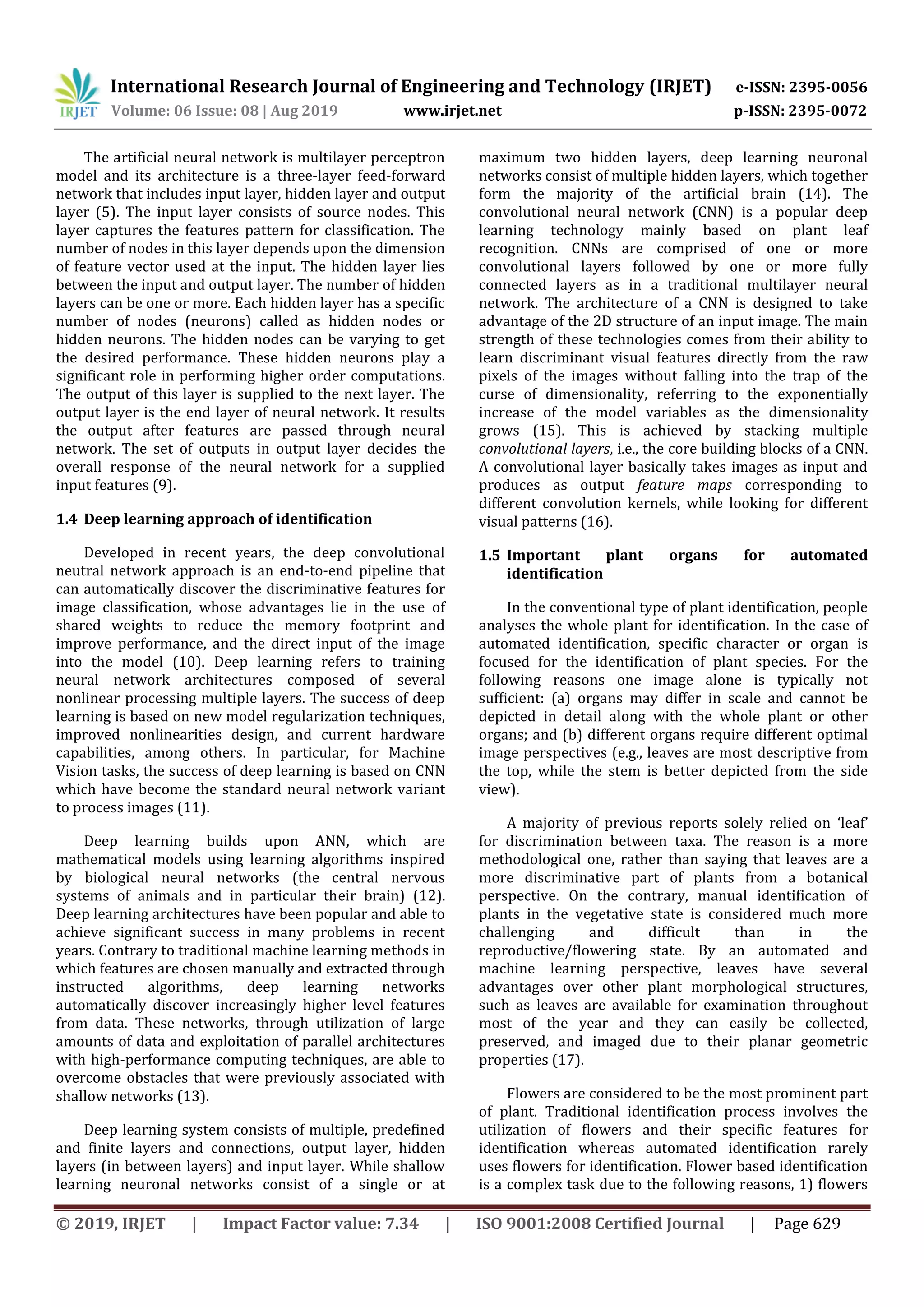
Automated plant identification process begins with
capturing of the image of whole plant or its specific organs
and then performing enhancement of the image captured,
extracting or reducing the important features from the
image and matching the extracted features with the image
database to identify the plant species. All the steps
involved are considered very important for the accuracy
and efficiency of the classifier and are explained below.
1.1.1 Image acquisition
The process involves capturing the image of organs of
plant so that analysis towards classification can be
performed. Images are usually captured by digital cameras
or scanners in formats like JPEG, BMP or GIF.
International Research Journal of Engineering and Technology (IRJET) e-ISSN: 2395-0056
Volume: 06 Issue: 08 | Aug 2019 www.irjet.net p-ISSN: 2395-0072
© 2019, IRJET | Impact Factor value: 7.34 | ISO 9001:2008 Certified Journal | Page 628
1.1.2 Pre-processing
The pre-processing generally involves denoising,
image content enhancement and segmentation. Noise is
defined as anything that hinders the identification and
recognition system. The input data always contains some
amount of noise, removal of which is always desirable to
fulfill the task. Enhancement techniques also include
operations that can improve leaf image properties which
help to increase the overall performance of the
identification system. The segmentation is a process which
subdivides the input image into various parts of
meaningful entities. Segmentation techniques use the
various features extracted like gray or color features or
texture features to separate the various regions of the
input image. All these methods work on a common
objective, that is, to provide a solution for efficient
automatic image segmentation.
1.1.3 Feature extraction
Feature extraction refers to taking measurements,
geometric or otherwise, of possibly segmented,
meaningful regions in the image. Features are described
by a set of numbers those characterizes some property of
the plant or the plant’s organs captured in the images.
Feature extraction involves tasks such as feature
construction, feature selection and dimensionality
reduction. Feature construction task combines the various
existing features of an image to form a feature vector. Care
should be taken not to lose important features during the
feature construction step. Feature selection is the process
of selecting relevant and informative features from the
constructed features. Dimensionality reduction is another
form of feature selection that focuses on reducing the
number of variables required to represent a leaf image.
1.2 Classification
In the classification step, all extracted features are
concatenated into a feature vector, which is then being
classified. All the preceding stages should be designed and
modulated for fulfilling the success of this phase. The
classification step involves construction of a procedure
that maps data into one of several predefined classes.
1.3 ANN as a tool for plant identification
Artificial Neural Networks (ANN) are powerful
computational tools that ‘‘learn’’ with training examples
and have the capability for extrapolating their
‘‘knowledge’’ to new situations related to problems of
classification, modeling, mapping and association types.
ANN is an attempt to emulate (very roughly) the basic
functions of the mammalian brain to perform complex
functions that computer systems are incapable of doing.
Though one of the acknowledged advantages of the neural
networks is the capacity to overcome the need for a
sample statistically representative of a population, they
also have the capability for generalization beyond the
training data, to produce approximately correct results for
new cases that were not used in training (6). The most
utilized type of network for plant identification is the
supervised back-propagation neural network (7,8), which
is a particular kind of multilayer feed-forward network, or
multilayer perceptron (MLP).
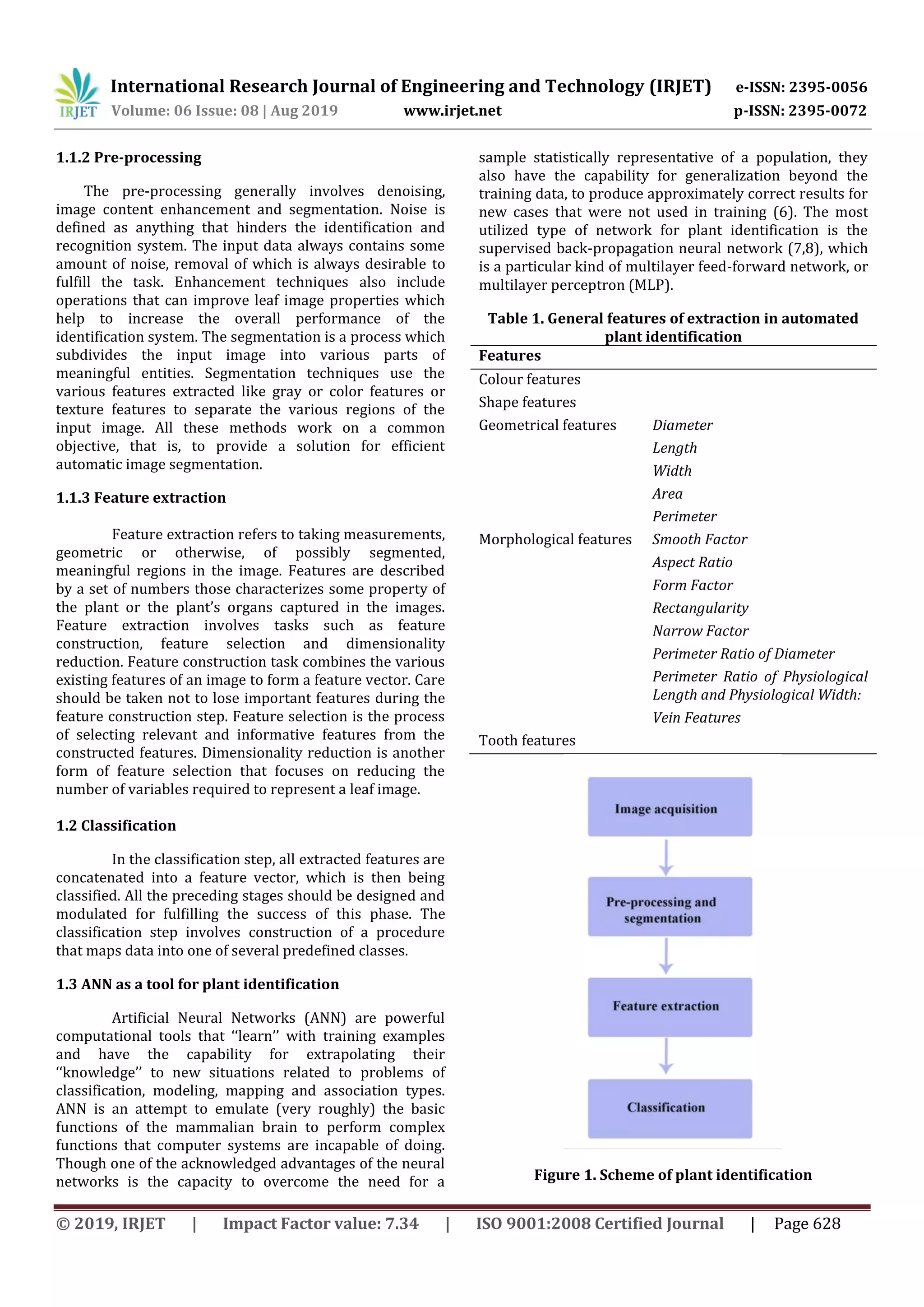
Table 1. General features of extraction in automated
plant identification
Features
Colour features
Shape features
Geometrical features Diameter
Length
Width
Area
Perimeter
Morphological features Smooth Factor
Aspect Ratio
Form Factor
Rectangularity
Narrow Factor
Perimeter Ratio of Diameter
Perimeter Ratio of Physiological
Length and Physiological Width:
Vein Features
Tooth features
Figure 1. Scheme of plant identification
International Research Journal of Engineering and Technology (IRJET) e-ISSN: 2395-0056
Volume: 06 Issue: 08 | Aug 2019 www.irjet.net p-ISSN: 2395-0072
© 2019, IRJET | Impact Factor value: 7.34 | ISO 9001:2008 Certified Journal | Page 629
The artificial neural network is multilayer perceptron
model and its architecture is a three-layer feed-forward
network that includes input layer, hidden layer and output
layer (5). The input layer consists of source nodes. This
layer captures the features pattern for classification. The
number of nodes in this layer depends upon the dimension
of feature vector used at the input. The hidden layer lies
between the input and output layer. The number of hidden
layers can be one or more. Each hidden layer has a specific
number of nodes (neurons) called as hidden nodes or
hidden neurons. The hidden nodes can be varying to get
the desired performance. These hidden neurons play a
significant role in performing higher order computations.
The output of this layer is supplied to the next layer. The
output layer is the end layer of neural network. It results
the output after features are passed through neural
network. The set of outputs in output layer decides the
overall response of the neural network for a supplied
input features (9).
1.4 Deep learning approach of identification
Developed in recent years, the deep convolutional
neutral network approach is an end-to-end pipeline that
can automatically discover the discriminative features for
image classification, whose advantages lie in the use of
shared weights to reduce the memory footprint and
improve performance, and the direct input of the image
into the model (10). Deep learning refers to training
neural network architectures composed of several
nonlinear processing multiple layers. The success of deep
learning is based on new model regularization techniques,
improved nonlinearities design, and current hardware
capabilities, among others. In particular, for Machine
Vision tasks, the success of deep learning is based on CNN
which have become the standard neural network variant
to process images (11).
Deep learning builds upon ANN, which are
mathematical models using learning algorithms inspired
by biological neural networks (the central nervous
systems of animals and in particular their brain) (12).
Deep learning architectures have been popular and able to
achieve significant success in many problems in recent
years. Contrary to traditional machine learning methods in
which features are chosen manually and extracted through
instructed algorithms, deep learning networks
automatically discover increasingly higher level features
from data. These networks, through utilization of large
amounts of data and exploitation of parallel architectures
with high-performance computing techniques, are able to
overcome obstacles that were previously associated with
shallow networks (13).
Deep learning system consists of multiple, predefined
and finite layers and connections, output layer, hidden
layers (in between layers) and input layer. While shallow
learning neuronal networks consist of a single or at
maximum two hidden layers, deep learning neuronal
networks consist of multiple hidden layers, which together
form the majority of the artificial brain (14). The
convolutional neural network (CNN) is a popular deep
learning technology mainly based on plant leaf
recognition. CNNs are comprised of one or more
convolutional layers followed by one or more fully
connected layers as in a traditional multilayer neural
network. The architecture of a CNN is designed to take
advantage of the 2D structure of an input image. The main
strength of these technologies comes from their ability to
learn discriminant visual features directly from the raw
pixels of the images without falling into the trap of the
curse of dimensionality, referring to the exponentially
increase of the model variables as the dimensionality
grows (15). This is achieved by stacking multiple
convolutional layers, i.e., the core building blocks of a CNN.
A convolutional layer basically takes images as input and
produces as output feature maps corresponding to
different convolution kernels, while looking for different
visual patterns (16).
1.5 Important plant organs for automated
identification
In the conventional type of plant identification, people
analyses the whole plant for identification. In the case of
automated identification, specific character or organ is
focused for the identification of plant species. For the
following reasons one image alone is typically not
sufficient: (a) organs may differ in scale and cannot be
depicted in detail along with the whole plant or other
organs; and (b) different organs require different optimal
image perspectives (e.g., leaves are most descriptive from
the top, while the stem is better depicted from the side
view).
A majority of previous reports solely relied on ‘leaf’
for discrimination between taxa. The reason is a more
methodological one, rather than saying that leaves are a
more discriminative part of plants from a botanical
perspective. On the contrary, manual identification of
plants in the vegetative state is considered much more
challenging and difficult than in the
reproductive/flowering state. By an automated and
machine learning perspective, leaves have several
advantages over other plant morphological structures,
such as leaves are available for examination throughout
most of the year and they can easily be collected,
preserved, and imaged due to their planar geometric
properties (17).
Flowers are considered to be the most prominent part
of plant. Traditional identification process involves the
utilization of flowers and their specific features for
identification whereas automated identification rarely
uses flowers for identification. Flower based identification
is a complex task due to the following reasons, 1) flowers
International Research Journal of Engineering and Technology (IRJET) e-ISSN: 2395-0056
Volume: 06 Issue: 08 | Aug 2019 www.irjet.net p-ISSN: 2395-0072
© 2019, IRJET | Impact Factor value: 7.34 | ISO 9001:2008 Certified Journal | Page 630
are usually available during short period or particular
seasons, 2) considerable variations can be seen in their
view point, being the complex 3D structure of flower, 3)
images of flowers vary due to lighting conditions, time,
date, and weather during the image acquisition in their
habitat. Towards a more advanced automated
identification approach, solely analyzing one organ will
often not be sufficient. Therefore, multi-organ-based plant
identification is to be explored for the accurate
identification (14).
1.6 Relevant characters for automated identification
1.6.1 Leaf shape: It is the most studied characteristic
feature for plant identification. While traditional
identification categorizes leaf shape into classes (e.g.,
ovate, oblique, oblanceolate), computerized shape
descriptors either analyze the contour or the whole region
of a leaf. Initially, basic geometric descriptors, such as
aspect ratio, rectangularity, circularity, and eccentricity,
were used to describe the shape. Later, more sophisticated
descriptions, such as center contour distance, fourier
descriptors, and invariant moments, were intensively
studied (18, 3).
1.6.2 Vein structure: As a leaf-specific characteristic it
also played a subordinate role in previous studies.
Venation extraction is not trivial, mainly due to a possible
low contrast between the venation and the rest of the leaf
blade structure (19).
1.6.3 Leaf color: It is considered as a least discriminative
character than shape and texture. Leaves are mostly
colored in some shade of green that varies greatly under
different illumination, creating low interclass color
variability. In addition, there is high intraclass variability.
For example, the leaves belonging to the same species or
even the same plant show a wide range of colors
depending on the season, topography, soil and the plant's
overall condition (e.g., nutrients and water) (20).
1.6.4 Flower color: It is a more discriminative character
which has been mostly described by color moments and
color histograms in automated identification. Due to the
low dimensionality and the low computational complexity
of these descriptors, they are also suitable for real-time
applications. However, solely analyzing color characters,
without considering other characters like flower shape,
cannot classify flowers effectively (21, 22). Flowers are
often transparent to some degree, i.e., the perceived color
of a flower differs depending on whether the light comes
from the back or the front of the flower. Since flower
images are taken under different environmental
conditions, the variation in illumination is greatly affecting
analysis results (23).
1.6.5 Flower shape: It has hardly been considered so far
rather than highly relevant character of leaf shape.
Interestingly, flower shape is an important characteristic
in the traditional identification process. However,
previous attempts of automated plant identification for
describing flower shape in a computable form did not find
it to be very discriminative due to the complex 3D
structure of flowers, which makes its shape vary
depending on the perspective from which an image was
taken (24).
As described in the previous section, no single organ
may be sufficient to separate all desired taxa. Likewise,
using a single character selection, identification becomes a
seriously challenging task. Therefore, use of a combination
of characteristics are mandatory for describing leaves and
flowers. This can rule out a fundamental drawback of
shallow learning techniques using hand-crafted features
for specific characters.
1.7 Popular identification tools
Despite the vast research on automated plant
identification, only few studies resulted in approaches that
can be used by the general public, such as Leafsnap and
Pl@ntNet (most popular plant identifiers). Leafsnap is a
first mobile app for identifying plant species using
automatic visual recognition of leaves (25). The
Smithsonian Institution, Columbia University and the
University of Maryland have pooled their expertise to
create the world’s first plant identification mobile app
using visual search—Leafsnap. This electronic field guide
allows users to identify tree species simply by taking a
photograph of the tree’s leaves. In addition to the species
name, Leafsnap provides high-resolution photographs and
information about the tree’s flowers, fruit, seeds and
bark—giving the user a comprehensive understanding of
the species. Leafsnap has coverage for all of the 184 tree
species of the Northeastern United States. Leafsnap was
developed to greatly speed up the manual process of plant
species identification, collection, and monitoring (26).
Pl@ntNet is image retrieval and sharing application
for the identification of plants and having 1+million users
(27). It is being developed in a collaboration of four French
research organizations (French agricultural research and
international cooperation organization [Cirad], French
National Institute for Agricultural Research [INRA], French
Institute for Research in Computer Science and
Automation [Inria], and French National Research
Institute for Sustainable Development [IRD]) and the
TelaBotanica network. It offers three front-ends, an
Android app, an iOS app, and a web interface, each
allowing users to submit one or several pictures of a plant
in order to get a list of the most likely species in return.
The following are the other top best plant
identification apps for android and iphone.
International Research Journal of Engineering and Technology (IRJET) e-ISSN: 2395-0056
Volume: 06 Issue: 08 | Aug 2019 www.irjet.net p-ISSN: 2395-0072
© 2019, IRJET | Impact Factor value: 7.34 | ISO 9001:2008 Certified Journal | Page 631
1.7.1 PictureThis: This is a free app that identifies plants
and flowers from its pictures. It has 50K users and
powerful features.
1.7.2 FlowerChecker: It uses real botanists to identify
unknown plants, moss, fungus and even lichen. The
picture will be identified by an international team of
experts. Because of this, it may be the most accurate of the
apps.
1.7.3 NatureGate: This identify the plant with a database
of 700 species. It also helps to identify birds, fish and
butterflies.
1.7.4 Google Goggles: Although not directly plant related,
Google Googles works with the user taking a photograph,
and if the app recognizes what is in the picture, it will offer
up suggestions and information of what it may be.
1.7.5 PlantSnap: When you take a photograph of the
plant, the app will do its best to recognize it. Once
recognized, it will give details of name, care information
and even where/when it must be planted. Once you’ve
found out what your mystery plant is, you can then buy it
through the app from one of their HTA certified nurseries.
2. CURRENT CHALLENGES
Present studies still mostly function on the small and
non-representative datasets used in the past. Only a few
studies train CNN classifiers on large plant image datasets,
demonstrating their applicability in automated plant
species identification systems. An analogous dataset of
digital images of plant elements (e.g., leaves) does not
exist widely. However, there are several opportunities that
should be utilized. Firstly use of camera for large scale
image capture, secondly international working group on
Taxonomic Databases for Plant Sciences (TDWG) is a team
offers the recording of plant distributions and thereby aim
to provide a standard in which different organizations
maintaining databases could adopt so that they could
compare and exchange data with each other without loss
of information due to incompatible geographical
boundaries (28). Finally, upcoming trends in
crowdsourcing offer excellent opportunities to generate
and continuously update large repositories of required
information. Crowdsourcing systems with community-
driven forums can contribute both visual datasets of flora
and assisting members in determining species names of a
given visual observation (29). Crowdsourcing is a
technique that aims to take contributions from a large
group of people, especially an online community where
each person’s contribution combines with those of others
to achieve a cumulative result (30). Pl@ntNet can be
considered as the most successful crowdsourcing system
for plants. Another approach tackling the issue of small
datasets is using data augmentation schemes, commonly
including simple modifications of images, such as rotation,
translation, flipping, and scaling (Wäldchen et al., 2018c).
3. UTILIZATION OF HERBARIUM SPECIMENS
Herbaria maintain treasures of information that
should be essential to scale up the size of a global dataset
of digital images of elements of plants. Herbaria maintain
large collections of plants that have been carefully
mounted on sheets, could be digitized, and whose
elements (e.g., leaves) could be extracted to feed a global
dataset. Because herbaria sheets contain juxtaposed
leaves, flowers, and other plant elements, research on
detection and extraction of elements of plants needs to be
further evolved. In addition, more research is needed to
deal with noisy images, complex backgrounds, damage
detection and digital image repair, along with leaf
identifications based on portions of the leaf (in case it is
damaged) (31). Landmark-based morphometric research
should help with the latter. Landmark analysis is ideal for
capturing aspects of shape that are consistent among all
leaves within a given dataset. The selection of landmarks
should include points that are biologically homologous
and adequately represent the morphology of the leaf (32).
4. DEEP LEARNING
Deep learning particularly using CNN classifier is
found to be very successful in automated plant
identification due to the availability of efficient and
massively parallel computing on graphics processing units
(GPUs) and availability of large data sets of images (33).
Instead of following a gradual path that aims at using
images of elements of an organism first (e.g., leaves or
flowers of a plant), and then pictures of the whole
organism, CNN tackles directly the challenge of identifying
organisms by using pictures of the whole or parts of the
organism. However, this approach has at least two
important limitations. First, it tends to work better with
large scale image data and million parameters (33).
Secondly, it lacks the explanatory power of other
approaches such as landmark based morphometrics.
Nevertheless, as global data sets are developed, it is justa
matter of time to overcome the former. Additionally,
research work is already under way to overcome the latter
(34).
5. FUTURE PERSPECTIVES
So far, there are no “in-field applications” that carry
out the identification process semi-automatically. To
ensure and concretize the results it would be useful not
only relying on the purely automatic identifications.
Combining inter-active identification keys with computer
vision should be a future alternative to the
aforementioned plant identifications apps. This requires
very high implementation effort and expertise, but
achieves more accurate results in the end, especially for
International Research Journal of Engineering and Technology (IRJET) e-ISSN: 2395-0056
Volume: 06 Issue: 08 | Aug 2019 www.irjet.net p-ISSN: 2395-0072
© 2019, IRJET | Impact Factor value: 7.34 | ISO 9001:2008 Certified Journal | Page 632
species that are easy to confuse (14). Beyond taxa
identification, machine learning could also automate trait
recognition, such as leaf position, leaf shape, vein structure
and flower colour from herbaria and natural images. Trait
data could be gained on a large scale from digital images
for taxa which are already known but for which no trait
data are available so far. Connecting the traits inferred by
a deep learning algorithm to databases such as the TRY
Plant Trait Database can yield powerful new datasets for
exploring a range of questions in studies of plant diversity
(35). Automated trait recognition and extraction using
machine learning techniques is an open and less-explored
research direction.
Despite the leading progress in automated plant
identification, identification of dry herbal drugs at an
automated level is at its infancy. To date, there are no
reports concerning the identification of dry herbal drugs.
Developing an automated system for the identification of
dry herbal drugs by an efficient classifier will open a
plethora of opportunities at the herbal drug industry as
well as in the pharmaceutical research field.
6. CONCLUSION
The integration of various disciplines of science
with a computational platform paves the way for ample
number innovations. Regardless of all challenges of
automated identification of plant species, it can be
considered as a first-line technique in plant taxonomy
research.
ACKNOWLEDGEMENT
Authors are grateful to Prof. (Dr.) K. Kanakavalli,
Director General, Central Council for Research in Siddha,
Dr P Sathiyarajeswaran, Assistant Director (Siddha) and In
charge, Siddha Central Research Institute, Chennai and Dr
A Kangarajan, Assistant Director (Siddha) and In charge,
Siddha Regional Research Institute, Thiruvananthapuram
for their support.
REFERENCES
1. Murphy, G. E., Romanuk, T. N. 2014. A
meta‐analysis of declines in local species richness
from human disturbances. Ecology and
evolution, 4(1), pp. 91-103.
2. Gaston, K. J., O'Neill, M. A. 2004. Automated
species identification: why not?. Philosophical
Transactions of the Royal Society of London.
Series B: Biological Sciences, 359(1444), pp. 655-
667.
3. Wäldchen, J., Mäder, P. 2018a. Plant species
identification using computer vision techniques: A
systematic literature review. Archives of
Computational Methods in Engineering, 25(2), pp.
507-543.
4. Zhang, S., Lei, Y. K. 2011. Modified locally linear
discriminant embedding for plant leaf
recognition. Neurocomputing, 74(14-15), pp.
2284-2290.
5. Amlekar, M., Manza, R. R., Yannawar, P., Gaikwad,
A. T. 2014. Leaf features based plant classification
using artificial neural network. IBMRD's Journal of
Management & Research, 3(1), pp. 224-232.
6. Pandolfi, C., Mugnai, S., Azzarello, E., Bergamasco,
S., Masi, E., Mancuso, S. 2009. Artificial neural
networks as a tool for plant identification: a case
study on Vietnamese tea
accessions. Euphytica, 166(3), pp. 411-421.
7. Mancuso, S., Nicese, F. P. 1999. Identifying olive
(Oleaeuropaea) cultivars using artificial neural
networks. Journal of the American Society for
Horticultural Science, 124(5), pp. 527-531.
8. Pacifico, L. D., Macario, V., Oliveira, J. F. 2018. Plant
Classification Using Artificial Neural Networks.
In 2018 International Joint Conference on Neural
Networks (IJCNN)(pp. 1-6). IEEE.
9. Singh, S., Bhamrah, M. S. 2015. Leaf identification
using feature extraction and neural network. IOSR
Journal of Electronics and Communication
Engineering, 5, pp. 134-140.
10. Liu, B., Zhang, Y., He, D., Li, Y. 2017. Identification
of apple leaf diseases based on deep convolutional
neural networks. Symmetry, 10(1), pp. 11.
11. Grinblat, G. L., Uzal, L. C., Larese, M. G., Granitto, P.
M. 2016. Deep learning for plant identification
using vein morphological patterns. Computers
and Electronics in Agriculture, 127, pp. 418-424.
12. Azevedo, F. A., Carvalho, L. R., Grinberg, L. T.,
Farfel, J. M., Ferretti, R. E., Leite, R. E.,...
Herculano‐Houzel, S. 2009. Equal numbers of
neuronal and nonneuronal cells make the human
brain an isometrically scaled‐up primate
brain. Journal of Comparative Neurology, 513(5),
pp. 532-541.
13. Ghazi, M. M., Yanikoglu, B., Aptoula, E. 2017. Plant
identification using deep neural networks via
optimization of transfer learning
parameters. Neurocomputing, 235, pp. 228-235.
14. Wäldchen, J., Mäder, P. 2018b. Machine learning
for image based species identification. Methods in
Ecology and Evolution, 9(11), pp. 2216-2225.
15. Goodfellow, I., Bengio, Y., &Courville, A.
(2016). Deep learning. MIT press.
16. Carranza-Rojas, J., Goeau, H., Bonnet, P., Mata-
Montero, E., Joly, A. 2017. Going deeper in the
automated identification of Herbarium
specimens. BMC evolutionary biology, 17(1), pp.
181.
17. Wäldchen, J., Rzanny, M., Seeland, M., Mäder, P.
2018c. Automated plant species identification—
Trends and future directions. PLoS computational
biology, 14(4), pp. e1005993.
International Research Journal of Engineering and Technology (IRJET) e-ISSN: 2395-0056
Volume: 06 Issue: 08 | Aug 2019 www.irjet.net p-ISSN: 2395-0072
© 2019, IRJET | Impact Factor value: 7.34 | ISO 9001:2008 Certified Journal | Page 633
18. Cope, J. S., Corney, D., Clark, J. Y., Remagnino, P.,
Wilkin, P. 2012. Plant species identification using
digital morphometrics: A review. Expert Systems
with Applications, 39(8), pp. 7562-7573.
19. Bruno, O. M., de Oliveira Plotze, R., Falvo, M., de
Castro, M. 2008. Fractal dimension applied to
plant identification. Information
Sciences, 178(12), pp. 2722-2733.
20. Yanikoglu, B., Aptoula, E., Tirkaz, C. 2014.
Automatic plant identification from
photographs. Machine vision and
applications, 25(6), pp. 1369-1383.
21. Nilsback, M. E., Zisserman, A. 2006. A visual
vocabulary for flower classification. In 2006 IEEE
Computer Society Conference on Computer Vision
and Pattern Recognition (CVPR'06) (Vol. 2, pp.
1447-1454). IEEE.
22. Nilsback, M. E., Zisserman, A. 2008. Automated
flower classification over a large number of
classes. In 2008 Sixth Indian Conference on
Computer Vision, Graphics & Image
Processing (pp. 722-729). IEEE.
23. Seeland, M., Rzanny, M., Alaqraa, N., Thuille, A.,
Boho, D., Wäldchen, J., Mäder, P. 2016. Description
of flower colors for image based plant species
classification. In Proceedings of the 22nd German
Color Workshop (FWS), ZentrumfürBild-und
SignalverarbeitungeV, Ilmenau, Germany (pp.
145-154).
24. Hsu, T. H., Lee, C. H., Chen, L. H. 2011. An
interactive flower image recognition
system. Multimedia Tools and Applications, 53(1),
pp. 53-73.
25. Kumar, N., Belhumeur, P. N., Biswas, A., Jacobs, D.
W., Kress, W. J., Lopez, I. C., Soares, J. V. 2012.
Leafsnap: A computer vision system for automatic
plant species identification. In European
Conference on Computer Vision (pp. 502-516).
Springer, Berlin, Heidelberg.
26. ahttp://leafsnap.com/
27. Joly, A., Bonnet, P., Goëau, H., Barbe, J., Selmi, S.,
Champ, J., …Boujemaa, N. 2016. A look inside the
Pl@ ntNet experience. Multimedia Systems, 22(6),
pp. 751-766.
28. bhttps://www.tdwg.org/standards/wgsrpd/
29. Nguyen, T. T. N., Le, T. L., Vu, H., Hoang, V. S., Tran,
T. H. 2018. Crowdsourcing for botanical data
collection towards to automatic plant
identification: A review. Computers and
Electronics in Agriculture, 155, pp. 412-425.
30. He, Y., Wiggins, A. 2015. Community-as-a-service:
data validation in citizen science. METHOD 2015
workshop.
31. Mata-Montero, E., Carranza-Rojas, J. 2016.
Automated plant species identification:
Challenges and opportunities. In IFIP World
Information Technology Forum(pp. 26-36).
Springer, Cham.
32. Klein, L. L., Svoboda, H. T. 2017. Comprehensive
methods for leaf geometric morphometric
analyses. Bio-protocol, 7, pp. e2269.
33. Barré, P., Stöver, B. C., Müller, K. F., Steinhage, V.
2017. LeafNet: A computer vision system for
automatic plant species identification. Ecological
Informatics, 40, 50-56.
34. Lee, S. H., Chan, C. S., Wilkin, P., Remagnino, P.
2015. Deep-plant: Plant identification with
convolutional neural networks. In 2015 IEEE
International Conference on Image Processing
(ICIP) (pp. 452-456). IEEE.
35. Soltis, P. S. 2017. Digitization of herbaria enables
novel research. American Journal of
Botany, 104(9), pp. 1281-1284.
BIOGRAPHIES
Dr KN Sunil Kumar MSc and PhD served
as Senior Research Fellow (ICMR) in
‘Quality Standards of Indian Medicinal
Plants’ project and contributed for 55
monographs. Worked as Senior
Research Officer (Pharmacognosy) at
SDM Centre for Research in Ayurveda
and Allied Sciences, Udupi for 5 years and 5 months
before joining as Research Officer (Pharmacognosy) at
Siddha Central Research Institute (CCRS-AYUSH),
Chennai. Recipient of Seed money to Young scientist for
Research Award, Govt. of Karnataka and Dr. PD Sethi
award for 6 best HPTLC papers on traditional medicine.
Served as Principal Investigator, RGUHS project and Co-
Investigator of one UGC MRP, 4 RGUHS projects and a
PCIM (AYUSH) projects. Authored 127 research papers.
Serving as Chief Editor ‘Journal of Ayurvedic and Herbal
Medicine’, Subject editor - Pharmacognosy ‘AYU – An
International Quarterly Journal of Research in
Ayurveda’, Publishing editor – ‘Journal of Research in
Siddha Medicine’, Executive Editor ‘Journal of Ayurveda
Medical Sciences’, Associate Editor ‘The Journal of
Phytopharmacology’, Executive editor ‘Research and re-
views: Pharmacognosy and Phytochemistry’, Editorial
advisory board member ‘Journal of Scientific and
Innovative Research’ and ‘Journal of Traditional
Medicine and Clinical Naturopathy’ and Editorial board
member ‘Journal of Pharmacognosy and Natural
Products’ and ‘Traditional Medicine Research’. Guided 15
MD (Ayu) theses. Attended 10 training programs in
Pharmacognosy, Phytochemistry and quality control aspects.
Attended 18 national / international conferences, 5 as invited
speaker. Life member of Society of Pharmacognosy.
Biological Scientist – Institutional Animal Ethics
Committee, SCRI Chennai. Possesses 13 years of
research experience till date. The field of interest is
quality control and standardization of traditional
medicine.

IRJET- Recent Trends and Insight Towards Automated Identification of Plant Species

  • 1.
    International Research Journalof Engineering and Technology (IRJET) e-ISSN: 2395-0056 Volume: 06 Issue: 08 | Aug 2019 www.irjet.net p-ISSN: 2395-0072 © 2019, IRJET | Impact Factor value: 7.34 | ISO 9001:2008 Certified Journal | Page 627 Recent Trends and Insight towards Automated Identification of Plant Species Neethu Kannan B1, Sunil Kumar KN2, Bharath Paturi3 1Siddha Regional Research Institute, Thiruvananthapuram, Kerala 2Siddha Central Research Institute, Arumbakkam, Chennai 3Machine Learning Specialist, Standard Chartered Business Services, Bangalore ---------------------------------------------------------------------***-------------------------------------------------------------------- Abstract - The identification of plants by conventional keys and description is complex and tedious, due to the use of specific botanical terms making it quite difficult for non- experts and novices. In automated plant identification, leaf- based recognition is more common and reliable as it is claimed to be easily accessible and abundant compared to other plant morphological structures such as flowers, barks or fruits. Apart from using the leaf, the plant identification can be performed using various parts of a plant like stem, flower, petal, seed and leaf. Image acquisition, pre- processing (noise removal and segmentation), extracting features, matching algorithm and identification are the main steps in the automated plant identification. Artificial Neural Network (ANN) is a machine learning algorithm commonly used to build identification models, which is more efficient and accurate compared to other algorithmic models. Development of deep learning technology based on automated database will contribute to significantly increase the volume of descriptions of new species in the following years. Convolutional Neural Network (CNN) is a popular classifier of deep learning technology which opens the innovative doors of automated plant identification based on foliage recognition. Keywords: Artificial Intelligence for plant identification, artificial neural network, convolutional Neural Network deep learning, Machine learning. 1. INTRODUCTION Species identification plays an important role in botanical research, but traditional identification tools, which mainly depends on reference books or identification keys, is often recognized as a difficult task, especially for novices. In addition, with the deterioration of environments, even though many of the rare plant species are already dead, still many more of the rare plant species are at the margin of extinction. So, the investigation of plant recognition can contribute to environmental protection (1). The plant world is in constant flux, due to human and other factors, the possibility of extinction for many plants and animals can be envisaged. Hence, plant identification is an important task because of concerns about climate change and the resultant changes in geographic distribution also. In recent decades, many efforts have been made by taxonomists and programmers to ease the difficulty of species identification by developing a range of tools that increasingly involved the use of computers. Image-based methods are considered a promising approach for species identification (2, 3) A user can take a picture of a plant in the field with the built-in camera of a mobile device and analyze it with an installed recognition application to identify the species or at least to receive a list of possible species if a single match is impossible. By using a computer-aided plant identification system, non- professionals also can take part in this process. Therefore, it is not surprising that large numbers of research studies are devoted to automate the plant species identification process. Generally in automated system, plants can be identified based on their leaves, flowers, fruits or plant as a whole. Among all the modalities, leaves are considered as a major and promising modality for effective classification of plants. Leaves are easier accessible and abundant compared to other plant morphological structures such as flowers, barks or fruits (4, 5). In almost all automatic leaf plant identification, shape of the leaves is the most common feature used for identification as it is claimed to be the most discriminative feature of a plant’s leaf. The present paper is an attempt to highlight the recent trends, perspectives as well as the challenges of automated plant identification. 1.1 General plant recognition system Automated plant identification process begins with capturing of the image of whole plant or its specific organs and then performing enhancement of the image captured, extracting or reducing the important features from the image and matching the extracted features with the image database to identify the plant species. All the steps involved are considered very important for the accuracy and efficiency of the classifier and are explained below. 1.1.1 Image acquisition The process involves capturing the image of organs of plant so that analysis towards classification can be performed. Images are usually captured by digital cameras or scanners in formats like JPEG, BMP or GIF.
  • 2.
    International Research Journalof Engineering and Technology (IRJET) e-ISSN: 2395-0056 Volume: 06 Issue: 08 | Aug 2019 www.irjet.net p-ISSN: 2395-0072 © 2019, IRJET | Impact Factor value: 7.34 | ISO 9001:2008 Certified Journal | Page 628 1.1.2 Pre-processing The pre-processing generally involves denoising, image content enhancement and segmentation. Noise is defined as anything that hinders the identification and recognition system. The input data always contains some amount of noise, removal of which is always desirable to fulfill the task. Enhancement techniques also include operations that can improve leaf image properties which help to increase the overall performance of the identification system. The segmentation is a process which subdivides the input image into various parts of meaningful entities. Segmentation techniques use the various features extracted like gray or color features or texture features to separate the various regions of the input image. All these methods work on a common objective, that is, to provide a solution for efficient automatic image segmentation. 1.1.3 Feature extraction Feature extraction refers to taking measurements, geometric or otherwise, of possibly segmented, meaningful regions in the image. Features are described by a set of numbers those characterizes some property of the plant or the plant’s organs captured in the images. Feature extraction involves tasks such as feature construction, feature selection and dimensionality reduction. Feature construction task combines the various existing features of an image to form a feature vector. Care should be taken not to lose important features during the feature construction step. Feature selection is the process of selecting relevant and informative features from the constructed features. Dimensionality reduction is another form of feature selection that focuses on reducing the number of variables required to represent a leaf image. 1.2 Classification In the classification step, all extracted features are concatenated into a feature vector, which is then being classified. All the preceding stages should be designed and modulated for fulfilling the success of this phase. The classification step involves construction of a procedure that maps data into one of several predefined classes. 1.3 ANN as a tool for plant identification Artificial Neural Networks (ANN) are powerful computational tools that ‘‘learn’’ with training examples and have the capability for extrapolating their ‘‘knowledge’’ to new situations related to problems of classification, modeling, mapping and association types. ANN is an attempt to emulate (very roughly) the basic functions of the mammalian brain to perform complex functions that computer systems are incapable of doing. Though one of the acknowledged advantages of the neural networks is the capacity to overcome the need for a sample statistically representative of a population, they also have the capability for generalization beyond the training data, to produce approximately correct results for new cases that were not used in training (6). The most utilized type of network for plant identification is the supervised back-propagation neural network (7,8), which is a particular kind of multilayer feed-forward network, or multilayer perceptron (MLP). Table 1. General features of extraction in automated plant identification Features Colour features Shape features Geometrical features Diameter Length Width Area Perimeter Morphological features Smooth Factor Aspect Ratio Form Factor Rectangularity Narrow Factor Perimeter Ratio of Diameter Perimeter Ratio of Physiological Length and Physiological Width: Vein Features Tooth features Figure 1. Scheme of plant identification
  • 3.
    International Research Journalof Engineering and Technology (IRJET) e-ISSN: 2395-0056 Volume: 06 Issue: 08 | Aug 2019 www.irjet.net p-ISSN: 2395-0072 © 2019, IRJET | Impact Factor value: 7.34 | ISO 9001:2008 Certified Journal | Page 629 The artificial neural network is multilayer perceptron model and its architecture is a three-layer feed-forward network that includes input layer, hidden layer and output layer (5). The input layer consists of source nodes. This layer captures the features pattern for classification. The number of nodes in this layer depends upon the dimension of feature vector used at the input. The hidden layer lies between the input and output layer. The number of hidden layers can be one or more. Each hidden layer has a specific number of nodes (neurons) called as hidden nodes or hidden neurons. The hidden nodes can be varying to get the desired performance. These hidden neurons play a significant role in performing higher order computations. The output of this layer is supplied to the next layer. The output layer is the end layer of neural network. It results the output after features are passed through neural network. The set of outputs in output layer decides the overall response of the neural network for a supplied input features (9). 1.4 Deep learning approach of identification Developed in recent years, the deep convolutional neutral network approach is an end-to-end pipeline that can automatically discover the discriminative features for image classification, whose advantages lie in the use of shared weights to reduce the memory footprint and improve performance, and the direct input of the image into the model (10). Deep learning refers to training neural network architectures composed of several nonlinear processing multiple layers. The success of deep learning is based on new model regularization techniques, improved nonlinearities design, and current hardware capabilities, among others. In particular, for Machine Vision tasks, the success of deep learning is based on CNN which have become the standard neural network variant to process images (11). Deep learning builds upon ANN, which are mathematical models using learning algorithms inspired by biological neural networks (the central nervous systems of animals and in particular their brain) (12). Deep learning architectures have been popular and able to achieve significant success in many problems in recent years. Contrary to traditional machine learning methods in which features are chosen manually and extracted through instructed algorithms, deep learning networks automatically discover increasingly higher level features from data. These networks, through utilization of large amounts of data and exploitation of parallel architectures with high-performance computing techniques, are able to overcome obstacles that were previously associated with shallow networks (13). Deep learning system consists of multiple, predefined and finite layers and connections, output layer, hidden layers (in between layers) and input layer. While shallow learning neuronal networks consist of a single or at maximum two hidden layers, deep learning neuronal networks consist of multiple hidden layers, which together form the majority of the artificial brain (14). The convolutional neural network (CNN) is a popular deep learning technology mainly based on plant leaf recognition. CNNs are comprised of one or more convolutional layers followed by one or more fully connected layers as in a traditional multilayer neural network. The architecture of a CNN is designed to take advantage of the 2D structure of an input image. The main strength of these technologies comes from their ability to learn discriminant visual features directly from the raw pixels of the images without falling into the trap of the curse of dimensionality, referring to the exponentially increase of the model variables as the dimensionality grows (15). This is achieved by stacking multiple convolutional layers, i.e., the core building blocks of a CNN. A convolutional layer basically takes images as input and produces as output feature maps corresponding to different convolution kernels, while looking for different visual patterns (16). 1.5 Important plant organs for automated identification In the conventional type of plant identification, people analyses the whole plant for identification. In the case of automated identification, specific character or organ is focused for the identification of plant species. For the following reasons one image alone is typically not sufficient: (a) organs may differ in scale and cannot be depicted in detail along with the whole plant or other organs; and (b) different organs require different optimal image perspectives (e.g., leaves are most descriptive from the top, while the stem is better depicted from the side view). A majority of previous reports solely relied on ‘leaf’ for discrimination between taxa. The reason is a more methodological one, rather than saying that leaves are a more discriminative part of plants from a botanical perspective. On the contrary, manual identification of plants in the vegetative state is considered much more challenging and difficult than in the reproductive/flowering state. By an automated and machine learning perspective, leaves have several advantages over other plant morphological structures, such as leaves are available for examination throughout most of the year and they can easily be collected, preserved, and imaged due to their planar geometric properties (17). Flowers are considered to be the most prominent part of plant. Traditional identification process involves the utilization of flowers and their specific features for identification whereas automated identification rarely uses flowers for identification. Flower based identification is a complex task due to the following reasons, 1) flowers
  • 4.
    International Research Journalof Engineering and Technology (IRJET) e-ISSN: 2395-0056 Volume: 06 Issue: 08 | Aug 2019 www.irjet.net p-ISSN: 2395-0072 © 2019, IRJET | Impact Factor value: 7.34 | ISO 9001:2008 Certified Journal | Page 630 are usually available during short period or particular seasons, 2) considerable variations can be seen in their view point, being the complex 3D structure of flower, 3) images of flowers vary due to lighting conditions, time, date, and weather during the image acquisition in their habitat. Towards a more advanced automated identification approach, solely analyzing one organ will often not be sufficient. Therefore, multi-organ-based plant identification is to be explored for the accurate identification (14). 1.6 Relevant characters for automated identification 1.6.1 Leaf shape: It is the most studied characteristic feature for plant identification. While traditional identification categorizes leaf shape into classes (e.g., ovate, oblique, oblanceolate), computerized shape descriptors either analyze the contour or the whole region of a leaf. Initially, basic geometric descriptors, such as aspect ratio, rectangularity, circularity, and eccentricity, were used to describe the shape. Later, more sophisticated descriptions, such as center contour distance, fourier descriptors, and invariant moments, were intensively studied (18, 3). 1.6.2 Vein structure: As a leaf-specific characteristic it also played a subordinate role in previous studies. Venation extraction is not trivial, mainly due to a possible low contrast between the venation and the rest of the leaf blade structure (19). 1.6.3 Leaf color: It is considered as a least discriminative character than shape and texture. Leaves are mostly colored in some shade of green that varies greatly under different illumination, creating low interclass color variability. In addition, there is high intraclass variability. For example, the leaves belonging to the same species or even the same plant show a wide range of colors depending on the season, topography, soil and the plant's overall condition (e.g., nutrients and water) (20). 1.6.4 Flower color: It is a more discriminative character which has been mostly described by color moments and color histograms in automated identification. Due to the low dimensionality and the low computational complexity of these descriptors, they are also suitable for real-time applications. However, solely analyzing color characters, without considering other characters like flower shape, cannot classify flowers effectively (21, 22). Flowers are often transparent to some degree, i.e., the perceived color of a flower differs depending on whether the light comes from the back or the front of the flower. Since flower images are taken under different environmental conditions, the variation in illumination is greatly affecting analysis results (23). 1.6.5 Flower shape: It has hardly been considered so far rather than highly relevant character of leaf shape. Interestingly, flower shape is an important characteristic in the traditional identification process. However, previous attempts of automated plant identification for describing flower shape in a computable form did not find it to be very discriminative due to the complex 3D structure of flowers, which makes its shape vary depending on the perspective from which an image was taken (24). As described in the previous section, no single organ may be sufficient to separate all desired taxa. Likewise, using a single character selection, identification becomes a seriously challenging task. Therefore, use of a combination of characteristics are mandatory for describing leaves and flowers. This can rule out a fundamental drawback of shallow learning techniques using hand-crafted features for specific characters. 1.7 Popular identification tools Despite the vast research on automated plant identification, only few studies resulted in approaches that can be used by the general public, such as Leafsnap and Pl@ntNet (most popular plant identifiers). Leafsnap is a first mobile app for identifying plant species using automatic visual recognition of leaves (25). The Smithsonian Institution, Columbia University and the University of Maryland have pooled their expertise to create the world’s first plant identification mobile app using visual search—Leafsnap. This electronic field guide allows users to identify tree species simply by taking a photograph of the tree’s leaves. In addition to the species name, Leafsnap provides high-resolution photographs and information about the tree’s flowers, fruit, seeds and bark—giving the user a comprehensive understanding of the species. Leafsnap has coverage for all of the 184 tree species of the Northeastern United States. Leafsnap was developed to greatly speed up the manual process of plant species identification, collection, and monitoring (26). Pl@ntNet is image retrieval and sharing application for the identification of plants and having 1+million users (27). It is being developed in a collaboration of four French research organizations (French agricultural research and international cooperation organization [Cirad], French National Institute for Agricultural Research [INRA], French Institute for Research in Computer Science and Automation [Inria], and French National Research Institute for Sustainable Development [IRD]) and the TelaBotanica network. It offers three front-ends, an Android app, an iOS app, and a web interface, each allowing users to submit one or several pictures of a plant in order to get a list of the most likely species in return. The following are the other top best plant identification apps for android and iphone.
  • 5.
    International Research Journalof Engineering and Technology (IRJET) e-ISSN: 2395-0056 Volume: 06 Issue: 08 | Aug 2019 www.irjet.net p-ISSN: 2395-0072 © 2019, IRJET | Impact Factor value: 7.34 | ISO 9001:2008 Certified Journal | Page 631 1.7.1 PictureThis: This is a free app that identifies plants and flowers from its pictures. It has 50K users and powerful features. 1.7.2 FlowerChecker: It uses real botanists to identify unknown plants, moss, fungus and even lichen. The picture will be identified by an international team of experts. Because of this, it may be the most accurate of the apps. 1.7.3 NatureGate: This identify the plant with a database of 700 species. It also helps to identify birds, fish and butterflies. 1.7.4 Google Goggles: Although not directly plant related, Google Googles works with the user taking a photograph, and if the app recognizes what is in the picture, it will offer up suggestions and information of what it may be. 1.7.5 PlantSnap: When you take a photograph of the plant, the app will do its best to recognize it. Once recognized, it will give details of name, care information and even where/when it must be planted. Once you’ve found out what your mystery plant is, you can then buy it through the app from one of their HTA certified nurseries. 2. CURRENT CHALLENGES Present studies still mostly function on the small and non-representative datasets used in the past. Only a few studies train CNN classifiers on large plant image datasets, demonstrating their applicability in automated plant species identification systems. An analogous dataset of digital images of plant elements (e.g., leaves) does not exist widely. However, there are several opportunities that should be utilized. Firstly use of camera for large scale image capture, secondly international working group on Taxonomic Databases for Plant Sciences (TDWG) is a team offers the recording of plant distributions and thereby aim to provide a standard in which different organizations maintaining databases could adopt so that they could compare and exchange data with each other without loss of information due to incompatible geographical boundaries (28). Finally, upcoming trends in crowdsourcing offer excellent opportunities to generate and continuously update large repositories of required information. Crowdsourcing systems with community- driven forums can contribute both visual datasets of flora and assisting members in determining species names of a given visual observation (29). Crowdsourcing is a technique that aims to take contributions from a large group of people, especially an online community where each person’s contribution combines with those of others to achieve a cumulative result (30). Pl@ntNet can be considered as the most successful crowdsourcing system for plants. Another approach tackling the issue of small datasets is using data augmentation schemes, commonly including simple modifications of images, such as rotation, translation, flipping, and scaling (Wäldchen et al., 2018c). 3. UTILIZATION OF HERBARIUM SPECIMENS Herbaria maintain treasures of information that should be essential to scale up the size of a global dataset of digital images of elements of plants. Herbaria maintain large collections of plants that have been carefully mounted on sheets, could be digitized, and whose elements (e.g., leaves) could be extracted to feed a global dataset. Because herbaria sheets contain juxtaposed leaves, flowers, and other plant elements, research on detection and extraction of elements of plants needs to be further evolved. In addition, more research is needed to deal with noisy images, complex backgrounds, damage detection and digital image repair, along with leaf identifications based on portions of the leaf (in case it is damaged) (31). Landmark-based morphometric research should help with the latter. Landmark analysis is ideal for capturing aspects of shape that are consistent among all leaves within a given dataset. The selection of landmarks should include points that are biologically homologous and adequately represent the morphology of the leaf (32). 4. DEEP LEARNING Deep learning particularly using CNN classifier is found to be very successful in automated plant identification due to the availability of efficient and massively parallel computing on graphics processing units (GPUs) and availability of large data sets of images (33). Instead of following a gradual path that aims at using images of elements of an organism first (e.g., leaves or flowers of a plant), and then pictures of the whole organism, CNN tackles directly the challenge of identifying organisms by using pictures of the whole or parts of the organism. However, this approach has at least two important limitations. First, it tends to work better with large scale image data and million parameters (33). Secondly, it lacks the explanatory power of other approaches such as landmark based morphometrics. Nevertheless, as global data sets are developed, it is justa matter of time to overcome the former. Additionally, research work is already under way to overcome the latter (34). 5. FUTURE PERSPECTIVES So far, there are no “in-field applications” that carry out the identification process semi-automatically. To ensure and concretize the results it would be useful not only relying on the purely automatic identifications. Combining inter-active identification keys with computer vision should be a future alternative to the aforementioned plant identifications apps. This requires very high implementation effort and expertise, but achieves more accurate results in the end, especially for
  • 6.
    International Research Journalof Engineering and Technology (IRJET) e-ISSN: 2395-0056 Volume: 06 Issue: 08 | Aug 2019 www.irjet.net p-ISSN: 2395-0072 © 2019, IRJET | Impact Factor value: 7.34 | ISO 9001:2008 Certified Journal | Page 632 species that are easy to confuse (14). Beyond taxa identification, machine learning could also automate trait recognition, such as leaf position, leaf shape, vein structure and flower colour from herbaria and natural images. Trait data could be gained on a large scale from digital images for taxa which are already known but for which no trait data are available so far. Connecting the traits inferred by a deep learning algorithm to databases such as the TRY Plant Trait Database can yield powerful new datasets for exploring a range of questions in studies of plant diversity (35). Automated trait recognition and extraction using machine learning techniques is an open and less-explored research direction. Despite the leading progress in automated plant identification, identification of dry herbal drugs at an automated level is at its infancy. To date, there are no reports concerning the identification of dry herbal drugs. Developing an automated system for the identification of dry herbal drugs by an efficient classifier will open a plethora of opportunities at the herbal drug industry as well as in the pharmaceutical research field. 6. CONCLUSION The integration of various disciplines of science with a computational platform paves the way for ample number innovations. Regardless of all challenges of automated identification of plant species, it can be considered as a first-line technique in plant taxonomy research. ACKNOWLEDGEMENT Authors are grateful to Prof. (Dr.) K. Kanakavalli, Director General, Central Council for Research in Siddha, Dr P Sathiyarajeswaran, Assistant Director (Siddha) and In charge, Siddha Central Research Institute, Chennai and Dr A Kangarajan, Assistant Director (Siddha) and In charge, Siddha Regional Research Institute, Thiruvananthapuram for their support. REFERENCES 1. Murphy, G. E., Romanuk, T. N. 2014. A meta‐analysis of declines in local species richness from human disturbances. Ecology and evolution, 4(1), pp. 91-103. 2. Gaston, K. J., O'Neill, M. A. 2004. Automated species identification: why not?. Philosophical Transactions of the Royal Society of London. Series B: Biological Sciences, 359(1444), pp. 655- 667. 3. Wäldchen, J., Mäder, P. 2018a. Plant species identification using computer vision techniques: A systematic literature review. Archives of Computational Methods in Engineering, 25(2), pp. 507-543. 4. Zhang, S., Lei, Y. K. 2011. Modified locally linear discriminant embedding for plant leaf recognition. Neurocomputing, 74(14-15), pp. 2284-2290. 5. Amlekar, M., Manza, R. R., Yannawar, P., Gaikwad, A. T. 2014. Leaf features based plant classification using artificial neural network. IBMRD's Journal of Management & Research, 3(1), pp. 224-232. 6. Pandolfi, C., Mugnai, S., Azzarello, E., Bergamasco, S., Masi, E., Mancuso, S. 2009. Artificial neural networks as a tool for plant identification: a case study on Vietnamese tea accessions. Euphytica, 166(3), pp. 411-421. 7. Mancuso, S., Nicese, F. P. 1999. Identifying olive (Oleaeuropaea) cultivars using artificial neural networks. Journal of the American Society for Horticultural Science, 124(5), pp. 527-531. 8. Pacifico, L. D., Macario, V., Oliveira, J. F. 2018. Plant Classification Using Artificial Neural Networks. In 2018 International Joint Conference on Neural Networks (IJCNN)(pp. 1-6). IEEE. 9. Singh, S., Bhamrah, M. S. 2015. Leaf identification using feature extraction and neural network. IOSR Journal of Electronics and Communication Engineering, 5, pp. 134-140. 10. Liu, B., Zhang, Y., He, D., Li, Y. 2017. Identification of apple leaf diseases based on deep convolutional neural networks. Symmetry, 10(1), pp. 11. 11. Grinblat, G. L., Uzal, L. C., Larese, M. G., Granitto, P. M. 2016. Deep learning for plant identification using vein morphological patterns. Computers and Electronics in Agriculture, 127, pp. 418-424. 12. Azevedo, F. A., Carvalho, L. R., Grinberg, L. T., Farfel, J. M., Ferretti, R. E., Leite, R. E.,... Herculano‐Houzel, S. 2009. Equal numbers of neuronal and nonneuronal cells make the human brain an isometrically scaled‐up primate brain. Journal of Comparative Neurology, 513(5), pp. 532-541. 13. Ghazi, M. M., Yanikoglu, B., Aptoula, E. 2017. Plant identification using deep neural networks via optimization of transfer learning parameters. Neurocomputing, 235, pp. 228-235. 14. Wäldchen, J., Mäder, P. 2018b. Machine learning for image based species identification. Methods in Ecology and Evolution, 9(11), pp. 2216-2225. 15. Goodfellow, I., Bengio, Y., &Courville, A. (2016). Deep learning. MIT press. 16. Carranza-Rojas, J., Goeau, H., Bonnet, P., Mata- Montero, E., Joly, A. 2017. Going deeper in the automated identification of Herbarium specimens. BMC evolutionary biology, 17(1), pp. 181. 17. Wäldchen, J., Rzanny, M., Seeland, M., Mäder, P. 2018c. Automated plant species identification— Trends and future directions. PLoS computational biology, 14(4), pp. e1005993.
  • 7.
    International Research Journalof Engineering and Technology (IRJET) e-ISSN: 2395-0056 Volume: 06 Issue: 08 | Aug 2019 www.irjet.net p-ISSN: 2395-0072 © 2019, IRJET | Impact Factor value: 7.34 | ISO 9001:2008 Certified Journal | Page 633 18. Cope, J. S., Corney, D., Clark, J. Y., Remagnino, P., Wilkin, P. 2012. Plant species identification using digital morphometrics: A review. Expert Systems with Applications, 39(8), pp. 7562-7573. 19. Bruno, O. M., de Oliveira Plotze, R., Falvo, M., de Castro, M. 2008. Fractal dimension applied to plant identification. Information Sciences, 178(12), pp. 2722-2733. 20. Yanikoglu, B., Aptoula, E., Tirkaz, C. 2014. Automatic plant identification from photographs. Machine vision and applications, 25(6), pp. 1369-1383. 21. Nilsback, M. E., Zisserman, A. 2006. A visual vocabulary for flower classification. In 2006 IEEE Computer Society Conference on Computer Vision and Pattern Recognition (CVPR'06) (Vol. 2, pp. 1447-1454). IEEE. 22. Nilsback, M. E., Zisserman, A. 2008. Automated flower classification over a large number of classes. In 2008 Sixth Indian Conference on Computer Vision, Graphics & Image Processing (pp. 722-729). IEEE. 23. Seeland, M., Rzanny, M., Alaqraa, N., Thuille, A., Boho, D., Wäldchen, J., Mäder, P. 2016. Description of flower colors for image based plant species classification. In Proceedings of the 22nd German Color Workshop (FWS), ZentrumfürBild-und SignalverarbeitungeV, Ilmenau, Germany (pp. 145-154). 24. Hsu, T. H., Lee, C. H., Chen, L. H. 2011. An interactive flower image recognition system. Multimedia Tools and Applications, 53(1), pp. 53-73. 25. Kumar, N., Belhumeur, P. N., Biswas, A., Jacobs, D. W., Kress, W. J., Lopez, I. C., Soares, J. V. 2012. Leafsnap: A computer vision system for automatic plant species identification. In European Conference on Computer Vision (pp. 502-516). Springer, Berlin, Heidelberg. 26. ahttp://leafsnap.com/ 27. Joly, A., Bonnet, P., Goëau, H., Barbe, J., Selmi, S., Champ, J., …Boujemaa, N. 2016. A look inside the Pl@ ntNet experience. Multimedia Systems, 22(6), pp. 751-766. 28. bhttps://www.tdwg.org/standards/wgsrpd/ 29. Nguyen, T. T. N., Le, T. L., Vu, H., Hoang, V. S., Tran, T. H. 2018. Crowdsourcing for botanical data collection towards to automatic plant identification: A review. Computers and Electronics in Agriculture, 155, pp. 412-425. 30. He, Y., Wiggins, A. 2015. Community-as-a-service: data validation in citizen science. METHOD 2015 workshop. 31. Mata-Montero, E., Carranza-Rojas, J. 2016. Automated plant species identification: Challenges and opportunities. In IFIP World Information Technology Forum(pp. 26-36). Springer, Cham. 32. Klein, L. L., Svoboda, H. T. 2017. Comprehensive methods for leaf geometric morphometric analyses. Bio-protocol, 7, pp. e2269. 33. Barré, P., Stöver, B. C., Müller, K. F., Steinhage, V. 2017. LeafNet: A computer vision system for automatic plant species identification. Ecological Informatics, 40, 50-56. 34. Lee, S. H., Chan, C. S., Wilkin, P., Remagnino, P. 2015. Deep-plant: Plant identification with convolutional neural networks. In 2015 IEEE International Conference on Image Processing (ICIP) (pp. 452-456). IEEE. 35. Soltis, P. S. 2017. Digitization of herbaria enables novel research. American Journal of Botany, 104(9), pp. 1281-1284. BIOGRAPHIES Dr KN Sunil Kumar MSc and PhD served as Senior Research Fellow (ICMR) in ‘Quality Standards of Indian Medicinal Plants’ project and contributed for 55 monographs. Worked as Senior Research Officer (Pharmacognosy) at SDM Centre for Research in Ayurveda and Allied Sciences, Udupi for 5 years and 5 months before joining as Research Officer (Pharmacognosy) at Siddha Central Research Institute (CCRS-AYUSH), Chennai. Recipient of Seed money to Young scientist for Research Award, Govt. of Karnataka and Dr. PD Sethi award for 6 best HPTLC papers on traditional medicine. Served as Principal Investigator, RGUHS project and Co- Investigator of one UGC MRP, 4 RGUHS projects and a PCIM (AYUSH) projects. Authored 127 research papers. Serving as Chief Editor ‘Journal of Ayurvedic and Herbal Medicine’, Subject editor - Pharmacognosy ‘AYU – An International Quarterly Journal of Research in Ayurveda’, Publishing editor – ‘Journal of Research in Siddha Medicine’, Executive Editor ‘Journal of Ayurveda Medical Sciences’, Associate Editor ‘The Journal of Phytopharmacology’, Executive editor ‘Research and re- views: Pharmacognosy and Phytochemistry’, Editorial advisory board member ‘Journal of Scientific and Innovative Research’ and ‘Journal of Traditional Medicine and Clinical Naturopathy’ and Editorial board member ‘Journal of Pharmacognosy and Natural Products’ and ‘Traditional Medicine Research’. Guided 15 MD (Ayu) theses. Attended 10 training programs in Pharmacognosy, Phytochemistry and quality control aspects. Attended 18 national / international conferences, 5 as invited speaker. Life member of Society of Pharmacognosy. Biological Scientist – Institutional Animal Ethics Committee, SCRI Chennai. Possesses 13 years of research experience till date. The field of interest is quality control and standardization of traditional medicine.