Download to read offline
![International Research Journal of Engineering and Technology (IRJET) e-ISSN: 2395-0056
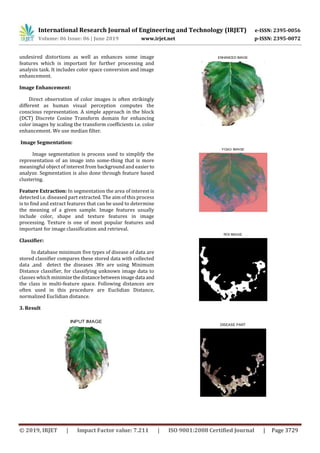
Volume: 06 Issue: 06 | June 2019 www.irjet.net p-ISSN: 2395-0072
© 2019, IRJET | Impact Factor value: 7.211 | ISO 9001:2008 Certified Journal | Page 3728
Plant Leaf Disease Detection Using Image Processing
Gharte Sneha H.1, Prof. (Dr.) S. B. Bagal2
1,2Electronics and Telecommunication & L. G. N. Sapkal College of Engineering, Nashik, Maharashtra, India
----------------------------------------------------------------------***---------------------------------------------------------------------
Abstract - It is difficult task for producing agricultural
products, various micro-organisms, pests and bacterial
diseases attack on plants. These diseases can occur through
the leaves, steams or fruit inspection. This paper covers
technique of image processing for early detection of plant
disease through feature extractionofleafandpreprocessingof
image from RGB (YCbCr) to different color space conversion,
image enhancement; segment the region of interest and
minimum distance classifier is used. Thedetectionofplantleaf
disease is very difficult role. Many of the plant diseases are
caused by bacteria, fungi, and viruses. An automatic detection
of plant disease is a necessary topic. Computer vision
techniques are used to discover the affected spots from the
image through an image processing capable of recognizing
the plant area is detailed in this paper. The achieved accuracy
of the overall system is 90.96%, in line with the experimental
results. Matlab software is used to detect plant leaf disease.
Key Words: Digital pictures, Matlab, Image-Processing,
Segmentation, Plant-Leaf-Diseases, agricultural-
production.
1. INTRODUCTION
Agriculture has become much a lot of than merely a way to
nurse ever growing populaces. Plants have become a vital
source of energy, and are a basic piece in the puzzle to
resolve the matter of world warming [1]. Diseases in plants
increases the value of agricultural production and a total
economic disaster of producers if not cured appropriatelyat
early stages and [3]. This can impact negativeonthecountry
whose economic income is solely depends on agricultural
produces. Procedures needs to monitor their plants
regularly and observe any primary symptoms so as to
prevent the unfold of a plant sickness,withlowcostandsave
the major part of the production. In 2015 Ghana lose 30% of
its annual crop yields to pests and bug infestation, the
situation, was attributed to restricted access to plant health
services as a result of inadequate extension officers [4].This
approach becomestiresomewhenfarmlandsbecomeslarge.
But the demand of this methodology is continuous
observation of the sector by an individual having superior
data regarding the the plants anditscorrespondingdiseases.
Moreover, appointing sucha personwouldmayprovepricey
[5]. An alternative methodology is seeking advice from the
professional by farmers when signs of diseases crop up, and
the expert advice should come in time otherwise it could
ends up in loss. Disease on plant is tested in the laboratory.
But this technique needs satisfactory laboratory conditions
on with skilled data. The laboratorydetection wayswill offer
lot of correct results. As the tests are dole out of field the
value could also be high and will be time intense [5]. An
artificial intelligence and Machine vision can offera bestand
alternative way for plant monitoring and early detection of
disease, which can be control byprofessional froma distance
and offer their professional advice at a low cost [2]. The self-
recognition of the sickness is based mostly on the
identification of the symptoms of disease. So that data
concerning the sickness incidence may be quickly and
accurately provided to the farmers, expertsandresearchers,
this in turn reduces the watching of enormous field by soul
[5].
1.1 Need of Project
From the start of humans are directly work in farms but
from the start of 21st century many industries worked to
reduce this human labor by making robots and machines.
Now-a- days many industries are trying to reduce this
human labor by making robotsandmachines.Nowmoreand
more chemicals applied to plants without knowing the
requirement of plants. Hence productivity of agriculture
decreases.
2. Methodology
Block Diagram
Fig2.1: Block Diagram of methodology
Leaf Image:
Plant leaf disease is one of the crucial causes that
reduces quantity and degrades quality of the agricultural
products. Now chemicals are applied to the plants
periodically without knowing the requirement of plants.
Pre-process:
Image pre-processing is the lowest level of abstraction
whose aim is to improve the image data that suppress
Leaf
Image
Preprocess (Enhancement,
disease segmentation)
Feature Extraction
Classifier
Output
Database](https://image.slidesharecdn.com/irjet-v6i6748-191218071726/85/IRJET-Plant-Leaf-Disease-Detection-using-Image-Processing-1-320.jpg)
![International Research Journal of Engineering and Technology (IRJET) e-ISSN: 2395-0056
Volume: 06 Issue: 06 | June 2019 www.irjet.net p-ISSN: 2395-0072
© 2019, IRJET | Impact Factor value: 7.211 | ISO 9001:2008 Certified Journal | Page 3728
Plant Leaf Disease Detection Using Image Processing
Gharte Sneha H.1, Prof. (Dr.) S. B. Bagal2
1,2Electronics and Telecommunication & L. G. N. Sapkal College of Engineering, Nashik, Maharashtra, India
----------------------------------------------------------------------***---------------------------------------------------------------------
Abstract - It is difficult task for producing agricultural
products, various micro-organisms, pests and bacterial
diseases attack on plants. These diseases can occur through
the leaves, steams or fruit inspection. This paper covers
technique of image processing for early detection of plant
disease through feature extractionofleafandpreprocessingof
image from RGB (YCbCr) to different color space conversion,
image enhancement; segment the region of interest and
minimum distance classifier is used. Thedetectionofplantleaf
disease is very difficult role. Many of the plant diseases are
caused by bacteria, fungi, and viruses. An automatic detection
of plant disease is a necessary topic. Computer vision
techniques are used to discover the affected spots from the
image through an image processing capable of recognizing
the plant area is detailed in this paper. The achieved accuracy
of the overall system is 90.96%, in line with the experimental
results. Matlab software is used to detect plant leaf disease.
Key Words: Digital pictures, Matlab, Image-Processing,
Segmentation, Plant-Leaf-Diseases, agricultural-
production.
1. INTRODUCTION
Agriculture has become much a lot of than merely a way to
nurse ever growing populaces. Plants have become a vital
source of energy, and are a basic piece in the puzzle to
resolve the matter of world warming [1]. Diseases in plants
increases the value of agricultural production and a total
economic disaster of producers if not cured appropriatelyat
early stages and [3]. This can impact negativeonthecountry
whose economic income is solely depends on agricultural
produces. Procedures needs to monitor their plants
regularly and observe any primary symptoms so as to
prevent the unfold of a plant sickness,withlowcostandsave
the major part of the production. In 2015 Ghana lose 30% of
its annual crop yields to pests and bug infestation, the
situation, was attributed to restricted access to plant health
services as a result of inadequate extension officers [4].This
approach becomestiresomewhenfarmlandsbecomeslarge.
But the demand of this methodology is continuous
observation of the sector by an individual having superior
data regarding the the plants anditscorrespondingdiseases.
Moreover, appointing sucha personwouldmayprovepricey
[5]. An alternative methodology is seeking advice from the
professional by farmers when signs of diseases crop up, and
the expert advice should come in time otherwise it could
ends up in loss. Disease on plant is tested in the laboratory.
But this technique needs satisfactory laboratory conditions
on with skilled data. The laboratorydetection wayswill offer
lot of correct results. As the tests are dole out of field the
value could also be high and will be time intense [5]. An
artificial intelligence and Machine vision can offera bestand
alternative way for plant monitoring and early detection of
disease, which can be control byprofessional froma distance
and offer their professional advice at a low cost [2]. The self-
recognition of the sickness is based mostly on the
identification of the symptoms of disease. So that data
concerning the sickness incidence may be quickly and
accurately provided to the farmers, expertsandresearchers,
this in turn reduces the watching of enormous field by soul
[5].
1.1 Need of Project
From the start of humans are directly work in farms but
from the start of 21st century many industries worked to
reduce this human labor by making robots and machines.
Now-a- days many industries are trying to reduce this
human labor by making robotsandmachines.Nowmoreand
more chemicals applied to plants without knowing the
requirement of plants. Hence productivity of agriculture
decreases.
2. Methodology
Block Diagram
Fig2.1: Block Diagram of methodology
Leaf Image:
Plant leaf disease is one of the crucial causes that
reduces quantity and degrades quality of the agricultural
products. Now chemicals are applied to the plants
periodically without knowing the requirement of plants.
Pre-process:
Image pre-processing is the lowest level of abstraction
whose aim is to improve the image data that suppress
Leaf
Image
Preprocess (Enhancement,
disease segmentation)
Feature Extraction
Classifier
Output
Database](https://image.slidesharecdn.com/irjet-v6i6748-191218071726/75/IRJET-Plant-Leaf-Disease-Detection-using-Image-Processing-1-2048.jpg)
![International Research Journal of Engineering and Technology (IRJET) e-ISSN: 2395-0056
Volume: 06 Issue: 06 | June 2019 www.irjet.net p-ISSN: 2395-0072
© 2019, IRJET | Impact Factor value: 7.211 | ISO 9001:2008 Certified Journal | Page 3730
1 2 3 4 5 6
0
10
20
30
40
50
60
COLOR MOMENTS
4. CONCLUSION
The exact detection and classification of the plant disease is
very important for the successful cultivation of cropandthis
can be done using image processing. This paper discussed
the image processing technique for diseased plant leaf
detection. Extraction of feature of an infected leaf and the
classification of plant diseases can accurately identify and
classify various plant diseases and provide the farmer an
idea about extend the damage for suitable treatment using
image processing techniques. The overall achievedaccuracy
of the proposed system is higher than 90.96% in line with
the experimental results compared with [2].
5. FUTURE SCOPE
The project can be modifying by using web camera. The
project can be modifying by using Audio clip fromGUIwhich
help farmer to decide the specific quantity for pesticides
applications to reduce the cost and environmental pollution
and increases the productivity. The system can work
extensively by predicting the type of plant, the kind of
disease and recommend the specific pesticides orfungicides
to be used, hence recommended for future work.
REFERENCES
[1] F. Argenti,L. Alparone,G. Benelli ,” Fast algorithms for
texture analysis using co-occurrence matrices” Radar and
Signal Processing, IEE Proceedings,vol.137,Issue6,pp:443-
448 , No. 6, December 1990.
[2] A. Martin and S. Tosunoglu, “Image Processing
Techniqoes for Machine Vision,” Florida International
University Department of Mechanical Engineering 10555
West Flagler Street, Miami, Florida 33174, 2000.
[3] D. J. Sena, F. Pinto, D. Queiroz and P. Viana, “Fall
armyworm damaged maize plant identification using digital
images.,” BiosystEng, vol. 85, no. 4, p. 449–454, 2003.
[4] Fang Jianjun, “Present Situation and Development of
Mobile Harvesting Robot” and Transactions of the Chinese
Society of Agricultural Engineering, 2004, vol. 20, no. 2,pp.
273-278.
[5] Sanjay B. Patil et al. / International Journal of
Engineering and Technology Vol.3(5),2011,297-301.”LEAF
DISEASE SEVERITYMEASUREMENT USING
IMAGEPROCESSING”.
[6] International Journal of Advanced Technology
Engineering and Science www.ijates.com Volume No.03,
Issue No. 01, January 2015 ISSN (online): 2348 – 7550
‘Autonomous Farming Robot with Plant Health Indication’.
Prof. K.V. Fale 1, Bhure Amit P 2, Mangnale Shivkumar 3
Pandharkar Suraj R 4Professor, RSCOE, Pune, (India) 2, 3, 4
Student, RSCOE, Pune, (India)
[7] N. Petrellis, “Plant Disease Diagnosis Based on Image
Processing, Appropriate for Mobile Phone Implementation,”
International Conference on Information & Communication
Technologies inAgriculture, Food andEnvironment,pp.238-
246, 2015.
[8] NCSA, “illinois.edu: Image ProcessingTechniques,”2000.
[Online].Available:http://www.ncsa.illinois.edu/People/kin
dr/phd/PART1.PDF. [Accessed 10 August 2015].
BIOGRAPHIES
“Sneha Gharte received the B.E.
degree from the Department of
Electronics & Telecommunication
Engineering, Pune University, and
Maharashtra, India in 2017.
Currently pursuing M.E. in Signal
Processing from Pune University,
Maharashtra, India.”
“S. B. Bagal received the B.E.
degree and M.E. degree in
Electronics&Telecommunnication
Engineering and also Ph.D in E&TC
Engineering. He is currently
principle at L. G. N. Sapkal, COE,
Nashik, and Maharashtra, India.”](https://image.slidesharecdn.com/irjet-v6i6748-191218071726/85/IRJET-Plant-Leaf-Disease-Detection-using-Image-Processing-3-320.jpg)

This document discusses a technique for early detection of plant diseases through image processing. The technique involves preprocessing leaf images through color space conversion and enhancement. The region of interest (disease area) is segmented and features are extracted. A minimum distance classifier compares the features to a database of known plant diseases and identifies the disease. The methodology achieves over 90% accuracy in detecting diseases. The system could help farmers monitor crops efficiently and apply treatments early to reduce losses from diseases. Future work may involve integrating audio cues and recommending specific treatments to increase productivity and reduce costs and pollution.


