International Research Journal of Engineering and Technology (IRJET) e-ISSN: 2395-0056
Volume: 06 Issue: 06 | June 2019 www.irjet.net p-ISSN: 2395-0072
© 2019, IRJET | Impact Factor value: 7.211 | ISO 9001:2008 Certified Journal | Page 3118
PATIENT MONITORING SYSTEM
Haitham Saleh1, Nabhanshul Thakur2, Sameen Akbar3, Assistant Prof. S.P Tondare4
1,2,3Student of Semester VIII Btech(Biomedical).
4Department of Electronics Engineering, Bharati Vidyapeeth (Deemed to be University) College of Engineering,
Pune-41104
---------------------------------------------------------------------***----------------------------------------------------------------------
1. ABSTRACT: - The proposed system can be described as
computerized patient monitoring system is described. The
bedside module is a general-purpose unit designed to
replace the entire range of traditional monitoring devices.
All user-interaction, signal processing, and data
presentation in this unit are under the direct control of a
microcomputer. The nurse-station module, also containing
a microcomputer, is responsible for information routing,
controlling nurse-desk equipment as well as data and
signal presentation. The system has been in use since 1978
in our 8-bed surgical ICU and since 1980 in an 8-bed
coronary care unit. The application programs for heart
rate and temperature.
Heart rate sensor using microcontroller is used. The device
senses the heart rate from the fingertip using IR reflection
method and displays it on a three digit seven segment
display in beats per minute.
LM35 is used for the measurement of body temperature.
This sensor is a passive transducer and its resistance
depends on the heat being applied on it. We have arranged
the sensor LM35 gives 10 mV per degree Celsius. The
patient’s heart beat rate is monitored using a
photoelectric sensor which can sense the patient’s pulse
rate. This method of tracking the heart rate is more
efficient than the traditional method.
2. INTRODUCTION
The proposed work is a working model which
incorporates sensors to measure parameters like body
temperature, heart beat rate, so that the patient’s health
condition can be analysed by doctors in any part of the
hospital. Patient monitors found profound use in critical
care units and other healthcare departments to
constantly monitor body temperature, pulse rate,
respiratory rate and blood pressure. The periodic check
on these key parameters helps in live monitoring the
state of the patient. We make sure patients don’t feel
uncomfortable with lots of probes and wires running
over them. The non-contact temperature feature in the
device monitors patients once in 4 or 6 hours. The device
records and provides the trend of various readings over
a period of time. Patient care begins with data collection
and assessment of current patient status. Decision
making as to therapeutic goals and diagnostic means
follows. At specified intervals, the patient is re- assessed,
and objectives are redefined. Multidisciplinary tasks
make process more complex.
Based on above facts, there have been numerous
attempts to develop medical systems similar to the work.
Such efforts are primarily led by the academia but
extending deeply into the industries. However, most
research efforts have been focusing on either the vital
sign monitoring aspect using standard databases both
falling short of expectation. Having analysed the existing
solutions, this work vows to bridge the two major
research efforts and bring out a more realizable product
to directly benefit the consumers in the medical field.
3. DESCRIPTION:
This system monitors parameters like body temperature,
heart beat rate, ecg and displayed on the LCD 16x2. In
this system the heart beat sensor (IR sensor), Lm35
sensor are interfaced with a microcontroller. The heart
beat sensor gives the heart rate and temperature sensor
gives the temperature of body. If temperature goes
above 40 degree Celsius then buzzer on and indicates
temperature is high. A micro-controller board is used for
analysing the inputs from the patient and any
abnormality felt by the patient causes the monitoring
system to give an alarm. This is very useful for future
analysis and review of patient’s health condition.
4. SPECIFICATIONS:
1. Arduino Uno Board (AT mega 328
Microcontroller)
2. 16x2 character LCD display
3. Heart Beat sensor for monitoring heart rate.
4. LM 35 sensor for monitoring temperature.
5. Buzzer.
6. LEDs.
7. Keys.
International Research Journal of Engineering and Technology (IRJET) e-ISSN: 2395-0056
Volume: 06 Issue: 06 | June 2019 www.irjet.net p-ISSN: 2395-0072
© 2019, IRJET | Impact Factor value: 7.211 | ISO 9001:2008 Certified Journal | Page 3119
4.1. Arduino Uno Board
Fig1. Arduino Uno Board
4.2. 16x2 character LCD display:
Fig 2: 16x2 character LCD display
5 x 8 dots with cursor
Built-in controller
+ 5V power supply (Also available for + 3V)
1/16 duty cycle
N.V. optional for + 3V power supply
4.3. Heart Beat sensor:
Fig3. Heart Beat sensor
The patient’s heart beat rate is monitored using a
photoelectric sensor which can Sense the patient’s pulse
rate. This method of tracking the heart rate is more
efficient than the traditional method which derives the
same from the ECG graph.This project uses bright
infrared (IR) Led and photo detector to detect the pulses
of finger.
The LED is the light side of finger and photo detector on
the other side of the finger. Phototransistor used to
obtain the flux emitted, when the blood pressure pulse
by the finger when the resistance of the transistor will be
slight changed.
4.4. LM35 sensor:
Fig3. LM35 sensor
Calibrated directly in ˚ Celsius (Centigrade).
Linear + 10.0 mV/˚C scale factor.
0.5˚C accuracy guarantee able (at +25˚C).
Rated for full −55˚ to +150˚C range.
Suitable for remote applications.
Low cost due to wafer-level trimming.
Operates from 4 to 30 volts.
Less than 60 µA current drain.
Low self-heating, 0.08˚C in still air.
Nonlinearity only ±1⁄4˚C typical.
Low impedance output, 0.1 Ω for 1 mA load.
The LM35 series are precision integrated-circuit
temperature sensors, whose output voltage is linearly
proportional to the Celsius (Centigrade) temperature.
International Research Journal of Engineering and Technology (IRJET) e-ISSN: 2395-0056
Volume: 06 Issue: 06 | June 2019 www.irjet.net p-ISSN: 2395-0072
© 2019, IRJET | Impact Factor value: 7.211 | ISO 9001:2008 Certified Journal | Page 3120
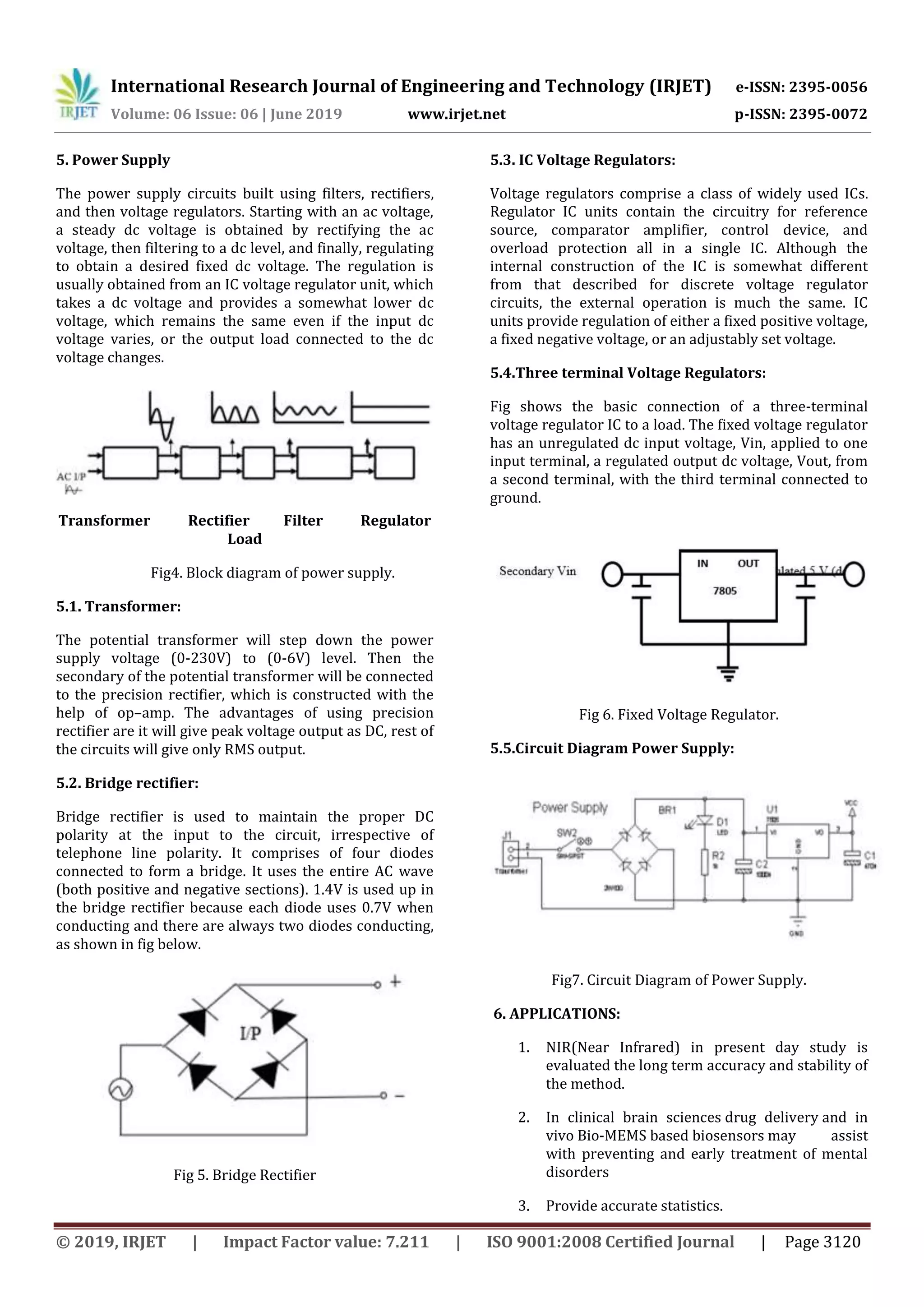
5. Power Supply
The power supply circuits built using filters, rectifiers,
and then voltage regulators. Starting with an ac voltage,
a steady dc voltage is obtained by rectifying the ac
voltage, then filtering to a dc level, and finally, regulating
to obtain a desired fixed dc voltage. The regulation is
usually obtained from an IC voltage regulator unit, which
takes a dc voltage and provides a somewhat lower dc
voltage, which remains the same even if the input dc
voltage varies, or the output load connected to the dc
voltage changes.
Transformer Rectifier Filter Regulator
Load
Fig4. Block diagram of power supply.
5.1. Transformer:
The potential transformer will step down the power
supply voltage (0-230V) to (0-6V) level. Then the
secondary of the potential transformer will be connected
to the precision rectifier, which is constructed with the
help of op–amp. The advantages of using precision
rectifier are it will give peak voltage output as DC, rest of
the circuits will give only RMS output.
5.2. Bridge rectifier:
Bridge rectifier is used to maintain the proper DC
polarity at the input to the circuit, irrespective of
telephone line polarity. It comprises of four diodes
connected to form a bridge. It uses the entire AC wave
(both positive and negative sections). 1.4V is used up in
the bridge rectifier because each diode uses 0.7V when
conducting and there are always two diodes conducting,
as shown in fig below.
Fig 5. Bridge Rectifier
5.3. IC Voltage Regulators:
Voltage regulators comprise a class of widely used ICs.
Regulator IC units contain the circuitry for reference
source, comparator amplifier, control device, and
overload protection all in a single IC. Although the
internal construction of the IC is somewhat different
from that described for discrete voltage regulator
circuits, the external operation is much the same. IC
units provide regulation of either a fixed positive voltage,
a fixed negative voltage, or an adjustably set voltage.
5.4.Three terminal Voltage Regulators:
Fig shows the basic connection of a three-terminal
voltage regulator IC to a load. The fixed voltage regulator
has an unregulated dc input voltage, Vin, applied to one
input terminal, a regulated output dc voltage, Vout, from
a second terminal, with the third terminal connected to
ground.
Fig 6. Fixed Voltage Regulator.
5.5.Circuit Diagram Power Supply:
Fig7. Circuit Diagram of Power Supply.
6. APPLICATIONS:
1. NIR(Near Infrared) in present day study is
evaluated the long term accuracy and stability of
the method.
2. In clinical brain sciences drug delivery and in
vivo Bio-MEMS based biosensors may assist
with preventing and early treatment of mental
disorders
3. Provide accurate statistics.
International Research Journal of Engineering and Technology (IRJET) e-ISSN: 2395-0056
Volume: 06 Issue: 06 | June 2019 www.irjet.net p-ISSN: 2395-0072
© 2019, IRJET | Impact Factor value: 7.211 | ISO 9001:2008 Certified Journal | Page 3121
4. It also stores the data in the system memory for
the future use.
5. Less sensitive towards temperature.
Even less sensitive to water.
7. CONCLUSION
In the proposed system the low-cost biomedical
measurement system with the ability of storage in digital
format as well as sending the data to the remote area has
been presented. This indeed is an easy, practical,
inexpensive and yet very effective way for transmitting
vital information to the healthcare staff and healthcare
provider. The system monitors patient's health status,
such as heart rate, and temperature.
All the information obtained from the human body from
sensors is then transmitted to the Arduino
microcontroller system as digital values. The values
obtained from like heart rate and temperature is also
displayed on to the attached LCD in alphanumerical
form. In the conclusion we consider how this system can
be further improved in future, may be by adding new
type of sensors as well as using new approaches for the
security and triggering alarm.
8. REFERENCES
1. Jan-Kan Chen,” biomedical semantics” ,Journal of
natural science, biology, and medicine, 2016
2. Bhaskar Birru ,” clinical and diagnostic research”,
Journal of clinical and diagnostic research , 2018.
3. C.Raja Rao, “Principles of Medical Electronics and
Biomedical Instrumentation”, Universities Press, 2001.
4. Suneet Mittal, “Remote Patient Monitoring in
Cardiology”, Demons Medical Publishing , 2012.
5. X.J. Wu, M.M.F. Choi, Anal. Chim. Acta 514 (2004) 219–
226.
6. S.K. Shukla a, SwapneelR.Deshpande b, Sudheesh
K.Shukla b, Ashutosh Tiwari Talanta 99 (2012) 283–287.

IRJET- Patient Monitoring System

  • 1.
    International Research Journalof Engineering and Technology (IRJET) e-ISSN: 2395-0056 Volume: 06 Issue: 06 | June 2019 www.irjet.net p-ISSN: 2395-0072 © 2019, IRJET | Impact Factor value: 7.211 | ISO 9001:2008 Certified Journal | Page 3118 PATIENT MONITORING SYSTEM Haitham Saleh1, Nabhanshul Thakur2, Sameen Akbar3, Assistant Prof. S.P Tondare4 1,2,3Student of Semester VIII Btech(Biomedical). 4Department of Electronics Engineering, Bharati Vidyapeeth (Deemed to be University) College of Engineering, Pune-41104 ---------------------------------------------------------------------***---------------------------------------------------------------------- 1. ABSTRACT: - The proposed system can be described as computerized patient monitoring system is described. The bedside module is a general-purpose unit designed to replace the entire range of traditional monitoring devices. All user-interaction, signal processing, and data presentation in this unit are under the direct control of a microcomputer. The nurse-station module, also containing a microcomputer, is responsible for information routing, controlling nurse-desk equipment as well as data and signal presentation. The system has been in use since 1978 in our 8-bed surgical ICU and since 1980 in an 8-bed coronary care unit. The application programs for heart rate and temperature. Heart rate sensor using microcontroller is used. The device senses the heart rate from the fingertip using IR reflection method and displays it on a three digit seven segment display in beats per minute. LM35 is used for the measurement of body temperature. This sensor is a passive transducer and its resistance depends on the heat being applied on it. We have arranged the sensor LM35 gives 10 mV per degree Celsius. The patient’s heart beat rate is monitored using a photoelectric sensor which can sense the patient’s pulse rate. This method of tracking the heart rate is more efficient than the traditional method. 2. INTRODUCTION The proposed work is a working model which incorporates sensors to measure parameters like body temperature, heart beat rate, so that the patient’s health condition can be analysed by doctors in any part of the hospital. Patient monitors found profound use in critical care units and other healthcare departments to constantly monitor body temperature, pulse rate, respiratory rate and blood pressure. The periodic check on these key parameters helps in live monitoring the state of the patient. We make sure patients don’t feel uncomfortable with lots of probes and wires running over them. The non-contact temperature feature in the device monitors patients once in 4 or 6 hours. The device records and provides the trend of various readings over a period of time. Patient care begins with data collection and assessment of current patient status. Decision making as to therapeutic goals and diagnostic means follows. At specified intervals, the patient is re- assessed, and objectives are redefined. Multidisciplinary tasks make process more complex. Based on above facts, there have been numerous attempts to develop medical systems similar to the work. Such efforts are primarily led by the academia but extending deeply into the industries. However, most research efforts have been focusing on either the vital sign monitoring aspect using standard databases both falling short of expectation. Having analysed the existing solutions, this work vows to bridge the two major research efforts and bring out a more realizable product to directly benefit the consumers in the medical field. 3. DESCRIPTION: This system monitors parameters like body temperature, heart beat rate, ecg and displayed on the LCD 16x2. In this system the heart beat sensor (IR sensor), Lm35 sensor are interfaced with a microcontroller. The heart beat sensor gives the heart rate and temperature sensor gives the temperature of body. If temperature goes above 40 degree Celsius then buzzer on and indicates temperature is high. A micro-controller board is used for analysing the inputs from the patient and any abnormality felt by the patient causes the monitoring system to give an alarm. This is very useful for future analysis and review of patient’s health condition. 4. SPECIFICATIONS: 1. Arduino Uno Board (AT mega 328 Microcontroller) 2. 16x2 character LCD display 3. Heart Beat sensor for monitoring heart rate. 4. LM 35 sensor for monitoring temperature. 5. Buzzer. 6. LEDs. 7. Keys.
  • 2.
    International Research Journalof Engineering and Technology (IRJET) e-ISSN: 2395-0056 Volume: 06 Issue: 06 | June 2019 www.irjet.net p-ISSN: 2395-0072 © 2019, IRJET | Impact Factor value: 7.211 | ISO 9001:2008 Certified Journal | Page 3119 4.1. Arduino Uno Board Fig1. Arduino Uno Board 4.2. 16x2 character LCD display: Fig 2: 16x2 character LCD display 5 x 8 dots with cursor Built-in controller + 5V power supply (Also available for + 3V) 1/16 duty cycle N.V. optional for + 3V power supply 4.3. Heart Beat sensor: Fig3. Heart Beat sensor The patient’s heart beat rate is monitored using a photoelectric sensor which can Sense the patient’s pulse rate. This method of tracking the heart rate is more efficient than the traditional method which derives the same from the ECG graph.This project uses bright infrared (IR) Led and photo detector to detect the pulses of finger. The LED is the light side of finger and photo detector on the other side of the finger. Phototransistor used to obtain the flux emitted, when the blood pressure pulse by the finger when the resistance of the transistor will be slight changed. 4.4. LM35 sensor: Fig3. LM35 sensor Calibrated directly in ˚ Celsius (Centigrade). Linear + 10.0 mV/˚C scale factor. 0.5˚C accuracy guarantee able (at +25˚C). Rated for full −55˚ to +150˚C range. Suitable for remote applications. Low cost due to wafer-level trimming. Operates from 4 to 30 volts. Less than 60 µA current drain. Low self-heating, 0.08˚C in still air. Nonlinearity only ±1⁄4˚C typical. Low impedance output, 0.1 Ω for 1 mA load. The LM35 series are precision integrated-circuit temperature sensors, whose output voltage is linearly proportional to the Celsius (Centigrade) temperature.
  • 3.
    International Research Journalof Engineering and Technology (IRJET) e-ISSN: 2395-0056 Volume: 06 Issue: 06 | June 2019 www.irjet.net p-ISSN: 2395-0072 © 2019, IRJET | Impact Factor value: 7.211 | ISO 9001:2008 Certified Journal | Page 3120 5. Power Supply The power supply circuits built using filters, rectifiers, and then voltage regulators. Starting with an ac voltage, a steady dc voltage is obtained by rectifying the ac voltage, then filtering to a dc level, and finally, regulating to obtain a desired fixed dc voltage. The regulation is usually obtained from an IC voltage regulator unit, which takes a dc voltage and provides a somewhat lower dc voltage, which remains the same even if the input dc voltage varies, or the output load connected to the dc voltage changes. Transformer Rectifier Filter Regulator Load Fig4. Block diagram of power supply. 5.1. Transformer: The potential transformer will step down the power supply voltage (0-230V) to (0-6V) level. Then the secondary of the potential transformer will be connected to the precision rectifier, which is constructed with the help of op–amp. The advantages of using precision rectifier are it will give peak voltage output as DC, rest of the circuits will give only RMS output. 5.2. Bridge rectifier: Bridge rectifier is used to maintain the proper DC polarity at the input to the circuit, irrespective of telephone line polarity. It comprises of four diodes connected to form a bridge. It uses the entire AC wave (both positive and negative sections). 1.4V is used up in the bridge rectifier because each diode uses 0.7V when conducting and there are always two diodes conducting, as shown in fig below. Fig 5. Bridge Rectifier 5.3. IC Voltage Regulators: Voltage regulators comprise a class of widely used ICs. Regulator IC units contain the circuitry for reference source, comparator amplifier, control device, and overload protection all in a single IC. Although the internal construction of the IC is somewhat different from that described for discrete voltage regulator circuits, the external operation is much the same. IC units provide regulation of either a fixed positive voltage, a fixed negative voltage, or an adjustably set voltage. 5.4.Three terminal Voltage Regulators: Fig shows the basic connection of a three-terminal voltage regulator IC to a load. The fixed voltage regulator has an unregulated dc input voltage, Vin, applied to one input terminal, a regulated output dc voltage, Vout, from a second terminal, with the third terminal connected to ground. Fig 6. Fixed Voltage Regulator. 5.5.Circuit Diagram Power Supply: Fig7. Circuit Diagram of Power Supply. 6. APPLICATIONS: 1. NIR(Near Infrared) in present day study is evaluated the long term accuracy and stability of the method. 2. In clinical brain sciences drug delivery and in vivo Bio-MEMS based biosensors may assist with preventing and early treatment of mental disorders 3. Provide accurate statistics.
  • 4.
    International Research Journalof Engineering and Technology (IRJET) e-ISSN: 2395-0056 Volume: 06 Issue: 06 | June 2019 www.irjet.net p-ISSN: 2395-0072 © 2019, IRJET | Impact Factor value: 7.211 | ISO 9001:2008 Certified Journal | Page 3121 4. It also stores the data in the system memory for the future use. 5. Less sensitive towards temperature. Even less sensitive to water. 7. CONCLUSION In the proposed system the low-cost biomedical measurement system with the ability of storage in digital format as well as sending the data to the remote area has been presented. This indeed is an easy, practical, inexpensive and yet very effective way for transmitting vital information to the healthcare staff and healthcare provider. The system monitors patient's health status, such as heart rate, and temperature. All the information obtained from the human body from sensors is then transmitted to the Arduino microcontroller system as digital values. The values obtained from like heart rate and temperature is also displayed on to the attached LCD in alphanumerical form. In the conclusion we consider how this system can be further improved in future, may be by adding new type of sensors as well as using new approaches for the security and triggering alarm. 8. REFERENCES 1. Jan-Kan Chen,” biomedical semantics” ,Journal of natural science, biology, and medicine, 2016 2. Bhaskar Birru ,” clinical and diagnostic research”, Journal of clinical and diagnostic research , 2018. 3. C.Raja Rao, “Principles of Medical Electronics and Biomedical Instrumentation”, Universities Press, 2001. 4. Suneet Mittal, “Remote Patient Monitoring in Cardiology”, Demons Medical Publishing , 2012. 5. X.J. Wu, M.M.F. Choi, Anal. Chim. Acta 514 (2004) 219– 226. 6. S.K. Shukla a, SwapneelR.Deshpande b, Sudheesh K.Shukla b, Ashutosh Tiwari Talanta 99 (2012) 283–287.