USN
2BL21EE024
2BL21EE040
2BL21EE055
2BL22EE401
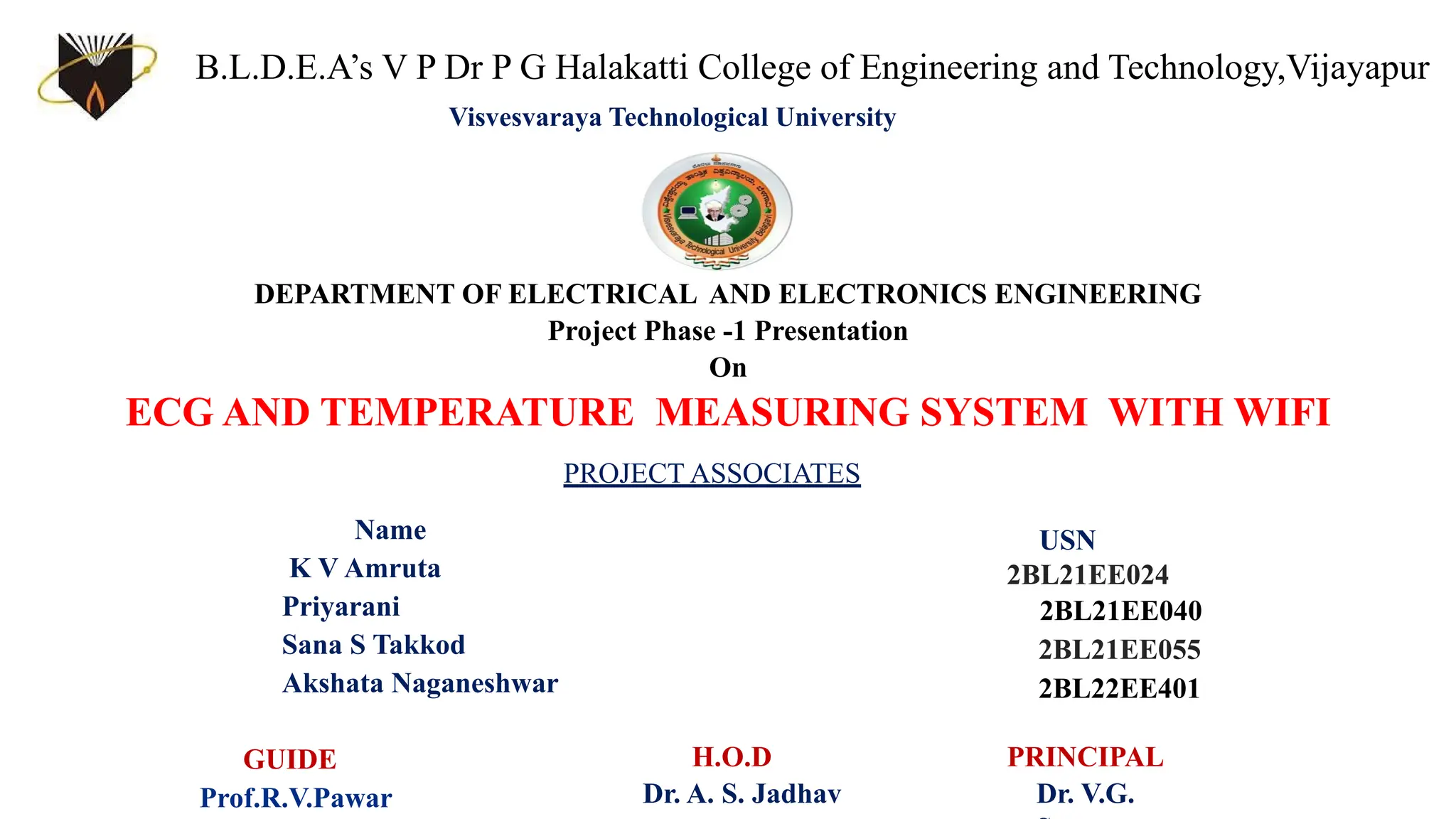
DEPARTMENT OF ELECTRICAL AND ELECTRONICS ENGINEERING
Project Phase -1 Presentation
On
ECG AND TEMPERATURE MEASURING SYSTEM WITH WIFI
PROJECT ASSOCIATES
B.L.D.E.A’s V P Dr P G Halakatti College of Engineering and Technology,Vijayapur
Visvesvaraya Technological University
Name
K V Amruta
Priyarani
Sana S Takkod
Akshata Naganeshwar
GUIDE
Prof.R.V.Pawar
H.O.D
Dr. A. S. Jadhav
PRINCIPAL
Dr. V.G.
CONTENTS
• Introduction
• Objectives
• Literature Survey
• Methodology
• Components
• Advantages And Disadvantages
• Applications
• Result
• Conclusion
• References
In modern times, ECG systems and body temperature measuring systems have evolved into sophisticated tools
essential for real-time health monitoring, diagnostics and preventive care. With advancements in technology heart
rate sensor and body temperature sensore have evolved to provide, non-invasive, and real-time measurement,
making them indispensabale for personal health monitoring, clinical use.
The ECG system record the heart’s electrical activity to monitor heart rate, rhythm and potential abnormalities. The
body temperature measuring sensor have become essential components in health care, fitness and safety
application.
The ECG system is a medical technology used to measure and record electrical activity of the heart. These electrical
signals can be detected and displayed on PC, providing a valuable information about hearts’s rhythm, electrical
activity and overall health .
INTRODUCTION
OBJECTIVES
• Developing a compact, wearable system that can be used to monitor heart activity remotely and measure
body temperature accurately.
• Designing and implementing the hardware and software components required for acquiring, processing,
displaying, and transmitting the ECG signal.
• Optimizing the system's performance to ensure accuracy and reliability in measuring body temperature and
monitoring heart activity data.
LITERATURE SURVEY
SR
NO
Publication Work-done Limitation /drawbacks
1. "Design and Development of Low
Cost ECG Monitoring System" by K.
J. Kumar and R. K. Tiwari, published
in the International Journal of
Engineering and Technology in 2013.
This paper presents the design and
development of a low-cost ECG
monitoring system using an Atmega8
microcontroller and an AD620
instrumentation amplifier. The system
uses 3 electrodes to acquire ECG
signals, which are displayed on an
LCD screen.
limitation of the system is the limited
processing power of the Atmega8
microcontroller.
2. "Real-Time ECG Monitoring System
using LabVIEW and DAQ Card" by K.
N. K. Venkata and B. Venkata
Ramana, published in the International
Journal of Emerging Technology and
Advanced Engineering in 2012.
This paper presents the design and
implementation of a real-time ECG
monitoring system using LabVIEW
software and a DAQ card. The system
uses 3 electrodes to acquire ECG
signals, which are displayed. The
paper discusses the hardware and
software design, as well as the testing
and validation of the system.
limitation of the system is the need
for a computer and LabVIEW
software to process and display the
ECG signals.
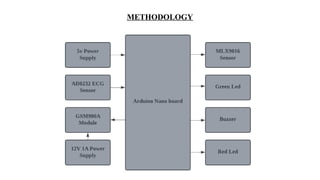
METHODOLOGY
Fig : Block Diagram
COMPONENTS
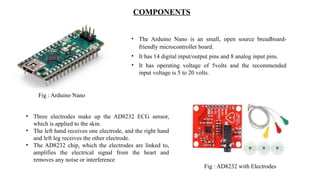
• The Arduino Nano is an small, open source breadboard-
friendly microcontroller board.
• It has 14 digital input/output pins and 8 analog input pins.
• It has operating voltage of 5volts and the recommended
input voltage is 5 to 20 volts.
Fig : Arduino Nano
• Three electrodes make up the AD8232 ECG sensor,
which is applied to the skin.
• The left hand receives one electrode, and the right hand
and left leg receives the other electrode.
• The AD8232 chip, which the electrodes are linked to,
amplifies the electrical signal from the heart and
removes any noise or interference
Fig : AD8232 with Electrodes
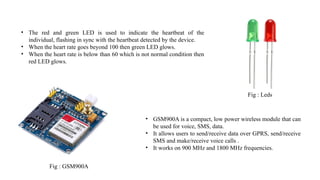
Fig : Leds
• The red and green LED is used to indicate the heartbeat of the
individual, flashing in sync with the heartbeat detected by the device.
• When the heart rate goes beyond 100 then green LED glows.
• When the heart rate is below than 60 which is not normal condition then
red LED glows.
Fig : GSM900A
• GSM900A is a compact, low power wireless module that can
be used for voice, SMS, data.
• It allows users to send/receive data over GPRS, send/receive
SMS and make/receive voice calls .
• It works on 900 MHz and 1800 MHz frequencies.
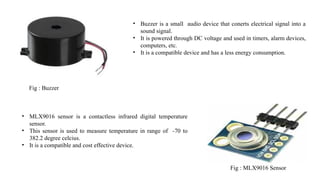
• Buzzer is a small audio device that conerts electrical signal into a
sound signal.
• It is powered through DC voltage and used in timers, alarm devices,
computers, etc.
• It is a compatible device and has a less energy consumption.
Fig : Buzzer
• MLX9016 sensor is a contactless infrared digital temperature
sensor.
• This sensor is used to measure temperature in range of -70 to
382.2 degree celcius.
• It is a compatible and cost effective device.
Fig : MLX9016 Sensor
ADVANTAGES AND DISADVANTAGES
1. The device is small, lightweight, and easy for individuals to use and carry with them.
2. The device provides real-time monitoring of heart activity data and body temperature.
3. The device uses WiFi connectivity to transmit heart activity and body temperature data of patients to
doctors.
4. The device is relatively low cost.
5. If disorders are found, an emergency email or sms can be sent to users or doctors.
Disadvantages
1. Digital systems can be disrupted by technical issues or power outages, which can delay patient care.
Advantages
APPLICATIONS
1.The device can be used for diagnosis of heart conditions such as arrhythmias, irregular heartbeats, and
other heart rhythm disorders and also rheumatic heart disease.
2.The device can be used to measure body temperature and give alert message.
3.The device is used for continuous monitoring in hospital settings for critically ill patients.
4.The device can be used for remote monitoring of heart activity data and body temperature measuring
of patients, allowing healthcare providers to monitor the individual's heart health from a remote location.
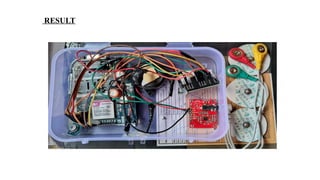
RESULT
CONCLUSION
In conclusion, the ECG and Body Temperature Measuring system using Arduino Nano, AD8232 ECG
sensor, electrodes and LED, GSM9000A, Buzzer, MLX9016 Sensor. The system has the potential to
improve the management of heart conditions, particularly in resource-limited settings where access to
traditional ECG machines is limited. The MLX9016 temperature sensor provides accurate temperature
readings without physical contact, making it ideal for application where direct measurement is
impractical.
REFERENCES
1. Shi Zhang, Jinshuan Zhao, Lihuang She, Guohua Wang, A Novel Pocket Intelligent One
Lead ECG Monitor Based on Finger Touching, 978-14244-4131-0/09/$25.009(c)2009IEE.
2. Cano-Garcia J.M., Gonzalez-Parada E., Alarcon-Collants V, Casilari-Perez, A PDA-based
Portable Wirelss ECG Monitor for Medical Personal Area Network.
3. K. Hung, Y.T. Zhang and B. Tai, Wearable Medical Devices for Tele-Home Healthcare.
4. Proceedings of the 26th Annual International Conference of the IEEE EMBS, San Francisco,
CA, USA. September 1-5,2004.
5. Tac-Soo Lee, Joo-Hyun Hong, Myeong-Chan Cho, Biomedical Digital Assistant for
Ubiquitous Health, Proceedings of the 29th Annual International Conference of the IEEE
EMBS Cite Internationale,Lyon,France, August 23-26,2007.
6. National Center for Competency Testing, February 2012.

ECG and temperature measuring system with wifi

  • 1.
    USN 2BL21EE024 2BL21EE040 2BL21EE055 2BL22EE401 DEPARTMENT OF ELECTRICALAND ELECTRONICS ENGINEERING Project Phase -1 Presentation On ECG AND TEMPERATURE MEASURING SYSTEM WITH WIFI PROJECT ASSOCIATES B.L.D.E.A’s V P Dr P G Halakatti College of Engineering and Technology,Vijayapur Visvesvaraya Technological University Name K V Amruta Priyarani Sana S Takkod Akshata Naganeshwar GUIDE Prof.R.V.Pawar H.O.D Dr. A. S. Jadhav PRINCIPAL Dr. V.G.
  • 2.
    CONTENTS • Introduction • Objectives •Literature Survey • Methodology • Components • Advantages And Disadvantages • Applications • Result • Conclusion • References
  • 3.
    In modern times,ECG systems and body temperature measuring systems have evolved into sophisticated tools essential for real-time health monitoring, diagnostics and preventive care. With advancements in technology heart rate sensor and body temperature sensore have evolved to provide, non-invasive, and real-time measurement, making them indispensabale for personal health monitoring, clinical use. The ECG system record the heart’s electrical activity to monitor heart rate, rhythm and potential abnormalities. The body temperature measuring sensor have become essential components in health care, fitness and safety application. The ECG system is a medical technology used to measure and record electrical activity of the heart. These electrical signals can be detected and displayed on PC, providing a valuable information about hearts’s rhythm, electrical activity and overall health . INTRODUCTION
  • 4.
    OBJECTIVES • Developing acompact, wearable system that can be used to monitor heart activity remotely and measure body temperature accurately. • Designing and implementing the hardware and software components required for acquiring, processing, displaying, and transmitting the ECG signal. • Optimizing the system's performance to ensure accuracy and reliability in measuring body temperature and monitoring heart activity data.
  • 5.
    LITERATURE SURVEY SR NO Publication Work-doneLimitation /drawbacks 1. "Design and Development of Low Cost ECG Monitoring System" by K. J. Kumar and R. K. Tiwari, published in the International Journal of Engineering and Technology in 2013. This paper presents the design and development of a low-cost ECG monitoring system using an Atmega8 microcontroller and an AD620 instrumentation amplifier. The system uses 3 electrodes to acquire ECG signals, which are displayed on an LCD screen. limitation of the system is the limited processing power of the Atmega8 microcontroller. 2. "Real-Time ECG Monitoring System using LabVIEW and DAQ Card" by K. N. K. Venkata and B. Venkata Ramana, published in the International Journal of Emerging Technology and Advanced Engineering in 2012. This paper presents the design and implementation of a real-time ECG monitoring system using LabVIEW software and a DAQ card. The system uses 3 electrodes to acquire ECG signals, which are displayed. The paper discusses the hardware and software design, as well as the testing and validation of the system. limitation of the system is the need for a computer and LabVIEW software to process and display the ECG signals.
  • 6.
  • 7.
    COMPONENTS • The ArduinoNano is an small, open source breadboard- friendly microcontroller board. • It has 14 digital input/output pins and 8 analog input pins. • It has operating voltage of 5volts and the recommended input voltage is 5 to 20 volts. Fig : Arduino Nano • Three electrodes make up the AD8232 ECG sensor, which is applied to the skin. • The left hand receives one electrode, and the right hand and left leg receives the other electrode. • The AD8232 chip, which the electrodes are linked to, amplifies the electrical signal from the heart and removes any noise or interference Fig : AD8232 with Electrodes
  • 8.
    Fig : Leds •The red and green LED is used to indicate the heartbeat of the individual, flashing in sync with the heartbeat detected by the device. • When the heart rate goes beyond 100 then green LED glows. • When the heart rate is below than 60 which is not normal condition then red LED glows. Fig : GSM900A • GSM900A is a compact, low power wireless module that can be used for voice, SMS, data. • It allows users to send/receive data over GPRS, send/receive SMS and make/receive voice calls . • It works on 900 MHz and 1800 MHz frequencies.
  • 9.
    • Buzzer isa small audio device that conerts electrical signal into a sound signal. • It is powered through DC voltage and used in timers, alarm devices, computers, etc. • It is a compatible device and has a less energy consumption. Fig : Buzzer • MLX9016 sensor is a contactless infrared digital temperature sensor. • This sensor is used to measure temperature in range of -70 to 382.2 degree celcius. • It is a compatible and cost effective device. Fig : MLX9016 Sensor
  • 10.
    ADVANTAGES AND DISADVANTAGES 1.The device is small, lightweight, and easy for individuals to use and carry with them. 2. The device provides real-time monitoring of heart activity data and body temperature. 3. The device uses WiFi connectivity to transmit heart activity and body temperature data of patients to doctors. 4. The device is relatively low cost. 5. If disorders are found, an emergency email or sms can be sent to users or doctors. Disadvantages 1. Digital systems can be disrupted by technical issues or power outages, which can delay patient care. Advantages
  • 11.
    APPLICATIONS 1.The device canbe used for diagnosis of heart conditions such as arrhythmias, irregular heartbeats, and other heart rhythm disorders and also rheumatic heart disease. 2.The device can be used to measure body temperature and give alert message. 3.The device is used for continuous monitoring in hospital settings for critically ill patients. 4.The device can be used for remote monitoring of heart activity data and body temperature measuring of patients, allowing healthcare providers to monitor the individual's heart health from a remote location.
  • 12.
  • 13.
    CONCLUSION In conclusion, theECG and Body Temperature Measuring system using Arduino Nano, AD8232 ECG sensor, electrodes and LED, GSM9000A, Buzzer, MLX9016 Sensor. The system has the potential to improve the management of heart conditions, particularly in resource-limited settings where access to traditional ECG machines is limited. The MLX9016 temperature sensor provides accurate temperature readings without physical contact, making it ideal for application where direct measurement is impractical.
  • 14.
    REFERENCES 1. Shi Zhang,Jinshuan Zhao, Lihuang She, Guohua Wang, A Novel Pocket Intelligent One Lead ECG Monitor Based on Finger Touching, 978-14244-4131-0/09/$25.009(c)2009IEE. 2. Cano-Garcia J.M., Gonzalez-Parada E., Alarcon-Collants V, Casilari-Perez, A PDA-based Portable Wirelss ECG Monitor for Medical Personal Area Network. 3. K. Hung, Y.T. Zhang and B. Tai, Wearable Medical Devices for Tele-Home Healthcare. 4. Proceedings of the 26th Annual International Conference of the IEEE EMBS, San Francisco, CA, USA. September 1-5,2004. 5. Tac-Soo Lee, Joo-Hyun Hong, Myeong-Chan Cho, Biomedical Digital Assistant for Ubiquitous Health, Proceedings of the 29th Annual International Conference of the IEEE EMBS Cite Internationale,Lyon,France, August 23-26,2007. 6. National Center for Competency Testing, February 2012.