International Research Journal of Engineering and Technology (IRJET) e-ISSN: 2395-0056
Volume: 06 Issue: 04 | Apr 2019 www.irjet.net p-ISSN: 2395-0072
© 2019, IRJET | Impact Factor value: 7.211 | ISO 9001:2008 Certified Journal | Page 4333
IoT Based Smart Home Using Renewable Solar Energy
Princy S1, Varun K S2, Aiswarya C3 ,Sujith A H4 ,Sithara Krishnan5
1,2,3,4Final year Students, Dept. of ECE, Ammini College of Engineering, Palakkad, Kerala, India
5Asst Professor, Dept. of Electronics and Communication Engineering, Ammini College of Engineering, Palakkad
---------------------------------------------------------------------***---------------------------------------------------------------------
Abstract -The Internet of Things has a vision in which the
internet extends into the real world embracing everyday
objects. The IoT allows objects to be sensed and/or controlled
remotely over existing network infrastructure, creating
opportunities for pure integration of the physical world into
computer-based systems, and resulting in improvedefficiency,
accuracy and economic benefit in addition to reduced human
intervention. This technology has many applicationslikeSolar
cities, Smart villages, Micro gridsandSolarStreetlights and so
on. As Renewable energy grew at a rate faster than any other
time in history during this period. The proposed system refers
to the online display of the power usage of solar energy as a
renewable energy. This monitoring is done through arduino.
Smart Monitoring displays daily usage of renewable energy.
This helps the user to control the switching of the devices with
the help of app using IOT.
Key Words: IoT , Relay ,Current Sensor ,Voltage Sensor,
Node MCU, Solar Panel, atmega328p,blynk app.
1. INTRODUCTION
Automation is today’s fact, where more things are being
completed every day automatically. The home automation
system conception remains for several years. The control of
the appliances when completely takenoverbythemachines,
the process of monitoring and controlling becomes more
eventful. Renewable energy is generally defined as energy
that comes from resources which are naturally available
such as sunlight, wind, rain, tides, waves and geothermal
heat. Renewable energy replaces conventional fuels in four
distinct areas: electricity generation, hot water/space
heating, motor fuels, and rural (off-grid) energy services.
This project is fully based on renewable energy resources.
The energy consumption in home areas is greater as more
home equipments are used. For solving this home energy
problem, we consider energy saving and another one is
energy renewable sources. At the same time we also have to
save the home energy cost. For this, two things must be
considered and these are energy consumption and energy
generation. Also we are going to apply IOT concept by using
Wi-Fi module.
Its era of technology world is becoming fasterand easierdue
to this reason our homes also should become part of it.
Setting in any part of world we can operate our home just by
our smart phone. Isn’t it a great idea, yes with the help of
node MCU and Blynk app it’s possible.
Here we use the concept called IOT. Using the concept of
internet of things we design our project to make human life
reliable. With the help of IOT things can be too easy. Main
aim of this project is to atomize ruler homes in less cost.
1.1 Basic Concept
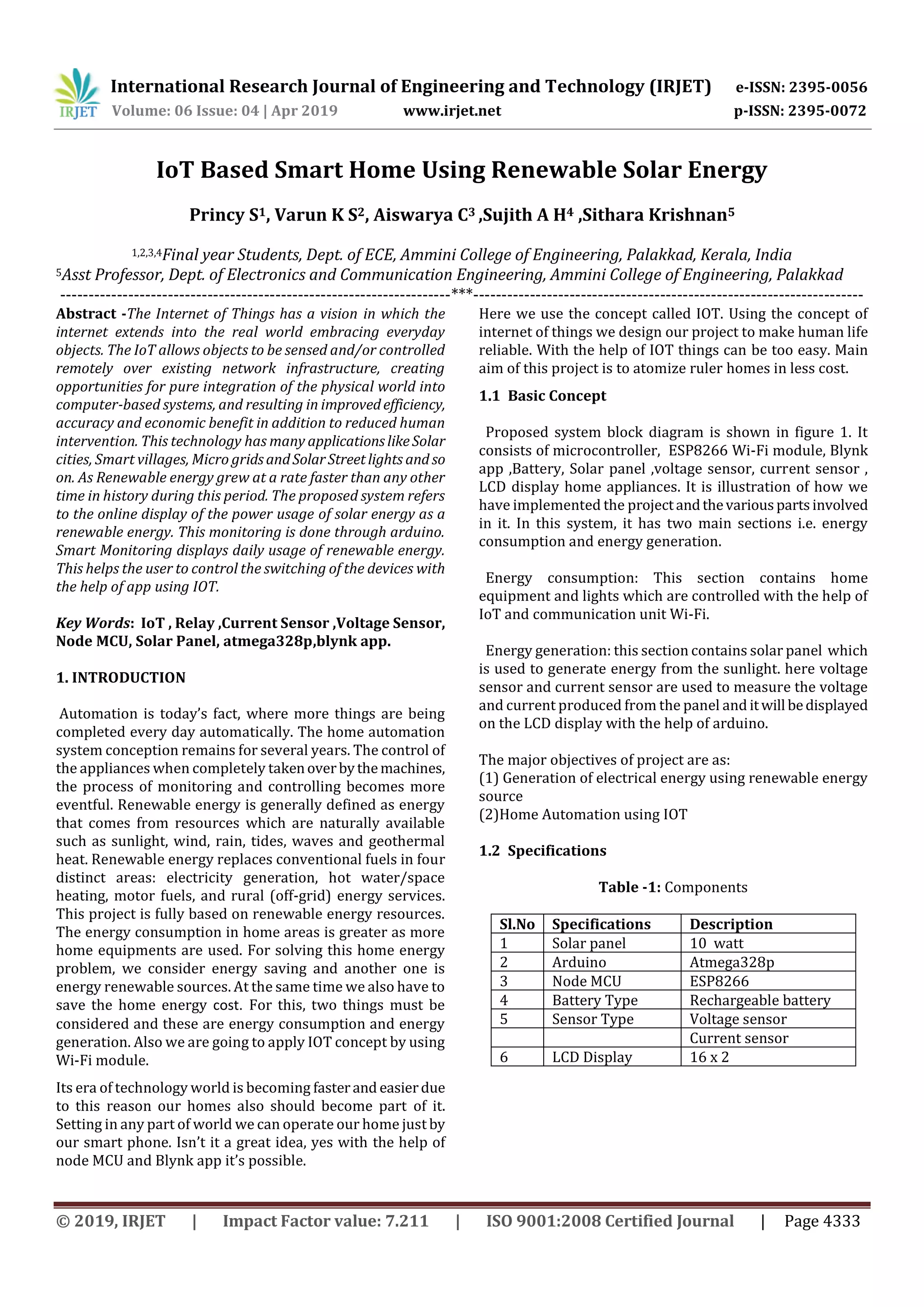
Proposed system block diagram is shown in figure 1. It
consists of microcontroller, ESP8266 Wi-Fi module, Blynk
app ,Battery, Solar panel ,voltage sensor, current sensor ,
LCD display home appliances. It is illustration of how we
have implemented the projectandthevariouspartsinvolved
in it. In this system, it has two main sections i.e. energy
consumption and energy generation.
Energy consumption: This section contains home
equipment and lights which are controlled with the help of
IoT and communication unit Wi-Fi.
Energy generation: this section contains solar panel which
is used to generate energy from the sunlight. here voltage
sensor and current sensor are used to measure the voltage
and current produced from the panel and itwill bedisplayed
on the LCD display with the help of arduino.
The major objectives of project are as:
(1) Generation of electrical energy using renewable energy
source
(2)Home Automation using IOT
1.2 Specifications
Table -1: Components
Sl.No Specifications Description
1 Solar panel 10 watt
2 Arduino Atmega328p
3 Node MCU ESP8266
4 Battery Type Rechargeable battery
5 Sensor Type Voltage sensor
Current sensor
6 LCD Display 16 x 2
International Research Journal of Engineering and Technology (IRJET) e-ISSN: 2395-0056
Volume: 06 Issue: 04 | Apr 2019 www.irjet.net p-ISSN: 2395-0072
© 2019, IRJET | Impact Factor value: 7.211 | ISO 9001:2008 Certified Journal | Page 4334
2. WORKING
Fig -1: block diagram
Once the circuit is assembled, it is readytodeployalongwith
the solar panel. When sunlight falls on solar panel photo
voltaic cell(solar panel) generate thevoltage,thisvoltageisa
variable voltage. Then Its Output is given to the Dc booster,
which can gives constant voltage to battery and battery can
save the energy. The attached IOT device developed in this
project monitors its various parameters. The device is
powered from the inverter battery. The system consist of a
current sensor, voltage sensor, battery ,charge level
indicator and an smart home system .These sensors senses
the parameters and is been transferred to the central
microcontroller(Arduino).The collected data is been
processed on arduino and the data’s needed to be uploaded
to the server is been transferred to the node MCU module.
The system continuously monitors the current and voltage
levels and the battery charge level. If the batterychargelevel
is low the solar charges the battery and when the battery
becomes full it is been noticed in the UI and the notification
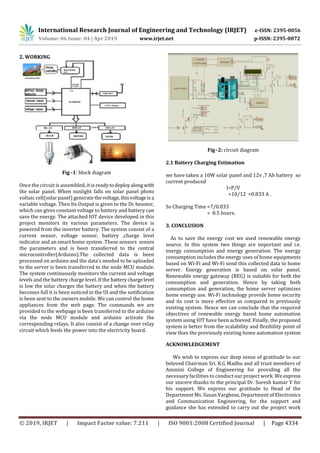
is been sent to the owners mobile. We can control the home
appliances from the web page. The commands we are
provided to the webpage is been transferred to the arduino
via the node MCU module and arduino activate the
corresponding relays. It also consist of a change over relay
circuit which feeds the power into the electricity board.
Fig -2: circuit diagram
2.1 Battery Charging Estimation
we have taken a 10W solar panel and 12v ,7 Ah battery so
current produced
I=P/V
=10/12 =0.833 A .
So Charging Time =7/0.833
= 8.5 hours.
3. CONCLUSION
As to save the energy cost we used renewable energy
source. In this system two things are important and i.e.
energy consumption and energy generation. The energy
consumption includes the energy uses of home equipments
based on Wi-Fi and Wi-Fi send this collected data to home
server. Energy generation is based on solar panel.
Renewable energy gateway (REG) is suitable for both the
consumption and generation. Hence by taking both
consumption and generation, the home server optimizes
home energy use. Wi-Fi technology provide home security
and its cost is more effective as compared to previously
existing system. Hence we can conclude that the required
objectives of renewable energy based home automation
system using IOT have been achieved. Finally, the proposed
system is better from the scalability and flexibility point of
view than the previously existing home automation system
ACKNOWLEDGEMENT
We wish to express our deep sense of gratitude to our
beloved Chairman Sri. K.G Madhu and all trust members of
Ammini College of Engineering for providing all the
necessary facilities to conduct our project work. We express
our sincere thanks to the principal Dr. Suresh kumar V for
his support. We express our gratitude to Head of the
Department Ms. Susan Varghese, Department of Electronics
and Communication Engineering, for the support and
guidance she has extended to carry out the project work
International Research Journal of Engineering and Technology (IRJET) e-ISSN: 2395-0056
Volume: 06 Issue: 04 | Apr 2019 www.irjet.net p-ISSN: 2395-0072
© 2019, IRJET | Impact Factor value: 7.211 | ISO 9001:2008 Certified Journal | Page 4335
successfully. We extend our sincere thanks to the project
coordinator and our guide Ms. Sithara Krishnan, Assistant
professor and staff members of the Department of
Electronics and Communication Engineering for their
valuable suggestions and help throughout our project work.
REFERENCES
[1] Hiral S. Doshi, Minesh S. Shah, Umair S A. Shaikh,
Internet of things (IoT): Inte-gration of Blynk for Domestic
Usability", VJER-Vishwakarma Journal of Engineering
Research, Volume 1 Issue 4, December 2017.
[2] Tejal Deshpande, Nitin Ahire, Home AutomationUsing
the Concept of IoT", IJCSN International Journal ofComputer
Science and Network, Volume 5, Issue 3, June 2016.
[3] Bharat Bohara and Sunil Maharjan, IoT Based Smart
Home Using Blynk Frame- work", ZERONE SCHOLAR,
Volume. 1, NO. 1, November 2016.
BIOGRAPHIES
Sithara Krishnan is with Ammini
College of engineering,Palakkadas
Assistant professor in the ECE
dept. She received the B.E degree
in InstrumentationandElectronics
Engineering from Bangalore
Institute of Technology. M.E in
VLSI Design from SasurieAcademy
of Engineering Coimbatore
Princy S is doing her B.Tech in
Electronics and Communication
Engineering at Ammini College of
Engineering, Kerala
Technological University, Kerala.
Aiswarya C is doing her B.Tech in
Electronics and Communication
Engineering at Ammini College of
Engineering, Kerala Technological
University, Kerala
4th
Author
Photo
3rd
Author
Photo
4th
Author
Photo
Varun K S is doing his B.Tech in
Electronics and Communication
Engineering at Ammini College of
Engineering, Kerala Technological
University, Kerala
Sujith A H is doing his B.Tech in Electronics
and Communication Engineering at Ammini
College of Engineering, Kerala Technological
University, Kerala

IRJET- IoT based Smart Home using Renewable Solar Energy

  • 1.
    International Research Journalof Engineering and Technology (IRJET) e-ISSN: 2395-0056 Volume: 06 Issue: 04 | Apr 2019 www.irjet.net p-ISSN: 2395-0072 © 2019, IRJET | Impact Factor value: 7.211 | ISO 9001:2008 Certified Journal | Page 4333 IoT Based Smart Home Using Renewable Solar Energy Princy S1, Varun K S2, Aiswarya C3 ,Sujith A H4 ,Sithara Krishnan5 1,2,3,4Final year Students, Dept. of ECE, Ammini College of Engineering, Palakkad, Kerala, India 5Asst Professor, Dept. of Electronics and Communication Engineering, Ammini College of Engineering, Palakkad ---------------------------------------------------------------------***--------------------------------------------------------------------- Abstract -The Internet of Things has a vision in which the internet extends into the real world embracing everyday objects. The IoT allows objects to be sensed and/or controlled remotely over existing network infrastructure, creating opportunities for pure integration of the physical world into computer-based systems, and resulting in improvedefficiency, accuracy and economic benefit in addition to reduced human intervention. This technology has many applicationslikeSolar cities, Smart villages, Micro gridsandSolarStreetlights and so on. As Renewable energy grew at a rate faster than any other time in history during this period. The proposed system refers to the online display of the power usage of solar energy as a renewable energy. This monitoring is done through arduino. Smart Monitoring displays daily usage of renewable energy. This helps the user to control the switching of the devices with the help of app using IOT. Key Words: IoT , Relay ,Current Sensor ,Voltage Sensor, Node MCU, Solar Panel, atmega328p,blynk app. 1. INTRODUCTION Automation is today’s fact, where more things are being completed every day automatically. The home automation system conception remains for several years. The control of the appliances when completely takenoverbythemachines, the process of monitoring and controlling becomes more eventful. Renewable energy is generally defined as energy that comes from resources which are naturally available such as sunlight, wind, rain, tides, waves and geothermal heat. Renewable energy replaces conventional fuels in four distinct areas: electricity generation, hot water/space heating, motor fuels, and rural (off-grid) energy services. This project is fully based on renewable energy resources. The energy consumption in home areas is greater as more home equipments are used. For solving this home energy problem, we consider energy saving and another one is energy renewable sources. At the same time we also have to save the home energy cost. For this, two things must be considered and these are energy consumption and energy generation. Also we are going to apply IOT concept by using Wi-Fi module. Its era of technology world is becoming fasterand easierdue to this reason our homes also should become part of it. Setting in any part of world we can operate our home just by our smart phone. Isn’t it a great idea, yes with the help of node MCU and Blynk app it’s possible. Here we use the concept called IOT. Using the concept of internet of things we design our project to make human life reliable. With the help of IOT things can be too easy. Main aim of this project is to atomize ruler homes in less cost. 1.1 Basic Concept Proposed system block diagram is shown in figure 1. It consists of microcontroller, ESP8266 Wi-Fi module, Blynk app ,Battery, Solar panel ,voltage sensor, current sensor , LCD display home appliances. It is illustration of how we have implemented the projectandthevariouspartsinvolved in it. In this system, it has two main sections i.e. energy consumption and energy generation. Energy consumption: This section contains home equipment and lights which are controlled with the help of IoT and communication unit Wi-Fi. Energy generation: this section contains solar panel which is used to generate energy from the sunlight. here voltage sensor and current sensor are used to measure the voltage and current produced from the panel and itwill bedisplayed on the LCD display with the help of arduino. The major objectives of project are as: (1) Generation of electrical energy using renewable energy source (2)Home Automation using IOT 1.2 Specifications Table -1: Components Sl.No Specifications Description 1 Solar panel 10 watt 2 Arduino Atmega328p 3 Node MCU ESP8266 4 Battery Type Rechargeable battery 5 Sensor Type Voltage sensor Current sensor 6 LCD Display 16 x 2
  • 2.
    International Research Journalof Engineering and Technology (IRJET) e-ISSN: 2395-0056 Volume: 06 Issue: 04 | Apr 2019 www.irjet.net p-ISSN: 2395-0072 © 2019, IRJET | Impact Factor value: 7.211 | ISO 9001:2008 Certified Journal | Page 4334 2. WORKING Fig -1: block diagram Once the circuit is assembled, it is readytodeployalongwith the solar panel. When sunlight falls on solar panel photo voltaic cell(solar panel) generate thevoltage,thisvoltageisa variable voltage. Then Its Output is given to the Dc booster, which can gives constant voltage to battery and battery can save the energy. The attached IOT device developed in this project monitors its various parameters. The device is powered from the inverter battery. The system consist of a current sensor, voltage sensor, battery ,charge level indicator and an smart home system .These sensors senses the parameters and is been transferred to the central microcontroller(Arduino).The collected data is been processed on arduino and the data’s needed to be uploaded to the server is been transferred to the node MCU module. The system continuously monitors the current and voltage levels and the battery charge level. If the batterychargelevel is low the solar charges the battery and when the battery becomes full it is been noticed in the UI and the notification is been sent to the owners mobile. We can control the home appliances from the web page. The commands we are provided to the webpage is been transferred to the arduino via the node MCU module and arduino activate the corresponding relays. It also consist of a change over relay circuit which feeds the power into the electricity board. Fig -2: circuit diagram 2.1 Battery Charging Estimation we have taken a 10W solar panel and 12v ,7 Ah battery so current produced I=P/V =10/12 =0.833 A . So Charging Time =7/0.833 = 8.5 hours. 3. CONCLUSION As to save the energy cost we used renewable energy source. In this system two things are important and i.e. energy consumption and energy generation. The energy consumption includes the energy uses of home equipments based on Wi-Fi and Wi-Fi send this collected data to home server. Energy generation is based on solar panel. Renewable energy gateway (REG) is suitable for both the consumption and generation. Hence by taking both consumption and generation, the home server optimizes home energy use. Wi-Fi technology provide home security and its cost is more effective as compared to previously existing system. Hence we can conclude that the required objectives of renewable energy based home automation system using IOT have been achieved. Finally, the proposed system is better from the scalability and flexibility point of view than the previously existing home automation system ACKNOWLEDGEMENT We wish to express our deep sense of gratitude to our beloved Chairman Sri. K.G Madhu and all trust members of Ammini College of Engineering for providing all the necessary facilities to conduct our project work. We express our sincere thanks to the principal Dr. Suresh kumar V for his support. We express our gratitude to Head of the Department Ms. Susan Varghese, Department of Electronics and Communication Engineering, for the support and guidance she has extended to carry out the project work
  • 3.
    International Research Journalof Engineering and Technology (IRJET) e-ISSN: 2395-0056 Volume: 06 Issue: 04 | Apr 2019 www.irjet.net p-ISSN: 2395-0072 © 2019, IRJET | Impact Factor value: 7.211 | ISO 9001:2008 Certified Journal | Page 4335 successfully. We extend our sincere thanks to the project coordinator and our guide Ms. Sithara Krishnan, Assistant professor and staff members of the Department of Electronics and Communication Engineering for their valuable suggestions and help throughout our project work. REFERENCES [1] Hiral S. Doshi, Minesh S. Shah, Umair S A. Shaikh, Internet of things (IoT): Inte-gration of Blynk for Domestic Usability", VJER-Vishwakarma Journal of Engineering Research, Volume 1 Issue 4, December 2017. [2] Tejal Deshpande, Nitin Ahire, Home AutomationUsing the Concept of IoT", IJCSN International Journal ofComputer Science and Network, Volume 5, Issue 3, June 2016. [3] Bharat Bohara and Sunil Maharjan, IoT Based Smart Home Using Blynk Frame- work", ZERONE SCHOLAR, Volume. 1, NO. 1, November 2016. BIOGRAPHIES Sithara Krishnan is with Ammini College of engineering,Palakkadas Assistant professor in the ECE dept. She received the B.E degree in InstrumentationandElectronics Engineering from Bangalore Institute of Technology. M.E in VLSI Design from SasurieAcademy of Engineering Coimbatore Princy S is doing her B.Tech in Electronics and Communication Engineering at Ammini College of Engineering, Kerala Technological University, Kerala. Aiswarya C is doing her B.Tech in Electronics and Communication Engineering at Ammini College of Engineering, Kerala Technological University, Kerala 4th Author Photo 3rd Author Photo 4th Author Photo Varun K S is doing his B.Tech in Electronics and Communication Engineering at Ammini College of Engineering, Kerala Technological University, Kerala Sujith A H is doing his B.Tech in Electronics and Communication Engineering at Ammini College of Engineering, Kerala Technological University, Kerala