International Research Journal of Engineering and Technology (IRJET) e-ISSN: 2395-0056
Volume: 05 Issue: 10 | Oct 2018 www.irjet.net p-ISSN: 2395-0072
© 2018, IRJET | Impact Factor value: 7.211 | ISO 9001:2008 Certified Journal | Page 1036
FLYWHEEL POWER GENERATION AND MULTIPLICATION
Chaganti Srinivas Bhaskar1, Chaganti Bala2
1,2Cow and Calf Dairy Farms Limited (Research Institute), Hyderabad, Telangana State, India
---------------------------------------------------------------------***----------------------------------------------------------------------
Abstract:- This Case study of multi-hour electrical generation using the continuously available rotating force from a specific
weight, diameter, and rpm is considered in flywheel power generation technology because the wheel is continuous in motion. we
are designing energy generation and storage projects for generating clean electricity using Gear-flywheeland Piniongear. Pinion
gear harboring the generator is the innovation.
This technology major advantage is the design, where distribution of mass in a given area of the flywheel is the key to success.
Flywheels with Different geometrical figures are used for multidimensional requirements. For1Kwpowergenerationatleast150
Kg weight is required.
Key Words: Gear Flywheel, Flywheel, Power Multiplication, Generator, Motor, Storage
1. INTRODUCTION
In this technology we always consider weight, diameter and stored rotating force of the flywheel (rpm). This flywheel is
designed as a gear flywheel either from the world of steel, rubber, plastic, concrete and hybridglassorwiththecombinationof
the above described material where ever required in the design and as per the design.
For the safety purpose, this innovation adopts bunkers design to fix flywheels horizontally or verticallyandrotate below2000
rpm.
In this design we are using single 12 m diameter gear-flywheel with teeth on the periphery of the wheel and rotate the 67 ton
weight with 350 kW motor at 800 rpm and on the periphery we fix small pinion gear to rotate at 1800 rpm there by 19 pinion
gears are connected all around the 12 diameter and each pinion gear will be attached with 40 KW PMG generator with 1800
rpm. Here the input motor rpm is only 10 rotations because it is connected directly to the speed increasing gearbox there by
the motor connected to the VFD will have minimum stress and consume fewer amps.
In this design we expresses our idea to show, by using less energy motor and connecting a higher kWgenerator,weareusinga
big diameter ring gear wheel to balance the back torque generated when the load is applied on the 750 KW PMG generator.
Please consider the different torques generated by using theflywheel,motor,andPMG generatortounderstandhowelectricity
is generated.
67 ton and 12 m diameter, rpm 800 Flywheel torque: - 28070.71 Nm
350 kW Motor torque: - 5570.13 Nm at 600 rpm
750 kW PMG generator torque: - 3978.67 Nm at 1800 rpm
Flywheel + Motor torque = cumulative 33640.84 torque Nm – PMG generator torque 3978.67 Nm = 29662.17 Nm balance
torque still in the rotating gear flywheel.
1.1 Related Work
Practical Observation on a case study in our workshop.
By manufacturing 5 Gear-flywheels with equal engineering specifications example:- Each flywheel weight is 13400 kg (total 5
flywheels weight is 67 tons), 3 meter in diameter and rotated at 800 rpm by a 2 speed motor connected to speed increasing,
multiple gearboxes by using a common shaft design i.e. using a cardan shaft to connect in-between independent flywheels and
fix 5 pinion gearwheels to the5 gear flywheels so that all the 5 gear flywheels help increase the rpm of the 5 pinion gearwheels
connected to the shaft which is connecting the PMG generator, is the working prototype design.
In the flywheel power multiplication design weuse mix of renewable energy to charge the Battery bank and the battery bank is
connected to VFD and VFD isconnected to a motor and motor is connectedtomorethan1speedincreasinggearboxandthegear
boxes to the series of flywheelsare connected and rotatedbelow 2000 rpm within 10 to60 seconds timeso that the cumulative
torque generated by the 5 flywheels will be absorbed by the PMG generator and generate clean electricity.
International Research Journal of Engineering and Technology (IRJET) e-ISSN: 2395-0056
Volume: 05 Issue: 10 | Oct 2018 www.irjet.net p-ISSN: 2395-0072
© 2018, IRJET | Impact Factor value: 7.211 | ISO 9001:2008 Certified Journal | Page 1037
Each flywheel with this specification of 13400 kg weight and 3 m in diameter at 800 rpm will store 30 KWof energy in thetorus
ring design where weight is maximum on the periphery of the flywheel.
There by 5 flywheels are storing 150 KW of energy at 800 rpm.
Please note:- 5 gear flywheels with common shaft are connected to 5 pinion gearwheels with common shaft both are separate
but connected with gear teeth with each other
750kW PMG generator is rotated at 1800 rpm by rotating the Pinion gears. 5 gear flywheels rotate at 800 rpm and 5 pinions
connected to 5gear flywheels rotate at 1800 rpm. Please understand the design.
The cumulative torque generated by 5 gear flywheels: - In one gear flywheel 359 Nm X 5 gear flywheels = total torque 1795 Nm
is the rotating force transferred into the 5 pinion gearwheels connected to 750kWPMGgeneratorbyacommonshaftrotatedat
1800 rpm to generate clean electricity.
The motor rotating the slow speed shaft of the speed increasing gearbox at 10 rpm. first gearbox (1) input 10 rpm and output
200 rpm second gearbox (2) input 200 rpm and output 800 rpm so that the fully charged flywheel with maximum surface
velocity of 126 meters per second is connected to the 750 KW permanent magnet generator with load and is rotated
continuously without any stop. TheflywheelsarefixedonthePlummerblockbearingsandrotatedfreelyistheinnovation.When
the flywheels are rotated they rotate freely for a long period of time.
In our workshop we observed, if the diameter is more, the energy is more due to increasing surface velocity, because it has to
revolve in bigger circle. Example for 1m, 2m, 3m, 4m, 5m,12m. But the 350 kW Motor used will be the same because mass or
weight is same rpm is the same but diameter differs because of bigger circle formation there by more storage of energy.
Here is an Example for distributing mass in a given area for designing a flywheel cum energy storage system
Vertical design - 67 Ton weight, Diameter 3 meters, Rpm 1800, Surface Speed (m/sec) 282.78, Ring (joules) 2678811701.39,
useful energy 744.11 Kwh ,Motor 350 kW. Flywheel in any Geometrical shape or cylindrical, round etc..
Horizontal design - 67 Ton, Diameter 12 meters, Rpm 1800, Surface Speed (m/sec) 1131.12, Ring (joules) 42860987222.39,
useful energy 11905.82 Kwh. Motor 350 kW. Flywheel in disc shape round and flat.
1.2 Body
Concept is derived, using Hydro power formula, General Formula
Head X Flow X Gravity X Efficiency = Kwh and 1800 rpm of the generator
Head 3 m X flow 67m3/sec X gravity 9.81 X efficiency 92% = 1500 KW power generated per hour from hydro sector.
Now in Flywheel Power multiplication technology: Our formula is
Head X Flow X Gravity X Efficiency = Kwh is adopted and made like this.
Head converted to the total Diameter i.e. 3 meters round in shape torus ring wheel X Flow is the water weightinliterschanged
to kg weight of the Flywheel i.e. 67 cubic meter per sec. is converted to 67000 Kilograms or 67 tons carbon steel torus ring
wheel X Gravity is 9.81 X Efficiency of 92% in combination of {Torus flywheel + Generator + Transformer} 92% = 1500 Kwh.
Compare with hydro power and judge the efficiency
Please take the Torque value of the Torus ring wheel with 67000 Kilograms weight and 1800 rpminbetween10secondsto60
seconds and 3 meters in Diameter, round flywheel where the maximum weight is on the periphery of the wheel or on the top
side of the Rim of the wheel with small ‘r’ as the maximum width and thickness of the wheel.ConverttheTorqueof therotating
wheel in 10 seconds time and you get Nm again convert into joules and theninto Kwh. HeretheSpeed(RPM),diameter,weight,
time are the deciding key factors for generating the torque from the toruswheel tocounterthereversetorquedeveloped when
the load is applied on the 750 kW PMG generator rotated at 1800 rpm, in our workshop practical experience we have noted
100 kg back pressure per cubic centimeter of the generator rotor total area as reverse torque opposing the rotating force
coming from the flywheel and motor while rotating the common shaft of the cumulative flywheels.
The reverse torque always decreases volts, Hz and Rpm of the motor and generator.Tocounterall this,67tonFlywheel should
have maximum torque then, we can generate grid connectivity power with 50 or 60 HZ and required voltage.
International Research Journal of Engineering and Technology (IRJET) e-ISSN: 2395-0056
Volume: 05 Issue: 10 | Oct 2018 www.irjet.net p-ISSN: 2395-0072
© 2018, IRJET | Impact Factor value: 7.211 | ISO 9001:2008 Certified Journal | Page 1038
We are using one motor for one flywheel in vertical design in horizontal design we use only one big motorthisisthedifference
in vertical and horizontal designs.
For vertical design
Power (kW) = Torque (Nm) x Speed (RPM) / 9.5488
Total 350 kW motor is considered to rotate 67 Ton Weight.
350 kW motor is divided into 5 equal parts of 70 kW each.
Each 70 KW two speed motor (300/600 Rpm)
Torque
At 10 rpm 66841.60 Nm
At 300 rpm 2228.05 Nm
At 600 rpm 1114.03 Nm
There by the torque of the 5 motors will be At 10 rpm 334208 Nm
At 300 rpm 11140.25 Nm
At 600 rpm 5570.15 Nm
5 flywheel cumulative torques is 3978.67 Nm
One 750 rpm PMG generator torque at 1800 rpm is 3978.67 Nm
Motor Torque
Flywheel 9548.82
750 kW PMG Generator Torque 3978.67 Nm
Motor side torque is more than the torque of PMG generator because the 350 kW is rotated at 10 Rpm i.e. controlled rotations
using a VFD.
When the motor shaft is connected to the speed increasing gear box shaft the input Rpm is only 10 there by the speed
increasing output shaft will rotate at 1800 Rpm. The PMG generator connected at end of the common shaft will also rotate
at1800 Rpm and generate electricity.
2. PERFORMANCE EXPERIMENTS
We have started our carrier in 1994 and we have more than 2 decades of field experience, in this long journey we have clearly
understood whatare the parameters for successfully generating electricity using flywheels, because big diameter isalways the
success for power generation and with sufficient weight on the periphery of the wheel then storage of energy is more there by
the wheel will be rotating for more time because more surface velocity is available in the rotating force.
As an experiment we have assembled eleven tons of flywheel with two meters in diameter and 2000 RPM we have observed
when the motor gets disconnected then the flywheels rotate for more than 30 minutes here we did not use gear box.
In our observation, if we can convert the flywheel or fabricate the flywheel outer section as a ring gear then the rotating gear
flywheel in low RPM, in between 500 to 600 RPM will also generate electricity when load applied on the generator.
By attaching a pinion gear to the big diameter gear flywheel, where the periphery is designed as the double helical gear teeth.
The pinion RPM will be increased from 600 to 1800 RPM below one minute. Here we use 10 RPM as the input RPM with the
International Research Journal of Engineering and Technology (IRJET) e-ISSN: 2395-0056
Volume: 05 Issue: 10 | Oct 2018 www.irjet.net p-ISSN: 2395-0072
© 2018, IRJET | Impact Factor value: 7.211 | ISO 9001:2008 Certified Journal | Page 1039
speed increase gearbox and exciteto 600RPM the 67 ton weight below1minutethereafterthepiniongearwillreach1800RPM
after reaching this speed of 1800 rotations in 1 minute then load is connected to the PMG generator.
In our work shop we always use a higher capacity of inverter cum VFD to connect to the two speed motor and rotate the motor
with a pre-designed programmed in the VFD from 10 Rpm to 1800 Rpm.
We have observed that if we connect the motor with VFD then the motor RPM can be controlled there by consumption of less
Amps by the motor because the input gearbox shaft has to rotateat 10 Rpm and wecan rotate the motor on critical continuous
duty for long hours without any interruption even when load is applied.
In our observation, by using eleven ton weight with 2 meter diameter flywheel rotated at 600RPM(Piniongear1800RPM)bya
70 Kw motor and connecta 40 Kw PMG generator with 1800RPMtherebythemotorconnectedtoVFDwillrotatetheeleventon
flywheel by consuming 20 Amps. Here one should observe that the eleven Ton flywheel rotating at 600 Rpm and pinion gear
rotating at 1800 Rpm what is the maximum contact area of the pinion gear when connected to the two meter diameter having
eleven Tons should be discussed.
When load is applied to the 40 kW PMG generator connected to the pinion gear the teeth of the big gear wheel and the pinion
gear wheel have small amount of friction. The lubrication in between the big gear and small pinion gear will help to reduce the
friction there by the eleven Ton flywheel Rpm is maintained constantly at 600 Rpm.
This is what we have experienced in our workshop.
40 Kw PMG rotor weight is 40 Kilograms
Total flywheel weight is 11 tons and 2 meter diameter
Motor used is 70 Kw at 10 RPM (connected to the VFD)
3 Phases, 50 Hz, 415 Volt
Torque at various Rpm’s
10 Rpm 66841.60 Nm
300 Rpm 2228.05 Nm
600 Rpm 1114.03 Nm
11 Ton flywheel torque 95 Nm at 600 rpm
PMG generator 40 Kw and 1800 RPM 212.20 Nm
40 Kw PMG will be generating 61.83 Amps, useful energy at 80% load is 50 Amps.
3 phase, 50Hz, 415 Volt
These are the Disc type wheel 2 Meter in diameter. In our work shop we have rotated 11 ton at 2000 RPM. Using SKF Bearings.
Motor of 110 kW consumed 71 amps and without gearbox.
International Research Journal of Engineering and Technology (IRJET) e-ISSN: 2395-0056
Volume: 05 Issue: 10 | Oct 2018 www.irjet.net p-ISSN: 2395-0072
© 2018, IRJET | Impact Factor value: 7.211 | ISO 9001:2008 Certified Journal | Page 1040
2.1 EQUATIONS
The amount of energy ‘E’ stored in a flywheel varies linearlywithmomentofinertia‘I’andwiththesquareoftheangularvelocity
‘ω’.
Physical quantity of inertia, isthe integral of the square of the distance ‘x’ from the axis of rotation to the differential mass ‘dmx’
Cylindrical flywheel of mass ‘m’ and radius ‘r’
I = m.r2
Energy stored is proportional to the square of angular velocity
E=
1
2
.m.r2. 𝜔2
Energy stored can be expressed in terms of peripheral velocity ‘v’,
Perpendicular distance from the axis of rotation and angular speed as
E= .m.v2 since v= r.𝜔
For a mass density ‘ρ’, the tensile strength
𝜎=𝜌.v2
Energy density, Em is loosely defined for a flywheel as the ratio of energy stored to its mass
= .
Stored energy equation, as the product of volume and the mass density
General expression of maximum energy stored per mass, K is flywheel shape factor
International Research Journal of Engineering and Technology (IRJET) e-ISSN: 2395-0056
Volume: 05 Issue: 10 | Oct 2018 www.irjet.net p-ISSN: 2395-0072
© 2018, IRJET | Impact Factor value: 7.211 | ISO 9001:2008 Certified Journal | Page 1041
Energy stored per mass, where‘s’ is the ratio of minimum to maximum operating speed, usually set at 0.2
The paper concludes with recommendations for future research.
2.2 DISCUSSIONS
In our workshop we always discuss with our colleagues about the designs, constructions etc. We discuss with cross functional
teams like mechanical, electrical, electronics, instrumentations etc.. departments core manufacturing teams to get a successful
innovation in flywheel power multiplication design.
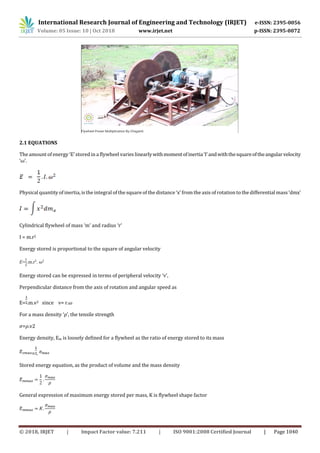
We are presenting few picture of discussion held in our workshop for discussing the pros and cons of flywheel power
multiplication.
We always considered the flywheel as a round object, square object, rectangle object, elliptical object i.e. in any geometrical
figure.
Because ultimately we have to rotate the rotor of PMG generator by using the rotating force of the flywheel.
We always consider various materials for designing of the flywheel, which are viable for various Rpm’s.
Here the most important design is fixing of gear teeth either inside or outside of the flywheel there by the flywheel efficiency
increase, when we use a pinion gear connected to PMG generator.
2.3 PICTURE FOR DISCUSSIONS
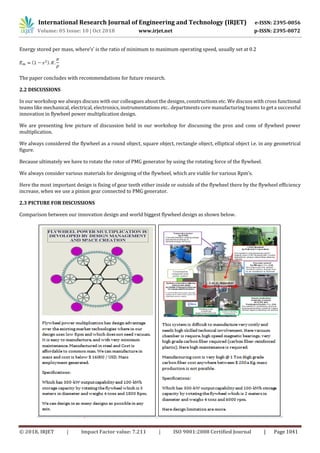
Comparison between our innovation design and world biggest flywheel design as shown below.
International Research Journal of Engineering and Technology (IRJET) e-ISSN: 2395-0056
Volume: 05 Issue: 10 | Oct 2018 www.irjet.net p-ISSN: 2395-0072
© 2018, IRJET | Impact Factor value: 7.211 | ISO 9001:2008 Certified Journal | Page 1042
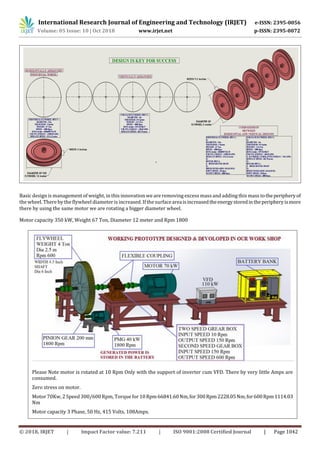
Basic design is management of weight, in this innovationweare removing excess massand adding this mass totheperipheryof
the wheel. There by the flywheel diameter is increased. If the surfaceareaisincreasedtheenergystoredintheperipheryismore
there by using the same motor we are rotating a bigger diameter wheel.
Motor capacity 350 kW, Weight 67 Ton, Diameter 12 meter and Rpm 1800
Please Note motor is rotated at 10 Rpm Only with the support of inverter cum VFD. There by very little Amps are
consumed.
Zero stress on motor.
Motor70Kw, 2 Speed 300/600 Rpm, Torque for10Rpm66841.60Nm,for300Rpm2228.05Nm,for600Rpm1114.03
Nm
Motor capacity 3 Phase, 50 Hz, 415 Volts, 108Amps.
40 kW PMG 1800Rpm, 3 Phase, 50 Hz, 415 Volts, 62Amps (Use full Amps: 50), 24 X 7 load rotating all 365 days.
International Research Journal of Engineering and Technology (IRJET) e-ISSN: 2395-0056
Volume: 05 Issue: 10 | Oct 2018 www.irjet.net p-ISSN: 2395-0072
© 2018, IRJET | Impact Factor value: 7.211 | ISO 9001:2008 Certified Journal | Page 1043
3. CONCLUSIONS
This technology mainly rotates in and around weight and space management, there by using a specified weight i.e.
For example
In the present market design, 67 Ton weight is designed as a cylinder byusingcarbonfiber-reinforcedplasticflywheelsfixedin
a vacuum chamber and rotated in between 6000 to 16000 Rpm using magnetic bearings and afterreachingthepeak Rpmthen
deceleration of the flywheel starts.
Here the pulse of the flywheel recorded is maximum in between 1 to 5 min. Then again the process of acceleration and
deceleration has to be repeated. There is no continuous mode.
In our technology 67 Ton weight is distributed on a large surfacearea thereby biggersurfacearea isavailableandwill generate
more surface velocity there by more energy is stored in the rotating flywheel mass.
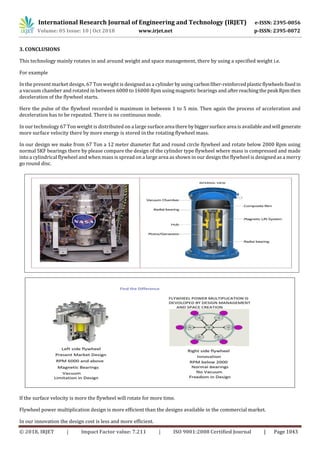
In our design we make from 67 Ton a 12 meter diameter flat and round circle flywheel and rotate below 2000 Rpm using
normal SKF bearings there by please compare the design of the cylinder type flywheel where mass is compressed and made
into a cylindrical flywheel and when mass is spread on a large area as shown in our design the flywheel is designed as a merry
go round disc.
If the surface velocity is more the flywheel will rotate for more time.
Flywheel power multiplication design is more efficient than the designs available in the commercial market.
In our innovation the design cost is less and more efficient.
International Research Journal of Engineering and Technology (IRJET) e-ISSN: 2395-0056
Volume: 05 Issue: 10 | Oct 2018 www.irjet.net p-ISSN: 2395-0072
© 2018, IRJET | Impact Factor value: 7.211 | ISO 9001:2008 Certified Journal | Page 1044
3.1 RECOMMENDATIONS
Flywheel power multiplication is recommended for existing power generation technologies in the present market because of
the efficient plant load factor compared to other technologies.
For example solar PLF has in between 10 to 13 % efficiency, wind PLF has in between 15 to 20%, HydroPLFhasinbetween70
to 80 %, Thermal PLF has in between 70 to 80 %, and Nuclear PLF has in between 70 to 80 % and Flywheel power
multiplication PLF 98%.
3.2 FUTURE WORKS
We are designing flywheel power multiplication energy storage application by using road ways, air ways, and seaways using
technologies for multi megawatt power generation for our future projects.
For example in this sector we will be using the available electrical vehicles to rotate the flywheel fixed in vertical or horizontal
designs.
In air ways we will keep a flywheel under side of the air craft and when the plane climbs to the maximumheightthe flywheel is
lowered down and rotated by the wind blowing under side of the plane and generated electricity is stored in the batteries. In
marine ways a flywheel is fixed in the water and a boat or a ship used to rotate the flywheel.BygoingRoundofthedefined path
and generated energy is stored in the batteries.
International Research Journal of Engineering and Technology (IRJET) e-ISSN: 2395-0056
Volume: 05 Issue: 10 | Oct 2018 www.irjet.net p-ISSN: 2395-0072
© 2018, IRJET | Impact Factor value: 7.211 | ISO 9001:2008 Certified Journal | Page 1045
ACKNOWLEDGEMENT
[1] IEEE Submission
1570315771: Still Water Electrical Generation
[2] Climate samurai renewable energy Magazine publication:
https://view.publitas.com/climatesamurai-com/climate-samurai-january-2018-issue/page/16-17
REFERENCES
[1] https://www.furukawa.co.jp/en/release/2015/kenkai_150415.html
[2] https://en.wikipedia.org/wiki/Joint_European_Torus
International Research Journal of Engineering and Technology (IRJET) e-ISSN: 2395-0056
Volume: 05 Issue: 10 | Oct 2018 www.irjet.net p-ISSN: 2395-0072
© 2018, IRJET | Impact Factor value: 7.211 | ISO 9001:2008 Certified Journal | Page 1046
AUTHORS
Srinivas Bhaskar Chaganti
B.Tech, M.Tech, Ph.D
Department:- Mechanical Engineering
Research Director in Cow and Calf Dairy Farms Limited (Research institute)
Having more than 2 decade’s field experience in new designs for energy storage projects.
Chaganti Bala
B.Tech, M.Tech
Department:- Mechanical Engineering
Research Director in Cow and Calf Dairy Farms Limited (Research institute)
Having more than 2 decade’s field experience in new designs for energy storage projects.

IRJET- Flywheel Power Generation and Multiplication

  • 1.
    International Research Journalof Engineering and Technology (IRJET) e-ISSN: 2395-0056 Volume: 05 Issue: 10 | Oct 2018 www.irjet.net p-ISSN: 2395-0072 © 2018, IRJET | Impact Factor value: 7.211 | ISO 9001:2008 Certified Journal | Page 1036 FLYWHEEL POWER GENERATION AND MULTIPLICATION Chaganti Srinivas Bhaskar1, Chaganti Bala2 1,2Cow and Calf Dairy Farms Limited (Research Institute), Hyderabad, Telangana State, India ---------------------------------------------------------------------***---------------------------------------------------------------------- Abstract:- This Case study of multi-hour electrical generation using the continuously available rotating force from a specific weight, diameter, and rpm is considered in flywheel power generation technology because the wheel is continuous in motion. we are designing energy generation and storage projects for generating clean electricity using Gear-flywheeland Piniongear. Pinion gear harboring the generator is the innovation. This technology major advantage is the design, where distribution of mass in a given area of the flywheel is the key to success. Flywheels with Different geometrical figures are used for multidimensional requirements. For1Kwpowergenerationatleast150 Kg weight is required. Key Words: Gear Flywheel, Flywheel, Power Multiplication, Generator, Motor, Storage 1. INTRODUCTION In this technology we always consider weight, diameter and stored rotating force of the flywheel (rpm). This flywheel is designed as a gear flywheel either from the world of steel, rubber, plastic, concrete and hybridglassorwiththecombinationof the above described material where ever required in the design and as per the design. For the safety purpose, this innovation adopts bunkers design to fix flywheels horizontally or verticallyandrotate below2000 rpm. In this design we are using single 12 m diameter gear-flywheel with teeth on the periphery of the wheel and rotate the 67 ton weight with 350 kW motor at 800 rpm and on the periphery we fix small pinion gear to rotate at 1800 rpm there by 19 pinion gears are connected all around the 12 diameter and each pinion gear will be attached with 40 KW PMG generator with 1800 rpm. Here the input motor rpm is only 10 rotations because it is connected directly to the speed increasing gearbox there by the motor connected to the VFD will have minimum stress and consume fewer amps. In this design we expresses our idea to show, by using less energy motor and connecting a higher kWgenerator,weareusinga big diameter ring gear wheel to balance the back torque generated when the load is applied on the 750 KW PMG generator. Please consider the different torques generated by using theflywheel,motor,andPMG generatortounderstandhowelectricity is generated. 67 ton and 12 m diameter, rpm 800 Flywheel torque: - 28070.71 Nm 350 kW Motor torque: - 5570.13 Nm at 600 rpm 750 kW PMG generator torque: - 3978.67 Nm at 1800 rpm Flywheel + Motor torque = cumulative 33640.84 torque Nm – PMG generator torque 3978.67 Nm = 29662.17 Nm balance torque still in the rotating gear flywheel. 1.1 Related Work Practical Observation on a case study in our workshop. By manufacturing 5 Gear-flywheels with equal engineering specifications example:- Each flywheel weight is 13400 kg (total 5 flywheels weight is 67 tons), 3 meter in diameter and rotated at 800 rpm by a 2 speed motor connected to speed increasing, multiple gearboxes by using a common shaft design i.e. using a cardan shaft to connect in-between independent flywheels and fix 5 pinion gearwheels to the5 gear flywheels so that all the 5 gear flywheels help increase the rpm of the 5 pinion gearwheels connected to the shaft which is connecting the PMG generator, is the working prototype design. In the flywheel power multiplication design weuse mix of renewable energy to charge the Battery bank and the battery bank is connected to VFD and VFD isconnected to a motor and motor is connectedtomorethan1speedincreasinggearboxandthegear boxes to the series of flywheelsare connected and rotatedbelow 2000 rpm within 10 to60 seconds timeso that the cumulative torque generated by the 5 flywheels will be absorbed by the PMG generator and generate clean electricity.
  • 2.
    International Research Journalof Engineering and Technology (IRJET) e-ISSN: 2395-0056 Volume: 05 Issue: 10 | Oct 2018 www.irjet.net p-ISSN: 2395-0072 © 2018, IRJET | Impact Factor value: 7.211 | ISO 9001:2008 Certified Journal | Page 1037 Each flywheel with this specification of 13400 kg weight and 3 m in diameter at 800 rpm will store 30 KWof energy in thetorus ring design where weight is maximum on the periphery of the flywheel. There by 5 flywheels are storing 150 KW of energy at 800 rpm. Please note:- 5 gear flywheels with common shaft are connected to 5 pinion gearwheels with common shaft both are separate but connected with gear teeth with each other 750kW PMG generator is rotated at 1800 rpm by rotating the Pinion gears. 5 gear flywheels rotate at 800 rpm and 5 pinions connected to 5gear flywheels rotate at 1800 rpm. Please understand the design. The cumulative torque generated by 5 gear flywheels: - In one gear flywheel 359 Nm X 5 gear flywheels = total torque 1795 Nm is the rotating force transferred into the 5 pinion gearwheels connected to 750kWPMGgeneratorbyacommonshaftrotatedat 1800 rpm to generate clean electricity. The motor rotating the slow speed shaft of the speed increasing gearbox at 10 rpm. first gearbox (1) input 10 rpm and output 200 rpm second gearbox (2) input 200 rpm and output 800 rpm so that the fully charged flywheel with maximum surface velocity of 126 meters per second is connected to the 750 KW permanent magnet generator with load and is rotated continuously without any stop. TheflywheelsarefixedonthePlummerblockbearingsandrotatedfreelyistheinnovation.When the flywheels are rotated they rotate freely for a long period of time. In our workshop we observed, if the diameter is more, the energy is more due to increasing surface velocity, because it has to revolve in bigger circle. Example for 1m, 2m, 3m, 4m, 5m,12m. But the 350 kW Motor used will be the same because mass or weight is same rpm is the same but diameter differs because of bigger circle formation there by more storage of energy. Here is an Example for distributing mass in a given area for designing a flywheel cum energy storage system Vertical design - 67 Ton weight, Diameter 3 meters, Rpm 1800, Surface Speed (m/sec) 282.78, Ring (joules) 2678811701.39, useful energy 744.11 Kwh ,Motor 350 kW. Flywheel in any Geometrical shape or cylindrical, round etc.. Horizontal design - 67 Ton, Diameter 12 meters, Rpm 1800, Surface Speed (m/sec) 1131.12, Ring (joules) 42860987222.39, useful energy 11905.82 Kwh. Motor 350 kW. Flywheel in disc shape round and flat. 1.2 Body Concept is derived, using Hydro power formula, General Formula Head X Flow X Gravity X Efficiency = Kwh and 1800 rpm of the generator Head 3 m X flow 67m3/sec X gravity 9.81 X efficiency 92% = 1500 KW power generated per hour from hydro sector. Now in Flywheel Power multiplication technology: Our formula is Head X Flow X Gravity X Efficiency = Kwh is adopted and made like this. Head converted to the total Diameter i.e. 3 meters round in shape torus ring wheel X Flow is the water weightinliterschanged to kg weight of the Flywheel i.e. 67 cubic meter per sec. is converted to 67000 Kilograms or 67 tons carbon steel torus ring wheel X Gravity is 9.81 X Efficiency of 92% in combination of {Torus flywheel + Generator + Transformer} 92% = 1500 Kwh. Compare with hydro power and judge the efficiency Please take the Torque value of the Torus ring wheel with 67000 Kilograms weight and 1800 rpminbetween10secondsto60 seconds and 3 meters in Diameter, round flywheel where the maximum weight is on the periphery of the wheel or on the top side of the Rim of the wheel with small ‘r’ as the maximum width and thickness of the wheel.ConverttheTorqueof therotating wheel in 10 seconds time and you get Nm again convert into joules and theninto Kwh. HeretheSpeed(RPM),diameter,weight, time are the deciding key factors for generating the torque from the toruswheel tocounterthereversetorquedeveloped when the load is applied on the 750 kW PMG generator rotated at 1800 rpm, in our workshop practical experience we have noted 100 kg back pressure per cubic centimeter of the generator rotor total area as reverse torque opposing the rotating force coming from the flywheel and motor while rotating the common shaft of the cumulative flywheels. The reverse torque always decreases volts, Hz and Rpm of the motor and generator.Tocounterall this,67tonFlywheel should have maximum torque then, we can generate grid connectivity power with 50 or 60 HZ and required voltage.
  • 3.
    International Research Journalof Engineering and Technology (IRJET) e-ISSN: 2395-0056 Volume: 05 Issue: 10 | Oct 2018 www.irjet.net p-ISSN: 2395-0072 © 2018, IRJET | Impact Factor value: 7.211 | ISO 9001:2008 Certified Journal | Page 1038 We are using one motor for one flywheel in vertical design in horizontal design we use only one big motorthisisthedifference in vertical and horizontal designs. For vertical design Power (kW) = Torque (Nm) x Speed (RPM) / 9.5488 Total 350 kW motor is considered to rotate 67 Ton Weight. 350 kW motor is divided into 5 equal parts of 70 kW each. Each 70 KW two speed motor (300/600 Rpm) Torque At 10 rpm 66841.60 Nm At 300 rpm 2228.05 Nm At 600 rpm 1114.03 Nm There by the torque of the 5 motors will be At 10 rpm 334208 Nm At 300 rpm 11140.25 Nm At 600 rpm 5570.15 Nm 5 flywheel cumulative torques is 3978.67 Nm One 750 rpm PMG generator torque at 1800 rpm is 3978.67 Nm Motor Torque Flywheel 9548.82 750 kW PMG Generator Torque 3978.67 Nm Motor side torque is more than the torque of PMG generator because the 350 kW is rotated at 10 Rpm i.e. controlled rotations using a VFD. When the motor shaft is connected to the speed increasing gear box shaft the input Rpm is only 10 there by the speed increasing output shaft will rotate at 1800 Rpm. The PMG generator connected at end of the common shaft will also rotate at1800 Rpm and generate electricity. 2. PERFORMANCE EXPERIMENTS We have started our carrier in 1994 and we have more than 2 decades of field experience, in this long journey we have clearly understood whatare the parameters for successfully generating electricity using flywheels, because big diameter isalways the success for power generation and with sufficient weight on the periphery of the wheel then storage of energy is more there by the wheel will be rotating for more time because more surface velocity is available in the rotating force. As an experiment we have assembled eleven tons of flywheel with two meters in diameter and 2000 RPM we have observed when the motor gets disconnected then the flywheels rotate for more than 30 minutes here we did not use gear box. In our observation, if we can convert the flywheel or fabricate the flywheel outer section as a ring gear then the rotating gear flywheel in low RPM, in between 500 to 600 RPM will also generate electricity when load applied on the generator. By attaching a pinion gear to the big diameter gear flywheel, where the periphery is designed as the double helical gear teeth. The pinion RPM will be increased from 600 to 1800 RPM below one minute. Here we use 10 RPM as the input RPM with the
  • 4.
    International Research Journalof Engineering and Technology (IRJET) e-ISSN: 2395-0056 Volume: 05 Issue: 10 | Oct 2018 www.irjet.net p-ISSN: 2395-0072 © 2018, IRJET | Impact Factor value: 7.211 | ISO 9001:2008 Certified Journal | Page 1039 speed increase gearbox and exciteto 600RPM the 67 ton weight below1minutethereafterthepiniongearwillreach1800RPM after reaching this speed of 1800 rotations in 1 minute then load is connected to the PMG generator. In our work shop we always use a higher capacity of inverter cum VFD to connect to the two speed motor and rotate the motor with a pre-designed programmed in the VFD from 10 Rpm to 1800 Rpm. We have observed that if we connect the motor with VFD then the motor RPM can be controlled there by consumption of less Amps by the motor because the input gearbox shaft has to rotateat 10 Rpm and wecan rotate the motor on critical continuous duty for long hours without any interruption even when load is applied. In our observation, by using eleven ton weight with 2 meter diameter flywheel rotated at 600RPM(Piniongear1800RPM)bya 70 Kw motor and connecta 40 Kw PMG generator with 1800RPMtherebythemotorconnectedtoVFDwillrotatetheeleventon flywheel by consuming 20 Amps. Here one should observe that the eleven Ton flywheel rotating at 600 Rpm and pinion gear rotating at 1800 Rpm what is the maximum contact area of the pinion gear when connected to the two meter diameter having eleven Tons should be discussed. When load is applied to the 40 kW PMG generator connected to the pinion gear the teeth of the big gear wheel and the pinion gear wheel have small amount of friction. The lubrication in between the big gear and small pinion gear will help to reduce the friction there by the eleven Ton flywheel Rpm is maintained constantly at 600 Rpm. This is what we have experienced in our workshop. 40 Kw PMG rotor weight is 40 Kilograms Total flywheel weight is 11 tons and 2 meter diameter Motor used is 70 Kw at 10 RPM (connected to the VFD) 3 Phases, 50 Hz, 415 Volt Torque at various Rpm’s 10 Rpm 66841.60 Nm 300 Rpm 2228.05 Nm 600 Rpm 1114.03 Nm 11 Ton flywheel torque 95 Nm at 600 rpm PMG generator 40 Kw and 1800 RPM 212.20 Nm 40 Kw PMG will be generating 61.83 Amps, useful energy at 80% load is 50 Amps. 3 phase, 50Hz, 415 Volt These are the Disc type wheel 2 Meter in diameter. In our work shop we have rotated 11 ton at 2000 RPM. Using SKF Bearings. Motor of 110 kW consumed 71 amps and without gearbox.
  • 5.
    International Research Journalof Engineering and Technology (IRJET) e-ISSN: 2395-0056 Volume: 05 Issue: 10 | Oct 2018 www.irjet.net p-ISSN: 2395-0072 © 2018, IRJET | Impact Factor value: 7.211 | ISO 9001:2008 Certified Journal | Page 1040 2.1 EQUATIONS The amount of energy ‘E’ stored in a flywheel varies linearlywithmomentofinertia‘I’andwiththesquareoftheangularvelocity ‘ω’. Physical quantity of inertia, isthe integral of the square of the distance ‘x’ from the axis of rotation to the differential mass ‘dmx’ Cylindrical flywheel of mass ‘m’ and radius ‘r’ I = m.r2 Energy stored is proportional to the square of angular velocity E= 1 2 .m.r2. 𝜔2 Energy stored can be expressed in terms of peripheral velocity ‘v’, Perpendicular distance from the axis of rotation and angular speed as E= .m.v2 since v= r.𝜔 For a mass density ‘ρ’, the tensile strength 𝜎=𝜌.v2 Energy density, Em is loosely defined for a flywheel as the ratio of energy stored to its mass = . Stored energy equation, as the product of volume and the mass density General expression of maximum energy stored per mass, K is flywheel shape factor
  • 6.
    International Research Journalof Engineering and Technology (IRJET) e-ISSN: 2395-0056 Volume: 05 Issue: 10 | Oct 2018 www.irjet.net p-ISSN: 2395-0072 © 2018, IRJET | Impact Factor value: 7.211 | ISO 9001:2008 Certified Journal | Page 1041 Energy stored per mass, where‘s’ is the ratio of minimum to maximum operating speed, usually set at 0.2 The paper concludes with recommendations for future research. 2.2 DISCUSSIONS In our workshop we always discuss with our colleagues about the designs, constructions etc. We discuss with cross functional teams like mechanical, electrical, electronics, instrumentations etc.. departments core manufacturing teams to get a successful innovation in flywheel power multiplication design. We are presenting few picture of discussion held in our workshop for discussing the pros and cons of flywheel power multiplication. We always considered the flywheel as a round object, square object, rectangle object, elliptical object i.e. in any geometrical figure. Because ultimately we have to rotate the rotor of PMG generator by using the rotating force of the flywheel. We always consider various materials for designing of the flywheel, which are viable for various Rpm’s. Here the most important design is fixing of gear teeth either inside or outside of the flywheel there by the flywheel efficiency increase, when we use a pinion gear connected to PMG generator. 2.3 PICTURE FOR DISCUSSIONS Comparison between our innovation design and world biggest flywheel design as shown below.
  • 7.
    International Research Journalof Engineering and Technology (IRJET) e-ISSN: 2395-0056 Volume: 05 Issue: 10 | Oct 2018 www.irjet.net p-ISSN: 2395-0072 © 2018, IRJET | Impact Factor value: 7.211 | ISO 9001:2008 Certified Journal | Page 1042 Basic design is management of weight, in this innovationweare removing excess massand adding this mass totheperipheryof the wheel. There by the flywheel diameter is increased. If the surfaceareaisincreasedtheenergystoredintheperipheryismore there by using the same motor we are rotating a bigger diameter wheel. Motor capacity 350 kW, Weight 67 Ton, Diameter 12 meter and Rpm 1800 Please Note motor is rotated at 10 Rpm Only with the support of inverter cum VFD. There by very little Amps are consumed. Zero stress on motor. Motor70Kw, 2 Speed 300/600 Rpm, Torque for10Rpm66841.60Nm,for300Rpm2228.05Nm,for600Rpm1114.03 Nm Motor capacity 3 Phase, 50 Hz, 415 Volts, 108Amps. 40 kW PMG 1800Rpm, 3 Phase, 50 Hz, 415 Volts, 62Amps (Use full Amps: 50), 24 X 7 load rotating all 365 days.
  • 8.
    International Research Journalof Engineering and Technology (IRJET) e-ISSN: 2395-0056 Volume: 05 Issue: 10 | Oct 2018 www.irjet.net p-ISSN: 2395-0072 © 2018, IRJET | Impact Factor value: 7.211 | ISO 9001:2008 Certified Journal | Page 1043 3. CONCLUSIONS This technology mainly rotates in and around weight and space management, there by using a specified weight i.e. For example In the present market design, 67 Ton weight is designed as a cylinder byusingcarbonfiber-reinforcedplasticflywheelsfixedin a vacuum chamber and rotated in between 6000 to 16000 Rpm using magnetic bearings and afterreachingthepeak Rpmthen deceleration of the flywheel starts. Here the pulse of the flywheel recorded is maximum in between 1 to 5 min. Then again the process of acceleration and deceleration has to be repeated. There is no continuous mode. In our technology 67 Ton weight is distributed on a large surfacearea thereby biggersurfacearea isavailableandwill generate more surface velocity there by more energy is stored in the rotating flywheel mass. In our design we make from 67 Ton a 12 meter diameter flat and round circle flywheel and rotate below 2000 Rpm using normal SKF bearings there by please compare the design of the cylinder type flywheel where mass is compressed and made into a cylindrical flywheel and when mass is spread on a large area as shown in our design the flywheel is designed as a merry go round disc. If the surface velocity is more the flywheel will rotate for more time. Flywheel power multiplication design is more efficient than the designs available in the commercial market. In our innovation the design cost is less and more efficient.
  • 9.
    International Research Journalof Engineering and Technology (IRJET) e-ISSN: 2395-0056 Volume: 05 Issue: 10 | Oct 2018 www.irjet.net p-ISSN: 2395-0072 © 2018, IRJET | Impact Factor value: 7.211 | ISO 9001:2008 Certified Journal | Page 1044 3.1 RECOMMENDATIONS Flywheel power multiplication is recommended for existing power generation technologies in the present market because of the efficient plant load factor compared to other technologies. For example solar PLF has in between 10 to 13 % efficiency, wind PLF has in between 15 to 20%, HydroPLFhasinbetween70 to 80 %, Thermal PLF has in between 70 to 80 %, and Nuclear PLF has in between 70 to 80 % and Flywheel power multiplication PLF 98%. 3.2 FUTURE WORKS We are designing flywheel power multiplication energy storage application by using road ways, air ways, and seaways using technologies for multi megawatt power generation for our future projects. For example in this sector we will be using the available electrical vehicles to rotate the flywheel fixed in vertical or horizontal designs. In air ways we will keep a flywheel under side of the air craft and when the plane climbs to the maximumheightthe flywheel is lowered down and rotated by the wind blowing under side of the plane and generated electricity is stored in the batteries. In marine ways a flywheel is fixed in the water and a boat or a ship used to rotate the flywheel.BygoingRoundofthedefined path and generated energy is stored in the batteries.
  • 10.
    International Research Journalof Engineering and Technology (IRJET) e-ISSN: 2395-0056 Volume: 05 Issue: 10 | Oct 2018 www.irjet.net p-ISSN: 2395-0072 © 2018, IRJET | Impact Factor value: 7.211 | ISO 9001:2008 Certified Journal | Page 1045 ACKNOWLEDGEMENT [1] IEEE Submission 1570315771: Still Water Electrical Generation [2] Climate samurai renewable energy Magazine publication: https://view.publitas.com/climatesamurai-com/climate-samurai-january-2018-issue/page/16-17 REFERENCES [1] https://www.furukawa.co.jp/en/release/2015/kenkai_150415.html [2] https://en.wikipedia.org/wiki/Joint_European_Torus
  • 11.
    International Research Journalof Engineering and Technology (IRJET) e-ISSN: 2395-0056 Volume: 05 Issue: 10 | Oct 2018 www.irjet.net p-ISSN: 2395-0072 © 2018, IRJET | Impact Factor value: 7.211 | ISO 9001:2008 Certified Journal | Page 1046 AUTHORS Srinivas Bhaskar Chaganti B.Tech, M.Tech, Ph.D Department:- Mechanical Engineering Research Director in Cow and Calf Dairy Farms Limited (Research institute) Having more than 2 decade’s field experience in new designs for energy storage projects. Chaganti Bala B.Tech, M.Tech Department:- Mechanical Engineering Research Director in Cow and Calf Dairy Farms Limited (Research institute) Having more than 2 decade’s field experience in new designs for energy storage projects.