i
CERTIFICATE
This is certified that project report entitled "POWER GENERATION FROM
SPEED BREAKER" that is being submitted by Mr. E.RAJKUMAR (139K1A0309),
Mr. J.RAHUL (139K1A0314), Mr. CH.MALLESH (149K5A0301) in the partial
fulfilment for the award of the Degree of Bachelor of Technology in Mechanical Engineering
to the Jawaharlal Nehru Technological University is a record of Bonafide work carried out
by them under my guidance and supervision. The results embodied in this work is original
and have not been submitted to any other University or Institute for the award of any degree
or diploma.
Date:
(Internal Guide) (External Examiner)
Mr. V.Rajashekar
Asst. Professor
Head of Department Principal
Mr. G.Kartheek Kumar Dr. M.Sujatha
Sr. Asst. Professor
ii
DECLARATION
We hereby declare that the work contained in this report entitled "POWER
GENERATION FROM SPEED BREAKER" is original. The work is original and has not
been submitted to any other institute for any degree or diploma. We have followed the
guidelines provided by the institute in preparing report. We have confirmed to the norms and
guidelines given in the ethical code of conduct of the institute. Whenever we have used
materials (data, theoretical analysis, figures and text) from other sources, we have given
credit to them by editing them in the text of the report and given their details in the references.
Place: Parvathapur
E.RAJKUMAR (139K1A0309)
J.RAHUL (139K1A0314)
CH.MALLESH (149K5A0301)
iii
ACKNOWLEDGEMENT
This is a great opportunity to thank to who really gave us support during the project,
the report itself is the acknowledgement to the dedication, drive and technical competence
of the individuals who contributed to it.
We have immense pleasure in expressing our thanks and deep sense of gratitude to
our guide Mr. V.RAJASHEKAR Assistant Professor, Department of Mechanical for his
guidance and assistance offered in an amiable and pleasant manner throughout our project.
We articulate our heartful gratitude to Mr. G.KARTHEEK KUMAR Sr. Assistant
Professor and Head of the Department of mechanical, who guided always with a constant
source of stimulation and encouragement, we will always indebted to him for his valuable
supervision and help.
We convey our profound gratitude to the Principal Dr. M.SUJATHA whose
blessings, it would not have been for us to convey out this dissertation works.
Last but not least we thank to all the teaching and non-teaching staff for their
encouragement and support in successful in completion of the project.
By
E.RAJKUMAR (139K1A0309)
J.RAHUL (139K1A0314)
CH.MALLESH (149K5A0301)
iv
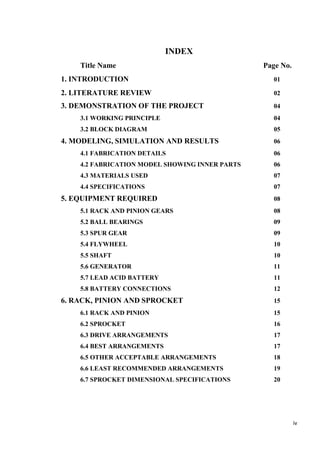
INDEX
Title Name Page No.
1. INTRODUCTION 01
2. LITERATURE REVIEW 02
3. DEMONSTRATION OF THE PROJECT 04
3.1 WORKING PRINCIPLE 04
3.2 BLOCK DIAGRAM 05
4. MODELING, SIMULATION AND RESULTS 06
4.1 FABRICATION DETAILS 06
4.2 FABRICATION MODEL SHOWING INNER PARTS 06
4.3 MATERIALS USED 07
4.4 SPECIFICATIONS 07
5. EQUIPMENT REQUIRED 08
5.1 RACK AND PINION GEARS 08
5.2 BALL BEARINGS 09
5.3 SPUR GEAR 09
5.4 FLYWHEEL 10
5.5 SHAFT 10
5.6 GENERATOR 11
5.7 LEAD ACID BATTERY 11
5.8 BATTERY CONNECTIONS 12
6. RACK, PINION AND SPROCKET 15
6.1 RACK AND PINION 15
6.2 SPROCKET 16
6.3 DRIVE ARRANGEMENTS 17
6.4 BEST ARRANGEMENTS 17
6.5 OTHER ACCEPTABLE ARRANGEMENTS 18
6.6 LEAST RECOMMENDED ARRANGEMENTS 19
6.7 SPROCKET DIMENSIONAL SPECIFICATIONS 20
v
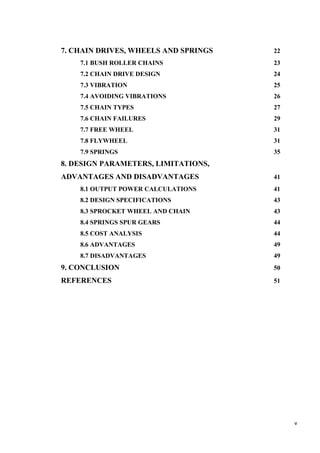
7. CHAIN DRIVES, WHEELS AND SPRINGS 22
7.1 BUSH ROLLER CHAINS 23
7.2 CHAIN DRIVE DESIGN 24
7.3 VIBRATION 25
7.4 AVOIDING VIBRATIONS 26
7.5 CHAIN TYPES 27
7.6 CHAIN FAILURES 29
7.7 FREE WHEEL 31
7.8 FLYWHEEL 31
7.9 SPRINGS 35
8. DESIGN PARAMETERS, LIMITATIONS,
ADVANTAGES AND DISADVANTAGES 41
8.1 OUTPUT POWER CALCULATIONS 41
8.2 DESIGN SPECIFICATIONS 43
8.3 SPROCKET WHEEL AND CHAIN 43
8.4 SPRINGS SPUR GEARS 44
8.5 COST ANALYSIS 44
8.6 ADVANTAGES 49
8.7 DISADVANTAGES 49
9. CONCLUSION 50
REFERENCES 51
vi
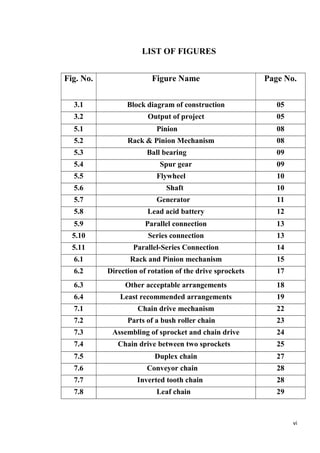
LIST OF FIGURES
Fig. No. Figure Name Page No.
3.1 Block diagram of construction 05
3.2 Output of project 05
5.1 Pinion 08
5.2 Rack & Pinion Mechanism 08
5.3 Ball bearing 09
5.4 Spur gear 09
5.5 Flywheel 10
5.6 Shaft 10
5.7 Generator 11
5.8 Lead acid battery 12
5.9 Parallel connection 13
5.10 Series connection 13
5.11 Parallel-Series Connection 14
6.1 Rack and Pinion mechanism 15
6.2 Direction of rotation of the drive sprockets 17
6.3 Other acceptable arrangements 18
6.4 Least recommended arrangements 19
7.1 Chain drive mechanism 22
7.2 Parts of a bush roller chain 23
7.3 Assembling of sprocket and chain drive 24
7.4 Chain drive between two sprockets 25
7.5 Duplex chain 27
7.6 Conveyor chain 28
7.7 Inverted tooth chain 28
7.8 Leaf chain 29
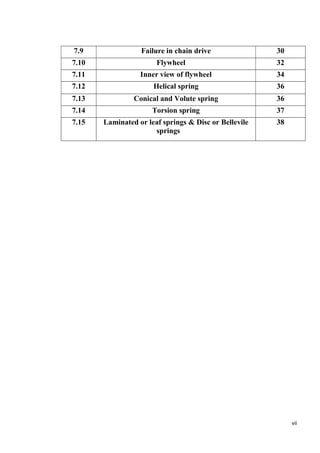
vii
7.9 Failure in chain drive 30
7.10 Flywheel 32
7.11 Inner view of flywheel 34
7.12 Helical spring 36
7.13 Conical and Volute spring 36
7.14 Torsion spring 37
7.15 Laminated or leaf springs & Disc or Bellevile
springs
38
viii
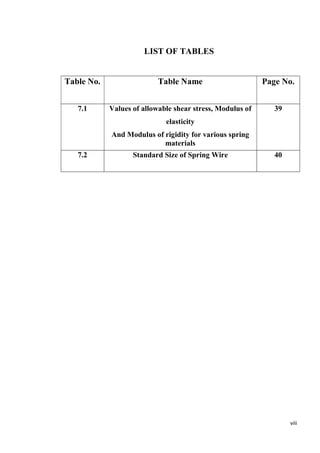
LIST OF TABLES
Table No. Table Name Page No.
7.1 Values of allowable shear stress, Modulus of
elasticity
And Modulus of rigidity for various spring
materials
39
7.2 Standard Size of Spring Wire 40

Pgfs index

  • 1.
    i CERTIFICATE This is certifiedthat project report entitled "POWER GENERATION FROM SPEED BREAKER" that is being submitted by Mr. E.RAJKUMAR (139K1A0309), Mr. J.RAHUL (139K1A0314), Mr. CH.MALLESH (149K5A0301) in the partial fulfilment for the award of the Degree of Bachelor of Technology in Mechanical Engineering to the Jawaharlal Nehru Technological University is a record of Bonafide work carried out by them under my guidance and supervision. The results embodied in this work is original and have not been submitted to any other University or Institute for the award of any degree or diploma. Date: (Internal Guide) (External Examiner) Mr. V.Rajashekar Asst. Professor Head of Department Principal Mr. G.Kartheek Kumar Dr. M.Sujatha Sr. Asst. Professor
  • 2.
    ii DECLARATION We hereby declarethat the work contained in this report entitled "POWER GENERATION FROM SPEED BREAKER" is original. The work is original and has not been submitted to any other institute for any degree or diploma. We have followed the guidelines provided by the institute in preparing report. We have confirmed to the norms and guidelines given in the ethical code of conduct of the institute. Whenever we have used materials (data, theoretical analysis, figures and text) from other sources, we have given credit to them by editing them in the text of the report and given their details in the references. Place: Parvathapur E.RAJKUMAR (139K1A0309) J.RAHUL (139K1A0314) CH.MALLESH (149K5A0301)
  • 3.
    iii ACKNOWLEDGEMENT This is agreat opportunity to thank to who really gave us support during the project, the report itself is the acknowledgement to the dedication, drive and technical competence of the individuals who contributed to it. We have immense pleasure in expressing our thanks and deep sense of gratitude to our guide Mr. V.RAJASHEKAR Assistant Professor, Department of Mechanical for his guidance and assistance offered in an amiable and pleasant manner throughout our project. We articulate our heartful gratitude to Mr. G.KARTHEEK KUMAR Sr. Assistant Professor and Head of the Department of mechanical, who guided always with a constant source of stimulation and encouragement, we will always indebted to him for his valuable supervision and help. We convey our profound gratitude to the Principal Dr. M.SUJATHA whose blessings, it would not have been for us to convey out this dissertation works. Last but not least we thank to all the teaching and non-teaching staff for their encouragement and support in successful in completion of the project. By E.RAJKUMAR (139K1A0309) J.RAHUL (139K1A0314) CH.MALLESH (149K5A0301)
  • 4.
    iv INDEX Title Name PageNo. 1. INTRODUCTION 01 2. LITERATURE REVIEW 02 3. DEMONSTRATION OF THE PROJECT 04 3.1 WORKING PRINCIPLE 04 3.2 BLOCK DIAGRAM 05 4. MODELING, SIMULATION AND RESULTS 06 4.1 FABRICATION DETAILS 06 4.2 FABRICATION MODEL SHOWING INNER PARTS 06 4.3 MATERIALS USED 07 4.4 SPECIFICATIONS 07 5. EQUIPMENT REQUIRED 08 5.1 RACK AND PINION GEARS 08 5.2 BALL BEARINGS 09 5.3 SPUR GEAR 09 5.4 FLYWHEEL 10 5.5 SHAFT 10 5.6 GENERATOR 11 5.7 LEAD ACID BATTERY 11 5.8 BATTERY CONNECTIONS 12 6. RACK, PINION AND SPROCKET 15 6.1 RACK AND PINION 15 6.2 SPROCKET 16 6.3 DRIVE ARRANGEMENTS 17 6.4 BEST ARRANGEMENTS 17 6.5 OTHER ACCEPTABLE ARRANGEMENTS 18 6.6 LEAST RECOMMENDED ARRANGEMENTS 19 6.7 SPROCKET DIMENSIONAL SPECIFICATIONS 20
  • 5.
    v 7. CHAIN DRIVES,WHEELS AND SPRINGS 22 7.1 BUSH ROLLER CHAINS 23 7.2 CHAIN DRIVE DESIGN 24 7.3 VIBRATION 25 7.4 AVOIDING VIBRATIONS 26 7.5 CHAIN TYPES 27 7.6 CHAIN FAILURES 29 7.7 FREE WHEEL 31 7.8 FLYWHEEL 31 7.9 SPRINGS 35 8. DESIGN PARAMETERS, LIMITATIONS, ADVANTAGES AND DISADVANTAGES 41 8.1 OUTPUT POWER CALCULATIONS 41 8.2 DESIGN SPECIFICATIONS 43 8.3 SPROCKET WHEEL AND CHAIN 43 8.4 SPRINGS SPUR GEARS 44 8.5 COST ANALYSIS 44 8.6 ADVANTAGES 49 8.7 DISADVANTAGES 49 9. CONCLUSION 50 REFERENCES 51
  • 6.
    vi LIST OF FIGURES Fig.No. Figure Name Page No. 3.1 Block diagram of construction 05 3.2 Output of project 05 5.1 Pinion 08 5.2 Rack & Pinion Mechanism 08 5.3 Ball bearing 09 5.4 Spur gear 09 5.5 Flywheel 10 5.6 Shaft 10 5.7 Generator 11 5.8 Lead acid battery 12 5.9 Parallel connection 13 5.10 Series connection 13 5.11 Parallel-Series Connection 14 6.1 Rack and Pinion mechanism 15 6.2 Direction of rotation of the drive sprockets 17 6.3 Other acceptable arrangements 18 6.4 Least recommended arrangements 19 7.1 Chain drive mechanism 22 7.2 Parts of a bush roller chain 23 7.3 Assembling of sprocket and chain drive 24 7.4 Chain drive between two sprockets 25 7.5 Duplex chain 27 7.6 Conveyor chain 28 7.7 Inverted tooth chain 28 7.8 Leaf chain 29
  • 7.
    vii 7.9 Failure inchain drive 30 7.10 Flywheel 32 7.11 Inner view of flywheel 34 7.12 Helical spring 36 7.13 Conical and Volute spring 36 7.14 Torsion spring 37 7.15 Laminated or leaf springs & Disc or Bellevile springs 38
  • 8.
    viii LIST OF TABLES TableNo. Table Name Page No. 7.1 Values of allowable shear stress, Modulus of elasticity And Modulus of rigidity for various spring materials 39 7.2 Standard Size of Spring Wire 40