International Research Journal of Engineering and Technology (IRJET) e-ISSN: 2395-0056
Volume: 05 Issue: 03 | Mar-2018 www.irjet.net p-ISSN: 2395-0072
© 2018, IRJET | Impact Factor value: 6.171 | ISO 9001:2008 Certified Journal | Page 2147
ECOFRIENDLY BRICK CONSTRUCTION USING WASTE MATERIALS
Salman Shah S1, Vidya Jose2
1 M Tech Student, Department of Civil Engineering, Toc H Institute of Science and Technology, Kerala, India
2 Assistant Professor, Department of Civil Engineering, Toc H Institute of Science and Technology, Kerala, India
---------------------------------------------------------------------***---------------------------------------------------------------------
Abstract - Reuse of waste generated from industrial and
agricultural activities as building materials appears to be
viable solution to problem of pollution and waste disposal. In
India it has been estimated that nearly 30% of the daily
production turns on waste during the manufacturing,
transportation and usage. From decades burnt clay bricks
have been used in the building construction and it helps to
reduce the energy consumptionofbuildingsduetoitsexcellent
thermal insulation property. As a result of this, there is still an
existing demand for clay bricks and huge quantity of soil is
being exploited for its production. Wide use of ceramic tiles,
marbles, etc. results in the production of huge quantity of
ceramic powder, marble dust which are found to be difficult
for disposal. Also rice milling industries generates rice husk
ash which is also considered as a waste product. This study
focuses on the investigation of properties of clay brick
produced by the partial replacement of the clay with ricehusk
ash(RHA), ceramic powder(CP) and marble dust(MP) in
varying percentages of 0%, 4%, 8% and 12%. Properties such
as compressive strength, water absorption, initial rate of
absorption, efflorescence, linear shrinkage, bulk density and
apparent porosity of modified clay bricks are determined.
Key Words: Reuse, waste materials, Brick properties,
Industrial waste, Environmental pollution
1. INTRODUCTION
Housing is one of the basic requirements for human survival.
Masonry is an inevitable component of housing. Among
different types of masonries,brickmasonryisoneofthemost
widely used in our country, because of low cost, easy
availabilityofrawmaterials,goodstrength,easyconstruction
with less supervision, good sound and heat insulation
properties, and availability of manpower. Brick masonry is a
composite material of systematic arrangement of brick units
and mortar joints. The behaviourofmasonryisdependenton
the properties of its constituents such as brick units and
mortar separately and together as a unified mass. Burnt clay
bricks are widely used around the globe but in recent years
many other varieties of bricks have been developed.
Brick is one of the oldest manufactured buildingmaterialsin
the world. The fired bricks were further developed as
archaeological traces discovered in early civilizations, such
as the Euphrates, the Tigris and the Indus that used both
fired and unfired bricks. The development of different types
of bricks continued in most countriesintheworldand bricks
were part of the cargo of the First Fleet to Australia, along
with brick moulds and a skilled brick maker. Bricks have
continuously been used by most cultures throughout the
ages for buildings due to their outstanding physical and
engineering properties. Brick is one of the most demanding
masonry units. It has the widest range of products, with its
unlimited assortment of patterns, textures and coolers. In
1996, the industry produced 300 million bricks in Victoria,
which were about 55% of the potential production of the
facilities available. The export markets included Japan, New
Zealand, the Middle East and other Asian countries. Brick is
durable and has developed with time. With the
advancements in technology, it led to the development of
concrete, mortar, cellular and hollow blocks. The main
advantage of using clay bricks is its thermal insulation
property. It helps the building to remain cool during
summers. As a result of this, there is still a rising demand for
clay brick. The main raw material for bricks is clay besides
clayey soils, soft slate and shale, which are usually obtained
from open pits which may include disruption of drainage,
vegetation and wildlife habitat. Soil used for brick making
vary broadly in their composition and are dependent on the
locality from which the soil originates. Differentproportions
of clays are composed mainly of silica, alumina, lime, iron,
manganese, sulphur and phosphates.
2. OBJECTIVE
Utilization of waste in the production of bricks can help in
the conservation of natural resource like clay. Since the
present scenario is dumping the waste landfill sites, it leads
to cause various environment problems. The main objective
of this research is to investigate the properties of bricks
produced by partial replacement of clay with ceramic
powder, marble powder and rice husk ash
3. METHODOLOGY
3.1. MATERIAL COLLECTION
Common clay (soil), rice huskash,ceramicwastepowderand
marble dust were used as raw materials. Soil was collected
from kiln located near Velloor, Kerala. Rice husk ash was
collected from Nellad rice mills, Kerala. Ceramic waste
powder was collected from Cochin Special Economic Zone,
Kerala and marble dust was collected from intercity
enterprises, Chennai.
A. CLAY
Soil used for brick manufacturing can be of any type with
good plasticity. Clay, loam and laterite are the most
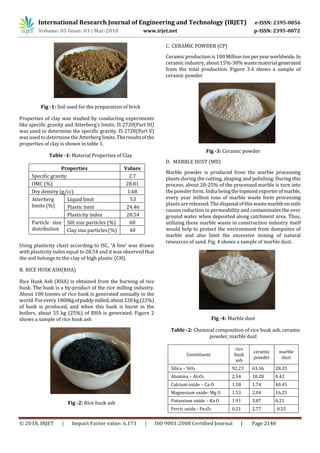
commonly used types of soil. Fig. 1 shows the clay used for
this study.
International Research Journal of Engineering and Technology (IRJET) e-ISSN: 2395-0056
Volume: 05 Issue: 03 | Mar-2018 www.irjet.net p-ISSN: 2395-0072
© 2018, IRJET | Impact Factor value: 6.171 | ISO 9001:2008 Certified Journal | Page 2148
Fig -1: Soil used for the preparation of brick
Properties of clay was studied by conducting experiments
like specific gravity and Atterberg’s limits. IS 2720(Part III)
was used to determine the specific gravity. IS 2720(Part V)
was used to determine the Atterberg limits.Theresultsofthe
properties of clay is shown in table 1.
Table -1: Material Properties of Clay
Properties Values
Specific gravity 2.7
OMC (%) 28.81
Dry density (g/cc) 1.68
Atterberg
limits (%)
Liquid limit 53
Plastic limit 24.46
Plasticity index 28.54
Particle size
distribution
Silt size particles (%) 60
Clay size particles (%) 40
Using plasticity chart according to ISC, ‘A line’ was drawn
with plasticity index equal to 28.54 and it was observed that
the soil belongs to the clay of high plastic (CH).
B. RICE HUSK ASH(RHA)
Rice Husk Ash (RHA) is obtained from the burning of rice
husk. The husk is a by-product of the rice milling industry.
About 100 tonnes of rice husk is generated annually in the
world.For every1000kgofpaddymilled,about220kg(22%)
of husk is produced, and when this husk is burnt in the
boilers, about 55 kg (25%) of RHA is generated. Figure 2
shows a sample of rice husk ash
Fig -2: Rice husk ash
C. CERAMIC POWDER (CP)
Ceramic production is 100 Million ton peryearworldwide.In
ceramic industry, about 15%-30% wastematerial generated
from the total production. Figure 3.4 shows a sample of
ceramic powder
Fig -3: Ceramic powder
D. MARBLE DUST (MD)
Marble powder is produced from the marble processing
plants during the cutting, shaping and polishing. During this
process, about 20-25% of the processed marble is turn into
the powder form. India beingthetopmostexporterofmarble,
every year million tons of marble waste form processing
plantsare released. The disposalofthiswastemarbleonsoils
causes reduction in permeability and contaminates the over
ground water when deposited along catchment area. Thus,
utilizing these marble waste in construction industry itself
would help to protect the environment from dumpsites of
marble and also limit the excessive mining of natural
resources of sand. Fig. 4 shows a sample of marble dust.
Fig -4: Marble dust
Table -2: Chemical composition of rice husk ash, ceramic
powder, marble dust
Constituent
rice
husk
ash
ceramic
powder
marble
dust
Silica – SiO2 92.23 63.36 28.35
Alumina – Al2O3 2.54 18.20 0.42
Calcium oxide – Ca O 1.58 1.74 40.45
Magnesium oxide- Mg O 1.53 2.04 16.25
Potassium oxide – Ka O 1.91 3.87 0.21
Ferric oxide - Fe2O3 0.21 2.77 0.55
International Research Journal of Engineering and Technology (IRJET) e-ISSN: 2395-0056
Volume: 05 Issue: 03 | Mar-2018 www.irjet.net p-ISSN: 2395-0072
© 2018, IRJET | Impact Factor value: 6.171 | ISO 9001:2008 Certified Journal | Page 2149
3.2. PREPARATION OF BRICKS
Bricks prepared are hand moulded and are burnt in the kiln.
Raw materials are mixed manually byvaryingtheproportion
of ceramic powder, marble dust, rice husk ash with clay. The
mix proportion used for the preparation of brick is shown in
table 4.1. The mixturewas prepared with the predetermined
optimum moisturecontent. Mould size was selected as 230 x
110 x 70 mm, which is the size of non-modular bricks as per
IS 1077:1992. The bricks were air dried until it is left with
less moisture content. The bricks were dried for 10 days and
were transported to the kiln, where it is burned at around
9800C. Bricks are taken out from kiln after cooling.
Table -3: Mix Proportion for the Preparation of Bricks
Clay
(%)
Powder of
ceramic waste
(%)
Powder of
marble waste
(%)
Rice husk
ash
(%)
100 0 0 0
96 4 4 4
92 8 8 8
88 12 12 12
4. EXPERIMENTAL INVESTIGATION
Several experimental tests was conducted on brick units to
determine the mechanical properties such as compressive
strength, water absorption, efflorescence, initial rate of
absorption, bulk density, apparent porosity and linear
shrinkage. A total of 60 brick units comprising of pure clay
and replaced clay bricks are tested.
4.1. COMPRESSIVE STRENGTH
The compressive strength was determined according to IS
3495 (PART I):1992. The compressive strength ofthebricks
depends mainly on the density and porosity of the bricks.
The reduction in compressive strength maybecauseddueto
the decomposition of organic matter. The compressive
strength values showed a linear relationship with the water
absorption values.
Table -4: Compressive strength values for bricks
Clay content
(%)
Replacing material
(%)
Compressive strength
(N/ mm2)
100 0 12.33
96 RHA - 4 12.23
92 RHA - 8 11.94
88 RHA - 12 10.85
96 CP - 4 12.00
92 CP - 8 11.80
88 CP - 12 11.25
96 MD - 4 12.04
92 MD - 8 11.32
88 MD - 12 10.72
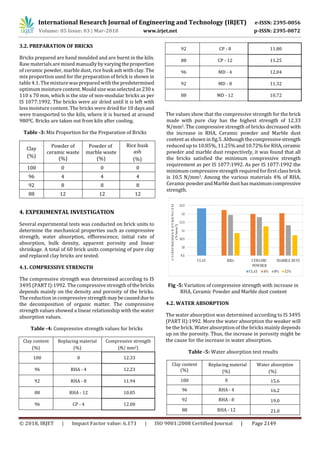
The values show that the compressive strength for the brick
made with pure clay has the highest strength of 12.33
N/mm2. The compressive strength of bricks decreased with
the increase in RHA, Ceramic powder and Marble dust
content as shown in fig.5. Althoughthecompressivestrength
reduced up to 10.85%, 11.25% and10.72%forRHA,ceramic
powder and marble dust respectively, it was found that all
the bricks satisfied the minimum compressive strength
requirement as per IS 1077:1992. As per IS 1077:1992 the
minimum compressive strength required forfirstclassbrick
is 10.5 N/mm2. Among the various materials 4% of RHA,
Ceramic powderandMarbledusthasmaximumcompressive
strength.
Fig -5: Variation of compressive strength with increase in
RHA, Ceramic Powder and Marble dust content
4.2. WATER ABSORPTION
The water absorption was determined according to IS 3495
(PART II):1992. More the water absorption the weaker will
be the brick. Water absorption of the bricks mainly depends
up on the porosity. Thus, the increase in porosity might be
the cause for the increase in water absorption.
Table -5: Water absorption test results
Clay content
(%)
Replacing material
(%)
Water absorption
(%)
100 0 15.6
96 RHA - 4 16.2
92 RHA - 8 19.0
88 RHA - 12 21.0
International Research Journal of Engineering and Technology (IRJET) e-ISSN: 2395-0056
Volume: 05 Issue: 03 | Mar-2018 www.irjet.net p-ISSN: 2395-0072
© 2018, IRJET | Impact Factor value: 6.171 | ISO 9001:2008 Certified Journal | Page 2150
96 CP - 4 16.8
92 CP - 8 18.4
88 CP - 12 20.0
96 MD - 4 16.4
92 MD - 8 18.0
88 MD - 12 19.8
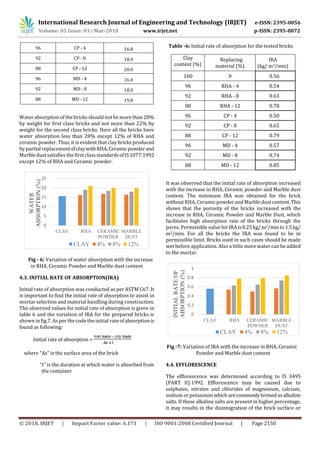
Water absorption of the bricks should not be more than 20%
by weight for first class bricks and not more than 22% by
weight for the second class bricks. Here all the bricks have
water absorption less than 20% except 12% of RHA and
ceramic powder. Thus, it is evident thatclay bricks produced
by partial replacementofclaywithRHA,Ceramicpowderand
Marble dustsatisfies the firstclassstandardsofIS1077:1992
except 12% of RHA and Ceramic powder.
0
5
10
15
20
25
CLAY RHA CERAMIC
POWDER
MARBLE
DUST
WATER
ABSORPTION(%)
CLAY 4% 8% 12%
Fig - 6: Variation of water absorption with the increase
in RHA, Ceramic Powder and Marble dust content
4.3. INITIAL RATE OF ABSORPTION(IRA)
Initial rate of absorption was conducted as per ASTM C67. It
is important to find the initial rate of absorption to assist in
mortar selection and material handling during construction.
The observed values for initial rate of absorption is given in
table 6 and the variation of IRA for the prepared bricks is
shown in fig.7. As per the codethe initial rate of absorptionis
found as following:
Initial rate of absorption =
where “As” is the surface area of the brick
“t” is the duration at which water is absorbed from
the container
Table -6: Initial rate of absorption for the tested bricks
Clay
content (%)
Replacing
material (%)
IRA
(kg/ m2/min)
100 0 0.56
96 RHA - 4 0.54
92 RHA - 8 0.63
88 RHA - 12 0.78
96 CP - 4 0.50
92 CP - 8 0.65
88 CP - 12 0.79
96 MD - 4 0.57
92 MD - 8 0.74
88 MD - 12 0.85
It was observed that the initial rate of absorption increased
with the increase in RHA, Ceramic powder and Marble dust
content. The minimum IRA was obtained for the brick
without RHA, Ceramic powder and Marble dustcontent.This
shows that the porosity of the bricks increased with the
increase in RHA, Ceramic Powder and Marble Dust, which
facilitates high absorption rate of the bricks through the
pores. Permissible value forIRAis0.25kg/m2/minto1.5kg/
m2/min. For all the bricks the IRA was found to be in
permissible limit. Bricks used in such cases should be made
wet before application. Also a little more water can be added
to the mortar.
0
0.2
0.4
0.6
0.8
1
CLAY RHA CERAMIC
POWDER
MARBLE
DUST
INITIALRATEOF
ABSORPTION(%)
CLAY 4% 8% 12%
Fig -7: Variation of IRA with the increase in RHA, Ceramic
Powder and Marble dust content
4.4. EFFLORESCENCE
The efflorescence was determined according to IS 3495
(PART II):1992. Efflorescence may be caused due to
sulphates, nitrates and chlorides of magnesium, calcium,
sodium or potassiumwhicharecommonlytermedasalkaline
salts. If these alkaline salts are present in higher percentage,
it may results in the disintegration of the brick surface or
International Research Journal of Engineering and Technology (IRJET) e-ISSN: 2395-0056
Volume: 05 Issue: 03 | Mar-2018 www.irjet.net p-ISSN: 2395-0072
© 2018, IRJET | Impact Factor value: 6.171 | ISO 9001:2008 Certified Journal | Page 2151
plaster applied over it. Afterconductingtheefflorescencetest
it was determined that all the bricks were showing “slight”
efflorescence. Brick were entitled to show slight
efflorescence, because only 10% of the brick surface was
covered with alkaline salts. Therefore, bricks are in a range
that does not affect the aesthetics of the building if used.
4.5. BULK DENSITY
Bulk density of brick is defined as dry weightofbrickperunit
volume of brick. High bulk density is an indication of less
pore space. Higher the density, higher will be the
compressive strength. This is evident from the compressive
strength values obtained for the bricks. Table 7 shows the
bulk density values of the bricks.
Table -7: Bulk density of the tested bricks
Clay content
(%)
Replacing
material (%)
Bulk density
(g/cc)
100 0 1.79
96 RHA - 4 1.68
92 RHA - 8 1.62
88 RHA - 12 1.58
96 CP - 4 1.70
92 CP - 8 1.66
88 CP - 12 1.62
96 MD - 4 1.69
92 MD - 8 1.64
88 MD - 12 1.60
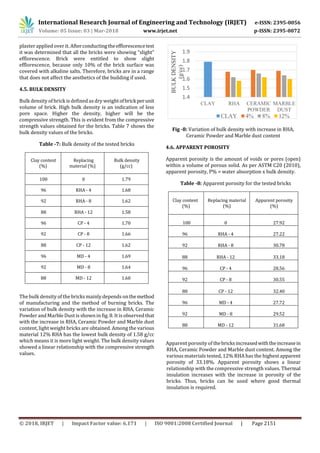
The bulk density of the bricksmainly depends onthemethod
of manufacturing and the method of burning bricks. The
variation of bulk density with the increase in RHA, Ceramic
Powder and Marble Dust is shown in fig. 8. It is observed that
with the increase in RHA, Ceramic Powder and Marble dust
content, light weight bricks are obtained. Among the various
material 12% RHA has the lowest bulk density of 1.58 g/cc
which means it is more light weight. The bulk density values
showed a linear relationship with the compressive strength
values.
1.4
1.5
1.6
1.7
1.8
1.9
CLAY RHA CERAMIC
POWDER
MARBLE
DUST
BULKDENSITY
(g/cc)
CLAY 4% 8% 12%
Fig -8: Variation of bulk density with increase in RHA,
Ceramic Powder and Marble dust content
4.6. APPARENT POROSITY
Apparent porosity is the amount of voids or pores (open)
within a volume of porous solid. As per ASTM C20 (2010),
apparent porosity, P% = water absorption x bulk density.
Table -8: Apparent porosity for the tested bricks
Clay content
(%)
Replacing material
(%)
Apparent porosity
(%)
100 0 27.92
96 RHA - 4 27.22
92 RHA - 8 30.78
88 RHA - 12 33.18
96 CP - 4 28.56
92 CP - 8 30.55
88 CP - 12 32.40
96 MD - 4 27.72
92 MD - 8 29.52
88 MD - 12 31.68
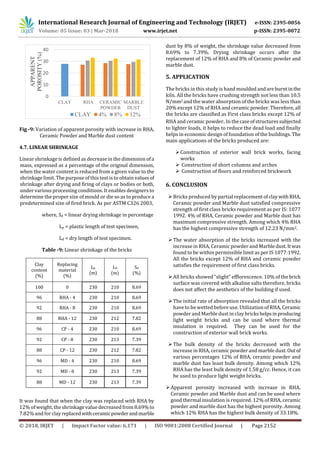
Apparent porosity of thebricksincreasedwiththeincreasein
RHA, Ceramic Powder and Marble dust content. Among the
various materials tested, 12% RHA has the highest apparent
porosity of 33.18%. Apparent porosity shows a linear
relationship with the compressive strength values. Thermal
insulation increases with the increase in porosity of the
bricks. Thus, bricks can be used where good thermal
insulation is required.
International Research Journal of Engineering and Technology (IRJET) e-ISSN: 2395-0056
Volume: 05 Issue: 03 | Mar-2018 www.irjet.net p-ISSN: 2395-0072
© 2018, IRJET | Impact Factor value: 6.171 | ISO 9001:2008 Certified Journal | Page 2152
0
10
20
30
40
CLAY RHA CERAMIC
POWDER
MARBLE
DUST
APPARENT
POROSITY(%)
CLAY 4% 8% 12%
Fig -9: Variation of apparent porosity with increase in RHA,
Ceramic Powder and Marble dust content
4.7. LINEAR SHRINKAGE
Linear shrinkage is defined as decrease in the dimension of a
mass, expressed as a percentage of the original dimension,
when the water content is reduced from a given value to the
shrinkage limit. The purpose of this test is to obtain valuesof
shrinkage after drying and firing of clays or bodies or both,
under various processing conditions. It enables designers to
determine the proper size of mould or die so as to produce a
predetermined size of fired brick. As per ASTM C326 2003,
where, Sd = linear drying shrinkage in percentage
Lp = plastic length of test specimen,
Ld = dry length of test specimen.
Table -9: Linear shrinkage of the bricks
Clay
content
(%)
Replacing
material
(%)
Lp
(m)
Ld
(m)
Sd
(%)
100 0 230 210 8.69
96 RHA - 4 230 210 8.69
92 RHA - 8 230 210 8.69
88 RHA - 12 230 212 7.82
96 CP - 4 230 210 8.69
92 CP - 8 230 213 7.39
88 CP - 12 230 212 7.82
96 MD - 4 230 210 8.69
92 MD - 8 230 213 7.39
88 MD - 12 230 213 7.39
It was found that when the clay was replaced with RHA by
12% of weight, the shrinkage value decreased from 8.69%to
7.82%and forclayreplacedwithceramicpowderandmarble
dust by 8% of weight, the shrinkage value decreased from
8.69% to 7.39%. Drying shrinkage occurs after the
replacement of 12% of RHA and 8% of Ceramic powder and
marble dust.
5. APPLICATION
The bricks in this study is hand moulded andareburntinthe
kiln. All the bricks have crushing strength not less than 10.5
N/mm2 and the water absorption of the bricks was less than
20% except 12% of RHA and ceramic powder. Therefore, all
the bricks are classified as First class bricks except 12% of
RHA and ceramic powder. In the caseofstructuressubjected
to lighter loads, it helps to reduce the dead load and finally
helps in economic design of foundation of the buildings. The
main applications of the bricks produced are:
Construction of exterior wall brick works, facing
works
 Construction of short columns and arches
 Construction of floors and reinforced brickwork
6. CONCLUSION
Bricks produced by partial replacementofclaywithRHA,
Ceramic powder and Marble dust satisfied compressive
strength of first class bricks requirement as per IS: 1077
1992. 4% of RHA, Ceramic powder and Marble dust has
maximum compressive strength. Among which 4% RHA
has the highest compressive strength of 12.23 N/mm2.
The water absorption of the bricks increased with the
increase in RHA, Ceramic powder and Marbledust.Itwas
found to be within permissible limit as per IS 1077:1992.
All the bricks except 12% of RHA and ceramic powder
satisfies the requirement of first class bricks.
All bricks showed “slight” efflorescence. 10% of thebrick
surface was covered with alkaline salts therefore, bricks
does not affect the aesthetics of the building if used.
The initial rate of absorption revealed that all the bricks
have to be wetted before use. Utilization of RHA, Ceramic
powder and Marble dust in clay brickshelpsinproducing
light weight bricks and can be used where thermal
insulation is required. They can be used for the
construction of exterior wall brick works.
The bulk density of the bricks decreased with the
increase in RHA, ceramic powder and marble dust. Outof
various percentages 12% of RHA, ceramic powder and
marble dust has least bulk density. Among which 12%
RHA has the least bulk density of 1.58 g/cc. Hence, it can
be used to produce light weight bricks.
Apparent porosity increased with increase in RHA,
Ceramic powder and Marble dust and can be used where
good thermal insulation is required. 12% of RHA, ceramic
powder and marble dust has the highest porosity. Among
which 12% RHA has the highest bulk density of 33.18%.
International Research Journal of Engineering and Technology (IRJET) e-ISSN: 2395-0056
Volume: 05 Issue: 03 | Mar-2018 www.irjet.net p-ISSN: 2395-0072
© 2018, IRJET | Impact Factor value: 6.171 | ISO 9001:2008 Certified Journal | Page 2153
Linear shrinkage of the bricks decreased with increase in
RHA, Ceramic powder and Marble dust. It was observed
that the bricks can be replaced up to 8% RHA, 8% ceramic
powder and 12% marble dust by weight and this can help
in waste management as well productioneconomicbricks.
Utilization of rice husk ash and ceramic waste powder up
to 8% replacement of clay in bricks and marble dust up to
12% replacement of clay in bricks helps in waste
management and conservation of clay.
REFERENCES
[1]Badr El-Din Ezzat Hegazy, Hanan Ahmed Fouad and
Ahmed Mohammed Hassanain, “Incorporation of water
sludge, silica fume, and rice husk ash in brick making,”
Construction and Building Materials, Vol 1, No. 1, pp
1568-1593, April 2012.
[2]C.A. García-Ubaque, Liliana Giraldo and Juan Carlos
Moreno-Pirajan, “Quality study of ceramic bricks
manufacture with clay and ashes from the incinerationof
municipal solid wastes,” Sustainability, Vol 70, No. 561,
pp 736-749, January 2012.
[3]J. Sutas, A. Mana and L. Pitak, “Effect of Rice Husk and
Rice Husk Ash to Properties of Bricks, Procedia
Engineering, Vol 32, pp 1061 – 1067, 2012.
[4]L. Miqueleiz, F. Ramirez, J.E. Oti , A. Seco , J.M. Kinuthia , I.
Oreja and P. Urmeneta, “Alumina filler waste as clay
replacement material for unfired brick production,”
Journal of engineering geology, Vol 163, No. 19, pp 68–
74, August 2013.
[5]Mucahit Sutcu,HandeAlptekin,Ertugrul Erdogmus,Yusuf
Er and Osman Gencel, “Characteristics of firedclaybricks
with waste marble powder addition as building
materials,” Construction and Building Materials, Vol 82,
No. 1, pp 1–8, May 2015.
[6]Nonthaphong Phonphuak,Siwadol KanyakamandPrinya
Chindaprasirt, “Utilization of Waste Glass to Enhance
Physical-Mechanical Properties of Fired Clay Brick,”
Journal of Cleaner Production, Vol. 112, No. 4, pp. 43057-
3062, January 2016.
[7]Romualdo R. Menezes, Heber S. Ferreirab, Gelmires A.
Nevesb, Helio de L. Lirab and Heber C. Ferreirab, “Use of
granite sawing wastesinthe productionofceramicbricks
and tiles,” Journal of the European Ceramic Society, Vol
25, No. 7, pp 1149–1158, May 2005.
[8]Syed M. S. Kazmi, Safeer Abbas, Muhammad A. Saleem,
Muhammad J. Munir and Anwar Khitab, “Manufacturing
of Sustainable Clay Bricks: UtilizationofWasteSugarcane
Bagasse and Rice Husk Ashes,” Journal of Construction
and Building Materials, Vol. 120, No. 1, pp. 29-41,
September 2016.

IRJET- Ecofriendly Brick Construction using Waste Materials

  • 1.
    International Research Journalof Engineering and Technology (IRJET) e-ISSN: 2395-0056 Volume: 05 Issue: 03 | Mar-2018 www.irjet.net p-ISSN: 2395-0072 © 2018, IRJET | Impact Factor value: 6.171 | ISO 9001:2008 Certified Journal | Page 2147 ECOFRIENDLY BRICK CONSTRUCTION USING WASTE MATERIALS Salman Shah S1, Vidya Jose2 1 M Tech Student, Department of Civil Engineering, Toc H Institute of Science and Technology, Kerala, India 2 Assistant Professor, Department of Civil Engineering, Toc H Institute of Science and Technology, Kerala, India ---------------------------------------------------------------------***--------------------------------------------------------------------- Abstract - Reuse of waste generated from industrial and agricultural activities as building materials appears to be viable solution to problem of pollution and waste disposal. In India it has been estimated that nearly 30% of the daily production turns on waste during the manufacturing, transportation and usage. From decades burnt clay bricks have been used in the building construction and it helps to reduce the energy consumptionofbuildingsduetoitsexcellent thermal insulation property. As a result of this, there is still an existing demand for clay bricks and huge quantity of soil is being exploited for its production. Wide use of ceramic tiles, marbles, etc. results in the production of huge quantity of ceramic powder, marble dust which are found to be difficult for disposal. Also rice milling industries generates rice husk ash which is also considered as a waste product. This study focuses on the investigation of properties of clay brick produced by the partial replacement of the clay with ricehusk ash(RHA), ceramic powder(CP) and marble dust(MP) in varying percentages of 0%, 4%, 8% and 12%. Properties such as compressive strength, water absorption, initial rate of absorption, efflorescence, linear shrinkage, bulk density and apparent porosity of modified clay bricks are determined. Key Words: Reuse, waste materials, Brick properties, Industrial waste, Environmental pollution 1. INTRODUCTION Housing is one of the basic requirements for human survival. Masonry is an inevitable component of housing. Among different types of masonries,brickmasonryisoneofthemost widely used in our country, because of low cost, easy availabilityofrawmaterials,goodstrength,easyconstruction with less supervision, good sound and heat insulation properties, and availability of manpower. Brick masonry is a composite material of systematic arrangement of brick units and mortar joints. The behaviourofmasonryisdependenton the properties of its constituents such as brick units and mortar separately and together as a unified mass. Burnt clay bricks are widely used around the globe but in recent years many other varieties of bricks have been developed. Brick is one of the oldest manufactured buildingmaterialsin the world. The fired bricks were further developed as archaeological traces discovered in early civilizations, such as the Euphrates, the Tigris and the Indus that used both fired and unfired bricks. The development of different types of bricks continued in most countriesintheworldand bricks were part of the cargo of the First Fleet to Australia, along with brick moulds and a skilled brick maker. Bricks have continuously been used by most cultures throughout the ages for buildings due to their outstanding physical and engineering properties. Brick is one of the most demanding masonry units. It has the widest range of products, with its unlimited assortment of patterns, textures and coolers. In 1996, the industry produced 300 million bricks in Victoria, which were about 55% of the potential production of the facilities available. The export markets included Japan, New Zealand, the Middle East and other Asian countries. Brick is durable and has developed with time. With the advancements in technology, it led to the development of concrete, mortar, cellular and hollow blocks. The main advantage of using clay bricks is its thermal insulation property. It helps the building to remain cool during summers. As a result of this, there is still a rising demand for clay brick. The main raw material for bricks is clay besides clayey soils, soft slate and shale, which are usually obtained from open pits which may include disruption of drainage, vegetation and wildlife habitat. Soil used for brick making vary broadly in their composition and are dependent on the locality from which the soil originates. Differentproportions of clays are composed mainly of silica, alumina, lime, iron, manganese, sulphur and phosphates. 2. OBJECTIVE Utilization of waste in the production of bricks can help in the conservation of natural resource like clay. Since the present scenario is dumping the waste landfill sites, it leads to cause various environment problems. The main objective of this research is to investigate the properties of bricks produced by partial replacement of clay with ceramic powder, marble powder and rice husk ash 3. METHODOLOGY 3.1. MATERIAL COLLECTION Common clay (soil), rice huskash,ceramicwastepowderand marble dust were used as raw materials. Soil was collected from kiln located near Velloor, Kerala. Rice husk ash was collected from Nellad rice mills, Kerala. Ceramic waste powder was collected from Cochin Special Economic Zone, Kerala and marble dust was collected from intercity enterprises, Chennai. A. CLAY Soil used for brick manufacturing can be of any type with good plasticity. Clay, loam and laterite are the most commonly used types of soil. Fig. 1 shows the clay used for this study.
  • 2.
    International Research Journalof Engineering and Technology (IRJET) e-ISSN: 2395-0056 Volume: 05 Issue: 03 | Mar-2018 www.irjet.net p-ISSN: 2395-0072 © 2018, IRJET | Impact Factor value: 6.171 | ISO 9001:2008 Certified Journal | Page 2148 Fig -1: Soil used for the preparation of brick Properties of clay was studied by conducting experiments like specific gravity and Atterberg’s limits. IS 2720(Part III) was used to determine the specific gravity. IS 2720(Part V) was used to determine the Atterberg limits.Theresultsofthe properties of clay is shown in table 1. Table -1: Material Properties of Clay Properties Values Specific gravity 2.7 OMC (%) 28.81 Dry density (g/cc) 1.68 Atterberg limits (%) Liquid limit 53 Plastic limit 24.46 Plasticity index 28.54 Particle size distribution Silt size particles (%) 60 Clay size particles (%) 40 Using plasticity chart according to ISC, ‘A line’ was drawn with plasticity index equal to 28.54 and it was observed that the soil belongs to the clay of high plastic (CH). B. RICE HUSK ASH(RHA) Rice Husk Ash (RHA) is obtained from the burning of rice husk. The husk is a by-product of the rice milling industry. About 100 tonnes of rice husk is generated annually in the world.For every1000kgofpaddymilled,about220kg(22%) of husk is produced, and when this husk is burnt in the boilers, about 55 kg (25%) of RHA is generated. Figure 2 shows a sample of rice husk ash Fig -2: Rice husk ash C. CERAMIC POWDER (CP) Ceramic production is 100 Million ton peryearworldwide.In ceramic industry, about 15%-30% wastematerial generated from the total production. Figure 3.4 shows a sample of ceramic powder Fig -3: Ceramic powder D. MARBLE DUST (MD) Marble powder is produced from the marble processing plants during the cutting, shaping and polishing. During this process, about 20-25% of the processed marble is turn into the powder form. India beingthetopmostexporterofmarble, every year million tons of marble waste form processing plantsare released. The disposalofthiswastemarbleonsoils causes reduction in permeability and contaminates the over ground water when deposited along catchment area. Thus, utilizing these marble waste in construction industry itself would help to protect the environment from dumpsites of marble and also limit the excessive mining of natural resources of sand. Fig. 4 shows a sample of marble dust. Fig -4: Marble dust Table -2: Chemical composition of rice husk ash, ceramic powder, marble dust Constituent rice husk ash ceramic powder marble dust Silica – SiO2 92.23 63.36 28.35 Alumina – Al2O3 2.54 18.20 0.42 Calcium oxide – Ca O 1.58 1.74 40.45 Magnesium oxide- Mg O 1.53 2.04 16.25 Potassium oxide – Ka O 1.91 3.87 0.21 Ferric oxide - Fe2O3 0.21 2.77 0.55
  • 3.
    International Research Journalof Engineering and Technology (IRJET) e-ISSN: 2395-0056 Volume: 05 Issue: 03 | Mar-2018 www.irjet.net p-ISSN: 2395-0072 © 2018, IRJET | Impact Factor value: 6.171 | ISO 9001:2008 Certified Journal | Page 2149 3.2. PREPARATION OF BRICKS Bricks prepared are hand moulded and are burnt in the kiln. Raw materials are mixed manually byvaryingtheproportion of ceramic powder, marble dust, rice husk ash with clay. The mix proportion used for the preparation of brick is shown in table 4.1. The mixturewas prepared with the predetermined optimum moisturecontent. Mould size was selected as 230 x 110 x 70 mm, which is the size of non-modular bricks as per IS 1077:1992. The bricks were air dried until it is left with less moisture content. The bricks were dried for 10 days and were transported to the kiln, where it is burned at around 9800C. Bricks are taken out from kiln after cooling. Table -3: Mix Proportion for the Preparation of Bricks Clay (%) Powder of ceramic waste (%) Powder of marble waste (%) Rice husk ash (%) 100 0 0 0 96 4 4 4 92 8 8 8 88 12 12 12 4. EXPERIMENTAL INVESTIGATION Several experimental tests was conducted on brick units to determine the mechanical properties such as compressive strength, water absorption, efflorescence, initial rate of absorption, bulk density, apparent porosity and linear shrinkage. A total of 60 brick units comprising of pure clay and replaced clay bricks are tested. 4.1. COMPRESSIVE STRENGTH The compressive strength was determined according to IS 3495 (PART I):1992. The compressive strength ofthebricks depends mainly on the density and porosity of the bricks. The reduction in compressive strength maybecauseddueto the decomposition of organic matter. The compressive strength values showed a linear relationship with the water absorption values. Table -4: Compressive strength values for bricks Clay content (%) Replacing material (%) Compressive strength (N/ mm2) 100 0 12.33 96 RHA - 4 12.23 92 RHA - 8 11.94 88 RHA - 12 10.85 96 CP - 4 12.00 92 CP - 8 11.80 88 CP - 12 11.25 96 MD - 4 12.04 92 MD - 8 11.32 88 MD - 12 10.72 The values show that the compressive strength for the brick made with pure clay has the highest strength of 12.33 N/mm2. The compressive strength of bricks decreased with the increase in RHA, Ceramic powder and Marble dust content as shown in fig.5. Althoughthecompressivestrength reduced up to 10.85%, 11.25% and10.72%forRHA,ceramic powder and marble dust respectively, it was found that all the bricks satisfied the minimum compressive strength requirement as per IS 1077:1992. As per IS 1077:1992 the minimum compressive strength required forfirstclassbrick is 10.5 N/mm2. Among the various materials 4% of RHA, Ceramic powderandMarbledusthasmaximumcompressive strength. Fig -5: Variation of compressive strength with increase in RHA, Ceramic Powder and Marble dust content 4.2. WATER ABSORPTION The water absorption was determined according to IS 3495 (PART II):1992. More the water absorption the weaker will be the brick. Water absorption of the bricks mainly depends up on the porosity. Thus, the increase in porosity might be the cause for the increase in water absorption. Table -5: Water absorption test results Clay content (%) Replacing material (%) Water absorption (%) 100 0 15.6 96 RHA - 4 16.2 92 RHA - 8 19.0 88 RHA - 12 21.0
  • 4.
    International Research Journalof Engineering and Technology (IRJET) e-ISSN: 2395-0056 Volume: 05 Issue: 03 | Mar-2018 www.irjet.net p-ISSN: 2395-0072 © 2018, IRJET | Impact Factor value: 6.171 | ISO 9001:2008 Certified Journal | Page 2150 96 CP - 4 16.8 92 CP - 8 18.4 88 CP - 12 20.0 96 MD - 4 16.4 92 MD - 8 18.0 88 MD - 12 19.8 Water absorption of the bricks should not be more than 20% by weight for first class bricks and not more than 22% by weight for the second class bricks. Here all the bricks have water absorption less than 20% except 12% of RHA and ceramic powder. Thus, it is evident thatclay bricks produced by partial replacementofclaywithRHA,Ceramicpowderand Marble dustsatisfies the firstclassstandardsofIS1077:1992 except 12% of RHA and Ceramic powder. 0 5 10 15 20 25 CLAY RHA CERAMIC POWDER MARBLE DUST WATER ABSORPTION(%) CLAY 4% 8% 12% Fig - 6: Variation of water absorption with the increase in RHA, Ceramic Powder and Marble dust content 4.3. INITIAL RATE OF ABSORPTION(IRA) Initial rate of absorption was conducted as per ASTM C67. It is important to find the initial rate of absorption to assist in mortar selection and material handling during construction. The observed values for initial rate of absorption is given in table 6 and the variation of IRA for the prepared bricks is shown in fig.7. As per the codethe initial rate of absorptionis found as following: Initial rate of absorption = where “As” is the surface area of the brick “t” is the duration at which water is absorbed from the container Table -6: Initial rate of absorption for the tested bricks Clay content (%) Replacing material (%) IRA (kg/ m2/min) 100 0 0.56 96 RHA - 4 0.54 92 RHA - 8 0.63 88 RHA - 12 0.78 96 CP - 4 0.50 92 CP - 8 0.65 88 CP - 12 0.79 96 MD - 4 0.57 92 MD - 8 0.74 88 MD - 12 0.85 It was observed that the initial rate of absorption increased with the increase in RHA, Ceramic powder and Marble dust content. The minimum IRA was obtained for the brick without RHA, Ceramic powder and Marble dustcontent.This shows that the porosity of the bricks increased with the increase in RHA, Ceramic Powder and Marble Dust, which facilitates high absorption rate of the bricks through the pores. Permissible value forIRAis0.25kg/m2/minto1.5kg/ m2/min. For all the bricks the IRA was found to be in permissible limit. Bricks used in such cases should be made wet before application. Also a little more water can be added to the mortar. 0 0.2 0.4 0.6 0.8 1 CLAY RHA CERAMIC POWDER MARBLE DUST INITIALRATEOF ABSORPTION(%) CLAY 4% 8% 12% Fig -7: Variation of IRA with the increase in RHA, Ceramic Powder and Marble dust content 4.4. EFFLORESCENCE The efflorescence was determined according to IS 3495 (PART II):1992. Efflorescence may be caused due to sulphates, nitrates and chlorides of magnesium, calcium, sodium or potassiumwhicharecommonlytermedasalkaline salts. If these alkaline salts are present in higher percentage, it may results in the disintegration of the brick surface or
  • 5.
    International Research Journalof Engineering and Technology (IRJET) e-ISSN: 2395-0056 Volume: 05 Issue: 03 | Mar-2018 www.irjet.net p-ISSN: 2395-0072 © 2018, IRJET | Impact Factor value: 6.171 | ISO 9001:2008 Certified Journal | Page 2151 plaster applied over it. Afterconductingtheefflorescencetest it was determined that all the bricks were showing “slight” efflorescence. Brick were entitled to show slight efflorescence, because only 10% of the brick surface was covered with alkaline salts. Therefore, bricks are in a range that does not affect the aesthetics of the building if used. 4.5. BULK DENSITY Bulk density of brick is defined as dry weightofbrickperunit volume of brick. High bulk density is an indication of less pore space. Higher the density, higher will be the compressive strength. This is evident from the compressive strength values obtained for the bricks. Table 7 shows the bulk density values of the bricks. Table -7: Bulk density of the tested bricks Clay content (%) Replacing material (%) Bulk density (g/cc) 100 0 1.79 96 RHA - 4 1.68 92 RHA - 8 1.62 88 RHA - 12 1.58 96 CP - 4 1.70 92 CP - 8 1.66 88 CP - 12 1.62 96 MD - 4 1.69 92 MD - 8 1.64 88 MD - 12 1.60 The bulk density of the bricksmainly depends onthemethod of manufacturing and the method of burning bricks. The variation of bulk density with the increase in RHA, Ceramic Powder and Marble Dust is shown in fig. 8. It is observed that with the increase in RHA, Ceramic Powder and Marble dust content, light weight bricks are obtained. Among the various material 12% RHA has the lowest bulk density of 1.58 g/cc which means it is more light weight. The bulk density values showed a linear relationship with the compressive strength values. 1.4 1.5 1.6 1.7 1.8 1.9 CLAY RHA CERAMIC POWDER MARBLE DUST BULKDENSITY (g/cc) CLAY 4% 8% 12% Fig -8: Variation of bulk density with increase in RHA, Ceramic Powder and Marble dust content 4.6. APPARENT POROSITY Apparent porosity is the amount of voids or pores (open) within a volume of porous solid. As per ASTM C20 (2010), apparent porosity, P% = water absorption x bulk density. Table -8: Apparent porosity for the tested bricks Clay content (%) Replacing material (%) Apparent porosity (%) 100 0 27.92 96 RHA - 4 27.22 92 RHA - 8 30.78 88 RHA - 12 33.18 96 CP - 4 28.56 92 CP - 8 30.55 88 CP - 12 32.40 96 MD - 4 27.72 92 MD - 8 29.52 88 MD - 12 31.68 Apparent porosity of thebricksincreasedwiththeincreasein RHA, Ceramic Powder and Marble dust content. Among the various materials tested, 12% RHA has the highest apparent porosity of 33.18%. Apparent porosity shows a linear relationship with the compressive strength values. Thermal insulation increases with the increase in porosity of the bricks. Thus, bricks can be used where good thermal insulation is required.
  • 6.
    International Research Journalof Engineering and Technology (IRJET) e-ISSN: 2395-0056 Volume: 05 Issue: 03 | Mar-2018 www.irjet.net p-ISSN: 2395-0072 © 2018, IRJET | Impact Factor value: 6.171 | ISO 9001:2008 Certified Journal | Page 2152 0 10 20 30 40 CLAY RHA CERAMIC POWDER MARBLE DUST APPARENT POROSITY(%) CLAY 4% 8% 12% Fig -9: Variation of apparent porosity with increase in RHA, Ceramic Powder and Marble dust content 4.7. LINEAR SHRINKAGE Linear shrinkage is defined as decrease in the dimension of a mass, expressed as a percentage of the original dimension, when the water content is reduced from a given value to the shrinkage limit. The purpose of this test is to obtain valuesof shrinkage after drying and firing of clays or bodies or both, under various processing conditions. It enables designers to determine the proper size of mould or die so as to produce a predetermined size of fired brick. As per ASTM C326 2003, where, Sd = linear drying shrinkage in percentage Lp = plastic length of test specimen, Ld = dry length of test specimen. Table -9: Linear shrinkage of the bricks Clay content (%) Replacing material (%) Lp (m) Ld (m) Sd (%) 100 0 230 210 8.69 96 RHA - 4 230 210 8.69 92 RHA - 8 230 210 8.69 88 RHA - 12 230 212 7.82 96 CP - 4 230 210 8.69 92 CP - 8 230 213 7.39 88 CP - 12 230 212 7.82 96 MD - 4 230 210 8.69 92 MD - 8 230 213 7.39 88 MD - 12 230 213 7.39 It was found that when the clay was replaced with RHA by 12% of weight, the shrinkage value decreased from 8.69%to 7.82%and forclayreplacedwithceramicpowderandmarble dust by 8% of weight, the shrinkage value decreased from 8.69% to 7.39%. Drying shrinkage occurs after the replacement of 12% of RHA and 8% of Ceramic powder and marble dust. 5. APPLICATION The bricks in this study is hand moulded andareburntinthe kiln. All the bricks have crushing strength not less than 10.5 N/mm2 and the water absorption of the bricks was less than 20% except 12% of RHA and ceramic powder. Therefore, all the bricks are classified as First class bricks except 12% of RHA and ceramic powder. In the caseofstructuressubjected to lighter loads, it helps to reduce the dead load and finally helps in economic design of foundation of the buildings. The main applications of the bricks produced are: Construction of exterior wall brick works, facing works  Construction of short columns and arches  Construction of floors and reinforced brickwork 6. CONCLUSION Bricks produced by partial replacementofclaywithRHA, Ceramic powder and Marble dust satisfied compressive strength of first class bricks requirement as per IS: 1077 1992. 4% of RHA, Ceramic powder and Marble dust has maximum compressive strength. Among which 4% RHA has the highest compressive strength of 12.23 N/mm2. The water absorption of the bricks increased with the increase in RHA, Ceramic powder and Marbledust.Itwas found to be within permissible limit as per IS 1077:1992. All the bricks except 12% of RHA and ceramic powder satisfies the requirement of first class bricks. All bricks showed “slight” efflorescence. 10% of thebrick surface was covered with alkaline salts therefore, bricks does not affect the aesthetics of the building if used. The initial rate of absorption revealed that all the bricks have to be wetted before use. Utilization of RHA, Ceramic powder and Marble dust in clay brickshelpsinproducing light weight bricks and can be used where thermal insulation is required. They can be used for the construction of exterior wall brick works. The bulk density of the bricks decreased with the increase in RHA, ceramic powder and marble dust. Outof various percentages 12% of RHA, ceramic powder and marble dust has least bulk density. Among which 12% RHA has the least bulk density of 1.58 g/cc. Hence, it can be used to produce light weight bricks. Apparent porosity increased with increase in RHA, Ceramic powder and Marble dust and can be used where good thermal insulation is required. 12% of RHA, ceramic powder and marble dust has the highest porosity. Among which 12% RHA has the highest bulk density of 33.18%.
  • 7.
    International Research Journalof Engineering and Technology (IRJET) e-ISSN: 2395-0056 Volume: 05 Issue: 03 | Mar-2018 www.irjet.net p-ISSN: 2395-0072 © 2018, IRJET | Impact Factor value: 6.171 | ISO 9001:2008 Certified Journal | Page 2153 Linear shrinkage of the bricks decreased with increase in RHA, Ceramic powder and Marble dust. It was observed that the bricks can be replaced up to 8% RHA, 8% ceramic powder and 12% marble dust by weight and this can help in waste management as well productioneconomicbricks. Utilization of rice husk ash and ceramic waste powder up to 8% replacement of clay in bricks and marble dust up to 12% replacement of clay in bricks helps in waste management and conservation of clay. REFERENCES [1]Badr El-Din Ezzat Hegazy, Hanan Ahmed Fouad and Ahmed Mohammed Hassanain, “Incorporation of water sludge, silica fume, and rice husk ash in brick making,” Construction and Building Materials, Vol 1, No. 1, pp 1568-1593, April 2012. [2]C.A. García-Ubaque, Liliana Giraldo and Juan Carlos Moreno-Pirajan, “Quality study of ceramic bricks manufacture with clay and ashes from the incinerationof municipal solid wastes,” Sustainability, Vol 70, No. 561, pp 736-749, January 2012. [3]J. Sutas, A. Mana and L. Pitak, “Effect of Rice Husk and Rice Husk Ash to Properties of Bricks, Procedia Engineering, Vol 32, pp 1061 – 1067, 2012. [4]L. Miqueleiz, F. Ramirez, J.E. Oti , A. Seco , J.M. Kinuthia , I. Oreja and P. Urmeneta, “Alumina filler waste as clay replacement material for unfired brick production,” Journal of engineering geology, Vol 163, No. 19, pp 68– 74, August 2013. [5]Mucahit Sutcu,HandeAlptekin,Ertugrul Erdogmus,Yusuf Er and Osman Gencel, “Characteristics of firedclaybricks with waste marble powder addition as building materials,” Construction and Building Materials, Vol 82, No. 1, pp 1–8, May 2015. [6]Nonthaphong Phonphuak,Siwadol KanyakamandPrinya Chindaprasirt, “Utilization of Waste Glass to Enhance Physical-Mechanical Properties of Fired Clay Brick,” Journal of Cleaner Production, Vol. 112, No. 4, pp. 43057- 3062, January 2016. [7]Romualdo R. Menezes, Heber S. Ferreirab, Gelmires A. Nevesb, Helio de L. Lirab and Heber C. Ferreirab, “Use of granite sawing wastesinthe productionofceramicbricks and tiles,” Journal of the European Ceramic Society, Vol 25, No. 7, pp 1149–1158, May 2005. [8]Syed M. S. Kazmi, Safeer Abbas, Muhammad A. Saleem, Muhammad J. Munir and Anwar Khitab, “Manufacturing of Sustainable Clay Bricks: UtilizationofWasteSugarcane Bagasse and Rice Husk Ashes,” Journal of Construction and Building Materials, Vol. 120, No. 1, pp. 29-41, September 2016.