International Research Journal of Engineering and Technology (IRJET) e-ISSN: 2395-0056
Volume: 06 Issue: 04 | Apr 2019 www.irjet.net p-ISSN: 2395-0072
© 2019, IRJET | Impact Factor value: 7.211 | ISO 9001:2008 Certified Journal | Page 3192
Conversion of Solid Organic Kitchen Waste into Useful Compost
Taaib Anjum, Prashant Gowda, Shaikh Mohammed Rafi, Mohammed Akif Dalal
Anjuman Institute of Technology and Management (AITM), Bhatkal
Under the guidance of
Dr. Anantmurthy Shastry
(Associate professor, Department of Mechanical Engineering, AITM Bhatkal)
---------------------------------------------------------------------***---------------------------------------------------------------------
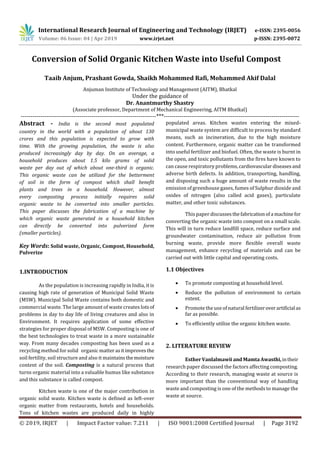
Abstract - India is the second most populated
country in the world with a population of about 130
crores and this population is expected to grow with
time. With the growing population, the waste is also
produced increasingly day by day. On an average, a
household produces about 1.5 kilo grams of solid
waste per day out of which about one-third is organic.
This organic waste can be utilized for the betterment
of soil in the form of compost which shall benefit
plants and trees in a household. However, almost
every composting process initially requires solid
organic waste to be converted into smaller particles.
This paper discusses the fabrication of a machine by
which organic waste generated in a household kitchen
can directly be converted into pulverized form
(smaller particles).
Key Words: Solid waste, Organic, Compost, Household,
Pulverize
1.INTRODUCTION
As the population is increasing rapidly in India, it is
causing high rate of generation of Municipal Solid Waste
(MSW). Municipal Solid Waste contains both domestic and
commercial waste. The large amount of waste creates lotsof
problems in day to day life of living creatures and also in
Environment. It requires application of some effective
strategies for proper disposal of MSW. Composting is one of
the best technologies to treat waste in a more sustainable
way. From many decades composting has been used as a
recycling method for solid organic matterasitimproves the
soil fertility, soil structure and also it maintainsthemoisture
content of the soil. Composting is a natural process that
turns organic material into a valuable humus like substance
and this substance is called compost.
Kitchen waste is one of the major contribution in
organic solid waste. Kitchen waste is defined as left-over
organic matter from restaurants, hotels and households.
Tons of kitchen wastes are produced daily in highly
populated areas. Kitchen wastes entering the mixed-
municipal waste system are difficult to process by standard
means, such as incineration, due to the high moisture
content. Furthermore, organic matter can be transformed
into useful fertilizer and biofuel. Often, the waste is burnt in
the open, and toxic pollutants from the fires have known to
can cause respiratory problems,cardiovasculardiseasesand
adverse birth defects. In addition, transporting, handling,
and disposing such a huge amount of waste results in the
emission of greenhouse gases, fumes of Sulphur dioxide and
oxides of nitrogen (also called acid gases), particulate
matter, and other toxic substances.
This paper discussesthefabricationofa machinefor
converting the organic waste into compost on a small scale.
This will in turn reduce landfill space, reduce surface and
groundwater contamination, reduce air pollution from
burning waste, provide more flexible overall waste
management, enhance recycling of materials and can be
carried out with little capital and operating costs.
1.1 Objectives
 To promote composting at household level.
 Reduce the pollution of environment to certain
extent.
 Promote the use of natural fertilizeroverartificialas
far as possible.
 To efficiently utilize the organic kitchen waste.
2. LITERATURE REVIEW
EstherVanlalmawii andMamtaAwasthi,intheir
research paper discussed the factors affecting composting.
According to their research, managing waste at source is
more important than the conventional way of handling
waste and composting is one of the methods to manage the
waste at source.
International Research Journal of Engineering and Technology (IRJET) e-ISSN: 2395-0056
Volume: 06 Issue: 04 | Apr 2019 www.irjet.net p-ISSN: 2395-0072
© 2019, IRJET | Impact Factor value: 7.211 | ISO 9001:2008 Certified Journal | Page 3193
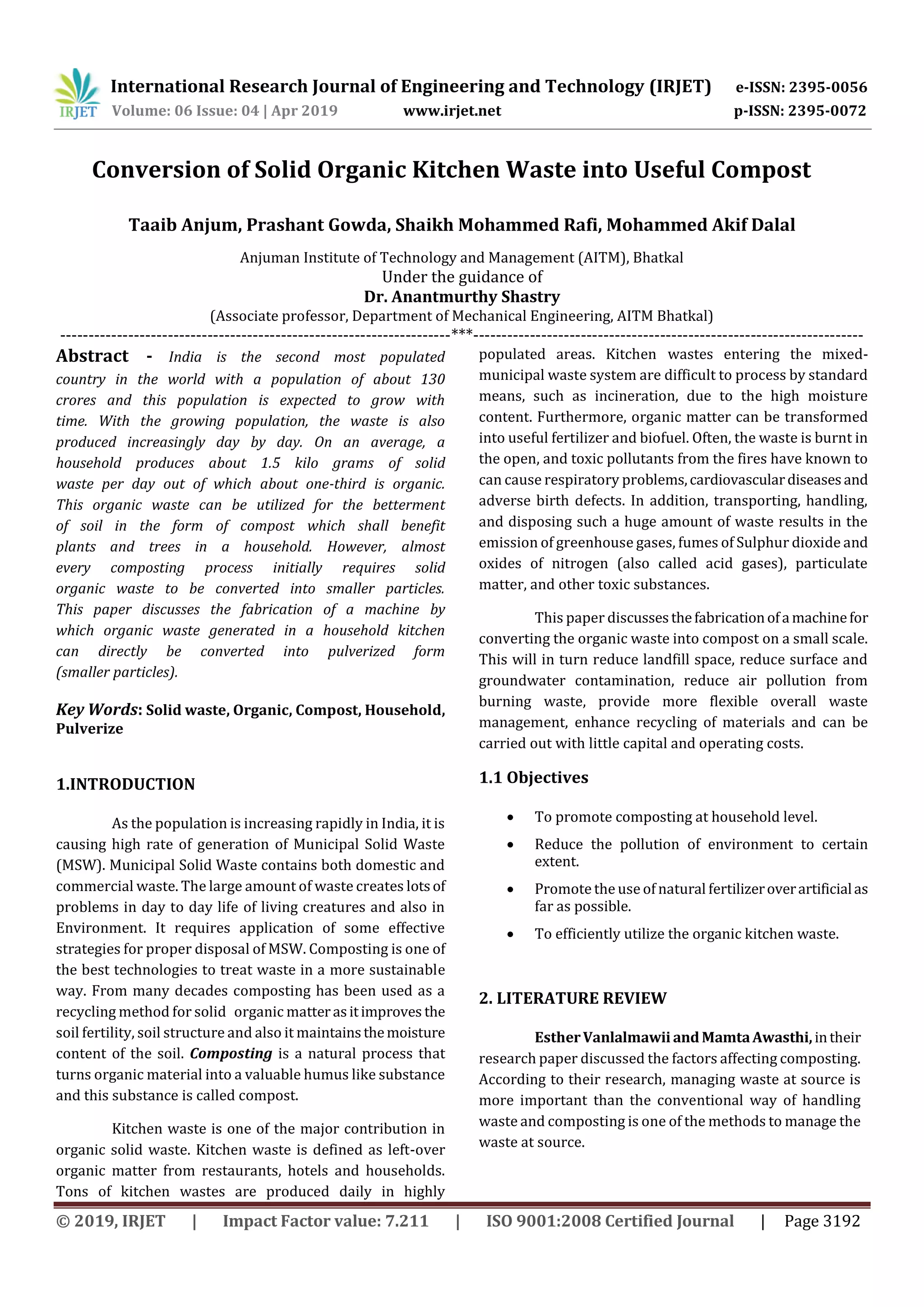
The authors in their research paper have given certain
standards values to be maintained during composting
process which are as follows:
Table -1: Composting Standards
K. Udhaya Kumar and two others intheirresearch,
employed the techniqueofvermicomposting tocompost the
organic waste and convert it into a bio-fertilizer. They used
eisenia foetida species of earthworm forvermicomposting.
Their research samples and results are given below:
Table -2: Sample
Table -3: Result
SL NO. Chemical Parameters Content
1 pH 7.1
2 Salt EC (dSm-1) 1.2 kg
3 Nitrogen (N) 0.44 kg
4 Phosphorous (P) 0.257 kg
5 Potassium (K) 1.1 kg
According to K. Udhaya Kumar, the central idea of
vermicomposting is not only to manage the solid waste
system but also to save the environment from pollution. In
their study, they conclude that they can earn 9.36 lakhs per
annum using this vermicomposting method in their locality
called padmanadapuram municipality.
Md. Maruf Mortula and two others, in their
experimental research used a machine called nature mill to
conduct the experiment on organic solid waste. Their
experimental samples included greens such as salads,
leftover vegetables, beans, lemons and fruits and browns
such as potatoes, bread, poultry and meats,riceand noodles.
Their experimental results are given in the table below:
Table -4: Results
Parameter Sample
1
Sample
2
Sample
3
Ministry
Standards
pH 4.44 4.28 4.16 ≤7.5
Salinity 3.6% 4.7% 3.7% <2%
Moisture
content
55.53% 42.02% 55.10% <25%
Organic
carbon
54.56% 54.53% 53.96% Around
54%
C:N ratio 29.65:1 24.02:1 28.10:1 ≤20:1
Nitrogen 1.84% 2.27% 1.92% 1% to 5%
Colour Light
brown
Light
brown
Light
brown
Dark
brown
3. PROPOSED SYSTEM
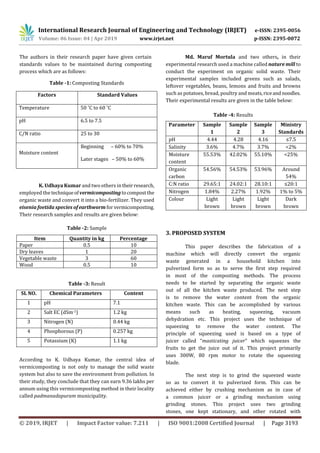
This paper describes the fabrication of a
machine which will directly convert the organic
waste generated in a household kitchen into
pulverized form so as to serve the first step required
in most of the composting methods. The process
needs to be started by separating the organic waste
out of all the kitchen waste produced. The next step
is to remove the water content from the organic
kitchen waste. This can be accomplished by various
means such as heating, squeezing, vacuum
dehydration etc. This project uses the technique of
squeezing to remove the water content. The
principle of squeezing used is based on a type of
juicer called “masticating juicer” which squeezes the
fruits to get the juice out of it. This project primarily
uses 300W, 80 rpm motor to rotate the squeezing
blade.
The next step is to grind the squeezed waste
so as to convert it to pulverized form. This can be
achieved either by crushing mechanism as in case of
a common juicer or a grinding mechanism using
grinding stones. This project uses two grinding
stones, one kept stationary, and other rotated with
Factors Standard Values
Temperature 50 ˚C to 60 ˚C
pH 6.5 to 7.5
C/N ratio 25 to 30
Moisture content
Beginning – 60% to 70%
Later stages – 50% to 60%
Item Quantity in kg Percentage
Paper 0.5 10
Dry leaves 1 20
Vegetable waste 3 60
Wood 0.5 10
International Research Journal of Engineering and Technology (IRJET) e-ISSN: 2395-0056
Volume: 06 Issue: 04 | Apr 2019 www.irjet.net p-ISSN: 2395-0072
© 2019, IRJET | Impact Factor value: 7.211 | ISO 9001:2008 Certified Journal | Page 3194
the help of a secondary motor with almost identical
characteristics as that of primary motor. The waste
matter after grinding process is let to cool for some
time at normal room temperature.
The pulverized waste can then be converted
to compost by various composting methods
available. Since composting is concerned with the
microbial activity which is a natural process, it
cannot be accomplished by any synthetic means.
However, by the addition of some pre-formed
natural fertilizer into the powdered waste or by
maintaining favorable environmental conditions, the
composting process can be accelerated.
Fig -1: Block diagram of the machine
4. COMPONENTS REQUIRED
4.1 Squeezer
A small squeezer as shown below:
Fig -2: Squeezer
4.2 DC Motor
Two motors of 300W with 80 rpm, one used to
rotate the squeezing shaft and another motor shall be used
to rotate the grinder.
4.3 Grinder
Two grinding stones of 150 mm diameter, one kept
stationary and other rotated using DC motor so as to grind
the squeezed waste matter.
5. METHODOLOGY
The systematic approach followed during the
project consisted of the following steps:
Fig -2: Process Flowchart
6. ADVANTAGES
 Good and efficient use of organic kitchen waste.
 Household production of natural fertilizer for
plants.
 Low investment.
International Research Journal of Engineering and Technology (IRJET) e-ISSN: 2395-0056
Volume: 06 Issue: 04 | Apr 2019 www.irjet.net p-ISSN: 2395-0072
© 2019, IRJET | Impact Factor value: 7.211 | ISO 9001:2008 Certified Journal | Page 3195
 Environment friendly.
 Light weight and easy to use.
 Tendency to reduce landfills space in near future.
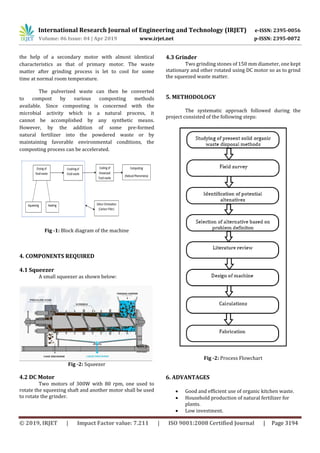
7. CONCLUSION
Solid waste management is one of the serious
problems today and with growing population, it is getting
worst day by day. This project however cannot solve this
problem but the proposed idea of this project can help to
reduce the solid waste managementproblembyindividually
reducing the waste contribution (reduction of waste
contribution from a household). The individual contribution
in ‘n’ numbers shall thus reduce a lot of waste thereby
helping to solve the problem of solid waste management.
8. ACKNOWLEDGEMENT
We consider it as a privilege to articulate a few
words of gratitude and respect to all those deserving
individuals who guided us in this project. First and
foremost, we would like to extend our profound gratitude
and our sincere thanks to our guide Dr. Anantmurthy
Shastry, Associate professor, Department of mechanical
engineering, Anjuman Institute of Technology and
Management(AITM),Bhatkal,whoconstantlysupportedand
encouraged us during every step of dissertation. We really
feel highly indebted to him for constantly guiding us to
continue our work and giving us short term goals.
We are thankful to our project co-ordinator,
Dr. Padmayya S Naik, Professor, Department of mechanical
engineering, AITM, Bhatkal for his immense support
throughout this project.
We take this opportunity to thank Dr. M. A
Bhavikatti, Principal, AITM, Bhatkal for his encouragement
and useful suggestions to pursue this work.
9. REFERENCES
1. Esther Vanlalmawii, Mamta Awasthi, Municipal
Solid Waste Composting - a review, Vol-4, Iss-2, Spl.
Issue-1, April -2016.
2. K. Udhaya Kumar, Henock, Tsegay, Conversion of
Solid Waste into Bio Fertilizer byVermicomposting-a
Case Study of Padmanadapuram, Vol. 4,Issue6,June
2015.
3. Md. Maruf Mortula, Aqeel Ahmed, and Mohammod
Hafizur Rahman, Decentralized Composting of
Organic Waste in UniversityCity,SharjahConference
Paper, April 2015.
4. Suhas S. Gonawala and Hemali Jardosh, Organic
Waste in Composting: A brief review, Vol.8, No.1
(Jan/Feb 2018).
5. Vivek Saini, Sankalp Gupta, Roopendra kr. Verma,
Balvindra Singh, A Review Study on Municipal
Organic Waste Composting, Volume: 04 Issue: 04
Apr -2017.
6. Dinesh Dekate, Tushar Karhale, Mona Dekate,
Development of Composting Machine for Utilization
of Kitchen Waste, Vol-4 Issue-2, 2018.
BIOGRAPHIES
Taaib Anjum
Dept. of Mechanical Engineering,
AITM, Bhatkal.
Prashant Gowda
Dept. of Mechanical Engineering,
AITM, Bhatkal.
Shaikh Mohammed Rafi
Dept. of Mechanical Engineering,
AITM, Bhatkal.
Mohammed Akif Dalal
Dept. of Mechanical Engineering,
AITM, Bhatkal.

IRJET- Conversion of Solid Organic Kitchen Waste into Useful Compost

  • 1.
    International Research Journalof Engineering and Technology (IRJET) e-ISSN: 2395-0056 Volume: 06 Issue: 04 | Apr 2019 www.irjet.net p-ISSN: 2395-0072 © 2019, IRJET | Impact Factor value: 7.211 | ISO 9001:2008 Certified Journal | Page 3192 Conversion of Solid Organic Kitchen Waste into Useful Compost Taaib Anjum, Prashant Gowda, Shaikh Mohammed Rafi, Mohammed Akif Dalal Anjuman Institute of Technology and Management (AITM), Bhatkal Under the guidance of Dr. Anantmurthy Shastry (Associate professor, Department of Mechanical Engineering, AITM Bhatkal) ---------------------------------------------------------------------***--------------------------------------------------------------------- Abstract - India is the second most populated country in the world with a population of about 130 crores and this population is expected to grow with time. With the growing population, the waste is also produced increasingly day by day. On an average, a household produces about 1.5 kilo grams of solid waste per day out of which about one-third is organic. This organic waste can be utilized for the betterment of soil in the form of compost which shall benefit plants and trees in a household. However, almost every composting process initially requires solid organic waste to be converted into smaller particles. This paper discusses the fabrication of a machine by which organic waste generated in a household kitchen can directly be converted into pulverized form (smaller particles). Key Words: Solid waste, Organic, Compost, Household, Pulverize 1.INTRODUCTION As the population is increasing rapidly in India, it is causing high rate of generation of Municipal Solid Waste (MSW). Municipal Solid Waste contains both domestic and commercial waste. The large amount of waste creates lotsof problems in day to day life of living creatures and also in Environment. It requires application of some effective strategies for proper disposal of MSW. Composting is one of the best technologies to treat waste in a more sustainable way. From many decades composting has been used as a recycling method for solid organic matterasitimproves the soil fertility, soil structure and also it maintainsthemoisture content of the soil. Composting is a natural process that turns organic material into a valuable humus like substance and this substance is called compost. Kitchen waste is one of the major contribution in organic solid waste. Kitchen waste is defined as left-over organic matter from restaurants, hotels and households. Tons of kitchen wastes are produced daily in highly populated areas. Kitchen wastes entering the mixed- municipal waste system are difficult to process by standard means, such as incineration, due to the high moisture content. Furthermore, organic matter can be transformed into useful fertilizer and biofuel. Often, the waste is burnt in the open, and toxic pollutants from the fires have known to can cause respiratory problems,cardiovasculardiseasesand adverse birth defects. In addition, transporting, handling, and disposing such a huge amount of waste results in the emission of greenhouse gases, fumes of Sulphur dioxide and oxides of nitrogen (also called acid gases), particulate matter, and other toxic substances. This paper discussesthefabricationofa machinefor converting the organic waste into compost on a small scale. This will in turn reduce landfill space, reduce surface and groundwater contamination, reduce air pollution from burning waste, provide more flexible overall waste management, enhance recycling of materials and can be carried out with little capital and operating costs. 1.1 Objectives  To promote composting at household level.  Reduce the pollution of environment to certain extent.  Promote the use of natural fertilizeroverartificialas far as possible.  To efficiently utilize the organic kitchen waste. 2. LITERATURE REVIEW EstherVanlalmawii andMamtaAwasthi,intheir research paper discussed the factors affecting composting. According to their research, managing waste at source is more important than the conventional way of handling waste and composting is one of the methods to manage the waste at source.
  • 2.
    International Research Journalof Engineering and Technology (IRJET) e-ISSN: 2395-0056 Volume: 06 Issue: 04 | Apr 2019 www.irjet.net p-ISSN: 2395-0072 © 2019, IRJET | Impact Factor value: 7.211 | ISO 9001:2008 Certified Journal | Page 3193 The authors in their research paper have given certain standards values to be maintained during composting process which are as follows: Table -1: Composting Standards K. Udhaya Kumar and two others intheirresearch, employed the techniqueofvermicomposting tocompost the organic waste and convert it into a bio-fertilizer. They used eisenia foetida species of earthworm forvermicomposting. Their research samples and results are given below: Table -2: Sample Table -3: Result SL NO. Chemical Parameters Content 1 pH 7.1 2 Salt EC (dSm-1) 1.2 kg 3 Nitrogen (N) 0.44 kg 4 Phosphorous (P) 0.257 kg 5 Potassium (K) 1.1 kg According to K. Udhaya Kumar, the central idea of vermicomposting is not only to manage the solid waste system but also to save the environment from pollution. In their study, they conclude that they can earn 9.36 lakhs per annum using this vermicomposting method in their locality called padmanadapuram municipality. Md. Maruf Mortula and two others, in their experimental research used a machine called nature mill to conduct the experiment on organic solid waste. Their experimental samples included greens such as salads, leftover vegetables, beans, lemons and fruits and browns such as potatoes, bread, poultry and meats,riceand noodles. Their experimental results are given in the table below: Table -4: Results Parameter Sample 1 Sample 2 Sample 3 Ministry Standards pH 4.44 4.28 4.16 ≤7.5 Salinity 3.6% 4.7% 3.7% <2% Moisture content 55.53% 42.02% 55.10% <25% Organic carbon 54.56% 54.53% 53.96% Around 54% C:N ratio 29.65:1 24.02:1 28.10:1 ≤20:1 Nitrogen 1.84% 2.27% 1.92% 1% to 5% Colour Light brown Light brown Light brown Dark brown 3. PROPOSED SYSTEM This paper describes the fabrication of a machine which will directly convert the organic waste generated in a household kitchen into pulverized form so as to serve the first step required in most of the composting methods. The process needs to be started by separating the organic waste out of all the kitchen waste produced. The next step is to remove the water content from the organic kitchen waste. This can be accomplished by various means such as heating, squeezing, vacuum dehydration etc. This project uses the technique of squeezing to remove the water content. The principle of squeezing used is based on a type of juicer called “masticating juicer” which squeezes the fruits to get the juice out of it. This project primarily uses 300W, 80 rpm motor to rotate the squeezing blade. The next step is to grind the squeezed waste so as to convert it to pulverized form. This can be achieved either by crushing mechanism as in case of a common juicer or a grinding mechanism using grinding stones. This project uses two grinding stones, one kept stationary, and other rotated with Factors Standard Values Temperature 50 ˚C to 60 ˚C pH 6.5 to 7.5 C/N ratio 25 to 30 Moisture content Beginning – 60% to 70% Later stages – 50% to 60% Item Quantity in kg Percentage Paper 0.5 10 Dry leaves 1 20 Vegetable waste 3 60 Wood 0.5 10
  • 3.
    International Research Journalof Engineering and Technology (IRJET) e-ISSN: 2395-0056 Volume: 06 Issue: 04 | Apr 2019 www.irjet.net p-ISSN: 2395-0072 © 2019, IRJET | Impact Factor value: 7.211 | ISO 9001:2008 Certified Journal | Page 3194 the help of a secondary motor with almost identical characteristics as that of primary motor. The waste matter after grinding process is let to cool for some time at normal room temperature. The pulverized waste can then be converted to compost by various composting methods available. Since composting is concerned with the microbial activity which is a natural process, it cannot be accomplished by any synthetic means. However, by the addition of some pre-formed natural fertilizer into the powdered waste or by maintaining favorable environmental conditions, the composting process can be accelerated. Fig -1: Block diagram of the machine 4. COMPONENTS REQUIRED 4.1 Squeezer A small squeezer as shown below: Fig -2: Squeezer 4.2 DC Motor Two motors of 300W with 80 rpm, one used to rotate the squeezing shaft and another motor shall be used to rotate the grinder. 4.3 Grinder Two grinding stones of 150 mm diameter, one kept stationary and other rotated using DC motor so as to grind the squeezed waste matter. 5. METHODOLOGY The systematic approach followed during the project consisted of the following steps: Fig -2: Process Flowchart 6. ADVANTAGES  Good and efficient use of organic kitchen waste.  Household production of natural fertilizer for plants.  Low investment.
  • 4.
    International Research Journalof Engineering and Technology (IRJET) e-ISSN: 2395-0056 Volume: 06 Issue: 04 | Apr 2019 www.irjet.net p-ISSN: 2395-0072 © 2019, IRJET | Impact Factor value: 7.211 | ISO 9001:2008 Certified Journal | Page 3195  Environment friendly.  Light weight and easy to use.  Tendency to reduce landfills space in near future. 7. CONCLUSION Solid waste management is one of the serious problems today and with growing population, it is getting worst day by day. This project however cannot solve this problem but the proposed idea of this project can help to reduce the solid waste managementproblembyindividually reducing the waste contribution (reduction of waste contribution from a household). The individual contribution in ‘n’ numbers shall thus reduce a lot of waste thereby helping to solve the problem of solid waste management. 8. ACKNOWLEDGEMENT We consider it as a privilege to articulate a few words of gratitude and respect to all those deserving individuals who guided us in this project. First and foremost, we would like to extend our profound gratitude and our sincere thanks to our guide Dr. Anantmurthy Shastry, Associate professor, Department of mechanical engineering, Anjuman Institute of Technology and Management(AITM),Bhatkal,whoconstantlysupportedand encouraged us during every step of dissertation. We really feel highly indebted to him for constantly guiding us to continue our work and giving us short term goals. We are thankful to our project co-ordinator, Dr. Padmayya S Naik, Professor, Department of mechanical engineering, AITM, Bhatkal for his immense support throughout this project. We take this opportunity to thank Dr. M. A Bhavikatti, Principal, AITM, Bhatkal for his encouragement and useful suggestions to pursue this work. 9. REFERENCES 1. Esther Vanlalmawii, Mamta Awasthi, Municipal Solid Waste Composting - a review, Vol-4, Iss-2, Spl. Issue-1, April -2016. 2. K. Udhaya Kumar, Henock, Tsegay, Conversion of Solid Waste into Bio Fertilizer byVermicomposting-a Case Study of Padmanadapuram, Vol. 4,Issue6,June 2015. 3. Md. Maruf Mortula, Aqeel Ahmed, and Mohammod Hafizur Rahman, Decentralized Composting of Organic Waste in UniversityCity,SharjahConference Paper, April 2015. 4. Suhas S. Gonawala and Hemali Jardosh, Organic Waste in Composting: A brief review, Vol.8, No.1 (Jan/Feb 2018). 5. Vivek Saini, Sankalp Gupta, Roopendra kr. Verma, Balvindra Singh, A Review Study on Municipal Organic Waste Composting, Volume: 04 Issue: 04 Apr -2017. 6. Dinesh Dekate, Tushar Karhale, Mona Dekate, Development of Composting Machine for Utilization of Kitchen Waste, Vol-4 Issue-2, 2018. BIOGRAPHIES Taaib Anjum Dept. of Mechanical Engineering, AITM, Bhatkal. Prashant Gowda Dept. of Mechanical Engineering, AITM, Bhatkal. Shaikh Mohammed Rafi Dept. of Mechanical Engineering, AITM, Bhatkal. Mohammed Akif Dalal Dept. of Mechanical Engineering, AITM, Bhatkal.