International Research Journal of Engineering and Technology (IRJET) e-ISSN: 2395-0056
Volume: 07 Issue: 04 | Apr 2020 www.irjet.net p-ISSN: 2395-0072
© 2020, IRJET | Impact Factor value: 7.34 | ISO 9001:2008 Certified Journal | Page 398
A Robust Sign Language and Hand Gesture Recognition System Using
Convolution Neural Network
K.Chandra Sekhar 1, Prakhya D2, NSVK Reddy3, A Varaprasadh4,M Sri Manjari5
1Asst.Professor, Dept of Computer Science Engineering, ANITS, Andhra Pradesh, India
2Student, Dept of Computer Science Engineering, ANITS, Andhra Pradesh, India
3 Student, Dept of Computer Science Engineering, ANITS, Andhra Pradesh, India
4 Student, Dept of Computer Science Engineering, ANITS, Andhra Pradesh, India
5 Student, Dept of Computer Science Engineering, ANITS, Andhra Pradesh, India
---------------------------------------------------------------------***---------------------------------------------------------------------
Abstract - Sign Language is the only way of
communication for the people who are not able to speak
and hear anything. It is a boon for the physically challenged
people to express their thoughts and emotions. But not
everyone can understand their gestured language. Hence
forming a communication gap . In this work, a novel scheme
of sign language recognition has been proposed for
identifying the alphabets,numbers and hand gestures in sign
language. This serves as the bridge between verbally
impaired people and normal ones. With the help of
computer vision and neural networks we made an attempt
to detect the signs and give the appropriate text as
output,which can be read and understood by the normal
people.
Key Words: :Sign Language Recognition,
Convolution Neural Network,Image Processing,Edge
Detection,Hand Gesture Recogniton.
1.INTRODUCTION
We capture the stream of frames from the
hardware of the system and each frame goes through
the prescribed process. The hand position in each
frame can be obtained by various methods. Thus
obtained image goes through various layers of neural
network to obtain the most appropriate result as
output. The system is properly trained using a large
data set to make itself more robust.
1.1 Image Processing
Image processing is the process of performing some
operations on an image to get an enhanced image or to
extract some useful information from it. It is a type of
signal processing in which input is an image and output
may be image or characteristics/features of that image.
Nowadays, image processing is one of the rapidly growing
technologies.
Image processing basically includes the following 3 steps:
 Capturing the image through image acquisition
tools.
 Performing various operations to extract or
manipulate the image.
 Give the output which is either an alternative
image or the report of analyzed results of the
image.
1.2 Sign Language
It is a language that includes gestures made with
the hands and other body parts, including facial
expressions and postures of the body. It used primarily by
people who are deaf and dumb. There are many different
sign languages as, British, Indian and American sign
languages. British sign language (BSL) is not easily
intelligible to users of American sign Language (ASL) and
vice versa .
A functioning signing recognition system could
provide a chance for the inattentive communicate with
non-signing people without the necessity for an
interpreter. It might be wont to generate speech or text
making the deaf more independent. Unfortunately there
has not been any system with these capabilities thus far.
during this project our aim is to develop a system which
may classify signing accurately.
2.RELATED WORK
2.1 A Survey of Hand Gesture Recognition
Methods in Sign Recognition.
Sign Language is that the sole technique utilized
in conversation between the hearing-impaired community
and normal community.
Signing Recognition gadget, that's required to
renowned signing, has been extensively studied for years.
The research are supported numerous enter sensors,
gesture segmentation, extraction of capabilities and
classification techniques. This paper aims to analyze and
evaluate the techniques employed in the SLR systems,
classifications strategies that are used, and suggests the
foremost promising technique for future research. way to
latest development in classification strategies, most of the
current proposed works in particular contribute at the
classification strategies, like hybrid method and Deep
International Research Journal of Engineering and Technology (IRJET) e-ISSN: 2395-0056
Volume: 07 Issue: 04 | Apr 2020 www.irjet.net p-ISSN: 2395-0072
© 2020, IRJET | Impact Factor value: 7.34 | ISO 9001:2008 Certified Journal | Page 399
Learning. This paper specializes in the classification
methods used in earlier signing Recognition device.
Supported our review, HMM-based approaches are
explored drastically in earlier research, including its
modifications. Sign Language is that the only technique
applied in community among the hearing-impaired
network and customary network. Signing Recognition
(SLR) gadget, that's required to acknowledge sign
languages, has been broadly studied for years. The studies
are supported various input sensors, gesture
segmentation, extraction of capabilities and classification
techniques. This paper aims to investigate and examine
the methods employed inside the SLR systems,
classifications techniques which might be used, and
suggests the most promising technique for future
research. Thanks to current advancement in classification
strategies, many of the current proposed works
particularly contribute on the classification strategies, like
hybrid method and Deep Learning. This paper specializes
in the classification methods used in previous signing
Recognition machine. Supported our review,HMM-
primarily based methods are explored appreciably in
previous research, including its modifications. Sign
Language is that the sole technique applied in verbal
exchange between the hearing-impaired community and
standard community. Signing Recognition (SLR) system,
that's required to renowned sign languages, has been
widely studied for years. The research are supported
various input sensors, gesture segmentation, extraction of
functions and classification techniques. This paper aims to
research and evaluate the techniques employed in the SLR
systems, classifications techniques which can be used, and
suggests the most promising approach for destiny
research. thanks to current advancement in classification
strategies, a number of the current proposed works
mainly contribute at the classification strategies, like
hybrid approach and Deep Learning. This paper
specializes in the classification techniques applied in prior
signing Recognition gadget. Supported our review, HMM-
based methods are explored substantially in prior
research, consisting of its modifications. Sign Language is
that the sole technique applied in communique between
the hearing-impaired network and commonplace
community. Signing Recognition (SLR) system, that's
required to acknowledge signal languages, has been
broadly studied for years. The studies are supported
numerous input sensors, gesture segmentation, extraction
of functions and classification techniques. This paper aims
to research and compare the strategies employed in the
SLR systems, classifications techniques that are used, and
suggests the most promising approach for future research.
way to recent advancement in classification techniques,
most of the latest proposed works specially contribute at
the classification techniques, like hybrid technique and
Deep Learning. This paper makes a speciality of the
classification methods used in earlier signing Recognition
gadget. Supported our review, HMM-based totally
methods are explored drastically in previous research,
along with its modifications. This observation is primarily
based on various input sensors, gesture segmentation,
extraction of features and classification strategies. This
paper aims to research and examine the strategies
employed within the SLR systems, classifications methods
which are used, and suggests the most reliable approach
for future research. One way to current advancement in
classification strategies, a few of the these days proposed
works mainly contribute to the classification strategies,
like hybrid method and Deep Learning. Supported our
review, HMM-primarily based approaches are explored
extensively in earlier research, together with its
modifications. Hybrid CNN-HMM and completely Deep
Learning approaches have proven promising effects and
offer possibilities for in addition exploration. Hybrid CNN-
HMM and absolutely Deep Learning strategies have
proven promising consequences and offer possibilities for
further exploration .Hybrid CNN-HMM and absolutely
Deep Learning approaches have shown promising
consequences and offer possibilities for similarly
exploration
.
2.2 Communication among Deaf-Dumb People
and Normal People
Chat packages became a sturdy media that assist
humans to talk in several languages with each other. There
are many chat applications which can be used different
people in numerous languages but there are not such an
interview utility that has facilitate to speak with signal
languages. The developed device is primarily based on
Sinhala signing. The system has included 4 main
components as textual content messages are converted to
sign messages, voice messages are transformed to sign
messages, sign messages are transformed to textual
content messages and signal messages are converted to
voice messages. Google voice reputation API has used to
expand speech man or woman popularity for voice
messages. The device has been trained for the speech and
text patterns by using the usage of a few text parameters
and symptoms of Sinhala signing is displayed through
emoji. Those emoji and signs which can be included during
this method will bring the regular humans more on the
point of the disabled human beings. that is regularly
frequently often frequently a 2 way communique device
however it uses pattern of gesture popularity which isn't
always realiable in getting suitable output.
2.3 A System for Recognition of Indian signing for
Deaf People the use of Otsu’s Algorithm
Trough this paper we proposed a few techniques, through
which the popularity of the signs and symptoms will
become clean for peoples while verbal exchange. . And
therefore the effects of those symbols symptoms are
becoming to be converted into the text. at some stage in
this project, we're taking pictures hand gestures via
webcam and convert this photo into grey scale picture.
International Research Journal of Engineering and Technology (IRJET) e-ISSN: 2395-0056
Volume: 07 Issue: 04 | Apr 2020 www.irjet.net p-ISSN: 2395-0072
© 2020, IRJET | Impact Factor value: 7.34 | ISO 9001:2008 Certified Journal | Page 400
The segmentation of grey scale picture of a hand gesture is
performed using Otsu thresholding algorithm.. Total
photograph stage is split into two lessons one is hand and
other is history. The highest quality threshold cost is about
via computing the ratio between class variance and total
magnificence variance. to hunt out the boundary of hand
gesture in image Canny facet detection approach is used.
In Canny part detection we used aspect primarily based
segmentation and threshold based segmentation. Then
Otsu’s set of rules is employed due to its simple calculation
and stability. This set of rules fails, when the global
distribution of the goal and background vary broadly.
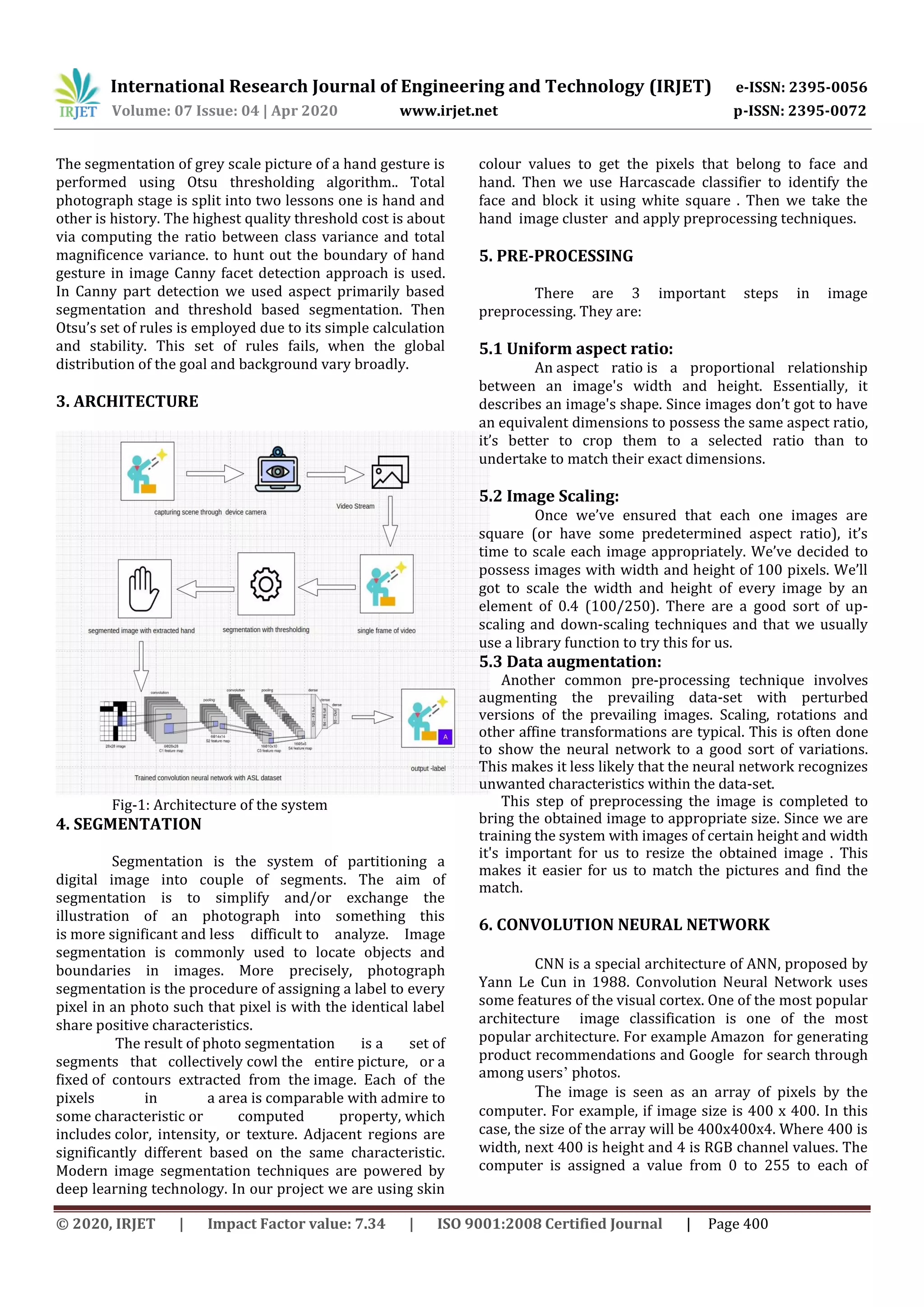
3. ARCHITECTURE
Fig-1: Architecture of the system
4. SEGMENTATION
Segmentation is the system of partitioning a
digital image into couple of segments. The aim of
segmentation is to simplify and/or exchange the
illustration of an photograph into something this
is more significant and less difficult to analyze. Image
segmentation is commonly used to locate objects and
boundaries in images. More precisely, photograph
segmentation is the procedure of assigning a label to every
pixel in an photo such that pixel is with the identical label
share positive characteristics.
The result of photo segmentation is a set of
segments that collectively cowl the entire picture, or a
fixed of contours extracted from the image. Each of the
pixels in a area is comparable with admire to
some characteristic or computed property, which
includes color, intensity, or texture. Adjacent regions are
significantly different based on the same characteristic.
Modern image segmentation techniques are powered by
deep learning technology. In our project we are using skin
colour values to get the pixels that belong to face and
hand. Then we use Harcascade classifier to identify the
face and block it using white square . Then we take the
hand image cluster and apply preprocessing techniques.
5. PRE-PROCESSING
There are 3 important steps in image
preprocessing. They are:
5.1 Uniform aspect ratio:
An aspect ratio is a proportional relationship
between an image's width and height. Essentially, it
describes an image's shape. Since images don’t got to have
an equivalent dimensions to possess the same aspect ratio,
it’s better to crop them to a selected ratio than to
undertake to match their exact dimensions.
5.2 Image Scaling:
Once we’ve ensured that each one images are
square (or have some predetermined aspect ratio), it’s
time to scale each image appropriately. We’ve decided to
possess images with width and height of 100 pixels. We’ll
got to scale the width and height of every image by an
element of 0.4 (100/250). There are a good sort of up-
scaling and down-scaling techniques and that we usually
use a library function to try this for us.
5.3 Data augmentation:
Another common pre-processing technique involves
augmenting the prevailing data-set with perturbed
versions of the prevailing images. Scaling, rotations and
other affine transformations are typical. This is often done
to show the neural network to a good sort of variations.
This makes it less likely that the neural network recognizes
unwanted characteristics within the data-set.
This step of preprocessing the image is completed to
bring the obtained image to appropriate size. Since we are
training the system with images of certain height and width
it's important for us to resize the obtained image . This
makes it easier for us to match the pictures and find the
match.
6. CONVOLUTION NEURAL NETWORK
CNN is a special architecture of ANN, proposed by
Yann Le Cun in 1988. Convolution Neural Network uses
some features of the visual cortex. One of the most popular
architecture image classification is one of the most
popular architecture. For example Amazon for generating
product recommendations and Google for search through
among users’ photos.
The image is seen as an array of pixels by the
computer. For example, if image size is 400 x 400. In this
case, the size of the array will be 400x400x4. Where 400 is
width, next 400 is height and 4 is RGB channel values. The
computer is assigned a value from 0 to 255 to each of
International Research Journal of Engineering and Technology (IRJET) e-ISSN: 2395-0056
Volume: 07 Issue: 04 | Apr 2020 www.irjet.net p-ISSN: 2395-0072
© 2020, IRJET | Impact Factor value: 7.34 | ISO 9001:2008 Certified Journal | Page 401
these numbers. This value describes the intensity of the
pixel at each and every point.
To solve this problem the computer looks for the
characteristics of the base level. In human understanding
such characteristics are for example are the trunk or large
ears. For the computer, these characteristics are the
boundaries or curvatures. Then, it is passed through the
groups of convolutional layers the computer constructs
more abstract concepts. In more detail: the image is
passed through a series of convolutional layers
(nonlinear,pooling,fully,connected layers).
RESULTS
Our system worked well to provide appropriate results.
We trained our system using the American Sign Language
gestures. The samples of the obtained results are shown
below.
Fig-2: Result of Alphabet A
Fig-3: Result of Alphabet W
Fig-4: Result of Alphabet L
CONCLUSION
We obtained letters as output of the signs . The project
can be further extended such that we conjugate all the
letters to obtain statements. Thus making the output more
readable.
Nowadays, applications need several kinds of
images as sources of information for elucidation and
analysis. Several features are to be extracted so as to
perform various applications. The aim of this project is to
create an offline sign language recognition system that is
more robust in order to get the most appropriate output.
In our work we trained the system with a large data set of
images. Then we used cluster segmentation with respect
to colour and edges. Image then undergoes feature
extraction using various methods to make the image more
readable by the computer. The closest match from the
database is the obtained. Its label is displayed as output.
Sign language recognition system is a powerful tool to
prepare an expert knowledge, edge detect and the
combination of inaccurate information from different
sources. The intend of convolution neural network is to
get the appropriate classification and accurate output.
REFERENCES
[1] https://medium.com/@RaghavPrabhu/understandin
g-of-convolutional-neural-network-cnn-deep-
learning-99760835f148
[2] https://adeshpande3.github.io/adeshpande3.github.i
o/A-Beginner's-Guide-To-Understanding-
Convolutional-Neural-Networks/
[3] http://citeseerx.ist.psu.edu/viewdoc/download?doi=
10.1.1.734.8389&rep=rep1&type=pdf

IRJET - A Robust Sign Language and Hand Gesture Recognition System using Convolution Neural Network

  • 1.
    International Research Journalof Engineering and Technology (IRJET) e-ISSN: 2395-0056 Volume: 07 Issue: 04 | Apr 2020 www.irjet.net p-ISSN: 2395-0072 © 2020, IRJET | Impact Factor value: 7.34 | ISO 9001:2008 Certified Journal | Page 398 A Robust Sign Language and Hand Gesture Recognition System Using Convolution Neural Network K.Chandra Sekhar 1, Prakhya D2, NSVK Reddy3, A Varaprasadh4,M Sri Manjari5 1Asst.Professor, Dept of Computer Science Engineering, ANITS, Andhra Pradesh, India 2Student, Dept of Computer Science Engineering, ANITS, Andhra Pradesh, India 3 Student, Dept of Computer Science Engineering, ANITS, Andhra Pradesh, India 4 Student, Dept of Computer Science Engineering, ANITS, Andhra Pradesh, India 5 Student, Dept of Computer Science Engineering, ANITS, Andhra Pradesh, India ---------------------------------------------------------------------***--------------------------------------------------------------------- Abstract - Sign Language is the only way of communication for the people who are not able to speak and hear anything. It is a boon for the physically challenged people to express their thoughts and emotions. But not everyone can understand their gestured language. Hence forming a communication gap . In this work, a novel scheme of sign language recognition has been proposed for identifying the alphabets,numbers and hand gestures in sign language. This serves as the bridge between verbally impaired people and normal ones. With the help of computer vision and neural networks we made an attempt to detect the signs and give the appropriate text as output,which can be read and understood by the normal people. Key Words: :Sign Language Recognition, Convolution Neural Network,Image Processing,Edge Detection,Hand Gesture Recogniton. 1.INTRODUCTION We capture the stream of frames from the hardware of the system and each frame goes through the prescribed process. The hand position in each frame can be obtained by various methods. Thus obtained image goes through various layers of neural network to obtain the most appropriate result as output. The system is properly trained using a large data set to make itself more robust. 1.1 Image Processing Image processing is the process of performing some operations on an image to get an enhanced image or to extract some useful information from it. It is a type of signal processing in which input is an image and output may be image or characteristics/features of that image. Nowadays, image processing is one of the rapidly growing technologies. Image processing basically includes the following 3 steps:  Capturing the image through image acquisition tools.  Performing various operations to extract or manipulate the image.  Give the output which is either an alternative image or the report of analyzed results of the image. 1.2 Sign Language It is a language that includes gestures made with the hands and other body parts, including facial expressions and postures of the body. It used primarily by people who are deaf and dumb. There are many different sign languages as, British, Indian and American sign languages. British sign language (BSL) is not easily intelligible to users of American sign Language (ASL) and vice versa . A functioning signing recognition system could provide a chance for the inattentive communicate with non-signing people without the necessity for an interpreter. It might be wont to generate speech or text making the deaf more independent. Unfortunately there has not been any system with these capabilities thus far. during this project our aim is to develop a system which may classify signing accurately. 2.RELATED WORK 2.1 A Survey of Hand Gesture Recognition Methods in Sign Recognition. Sign Language is that the sole technique utilized in conversation between the hearing-impaired community and normal community. Signing Recognition gadget, that's required to renowned signing, has been extensively studied for years. The research are supported numerous enter sensors, gesture segmentation, extraction of capabilities and classification techniques. This paper aims to analyze and evaluate the techniques employed in the SLR systems, classifications strategies that are used, and suggests the foremost promising technique for future research. way to latest development in classification strategies, most of the current proposed works in particular contribute at the classification strategies, like hybrid method and Deep
  • 2.
    International Research Journalof Engineering and Technology (IRJET) e-ISSN: 2395-0056 Volume: 07 Issue: 04 | Apr 2020 www.irjet.net p-ISSN: 2395-0072 © 2020, IRJET | Impact Factor value: 7.34 | ISO 9001:2008 Certified Journal | Page 399 Learning. This paper specializes in the classification methods used in earlier signing Recognition device. Supported our review, HMM-based approaches are explored drastically in earlier research, including its modifications. Sign Language is that the only technique applied in community among the hearing-impaired network and customary network. Signing Recognition (SLR) gadget, that's required to acknowledge sign languages, has been broadly studied for years. The studies are supported various input sensors, gesture segmentation, extraction of capabilities and classification techniques. This paper aims to investigate and examine the methods employed inside the SLR systems, classifications techniques which might be used, and suggests the most promising technique for future research. Thanks to current advancement in classification strategies, many of the current proposed works particularly contribute on the classification strategies, like hybrid method and Deep Learning. This paper specializes in the classification methods used in previous signing Recognition machine. Supported our review,HMM- primarily based methods are explored appreciably in previous research, including its modifications. Sign Language is that the sole technique applied in verbal exchange between the hearing-impaired community and standard community. Signing Recognition (SLR) system, that's required to renowned sign languages, has been widely studied for years. The research are supported various input sensors, gesture segmentation, extraction of functions and classification techniques. This paper aims to research and evaluate the techniques employed in the SLR systems, classifications techniques which can be used, and suggests the most promising approach for destiny research. thanks to current advancement in classification strategies, a number of the current proposed works mainly contribute at the classification strategies, like hybrid approach and Deep Learning. This paper specializes in the classification techniques applied in prior signing Recognition gadget. Supported our review, HMM- based methods are explored substantially in prior research, consisting of its modifications. Sign Language is that the sole technique applied in communique between the hearing-impaired network and commonplace community. Signing Recognition (SLR) system, that's required to acknowledge signal languages, has been broadly studied for years. The studies are supported numerous input sensors, gesture segmentation, extraction of functions and classification techniques. This paper aims to research and compare the strategies employed in the SLR systems, classifications techniques that are used, and suggests the most promising approach for future research. way to recent advancement in classification techniques, most of the latest proposed works specially contribute at the classification techniques, like hybrid technique and Deep Learning. This paper makes a speciality of the classification methods used in earlier signing Recognition gadget. Supported our review, HMM-based totally methods are explored drastically in previous research, along with its modifications. This observation is primarily based on various input sensors, gesture segmentation, extraction of features and classification strategies. This paper aims to research and examine the strategies employed within the SLR systems, classifications methods which are used, and suggests the most reliable approach for future research. One way to current advancement in classification strategies, a few of the these days proposed works mainly contribute to the classification strategies, like hybrid method and Deep Learning. Supported our review, HMM-primarily based approaches are explored extensively in earlier research, together with its modifications. Hybrid CNN-HMM and completely Deep Learning approaches have proven promising effects and offer possibilities for in addition exploration. Hybrid CNN- HMM and absolutely Deep Learning strategies have proven promising consequences and offer possibilities for further exploration .Hybrid CNN-HMM and absolutely Deep Learning approaches have shown promising consequences and offer possibilities for similarly exploration . 2.2 Communication among Deaf-Dumb People and Normal People Chat packages became a sturdy media that assist humans to talk in several languages with each other. There are many chat applications which can be used different people in numerous languages but there are not such an interview utility that has facilitate to speak with signal languages. The developed device is primarily based on Sinhala signing. The system has included 4 main components as textual content messages are converted to sign messages, voice messages are transformed to sign messages, sign messages are transformed to textual content messages and signal messages are converted to voice messages. Google voice reputation API has used to expand speech man or woman popularity for voice messages. The device has been trained for the speech and text patterns by using the usage of a few text parameters and symptoms of Sinhala signing is displayed through emoji. Those emoji and signs which can be included during this method will bring the regular humans more on the point of the disabled human beings. that is regularly frequently often frequently a 2 way communique device however it uses pattern of gesture popularity which isn't always realiable in getting suitable output. 2.3 A System for Recognition of Indian signing for Deaf People the use of Otsu’s Algorithm Trough this paper we proposed a few techniques, through which the popularity of the signs and symptoms will become clean for peoples while verbal exchange. . And therefore the effects of those symbols symptoms are becoming to be converted into the text. at some stage in this project, we're taking pictures hand gestures via webcam and convert this photo into grey scale picture.
  • 3.
    International Research Journalof Engineering and Technology (IRJET) e-ISSN: 2395-0056 Volume: 07 Issue: 04 | Apr 2020 www.irjet.net p-ISSN: 2395-0072 © 2020, IRJET | Impact Factor value: 7.34 | ISO 9001:2008 Certified Journal | Page 400 The segmentation of grey scale picture of a hand gesture is performed using Otsu thresholding algorithm.. Total photograph stage is split into two lessons one is hand and other is history. The highest quality threshold cost is about via computing the ratio between class variance and total magnificence variance. to hunt out the boundary of hand gesture in image Canny facet detection approach is used. In Canny part detection we used aspect primarily based segmentation and threshold based segmentation. Then Otsu’s set of rules is employed due to its simple calculation and stability. This set of rules fails, when the global distribution of the goal and background vary broadly. 3. ARCHITECTURE Fig-1: Architecture of the system 4. SEGMENTATION Segmentation is the system of partitioning a digital image into couple of segments. The aim of segmentation is to simplify and/or exchange the illustration of an photograph into something this is more significant and less difficult to analyze. Image segmentation is commonly used to locate objects and boundaries in images. More precisely, photograph segmentation is the procedure of assigning a label to every pixel in an photo such that pixel is with the identical label share positive characteristics. The result of photo segmentation is a set of segments that collectively cowl the entire picture, or a fixed of contours extracted from the image. Each of the pixels in a area is comparable with admire to some characteristic or computed property, which includes color, intensity, or texture. Adjacent regions are significantly different based on the same characteristic. Modern image segmentation techniques are powered by deep learning technology. In our project we are using skin colour values to get the pixels that belong to face and hand. Then we use Harcascade classifier to identify the face and block it using white square . Then we take the hand image cluster and apply preprocessing techniques. 5. PRE-PROCESSING There are 3 important steps in image preprocessing. They are: 5.1 Uniform aspect ratio: An aspect ratio is a proportional relationship between an image's width and height. Essentially, it describes an image's shape. Since images don’t got to have an equivalent dimensions to possess the same aspect ratio, it’s better to crop them to a selected ratio than to undertake to match their exact dimensions. 5.2 Image Scaling: Once we’ve ensured that each one images are square (or have some predetermined aspect ratio), it’s time to scale each image appropriately. We’ve decided to possess images with width and height of 100 pixels. We’ll got to scale the width and height of every image by an element of 0.4 (100/250). There are a good sort of up- scaling and down-scaling techniques and that we usually use a library function to try this for us. 5.3 Data augmentation: Another common pre-processing technique involves augmenting the prevailing data-set with perturbed versions of the prevailing images. Scaling, rotations and other affine transformations are typical. This is often done to show the neural network to a good sort of variations. This makes it less likely that the neural network recognizes unwanted characteristics within the data-set. This step of preprocessing the image is completed to bring the obtained image to appropriate size. Since we are training the system with images of certain height and width it's important for us to resize the obtained image . This makes it easier for us to match the pictures and find the match. 6. CONVOLUTION NEURAL NETWORK CNN is a special architecture of ANN, proposed by Yann Le Cun in 1988. Convolution Neural Network uses some features of the visual cortex. One of the most popular architecture image classification is one of the most popular architecture. For example Amazon for generating product recommendations and Google for search through among users’ photos. The image is seen as an array of pixels by the computer. For example, if image size is 400 x 400. In this case, the size of the array will be 400x400x4. Where 400 is width, next 400 is height and 4 is RGB channel values. The computer is assigned a value from 0 to 255 to each of
  • 4.
    International Research Journalof Engineering and Technology (IRJET) e-ISSN: 2395-0056 Volume: 07 Issue: 04 | Apr 2020 www.irjet.net p-ISSN: 2395-0072 © 2020, IRJET | Impact Factor value: 7.34 | ISO 9001:2008 Certified Journal | Page 401 these numbers. This value describes the intensity of the pixel at each and every point. To solve this problem the computer looks for the characteristics of the base level. In human understanding such characteristics are for example are the trunk or large ears. For the computer, these characteristics are the boundaries or curvatures. Then, it is passed through the groups of convolutional layers the computer constructs more abstract concepts. In more detail: the image is passed through a series of convolutional layers (nonlinear,pooling,fully,connected layers). RESULTS Our system worked well to provide appropriate results. We trained our system using the American Sign Language gestures. The samples of the obtained results are shown below. Fig-2: Result of Alphabet A Fig-3: Result of Alphabet W Fig-4: Result of Alphabet L CONCLUSION We obtained letters as output of the signs . The project can be further extended such that we conjugate all the letters to obtain statements. Thus making the output more readable. Nowadays, applications need several kinds of images as sources of information for elucidation and analysis. Several features are to be extracted so as to perform various applications. The aim of this project is to create an offline sign language recognition system that is more robust in order to get the most appropriate output. In our work we trained the system with a large data set of images. Then we used cluster segmentation with respect to colour and edges. Image then undergoes feature extraction using various methods to make the image more readable by the computer. The closest match from the database is the obtained. Its label is displayed as output. Sign language recognition system is a powerful tool to prepare an expert knowledge, edge detect and the combination of inaccurate information from different sources. The intend of convolution neural network is to get the appropriate classification and accurate output. REFERENCES [1] https://medium.com/@RaghavPrabhu/understandin g-of-convolutional-neural-network-cnn-deep- learning-99760835f148 [2] https://adeshpande3.github.io/adeshpande3.github.i o/A-Beginner's-Guide-To-Understanding- Convolutional-Neural-Networks/ [3] http://citeseerx.ist.psu.edu/viewdoc/download?doi= 10.1.1.734.8389&rep=rep1&type=pdf