IRAN
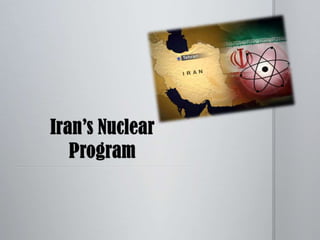
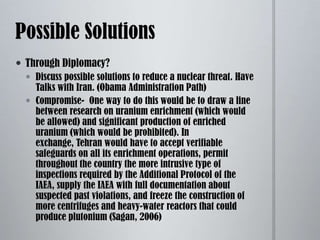
Intro.	Government & politics of Iran (Ray Khorasani)Human rights (BadihElarba)Terrorism (Cliff Martin)Nuclear program (Ivan Camacho)
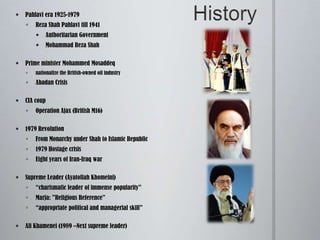
HistoryPahlavi era 1925-1979Reza Shah Pahlavi till 1941	Authoritarian GovernmentMohammad Reza ShahPrime minister Mohammed Mosaddeqnationalize the British-owned oil industry Abadan CrisisCIA coupOperation Ajax (British M16)1979 RevolutionFrom Monarchy under Shah to Islamic Republic1979 Hostage crisisEight years of Iran-Iraq war	Supreme Leader (Ayatollah Khomeini)“charismatic leader of immense popularity” Marja: "Religious Reference”“appropriate political and managerial skill” Ali Khamenei (1989 –Next supreme leader)
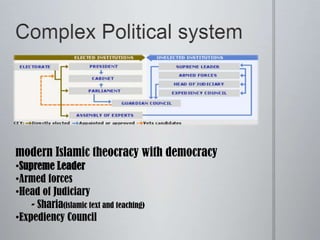
Complex Political systemmodern Islamic theocracy with democracySupreme Leader
Armed forces
Head of Judiciary- Sharia(islamic text and teaching)Expediency CouncilComplex Political SystemGuardian CouncilAssembly of expertsParliament (majlis)CabinetPresidentElectorate
Forces of Political PowerRepress the oppositionallocates economic resources Punish offenders (kidnap, torture, kill , assassinate and hang)Buy political loyaltyPolitical rentEconomic performanceMaintain political powerEconomic resources
before Iran’s recent electionObama Administrationencouraged the regime's power grabemboldened Khamenei and Ahmadinejad
CurrentlyPolitical situation is Foggy (after recent election)MahmoudAhmadinejad  tighten control of regime Khamenei attempting first vice president (EsfandiarMashaie)
Internet rumorOctober 14, 2009Ayatollah Khamenei was critically ill or even dead. London Newspaperdiscussion question:If khamenei’s death were true, how would it affect the regime of Iran? Would this be any less threat to the U.S?
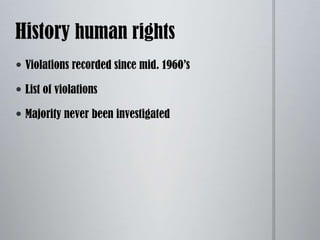
History human rightsViolations recorded since mid. 1960’sList of violations Majority never been investigated
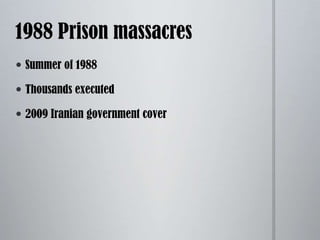
1988 Prison massacresSummer of 1988Thousands executed2009 Iranian government cover
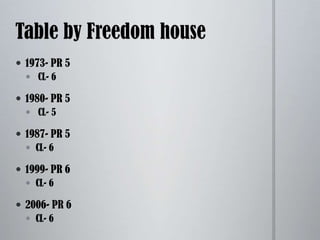
Table by Freedom house1973- PR 5 CL- 61980- PR 5 CL- 51987- PR 5CL- 61999- PR 6CL- 62006- PR 6CL- 6
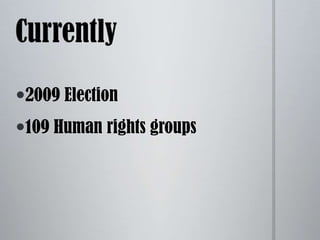
Currently2009 Election109 Human rights groups
Does Human rights violations by Iran prompt an invasion by the U.S to spread liberal ideals?
SECTION III:  Iran and TerrorismIn March 2006, then US Secretary of State Condoleezza Rice said, “Iran has been the country that has been in many ways a central banker for terrorism.”
The US Defense Department in a May 2009 report, stated that “Iran remains the most active state sponsor of terrorism in the world.”
Former CIA officer Michael Scheuer defines a state sponsor of terrorism as “a country that uses surrogates as its weapons to attack other people.”
Amy Zalman, Ph.D., a senior research strategist states, “ The most prominent group supported by Iran is the Lebanese group Hizbollah, and the reason accepted for their sponsorship of a terrorist organization:  To indirectly influence politics elsewhere.
US officials charge that as in previous years, Iran continues to provide funding, weapons training, and sanctuary to numerous terrorists groups based in Lebanon, Iraq, Afghanistan, and the Palestinian territories. 	IRAN AND TERRORISM:  HISTORY AND REASONS PAST: After the 1979 Revolution, Iran initially began supporting radical groups, many of whom embraced terrorism.
Iran were the representatives of the world’s largest Shi’a nation, and Tehran was especially active in working with Shi’a Muslim movements around the world.
The clerical regime in Tehran viewed supporting revolutions overseas as part of its revolutionary duty.
Iran’s Supreme Leader Ayatollah Khomeini declared shortly after taking power that, “We should try hard to export our revolution to the world….we [shall] confront the world with our ideology.”-Daniel Byman, The Saban Center for Middle East Policy.
Supporting subversive movements (terrorism), in the case of Iran, became a way of weakening, destabilizing, and toppling what in the eyes of Tehran were illegitimate regimes, (i.e. Iraq, Saudi  Arabia, Pakistan), where Shi’a Muslims faced oppression and discrimination.Iran and Terrorism:  History and ReasonsIn the case of Iraq, immediately following the Revolution, Iran began supporting radicalism there, especially various Iraqi Shi’ite groups under the umbrella of the SCIRI (Supreme Council for the Islamic Revolution in Iraq).
 This subsequently contributed to the decision of Bagdad to invade Iran.
Iranian expert R.K. Ramazani stated that Iran’s goal was, through terrorism, “to undermine the Hussein regime and pave the way for the establishment of an Iranian-type Islamic government in Iraq.”
During the Iran-Iraq War, Iran also used maritime terror, using unmarked gunboats and floating mines to attack noncombatant shipping.-Gary Sick, Iran:  Confronting Terrorism.Iran and Terrorism:  History and ReasonsDomestic politics have also motivated Iran to sponsor terrorism.
Iran’s self-proclamation as the protector of Shi’a Muslims required them to show clear gestures of support.
During the 1980s Iran provided funding to a wide range of Shi’a Muslim groups such as:
The Iraqi Dawa party
The Islamic Front for the Liberation of Bahrain
The Tehrik-e Jafariya-e PakistanIran and Terrorism:  History and ReasonsTerrorism was also a means for Iran to strike at the United States and Israel:
63 people died, including 17 Americans at the U.S. embassy in Beirut in April 1983 from suicide attacks by the Iranian trained and guided Lebanese Hizbollah.
In October 1983, 241 U.S. Marines were killed on an attack on the U.S. Marine Barracks forcing President Reagan to withdraw U.S. troops in February 1984.
Hizbollah and Iran worked together in March 1992 to bomb the Israeli embassy in Argentina. ( 29 died)
In July 1994, they attacked the Jewish Community Center in Buenos Aires. (86 died)
Iran directed the attack on the U.S. military facility of Khobar Towers in Saudi Arabia in 1996.
(17 American troops died)
Hizbollah also took numerous Western hostages in the 1980s, executing several of them.
One senior Hizbollah member said of the relationship to Iran in the early 1980s, “That ours is one of a junior to a senior, of a soldier to his commander.”Iran and Terrorism: Past ReasonsTerrorism gave Iran a way to weaken its neighbors and influence events beyond its borders.
Terrorism not only allowed Iran to weaken its adversaries, but also to have a voice in the opposition to a particular regime
Terrorism  allowed Iran to compensate for its military inferiority.
Lacking aircraft carriers or other military forces that could be deployed thousands of miles away, Iran used terrorism to project power.
Terrorism offered Iran some degree of deniability.
Working through proxies allowed Iran to achieve its own interest during this time against the United States and Israel without paying the consequences of a more direct involvement. Iran and Terrorism:  Present According to Daniel Byman of the Saban Center  for Middle East Policy, “Iran’s use of terrorism, from the U.S. point of view, has changed dramatically since the 1980s and parts of the 1990s.”
Iran, though it contains the capabilities to do so, appears not to target Americans directly.
Iran has also cut back on operations in Europe and the Gulf States since the early 1990s.
Iranian official feared continuing attacks on Iranian dissidents would lead to European sanctions and reduced investment in their economy
(up until the early 1990s, Iranian intelligence services routinely assassinated Iranian dissidents in Europe).

Iran

  • 1.
  • 2.
    Intro. Government & politicsof Iran (Ray Khorasani)Human rights (BadihElarba)Terrorism (Cliff Martin)Nuclear program (Ivan Camacho)
  • 3.
    HistoryPahlavi era 1925-1979RezaShah Pahlavi till 1941 Authoritarian GovernmentMohammad Reza ShahPrime minister Mohammed Mosaddeqnationalize the British-owned oil industry Abadan CrisisCIA coupOperation Ajax (British M16)1979 RevolutionFrom Monarchy under Shah to Islamic Republic1979 Hostage crisisEight years of Iran-Iraq war Supreme Leader (Ayatollah Khomeini)“charismatic leader of immense popularity” Marja: "Religious Reference”“appropriate political and managerial skill” Ali Khamenei (1989 –Next supreme leader)
  • 4.
    Complex Political systemmodernIslamic theocracy with democracySupreme Leader
  • 5.
  • 6.
    Head of Judiciary-Sharia(islamic text and teaching)Expediency CouncilComplex Political SystemGuardian CouncilAssembly of expertsParliament (majlis)CabinetPresidentElectorate
  • 7.
    Forces of PoliticalPowerRepress the oppositionallocates economic resources Punish offenders (kidnap, torture, kill , assassinate and hang)Buy political loyaltyPolitical rentEconomic performanceMaintain political powerEconomic resources
  • 8.
    before Iran’s recentelectionObama Administrationencouraged the regime's power grabemboldened Khamenei and Ahmadinejad
  • 9.
    CurrentlyPolitical situation isFoggy (after recent election)MahmoudAhmadinejad tighten control of regime Khamenei attempting first vice president (EsfandiarMashaie)
  • 10.
    Internet rumorOctober 14,2009Ayatollah Khamenei was critically ill or even dead. London Newspaperdiscussion question:If khamenei’s death were true, how would it affect the regime of Iran? Would this be any less threat to the U.S?
  • 11.
    History human rightsViolationsrecorded since mid. 1960’sList of violations Majority never been investigated
  • 12.
    1988 Prison massacresSummerof 1988Thousands executed2009 Iranian government cover
  • 13.
    Table by Freedomhouse1973- PR 5 CL- 61980- PR 5 CL- 51987- PR 5CL- 61999- PR 6CL- 62006- PR 6CL- 6
  • 14.
  • 15.
    Does Human rightsviolations by Iran prompt an invasion by the U.S to spread liberal ideals?
  • 16.
    SECTION III: Iran and TerrorismIn March 2006, then US Secretary of State Condoleezza Rice said, “Iran has been the country that has been in many ways a central banker for terrorism.”
  • 17.
    The US DefenseDepartment in a May 2009 report, stated that “Iran remains the most active state sponsor of terrorism in the world.”
  • 18.
    Former CIA officerMichael Scheuer defines a state sponsor of terrorism as “a country that uses surrogates as its weapons to attack other people.”
  • 19.
    Amy Zalman, Ph.D.,a senior research strategist states, “ The most prominent group supported by Iran is the Lebanese group Hizbollah, and the reason accepted for their sponsorship of a terrorist organization: To indirectly influence politics elsewhere.
  • 20.
    US officials chargethat as in previous years, Iran continues to provide funding, weapons training, and sanctuary to numerous terrorists groups based in Lebanon, Iraq, Afghanistan, and the Palestinian territories. IRAN AND TERRORISM: HISTORY AND REASONS PAST: After the 1979 Revolution, Iran initially began supporting radical groups, many of whom embraced terrorism.
  • 21.
    Iran were therepresentatives of the world’s largest Shi’a nation, and Tehran was especially active in working with Shi’a Muslim movements around the world.
  • 22.
    The clerical regimein Tehran viewed supporting revolutions overseas as part of its revolutionary duty.
  • 23.
    Iran’s Supreme LeaderAyatollah Khomeini declared shortly after taking power that, “We should try hard to export our revolution to the world….we [shall] confront the world with our ideology.”-Daniel Byman, The Saban Center for Middle East Policy.
  • 24.
    Supporting subversive movements(terrorism), in the case of Iran, became a way of weakening, destabilizing, and toppling what in the eyes of Tehran were illegitimate regimes, (i.e. Iraq, Saudi Arabia, Pakistan), where Shi’a Muslims faced oppression and discrimination.Iran and Terrorism: History and ReasonsIn the case of Iraq, immediately following the Revolution, Iran began supporting radicalism there, especially various Iraqi Shi’ite groups under the umbrella of the SCIRI (Supreme Council for the Islamic Revolution in Iraq).
  • 25.
    This subsequentlycontributed to the decision of Bagdad to invade Iran.
  • 26.
    Iranian expert R.K.Ramazani stated that Iran’s goal was, through terrorism, “to undermine the Hussein regime and pave the way for the establishment of an Iranian-type Islamic government in Iraq.”
  • 27.
    During the Iran-IraqWar, Iran also used maritime terror, using unmarked gunboats and floating mines to attack noncombatant shipping.-Gary Sick, Iran: Confronting Terrorism.Iran and Terrorism: History and ReasonsDomestic politics have also motivated Iran to sponsor terrorism.
  • 28.
    Iran’s self-proclamation asthe protector of Shi’a Muslims required them to show clear gestures of support.
  • 29.
    During the 1980sIran provided funding to a wide range of Shi’a Muslim groups such as:
  • 30.
  • 31.
    The Islamic Frontfor the Liberation of Bahrain
  • 32.
    The Tehrik-e Jafariya-ePakistanIran and Terrorism: History and ReasonsTerrorism was also a means for Iran to strike at the United States and Israel:
  • 33.
    63 people died,including 17 Americans at the U.S. embassy in Beirut in April 1983 from suicide attacks by the Iranian trained and guided Lebanese Hizbollah.
  • 34.
    In October 1983,241 U.S. Marines were killed on an attack on the U.S. Marine Barracks forcing President Reagan to withdraw U.S. troops in February 1984.
  • 35.
    Hizbollah and Iranworked together in March 1992 to bomb the Israeli embassy in Argentina. ( 29 died)
  • 36.
    In July 1994,they attacked the Jewish Community Center in Buenos Aires. (86 died)
  • 37.
    Iran directed theattack on the U.S. military facility of Khobar Towers in Saudi Arabia in 1996.
  • 38.
  • 39.
    Hizbollah also tooknumerous Western hostages in the 1980s, executing several of them.
  • 40.
    One senior Hizbollahmember said of the relationship to Iran in the early 1980s, “That ours is one of a junior to a senior, of a soldier to his commander.”Iran and Terrorism: Past ReasonsTerrorism gave Iran a way to weaken its neighbors and influence events beyond its borders.
  • 41.
    Terrorism not onlyallowed Iran to weaken its adversaries, but also to have a voice in the opposition to a particular regime
  • 42.
    Terrorism allowedIran to compensate for its military inferiority.
  • 43.
    Lacking aircraft carriersor other military forces that could be deployed thousands of miles away, Iran used terrorism to project power.
  • 44.
    Terrorism offered Iransome degree of deniability.
  • 45.
    Working through proxiesallowed Iran to achieve its own interest during this time against the United States and Israel without paying the consequences of a more direct involvement. Iran and Terrorism: Present According to Daniel Byman of the Saban Center for Middle East Policy, “Iran’s use of terrorism, from the U.S. point of view, has changed dramatically since the 1980s and parts of the 1990s.”
  • 46.
    Iran, though itcontains the capabilities to do so, appears not to target Americans directly.
  • 47.
    Iran has alsocut back on operations in Europe and the Gulf States since the early 1990s.
  • 48.
    Iranian official fearedcontinuing attacks on Iranian dissidents would lead to European sanctions and reduced investment in their economy
  • 49.
    (up until theearly 1990s, Iranian intelligence services routinely assassinated Iranian dissidents in Europe).