e-Books and Common Core State Standards:
The Flexible Nature of Digital Reading
International Reading Association 58th Annual Conventions
Dr. Elizabeth Dobler, Emporia State University
Dr. Lotta Larson, Kansas State university
Technology is
changing the
way we
read,
respond to,
and
interact with
texts
E-book Reading
 E-book reading has been around
since early 1990s
 Multiple formats: online,
downloadable, linear, multimodal
 Multiple devices and reading options
2013 Kids & Family Reading
Report
 http://mediaroom.scholastic.com/files/
kfrr2013-wappendix.pdf
2013 Kids & Family Reading
Report
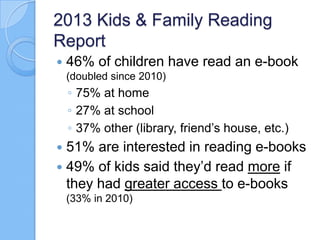
 46% of children have read an e-book
(doubled since 2010)
◦ 75% at home
◦ 27% at school
◦ 37% other (library, friend’s house, etc.)
 51% are interested in reading e-books
 49% of kids said they’d read more if
they had greater access to e-books
(33% in 2010)
2013 Kids & Family Reading
Report
 % of children who have read an e-book on each
device
2013 Kids & Family Reading
Report
 58% say they will always want to read
books printed on paper (66% in 2010)
Best Practices for Teaching with
Digital Readers
 Digital reading differs from print
reading
 Reading comprehension
◦ Reader factors
◦ Text factors
Reading Comprehension
 Reader factors address the aspects that
the readers bring to the reading
experience such as background
knowledge, engagement with text, and
strategies used while reading.
 Text factors represent the author’s
contributions to the reading experience
including the author’s ideas, organization
of ideas, and the words used to express
those ideas.
(Tompkins, 2010)
Common Core State
Standards
 CCSS recognize the need to prepare
students for their future success by
embedding rigorous standards and
calling for literacy-learning through
the use of technology.
Text Complexity
Important Attributes of
eBooks
Source: Scholastic, 2013
Customizing the Digital
“Page”
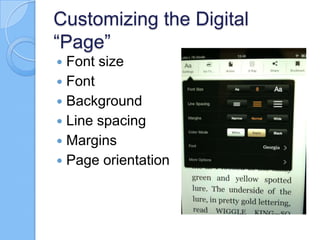
 Font size
 Font
 Background
 Line spacing
 Margins
 Page orientation
Notes/Annotations
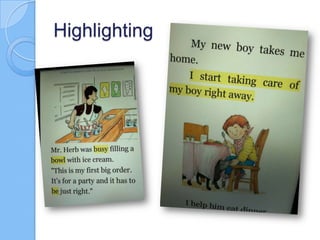
Highlighting
Digital Dictionary
Text-to-Speech & Narration
Interactive, Multimodal features
& Internet Access
CCSS Connections
Literature and Informational
Texts
 Key Ideas and Details (Quote from
text; Determine meaning; Compare &
contrast)
 Craft and Structure (Determine
meaning of language; Figurative
language; Point of view)
 Integration of Knowledge and Ideas
(Integrate information from multiple
sources)
CCSS Connections
Foundational Skills
 Phonics and Word Recognition
(Letter-sound correspondences; word
analysis, decoding)
 Fluency (Read orally; rereading)
Speaking & Listening
 Comprehension and collaboration
(Collaborative discussions; Come
prepared; Ask questions)
CCSS Connections
Language Standards
 Conventions of Standard English
(Parts of speech; Conventions;
Spelling patterns; Reference
materials)
 Knowledge of Language (Use of
language when writing, speaking,
reading, or listening)
 Vocabulary Acquisition and Use
(Consult reference materials, both in
print and digital)
Fewer people are reading, but
they are reading in more
formats than ever.
Digital Book Reading Devices:
E-reader, tablet, laptop, desktop, cell phone
21% of adults have read
an e-book.
Owners of e-readers read eight more
books a year than those without (25 - 17).
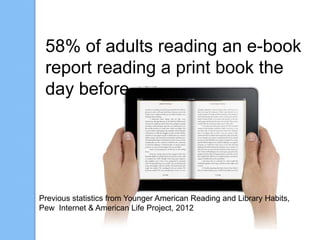
58% of adults reading an e-book
report reading a print book the
day before.
Previous statistics from Younger American Reading and Library Habits,
Pew Internet & American Life Project, 2012
Young Adults and Digital
Books
 One third have not read an ebook
 63% have not read a digital textbook
 I read Frindle on my iPhone. I liked it
because I always have my phone with
me, therefore, I always had the book
with me! I also enjoyed how you could
change the colors, font size, or the
way you read (scroll or book style). I
read a lot more as an ebook! I
usually am not very motivated to
read, but this was different. I LOVE IT! I
have never read an e-book before, but
my iBooks library is quickly filling
up; I have read two ebooks in record
time! I think this has encouraged me to
read more.
 I finished the book faster because I
read while waiting in lines, hanging
out with friends, etc. I am not as
against it as I once was.
Convenience is nice, but it is a
double-edged sword. It makes us
frustrated when we can't get
something right away and
dissatisfied with simple joys.
Maybe I am reading too far into it.
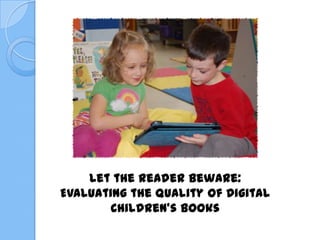
Let the Reader Beware:
Evaluating the Quality of Digital
Children's Books
 Traditional
digital book
 Original digital
book
 Book, game, or
movie inspired
digital book
A Word of Caution
 An enhanced
digital book
promotes
discussion
related to the
digital design
rather than the
content of the
book."Print vs. E-Books" Cooney Center at
Sesame Street Workshop, 2012
Issues of Quality
reading options, user friendliness,
appropriateness, polished
appearance
Digital Book
Evaluation Rubric
The meaning of the word "book" is being
transformed before our eyes.
Digital Fluency:
Children must learn to read books in many
different formats.
Caring adults must guide children in their
book selections.
Questions/Comments?
edobler@emporia.edu
lottalarson@ksu.edu

Ira Presentation Final April 20_2013

  • 1.
    e-Books and CommonCore State Standards: The Flexible Nature of Digital Reading International Reading Association 58th Annual Conventions Dr. Elizabeth Dobler, Emporia State University Dr. Lotta Larson, Kansas State university
  • 2.
    Technology is changing the waywe read, respond to, and interact with texts
  • 3.
    E-book Reading  E-bookreading has been around since early 1990s  Multiple formats: online, downloadable, linear, multimodal  Multiple devices and reading options
  • 4.
    2013 Kids &Family Reading Report  http://mediaroom.scholastic.com/files/ kfrr2013-wappendix.pdf
  • 5.
    2013 Kids &Family Reading Report  46% of children have read an e-book (doubled since 2010) ◦ 75% at home ◦ 27% at school ◦ 37% other (library, friend’s house, etc.)  51% are interested in reading e-books  49% of kids said they’d read more if they had greater access to e-books (33% in 2010)
  • 6.
    2013 Kids &Family Reading Report  % of children who have read an e-book on each device
  • 7.
    2013 Kids &Family Reading Report  58% say they will always want to read books printed on paper (66% in 2010)
  • 8.
    Best Practices forTeaching with Digital Readers  Digital reading differs from print reading  Reading comprehension ◦ Reader factors ◦ Text factors
  • 9.
    Reading Comprehension  Readerfactors address the aspects that the readers bring to the reading experience such as background knowledge, engagement with text, and strategies used while reading.  Text factors represent the author’s contributions to the reading experience including the author’s ideas, organization of ideas, and the words used to express those ideas. (Tompkins, 2010)
  • 10.
    Common Core State Standards CCSS recognize the need to prepare students for their future success by embedding rigorous standards and calling for literacy-learning through the use of technology.
  • 11.
  • 12.
  • 13.
    Customizing the Digital “Page” Font size  Font  Background  Line spacing  Margins  Page orientation
  • 14.
  • 15.
  • 16.
  • 17.
  • 18.
  • 19.
    CCSS Connections Literature andInformational Texts  Key Ideas and Details (Quote from text; Determine meaning; Compare & contrast)  Craft and Structure (Determine meaning of language; Figurative language; Point of view)  Integration of Knowledge and Ideas (Integrate information from multiple sources)
  • 20.
    CCSS Connections Foundational Skills Phonics and Word Recognition (Letter-sound correspondences; word analysis, decoding)  Fluency (Read orally; rereading) Speaking & Listening  Comprehension and collaboration (Collaborative discussions; Come prepared; Ask questions)
  • 21.
    CCSS Connections Language Standards Conventions of Standard English (Parts of speech; Conventions; Spelling patterns; Reference materials)  Knowledge of Language (Use of language when writing, speaking, reading, or listening)  Vocabulary Acquisition and Use (Consult reference materials, both in print and digital)
  • 22.
    Fewer people arereading, but they are reading in more formats than ever. Digital Book Reading Devices: E-reader, tablet, laptop, desktop, cell phone
  • 23.
    21% of adultshave read an e-book. Owners of e-readers read eight more books a year than those without (25 - 17).
  • 24.
    58% of adultsreading an e-book report reading a print book the day before. Previous statistics from Younger American Reading and Library Habits, Pew Internet & American Life Project, 2012
  • 25.
    Young Adults andDigital Books  One third have not read an ebook  63% have not read a digital textbook
  • 27.
     I readFrindle on my iPhone. I liked it because I always have my phone with me, therefore, I always had the book with me! I also enjoyed how you could change the colors, font size, or the way you read (scroll or book style). I read a lot more as an ebook! I usually am not very motivated to read, but this was different. I LOVE IT! I have never read an e-book before, but my iBooks library is quickly filling up; I have read two ebooks in record time! I think this has encouraged me to read more.
  • 28.
     I finishedthe book faster because I read while waiting in lines, hanging out with friends, etc. I am not as against it as I once was. Convenience is nice, but it is a double-edged sword. It makes us frustrated when we can't get something right away and dissatisfied with simple joys. Maybe I am reading too far into it.
  • 29.
    Let the ReaderBeware: Evaluating the Quality of Digital Children's Books
  • 30.
     Traditional digital book Original digital book  Book, game, or movie inspired digital book
  • 31.
    A Word ofCaution  An enhanced digital book promotes discussion related to the digital design rather than the content of the book."Print vs. E-Books" Cooney Center at Sesame Street Workshop, 2012
  • 32.
    Issues of Quality readingoptions, user friendliness, appropriateness, polished appearance Digital Book Evaluation Rubric
  • 34.
    The meaning ofthe word "book" is being transformed before our eyes. Digital Fluency: Children must learn to read books in many different formats. Caring adults must guide children in their book selections.
  • 35.

Editor's Notes

  • #2 Add a bio about research… talk about how the work I’ve done specific studies that contributed to this. From up front, explain amazon partnership. Define multimodal.
  • #18 Handouts? Clearly outline the specific studies thatKindles in this study were provided by Amazon.com.