www.legaltranscriptionservice.com (800) 670 2809
Why We Shouldn’t
Say Goodbye to
Handwriting
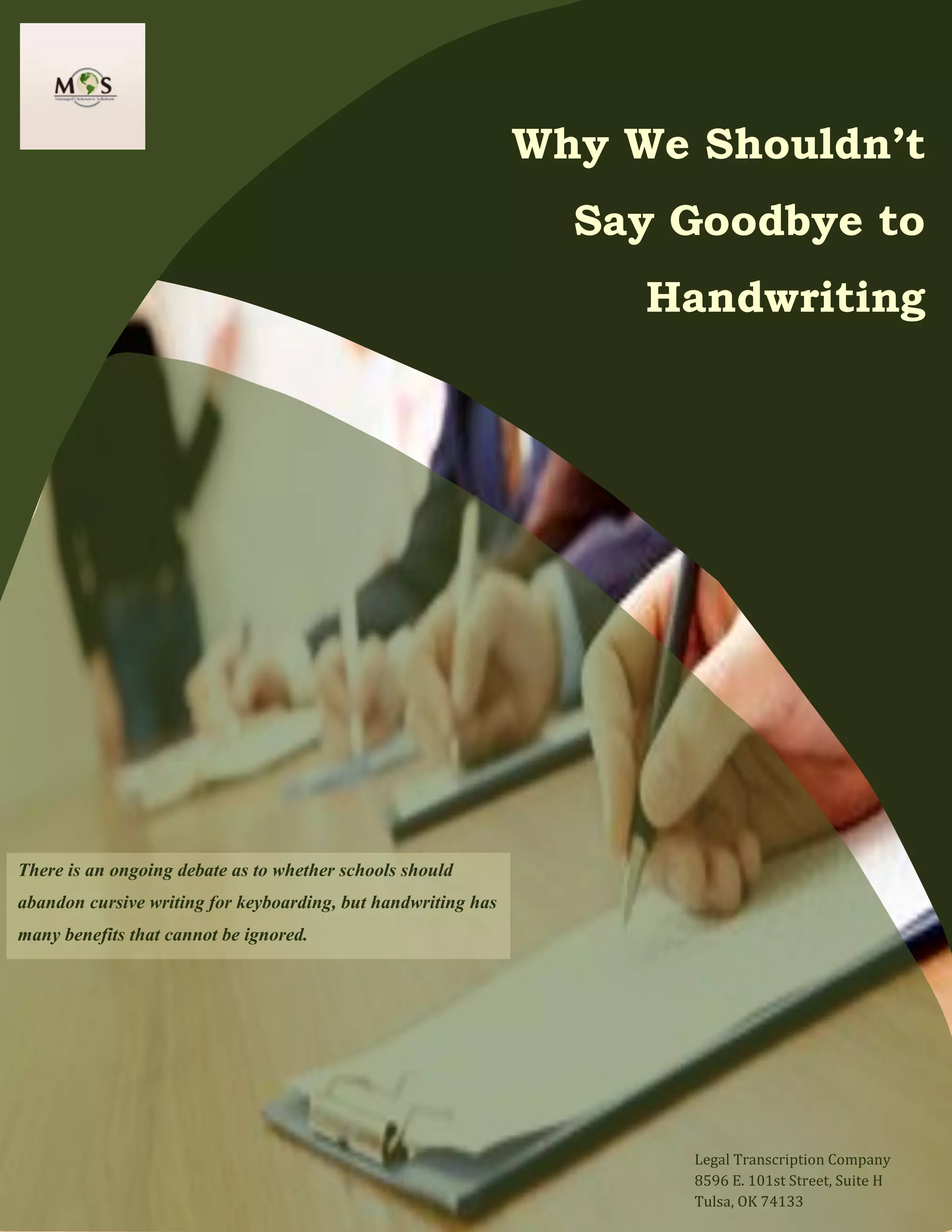
There is an ongoing debate as to whether schools should
abandon cursive writing for keyboarding, but handwriting has
many benefits that cannot be ignored.
Legal Transcription Company
8596 E. 101st Street, Suite H
Tulsa, OK 74133
www.legaltranscriptionservice.com (800) 670 2809
General transcription companies accurately convert digital recordings as well as handwriting
into digital text format. However, the requests for handwriting transcription seem to be
petering out. Is cursive writing on its way out? With the proliferation of computers, tablets
and smartphones, people seem to have forgotten how to put a pen to paper and write.
Children have been affected the most. According to a recent BBC report, schools in
countries such as Finland have replaced joined-up handwriting lessons with typing
courses. In the U.S., only a few states place value on formative cursive education, and the
requirement to learn cursive has been left out of core standards in the majority of states
since 2013. However, experts are coming out in support of handwriting as it can offer many
benefits.
According to a recent Illinois Times article, there are two schools of thought:
One school considers handwriting obsolete. The cellphone has an edge over pen and paper
as it can be used for various purposes -- to make an audio or video recording, take a
screenshot, send an email or text, post a comment or take notes. Technology has made
cursive writing obsolete.
The other school supports handwriting, saying it has a valuable connection to our past and
is a superior method for recording information. The proponents of handwriting emphasize
tradition and views learning to write longhand as a reflection of shared values, and even
virtues. Studies show that teachers are partial towards students with good handwriting and
consider them smarter.
Benefits of Handwriting
Several research studies show that even with technological development, there is a strong
association between handwriting and overall educational development. The benefits of
handwriting are:
• A University of Washington study showed that students could produce more words
faster with pen and paper than on keyboard and also express more ideas.
• Research from Aix-Marseille University compared typing and writing in children aged
three to five and reported that writing by hand helped the older ones recall the
letters better.
• Scientists say writing has a calming effect on the mind
www.legaltranscriptionservice.com (800) 670 2809
• Cursive writing can coordinate both the right and left side of the brain
• Handwriting can improve cognitive skills
• Studies have found that learning how to use a pencil and pen helps children learn to
read
• Writing by hand improves creativity, sharpens the mind, and improves memory and
visual recognition
• Handwriting can enhance fine motor skills in the hands and fingers
• Brain imaging studies show that cursive activates areas of the brain that do not get
involved when you type on a keyboard
The BBC reported on a 2014 study from UCLA studied laptop use among university
students, and suggested it could be "impairing learning because their use results in
shallower processing". Students were asked to take notes from a lecture, using either a
laptop or a pen and paper. When their recall on both facts and deeper conceptual questions
was tested, the researchers found that students taking long-form notes using pen and paper
were found to process the information on a deeper level. Typed notes, though faster,
tended to be closer to lecture transcription than personal notes.
Nevertheless, in today’s high-tech world, the role of cursive is declining. However, its value
cannot be ignored. As the BBC report puts it, “The invention of the phone, typewriter,
computer keyboard and email have all failed to extinguish penship from daily life, and
handwriting itself is a fluid and adaptable practice”. The author says that possible cursive
could continue to exist as the preserve of design enthusiasts, aesthetes and hobbyists.
The Illinois Times article suggests a compromise. The author recommends that schools have
a mandatory cursive writing course with a utilitarian approach. The aim should be to sign
one’s name to creating important documents, and offering students the option of using
longhand to record and process information and ideas. Students should learn keyboarding
as an essential skill and also how to take notes. Last but not least, he recommends that
students how learn to respect the written word.

Why We Shouldn’t Say Goodbye to Handwriting

  • 1.
    www.legaltranscriptionservice.com (800) 6702809 Why We Shouldn’t Say Goodbye to Handwriting There is an ongoing debate as to whether schools should abandon cursive writing for keyboarding, but handwriting has many benefits that cannot be ignored. Legal Transcription Company 8596 E. 101st Street, Suite H Tulsa, OK 74133
  • 2.
    www.legaltranscriptionservice.com (800) 6702809 General transcription companies accurately convert digital recordings as well as handwriting into digital text format. However, the requests for handwriting transcription seem to be petering out. Is cursive writing on its way out? With the proliferation of computers, tablets and smartphones, people seem to have forgotten how to put a pen to paper and write. Children have been affected the most. According to a recent BBC report, schools in countries such as Finland have replaced joined-up handwriting lessons with typing courses. In the U.S., only a few states place value on formative cursive education, and the requirement to learn cursive has been left out of core standards in the majority of states since 2013. However, experts are coming out in support of handwriting as it can offer many benefits. According to a recent Illinois Times article, there are two schools of thought: One school considers handwriting obsolete. The cellphone has an edge over pen and paper as it can be used for various purposes -- to make an audio or video recording, take a screenshot, send an email or text, post a comment or take notes. Technology has made cursive writing obsolete. The other school supports handwriting, saying it has a valuable connection to our past and is a superior method for recording information. The proponents of handwriting emphasize tradition and views learning to write longhand as a reflection of shared values, and even virtues. Studies show that teachers are partial towards students with good handwriting and consider them smarter. Benefits of Handwriting Several research studies show that even with technological development, there is a strong association between handwriting and overall educational development. The benefits of handwriting are: • A University of Washington study showed that students could produce more words faster with pen and paper than on keyboard and also express more ideas. • Research from Aix-Marseille University compared typing and writing in children aged three to five and reported that writing by hand helped the older ones recall the letters better. • Scientists say writing has a calming effect on the mind
  • 3.
    www.legaltranscriptionservice.com (800) 6702809 • Cursive writing can coordinate both the right and left side of the brain • Handwriting can improve cognitive skills • Studies have found that learning how to use a pencil and pen helps children learn to read • Writing by hand improves creativity, sharpens the mind, and improves memory and visual recognition • Handwriting can enhance fine motor skills in the hands and fingers • Brain imaging studies show that cursive activates areas of the brain that do not get involved when you type on a keyboard The BBC reported on a 2014 study from UCLA studied laptop use among university students, and suggested it could be "impairing learning because their use results in shallower processing". Students were asked to take notes from a lecture, using either a laptop or a pen and paper. When their recall on both facts and deeper conceptual questions was tested, the researchers found that students taking long-form notes using pen and paper were found to process the information on a deeper level. Typed notes, though faster, tended to be closer to lecture transcription than personal notes. Nevertheless, in today’s high-tech world, the role of cursive is declining. However, its value cannot be ignored. As the BBC report puts it, “The invention of the phone, typewriter, computer keyboard and email have all failed to extinguish penship from daily life, and handwriting itself is a fluid and adaptable practice”. The author says that possible cursive could continue to exist as the preserve of design enthusiasts, aesthetes and hobbyists. The Illinois Times article suggests a compromise. The author recommends that schools have a mandatory cursive writing course with a utilitarian approach. The aim should be to sign one’s name to creating important documents, and offering students the option of using longhand to record and process information and ideas. Students should learn keyboarding as an essential skill and also how to take notes. Last but not least, he recommends that students how learn to respect the written word.