Ebooks in the Academy:
Impacts on Learning and
       Pedagogy

     Beth M. Transue, MLS
  Messiah College Murray Library
    PALA Annual Conference
         October 2, 2012
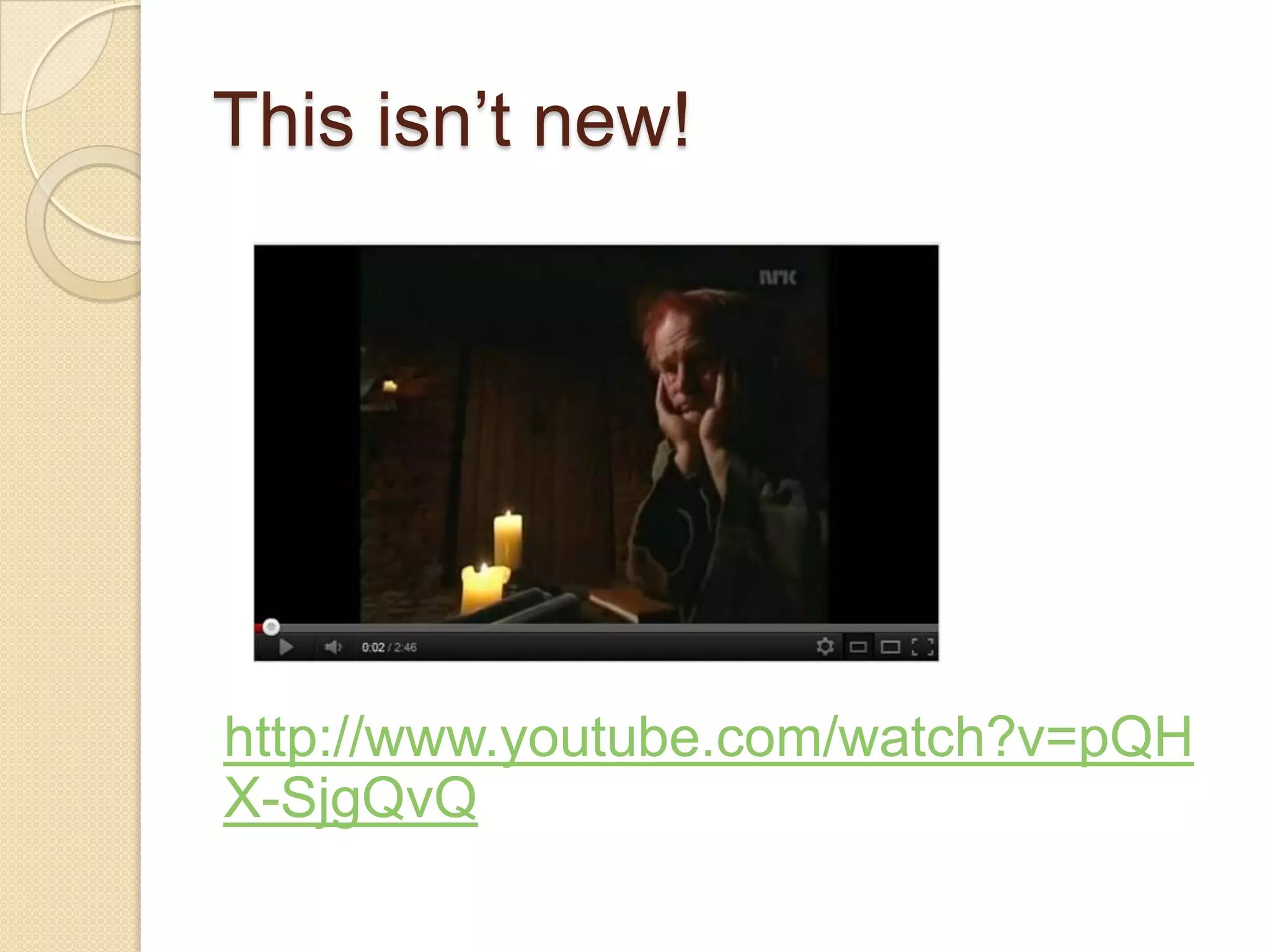
This isn’t new!


http://www.youtube.com/watch?v=pQH
X-SjgQvQ
History of ebooks
   1971 – Project Guttenberg – manually
    typed print book text to create ebooks
    (Declaration of Independence)
•   1993 – National Academy Press –
    publish some books in digital format.
    Free of charge. Sales increased.
•   1995 – Amazon launched. Started with
    excerpts and reviews
History
 2006 – Google Books. Full text of
  public domain or with permission.
  Excerpts or citation only from other
  books. Most books digitized through
  participating libraries.
 2007-current – ereaders, ipad.
Ebooks and Academic Study
What does the research say?
 There is currently a usability divide
  between ebooks for leisure/linear
  reading, and for academic/non-linear
  reading.

 Survey contradictions: After using
 ebooks, about 75% still prefer print for
 academic use (BISG, 2011). 58%
 prefer etexts for class
Pilot Studies
Cornell, Indiana U, U of MN, UVA, U of WI
Cooperative etextbook pilot (Internet2, 2012)

Liked: Portability, Storage, Costs, Multimedia
Features

Disliked:
readability, navigation, highlighting, annotating,
note sharing, lose access at end of term, not
aware of advanced features

Most students preferred paper text at end of
pilot
Pilot Studies
University of WA (Hickey, 2011)
Less than 40% of students still used
ereaders by the end of term

Cognitive mapping: students
complained that they couldn’t use
physical cues of book (location) to help
memory, recall, and learning new
material
Comparing Print to Ebook
Abilene Christian University
(Gertner, 2011)
Compared comprehension and learning
transfer (application) in college students
reading print or etext on ipad

Comparable results for comprehension.
Significantly better results for learning
transfer with etext.
Comparing print to ebook
University of Western Ontario
Students instructed to find identical
piece of information in identical
academic print and ebook

In print, students used predictable linear
and logical process to find information.
 • TOC, index, keywords, alternate
   words, scanning page
Comparing Print to Ebook
In ebook, students were non-linear and
there was no predictable or logical
process to find information.
 ◦ Unaware of TOC or index. Poor searches.
 ◦ When scanning, missed seeing relevant
   information more often than in print
 ◦ No sense of place. Mentioned they felt
   “lost” in the book.
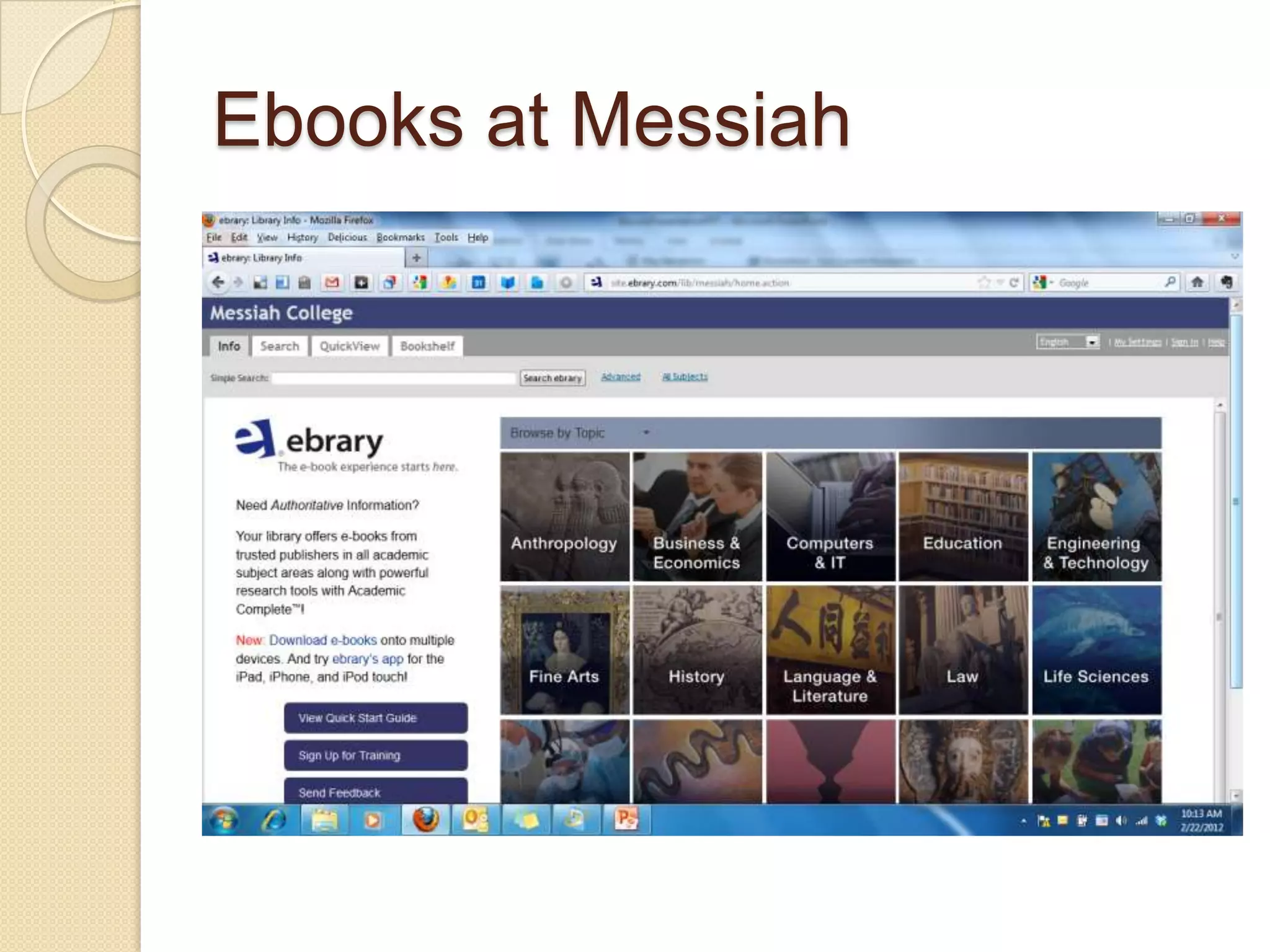
Ebooks at Messiah
Library and Faculty Concerns at
Messiah College

 No course reserves unless unlimited
  concurrent users.
 Will students/faculty request ILL of
  print book when we have ebook?
 Revocable collection, cost.
 Ordering becomes more complex.
Messiah College Student
Perspective
Swinging Bridge (student newspaper)
article, October 2010

“For novels, reference works, and all
kinds of classic literature, e-readers are
great…..
….When I read non-fiction such as
philosophy or theology, however, I need
to look ahead. I need to be able to
quickly flip pages so that I can see the
layout of the argument. Then, when I
begin to read from the beginning, my
mind fills in the gaps. My
comprehension is improved and I'm less
likely to get lost among the trees while
walking through the forest.”
(Brown, 2010)
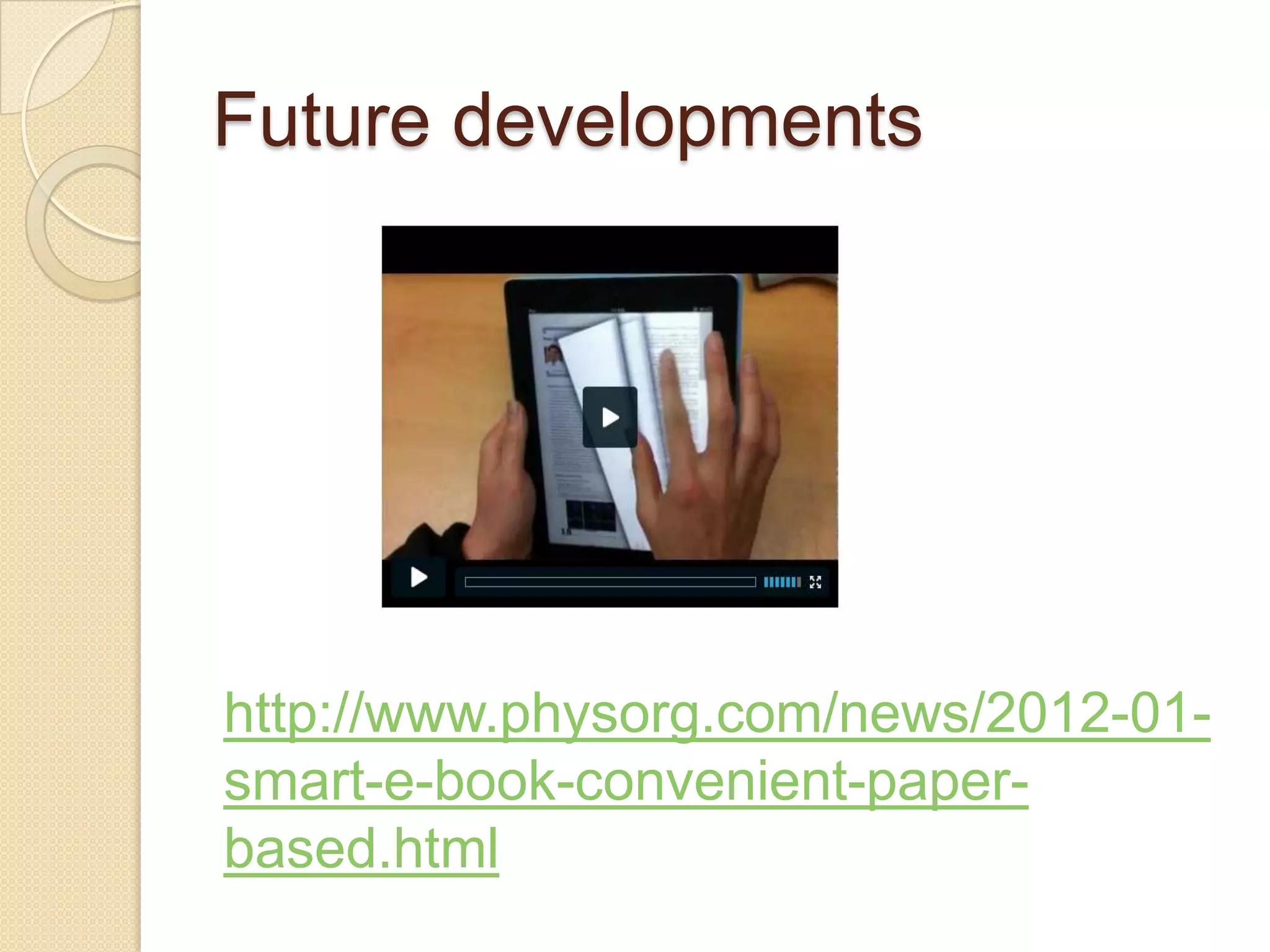
Future developments


http://www.physorg.com/news/2012-01-
smart-e-book-convenient-paper-
based.html
Conclusion

Enormous potential!
 Portability, storage, ADA, multimedia
  links, supplements, social learning and
  connections

But there are also serious obstacles.
Conclusion
   How do we structure and teach about
    our ebook collection to minimize
    pedagogical and utilization challenges.

   Instruction should include:
    Basics, Creating a cognitive map of the
    ebook, Access
    points, Searching, Annotating, Bookmar
    king, Social Features

   Choice of format when ordering should
    consider benefits AND challenges.
Sources
Berg, S., Hoffmann, K., & Dawson, D. (2010). Not on the same
page: Undergraduates' information retrieval in electronic and
print books. Journal Of Academic Librarianship, 36(6), 518-525.

BISG. (2011). College students want their books the old-
fashioned way: in print. Retrieved from:
http://www.bisg.org/news-5-603-press-releasecollege-students-
want-their-textbooks-the-old-fashioned-way-in-print.php

Brown, T. (October 27, 2010). My new Kindle. Swinging Bridge.
Retrieved from: http://www.messiahsb.com/my-new-kindle-
1.2431877#.TzQ3RIGGs7A

Demski, J. (2010). The device versus the book. Campus
Technology. Retrieved from:
http://campustechnology.com/articles/2010/05/01/the-device-
versus-the-book.aspx
Sources
Gertner, RT. (2011). The effects of multimedia technology on learning.
(Unpublished master’s thesis). Abilene Christian University. Retrieved from:
http://www.acu.edu/technology/mobilelearning/documents/research/effects-of-
technology-on-learning.pdf

Hickey, H. (2011). College students’ use of KindleDX points to ereader’s role in
academia. University of Washington. Retrieved from:
http://www.washington.edu/news/articles/college-students2019-use-of-kindle-dx-
points-to-e-reader2019s-role-in-academia

Internet2. (2012). Etextbook spring 2012 pilot. Retrieved from:
http://www.internet2.edu/netplus/etext/docs/eText-Spring-2012-Pilot-Report.pdf

Lebert, M. (2009). A short history of e-books. Retrieved from http://www.etudes-
francaises.net/dossiers/ebookEN.pdf

Pearson Foundation. (2012). Survey on students and tablets. Retrieved from
http://www.pearsonfoundation.org/downloads/PF_Tablet_Survey_Summary_201
2.pdf
Contact Me
Beth Transue, MLS
Collection Development Librarian
Messiah College Murray Library
btransue@messiah.edu
Facebook Beth Transue
Twitter: @bmtransue
LinkedIn: Beth Transue

Ebooks in the Academy: Impacts on Learning and Pedagogy

  • 1.
    Ebooks in theAcademy: Impacts on Learning and Pedagogy Beth M. Transue, MLS Messiah College Murray Library PALA Annual Conference October 2, 2012
  • 2.
  • 3.
    History of ebooks  1971 – Project Guttenberg – manually typed print book text to create ebooks (Declaration of Independence) • 1993 – National Academy Press – publish some books in digital format. Free of charge. Sales increased. • 1995 – Amazon launched. Started with excerpts and reviews
  • 4.
    History  2006 –Google Books. Full text of public domain or with permission. Excerpts or citation only from other books. Most books digitized through participating libraries.  2007-current – ereaders, ipad.
  • 5.
    Ebooks and AcademicStudy What does the research say?  There is currently a usability divide between ebooks for leisure/linear reading, and for academic/non-linear reading.  Survey contradictions: After using ebooks, about 75% still prefer print for academic use (BISG, 2011). 58% prefer etexts for class
  • 6.
    Pilot Studies Cornell, IndianaU, U of MN, UVA, U of WI Cooperative etextbook pilot (Internet2, 2012) Liked: Portability, Storage, Costs, Multimedia Features Disliked: readability, navigation, highlighting, annotating, note sharing, lose access at end of term, not aware of advanced features Most students preferred paper text at end of pilot
  • 7.
    Pilot Studies University ofWA (Hickey, 2011) Less than 40% of students still used ereaders by the end of term Cognitive mapping: students complained that they couldn’t use physical cues of book (location) to help memory, recall, and learning new material
  • 8.
    Comparing Print toEbook Abilene Christian University (Gertner, 2011) Compared comprehension and learning transfer (application) in college students reading print or etext on ipad Comparable results for comprehension. Significantly better results for learning transfer with etext.
  • 9.
    Comparing print toebook University of Western Ontario Students instructed to find identical piece of information in identical academic print and ebook In print, students used predictable linear and logical process to find information. • TOC, index, keywords, alternate words, scanning page
  • 10.
    Comparing Print toEbook In ebook, students were non-linear and there was no predictable or logical process to find information. ◦ Unaware of TOC or index. Poor searches. ◦ When scanning, missed seeing relevant information more often than in print ◦ No sense of place. Mentioned they felt “lost” in the book.
  • 11.
  • 12.
    Library and FacultyConcerns at Messiah College  No course reserves unless unlimited concurrent users.  Will students/faculty request ILL of print book when we have ebook?  Revocable collection, cost.  Ordering becomes more complex.
  • 13.
    Messiah College Student Perspective SwingingBridge (student newspaper) article, October 2010 “For novels, reference works, and all kinds of classic literature, e-readers are great…..
  • 14.
    ….When I readnon-fiction such as philosophy or theology, however, I need to look ahead. I need to be able to quickly flip pages so that I can see the layout of the argument. Then, when I begin to read from the beginning, my mind fills in the gaps. My comprehension is improved and I'm less likely to get lost among the trees while walking through the forest.” (Brown, 2010)
  • 15.
  • 16.
    Conclusion Enormous potential!  Portability,storage, ADA, multimedia links, supplements, social learning and connections But there are also serious obstacles.
  • 17.
    Conclusion  How do we structure and teach about our ebook collection to minimize pedagogical and utilization challenges.  Instruction should include: Basics, Creating a cognitive map of the ebook, Access points, Searching, Annotating, Bookmar king, Social Features  Choice of format when ordering should consider benefits AND challenges.
  • 18.
    Sources Berg, S., Hoffmann,K., & Dawson, D. (2010). Not on the same page: Undergraduates' information retrieval in electronic and print books. Journal Of Academic Librarianship, 36(6), 518-525. BISG. (2011). College students want their books the old- fashioned way: in print. Retrieved from: http://www.bisg.org/news-5-603-press-releasecollege-students- want-their-textbooks-the-old-fashioned-way-in-print.php Brown, T. (October 27, 2010). My new Kindle. Swinging Bridge. Retrieved from: http://www.messiahsb.com/my-new-kindle- 1.2431877#.TzQ3RIGGs7A Demski, J. (2010). The device versus the book. Campus Technology. Retrieved from: http://campustechnology.com/articles/2010/05/01/the-device- versus-the-book.aspx
  • 19.
    Sources Gertner, RT. (2011).The effects of multimedia technology on learning. (Unpublished master’s thesis). Abilene Christian University. Retrieved from: http://www.acu.edu/technology/mobilelearning/documents/research/effects-of- technology-on-learning.pdf Hickey, H. (2011). College students’ use of KindleDX points to ereader’s role in academia. University of Washington. Retrieved from: http://www.washington.edu/news/articles/college-students2019-use-of-kindle-dx- points-to-e-reader2019s-role-in-academia Internet2. (2012). Etextbook spring 2012 pilot. Retrieved from: http://www.internet2.edu/netplus/etext/docs/eText-Spring-2012-Pilot-Report.pdf Lebert, M. (2009). A short history of e-books. Retrieved from http://www.etudes- francaises.net/dossiers/ebookEN.pdf Pearson Foundation. (2012). Survey on students and tablets. Retrieved from http://www.pearsonfoundation.org/downloads/PF_Tablet_Survey_Summary_201 2.pdf
  • 20.
    Contact Me Beth Transue,MLS Collection Development Librarian Messiah College Murray Library btransue@messiah.edu Facebook Beth Transue Twitter: @bmtransue LinkedIn: Beth Transue