Gender Budgeting - Energy Dr. Jyoti Parikh Executive Director Integrated Research and Action for Development (IRADe)
Introduction  “ Fifty eight years after independence, Indian women still toil daily to collect fuel wood, crop residues and animal dung . Its time to make an  impact on the lives of women who live in the 19th century, if not in the 16th century.   ”   “ Although this is another first in budget making in India, it is only a beginning……. all departments will be required to present gender budgets as well as make benefit incidence analysis. ” - Finance Minister P. Chidambaram in Budget 2005 speech
Why clean fuels for women? Modern/ Not Modern is Relative Modern or Clean:   LPG, Electricity, Biogas, Kerosene Lighting:   Dirty Fuels   Inferior/ Not modern Cooking:   Cleaner Fuels (Pressure Stove)   Less Clean (Wick Stove) Kerosene is superior compared to bio-fuels Could be bought in flexible quantity with low fixed costs with more distribution network than LPG
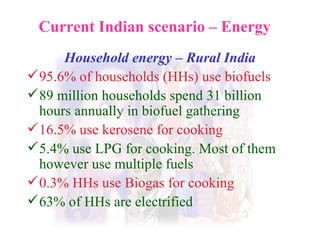
Current Indian scenario – Energy Household energy – Rural India 95.6% of households (HHs) use biofuels 89 million households spend 31 billion hours annually in biofuel gathering 16.5% use kerosene for cooking 5.4% use LPG for cooking. Most of them  however use multiple fuels 0.3% HHs use Biogas for cooking 63% of HHs are electrified
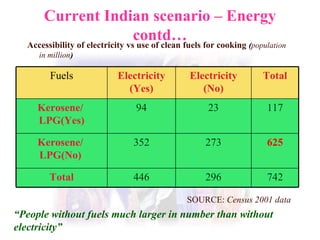
Current Indian scenario – Energy contd… Accessibility of electricity vs use of clean fuels for cooking   ( population in million ) SOURCE:  Census 2001 data “ People without fuels much larger in number than without electricity” 742 296 446 Total 625 273 352 Kerosene/  LPG(No)  117 23 94 Kerosene/  LPG(Yes) Total Electricity (No) Electricity (Yes) Fuels
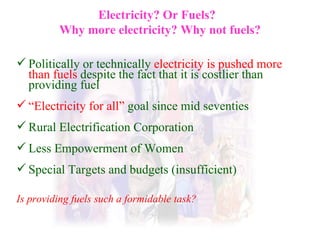
Electricity? Or Fuels?  Why more electricity? Why not fuels? Politically or technically  electricity is pushed more than fuels  despite the fact that it is costlier than providing fuel “ Electricity for all”  goal since mid seventies Rural Electrification Corporation Less Empowerment of Women Special Targets and budgets (insufficient)  Is providing fuels such a formidable task?
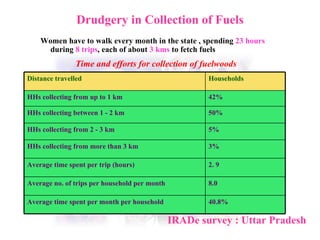
Drudgery in Collection of Fuels Women have to  walk every month in the state , spending  23 hours  during  8 trips , each of about  3 kms  to fetch fuels  Time and efforts for collection of fuelwoods IRADe survey : Uttar Pradesh  2. 9 Average time spent per trip (hours)  40.8% Average time spent per month per household  8.0 Average no. of trips per household per month 3% HHs collecting from more than 3 km  5% HHs collecting from 2 - 3 km  50% HHs collecting between 1 - 2 km  42% HHs collecting from up to 1 km  Households Distance travelled
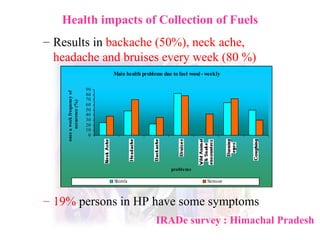
Health impacts of Collection of Fuels Results in   backache (50%),   neck ache, headache and bruises every week (80 %)  19%  persons in HP have some symptoms  IRADe survey : Himachal Pradesh
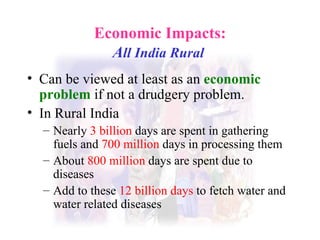
Economic Impacts: A ll India Rural   Can be viewed at least as an  economic problem  if not a drudgery problem. In Rural India Nearly  3 billion  days are spent in gathering fuels and  700 million  days in processing them  About  800 million  days are spent due to diseases  Add to these  12 billion days  to fetch water and water related diseases
Impact on MDG (Current Indian scenario) Infant and under 5 mortality rate in India are amongst the  highest  in the world. India’s child mortality rate at   87   is higher than even its poor neighbours Bangladesh (69), Bhutan (85) and Nepal(82). Source: Securing health – citizens report on MDGs The most recent estimates put  Maternal Mortality Rate (MMR)  in India as  408 . National Family Health Survey (NFHS) 2
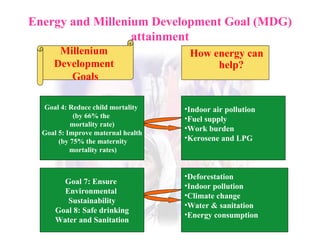
Energy and Millenium Development Goal (MDG) attainment How energy can help? Millenium  Development  Goals Goal 4: Reduce child mortality  (by 66% the  mortality rate) Goal 5: Improve maternal health (by 75% the maternity mortality rates) Indoor air pollution Fuel supply Work burden Kerosene and LPG Goal 7: Ensure  Environmental  Sustainability Goal 8: Safe drinking Water and Sanitation Deforestation Indoor pollution Climate change Water & sanitation Energy consumption
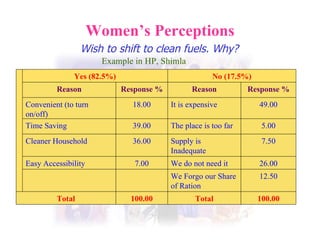
Women’s Perceptions Wish to shift to clean fuels. Why? Example in HP, Shimla 100.00 Total 100.00 Total 12.50 We Forgo our Share of Ration 26.00 We do not need it  7.00 Easy Accessibility 7.50 Supply is Inadequate 36.00 Cleaner Household 5.00 The place is too far 39.00 Time Saving 49.00 It is expensive 18.00 Convenient (to turn on/off) Response % Reason Response % Reason No (17.5%) Yes (82.5%)
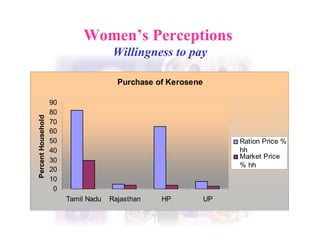
Women’s Perceptions  Willingness to pay
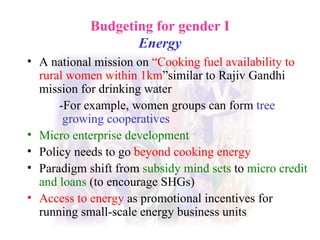
Budgeting for gender I Energy A national mission on  “Cooking fuel availability to rural women within 1km ”similar to Rajiv Gandhi mission for drinking water -For example, women groups can form  tree   growing cooperatives Micro enterprise development Policy needs to go   beyond cooking energy Paradigm shift f rom   subsidy mind sets   to  micro credit and loans  (to encourage SHGs) Access to energy   as promotional incentives for running small-scale energy business units
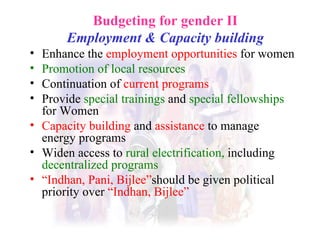
Budgeting for gender II Employment & Capacity building E nhance the  employment opportunities  for women Promotion of local resources  Continuation of  current programs Provide  special trainings  and  special fellowships  for Women   Capacity building   and   assistance   to manage energy programs  Widen access to  rural electrification,  including  decentralized programs   “ Indhan, Pani, Bijlee” should be given political priority over  “Indhan, Bijlee”
Budgeting for gender III Health Sensitize health centers Spot respiratory diseases from indoor air pollution Reduce daily drudgery: only then can women spend time generating income Gender should be fully taken into account
Budgeting for gender IV Education Launching mass education programmes especially for the girl child to achieve the MDG Use of media and electronic communication to educate the public and raise awareness Dissemination activities/information sharing national, international experiences
“ One-third of India’s total energy, is ‘managed’ mostly by women with too little inputs of investment, management or technology (IMT) and no political or administrative backing. These women energy suppliers or “managers” need to be helped without taking this role away from them and instead provide them IMT and improve their lives.” Jyoti Parikh, Business Standard
Thank you

Ira de gender energy budgeting

  • 1.
    Gender Budgeting -Energy Dr. Jyoti Parikh Executive Director Integrated Research and Action for Development (IRADe)
  • 2.
    Introduction “Fifty eight years after independence, Indian women still toil daily to collect fuel wood, crop residues and animal dung . Its time to make an impact on the lives of women who live in the 19th century, if not in the 16th century. ” “ Although this is another first in budget making in India, it is only a beginning……. all departments will be required to present gender budgets as well as make benefit incidence analysis. ” - Finance Minister P. Chidambaram in Budget 2005 speech
  • 3.
    Why clean fuelsfor women? Modern/ Not Modern is Relative Modern or Clean: LPG, Electricity, Biogas, Kerosene Lighting: Dirty Fuels Inferior/ Not modern Cooking: Cleaner Fuels (Pressure Stove) Less Clean (Wick Stove) Kerosene is superior compared to bio-fuels Could be bought in flexible quantity with low fixed costs with more distribution network than LPG
  • 4.
    Current Indian scenario– Energy Household energy – Rural India 95.6% of households (HHs) use biofuels 89 million households spend 31 billion hours annually in biofuel gathering 16.5% use kerosene for cooking 5.4% use LPG for cooking. Most of them however use multiple fuels 0.3% HHs use Biogas for cooking 63% of HHs are electrified
  • 5.
    Current Indian scenario– Energy contd… Accessibility of electricity vs use of clean fuels for cooking ( population in million ) SOURCE: Census 2001 data “ People without fuels much larger in number than without electricity” 742 296 446 Total 625 273 352 Kerosene/ LPG(No) 117 23 94 Kerosene/ LPG(Yes) Total Electricity (No) Electricity (Yes) Fuels
  • 6.
    Electricity? Or Fuels? Why more electricity? Why not fuels? Politically or technically electricity is pushed more than fuels despite the fact that it is costlier than providing fuel “ Electricity for all” goal since mid seventies Rural Electrification Corporation Less Empowerment of Women Special Targets and budgets (insufficient) Is providing fuels such a formidable task?
  • 7.
    Drudgery in Collectionof Fuels Women have to walk every month in the state , spending 23 hours during 8 trips , each of about 3 kms to fetch fuels Time and efforts for collection of fuelwoods IRADe survey : Uttar Pradesh 2. 9 Average time spent per trip (hours) 40.8% Average time spent per month per household 8.0 Average no. of trips per household per month 3% HHs collecting from more than 3 km 5% HHs collecting from 2 - 3 km 50% HHs collecting between 1 - 2 km 42% HHs collecting from up to 1 km Households Distance travelled
  • 8.
    Health impacts ofCollection of Fuels Results in backache (50%), neck ache, headache and bruises every week (80 %) 19% persons in HP have some symptoms IRADe survey : Himachal Pradesh
  • 9.
    Economic Impacts: All India Rural Can be viewed at least as an economic problem if not a drudgery problem. In Rural India Nearly 3 billion days are spent in gathering fuels and 700 million days in processing them About 800 million days are spent due to diseases Add to these 12 billion days to fetch water and water related diseases
  • 10.
    Impact on MDG(Current Indian scenario) Infant and under 5 mortality rate in India are amongst the highest in the world. India’s child mortality rate at 87 is higher than even its poor neighbours Bangladesh (69), Bhutan (85) and Nepal(82). Source: Securing health – citizens report on MDGs The most recent estimates put Maternal Mortality Rate (MMR) in India as 408 . National Family Health Survey (NFHS) 2
  • 11.
    Energy and MilleniumDevelopment Goal (MDG) attainment How energy can help? Millenium Development Goals Goal 4: Reduce child mortality (by 66% the mortality rate) Goal 5: Improve maternal health (by 75% the maternity mortality rates) Indoor air pollution Fuel supply Work burden Kerosene and LPG Goal 7: Ensure Environmental Sustainability Goal 8: Safe drinking Water and Sanitation Deforestation Indoor pollution Climate change Water & sanitation Energy consumption
  • 12.
    Women’s Perceptions Wishto shift to clean fuels. Why? Example in HP, Shimla 100.00 Total 100.00 Total 12.50 We Forgo our Share of Ration 26.00 We do not need it 7.00 Easy Accessibility 7.50 Supply is Inadequate 36.00 Cleaner Household 5.00 The place is too far 39.00 Time Saving 49.00 It is expensive 18.00 Convenient (to turn on/off) Response % Reason Response % Reason No (17.5%) Yes (82.5%)
  • 13.
    Women’s Perceptions Willingness to pay
  • 14.
    Budgeting for genderI Energy A national mission on “Cooking fuel availability to rural women within 1km ”similar to Rajiv Gandhi mission for drinking water -For example, women groups can form tree growing cooperatives Micro enterprise development Policy needs to go beyond cooking energy Paradigm shift f rom subsidy mind sets to micro credit and loans (to encourage SHGs) Access to energy as promotional incentives for running small-scale energy business units
  • 15.
    Budgeting for genderII Employment & Capacity building E nhance the employment opportunities for women Promotion of local resources Continuation of current programs Provide special trainings and special fellowships for Women Capacity building and assistance to manage energy programs Widen access to rural electrification, including decentralized programs “ Indhan, Pani, Bijlee” should be given political priority over “Indhan, Bijlee”
  • 16.
    Budgeting for genderIII Health Sensitize health centers Spot respiratory diseases from indoor air pollution Reduce daily drudgery: only then can women spend time generating income Gender should be fully taken into account
  • 17.
    Budgeting for genderIV Education Launching mass education programmes especially for the girl child to achieve the MDG Use of media and electronic communication to educate the public and raise awareness Dissemination activities/information sharing national, international experiences
  • 18.
    “ One-third ofIndia’s total energy, is ‘managed’ mostly by women with too little inputs of investment, management or technology (IMT) and no political or administrative backing. These women energy suppliers or “managers” need to be helped without taking this role away from them and instead provide them IMT and improve their lives.” Jyoti Parikh, Business Standard
  • 19.