Shankargouda.M. Patil, Sarojini B. K / International Journal of Engineering Research and
                   Applications (IJERA) ISSN: 2248-9622 www.ijera.com
                    Vol. 3, Issue 1, January -February 2013, pp.1621-1626
An Efficient Iris Recognition System using Phase-based Matching
                            Technique
                         Shankargouda.M. Patil 1 , Sarojini B. K 2
 1
   Department of Electronics and Telecommunication, MBE society’s College of Engineering Ambajogai
                                           431517-INDIA
 2
   Department of Electronics and Communication Engineering Basaveshwar Engineering College, Bagalkot-
                                         587102, INDIA

Abstract                                                  systems. In 1992, John Daugman was the first to
         A major approach for iris recognition            develop the iris identification software. Other
today is to generate feature vectors                      important contribution was by R.Wildes et al. Their
corresponding to individual iris images and to            method differed in the process of iris code
perform iris matching based on some distance              generation and also in the pattern matching
metrics. One of the difficult problems in feature-        technique. The Daugman system has been tested for
based iris recognition is that the matching               a billion images and the failure rate has been found
performance is significantly influenced by many           to be very low. His systems are patented by the
parameters in feature extraction process, which           Iriscan Inc. and are also being commercially used in
may vary depending on environmental factors of            Iridian technologies, UK National Physical Lab,
image acquisition. This paper presents an                 British Telecom etc.
efficient algorithm for iris recognition using
phase-based image matching. The use of phase              1.3   Organization of paper
components in 2D (two-dimensional) discrete                        This paper consists of six main parts,
Fourier transforms of iris images makes possible          which are Introduction, image acquisition,
to achieve highly robust iris recognition in a            preprocessing, Matching,; Simulation ,Results and
unified fashion with a simple matching                    discussions , Each section describes the theoretical
algorithm. Experimental evaluation using an iris          approach and is followed by how it is implemented.
image database clearly demonstrates an efficient
matching performance of the proposed                      2. Image Acquisitions
algorithm.                                                          This step is one of the most important and
                                                          deciding factors for obtaining a good result. A good
Keywords— Phase-based matching, Phase only                and clear image eliminates the process of noise
correlation, Band limited phase-only correlation, Iris    removal and also helps in avoiding errors in
Recognition, image processing.                            calculation. In this case, computational errors are
                                                          avoided due to absence of reflections, and because
1. Introduction                                           the images have been taken from close proximity.
1.1 Overview                                              This project uses the image provided by CASIA
          Biometrics refers to the identification and     (Institute of Automation, Chinese Academy of
verification of human identity based on certain           Sciences, http://www.sinobiometrics.com/) these
physiological traits of a person. The commonly used       images were taken solely for the purpose of iris
biometric features include speech, fingerprint, face,     recognition software research and implementation.
handwriting, gait, hand geometry etc. The face and        Infra-red light was used for illuminating the eye, and
speech techniques have been used for over 25 years,       hence they do not involve any specular reflections.
while iris method is a newly emergent technique.          Some part of the computation which involves
          The iris is the colored part of the eye         removal of errors due to reflections in the image was
behind the eyelids, and in front of the lens. It is the   hence not implemented.
only internal organ of the body which is normally
externally visible. These visible patterns are unique
to all individuals and it has been found that the
probability of finding two individuals with identical
iris patterns is almost zero. Though there lies a
problem in capturing the image, the great pattern
variability and the stability over time, makes this a
reliable security recognition system.
1.2 Background

         Ophthalmologists Alphonse Bertillon and          Figure 1: Image of the eye
Frank Burch were one among the first to propose
that iris patterns can be used for identification


                                                                                               1621 | P a g e
Shankargouda.M. Patil, Sarojini B. K / International Journal of Engineering Research and
                 Applications (IJERA) ISSN: 2248-9622 www.ijera.com
                  Vol. 3, Issue 1, January -February 2013, pp.1621-1626

3. Preprocessing
3.1 Image localization
          Due to computational case, the image was
scaled down by 60%. The image was filtered using
Gaussian filter, which blurs the image and reduces
effects due to noise. The degree of smoothening is
decided by the standard deviation, σ and
          The part of the eye carrying information is
only the iris part. It lies between the scalera and the
pupil. Hence the next step is separating the iris part
from the eye image. The iris inner and outer
boundaries are located by finding the edge image
using the canny edge detector.                            Figure 2: Canny edge image
          The Canny detector mainly involves three
steps, viz. finding the gradient, non-maximum                Edge detection is followed by finding the
suppression and the hysteresis thresholding. As           boundaries of the iris and the pupil. Daugman
proposed by Wildes, the thresholding for the eye          proposed the use of the Integra-differential operator
image is performed in a vertical direction only, so       to detect the boundaries and the radii. It is given by
that the influence due to the eyelids can be reduced.
This reduces the pixels on the circle boundary, but
with the use of Hough transform, successful
                                                                                                                …
localization of the boundary can be obtained even
                                                          ……1
with the absence of few pixels. It is also
                                                          This behaves as a circular edge detector by
computationally faster since the boundary pixels are
                                                          searching the gradient image along the boundary of
lesser for calculation.
                                                          circles of increasing radii. From the likelihood of all
          Using the gradient image, the peaks are
                                                          circles, the maximum sum is calculated and is used
localized using non-maximum suppression. It works
                                                          to find the circle centers and radii.
in the following manner. For a pixel imgrad(x,y), in
                                                              The Hough transform is another way of detecting
the gradient image, and given the orientation
                                                          the parameters of geometric objects, and in this
theta(x,y), the edge intersects two of its 8 connected
                                                          case, has been used to find the circles in the edge
neighbors. The point at (x, y) is a maximum if its
                                                          image. For every edge pixel, the points on the
value is not smaller than the values at the two
                                                          circles surrounding it at different radii are taken, and
intersection points.
                                                          their weights are increased if they are edge points
          The next step, hysteresis thresholding,
                                                          too, and these weights are added to the accumulator
eliminates the weak edges below a low threshold,
                                                          array. Thus, after all radii and edge pixels have been
but not if they are connected to a edge above a high
                                                          searched, the maximum from the accumulator array
threshold through a chain of pixels all above the low
                                                          is used to find the center of the circle and its radius.
threshold. In other words, the pixels above a
threshold T1 are separated. Then, these points are        The Hough transform is performed for the iris outer
                                                          boundary using the whole image, and then is
marked as edge points only if all its surrounding
                                                          performed for the pupil only, instead of the whole
pixels are greater than another threshold T2. The
                                                          eye, because the pupil is always inside the iris.
threshold values were found by trial and error, and
were obtained as 0.2 and 0.19.
                                                          There are a few problems with symmetric points
Hough transforms. Firstly, the threshold values are
                                                          on the circle for every search point and radius. The
to be found by trial. Secondly, it is computationally
                                                          eyelashes were separated by thresholding, and those
intensive. This is improved by just having eight-way
                                                          pixels were marked as noisepixels,
it is taken to be 2 in this case.


                                                                                                1622 | P a g e
Shankargouda.M. Patil, Sarojini B. K / International Journal of Engineering Research and
                 Applications (IJERA) ISSN: 2248-9622 www.ijera.com
                  Vol. 3, Issue 1, January -February 2013, pp.1621-1626
                                                          which yield a NaN, are divided by the sum to get a
                                                          normalized value.


                                                          Figure 5: Unwrapping the iris


Figure 3: Image with boundaries

3.2 Image Normalization
    Once the iris region is segmented, the next stage
is to normalize this part, to enable generation of the
iris templates’ and their comparisons. Since
variations in the eye, like optical size of the iris,
position of pupil in the iris, and the iris orientation
change person to person, it is required to normalize
the iris image, so that the representation is common      Figure 6: Normalized iris image
to all, with similar dimensions.
                                                          4. Matching
     Normalization process involves unwrapping the
                                                                   This method is performed to describe the
iris and converting it into its polar equivalent. It is
                                                          detailed process of effective region extraction,
done using Daugman’s Rubber sheet model. The
                                                          image alignment, and matching score calculation.
center of the pupil is considered as the reference
                                                          The main idea is to use the phase-based image
point and a remapping formula is used to convert the
                                                          matching for image alignment and matching score
points on the Cartesian scale to the polar scale.
                                                          calculation.
The modified form of the model is shown bellow.
                                                          4.1 Effective region extraction:
                                                                    This step is performed to avoid certain
                                                          problems, which occurs when the extracted effective
                                                          region becomes too small to perform image
                                                          matching. Given a pair of normalized iris images f
                                                          (n1, n2) and g (n1, n2) to be compared, the purpose
                                                          of this process is to extract from the two images, the
                                                          effective regions f (n1, n2) and g (n1, n2) of same
                                                          size, which do not contain irrelevant regions. The
                                                          index range is assumed in any specified matrix
                                                          where amplitude and phase is detected and
                                                          evaluated. The inverse DFT is calculated. When two
                                                          images are not similar, the peak drops and the height
                                                          of the peak gives the good similarity measure for
                                                          image matching and the localization of the peak
                                                          shows the translation displacement of the image.
Figure 4: Normalization process
                                                          4.2 Phase-Based Image Matching:
                                                                   Before discussing the image alignment and
           The radial resolution was set to 100 and the
                                                          the matching score calculation, we introduce the
angular resolution to 2400 pixels. For every pixel in
                                                          principle of phase-based image matching using
the iris, an equivalent position is found out on polar
                                                          Phase-Only Correlation (POC) function [5].
axes. The normalized image was then interpolated
                                                          Consider two N1×N2-pixel images, f(n1, n2) and
into the size of the original image, by using the
                                                          g(n1, n2), where we assume that the index ranges
interp2 function. The parts in the normalized image
                                                          are n1 = −M1 · · ·M1


                                                                                               1623 | P a g e
Shankargouda.M. Patil, Sarojini B. K / International Journal of Engineering Research and
                 Applications (IJERA) ISSN: 2248-9622 www.ijera.com
                  Vol. 3, Issue 1, January -February 2013, pp.1621-1626
(M1 > 0) and n2 = −M2 · · ·M2 (M2 > 0) for              4.2 Displacement alignment:
mathematical simplicity, and hence N1 = 2M1 + 1                   This step is performed to align the
and N2 = 2M2 + 1. Let F(k1, k2) and G(k1, k2)           translational displacement between the extracted
denote the 2D DFTs of the two images. F(k1, k2) is      images. Various factors like rotation of camera;
given by.                                               head tilt etc might cause displacement of the
                                                        normalized images. The displacement parameter can
                                                        be obtained as the peak location of the Phase only
                                                        Correlation (POC) Function. The obtained
                                                        parameters are used to align the images.

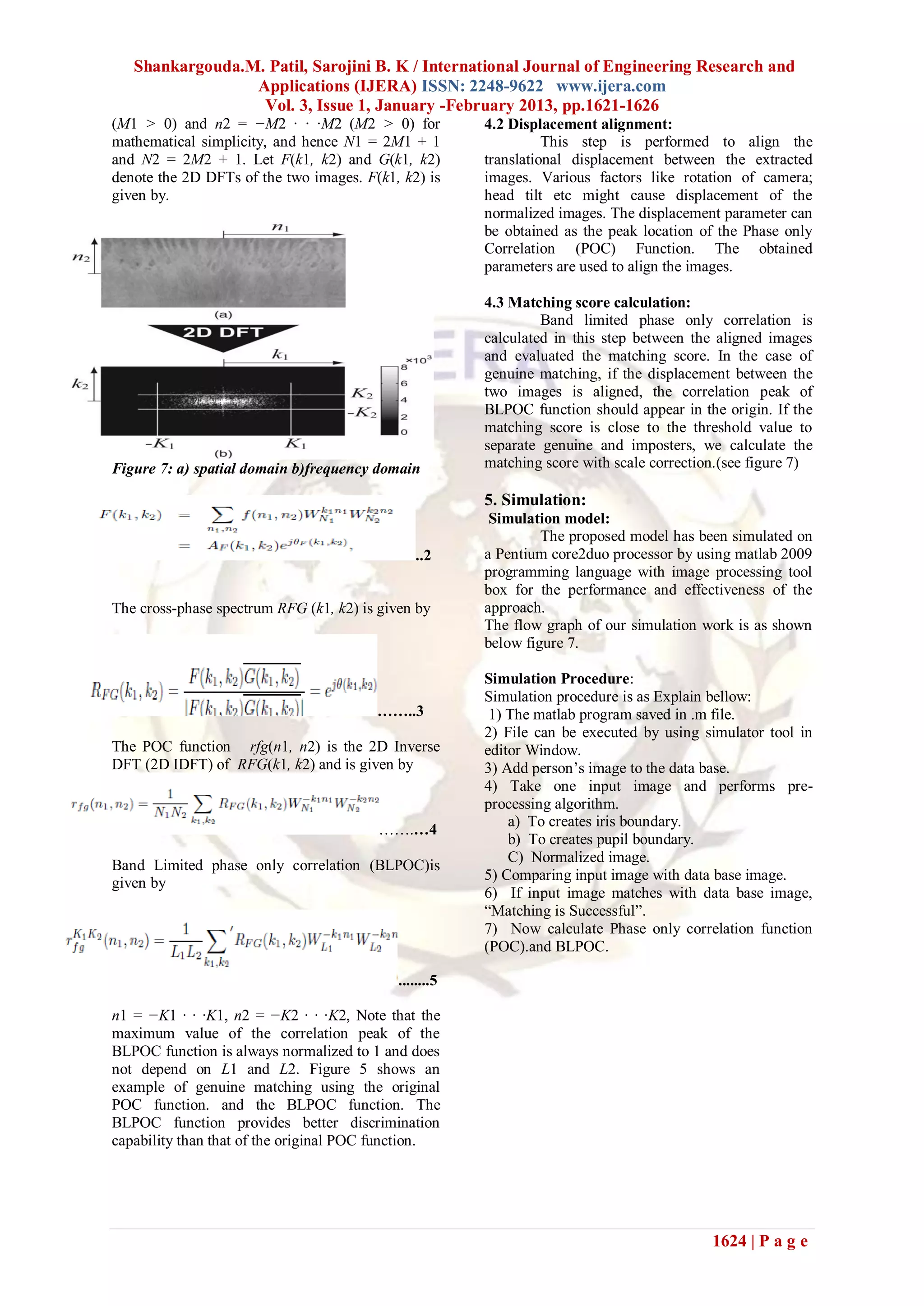
                                                        4.3 Matching score calculation:
                                                                 Band limited phase only correlation is
                                                        calculated in this step between the aligned images
                                                        and evaluated the matching score. In the case of
                                                        genuine matching, if the displacement between the
                                                        two images is aligned, the correlation peak of
                                                        BLPOC function should appear in the origin. If the
                                                        matching score is close to the threshold value to
                                                        separate genuine and imposters, we calculate the
Figure 7: a) spatial domain b)frequency domain          matching score with scale correction.(see figure 7)

                                                        5. Simulation:
                                                         Simulation model:
                                                                 The proposed model has been simulated on
                                               ..2      a Pentium core2duo processor by using matlab 2009
                                                        programming language with image processing tool
                                                        box for the performance and effectiveness of the
The cross-phase spectrum RFG (k1, k2) is given by       approach.
                                                        The flow graph of our simulation work is as shown
                                                        below figure 7.

                                                        Simulation Procedure:
                                                        Simulation procedure is as Explain bellow:
                                        ……..3            1) The matlab program saved in .m file.
                                                        2) File can be executed by using simulator tool in
The POC function rfg(n1, n2) is the 2D Inverse          editor Window.
DFT (2D IDFT) of RFG(k1, k2) and is given by            3) Add person’s image to the data base.
                                                        4) Take one input image and performs pre-
                                                        processing algorithm.
                                                            a) To creates iris boundary.
                                        …….…4
                                                            b) To creates pupil boundary.
                                                            C) Normalized image.
Band Limited phase only correlation (BLPOC)is
                                                        5) Comparing input image with data base image.
given by
                                                        6) If input image matches with data base image,
                                                        “Matching is Successful”.
                                                        7) Now calculate Phase only correlation function
                                                        (POC).and BLPOC.

                                            ........5

n1 = −K1 · · ·K1, n2 = −K2 · · ·K2, Note that the
maximum value of the correlation peak of the
BLPOC function is always normalized to 1 and does
not depend on L1 and L2. Figure 5 shows an
example of genuine matching using the original
POC function. and the BLPOC function. The
BLPOC function provides better discrimination
capability than that of the original POC function.


                                                                                           1624 | P a g e
Shankargouda.M. Patil, Sarojini B. K / International Journal of Engineering Research and
                               Applications (IJERA) ISSN: 2248-9622 www.ijera.com
                                Vol. 3, Issue 1, January -February 2013, pp.1621-1626


                          Phase Based Matching


                                    Matching Score
                                     Calculation
    Iris Image


                                                           N
                                     Is Maximum Score                                          (B)
                                    above the Threshold?
 Iris Localization
                                                                 Not
                                                   Y           Matching


Iris Normalization                      Matching
                                                                 Stop


                        Database


                     Figure 7: process of flow diagram

          Algorithm:
          Begin:
                Take input image.
                If input image f
                F1=cong [fft (f)]
                                                                                            (C)
          For all data base 20 people
             For all samples per person G1
               Matches F1 and G1
              POC store to peak
             BLPOC store to peak
             End
          End

          //TO find the maximum peak//
          If peak>Th               %Th= Threshold%
             Match
          Else
          Not Match                                                                          (D)
          End                                                             Figure 8: Genuine matching using (A) & (B) The
                                                                          original POC Function and (C) & (D) The Band
                                                                          Limited POC function.


                                         (A)


                                                                             Figure 9: Distributions of matching score


                                                                                                             1625 | P a g e
Shankargouda.M. Patil, Sarojini B. K / International Journal of Engineering Research and
                    Applications (IJERA) ISSN: 2248-9622 www.ijera.com
                     Vol. 3, Issue 1, January -February 2013, pp.1621-1626
6. Results and discussion:                           [3] B. Kumar, C. Xie, and J. Thornton, “Iris
          This section describes a set of experiments          verification using correlation filters,” Proc.
using CASIA iris image database [6] for evaluating             4th Int. Conf. Audio- and Video-based
the proposed algorithm. This database contains 756             Biometric Person Authentication, pp. 697–
eye images (108 eyes and 7 images of each eye). We             705, 2003.
evaluate the genuine matching scores and the             [4]   K. Miyazawa, K. Ito, T. Aoki, K.
impostor matching scores for all the possible                  Kobayashi, and H. Nakajima, “An efficient
combinations (genuine: 2,268 attempts, impostor:               iris recognition algorithm using phase-
283,122 attempts).                                             based image matching,” Proc. Int. Conf. on
The score between minimum genuine value and                    Image Processing, pp. II– 49–II–52, Sept.
maximum impostor values can be chosen as a                     2005.
threshold.                                               [5]   K. Miyazawa, K. Ito, T. Aoki, K.
Our observation shows that this performance                    Kobayashi, and H. Nakajima, “A phase-
degradation is mainly caused by the elimination of             based iris recognition algorithm,” Lecture
the eyelid masking and the effective region                    Notes in Computer Science (ICB2006), vol.
extraction steps. Note that CASIA iris image                   3832, pp. 356–365, Jan. 2006.
database contains many iris images whose irises are      [6]   CASIA iris image database ver 1.0.
heavily occluded by eyelids. Thus, the eyelid                  http://www.sinobiometris.com
masking and the effective region extraction steps        [7]   K. Ito, H. Nakajima, K. Kobayashi, T.
have a significant impact on the performance. In a             Aoki, and T. Higuchi, “A fingerprint
practical system, however, such a difficult condition          matching algorithm using phase-only
does not happen so often. On the other hand, the               correlation,” IEICE Trans. Fundamentals,
processing time could be greatly reduced by the                vol. E87-A, no. 3, pp. 682–691, Mar. 2004.
simplification which allows the system to perform        [8]   K. Ito, A. Morita, T. Aoki, T. Higuchi, H.
multiple matching within a short time. This leads to           Nakajima, and K. Kobayashi, “A
better GAR (Genuine Accept Rate) for users. The                fingerprint       recognition       algorithm
number of iris images in the database available at             combining phase-based image matching
[7] is smaller than the complete database. The result          and feature-based matching,” Lecture
demonstrates a potential possibility of phase-based            Notes in Computer Science (ICB2006), vol.
image matching for creating an efficient iris                  3832, pp. 316–325, Jan. 2006.
recognition system.                                      [9]   H. Nakajima, K. Kobayashi, M. Morikawa,
                                                               K. Atsushi, K. Ito, T. Aoki, and T. Higuchi,
7. Conclusion:                                                 “Fast and robust fingerprint identification
          The personal identification technique                algorithm and its application to residential
developed by John Daugman was implemented,                     access controller,” Lecture Notes in
with a few modifications involving due to                      Computer Science (ICB2006), vol. 3832,
processing speed. It has been tested only for the              pp. 326–333, Jan. 2006.
CASIA database image. Due to computational               [10] Products using phase-based image
efficiency, the search area in a couple of parts has           matching.
been reduced, and the elimination of errors due to             http://www.aoki.ecei.tohoku.ac.jp/poc/
reflections in the eye image has not been                [11] John Daugman, University of Cambridge,
implemented.                                                   How Iris Recognition Works. Proceedings
                                                               at International Conference on Image
8. Acknowledgment                                              Processing.
Portions of the research in this paper use CASIA iris     [12] Tisse, Martin, Torres, Robert, Personal
image database collected by Institute of Automation,           Identification using human iris recognition,
Chinese Academy of Sciences.                                   Peter Kovesi, Matlab functions for
                                                               Computer Vision and Image Processing
References:
  [1]    J. Daugman, “High confidence visual
         recognition of persons by a test of
         statistical independence,” IEEE Trans.
         Pattern Analy. Machine Intell., vol. 15, no.
         11, pp. 1148–1161, Nov. 1993.
  [2]    L. Ma, T. Tan, Y. Wang, and D. Zhang,
         “Efficient iris recognition by characterizing
         key local variations,” IEEE Trans. Image
         Processing, vol. 13, no. 6, pp. 739–750,
         June 2004.


                                                                                            1626 | P a g e

Iq3116211626

  • 1.
    Shankargouda.M. Patil, SarojiniB. K / International Journal of Engineering Research and Applications (IJERA) ISSN: 2248-9622 www.ijera.com Vol. 3, Issue 1, January -February 2013, pp.1621-1626 An Efficient Iris Recognition System using Phase-based Matching Technique Shankargouda.M. Patil 1 , Sarojini B. K 2 1 Department of Electronics and Telecommunication, MBE society’s College of Engineering Ambajogai 431517-INDIA 2 Department of Electronics and Communication Engineering Basaveshwar Engineering College, Bagalkot- 587102, INDIA Abstract systems. In 1992, John Daugman was the first to A major approach for iris recognition develop the iris identification software. Other today is to generate feature vectors important contribution was by R.Wildes et al. Their corresponding to individual iris images and to method differed in the process of iris code perform iris matching based on some distance generation and also in the pattern matching metrics. One of the difficult problems in feature- technique. The Daugman system has been tested for based iris recognition is that the matching a billion images and the failure rate has been found performance is significantly influenced by many to be very low. His systems are patented by the parameters in feature extraction process, which Iriscan Inc. and are also being commercially used in may vary depending on environmental factors of Iridian technologies, UK National Physical Lab, image acquisition. This paper presents an British Telecom etc. efficient algorithm for iris recognition using phase-based image matching. The use of phase 1.3 Organization of paper components in 2D (two-dimensional) discrete This paper consists of six main parts, Fourier transforms of iris images makes possible which are Introduction, image acquisition, to achieve highly robust iris recognition in a preprocessing, Matching,; Simulation ,Results and unified fashion with a simple matching discussions , Each section describes the theoretical algorithm. Experimental evaluation using an iris approach and is followed by how it is implemented. image database clearly demonstrates an efficient matching performance of the proposed 2. Image Acquisitions algorithm. This step is one of the most important and deciding factors for obtaining a good result. A good Keywords— Phase-based matching, Phase only and clear image eliminates the process of noise correlation, Band limited phase-only correlation, Iris removal and also helps in avoiding errors in Recognition, image processing. calculation. In this case, computational errors are avoided due to absence of reflections, and because 1. Introduction the images have been taken from close proximity. 1.1 Overview This project uses the image provided by CASIA Biometrics refers to the identification and (Institute of Automation, Chinese Academy of verification of human identity based on certain Sciences, http://www.sinobiometrics.com/) these physiological traits of a person. The commonly used images were taken solely for the purpose of iris biometric features include speech, fingerprint, face, recognition software research and implementation. handwriting, gait, hand geometry etc. The face and Infra-red light was used for illuminating the eye, and speech techniques have been used for over 25 years, hence they do not involve any specular reflections. while iris method is a newly emergent technique. Some part of the computation which involves The iris is the colored part of the eye removal of errors due to reflections in the image was behind the eyelids, and in front of the lens. It is the hence not implemented. only internal organ of the body which is normally externally visible. These visible patterns are unique to all individuals and it has been found that the probability of finding two individuals with identical iris patterns is almost zero. Though there lies a problem in capturing the image, the great pattern variability and the stability over time, makes this a reliable security recognition system. 1.2 Background Ophthalmologists Alphonse Bertillon and Figure 1: Image of the eye Frank Burch were one among the first to propose that iris patterns can be used for identification 1621 | P a g e
  • 2.
    Shankargouda.M. Patil, SarojiniB. K / International Journal of Engineering Research and Applications (IJERA) ISSN: 2248-9622 www.ijera.com Vol. 3, Issue 1, January -February 2013, pp.1621-1626 3. Preprocessing 3.1 Image localization Due to computational case, the image was scaled down by 60%. The image was filtered using Gaussian filter, which blurs the image and reduces effects due to noise. The degree of smoothening is decided by the standard deviation, σ and The part of the eye carrying information is only the iris part. It lies between the scalera and the pupil. Hence the next step is separating the iris part from the eye image. The iris inner and outer boundaries are located by finding the edge image using the canny edge detector. Figure 2: Canny edge image The Canny detector mainly involves three steps, viz. finding the gradient, non-maximum Edge detection is followed by finding the suppression and the hysteresis thresholding. As boundaries of the iris and the pupil. Daugman proposed by Wildes, the thresholding for the eye proposed the use of the Integra-differential operator image is performed in a vertical direction only, so to detect the boundaries and the radii. It is given by that the influence due to the eyelids can be reduced. This reduces the pixels on the circle boundary, but with the use of Hough transform, successful … localization of the boundary can be obtained even ……1 with the absence of few pixels. It is also This behaves as a circular edge detector by computationally faster since the boundary pixels are searching the gradient image along the boundary of lesser for calculation. circles of increasing radii. From the likelihood of all Using the gradient image, the peaks are circles, the maximum sum is calculated and is used localized using non-maximum suppression. It works to find the circle centers and radii. in the following manner. For a pixel imgrad(x,y), in The Hough transform is another way of detecting the gradient image, and given the orientation the parameters of geometric objects, and in this theta(x,y), the edge intersects two of its 8 connected case, has been used to find the circles in the edge neighbors. The point at (x, y) is a maximum if its image. For every edge pixel, the points on the value is not smaller than the values at the two circles surrounding it at different radii are taken, and intersection points. their weights are increased if they are edge points The next step, hysteresis thresholding, too, and these weights are added to the accumulator eliminates the weak edges below a low threshold, array. Thus, after all radii and edge pixels have been but not if they are connected to a edge above a high searched, the maximum from the accumulator array threshold through a chain of pixels all above the low is used to find the center of the circle and its radius. threshold. In other words, the pixels above a threshold T1 are separated. Then, these points are The Hough transform is performed for the iris outer boundary using the whole image, and then is marked as edge points only if all its surrounding performed for the pupil only, instead of the whole pixels are greater than another threshold T2. The eye, because the pupil is always inside the iris. threshold values were found by trial and error, and were obtained as 0.2 and 0.19. There are a few problems with symmetric points Hough transforms. Firstly, the threshold values are on the circle for every search point and radius. The to be found by trial. Secondly, it is computationally eyelashes were separated by thresholding, and those intensive. This is improved by just having eight-way pixels were marked as noisepixels, it is taken to be 2 in this case. 1622 | P a g e
  • 3.
    Shankargouda.M. Patil, SarojiniB. K / International Journal of Engineering Research and Applications (IJERA) ISSN: 2248-9622 www.ijera.com Vol. 3, Issue 1, January -February 2013, pp.1621-1626 which yield a NaN, are divided by the sum to get a normalized value. Figure 5: Unwrapping the iris Figure 3: Image with boundaries 3.2 Image Normalization Once the iris region is segmented, the next stage is to normalize this part, to enable generation of the iris templates’ and their comparisons. Since variations in the eye, like optical size of the iris, position of pupil in the iris, and the iris orientation change person to person, it is required to normalize the iris image, so that the representation is common Figure 6: Normalized iris image to all, with similar dimensions. 4. Matching Normalization process involves unwrapping the This method is performed to describe the iris and converting it into its polar equivalent. It is detailed process of effective region extraction, done using Daugman’s Rubber sheet model. The image alignment, and matching score calculation. center of the pupil is considered as the reference The main idea is to use the phase-based image point and a remapping formula is used to convert the matching for image alignment and matching score points on the Cartesian scale to the polar scale. calculation. The modified form of the model is shown bellow. 4.1 Effective region extraction: This step is performed to avoid certain problems, which occurs when the extracted effective region becomes too small to perform image matching. Given a pair of normalized iris images f (n1, n2) and g (n1, n2) to be compared, the purpose of this process is to extract from the two images, the effective regions f (n1, n2) and g (n1, n2) of same size, which do not contain irrelevant regions. The index range is assumed in any specified matrix where amplitude and phase is detected and evaluated. The inverse DFT is calculated. When two images are not similar, the peak drops and the height of the peak gives the good similarity measure for image matching and the localization of the peak shows the translation displacement of the image. Figure 4: Normalization process 4.2 Phase-Based Image Matching: Before discussing the image alignment and The radial resolution was set to 100 and the the matching score calculation, we introduce the angular resolution to 2400 pixels. For every pixel in principle of phase-based image matching using the iris, an equivalent position is found out on polar Phase-Only Correlation (POC) function [5]. axes. The normalized image was then interpolated Consider two N1×N2-pixel images, f(n1, n2) and into the size of the original image, by using the g(n1, n2), where we assume that the index ranges interp2 function. The parts in the normalized image are n1 = −M1 · · ·M1 1623 | P a g e
  • 4.
    Shankargouda.M. Patil, SarojiniB. K / International Journal of Engineering Research and Applications (IJERA) ISSN: 2248-9622 www.ijera.com Vol. 3, Issue 1, January -February 2013, pp.1621-1626 (M1 > 0) and n2 = −M2 · · ·M2 (M2 > 0) for 4.2 Displacement alignment: mathematical simplicity, and hence N1 = 2M1 + 1 This step is performed to align the and N2 = 2M2 + 1. Let F(k1, k2) and G(k1, k2) translational displacement between the extracted denote the 2D DFTs of the two images. F(k1, k2) is images. Various factors like rotation of camera; given by. head tilt etc might cause displacement of the normalized images. The displacement parameter can be obtained as the peak location of the Phase only Correlation (POC) Function. The obtained parameters are used to align the images. 4.3 Matching score calculation: Band limited phase only correlation is calculated in this step between the aligned images and evaluated the matching score. In the case of genuine matching, if the displacement between the two images is aligned, the correlation peak of BLPOC function should appear in the origin. If the matching score is close to the threshold value to separate genuine and imposters, we calculate the Figure 7: a) spatial domain b)frequency domain matching score with scale correction.(see figure 7) 5. Simulation: Simulation model: The proposed model has been simulated on ..2 a Pentium core2duo processor by using matlab 2009 programming language with image processing tool box for the performance and effectiveness of the The cross-phase spectrum RFG (k1, k2) is given by approach. The flow graph of our simulation work is as shown below figure 7. Simulation Procedure: Simulation procedure is as Explain bellow: ……..3 1) The matlab program saved in .m file. 2) File can be executed by using simulator tool in The POC function rfg(n1, n2) is the 2D Inverse editor Window. DFT (2D IDFT) of RFG(k1, k2) and is given by 3) Add person’s image to the data base. 4) Take one input image and performs pre- processing algorithm. a) To creates iris boundary. …….…4 b) To creates pupil boundary. C) Normalized image. Band Limited phase only correlation (BLPOC)is 5) Comparing input image with data base image. given by 6) If input image matches with data base image, “Matching is Successful”. 7) Now calculate Phase only correlation function (POC).and BLPOC. ........5 n1 = −K1 · · ·K1, n2 = −K2 · · ·K2, Note that the maximum value of the correlation peak of the BLPOC function is always normalized to 1 and does not depend on L1 and L2. Figure 5 shows an example of genuine matching using the original POC function. and the BLPOC function. The BLPOC function provides better discrimination capability than that of the original POC function. 1624 | P a g e
  • 5.
    Shankargouda.M. Patil, SarojiniB. K / International Journal of Engineering Research and Applications (IJERA) ISSN: 2248-9622 www.ijera.com Vol. 3, Issue 1, January -February 2013, pp.1621-1626 Phase Based Matching Matching Score Calculation Iris Image N Is Maximum Score (B) above the Threshold? Iris Localization Not Y Matching Iris Normalization Matching Stop Database Figure 7: process of flow diagram Algorithm: Begin: Take input image. If input image f F1=cong [fft (f)] (C) For all data base 20 people For all samples per person G1 Matches F1 and G1 POC store to peak BLPOC store to peak End End //TO find the maximum peak// If peak>Th %Th= Threshold% Match Else Not Match (D) End Figure 8: Genuine matching using (A) & (B) The original POC Function and (C) & (D) The Band Limited POC function. (A) Figure 9: Distributions of matching score 1625 | P a g e
  • 6.
    Shankargouda.M. Patil, SarojiniB. K / International Journal of Engineering Research and Applications (IJERA) ISSN: 2248-9622 www.ijera.com Vol. 3, Issue 1, January -February 2013, pp.1621-1626 6. Results and discussion: [3] B. Kumar, C. Xie, and J. Thornton, “Iris This section describes a set of experiments verification using correlation filters,” Proc. using CASIA iris image database [6] for evaluating 4th Int. Conf. Audio- and Video-based the proposed algorithm. This database contains 756 Biometric Person Authentication, pp. 697– eye images (108 eyes and 7 images of each eye). We 705, 2003. evaluate the genuine matching scores and the [4] K. Miyazawa, K. Ito, T. Aoki, K. impostor matching scores for all the possible Kobayashi, and H. Nakajima, “An efficient combinations (genuine: 2,268 attempts, impostor: iris recognition algorithm using phase- 283,122 attempts). based image matching,” Proc. Int. Conf. on The score between minimum genuine value and Image Processing, pp. II– 49–II–52, Sept. maximum impostor values can be chosen as a 2005. threshold. [5] K. Miyazawa, K. Ito, T. Aoki, K. Our observation shows that this performance Kobayashi, and H. Nakajima, “A phase- degradation is mainly caused by the elimination of based iris recognition algorithm,” Lecture the eyelid masking and the effective region Notes in Computer Science (ICB2006), vol. extraction steps. Note that CASIA iris image 3832, pp. 356–365, Jan. 2006. database contains many iris images whose irises are [6] CASIA iris image database ver 1.0. heavily occluded by eyelids. Thus, the eyelid http://www.sinobiometris.com masking and the effective region extraction steps [7] K. Ito, H. Nakajima, K. Kobayashi, T. have a significant impact on the performance. In a Aoki, and T. Higuchi, “A fingerprint practical system, however, such a difficult condition matching algorithm using phase-only does not happen so often. On the other hand, the correlation,” IEICE Trans. Fundamentals, processing time could be greatly reduced by the vol. E87-A, no. 3, pp. 682–691, Mar. 2004. simplification which allows the system to perform [8] K. Ito, A. Morita, T. Aoki, T. Higuchi, H. multiple matching within a short time. This leads to Nakajima, and K. Kobayashi, “A better GAR (Genuine Accept Rate) for users. The fingerprint recognition algorithm number of iris images in the database available at combining phase-based image matching [7] is smaller than the complete database. The result and feature-based matching,” Lecture demonstrates a potential possibility of phase-based Notes in Computer Science (ICB2006), vol. image matching for creating an efficient iris 3832, pp. 316–325, Jan. 2006. recognition system. [9] H. Nakajima, K. Kobayashi, M. Morikawa, K. Atsushi, K. Ito, T. Aoki, and T. Higuchi, 7. Conclusion: “Fast and robust fingerprint identification The personal identification technique algorithm and its application to residential developed by John Daugman was implemented, access controller,” Lecture Notes in with a few modifications involving due to Computer Science (ICB2006), vol. 3832, processing speed. It has been tested only for the pp. 326–333, Jan. 2006. CASIA database image. Due to computational [10] Products using phase-based image efficiency, the search area in a couple of parts has matching. been reduced, and the elimination of errors due to http://www.aoki.ecei.tohoku.ac.jp/poc/ reflections in the eye image has not been [11] John Daugman, University of Cambridge, implemented. How Iris Recognition Works. Proceedings at International Conference on Image 8. Acknowledgment Processing. Portions of the research in this paper use CASIA iris [12] Tisse, Martin, Torres, Robert, Personal image database collected by Institute of Automation, Identification using human iris recognition, Chinese Academy of Sciences. Peter Kovesi, Matlab functions for Computer Vision and Image Processing References: [1] J. Daugman, “High confidence visual recognition of persons by a test of statistical independence,” IEEE Trans. Pattern Analy. Machine Intell., vol. 15, no. 11, pp. 1148–1161, Nov. 1993. [2] L. Ma, T. Tan, Y. Wang, and D. Zhang, “Efficient iris recognition by characterizing key local variations,” IEEE Trans. Image Processing, vol. 13, no. 6, pp. 739–750, June 2004. 1626 | P a g e