 Act of Protection of Inventions in 1856 .
 Patents and Designs Protection Act in
1872.
The currently operative patents act :-
 Indian Patent Act (1970)
 Indian Patent & Design Act(1958)
 The Copyright Act(1957) but amended in
1999.
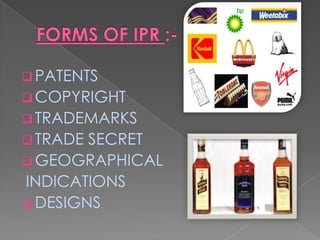
 PATENTS
 COPYRIGHT
 TRADEMARKS
 TRADE SECRET
 GEOGRAPHICAL
INDICATIONS
 DESIGNS
 A Patent is a right granted by the
Government to an inventor to exclude others
from imitating, manufacturing, using or
selling the invention of creator during
specified period.
PATENT REQUIREMENTS :-
o Novelty
o Inventiveness
o Industrial application & usefulness
o Patentability
o Disclosure
 A inventor files a properly prepared application to
the patenting office in India.
 If the application along with details is suitable then it
is published for the information of all, in INDIA, this
is done for 18 months.
 Anyone who wishes to challenge the award of patent
can do within 4 months in India.
 If patent application is not challenged, then the
patent is awarded immediately .
 Copyright is a legal term describing rights
given to creators for their literary &
artistic works.
ITS IMPORTANCE
 Respect intellectual rights of creators of
information
 Reward creativity of
authors, artists, musicians, etc.
 Legal mandate
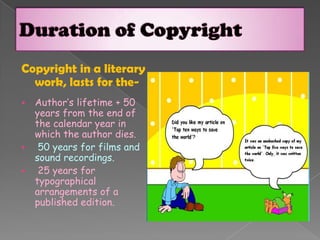
Copyright in a literary
work, lasts for the-
 Author’s lifetime + 50
years from the end of
the calendar year in
which the author dies.
 50 years for films and
sound recordings.
 25 years for
typographical
arrangements of a
published edition.
‡ A trademark is a distinctive
word, name, phrase, symbol, design, or other
device used by a company or person to
distinguish its goods or services from other
companies.
 India has a Trade Marks Act, 1999.
 Only the owner of a trade mark may file an
application for its registration.
 A mark is initially registered at National level
i.e called “basic registration” , then only the
person can transmit the request for
international filling, w/c is WIPO.
Trade marks
Name
Logotype
Symbol
Slogan
Shape
Color
 Here the organization owning an intellectual property
does not disclose the property to any one & keeps it as
secret to promote his business interest, it is called trade
secret.
ADVANTAGES :
 They are for unlimited duration.
 Risk of someone improving upon
the product is minimized.
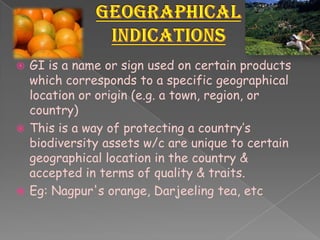
 GI is a name or sign used on certain products
which corresponds to a specific geographical
location or origin (e.g. a town, region, or
country)
 This is a way of protecting a country’s
biodiversity assets w/c are unique to certain
geographical location in the country &
accepted in terms of quality & traits.
 Eg: Nagpur's orange, Darjeeling tea, etc
 It means features of shape, pattern, etc applied to
an article or an object.
 The features are conceived in the authors
intellect, he gives those idea as a pictorial form or as
a specimen or model.
 In India, The Design Act,2000 is obeyed.
TO QUALIFY FOR REGISTRATION, THE
DESIGN MUST BE:-
 Be a new or original design &
 Not have been previously published in India.
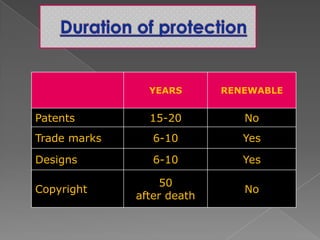
YEARS RENEWABLE
Patents 15-20 No
Trade marks 6-10 Yes
Designs 6-10 Yes
Copyright
50
after death
No
 It encourages intellectual & artistic
creations.
 It provides consumers with the results
of creations & inventions.
 It provides increased opportunities for
the industrial & economical development.
 It encourages R&D efforts.
 Spread new ideas.
 IPR has encouraged monopolies.
 The IPR situations may sometimes
difficult to handle.
 It is perceived by many as a threat to
food security.
 It may be detrimental to the livelihood
of the poor in developing countries.
 The Intellectual Property Rights (IPR)
provide us bundles of new opportunities &
exclusive rights , which attracts us
towards innovative ideas.
1) Biotechnology Expanding Horizons
by B. D SINGH, page no.850-865.
2) Plant biotechnology by h. s
chawla, page no.626-635.
3) Google.com, Wikipedia
4) Certain research papers on IPR
IPR
IPR

IPR

  • 4.
     Act ofProtection of Inventions in 1856 .  Patents and Designs Protection Act in 1872. The currently operative patents act :-  Indian Patent Act (1970)  Indian Patent & Design Act(1958)  The Copyright Act(1957) but amended in 1999.
  • 5.
     PATENTS  COPYRIGHT TRADEMARKS  TRADE SECRET  GEOGRAPHICAL INDICATIONS  DESIGNS
  • 6.
     A Patentis a right granted by the Government to an inventor to exclude others from imitating, manufacturing, using or selling the invention of creator during specified period. PATENT REQUIREMENTS :- o Novelty o Inventiveness o Industrial application & usefulness o Patentability o Disclosure
  • 7.
     A inventorfiles a properly prepared application to the patenting office in India.  If the application along with details is suitable then it is published for the information of all, in INDIA, this is done for 18 months.  Anyone who wishes to challenge the award of patent can do within 4 months in India.  If patent application is not challenged, then the patent is awarded immediately .
  • 8.
     Copyright isa legal term describing rights given to creators for their literary & artistic works. ITS IMPORTANCE  Respect intellectual rights of creators of information  Reward creativity of authors, artists, musicians, etc.  Legal mandate
  • 9.
    Copyright in aliterary work, lasts for the-  Author’s lifetime + 50 years from the end of the calendar year in which the author dies.  50 years for films and sound recordings.  25 years for typographical arrangements of a published edition.
  • 10.
    ‡ A trademarkis a distinctive word, name, phrase, symbol, design, or other device used by a company or person to distinguish its goods or services from other companies.  India has a Trade Marks Act, 1999.  Only the owner of a trade mark may file an application for its registration.  A mark is initially registered at National level i.e called “basic registration” , then only the person can transmit the request for international filling, w/c is WIPO.
  • 11.
  • 12.
     Here theorganization owning an intellectual property does not disclose the property to any one & keeps it as secret to promote his business interest, it is called trade secret. ADVANTAGES :  They are for unlimited duration.  Risk of someone improving upon the product is minimized.
  • 13.
     GI isa name or sign used on certain products which corresponds to a specific geographical location or origin (e.g. a town, region, or country)  This is a way of protecting a country’s biodiversity assets w/c are unique to certain geographical location in the country & accepted in terms of quality & traits.  Eg: Nagpur's orange, Darjeeling tea, etc
  • 14.
     It meansfeatures of shape, pattern, etc applied to an article or an object.  The features are conceived in the authors intellect, he gives those idea as a pictorial form or as a specimen or model.  In India, The Design Act,2000 is obeyed. TO QUALIFY FOR REGISTRATION, THE DESIGN MUST BE:-  Be a new or original design &  Not have been previously published in India.
  • 15.
    YEARS RENEWABLE Patents 15-20No Trade marks 6-10 Yes Designs 6-10 Yes Copyright 50 after death No
  • 16.
     It encouragesintellectual & artistic creations.  It provides consumers with the results of creations & inventions.  It provides increased opportunities for the industrial & economical development.  It encourages R&D efforts.  Spread new ideas.
  • 17.
     IPR hasencouraged monopolies.  The IPR situations may sometimes difficult to handle.  It is perceived by many as a threat to food security.  It may be detrimental to the livelihood of the poor in developing countries.
  • 18.
     The IntellectualProperty Rights (IPR) provide us bundles of new opportunities & exclusive rights , which attracts us towards innovative ideas.
  • 19.
    1) Biotechnology ExpandingHorizons by B. D SINGH, page no.850-865. 2) Plant biotechnology by h. s chawla, page no.626-635. 3) Google.com, Wikipedia 4) Certain research papers on IPR