Managing Intellectual
      Assets


      Fall 2011
     Hervé Lebret
Agenda

   Intellectual Capital

   Intellectual Property

   Why Intellectual Property?

   How to build Intellectual Property?


                                          2
A few quotes

 Baruch Lev, a professor of accounting at New York
 University:
 “Intangible Assets ranging from a skilled workforce
 to patents to know-how account for more than half
 of the market capitalization of America’s public
 companies.”


 Accenture calculates that “intangible assets have
 shot up from 20% of the value of companies in the
 S&P 500 in 1980 to around 70% today”.


                                                       3
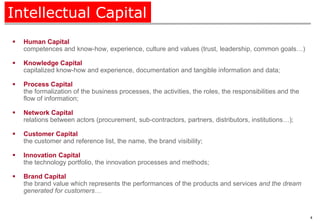
Intellectual Capital
   Human Capital
    competences and know-how, experience, culture and values (trust, leadership, common goals…)

   Knowledge Capital
    capitalized know-how and experience, documentation and tangible information and data;

   Process Capital
    the formalization of the business processes, the activities, the roles, the responsibilities and the
    flow of information;

   Network Capital
    relations between actors (procurement, sub-contractors, partners, distributors, institutions…);

   Customer Capital
    the customer and reference list, the name, the brand visibility;

   Innovation Capital
    the technology portfolio, the innovation processes and methods;

   Brand Capital
    the brand value which represents the performances of the products and services and the dream
    generated for customers…


                                                                                                           4
What is IP? An asset? An investment?

   It is a part of intellectual capital
   It is an intangible (immaterial good)


                                     Intellectual
                                     Property
                                                    5
Forms of Intellectual Property
  Know-How          1886: 'Coca-Cola' is made using a unique combination of
                     natural flavorings. The formula for 'Coca-Cola' is a closely
                     guarded secret and it is stored in a bank vault in Atlanta,
                     Georgia, USA.

  Trademark    ®    1893:


                      1937: Coca-Cola received a
                      “design patent” for the contour
  Design/drawings    bottle


  Patent             June 5, 2002 - P&G Sues Coca-Cola Over Patent -
                      Procter & Gamble Co. last week sued The Coca-Cola Co.
                      alleging that its former joint venture partner is infringing
                      on patented technology that adds calcium to fruit juices,
                      … seeking an injunction to stop the alleged violation of its
                      patent, which has been in force since 1988.
  Copyright ©
                                                                                    6
Know-How

 It represents all technical know-how which is not patented.

 There is no ownership right on know-how.

 But it may benefit from some legal protection
 (e.g. unfair behaviors, unfair competition).

 Condition: Know-how must remain secret.


                                                               7
Trademark

 Conditions to register:
  Novel (not identical or similar to a prior-registered one)
  Non-descriptive
  Not in the public domain


 How to register a trademark
 1. Look for prior art
 2. Choose one or several fields of products
 3. Define the geography
 4. Register to the adequate office


                                                                8
Design

 Rights on design
     No need for formal registration
     Deals with internal and external features of a product or a
    design
     Protection: 10 years from market entry


 Registration
     Deals specifically with the external appearance of a
    product
     Protection: 5 years, renewable 4 times x 5 years
                                                                    9
Copyright
    Advantages :
      free,
      no registrations.
    Weaknesses :
      protects the software, the code
      but not the basic idea, the concept, the algorithm
    They give the following exclusive rights :
          Reproduction
          Modification : adaptation, evolution, translation
          Circulation : distribution, licenses and sale
                                                               10
©          ®


    ©   Copyright, free, mentions year and author


       The author announces and claims rights on
        trademark, but it may not have been
        registered


®       Trademark has been registered and
        authorized.
                                                    11
An example (1/3)


                   12
An example (2/3)


Experts’ advice (jurist, biz. lawyer, IP
lawyer):

- There is probably no infringement

- Google gave its blessing anyway

- However the second email is an issue
and it is never easy to fight a powerful
player.

                                           13
An example (3/3)


                   14
Patents

  A patent protects an invention which is defined as a
  technical solution to a technical problem.

  In order to be patentable, an invention must be novel, non-
  obvious (not be simple evolution of prior art) and can be
  applicable (it must have a practical utility)

  The protection lasts twenty years if the maintenance fees are
  paid in each individual country where is is protected.

  A patent has an owner - who is not always the inventor(s) – it
  can be sold, transferred, licensed (rented).


                                                                   15
What is patent useful for?


 It prevents others from using the technical solution

 It gives the right to grant licenses

 It is a currency, it can be traded

 “It favors technical development”

 It is useful to obtain financing (for start-up for example)


                                                                16
The drawbacks of a patent


   The invention is disclosed

   It does not give a right to use

   It is often difficult to understand

   It is costly!


                                          17
Patentability conditions

   A patent must have a technical feature

   Exceptions
        Discoveries
        Esthetic creations
        Games and software
        Methods of treatment and diagnostics
        Inventions contrary to ethics/morals
        Animal and vegetal species

   A practical utility
   Newness/novelty
   Inventiveness (« non obviousness »)


                                                18
Patentability categories


   Product
      Object or material element which is new

   Process
      Means to obtain a product or a result (method,
      indication)

   “Product by process”


                                                       19
IP has a cost (… and a duration)

    Trademark : about CHF10k in Europe/USA, 10 years, renewable
    Copyrights: free, 50 to 70 years after the death of the author
    Know-how: free without limitation; but difficult to protect
    Patent : several tenths of kCHF, 20 years

     Example: Cost of a Europen Patent (6 countries)

            80000                                                 80000

            70000                                                 70000

            60000                                                 60000
            50000                                                 50000
      CHF


            40000                                                 40000   Yearly Cost
            30000                                                 30000

            20000                                                 20000   Cumulative
                                                                          cost
            10000                                                 10000

               0                                                  0
                0

                    2

                        4

                            6

                                8

                                    10

                                         12

                                              14

                                                   16

                                                        18

                                                             20

                                     Year


                                                                                        20
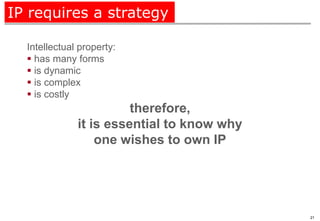
IP requires a strategy

  Intellectual property:
   has many forms
   is dynamic
   is complex
   is costly
                        therefore,
              it is essential to know why
                  one wishes to own IP


                                            21
How to build IP: the patent case


 It is important to assess first an invention:

  can it be patented: new, non obvious, applicable?

  why a patent: which strategy?

  a patent filing will be a process with many constraints


                                                             22
Filing: many possible choices
                Filing            Examination   Issuance   Administration


Switzterland    CH                   CH           CH           CH


                         Search
International   PCT


European        EP                   EP           EP

                                                                            23
A typical patent filing

                              Priority
                              year
              Priority                       PCT Filing          Preliminary           US            US               US
               Filing                                            examination
                                                                                      Filing      examination
                                                                                                                     patent


                                                                                       JP             JP
                                                                                                                      JP
                                                                                      Filing      examination        patent


                                                                                       EP            EP            Choice
                                                                                      Filing      examination    of countries


                  12 months max.                     18 months

  Priority date                    International                           National
                                       filing                               filing
                                                                                          CH                  D                  FR       UK
                                                                                         patent             patent              patent   patent

                                    30 months max.


                                                                                                                                                  24
Confidentiality and filing
                                                                            Patent
                                                                          application
                                                                             filing
                                                                                            18 months
              Should be short!               Evaluation of invention


                                                                                                                                             Issuance
 Invention date*             Invention disclosure                                                         Publication of the              (I.e. patent is
                              to a tech. transfer                       Priority date*                  application (available to             granted)
 (written down in
                                     office                                                                    the public)
 lab note books)


                                                                                              Examination period which duration
                                                                                                        is unknown


                Until filing, confidentiality is critical and a must!                                                       After publication, patent is
                                                                                       Until publication,
                    CDA to be used with the outside world                                                                   disclosed to the public and
                                                                                  confidentiality is better, but
                                                                                                                              no confidentiality need
                                                                                   protection is guaranteed
                                                                                                                                     anymore
                                                                                    after filing. CDA / NDA
                                                                                  should be a preferred tool


NB : 1- the USA have a grace period. It is possible to file in the 12 months following a disclosure.
     2- (*) : in Europe the priority date gives anteriority; in the USA, the invention date is the final
           anteriority date in case of competitive application.
However these 2 rules are being cancelled with the new US Patent Law.
                                                                                                                                                            25
The beginning of an adventure
  An IP strategy is usually built with one or several “patent
    attorney(s)”
     Writing an application is technical and legal

     To have a patent granted is a lengthy and very uncertain process

     A good strategy is critical
        geography, portfolio
        a constant competitive analysis is necessary

     A strategy of protection against competition and with partners is necessary
       (IP never gives direct rights but the rights to protect yourself against infringers)

     The commercial strategy has to be linked to the IP strategy


                                                                                              26
Patent case study (1/7) The initial filing


 a title
 inventors

(individuals)
 an owner
(individuals or an
institution)
 a geography

 a priority date

 a filing date

 a publication

date


                                                 27
Patent case study (2/7) The PCT filing


 a title
 inventors

(individuals)
 an owner
(individuals or an
institution)
 a geography

 a priority date

 a filing date

 a publication

date
 finally (ideally!) a
date of issuance


                                             28
Patent case study (3/7)   The search report -1


                                                 29
Patent case study (4/7)   The search report -2


                                                 30
Patent case study (5/7)   The Issued Patent


                                              31
Patent case study (6/7) The regional filings


                                           32
Patent case study (7/7) The content


                                      33
The content of a patent application

As a summary, a patent application includes:
    • Claims                     • Revendications
    • Description                • Description
    • Drawings                   • Dessins
    • Abstract                   • Résumé
 The essential additional information:
 • a title
 • inventors (individuals)
 • an owner (individuals or an institution)
 • a geography
 • a priority date
 • a filing date
 • a publication date
 • finally (ideally!) a date of issuance
                                                    34
The specific case of the USA *
- The US provisional filing
   Not published
   Limited to one year
   Not examined

   A written description
   No drawing, no claim necessary

   When?
      when time is short
      when strategy (on how) to proceed is unclear
      when short-term budget is limited


-The 12-month grace period after disclosure or publication

*: might be canceled soon with new US patent law
                                                             35
Search for prior art

                   Inventors then examiners
                   must check state of the art
                   through prior art search

                   The search is similar to
                   a publication bibliography and
                   includes the web, the technical
                   journals as well as patent databases.

                   SRI is supporting search through
                   visits to IPI (Swiss Federal Institute of
                   Intellectual Property) in Bern
                   (www.ipi.ch)
                   Tools are also available on the web
                                                           36
The European Patent Office


   http://worldwide.espacenet.com
                                    37
Derwent


  http://apps.webofknowledge.com
                                   38
Google Patent Search


    http://www.google.com/patents
                                    39
University licenses

   Many inventions and patent application belong to universities (or other
     institutions)

   Therefore a negotiation to obtain a license is usual

   The philosophy of licensing is as follows:

    EPFL deserves some reward for the IP use

    It is based on an upfront payment and royalties

    In the case of start-ups the upfront payment can be replaced with
     equity

    The licensee maintains the IP protection from the date of the license.


                                                                              40
Negotiation: a few ideas…

  Never forget it is a dynamic process with iterations

  IP is intangible so its value is difficult (impossible?) to assess

  On top of its value, there are other important features
   duration
   payments
   geography, jurisdiction
   fields of use
   conditions (“milestones”, “termination”)
   confidentiality, responsibility…..


                                                                       41
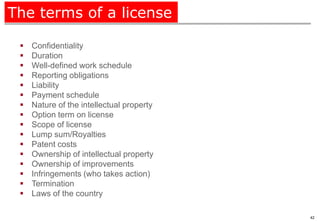
The terms of a license

    Confidentiality
    Duration
    Well-defined work schedule
    Reporting obligations
    Liability
    Payment schedule
    Nature of the intellectual property
    Option term on license
    Scope of license
    Lump sum/Royalties
    Patent costs
    Ownership of intellectual property
    Ownership of improvements
    Infringements (who takes action)
    Termination
    Laws of the country

                                           42
The value of IP


 Again… IP is intangible so its value is difficult (impossible?) to
 assess

 There are valuation techniques (just as for start-up valuation)
      25% rule
      Past investments
      Industry standards

 But the value is negotiated and the price is fixed between a
 buyer and a seller; it is the law of offer and demand.


                                                                      43
Example of royalty rates

                        Royalty Rates for In-Licensing by Industry
Industry                   0-2%      2-5%                5-10%         10-15%       15-20%     20-25%         >25%
Aerospace                  50.0%     50.0%
Automotive                 52.5%     45.0%               2.5%
Chemical                   16.5%     58.1%               24.3%         0.8%         0.4%
Computer                   62.5%     31.3%               6.3%
Electronics                          50.0%               25.0%         25.0%
Energy                               66.7%
Food/Consumer                       100.0%
General Mfg.               45.0%     28.6%               12.1%         14.3%
Governmetn/University      25.0%     25.0%               50.0%
Health Care                3.3%      51.7%               45.0%
Pharmaceuticals            23.6%     32.1%               29.3%         12.5%        1.1% Royalty Rate Distribution
                                                                                     LER   0.7%     0.7%
Telecommunications         40.0%     37.3%               23.6%
                                                         15


                                                         12
                                             Frequency


                                                          9


                                                          6


                                                          3


                                                          0
                                                              0


                                                                       3


                                                                                6


                                                                                          9

                                                                                              10

                                                                                                   12

                                                                                                        13

                                                                                                             15

                                                                                                                  16

                                                                                                                       18

                                                                                                                            19

                                                                                                                                 21

                                                                                                                                      22

                                                                                                                                           24

                                                                                                                                                25

                                                                                                                                                     27

                                                                                                                                                          28

                                                                                                                                                               30
                                                                  1.


                                                                           4.


                                                                                     7.


                                                                                                   Royalty Rate

                                                                                                                                                                    44
Example of royalty rates
                                     Earned             Up-Front           Minimum
                                                                                            Source : G.Gorey &
Technology / Industry                Royalty            Payments           Payments         E.Kahn, Genetic
Reagents/Process                      1-3%             Patent Costs         $2-10K          Engineering News, July-
                                                                                            August 1991
Reagents/Kit                           2-10            Patent Costs            $2-10K
Diagnostics In Vitro                    2-6                  $5-20K            $2-60K
Diagnostics In Vivo                     3-8                  $5-20K            $2-60K
Therapeutics                           4-12              $20-150K           $20-150K
Medical Instrumentation                4-10                $5-150K        $5-20K (Yr 1)


                          Industry                Average       Median   Max        Min      Count
                          Chemicals                   4.7%       4.3%    25.0%      0.1%        78
                          Internet (incl. software) 11.8%        8.8%    50.0%      0.3%        88
                          Telecom (excl Media)        4.9%       4.5%    15.5%      0.4%        73
                          Consumer Gds, Rtl & Leis                5.5%    5.0%      28.0%    0.1%           98
                          Media & Entertainment       9.1%       5.0%    50.0%      2.0%        25
                          Food Processing             3.2%       2.8%    10.0%      0.3%        38
                          Medical/Health Products 6.1%           5.0%    77.0%      0.1%       376
                          Pharma. & Biotech           7.0%       5.0%    50.0%      0.0%       458
                          Energy & Environment        5.0%       5.0%    20.0%      1.0%       107
                          Machines/Tools              5.2%       4.5%    25.0%      0.5%        90
                          Automotive                  4.3%       3.5%    15.0%      0.5%        59
                          Electrical & Electronics    4.2%       4.0%    15.0%      0.5%       139
                          Semiconductors              4.3%       3.0%    30.0%      0.0%        75
                          Computers & Office Equip                5.3%    4.0%      25.0%    0.2%           73
                          Software                   11.5%       6.8%    70.0%      0.0%       147
                          Industry Summary         6.40%        4.80%                        1,924

                                                                                                                      45
An example of royalty rates

 A raw idea is worth virtually nothing, due to an astronomical risk factor

 A patent pending with a strong business plan may be worth 1 %

 An issued patent may be worth 2 %

 A patent with a prototype, such as a pharmaceutical with pre-clinical testing may be
 worth 2-3 %

 A pharmaceutical with clinical trials may be worth 3-4 %

 A proven drug with FDA approval may be worth 5-7 %

 A drug with market share, such as one pharma. distributing through another, may be
 worth 8-10%


                                                                                        46
IP and Venture Capitalists


   Show you thought about an IP strategy
   Disclose your analysis, the strengths and weaknesses
   but…

  Never say (or think…) that your IP is a major asset for your
  business; it is a protection tool but it does not bring that much
  guarantee.

  Mention you have IP and focus on other elements of strength


                                                                      47
IP and VCs (according to Guy Kawasaki)


                                         48
IP and VCs (according to Guy Kawasaki)


                                         49
As a conclusion…
An investment! Not a guarantee!

                 Intellectual Property
      contributes to create value for a company.

  The company should define its IP strategy in order to
  optimize the value, with its partners:
   patent attorneys
   investors
   customers
   competitors
   licensees


                                                          50

Intellectual property

  • 1.
    Managing Intellectual Assets Fall 2011 Hervé Lebret
  • 2.
    Agenda Intellectual Capital  Intellectual Property  Why Intellectual Property?  How to build Intellectual Property? 2
  • 3.
    A few quotes Baruch Lev, a professor of accounting at New York University: “Intangible Assets ranging from a skilled workforce to patents to know-how account for more than half of the market capitalization of America’s public companies.” Accenture calculates that “intangible assets have shot up from 20% of the value of companies in the S&P 500 in 1980 to around 70% today”. 3
  • 4.
    Intellectual Capital  Human Capital competences and know-how, experience, culture and values (trust, leadership, common goals…)  Knowledge Capital capitalized know-how and experience, documentation and tangible information and data;  Process Capital the formalization of the business processes, the activities, the roles, the responsibilities and the flow of information;  Network Capital relations between actors (procurement, sub-contractors, partners, distributors, institutions…);  Customer Capital the customer and reference list, the name, the brand visibility;  Innovation Capital the technology portfolio, the innovation processes and methods;  Brand Capital the brand value which represents the performances of the products and services and the dream generated for customers… 4
  • 5.
    What is IP?An asset? An investment?  It is a part of intellectual capital  It is an intangible (immaterial good) Intellectual Property 5
  • 6.
    Forms of IntellectualProperty  Know-How 1886: 'Coca-Cola' is made using a unique combination of natural flavorings. The formula for 'Coca-Cola' is a closely guarded secret and it is stored in a bank vault in Atlanta, Georgia, USA.  Trademark  ® 1893: 1937: Coca-Cola received a “design patent” for the contour  Design/drawings bottle  Patent June 5, 2002 - P&G Sues Coca-Cola Over Patent - Procter & Gamble Co. last week sued The Coca-Cola Co. alleging that its former joint venture partner is infringing on patented technology that adds calcium to fruit juices, … seeking an injunction to stop the alleged violation of its patent, which has been in force since 1988.  Copyright © 6
  • 7.
    Know-How It representsall technical know-how which is not patented. There is no ownership right on know-how. But it may benefit from some legal protection (e.g. unfair behaviors, unfair competition). Condition: Know-how must remain secret. 7
  • 8.
    Trademark Conditions toregister:  Novel (not identical or similar to a prior-registered one)  Non-descriptive  Not in the public domain How to register a trademark 1. Look for prior art 2. Choose one or several fields of products 3. Define the geography 4. Register to the adequate office 8
  • 9.
    Design Rights ondesign  No need for formal registration  Deals with internal and external features of a product or a design  Protection: 10 years from market entry Registration  Deals specifically with the external appearance of a product  Protection: 5 years, renewable 4 times x 5 years 9
  • 10.
    Copyright Advantages :  free,  no registrations. Weaknesses :  protects the software, the code  but not the basic idea, the concept, the algorithm They give the following exclusive rights :  Reproduction  Modification : adaptation, evolution, translation  Circulation : distribution, licenses and sale 10
  • 11.
    ©  ® © Copyright, free, mentions year and author  The author announces and claims rights on trademark, but it may not have been registered ® Trademark has been registered and authorized. 11
  • 12.
  • 13.
    An example (2/3) Experts’advice (jurist, biz. lawyer, IP lawyer): - There is probably no infringement - Google gave its blessing anyway - However the second email is an issue and it is never easy to fight a powerful player. 13
  • 14.
  • 15.
    Patents Apatent protects an invention which is defined as a technical solution to a technical problem. In order to be patentable, an invention must be novel, non- obvious (not be simple evolution of prior art) and can be applicable (it must have a practical utility) The protection lasts twenty years if the maintenance fees are paid in each individual country where is is protected. A patent has an owner - who is not always the inventor(s) – it can be sold, transferred, licensed (rented). 15
  • 16.
    What is patentuseful for?  It prevents others from using the technical solution  It gives the right to grant licenses  It is a currency, it can be traded  “It favors technical development”  It is useful to obtain financing (for start-up for example) 16
  • 17.
    The drawbacks ofa patent  The invention is disclosed  It does not give a right to use  It is often difficult to understand  It is costly! 17
  • 18.
    Patentability conditions  A patent must have a technical feature  Exceptions  Discoveries  Esthetic creations  Games and software  Methods of treatment and diagnostics  Inventions contrary to ethics/morals  Animal and vegetal species  A practical utility  Newness/novelty  Inventiveness (« non obviousness ») 18
  • 19.
    Patentability categories  Product Object or material element which is new  Process Means to obtain a product or a result (method, indication)  “Product by process” 19
  • 20.
    IP has acost (… and a duration)  Trademark : about CHF10k in Europe/USA, 10 years, renewable  Copyrights: free, 50 to 70 years after the death of the author  Know-how: free without limitation; but difficult to protect  Patent : several tenths of kCHF, 20 years Example: Cost of a Europen Patent (6 countries) 80000 80000 70000 70000 60000 60000 50000 50000 CHF 40000 40000 Yearly Cost 30000 30000 20000 20000 Cumulative cost 10000 10000 0 0 0 2 4 6 8 10 12 14 16 18 20 Year 20
  • 21.
    IP requires astrategy Intellectual property:  has many forms  is dynamic  is complex  is costly therefore, it is essential to know why one wishes to own IP 21
  • 22.
    How to buildIP: the patent case It is important to assess first an invention:  can it be patented: new, non obvious, applicable?  why a patent: which strategy?  a patent filing will be a process with many constraints 22
  • 23.
    Filing: many possiblechoices Filing Examination Issuance Administration Switzterland CH CH CH CH Search International PCT European EP EP EP 23
  • 24.
    A typical patentfiling Priority year Priority PCT Filing Preliminary US US US Filing examination Filing examination patent JP JP JP Filing examination patent EP EP Choice Filing examination of countries 12 months max. 18 months Priority date International National filing filing CH D FR UK patent patent patent patent 30 months max. 24
  • 25.
    Confidentiality and filing Patent application filing 18 months Should be short! Evaluation of invention Issuance Invention date* Invention disclosure Publication of the (I.e. patent is to a tech. transfer Priority date* application (available to granted) (written down in office the public) lab note books) Examination period which duration is unknown Until filing, confidentiality is critical and a must! After publication, patent is Until publication, CDA to be used with the outside world disclosed to the public and confidentiality is better, but no confidentiality need protection is guaranteed anymore after filing. CDA / NDA should be a preferred tool NB : 1- the USA have a grace period. It is possible to file in the 12 months following a disclosure. 2- (*) : in Europe the priority date gives anteriority; in the USA, the invention date is the final anteriority date in case of competitive application. However these 2 rules are being cancelled with the new US Patent Law. 25
  • 26.
    The beginning ofan adventure An IP strategy is usually built with one or several “patent attorney(s)”  Writing an application is technical and legal  To have a patent granted is a lengthy and very uncertain process  A good strategy is critical  geography, portfolio  a constant competitive analysis is necessary  A strategy of protection against competition and with partners is necessary (IP never gives direct rights but the rights to protect yourself against infringers)  The commercial strategy has to be linked to the IP strategy 26
  • 27.
    Patent case study(1/7) The initial filing  a title  inventors (individuals)  an owner (individuals or an institution)  a geography  a priority date  a filing date  a publication date 27
  • 28.
    Patent case study(2/7) The PCT filing  a title  inventors (individuals)  an owner (individuals or an institution)  a geography  a priority date  a filing date  a publication date  finally (ideally!) a date of issuance 28
  • 29.
    Patent case study(3/7) The search report -1 29
  • 30.
    Patent case study(4/7) The search report -2 30
  • 31.
    Patent case study(5/7) The Issued Patent 31
  • 32.
    Patent case study(6/7) The regional filings 32
  • 33.
    Patent case study(7/7) The content 33
  • 34.
    The content ofa patent application As a summary, a patent application includes: • Claims • Revendications • Description • Description • Drawings • Dessins • Abstract • Résumé The essential additional information: • a title • inventors (individuals) • an owner (individuals or an institution) • a geography • a priority date • a filing date • a publication date • finally (ideally!) a date of issuance 34
  • 35.
    The specific caseof the USA * - The US provisional filing Not published Limited to one year Not examined A written description No drawing, no claim necessary When? when time is short when strategy (on how) to proceed is unclear when short-term budget is limited -The 12-month grace period after disclosure or publication *: might be canceled soon with new US patent law 35
  • 36.
    Search for priorart Inventors then examiners must check state of the art through prior art search The search is similar to a publication bibliography and includes the web, the technical journals as well as patent databases. SRI is supporting search through visits to IPI (Swiss Federal Institute of Intellectual Property) in Bern (www.ipi.ch) Tools are also available on the web 36
  • 37.
    The European PatentOffice http://worldwide.espacenet.com 37
  • 38.
  • 39.
    Google Patent Search http://www.google.com/patents 39
  • 40.
    University licenses Many inventions and patent application belong to universities (or other institutions) Therefore a negotiation to obtain a license is usual The philosophy of licensing is as follows:  EPFL deserves some reward for the IP use  It is based on an upfront payment and royalties  In the case of start-ups the upfront payment can be replaced with equity  The licensee maintains the IP protection from the date of the license. 40
  • 41.
    Negotiation: a fewideas… Never forget it is a dynamic process with iterations IP is intangible so its value is difficult (impossible?) to assess On top of its value, there are other important features  duration  payments  geography, jurisdiction  fields of use  conditions (“milestones”, “termination”)  confidentiality, responsibility….. 41
  • 42.
    The terms ofa license  Confidentiality  Duration  Well-defined work schedule  Reporting obligations  Liability  Payment schedule  Nature of the intellectual property  Option term on license  Scope of license  Lump sum/Royalties  Patent costs  Ownership of intellectual property  Ownership of improvements  Infringements (who takes action)  Termination  Laws of the country 42
  • 43.
    The value ofIP Again… IP is intangible so its value is difficult (impossible?) to assess There are valuation techniques (just as for start-up valuation)  25% rule  Past investments  Industry standards But the value is negotiated and the price is fixed between a buyer and a seller; it is the law of offer and demand. 43
  • 44.
    Example of royaltyrates Royalty Rates for In-Licensing by Industry Industry 0-2% 2-5% 5-10% 10-15% 15-20% 20-25% >25% Aerospace 50.0% 50.0% Automotive 52.5% 45.0% 2.5% Chemical 16.5% 58.1% 24.3% 0.8% 0.4% Computer 62.5% 31.3% 6.3% Electronics 50.0% 25.0% 25.0% Energy 66.7% Food/Consumer 100.0% General Mfg. 45.0% 28.6% 12.1% 14.3% Governmetn/University 25.0% 25.0% 50.0% Health Care 3.3% 51.7% 45.0% Pharmaceuticals 23.6% 32.1% 29.3% 12.5% 1.1% Royalty Rate Distribution LER 0.7% 0.7% Telecommunications 40.0% 37.3% 23.6% 15 12 Frequency 9 6 3 0 0 3 6 9 10 12 13 15 16 18 19 21 22 24 25 27 28 30 1. 4. 7. Royalty Rate 44
  • 45.
    Example of royaltyrates Earned Up-Front Minimum Source : G.Gorey & Technology / Industry Royalty Payments Payments E.Kahn, Genetic Reagents/Process 1-3% Patent Costs $2-10K Engineering News, July- August 1991 Reagents/Kit 2-10 Patent Costs $2-10K Diagnostics In Vitro 2-6 $5-20K $2-60K Diagnostics In Vivo 3-8 $5-20K $2-60K Therapeutics 4-12 $20-150K $20-150K Medical Instrumentation 4-10 $5-150K $5-20K (Yr 1) Industry Average Median Max Min Count Chemicals 4.7% 4.3% 25.0% 0.1% 78 Internet (incl. software) 11.8% 8.8% 50.0% 0.3% 88 Telecom (excl Media) 4.9% 4.5% 15.5% 0.4% 73 Consumer Gds, Rtl & Leis 5.5% 5.0% 28.0% 0.1% 98 Media & Entertainment 9.1% 5.0% 50.0% 2.0% 25 Food Processing 3.2% 2.8% 10.0% 0.3% 38 Medical/Health Products 6.1% 5.0% 77.0% 0.1% 376 Pharma. & Biotech 7.0% 5.0% 50.0% 0.0% 458 Energy & Environment 5.0% 5.0% 20.0% 1.0% 107 Machines/Tools 5.2% 4.5% 25.0% 0.5% 90 Automotive 4.3% 3.5% 15.0% 0.5% 59 Electrical & Electronics 4.2% 4.0% 15.0% 0.5% 139 Semiconductors 4.3% 3.0% 30.0% 0.0% 75 Computers & Office Equip 5.3% 4.0% 25.0% 0.2% 73 Software 11.5% 6.8% 70.0% 0.0% 147 Industry Summary 6.40% 4.80% 1,924 45
  • 46.
    An example ofroyalty rates A raw idea is worth virtually nothing, due to an astronomical risk factor A patent pending with a strong business plan may be worth 1 % An issued patent may be worth 2 % A patent with a prototype, such as a pharmaceutical with pre-clinical testing may be worth 2-3 % A pharmaceutical with clinical trials may be worth 3-4 % A proven drug with FDA approval may be worth 5-7 % A drug with market share, such as one pharma. distributing through another, may be worth 8-10% 46
  • 47.
    IP and VentureCapitalists  Show you thought about an IP strategy  Disclose your analysis, the strengths and weaknesses  but… Never say (or think…) that your IP is a major asset for your business; it is a protection tool but it does not bring that much guarantee. Mention you have IP and focus on other elements of strength 47
  • 48.
    IP and VCs(according to Guy Kawasaki) 48
  • 49.
    IP and VCs(according to Guy Kawasaki) 49
  • 50.
    As a conclusion… Aninvestment! Not a guarantee! Intellectual Property contributes to create value for a company. The company should define its IP strategy in order to optimize the value, with its partners:  patent attorneys  investors  customers  competitors  licensees 50