Download as PDF, PPTX


![SIXTH ASSESSMENT REPORT
Global warming
has caused dangerous and
widespread disruption in nature…
[Pacific Southwest Forest Service, USDA CC BY 2.0]](https://image.slidesharecdn.com/ipccar6wgiipressconferenceslides-220301112036/75/IPCC-6th-assessment-report-wg2-Slides-used-at-Press-conference-4-2048.jpg)
![SIXTH ASSESSMENT REPORT
…and climate change is affecting the lives
of billions of people, despite efforts to adapt.
[NLRC via IFRC CC BY-NC 2.0]](https://image.slidesharecdn.com/ipccar6wgiipressconferenceslides-220301112036/75/IPCC-6th-assessment-report-wg2-Slides-used-at-Press-conference-5-2048.jpg)
![SIXTH ASSESSMENT REPORT
Impacts are magnified in cities where more
than half the world’s population lives.
[Peter Nguyen / Unsplash]](https://image.slidesharecdn.com/ipccar6wgiipressconferenceslides-220301112036/75/IPCC-6th-assessment-report-wg2-Slides-used-at-Press-conference-6-2048.jpg)
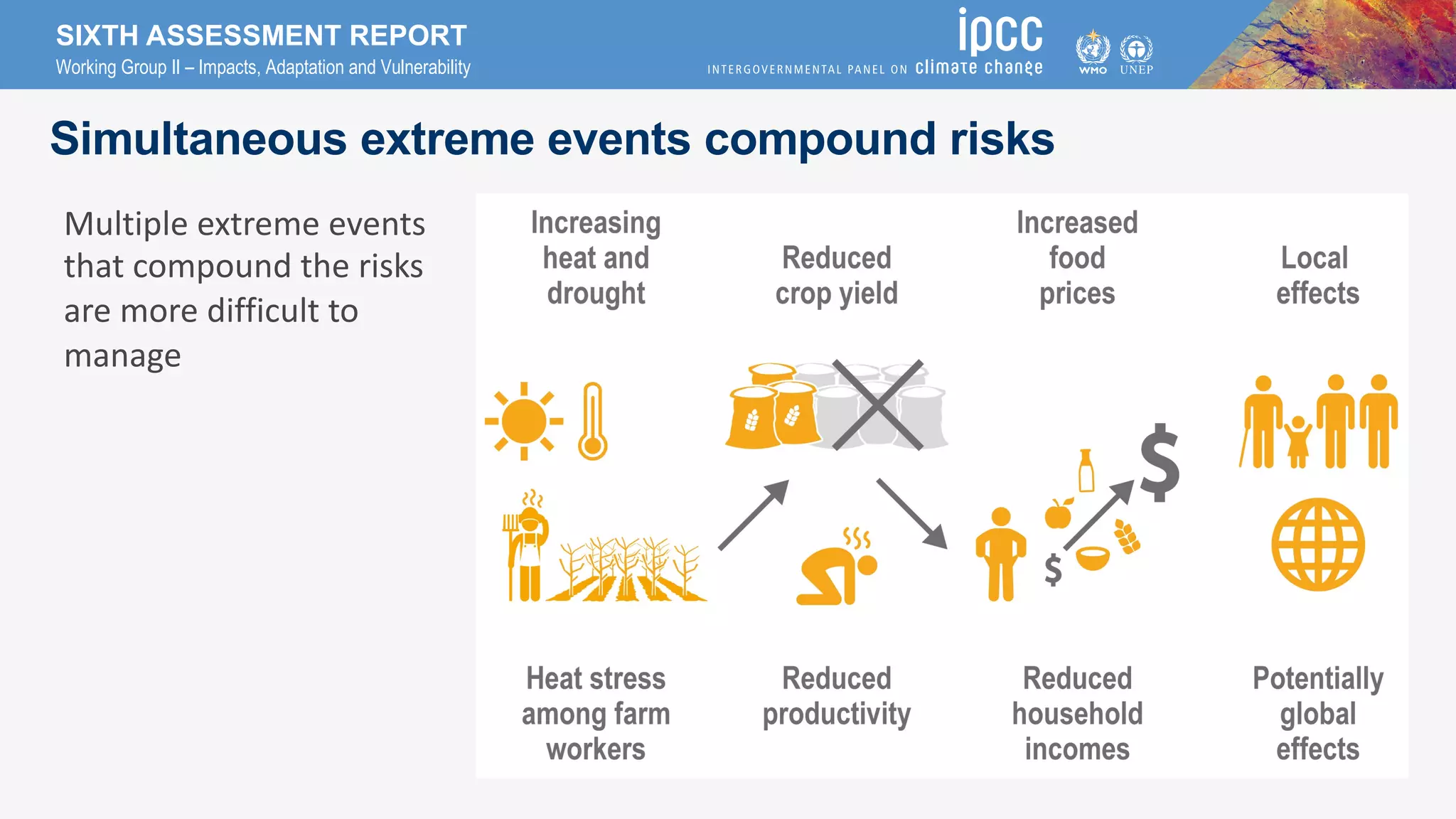
![SIXTH ASSESSMENT REPORT
Working Group II – Impacts, Adaptation and Vulnerability
[Axel Guibourg CC BY-NC-ND 2.0; Hugh Han / Unsplash; Axel Fassio/CIFOR CC BY-NC-ND 2.0]
New understanding of interconnections](https://image.slidesharecdn.com/ipccar6wgiipressconferenceslides-220301112036/75/IPCC-6th-assessment-report-wg2-Slides-used-at-Press-conference-8-2048.jpg)
![SIXTH ASSESSMENT REPORT
Climate change combines with
unsustainable use of natural resources,
habitat destruction, growing urbanization and inequity.
[Youssef Abdelwahab / Unsplash]](https://image.slidesharecdn.com/ipccar6wgiipressconferenceslides-220301112036/75/IPCC-6th-assessment-report-wg2-Slides-used-at-Press-conference-9-2048.jpg)
![SIXTH ASSESSMENT REPORT
3.3 – 3.6 billion people live in hotspots of
high vulnerability to climate change.
[Denis Onyodi / KRCS CC BY-NC 2.0]](https://image.slidesharecdn.com/ipccar6wgiipressconferenceslides-220301112036/75/IPCC-6th-assessment-report-wg2-Slides-used-at-Press-conference-10-2048.jpg)
![SIXTH ASSESSMENT REPORT
Working Group II – Impacts, Adaptation and Vulnerability
[Denis Onyodi / KRCS CC BY-NC 2.0; Marco Dormino UN Photo CC BY-NC-ND 2.0; Markus Krisetya / Unsplash]
Overlapping challenges
• Limited access to water, sanitation and
health services
• Climate-sensitive livelihoods
• High levels of poverty
• Weak leadership
• Lack of funding
• Lack of accountability and trust in
government](https://image.slidesharecdn.com/ipccar6wgiipressconferenceslides-220301112036/75/IPCC-6th-assessment-report-wg2-Slides-used-at-Press-conference-11-2048.jpg)
![SIXTH ASSESSMENT REPORT
Every small increase in warming
will result in increased risks.
[Ocean Image Bank / The Ocean Agency]](https://image.slidesharecdn.com/ipccar6wgiipressconferenceslides-220301112036/75/IPCC-6th-assessment-report-wg2-Slides-used-at-Press-conference-12-2048.jpg)

![SIXTH ASSESSMENT REPORT
Working Group II – Impacts, Adaptation and Vulnerability
Biodiversity loss at different warming levels
[Jack Charles / Unsplash]](https://image.slidesharecdn.com/ipccar6wgiipressconferenceslides-220301112036/75/IPCC-6th-assessment-report-wg2-Slides-used-at-Press-conference-14-2048.jpg)
![SIXTH ASSESSMENT REPORT
Working Group II – Impacts, Adaptation and Vulnerability
Biodiversity loss at different warming levels
[Chad King/NOAA]](https://image.slidesharecdn.com/ipccar6wgiipressconferenceslides-220301112036/75/IPCC-6th-assessment-report-wg2-Slides-used-at-Press-conference-15-2048.jpg)

![SIXTH ASSESSMENT REPORT
Working Group II – Impacts, Adaptation and Vulnerability
Future global climate risks
Heat stress
Exposure to heat
waves will continue
to increase with
additional warming.
Water scarcity
At 2°C, regions
relying on snowmelt
could experience 20%
decline in water
availability for
agriculture after 2050.
Flood risk
About a billion people
in low-lying cities by
the sea and on Small
Islands at risk from
sea level rise by mid-
century.
Food security
Climate change will
increasingly
undermine food
security.
[Well Bred Kannan - WBK Photography CC BY-NC-ND 2.0; Jay Huang CC BY 2.0; Cristina Anne Costello, Marcus Woodbridge / Unsplash]](https://image.slidesharecdn.com/ipccar6wgiipressconferenceslides-220301112036/75/IPCC-6th-assessment-report-wg2-Slides-used-at-Press-conference-17-2048.jpg)
![SIXTH ASSESSMENT REPORT
Action on adaptation has
increased but progress is uneven
and we are not adapting fast enough.
[Boskalis / Rijkswaterstaat]](https://image.slidesharecdn.com/ipccar6wgiipressconferenceslides-220301112036/75/IPCC-6th-assessment-report-wg2-Slides-used-at-Press-conference-18-2048.jpg)
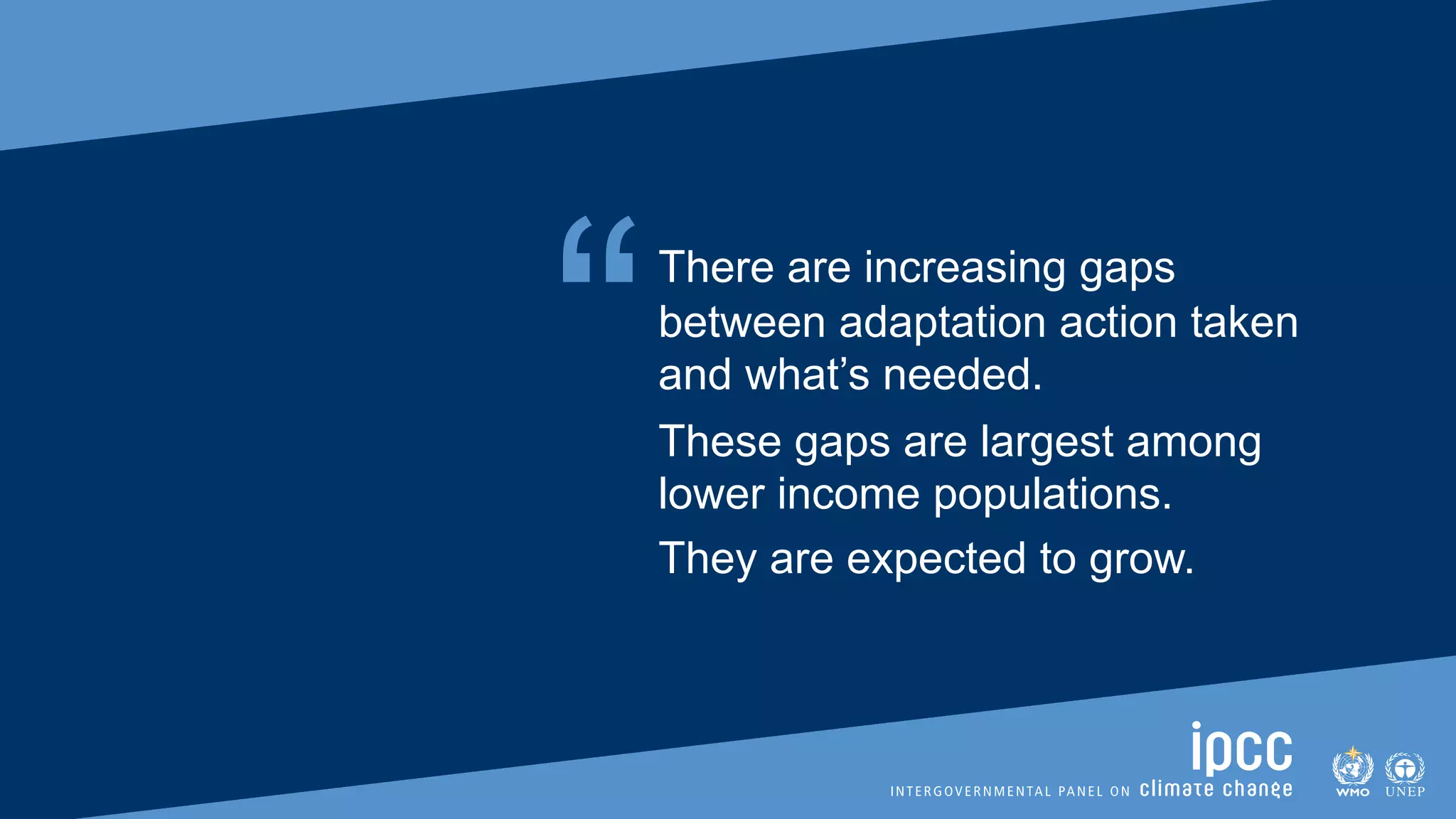
![SIXTH ASSESSMENT REPORT
There are options we can take
to reduce the risks to people and nature.
[Il Vagabiondo / Unsplash]](https://image.slidesharecdn.com/ipccar6wgiipressconferenceslides-220301112036/75/IPCC-6th-assessment-report-wg2-Slides-used-at-Press-conference-20-2048.jpg)
![SIXTH ASSESSMENT REPORT
Nature offers significant
untapped potential.
[World Agroforestry / Julius Atia CC BY-NC-SA 2.0]](https://image.slidesharecdn.com/ipccar6wgiipressconferenceslides-220301112036/75/IPCC-6th-assessment-report-wg2-Slides-used-at-Press-conference-21-2048.jpg)
![SIXTH ASSESSMENT REPORT
Working Group II – Impacts, Adaptation and Vulnerability
Water management
Options on farms:
• Irrigation
• Rainwater storage, water-saving tech
• Moisture conservation in soils
Economic and ecological benefits; reduced
vulnerability
Wider options:
• Securing drinking water
• Flood and drought risk management
• Working with nature, land-use planning
[Adam Öjdahl / IWMI CC BY-NC 2.0; Artem Beliaikin / Unsplash; rodjonesphotography.co.uk CC BY 2.0]
Effectiveness declines with increased warming](https://image.slidesharecdn.com/ipccar6wgiipressconferenceslides-220301112036/75/IPCC-6th-assessment-report-wg2-Slides-used-at-Press-conference-22-2048.jpg)
![SIXTH ASSESSMENT REPORT
Working Group II – Impacts, Adaptation and Vulnerability
Improving food security
Effective options:
• Cultivar improvements
• Agroforestry
• Farm and landscape diversification
• Community-based adaptation
• Strengthening biodiversity
Wider benefits:
• Food security and nutrition
• Health and well-being
• Livelihoods
[Jacquelyn Turner / CCAFS CC BY-NC-SA 2.0; FAO / Riccardo De Luca]](https://image.slidesharecdn.com/ipccar6wgiipressconferenceslides-220301112036/75/IPCC-6th-assessment-report-wg2-Slides-used-at-Press-conference-23-2048.jpg)
![SIXTH ASSESSMENT REPORT
Working Group II – Impacts, Adaptation and Vulnerability
Transforming cities
By 2050 urban areas could be home to two-
thirds of the world’s population.
Effective options
• Nature-based and engineering
approaches together
• Establishing green and blue spaces
• Urban agriculture
• Social-safety nets for disaster
management
Wider benefits
• Public health improvements
• Ecosystem conservation
[Chuttersnap, Jordan Brierley / Unsplash; SDOT Photos CC BY-NC 2.0]](https://image.slidesharecdn.com/ipccar6wgiipressconferenceslides-220301112036/75/IPCC-6th-assessment-report-wg2-Slides-used-at-Press-conference-24-2048.jpg)
![SIXTH ASSESSMENT REPORT
Working Group II – Impacts, Adaptation and Vulnerability
Adapting informal settlements
Effective options:
• Local knowledge
• Adequate capacity (information,
funding, tools)
• Engagement of policymakers
• Involvement of residents in decision-
making
• Institutional change (accountability,
commitment, transparency)
[India Water Portal CC BY-NC-SA 2.0 ]](https://image.slidesharecdn.com/ipccar6wgiipressconferenceslides-220301112036/75/IPCC-6th-assessment-report-wg2-Slides-used-at-Press-conference-25-2048.jpg)
![SIXTH ASSESSMENT REPORT
Working Group II – Impacts, Adaptation and Vulnerability
Maladaptation
Adaptation that results in unintended consequences
[M W Pinsent CC BY-NC-ND 2.0; Dr. Danielle Kreeger of the Partnership for the Delaware Estuary CC BY-NC-ND 2.0 ]
The most disadvantaged groups are most affected by maladaptation.](https://image.slidesharecdn.com/ipccar6wgiipressconferenceslides-220301112036/75/IPCC-6th-assessment-report-wg2-Slides-used-at-Press-conference-26-2048.jpg)
![SIXTH ASSESSMENT REPORT
Working Group II – Impacts, Adaptation and Vulnerability
[Denis Onyodi / KRCS CC BY-NC 2.0]
There are limits to adaptation
• Even effective adaptation cannot prevent
all losses and damages
• Above 1.5°C some natural solutions may
no longer work.
• Above 1.5°C, lack of fresh water could
mean that people living on small islands
and those dependent on glaciers and
snowmelt can no longer adapt.
• By 2°C it will be challenging to farm
multiple staple crops in many current
growing areas.](https://image.slidesharecdn.com/ipccar6wgiipressconferenceslides-220301112036/75/IPCC-6th-assessment-report-wg2-Slides-used-at-Press-conference-27-2048.jpg)
![SIXTH ASSESSMENT REPORT
Working Group II – Impacts, Adaptation and Vulnerability
[India Water Portal CC BY-NC-SA 2.0; Nasif Ahmed / UNDP Bangladesh CC BY-NC-ND 2.0; U.S. Army Corps of Engineers CC BY 2.0]
Financial constraints
• Current global financial flows are
insufficient
• Most finance targets emissions
reductions rather than adaptation
• Climate impacts can slow down
economic growth](https://image.slidesharecdn.com/ipccar6wgiipressconferenceslides-220301112036/75/IPCC-6th-assessment-report-wg2-Slides-used-at-Press-conference-28-2048.jpg)

![SIXTH ASSESSMENT REPORT
Working Group II – Impacts, Adaptation and Vulnerability
[Axel Fassio/CIFOR CC BY-NC-ND 2.0]
Accelerating adaptation
• Political commitment and follow-through
across all levels of government
• Institutional framework: clear goals, priorities
that define responsibilities
• Enhancing knowledge of impacts and risks
improves responses
• Monitoring and evaluation of adaptation
measures are essential to track progress
• Inclusive governance that prioritises equity
and justice – direct participation](https://image.slidesharecdn.com/ipccar6wgiipressconferenceslides-220301112036/75/IPCC-6th-assessment-report-wg2-Slides-used-at-Press-conference-30-2048.jpg)
![SIXTH ASSESSMENT REPORT
Working Group II – Impacts, Adaptation and Vulnerability
The wider benefits of adaptation
Restored and
connected habitats
can provide corridors
for vulnerable species
Green buildings,
green spaces, clean
water, renewable
energy, sustainable
transport – in cities
For more than 3.4
billion people in rural
areas: improved
roads, reliable energy,
clean water, food
security
Policies that increase
youth access to land,
credit, knowledge and
skills can support
agri-food employment
SDG 1: No poverty
SDG 3: Good health
and wellbeing
SDG 14/15: Life on
land & below water
[Anthony Gale CC BY-SA 2.0; Egor Myznik / Unsplash; Joe Nkadaani/CIFOR CC BY-NC-ND 2.0; Ocean Image Bank / Matt Curnock]
SDG 10: Reduced
inequality](https://image.slidesharecdn.com/ipccar6wgiipressconferenceslides-220301112036/75/IPCC-6th-assessment-report-wg2-Slides-used-at-Press-conference-31-2048.jpg)


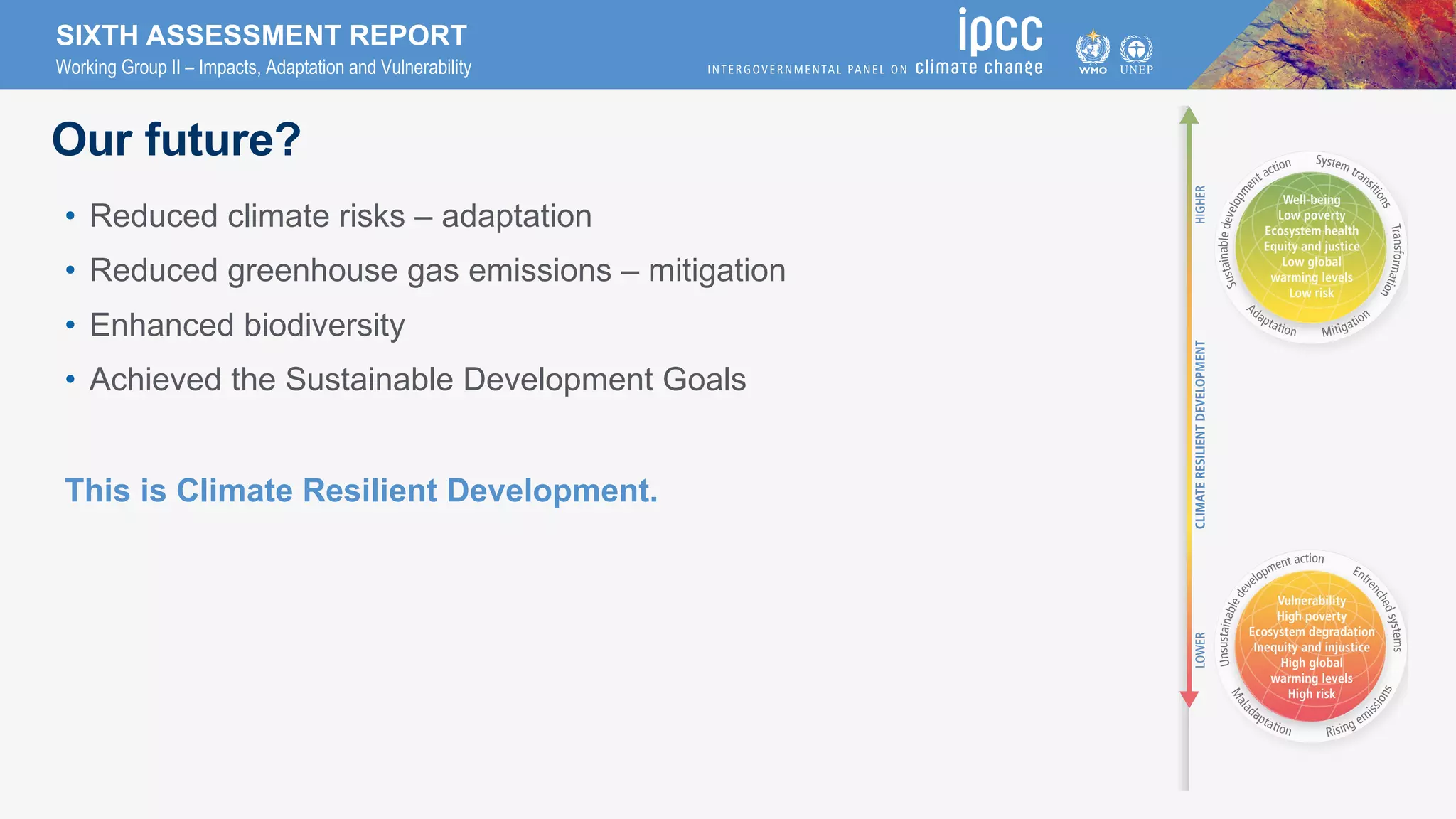
![SIXTH ASSESSMENT REPORT
Working Group II – Impacts, Adaptation and Vulnerability
Climate Resilient Development
The solutions framework:
• Is considered across government and all of civil society
• Involves everyone – forming partnerships
[GovernmentZA_DIRCO_CC BY-ND 2.0; Marlon del Aguila/CIFOR CC BY-NC-ND 2.0]](https://image.slidesharecdn.com/ipccar6wgiipressconferenceslides-220301112036/75/IPCC-6th-assessment-report-wg2-Slides-used-at-Press-conference-35-2048.jpg)
![SIXTH ASSESSMENT REPORT
Working Group II – Impacts, Adaptation and Vulnerability
Climate Resilient Development
The solutions framework:
• Draws on wide-ranging knowledge (scientific, Indigenous, local,
practical)
[thisisengineering-raeng / Unsplash; Aris Sanjaya/CIFOR CC BY-NC-ND 2.0]](https://image.slidesharecdn.com/ipccar6wgiipressconferenceslides-220301112036/75/IPCC-6th-assessment-report-wg2-Slides-used-at-Press-conference-36-2048.jpg)
![SIXTH ASSESSMENT REPORT
Working Group II – Impacts, Adaptation and Vulnerability
Climate Resilient Development
The solutions framework:
• Conserves and restores ecosystems
[Yuichi Ishida/UNDP Timor-Leste CC BY-NY 2.0; Axel Fassio/CIFOR CC BY-NC-ND 2.0]](https://image.slidesharecdn.com/ipccar6wgiipressconferenceslides-220301112036/75/IPCC-6th-assessment-report-wg2-Slides-used-at-Press-conference-37-2048.jpg)
![SIXTH ASSESSMENT REPORT
Working Group II – Impacts, Adaptation and Vulnerability
Climate Resilient Development
The solutions framework:
• Involves marginalized groups
• Prioritises equity and justice
• Reconciles different interests, values and world views
[Mika Baumeister / Unsplash; Aulia Erlangga/CIFOR CC BY-NC-ND 2.0]](https://image.slidesharecdn.com/ipccar6wgiipressconferenceslides-220301112036/75/IPCC-6th-assessment-report-wg2-Slides-used-at-Press-conference-38-2048.jpg)
![SIXTH ASSESSMENT REPORT
Working Group II – Impacts, Adaptation and Vulnerability
Climate Resilient Development
The solutions framework:
• Requires scaled-up investment and international cooperation
[Kumerra Gemechu/CIFOR CC BY-NC-ND 2.0, Thisisengineering Raeng / Unsplash]](https://image.slidesharecdn.com/ipccar6wgiipressconferenceslides-220301112036/75/IPCC-6th-assessment-report-wg2-Slides-used-at-Press-conference-39-2048.jpg)
![SIXTH ASSESSMENT REPORT
Working Group II – Impacts, Adaptation and Vulnerability
[Axel Fassio/CIFOR CC BY-NC-ND 2.0]
Increasing urgency
Starting today,
every action, every
decision matters.
Worldwide action is more urgent
than previously assessed.](https://image.slidesharecdn.com/ipccar6wgiipressconferenceslides-220301112036/75/IPCC-6th-assessment-report-wg2-Slides-used-at-Press-conference-40-2048.jpg)


The IPCC's sixth assessment report on climate change highlights its significant impacts, adaptation challenges, and vulnerabilities affecting billions, particularly in urban areas. It stresses the urgent need for global action to reduce emissions and adapt to ongoing changes, noting that delays will risk a viable future. The report calls for comprehensive solutions that involve diverse stakeholders and equitable approaches to enhance resilience against climate threats.


![The next forty years icrisat 40th anniversary robert [compatibility mode]](https://cdn.slidesharecdn.com/ss_thumbnails/thenextfortyyearsicrisat40thanniversaryrobertcompatibilitymode-121009063534-phpapp01-thumbnail.jpg?width=640&height=640&fit=bounds)


