Seminar work for IP Networks and Protocols
European Master of Reseach on Information and
Communication Technologies

IP-Based Communications Over
Satellites
Bektaş Şahin

Fall semester 2012-2013
Barcelona
Presentation Outline
• Introduction
• Satellite Systems
• Technical Difficulties in Satellite Communications
• Solutions to the Technical Difficulties
• Conclusions
• References

Seminar works for IP Networks and Protocols

2
Introduction
•

In the past Satellites were only used for Radio/TV Broadcasting or Oversea
phone calls.

•

A communications satellite in general is a radio relay station in orbit above the
earth that receives, amplifies, and redirects analog and digital signals carried
on a specific radio frequency.

•

Some other types of satellites are: Weather, Earth Observation and
Navigation.

•

Some of the benefits of Satellite communications over terrestrial systems can
be told as;
– High Bandwidth
• Ka-band (20-30 GHz) can give gigabits per second throughput.

– Inexpensive
• No requirement of cables, and also wide area of coverage.

– Simple Network Topology
• Compared to Terrestrial network GEO satellites require much simpler delivery paths.

– Easier for Broadcast/Multicast applications
Seminar works for IP Networks and Protocols

3
Introduction Cont’d

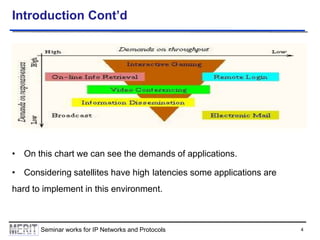
• On this chart we can see the demands of applications.
• Considering satellites have high latencies some applications are
hard to implement in this environment.

Seminar works for IP Networks and Protocols

4
Satellite Systems
•

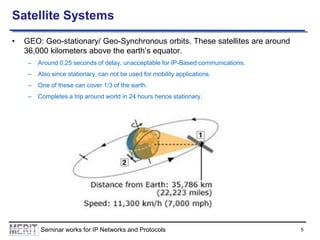
GEO: Geo-stationary/ Geo-Synchronous orbits. These satellites are around
36,000 kilometers above the earth’s equator.
–

Around 0.25 seconds of delay, unacceptable for IP-Based communications.

–

Also since stationary, can not be used for mobility applications.

–

One of these can cover 1/3 of the earth.

–

Completes a trip around world in 24 hours hence stationary.

Seminar works for IP Networks and Protocols

5
Satellite Systems Cont’d
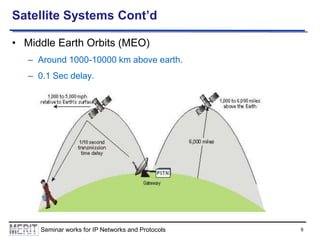
• Middle Earth Orbits (MEO)
– Around 1000-10000 km above earth.
– 0.1 Sec delay.

Seminar works for IP Networks and Protocols

6
Satellite Systems Cont’d
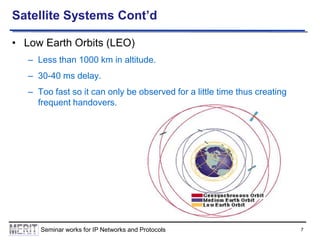
• Low Earth Orbits (LEO)
– Less than 1000 km in altitude.
– 30-40 ms delay.
– Too fast so it can only be observed for a little time thus creating
frequent handovers.

Seminar works for IP Networks and Protocols

7
Satellite Systems Cont’d
• Some Applications of TCP/IP over Satellites
• Eutelsat Tooway
– 18 mbps speed better than ADSL and on par with ADSL 2+.
– Works on Ku-Ka band.
– Up to 50 mbps for Business Solutions.
– 29 satellites covering Europe, some parts of Africa and some parts of
Asia.

• Inmarsat Global Xpress
– Works on Ka band.
– Promising around 50 mbps of speed.
– Aiming for full world coverage.

Seminar works for IP Networks and Protocols

8
Satellite Systems Cont’d
• Broadband Global Area Network (BGAN)
– Offered by Inmarsat, 3 satellites giving full world coverage.
– Aim is to give internet access on rural areas.
– 492 kbit/s of speed.

– Latency around 1-1.5 seconds.

• SES Broadband
– Max DL speed of 10 mbit/s.
– Works on 14-14.5 GHz.
– Two satellites are used, stationed to cover Europe.
– Minimum latency of around 0.5 seconds.

Seminar works for IP Networks and Protocols

9
Satellite Systems Cont’d
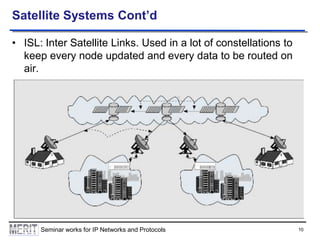
• ISL: Inter Satellite Links. Used in a lot of constellations to
keep every node updated and every data to be routed on
air.

Seminar works for IP Networks and Protocols

10
Satellite Systems Cont’d
• Some Network Topologies
– Simplex Transmission
• One way transmission, mostly receive only. Used for Broadcast
Services.

– Point to Point Bidirectional
• Common usage in internet, both Downlink and Uplink is done by
satellites.

– Mobile Antenna Service
• Used for special event broadcasting or situational demands.

– Mesh Networks
• Acting as a router for several networks all around the globe.

Seminar works for IP Networks and Protocols

11
Technical Difficulties in
SatelliteCommunications
•

There are several challenges in the field of Satellite Communications.
However the focus of this presentation is mainly TCP/IP related problems and
their solutions in two categories. Routing related problems and TCP/IP related
ones.

• Routing Problems
– Networking through satellites started with just amplifying the signal and frequency
shifting it back to the ground station.
– Development of ISL’s led to the need of dynamic routing. And also on board
processing and switching.
– With GEO satellites routing is not that much of an issue as they cover 1/3 of the
earth but the introduction of LEO constellations demanded this.

– Main problem is speed of LEO satellites, 25000 km/h. They stay in line of sight for
just seconds after which a handover is needed.
– RIP, OSPF require complete routing tables but the dynamic nature of these
constellations creates dynamic routing tables which is hard to maintain.
– Predictability, Periodicity, Regularity and constant number of nodes is the main
benefits of these constellations.
Seminar works for IP Networks and Protocols

12
Technical Difficulties in Satellite
Communications Cont’d
•

TCP/IP Related Issues

•

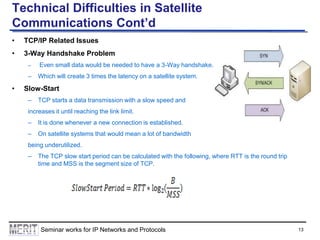
3-Way Handshake Problem
–

–

•

Even small data would be needed to have a 3-Way handshake.
Which will create 3 times the latency on a satellite system.

Slow-Start
–

TCP starts a data transmission with a slow speed and

increases it until reaching the link limit.
–

It is done whenever a new connection is established.

–

On satellite systems that would mean a lot of bandwidth

being underutilized.
–

The TCP slow start period can be calculated with the following, where RTT is the round trip
time and MSS is the segment size of TCP.

Seminar works for IP Networks and Protocols

13
Technical Difficulties in Satellite
Communications Cont’d
•

Congestion
–
–

However there are a lot of things that could cause this like attenuation, link noise, LOS etc.

–

•

TCP assumes every problem is because of congestion and slows its’ transmission speed. And
also acceleration method “Slow Start” accelerates slower than usual.

But due to the nature of TCP it cannot understand these problems and still will force slow start
resulting with a lot of unused bandwidth and also slow transmission speeds.

Asymmetry and TCP Transfer Speed
–

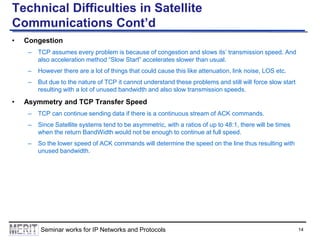
TCP can continue sending data if there is a continuous stream of ACK commands.

–

Since Satellite systems tend to be asymmetric, with a ratios of up to 48:1, there will be times
when the return BandWidth would not be enough to continue at full speed.

–

So the lower speed of ACK commands will determine the speed on the line thus resulting with
unused bandwidth.

Seminar works for IP Networks and Protocols

14
Solutions to the Technical Difficulties
• Routing Related Solutions

– OSPF and RIP relay on exchangin information whenever a change
is made.
– That works good on connection oriented systems however due to
the nature of NGEO satellites it will create substantial overhead.

– 3 Solutions are considered;
• Tunneling
• Network Address Translation
• Exterior Routing Protocols

Seminar works for IP Networks and Protocols

15
Solutions to the Technical Difficulties Cont’d
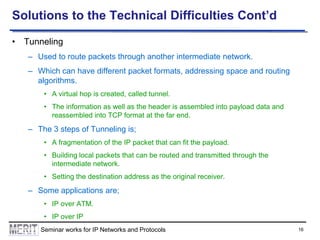
• Tunneling
– Used to route packets through another intermediate network.
– Which can have different packet formats, addressing space and routing
algorithms.
• A virtual hop is created, called tunnel.

• The information as well as the header is assembled into payload data and
reassembled into TCP format at the far end.

– The 3 steps of Tunneling is;
• A fragmentation of the IP packet that can fit the payload.
• Building local packets that can be routed and transmitted through the
intermediate network.
• Setting the destination address as the original receiver.

– Some applications are;
• IP over ATM.

• IP over IP
Seminar works for IP Networks and Protocols

16
Solutions to the Technical Difficulties Cont’d
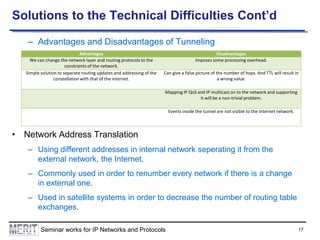
– Advantages and Disadvantages of Tunneling
Advantages
We can change the network layer and routing protocols to the
constraints of the network.
Simple solution to separate routing updates and addressing of the
constellation with that of the internet.

Disadvantages
Imposes some processing overhead.
Can give a false picture of the number of hops. And TTL will result in
a wrong value.
Mapping IP QoS and IP multicast on to the network and supporting
it will be a non-trivial problem.
Events inside the tunnel are not visible to the Internet network.

• Network Address Translation
– Using different addresses in internal network seperating it from the
external network, the Internet.
– Commonly used in order to renumber every network if there is a change
in external one.
– Used in satellite systems in order to decrease the number of routing table
exchanges.
Seminar works for IP Networks and Protocols

17
Solutions to the Technical Difficulties Cont’d
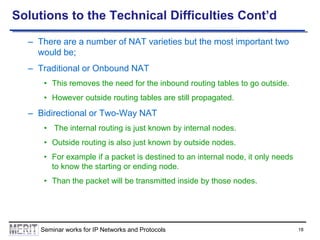
– There are a number of NAT varieties but the most important two
would be;
– Traditional or Onbound NAT
• This removes the need for the inbound routing tables to go outside.
• However outside routing tables are still propagated.

– Bidirectional or Two-Way NAT
• The internal routing is just known by internal nodes.
• Outside routing is also just known by outside nodes.
• For example if a packet is destined to an internal node, it only needs
to know the starting or ending node.
• Than the packet will be transmitted inside by those nodes.

Seminar works for IP Networks and Protocols

18
Solutions to the Technical Difficulties Cont’d
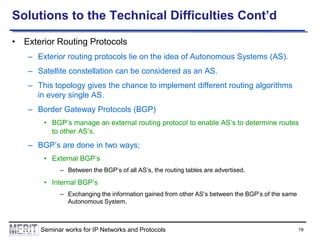
• Exterior Routing Protocols
– Exterior routing protocols lie on the idea of Autonomous Systems (AS).
– Satellite constellation can be considered as an AS.
– This topology gives the chance to implement different routing algorithms
in every single AS.

– Border Gateway Protocols (BGP)
• BGP’s manage an external routing protocol to enable AS’s to determine routes
to other AS’s.

– BGP’s are done in two ways;
• External BGP’s
– Between the BGP’s of all AS’s, the routing tables are advertised.

• Internal BGP’s
– Exchanging the information gained from other AS’s between the BGP’s of the same
Autonomous System.

Seminar works for IP Networks and Protocols

19
Solutions to the Technical Difficulties Cont’d
• Congestion Avoidane Solutions
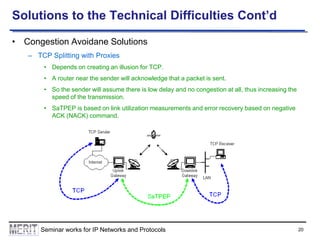
– TCP Splitting with Proxies
• Depends on creating an illusion for TCP.
• A router near the sender will acknowledge that a packet is sent.
• So the sender will assume there is low delay and no congestion at all, thus increasing the
speed of the transmission.

• SaTPEP is based on link utilization measurements and error recovery based on negative
ACK (NACK) command.

Seminar works for IP Networks and Protocols

20
Solutions to the Technical Difficulties Cont’d
– Explicit Window Adaptation (EWA)
• Explicit congestion control scheme of the window size of TCP connections as a function of
free buffer value.
• Only considers Free Buffer Value so makes a problem if there is high bandwidth and/or
delay. Such is the case in Satellite Communications mostly.
• However it can work fine in a average bandwidth and delay system.

– Recursive, explicit and fair window adjustment (REFWA, REFWA Plus)
• First comprehensive scheme that addresses both efficiency and fairness of TCP in NGEO
broadband satellite networks.
• The basic idea behind this REFWA scheme is to match the sum of window sizes of all
active TCP connections sharing a bottleneck link to the effective bandwidth-delay product
of the network .
• This improves efficiency bt assigning a weight proportional to their RTT’s.
• This feedback is the optimal value which gives the number of data that the sender should
send in order not to overload the network.
• REFWA+ is the upgrade of REFWA that copes with link errors as well.

Seminar works for IP Networks and Protocols

21
Solutions to the Technical Difficulties Cont’d
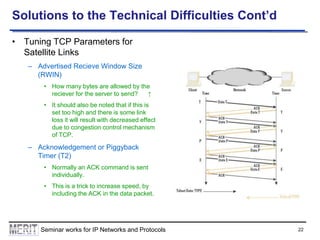
• Tuning TCP Parameters for
Satellite Links
– Advertised Recieve Window Size
(RWIN)
• How many bytes are allowed by the
reciever for the server to send?
↑
• It should also be noted that if this is
set too high and there is some link
loss it will result with decreased effect
due to congestion control mechanism
of TCP.

– Acknowledgement or Piggyback
Timer (T2)
• Normally an ACK command is sent
individually.
• This is a trick to increase speed, by
including the ACK in the data packet.

Seminar works for IP Networks and Protocols

22
Solutions to the Technical Difficulties Cont’d
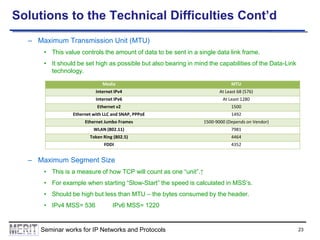
– Maximum Transmission Unit (MTU)
• This value controls the amount of data to be sent in a single data link frame.
• It should be set high as possible but also bearing in mind the capabilities of the Data-Link
technology.
Media

MTU

Internet IPv4

At Least 68 (576)

Internet IPv6

At Least 1280

Ethernet v2

1500

Ethernet with LLC and SNAP, PPPoE

1492

Ethernet Jumbo Frames

1500-9000 (Depends on Vendor)

WLAN (802.11)

7981

Token Ring (802.5)

4464

FDDI

4352

– Maximum Segment Size
• This is a measure of how TCP will count as one “unit”.↑
• For example when starting “Slow-Start” the speed is calculated in MSS’s.
• Should be high but less than MTU – the bytes consumed by the header.
• IPv4 MSS= 536

IPv6 MSS= 1220

Seminar works for IP Networks and Protocols

23
Solutions to the Technical Difficulties Cont’d
• Giving TCP Less Traffic to transport over Satellite.
– Compression
• A Compression system directly reduces the data required to be
transmitted.
• General İnternet browsing compression is around %30 but text based
data can be compressed up to %60.
– Caching
• Caching is the algorithm where some information is stored on a server
or a client so that it does not need to be transmitted again.

• Works well for corporate networks and sites where crucial information
is transmitted.
• Savings of up to %30-50 is achieved through caching.

Seminar works for IP Networks and Protocols

24
Solutions to the Technical Difficulties Cont’d
•

TCP Spoofing and Protocol Converters
– Spoofing
• Near end an Far End devices are used to trick TCP.
• With spoofing the end user has little to no effect on the protocol.
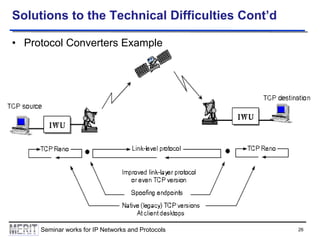
– Protocol Converters

• Kind of Super Spoofing.
• However after the Near End device to the Far End one can choose from a
variety of transmit protocols that can be more beneficial.
• Some changes that can be done on Protocol Converters are;
– Tuning and Controlling

– Flexibility
– Cross-Vendor and Cross-Product Compatibility.

Seminar works for IP Networks and Protocols

25
Solutions to the Technical Difficulties Cont’d
• Protocol Converters Example

Seminar works for IP Networks and Protocols

26
Conclusions
• Considered to be the future of communication systems,
TCP should be implemented on Satellites.
• Routing and TCP characteristics are the main problems.
• Though with the advancement of the technology, these
problems can be overcomed.
• Some of the solutions to these problems are discussed.
• If the problems could be solved, satellite can be the future
of communication systems.

Seminar works for IP Networks and Protocols

27
References
•

[1] T. Taleb, N. Kato, Y. Nemoto “Recent Trends In IP/NGEO Satellite Communication
System: Transport, Routing, And Mobility Management Concerns”, IEEE Wireless
Communications, Oct. 2005, pp. 63-69.

•

[2] J. Farserotu, R. Prasad “A Survey of Future Broadband Multimedia Satellite
Systems, Issues and Trends”, IEEE Communications Magazine, June 2000, pp. 12833.

•

[3] Constellation Networks Corporation, “Optimized TCP/IP for Satellite
Communications”, www.constellationnetcorp.com.

•

[4] H. Tsunoda et al., “Supporting IP/LEO Satellite Networks by Handover-Independent
IP Mobility Management,” IEEE JSAC, vol. 22, no. 2, Feb. 2004, pp. 300–07.

•

[5] Y. Zhang, D. De Lucia, B. Ryu, S.K. Dao, Hughes Research Laboratories, “Satellite
Communications in the Global Internet: Issues, Pitfalls and Potential”,
http://www.isoc.org/inet97/proceedings/F5/F5_1.HTM#s3 .

•

[6] M. Omueti, “Improving TCP Performance in Mobile Satellite IP Communications”,
Simon Fraser University,
http://www2.ensc.sfu.ca/~ljilja/cnl/presentations/modupe/TMP_Lisbon/TMP_lisbon.pdf,
June, 2006.

Seminar works for IP Networks and Protocols

28
References Cont’d
•

[7] Flash Networks, “TCP over Satellite: Getting it Right”,
http://www.gs.ru/soft/si/misc/TCP.pdf, 2000.

•

[8] T.J. Anderson, “TCP/IP over Satellite: Optimization vs Acceleration”, End || End
Communications, Inc. – White Paper, April 2005.

•

[9] T.Taleb, N.Kato, Y.Nemoto, “REFWA Plus: Enhancement of REFWA to Combat Link
Errors in LEO Satellite Networks”, IEEE, 2005.

•

[10] Intelsat, "Satellite Basics: How it Works",
http://www.intelsat.com/resources/satellite-basics/how-it-works.asp.

•

[11] Eutelsat Communications, http://www.eutelsat.com/products/broadbandtooway.html.

•

[12] L.Wood, A.Clerget, I.Andrekopoulos, G.Pavlau, W.Dabbous, "IP Routing Issues in
Satellite Constellation Networks", International Journal of Satellite Communications
Special Issue on Internet Protocols over Satellites, vol.18, no.6, Nov/Dec. 2000.

•

[13] D.Velenis, D.Kalogeras, B.Maglaris, " SaTPEP: a TCP Performance Enhancing
Proxy for Satellite Links", Department of Electrical and Computer Engineering, National
Technical University of Athens.

Seminar works for IP Networks and Protocols

29
References Cont’d
•

[14] REFWA T. Taleb, N. Kato, and Y. Nemoto, “An Explicit and Fair Window
Adjustment Method to Enhance TCP Efficiency and Fairness over Multi- Hops Satellite
Networks,” IEEE JSAC, vol. 22, no. 2, Feb. 2004, pp. 371–87.

•

[15] Inmersat Satellite Communications, Inmersat Global Xpress, http://www.igx.com/ .

•

[16] Inmersat Satellite Communications, Broadband Global Area Network,
http://www.inmarsat.com/services/BGAN .

•

[17] SES S.A. , SES Broadband, http://www.ses.com/broadband-services .

Seminar works for IP Networks and Protocols

30
Thanks for Listening

Seminar works for IP Networks and Protocols

31

IP based communications over satellites

  • 1.
    Seminar work forIP Networks and Protocols European Master of Reseach on Information and Communication Technologies IP-Based Communications Over Satellites Bektaş Şahin Fall semester 2012-2013 Barcelona
  • 2.
    Presentation Outline • Introduction •Satellite Systems • Technical Difficulties in Satellite Communications • Solutions to the Technical Difficulties • Conclusions • References Seminar works for IP Networks and Protocols 2
  • 3.
    Introduction • In the pastSatellites were only used for Radio/TV Broadcasting or Oversea phone calls. • A communications satellite in general is a radio relay station in orbit above the earth that receives, amplifies, and redirects analog and digital signals carried on a specific radio frequency. • Some other types of satellites are: Weather, Earth Observation and Navigation. • Some of the benefits of Satellite communications over terrestrial systems can be told as; – High Bandwidth • Ka-band (20-30 GHz) can give gigabits per second throughput. – Inexpensive • No requirement of cables, and also wide area of coverage. – Simple Network Topology • Compared to Terrestrial network GEO satellites require much simpler delivery paths. – Easier for Broadcast/Multicast applications Seminar works for IP Networks and Protocols 3
  • 4.
    Introduction Cont’d • Onthis chart we can see the demands of applications. • Considering satellites have high latencies some applications are hard to implement in this environment. Seminar works for IP Networks and Protocols 4
  • 5.
    Satellite Systems • GEO: Geo-stationary/Geo-Synchronous orbits. These satellites are around 36,000 kilometers above the earth’s equator. – Around 0.25 seconds of delay, unacceptable for IP-Based communications. – Also since stationary, can not be used for mobility applications. – One of these can cover 1/3 of the earth. – Completes a trip around world in 24 hours hence stationary. Seminar works for IP Networks and Protocols 5
  • 6.
    Satellite Systems Cont’d •Middle Earth Orbits (MEO) – Around 1000-10000 km above earth. – 0.1 Sec delay. Seminar works for IP Networks and Protocols 6
  • 7.
    Satellite Systems Cont’d •Low Earth Orbits (LEO) – Less than 1000 km in altitude. – 30-40 ms delay. – Too fast so it can only be observed for a little time thus creating frequent handovers. Seminar works for IP Networks and Protocols 7
  • 8.
    Satellite Systems Cont’d •Some Applications of TCP/IP over Satellites • Eutelsat Tooway – 18 mbps speed better than ADSL and on par with ADSL 2+. – Works on Ku-Ka band. – Up to 50 mbps for Business Solutions. – 29 satellites covering Europe, some parts of Africa and some parts of Asia. • Inmarsat Global Xpress – Works on Ka band. – Promising around 50 mbps of speed. – Aiming for full world coverage. Seminar works for IP Networks and Protocols 8
  • 9.
    Satellite Systems Cont’d •Broadband Global Area Network (BGAN) – Offered by Inmarsat, 3 satellites giving full world coverage. – Aim is to give internet access on rural areas. – 492 kbit/s of speed. – Latency around 1-1.5 seconds. • SES Broadband – Max DL speed of 10 mbit/s. – Works on 14-14.5 GHz. – Two satellites are used, stationed to cover Europe. – Minimum latency of around 0.5 seconds. Seminar works for IP Networks and Protocols 9
  • 10.
    Satellite Systems Cont’d •ISL: Inter Satellite Links. Used in a lot of constellations to keep every node updated and every data to be routed on air. Seminar works for IP Networks and Protocols 10
  • 11.
    Satellite Systems Cont’d •Some Network Topologies – Simplex Transmission • One way transmission, mostly receive only. Used for Broadcast Services. – Point to Point Bidirectional • Common usage in internet, both Downlink and Uplink is done by satellites. – Mobile Antenna Service • Used for special event broadcasting or situational demands. – Mesh Networks • Acting as a router for several networks all around the globe. Seminar works for IP Networks and Protocols 11
  • 12.
    Technical Difficulties in SatelliteCommunications • Thereare several challenges in the field of Satellite Communications. However the focus of this presentation is mainly TCP/IP related problems and their solutions in two categories. Routing related problems and TCP/IP related ones. • Routing Problems – Networking through satellites started with just amplifying the signal and frequency shifting it back to the ground station. – Development of ISL’s led to the need of dynamic routing. And also on board processing and switching. – With GEO satellites routing is not that much of an issue as they cover 1/3 of the earth but the introduction of LEO constellations demanded this. – Main problem is speed of LEO satellites, 25000 km/h. They stay in line of sight for just seconds after which a handover is needed. – RIP, OSPF require complete routing tables but the dynamic nature of these constellations creates dynamic routing tables which is hard to maintain. – Predictability, Periodicity, Regularity and constant number of nodes is the main benefits of these constellations. Seminar works for IP Networks and Protocols 12
  • 13.
    Technical Difficulties inSatellite Communications Cont’d • TCP/IP Related Issues • 3-Way Handshake Problem – – • Even small data would be needed to have a 3-Way handshake. Which will create 3 times the latency on a satellite system. Slow-Start – TCP starts a data transmission with a slow speed and increases it until reaching the link limit. – It is done whenever a new connection is established. – On satellite systems that would mean a lot of bandwidth being underutilized. – The TCP slow start period can be calculated with the following, where RTT is the round trip time and MSS is the segment size of TCP. Seminar works for IP Networks and Protocols 13
  • 14.
    Technical Difficulties inSatellite Communications Cont’d • Congestion – – However there are a lot of things that could cause this like attenuation, link noise, LOS etc. – • TCP assumes every problem is because of congestion and slows its’ transmission speed. And also acceleration method “Slow Start” accelerates slower than usual. But due to the nature of TCP it cannot understand these problems and still will force slow start resulting with a lot of unused bandwidth and also slow transmission speeds. Asymmetry and TCP Transfer Speed – TCP can continue sending data if there is a continuous stream of ACK commands. – Since Satellite systems tend to be asymmetric, with a ratios of up to 48:1, there will be times when the return BandWidth would not be enough to continue at full speed. – So the lower speed of ACK commands will determine the speed on the line thus resulting with unused bandwidth. Seminar works for IP Networks and Protocols 14
  • 15.
    Solutions to theTechnical Difficulties • Routing Related Solutions – OSPF and RIP relay on exchangin information whenever a change is made. – That works good on connection oriented systems however due to the nature of NGEO satellites it will create substantial overhead. – 3 Solutions are considered; • Tunneling • Network Address Translation • Exterior Routing Protocols Seminar works for IP Networks and Protocols 15
  • 16.
    Solutions to theTechnical Difficulties Cont’d • Tunneling – Used to route packets through another intermediate network. – Which can have different packet formats, addressing space and routing algorithms. • A virtual hop is created, called tunnel. • The information as well as the header is assembled into payload data and reassembled into TCP format at the far end. – The 3 steps of Tunneling is; • A fragmentation of the IP packet that can fit the payload. • Building local packets that can be routed and transmitted through the intermediate network. • Setting the destination address as the original receiver. – Some applications are; • IP over ATM. • IP over IP Seminar works for IP Networks and Protocols 16
  • 17.
    Solutions to theTechnical Difficulties Cont’d – Advantages and Disadvantages of Tunneling Advantages We can change the network layer and routing protocols to the constraints of the network. Simple solution to separate routing updates and addressing of the constellation with that of the internet. Disadvantages Imposes some processing overhead. Can give a false picture of the number of hops. And TTL will result in a wrong value. Mapping IP QoS and IP multicast on to the network and supporting it will be a non-trivial problem. Events inside the tunnel are not visible to the Internet network. • Network Address Translation – Using different addresses in internal network seperating it from the external network, the Internet. – Commonly used in order to renumber every network if there is a change in external one. – Used in satellite systems in order to decrease the number of routing table exchanges. Seminar works for IP Networks and Protocols 17
  • 18.
    Solutions to theTechnical Difficulties Cont’d – There are a number of NAT varieties but the most important two would be; – Traditional or Onbound NAT • This removes the need for the inbound routing tables to go outside. • However outside routing tables are still propagated. – Bidirectional or Two-Way NAT • The internal routing is just known by internal nodes. • Outside routing is also just known by outside nodes. • For example if a packet is destined to an internal node, it only needs to know the starting or ending node. • Than the packet will be transmitted inside by those nodes. Seminar works for IP Networks and Protocols 18
  • 19.
    Solutions to theTechnical Difficulties Cont’d • Exterior Routing Protocols – Exterior routing protocols lie on the idea of Autonomous Systems (AS). – Satellite constellation can be considered as an AS. – This topology gives the chance to implement different routing algorithms in every single AS. – Border Gateway Protocols (BGP) • BGP’s manage an external routing protocol to enable AS’s to determine routes to other AS’s. – BGP’s are done in two ways; • External BGP’s – Between the BGP’s of all AS’s, the routing tables are advertised. • Internal BGP’s – Exchanging the information gained from other AS’s between the BGP’s of the same Autonomous System. Seminar works for IP Networks and Protocols 19
  • 20.
    Solutions to theTechnical Difficulties Cont’d • Congestion Avoidane Solutions – TCP Splitting with Proxies • Depends on creating an illusion for TCP. • A router near the sender will acknowledge that a packet is sent. • So the sender will assume there is low delay and no congestion at all, thus increasing the speed of the transmission. • SaTPEP is based on link utilization measurements and error recovery based on negative ACK (NACK) command. Seminar works for IP Networks and Protocols 20
  • 21.
    Solutions to theTechnical Difficulties Cont’d – Explicit Window Adaptation (EWA) • Explicit congestion control scheme of the window size of TCP connections as a function of free buffer value. • Only considers Free Buffer Value so makes a problem if there is high bandwidth and/or delay. Such is the case in Satellite Communications mostly. • However it can work fine in a average bandwidth and delay system. – Recursive, explicit and fair window adjustment (REFWA, REFWA Plus) • First comprehensive scheme that addresses both efficiency and fairness of TCP in NGEO broadband satellite networks. • The basic idea behind this REFWA scheme is to match the sum of window sizes of all active TCP connections sharing a bottleneck link to the effective bandwidth-delay product of the network . • This improves efficiency bt assigning a weight proportional to their RTT’s. • This feedback is the optimal value which gives the number of data that the sender should send in order not to overload the network. • REFWA+ is the upgrade of REFWA that copes with link errors as well. Seminar works for IP Networks and Protocols 21
  • 22.
    Solutions to theTechnical Difficulties Cont’d • Tuning TCP Parameters for Satellite Links – Advertised Recieve Window Size (RWIN) • How many bytes are allowed by the reciever for the server to send? ↑ • It should also be noted that if this is set too high and there is some link loss it will result with decreased effect due to congestion control mechanism of TCP. – Acknowledgement or Piggyback Timer (T2) • Normally an ACK command is sent individually. • This is a trick to increase speed, by including the ACK in the data packet. Seminar works for IP Networks and Protocols 22
  • 23.
    Solutions to theTechnical Difficulties Cont’d – Maximum Transmission Unit (MTU) • This value controls the amount of data to be sent in a single data link frame. • It should be set high as possible but also bearing in mind the capabilities of the Data-Link technology. Media MTU Internet IPv4 At Least 68 (576) Internet IPv6 At Least 1280 Ethernet v2 1500 Ethernet with LLC and SNAP, PPPoE 1492 Ethernet Jumbo Frames 1500-9000 (Depends on Vendor) WLAN (802.11) 7981 Token Ring (802.5) 4464 FDDI 4352 – Maximum Segment Size • This is a measure of how TCP will count as one “unit”.↑ • For example when starting “Slow-Start” the speed is calculated in MSS’s. • Should be high but less than MTU – the bytes consumed by the header. • IPv4 MSS= 536 IPv6 MSS= 1220 Seminar works for IP Networks and Protocols 23
  • 24.
    Solutions to theTechnical Difficulties Cont’d • Giving TCP Less Traffic to transport over Satellite. – Compression • A Compression system directly reduces the data required to be transmitted. • General İnternet browsing compression is around %30 but text based data can be compressed up to %60. – Caching • Caching is the algorithm where some information is stored on a server or a client so that it does not need to be transmitted again. • Works well for corporate networks and sites where crucial information is transmitted. • Savings of up to %30-50 is achieved through caching. Seminar works for IP Networks and Protocols 24
  • 25.
    Solutions to theTechnical Difficulties Cont’d • TCP Spoofing and Protocol Converters – Spoofing • Near end an Far End devices are used to trick TCP. • With spoofing the end user has little to no effect on the protocol. – Protocol Converters • Kind of Super Spoofing. • However after the Near End device to the Far End one can choose from a variety of transmit protocols that can be more beneficial. • Some changes that can be done on Protocol Converters are; – Tuning and Controlling – Flexibility – Cross-Vendor and Cross-Product Compatibility. Seminar works for IP Networks and Protocols 25
  • 26.
    Solutions to theTechnical Difficulties Cont’d • Protocol Converters Example Seminar works for IP Networks and Protocols 26
  • 27.
    Conclusions • Considered tobe the future of communication systems, TCP should be implemented on Satellites. • Routing and TCP characteristics are the main problems. • Though with the advancement of the technology, these problems can be overcomed. • Some of the solutions to these problems are discussed. • If the problems could be solved, satellite can be the future of communication systems. Seminar works for IP Networks and Protocols 27
  • 28.
    References • [1] T. Taleb,N. Kato, Y. Nemoto “Recent Trends In IP/NGEO Satellite Communication System: Transport, Routing, And Mobility Management Concerns”, IEEE Wireless Communications, Oct. 2005, pp. 63-69. • [2] J. Farserotu, R. Prasad “A Survey of Future Broadband Multimedia Satellite Systems, Issues and Trends”, IEEE Communications Magazine, June 2000, pp. 12833. • [3] Constellation Networks Corporation, “Optimized TCP/IP for Satellite Communications”, www.constellationnetcorp.com. • [4] H. Tsunoda et al., “Supporting IP/LEO Satellite Networks by Handover-Independent IP Mobility Management,” IEEE JSAC, vol. 22, no. 2, Feb. 2004, pp. 300–07. • [5] Y. Zhang, D. De Lucia, B. Ryu, S.K. Dao, Hughes Research Laboratories, “Satellite Communications in the Global Internet: Issues, Pitfalls and Potential”, http://www.isoc.org/inet97/proceedings/F5/F5_1.HTM#s3 . • [6] M. Omueti, “Improving TCP Performance in Mobile Satellite IP Communications”, Simon Fraser University, http://www2.ensc.sfu.ca/~ljilja/cnl/presentations/modupe/TMP_Lisbon/TMP_lisbon.pdf, June, 2006. Seminar works for IP Networks and Protocols 28
  • 29.
    References Cont’d • [7] FlashNetworks, “TCP over Satellite: Getting it Right”, http://www.gs.ru/soft/si/misc/TCP.pdf, 2000. • [8] T.J. Anderson, “TCP/IP over Satellite: Optimization vs Acceleration”, End || End Communications, Inc. – White Paper, April 2005. • [9] T.Taleb, N.Kato, Y.Nemoto, “REFWA Plus: Enhancement of REFWA to Combat Link Errors in LEO Satellite Networks”, IEEE, 2005. • [10] Intelsat, "Satellite Basics: How it Works", http://www.intelsat.com/resources/satellite-basics/how-it-works.asp. • [11] Eutelsat Communications, http://www.eutelsat.com/products/broadbandtooway.html. • [12] L.Wood, A.Clerget, I.Andrekopoulos, G.Pavlau, W.Dabbous, "IP Routing Issues in Satellite Constellation Networks", International Journal of Satellite Communications Special Issue on Internet Protocols over Satellites, vol.18, no.6, Nov/Dec. 2000. • [13] D.Velenis, D.Kalogeras, B.Maglaris, " SaTPEP: a TCP Performance Enhancing Proxy for Satellite Links", Department of Electrical and Computer Engineering, National Technical University of Athens. Seminar works for IP Networks and Protocols 29
  • 30.
    References Cont’d • [14] REFWAT. Taleb, N. Kato, and Y. Nemoto, “An Explicit and Fair Window Adjustment Method to Enhance TCP Efficiency and Fairness over Multi- Hops Satellite Networks,” IEEE JSAC, vol. 22, no. 2, Feb. 2004, pp. 371–87. • [15] Inmersat Satellite Communications, Inmersat Global Xpress, http://www.igx.com/ . • [16] Inmersat Satellite Communications, Broadband Global Area Network, http://www.inmarsat.com/services/BGAN . • [17] SES S.A. , SES Broadband, http://www.ses.com/broadband-services . Seminar works for IP Networks and Protocols 30
  • 31.
    Thanks for Listening Seminarworks for IP Networks and Protocols 31