IoT Testing
Manual, Automation and Cybersecurity
techniques
Speaker
Bohdan Savchuk
● IoT and Cybersecurity Enthusiast;
● QA Expert;
● CTO and Co-Founder at Anbosoft;
● 11+years in IT, 6 years in IoT.
Audience
1) Junior QAs, who only start their testing journey
1) Experienced QAs, who never faced with IoT projects
1) IoT QAs, who want to improve their current testing
framework
2) Everybody else, who are interested in IoT
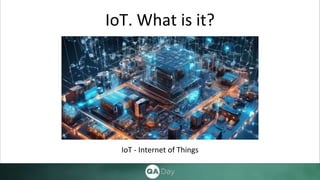
IoT. What is it?
IoT - Internet of Things
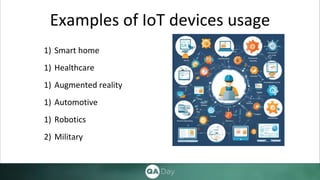
Examples of IoT devices usage
1) Smart home
1) Healthcare
1) Augmented reality
1) Automotive
1) Robotics
2) Military
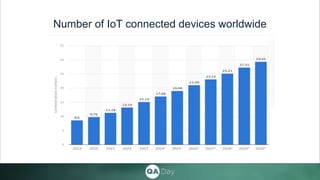
Number of IoT connected devices worldwide
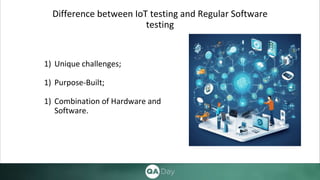
Difference between IoT testing and Regular Software
testing
1) Unique challenges;
1) Purpose-Built;
1) Combination of Hardware and
Software.
Common techniques
1) Requirements clarification;
1) Test documentation creation;
1) SDLC related processes.
Applicable types of testing
1) Manual
2) Automation
3) Performance
4) Security
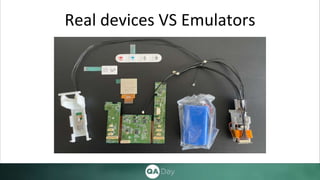
Real devices VS Emulators
Manual QA approach. Tasks
1) Configuring functionality to be
tested on Real Devices (RD) as well
as Emulators (E)
2) Conducting tests on both RD and E
3) Striking a balance between tests
conducted on RD and E
Manual QA approach. Techniques
1) Exploratory testing
2) User experience validation
3) Real world scenario testing
4) Edge case testing
5) Usability testing
Manual QA approach. Benefits
1) Human interaction
2) Comprehensive test coverage
3) Early detection of issues
4) UI and UX testing
5) Real time observation
6) Flexibility and adaptability
Cyber Security QA Approach. Tasks
1) Identify vulnerability in
device/network;
2) Verify the effectiveness if
authentication and authorisation;
3) Ensure proper transmission and
storing of sensitive data.
1) Firmware analysis (hard coded
passwords, insecure protocols)
2) Network verification
3) API testing (auth, data validation)
4) Physical Security Checks (tamper
detection, boot process)
5) Mobile app verification
6) Cloud Security Verification (data
storage, access)
Cyber Security QA Approach. Techniques
Cyber Security QA Approach. Benefits
1) Protect sensitive data
2) Prevent Unauthorized Access
3) Mitigate Cyber Risks
4) Ensure Compliance
5) Enhance Trust and Reputation
Automation QA Approach. Tasks
1) Streamline testing processes
2) Reduce the need for manual
intervention.
3) Save costs
4) Improve the efficiency of
software delivery
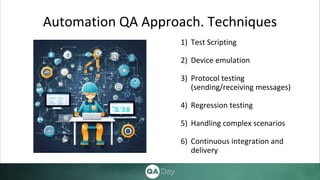
Automation QA Approach. Techniques
1) Test Scripting
2) Device emulation
3) Protocol testing
(sending/receiving messages)
4) Regression testing
5) Handling complex scenarios
6) Continuous integration and
delivery
Automation QA Approach. Benefits
1) Increased Efficiency
2) Tests Coverage
3) Reusability
4) Improved test accuracy
5) Time and Costs saving
6) Scalability
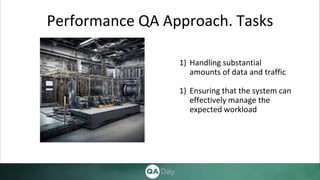
Performance QA Approach. Tasks
1) Handling substantial
amounts of data and traffic
1) Ensuring that the system can
effectively manage the
expected workload
Performance QA Approach. Techniques
1) Load (ability to handle high volume of data
or request)
2) Stress (high data traffic, device overload)
3) Endurance (device overheating, memory
fragmentation)
4) Power Consumption (battery
management)
Performance QA Approach. Benefits
1. Reliability
2. Scalability
3. UX
4. Optimization
5. Cost Efficiency
6. Compliance and Regulation
Summary
Conclusion
Integrating the system with both manual
(including cyber security) and automation
(including performance) techniques into the IoT
industry holds immense potential for future
advancements.
Thanks for attention!
Questions?

БОГДАН САВЧУК «IoT testing: Manual, Automation and Cyber Security techniques»

  • 1.
    IoT Testing Manual, Automationand Cybersecurity techniques
  • 2.
    Speaker Bohdan Savchuk ● IoTand Cybersecurity Enthusiast; ● QA Expert; ● CTO and Co-Founder at Anbosoft; ● 11+years in IT, 6 years in IoT.
  • 3.
    Audience 1) Junior QAs,who only start their testing journey 1) Experienced QAs, who never faced with IoT projects 1) IoT QAs, who want to improve their current testing framework 2) Everybody else, who are interested in IoT
  • 4.
    IoT. What isit? IoT - Internet of Things
  • 5.
    Examples of IoTdevices usage 1) Smart home 1) Healthcare 1) Augmented reality 1) Automotive 1) Robotics 2) Military
  • 6.
    Number of IoTconnected devices worldwide
  • 7.
    Difference between IoTtesting and Regular Software testing 1) Unique challenges; 1) Purpose-Built; 1) Combination of Hardware and Software.
  • 8.
    Common techniques 1) Requirementsclarification; 1) Test documentation creation; 1) SDLC related processes.
  • 9.
    Applicable types oftesting 1) Manual 2) Automation 3) Performance 4) Security
  • 10.
    Real devices VSEmulators
  • 11.
    Manual QA approach.Tasks 1) Configuring functionality to be tested on Real Devices (RD) as well as Emulators (E) 2) Conducting tests on both RD and E 3) Striking a balance between tests conducted on RD and E
  • 12.
    Manual QA approach.Techniques 1) Exploratory testing 2) User experience validation 3) Real world scenario testing 4) Edge case testing 5) Usability testing
  • 13.
    Manual QA approach.Benefits 1) Human interaction 2) Comprehensive test coverage 3) Early detection of issues 4) UI and UX testing 5) Real time observation 6) Flexibility and adaptability
  • 14.
    Cyber Security QAApproach. Tasks 1) Identify vulnerability in device/network; 2) Verify the effectiveness if authentication and authorisation; 3) Ensure proper transmission and storing of sensitive data.
  • 15.
    1) Firmware analysis(hard coded passwords, insecure protocols) 2) Network verification 3) API testing (auth, data validation) 4) Physical Security Checks (tamper detection, boot process) 5) Mobile app verification 6) Cloud Security Verification (data storage, access) Cyber Security QA Approach. Techniques
  • 16.
    Cyber Security QAApproach. Benefits 1) Protect sensitive data 2) Prevent Unauthorized Access 3) Mitigate Cyber Risks 4) Ensure Compliance 5) Enhance Trust and Reputation
  • 17.
    Automation QA Approach.Tasks 1) Streamline testing processes 2) Reduce the need for manual intervention. 3) Save costs 4) Improve the efficiency of software delivery
  • 18.
    Automation QA Approach.Techniques 1) Test Scripting 2) Device emulation 3) Protocol testing (sending/receiving messages) 4) Regression testing 5) Handling complex scenarios 6) Continuous integration and delivery
  • 19.
    Automation QA Approach.Benefits 1) Increased Efficiency 2) Tests Coverage 3) Reusability 4) Improved test accuracy 5) Time and Costs saving 6) Scalability
  • 20.
    Performance QA Approach.Tasks 1) Handling substantial amounts of data and traffic 1) Ensuring that the system can effectively manage the expected workload
  • 21.
    Performance QA Approach.Techniques 1) Load (ability to handle high volume of data or request) 2) Stress (high data traffic, device overload) 3) Endurance (device overheating, memory fragmentation) 4) Power Consumption (battery management)
  • 22.
    Performance QA Approach.Benefits 1. Reliability 2. Scalability 3. UX 4. Optimization 5. Cost Efficiency 6. Compliance and Regulation
  • 23.
  • 24.
    Conclusion Integrating the systemwith both manual (including cyber security) and automation (including performance) techniques into the IoT industry holds immense potential for future advancements.
  • 25.