INTERNET OF THINGS
IoT-Enabled Maintenance:
An Evolutionary Roadmap to
Anticipate the Unexpected
THE PROBLEM: MAINTENANCE IS A HEAVY BURDEN
ON OPERATIONAL COSTS AND EFFICIENCY
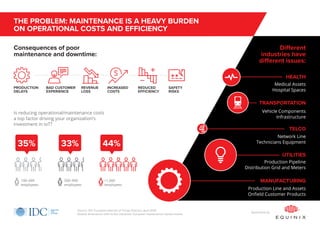
Consequences of poor
maintenance and downtime:
HEALTH
TRANSPORTATION
TELCO
UTILITIES
MANUFACTURING
Different
industries have
different issues:
PRODUCTION
DELAYS
BAD CUSTOMER
EXPERIENCE
REVENUE
LOSS
INCREASED
COSTS
REDUCED
EFFICIENCY
SAFETY
RISKS
35%
Sponsored by
Source: IDC European Internet of Things Practice, April 2018
Bubble dimensions refer to the industries’ European maintenance market shares.
Is reducing operational/maintenance costs
a top factor driving your organization’s
investment in IoT?
Medical Assets
Hospital Spaces
Vehicle Components
Infrastructure
Network Line
Technicians Equipment
Production Pipeline
Distribution Grid and Meters
Production Line and Assets
Onfield Customer Products
>1,000
employees
100–499
employees
500–999
employees
44%33%
THE SOLUTION: FROM PREVENTIVE TO
COGNITIVE-ENABLED MAINTENANCE
Source: IDC European Internet of Things Practice, April 2018
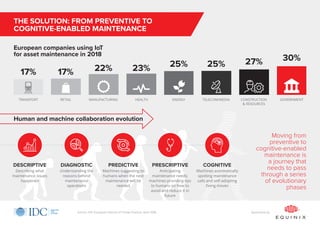
European companies using IoT
for asset maintenance in 2018
Human and machine collaboration evolution
17% 17% 22% 23% 25% 25% 27% 30%
TRANSPORT RETAIL MANUFACTURING HEALTH ENERGY TELECOM/MEDIA CONSTRUCTION
& RESOURCES
GOVERNMENT
DESCRIPTIVE DIAGNOSTIC PREDICTIVE PRESCRIPTIVE COGNITIVE
Describing what
maintenance issues
happened
Understanding the
reasons behind
maintenance
operations
Machines suggesting to
humans when the next
maintenance will be
needed
Anticipating
maintenance needs;
machines providing tips
to humans on how to
avoid and reduce it in
future
Machines automatically
spotting maintenance
calls and self-adopting
fixing moves
Moving from
preventive to
cognitive-enabled
maintenance is
a journey that
needs to pass
through a series
of evolutionary
phases
Sponsored by
THE USE CASE: LEVERAGING DIFFERENT DATA SOURCES
ACROSS MULTIPLE DISTRIBUTED EDGE LAYERS
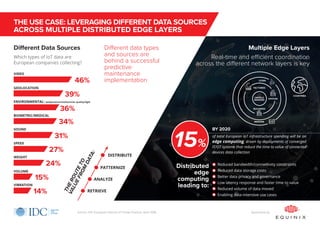
Different Data Sources
THEROUTETO
VALUEFROM
DATA:
Multiple Edge Layers
Which types of IoT data are
European companies collecting?
VIDEO
GEOLOCATION
RETRIEVE
DISTRIBUTE
PATTERNIZE
ANALYZE
BIOMETRIC/MEDICAL
SOUND
SPEED
WEIGHT
VOLUME
VIBRATION
ENVIRONMENTAL: temperature/moisture/air quality/light
46%
39%
36%
34%
31%
27%
24%
15%
14%
Different data types
and sources are
behind a successful
predictive
maintenance
implementation
Real-time and efficient coordination
across the different network layers is key
Distributed
edge
computing
leading to:
of total European IoT infrastructure spending will be on
edge computing, driven by deployments of converged
IT/OT systems that reduce the time to value of connected
devices data collection
Reduced bandwidth/connectivity constraints
Reduced data storage costs
Better data privacy and governance
Low latency response and faster time to value
Reduced volume of data moved
Enabling data-intensive use cases
BY 2020
15%
Source: IDC European Internet of Things Practice, April 2018 Sponsored by
COUNTRIES
ONFIELD
SENSORS
FACTORIES
CITIES
REGIONS
OFFICES
BUILDINGS
ESSENTIAL GUIDANCE AND GET INSPIRED
Define intangible and tangible
evaluation methods (ROI)
Optimize your network capabilities
Foster a distributed computing
approach
Find the right partner that
is an expert in your sector’s
needs and challenges
Put in place a maintenance roadmap
by evolutionary step (descriptive, diagnostic,
predictive, prescriptive, cognitive)
Check how a major global engineering
solutions provider is fostering a new
maintenance approach in the rail industry
“Our customers get more
mileage from fewer trains. Data
analytics can speed up the root-
cause analysis, reducing
labor time. It is all about
increasing uptime and avoiding
unplanned downtime. If we
predict incidents early enough,
we — and our customers — can
react accordingly.”
Sponsored bySource: IDC European Internet of Things Practice, April 2018

IoT-Enabled Predictive Maintenance Infobite

  • 1.
    INTERNET OF THINGS IoT-EnabledMaintenance: An Evolutionary Roadmap to Anticipate the Unexpected
  • 2.
    THE PROBLEM: MAINTENANCEIS A HEAVY BURDEN ON OPERATIONAL COSTS AND EFFICIENCY Consequences of poor maintenance and downtime: HEALTH TRANSPORTATION TELCO UTILITIES MANUFACTURING Different industries have different issues: PRODUCTION DELAYS BAD CUSTOMER EXPERIENCE REVENUE LOSS INCREASED COSTS REDUCED EFFICIENCY SAFETY RISKS 35% Sponsored by Source: IDC European Internet of Things Practice, April 2018 Bubble dimensions refer to the industries’ European maintenance market shares. Is reducing operational/maintenance costs a top factor driving your organization’s investment in IoT? Medical Assets Hospital Spaces Vehicle Components Infrastructure Network Line Technicians Equipment Production Pipeline Distribution Grid and Meters Production Line and Assets Onfield Customer Products >1,000 employees 100–499 employees 500–999 employees 44%33%
  • 3.
    THE SOLUTION: FROMPREVENTIVE TO COGNITIVE-ENABLED MAINTENANCE Source: IDC European Internet of Things Practice, April 2018 European companies using IoT for asset maintenance in 2018 Human and machine collaboration evolution 17% 17% 22% 23% 25% 25% 27% 30% TRANSPORT RETAIL MANUFACTURING HEALTH ENERGY TELECOM/MEDIA CONSTRUCTION & RESOURCES GOVERNMENT DESCRIPTIVE DIAGNOSTIC PREDICTIVE PRESCRIPTIVE COGNITIVE Describing what maintenance issues happened Understanding the reasons behind maintenance operations Machines suggesting to humans when the next maintenance will be needed Anticipating maintenance needs; machines providing tips to humans on how to avoid and reduce it in future Machines automatically spotting maintenance calls and self-adopting fixing moves Moving from preventive to cognitive-enabled maintenance is a journey that needs to pass through a series of evolutionary phases Sponsored by
  • 4.
    THE USE CASE:LEVERAGING DIFFERENT DATA SOURCES ACROSS MULTIPLE DISTRIBUTED EDGE LAYERS Different Data Sources THEROUTETO VALUEFROM DATA: Multiple Edge Layers Which types of IoT data are European companies collecting? VIDEO GEOLOCATION RETRIEVE DISTRIBUTE PATTERNIZE ANALYZE BIOMETRIC/MEDICAL SOUND SPEED WEIGHT VOLUME VIBRATION ENVIRONMENTAL: temperature/moisture/air quality/light 46% 39% 36% 34% 31% 27% 24% 15% 14% Different data types and sources are behind a successful predictive maintenance implementation Real-time and efficient coordination across the different network layers is key Distributed edge computing leading to: of total European IoT infrastructure spending will be on edge computing, driven by deployments of converged IT/OT systems that reduce the time to value of connected devices data collection Reduced bandwidth/connectivity constraints Reduced data storage costs Better data privacy and governance Low latency response and faster time to value Reduced volume of data moved Enabling data-intensive use cases BY 2020 15% Source: IDC European Internet of Things Practice, April 2018 Sponsored by COUNTRIES ONFIELD SENSORS FACTORIES CITIES REGIONS OFFICES BUILDINGS
  • 5.
    ESSENTIAL GUIDANCE ANDGET INSPIRED Define intangible and tangible evaluation methods (ROI) Optimize your network capabilities Foster a distributed computing approach Find the right partner that is an expert in your sector’s needs and challenges Put in place a maintenance roadmap by evolutionary step (descriptive, diagnostic, predictive, prescriptive, cognitive) Check how a major global engineering solutions provider is fostering a new maintenance approach in the rail industry “Our customers get more mileage from fewer trains. Data analytics can speed up the root- cause analysis, reducing labor time. It is all about increasing uptime and avoiding unplanned downtime. If we predict incidents early enough, we — and our customers — can react accordingly.” Sponsored bySource: IDC European Internet of Things Practice, April 2018