IOT Top 10 Security Vulnerabilities
Erez Metula
Chairman & Founder, AppSec Labs
ErezMetula@AppSec-Labs.com
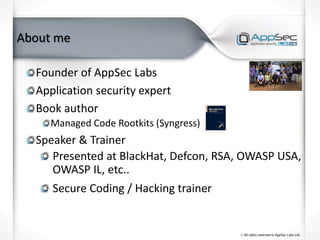
About me
Founder of AppSec Labs
Application security expert
Book author
Managed Code Rootkits (Syngress)
Speaker & Trainer
Presented at BlackHat, Defcon, RSA, OWASP USA,
OWASP IL, etc..
Secure Coding / Hacking trainer
Agenda
Introduction to IoT security
IoT architecture
Common vulnerabilities
Common misconceptions
Demo – if time permits
What’s common to all of them..?
Hacked Toilet
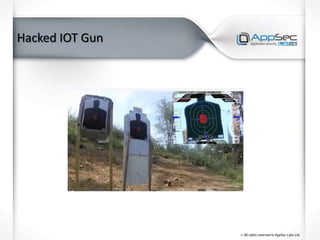
Hacked IOT Gun
Why would someone attack
the IOT?
Hack the product’s functionality
Break into the server side
Steal information from the system
Use the device as and entry point to the customer’s
network
Use the device to serve malware, send spam, etc.
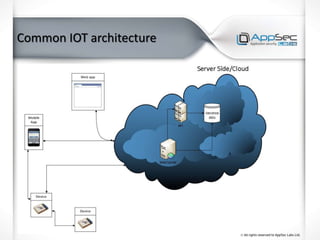
Common IOT architecture
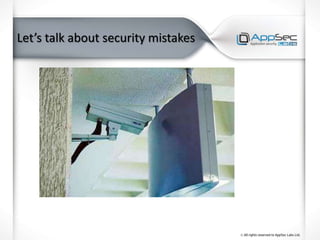
Let’s talk about security mistakes
And about some misconceptions
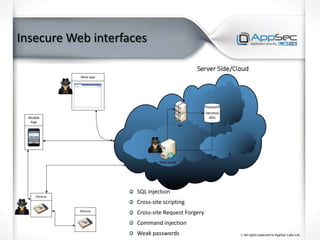
Insecure Web interfaces
SQL injection
Cross-site scripting
Cross-site Request Forgery
Command injection
Weak passwords
Common misconception
“My server is protected. I have a firewall, a WAF, and
I use SSL!”
About half of the attacks cannot be stopped by
automatic tools – usually attacks that are related to
business logic, and in particular to the product
specifics
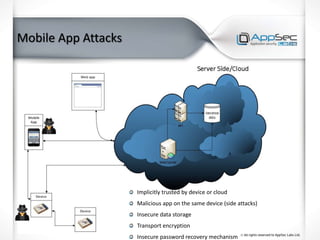
Mobile App Attacks
Implicitly trusted by device or cloud
Malicious app on the same device (side attacks)
Insecure data storage
Transport encryption
Insecure password recovery mechanism
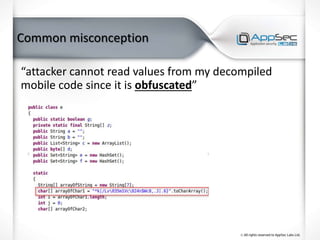
Common misconception
“attacker cannot read values from my decompiled
mobile code since it is obfuscated”
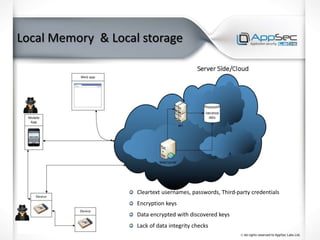
Local Memory & Local storage
Cleartext usernames, passwords, Third-party credentials
Encryption keys
Data encrypted with discovered keys
Lack of data integrity checks
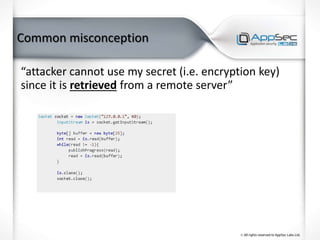
Common misconception
“attacker cannot use my secret (i.e. encryption key)
since it is retrieved from a remote server”
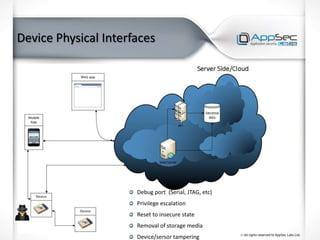
Device Physical Interfaces
Debug port (Serial, JTAG, etc)
Privilege escalation
Reset to insecure state
Removal of storage media
Device/sersor tampering
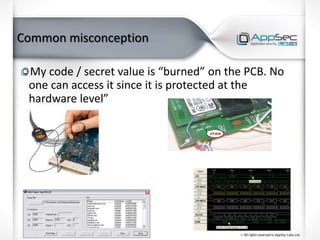
Common misconception
My code / secret value is “burned” on the PCB. No
one can access it since it is protected at the
hardware level”
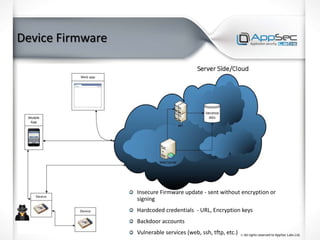
Device Firmware
Insecure Firmware update - sent without encryption or
signing
Hardcoded credentials - URL, Encryption keys
Backdoor accounts
Vulnerable services (web, ssh, tftp, etc.)
Common misconception
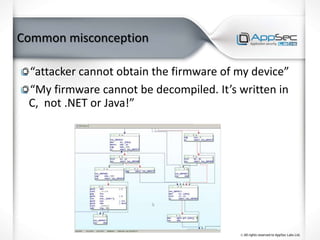
“attacker cannot obtain the firmware of my device”
“My firmware cannot be decompiled. It’s written in
C, not .NET or Java!”
Privacy
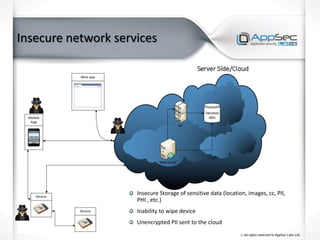
Insecure Storage of sensitive data (location, images, cc, PII,
PHI , etc.)
Inability to wipe device
Unencrypted PII sent to the cloud
Insecure network services
Common misconception
“my system enforce security right from the beginning,
at the client side - device or mobile app”
The network service assumes security had been
performed by the caller (device/mobile app)
Insecure network traffic
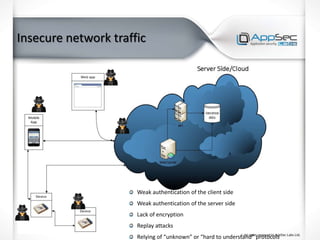
Weak authentication of the client side
Weak authentication of the server side
Lack of encryption
Replay attacks
Relying of “unknown” or “hard to understand” protocols
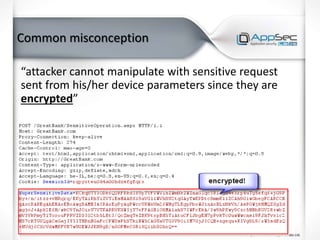
Common misconception
“attacker cannot manipulate with sensitive request
sent from his/her device parameters since they are
encrypted”
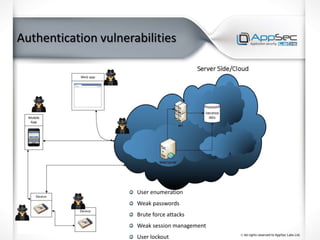
Authentication vulnerabilities
User enumeration
Weak passwords
Brute force attacks
Weak session management
User lockout
Common misconception
“the attacker can brute force users passwords. The
account is blocked after 5 failed login attempts”
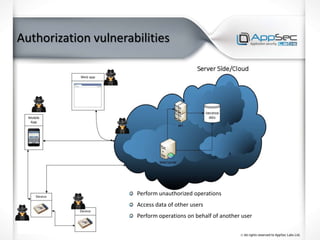
Authorization vulnerabilities
Perform unauthorized operations
Access data of other users
Perform operations on behalf of another user
Common misconception
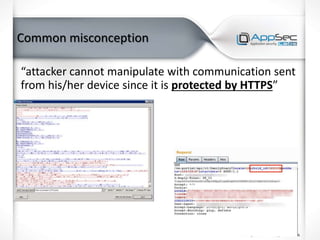
“attacker cannot manipulate with communication sent
from his/her device since it is protected by HTTPS”
Common misconception
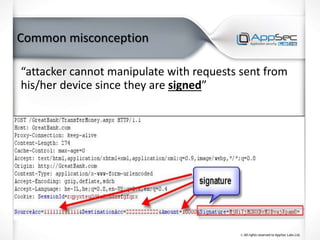
“attacker cannot manipulate with requests sent from
his/her device since they are signed”
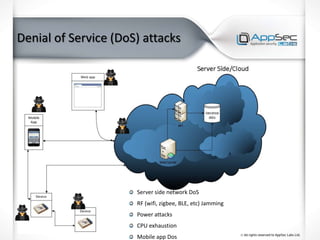
Denial of Service (DoS) attacks
Server side network DoS
RF (wifi, zigbee, BLE, etc) Jamming
Power attacks
CPU exhaustion
Mobile app Dos
Common misconception
“the attacker cannot disconnect the power source of a device without
physically touching it”
DoS attacks against battery operated devices by invoking a power
intensive task – over and over again
No power = DoS
Can be as trivial as causing a led to turn on!
Example – calculation of led power consumption
Device is operated by 2 AA batteries: 2700 mAh
the device is optimized to consume extremely minimal power - run for years since most
of the time it’s on standby
There’s a led that consumes about 20 mA when on
1 day = 480 mah.
Make it blink somehow and you can easily eat a battery in less than a week!
DEMO – reverse engineering the
RF protocol
Summary
IoT security is NOT just device security
IoT requires a wide range of security coverage for all
of the components - Device, Cloud API, Web app,
Mobile App, Network protocols, etc.
IoT have a lot of special vulnerabilities and attacks
Assume attacker will take the device apart, read the
flash memory, disassemble the firmware, etc.
Assume the attacker will decompile your mobile app
Testing IoT requires special expertise
QUESTIONS ?
Thank You!
Erez Metula
Chairman & Founder, AppSec Labs
ErezMetula@AppSec-Labs.com

Iot top 10 vulnerabilities and misconceptions 2016

  • 1.
    IOT Top 10Security Vulnerabilities Erez Metula Chairman & Founder, AppSec Labs ErezMetula@AppSec-Labs.com
  • 2.
    About me Founder ofAppSec Labs Application security expert Book author Managed Code Rootkits (Syngress) Speaker & Trainer Presented at BlackHat, Defcon, RSA, OWASP USA, OWASP IL, etc.. Secure Coding / Hacking trainer
  • 3.
    Agenda Introduction to IoTsecurity IoT architecture Common vulnerabilities Common misconceptions Demo – if time permits
  • 4.
    What’s common toall of them..?
  • 5.
  • 6.
  • 7.
    Why would someoneattack the IOT? Hack the product’s functionality Break into the server side Steal information from the system Use the device as and entry point to the customer’s network Use the device to serve malware, send spam, etc.
  • 8.
  • 9.
    Let’s talk aboutsecurity mistakes
  • 10.
    And about somemisconceptions
  • 11.
    Insecure Web interfaces SQLinjection Cross-site scripting Cross-site Request Forgery Command injection Weak passwords
  • 12.
    Common misconception “My serveris protected. I have a firewall, a WAF, and I use SSL!” About half of the attacks cannot be stopped by automatic tools – usually attacks that are related to business logic, and in particular to the product specifics
  • 13.
    Mobile App Attacks Implicitlytrusted by device or cloud Malicious app on the same device (side attacks) Insecure data storage Transport encryption Insecure password recovery mechanism
  • 14.
    Common misconception “attacker cannotread values from my decompiled mobile code since it is obfuscated”
  • 15.
    Local Memory &Local storage Cleartext usernames, passwords, Third-party credentials Encryption keys Data encrypted with discovered keys Lack of data integrity checks
  • 16.
    Common misconception “attacker cannotuse my secret (i.e. encryption key) since it is retrieved from a remote server”
  • 17.
    Device Physical Interfaces Debugport (Serial, JTAG, etc) Privilege escalation Reset to insecure state Removal of storage media Device/sersor tampering
  • 18.
    Common misconception My code/ secret value is “burned” on the PCB. No one can access it since it is protected at the hardware level”
  • 19.
    Device Firmware Insecure Firmwareupdate - sent without encryption or signing Hardcoded credentials - URL, Encryption keys Backdoor accounts Vulnerable services (web, ssh, tftp, etc.)
  • 20.
    Common misconception “attacker cannotobtain the firmware of my device” “My firmware cannot be decompiled. It’s written in C, not .NET or Java!”
  • 21.
    Privacy Insecure Storage ofsensitive data (location, images, cc, PII, PHI , etc.) Inability to wipe device Unencrypted PII sent to the cloud Insecure network services
  • 22.
    Common misconception “my systemenforce security right from the beginning, at the client side - device or mobile app” The network service assumes security had been performed by the caller (device/mobile app)
  • 23.
    Insecure network traffic Weakauthentication of the client side Weak authentication of the server side Lack of encryption Replay attacks Relying of “unknown” or “hard to understand” protocols
  • 24.
    Common misconception “attacker cannotmanipulate with sensitive request sent from his/her device parameters since they are encrypted”
  • 25.
    Authentication vulnerabilities User enumeration Weakpasswords Brute force attacks Weak session management User lockout
  • 26.
    Common misconception “the attackercan brute force users passwords. The account is blocked after 5 failed login attempts”
  • 27.
    Authorization vulnerabilities Perform unauthorizedoperations Access data of other users Perform operations on behalf of another user
  • 28.
    Common misconception “attacker cannotmanipulate with communication sent from his/her device since it is protected by HTTPS”
  • 29.
    Common misconception “attacker cannotmanipulate with requests sent from his/her device since they are signed”
  • 30.
    Denial of Service(DoS) attacks Server side network DoS RF (wifi, zigbee, BLE, etc) Jamming Power attacks CPU exhaustion Mobile app Dos
  • 31.
    Common misconception “the attackercannot disconnect the power source of a device without physically touching it” DoS attacks against battery operated devices by invoking a power intensive task – over and over again No power = DoS Can be as trivial as causing a led to turn on! Example – calculation of led power consumption Device is operated by 2 AA batteries: 2700 mAh the device is optimized to consume extremely minimal power - run for years since most of the time it’s on standby There’s a led that consumes about 20 mA when on 1 day = 480 mah. Make it blink somehow and you can easily eat a battery in less than a week!
  • 32.
    DEMO – reverseengineering the RF protocol
  • 33.
    Summary IoT security isNOT just device security IoT requires a wide range of security coverage for all of the components - Device, Cloud API, Web app, Mobile App, Network protocols, etc. IoT have a lot of special vulnerabilities and attacks Assume attacker will take the device apart, read the flash memory, disassemble the firmware, etc. Assume the attacker will decompile your mobile app Testing IoT requires special expertise
  • 34.
  • 35.
    Thank You! Erez Metula Chairman& Founder, AppSec Labs ErezMetula@AppSec-Labs.com

Editor's Notes

  • #6 Hack the toilet: observer.com/2013/08/hack-this-toilet-and-make-it-spray-water-all-over-someones-butt/ Red button attack: https://www.cs.columbia.edu/~angelos/Papers/2014/redbutton-usenix-sec14.pdf Hack stations: http://www.dn.se/nyheter/sverige/it-expert-bristerna-ett-hot-mot-rikets-sakerhet/ Zoombak: http://www.cnet.com/news/personal-safety-gps-device-presents-security-risk/
  • #7 https://www.blackhat.com/docs/us-15/materials/us-15-Sandvik-When-IoT-Attacks-Hacking-A-Linux-Powered-Rifle.pdf