Introduction To
Internet Of Things (IOT)
• Internet of Things refers to the network of physical devices, vehicles,
home appliances, and other items embedded with electronics,
software, sensors, and network connectivity, allowing them to collect
and exchange data
• The IoT enables these devices to interact with each other and with the
environment and enables the creation of smart systems and services.
• Examples:
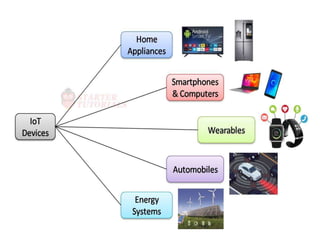
• Home appliances: smart TV, smart refrigerator, smart AC, etc.
• Smart phones and computers
• Wearables: smart watch, smart sensors, etc.
• Automobiles like self-driving cars
• Energy systems
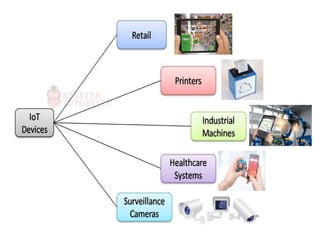
• Retail : smart payment
• Printers
• Industrial machines
• Healthcare: smart watch, smart healthcare, etc.
• Surveillance: smart cameras, smart trackers, etc.
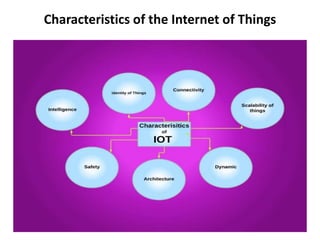
Characteristics of the Internet of Things
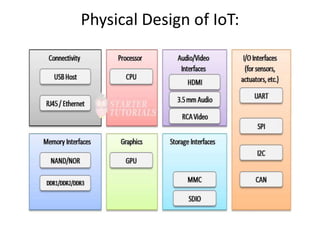
Physical Design of IoT:
• The physical design of an IoT system is referred to as
the Things/Devices and protocols that are used to build an IoT
system. All these things/Devices are called Node Devices and every
device has a unique identity that performs remote sensing,
actuating, and monitoring work, and the
• protocols that are used to establish communication between the
Node devices and servers over the internet
• Things in IoT refers to IoT devices. Things have unique identities.
Things can perform sensing, actuation, and monitoring
• Things can exchange data with other connected devices and
applications, collect data from other devices, and process the data
either locally or send it to centralized servers or cloud. IoT devices can
have several interfaces like:
• I/O interfaces for sensors
• Interface for Internet connectivity
• Memory and storage connectivity interfaces
• Audio/video interfaces
• An IoT device provides connectivity interfaces like
USB, RJ45, etc.
• It contains a microcontroller or processor for
computation tasks.
• It provides audio/video interfaces like HDMI, RCA,
3.5mm audio channel. It contains memory interfaces
like DDR.
• It might support graphics by providing a separate
Graphical Processing Unit (GPU),
• it provides storage interfaces like MMC, SDIO.
• Finally, it might provides different I/O interfaces for
connecting sensors and actuators like UART, SPI, I2C
and CAN.
PROTOCOLS
• A protocol is a set of rules that governs the
communication between two or more devices. A
protocol defines the rules, syntax, semantics and
synchronization of communication and possible error
recovery methods.
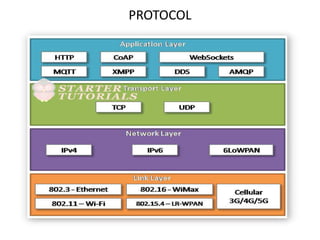
PROTOCOL
Link Layer Protocols
• The link layer is responsible for establishing and
terminating links between the nodes. The packets or
datagrams travel through these links. The link layer
also defines the format of packet that is to be
communicated across the link and is responsible for
physical addressing. The link layer also handles error
detection, retransmission, flow control and access of
the link. Protocols generally used at this layer are
Ethernet, Wi-Fi, WiMax, LR-WPAN, cellular
technologies, etc.
Network Layer Protocols
• The main role of the network layer is transfer the packet from
sender to receiving host. The network layer also handles
routing, which involves selecting the next node and
forwarding the packets across the communication path. The
network layer is also responsible for logical addressing (like IP
address) and for congestion control which prevents the
network from being overloaded with traffic.
• Different protocols at network layer are:
IPv4 (32-bit addresses)
IPv6 (128-bit addresses)
6LoWPAN (IPv6 over Low power Wireless Personal Area
Network)
Transport Layer Protocols
• The main role of transport layer is providing end-to-end
communication between the applications running on
hosts. The transport layer provides a logical
communication channel through which the end
applications can communicate with each other. The
transport layer is implemented on the end hosts. It is not
present in the routers. The transport layer is also
responsible for the reliable delivery of the message
across the end nodes, flow control and multiplexing and
demultiplexing of the channels at end nodes.
•
• Different protocols at transport layer are:
TCP (Transmission Control Protocol)
UDP (User Datagram Protocol)
Application Layer Protocols
• The application layer is where the users of an IoT
application interact with the IoT application/system.
The application layer allows the users to interact with
the IoT sensors and access other services provided
by the communication network. The application layer
provides services like authentication, naming,
message formatting, email, etc, to the users.
•
• Different protocols at application layer are:
• HTTP (HyperText Transfer Protocol)
– Uses TCP, Stateless, Request-Response Model
• CoAP (Constrained Application Protocol)
– Uses UDP, Request-Response Model
•
• MQTT (Message Queue Telemetry Transport)
– Follows publish-subscribe model
– No security
– Used with low power devices
• XMPP (Extensible Messaging and Presence Protocol)
– Real-time communication, For sending XML data
• AMQP (Advanced Message Queuing Protocol)
– Supports both point-to-point and publisher-subscriber
models
– High performance and secure protocol
– Uses TCP
• WebSocket
– Full-duplex connection over a single socket connection
– Uses TCP
•
• DDS (Data Distribution Service)
– Middleware standard, Reliable than MQTT
– Follows publish-subscribe model
– Uses UDP
A logical design for an IoT system
• A logical design for an IoT system is the actual design
of how its components (computers, sensors, and
actuators) should be arranged to complete a
particular function. It doesn’t go into the depth of
describing how each component will be built with
low-level programming specifics.
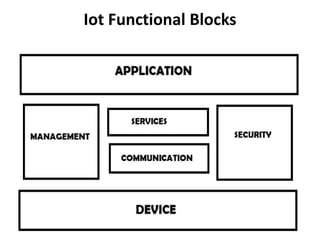
Iot Functional Blocks
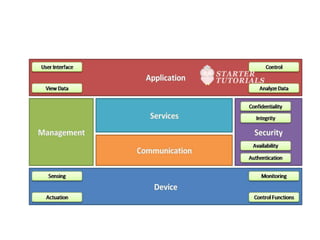
• The device block contains sensing, actuation, monitoring and control functions
for controlling the devices. The device block interacts with the communication
block.
• The communication block contains different protocols (wired or wireless)
through which the data moves from devices to Internet and from Internet to
devices. The services block acts as a middleware which can provide services
like device identification, device discovery, or data processing and analysis
• The users of an IoT application interacts with the application block. It provides
user interface with which the user can access the data sent by the sensors,
perform operations on that like aggregation, simplification, etc. and visualize
that data.
• The application interface can also provide control functions for controlling the
sensors, actuators or functionality of the application.
• The management block allows us to manage the other blocks like device,
services, communication, application, and security.
• The security block provides different security services like confidentiality,
integrity, availability, and authentication.
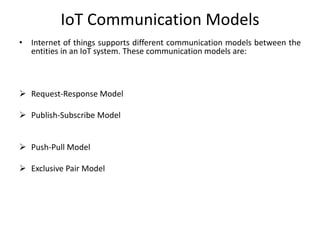
IoT Communication Models
• Internet of things supports different communication models between the
entities in an IoT system. These communication models are:
 Request-Response Model
 Publish-Subscribe Model
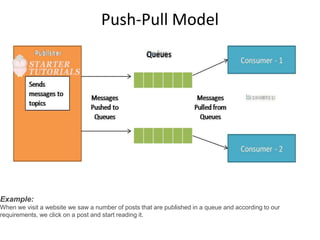
 Push-Pull Model
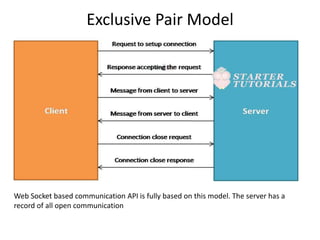
 Exclusive Pair Model
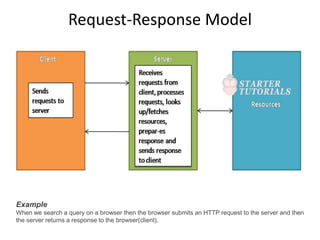
Request-Response Model
Example
When we search a query on a browser then the browser submits an HTTP request to the server and then
the server returns a response to the browser(client).
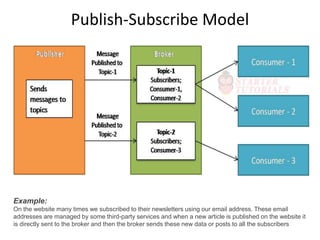
Publish-Subscribe Model
Example:
On the website many times we subscribed to their newsletters using our email address. These email
addresses are managed by some third-party services and when a new article is published on the website it
is directly sent to the broker and then the broker sends these new data or posts to all the subscribers
Push-Pull Model
Example:
When we visit a website we saw a number of posts that are published in a queue and according to our
requirements, we click on a post and start reading it.
Exclusive Pair Model
Web Socket based communication API is fully based on this model. The server has a
record of all open communication

iot.pptx related to technology which exist

  • 1.
  • 2.
    • Internet ofThings refers to the network of physical devices, vehicles, home appliances, and other items embedded with electronics, software, sensors, and network connectivity, allowing them to collect and exchange data • The IoT enables these devices to interact with each other and with the environment and enables the creation of smart systems and services. • Examples: • Home appliances: smart TV, smart refrigerator, smart AC, etc. • Smart phones and computers • Wearables: smart watch, smart sensors, etc. • Automobiles like self-driving cars • Energy systems • Retail : smart payment • Printers • Industrial machines • Healthcare: smart watch, smart healthcare, etc. • Surveillance: smart cameras, smart trackers, etc.
  • 5.
    Characteristics of theInternet of Things
  • 6.
  • 7.
    • The physicaldesign of an IoT system is referred to as the Things/Devices and protocols that are used to build an IoT system. All these things/Devices are called Node Devices and every device has a unique identity that performs remote sensing, actuating, and monitoring work, and the • protocols that are used to establish communication between the Node devices and servers over the internet • Things in IoT refers to IoT devices. Things have unique identities. Things can perform sensing, actuation, and monitoring • Things can exchange data with other connected devices and applications, collect data from other devices, and process the data either locally or send it to centralized servers or cloud. IoT devices can have several interfaces like: • I/O interfaces for sensors • Interface for Internet connectivity • Memory and storage connectivity interfaces • Audio/video interfaces
  • 8.
    • An IoTdevice provides connectivity interfaces like USB, RJ45, etc. • It contains a microcontroller or processor for computation tasks. • It provides audio/video interfaces like HDMI, RCA, 3.5mm audio channel. It contains memory interfaces like DDR. • It might support graphics by providing a separate Graphical Processing Unit (GPU), • it provides storage interfaces like MMC, SDIO. • Finally, it might provides different I/O interfaces for connecting sensors and actuators like UART, SPI, I2C and CAN.
  • 9.
    PROTOCOLS • A protocolis a set of rules that governs the communication between two or more devices. A protocol defines the rules, syntax, semantics and synchronization of communication and possible error recovery methods.
  • 10.
  • 11.
    Link Layer Protocols •The link layer is responsible for establishing and terminating links between the nodes. The packets or datagrams travel through these links. The link layer also defines the format of packet that is to be communicated across the link and is responsible for physical addressing. The link layer also handles error detection, retransmission, flow control and access of the link. Protocols generally used at this layer are Ethernet, Wi-Fi, WiMax, LR-WPAN, cellular technologies, etc.
  • 12.
    Network Layer Protocols •The main role of the network layer is transfer the packet from sender to receiving host. The network layer also handles routing, which involves selecting the next node and forwarding the packets across the communication path. The network layer is also responsible for logical addressing (like IP address) and for congestion control which prevents the network from being overloaded with traffic. • Different protocols at network layer are: IPv4 (32-bit addresses) IPv6 (128-bit addresses) 6LoWPAN (IPv6 over Low power Wireless Personal Area Network)
  • 13.
    Transport Layer Protocols •The main role of transport layer is providing end-to-end communication between the applications running on hosts. The transport layer provides a logical communication channel through which the end applications can communicate with each other. The transport layer is implemented on the end hosts. It is not present in the routers. The transport layer is also responsible for the reliable delivery of the message across the end nodes, flow control and multiplexing and demultiplexing of the channels at end nodes. • • Different protocols at transport layer are: TCP (Transmission Control Protocol) UDP (User Datagram Protocol)
  • 14.
    Application Layer Protocols •The application layer is where the users of an IoT application interact with the IoT application/system. The application layer allows the users to interact with the IoT sensors and access other services provided by the communication network. The application layer provides services like authentication, naming, message formatting, email, etc, to the users. • • Different protocols at application layer are: • HTTP (HyperText Transfer Protocol) – Uses TCP, Stateless, Request-Response Model
  • 15.
    • CoAP (ConstrainedApplication Protocol) – Uses UDP, Request-Response Model • • MQTT (Message Queue Telemetry Transport) – Follows publish-subscribe model – No security – Used with low power devices • XMPP (Extensible Messaging and Presence Protocol) – Real-time communication, For sending XML data
  • 16.
    • AMQP (AdvancedMessage Queuing Protocol) – Supports both point-to-point and publisher-subscriber models – High performance and secure protocol – Uses TCP • WebSocket – Full-duplex connection over a single socket connection – Uses TCP • • DDS (Data Distribution Service) – Middleware standard, Reliable than MQTT – Follows publish-subscribe model – Uses UDP
  • 17.
    A logical designfor an IoT system • A logical design for an IoT system is the actual design of how its components (computers, sensors, and actuators) should be arranged to complete a particular function. It doesn’t go into the depth of describing how each component will be built with low-level programming specifics.
  • 19.
  • 20.
    • The deviceblock contains sensing, actuation, monitoring and control functions for controlling the devices. The device block interacts with the communication block. • The communication block contains different protocols (wired or wireless) through which the data moves from devices to Internet and from Internet to devices. The services block acts as a middleware which can provide services like device identification, device discovery, or data processing and analysis • The users of an IoT application interacts with the application block. It provides user interface with which the user can access the data sent by the sensors, perform operations on that like aggregation, simplification, etc. and visualize that data. • The application interface can also provide control functions for controlling the sensors, actuators or functionality of the application. • The management block allows us to manage the other blocks like device, services, communication, application, and security. • The security block provides different security services like confidentiality, integrity, availability, and authentication.
  • 21.
    IoT Communication Models •Internet of things supports different communication models between the entities in an IoT system. These communication models are:  Request-Response Model  Publish-Subscribe Model  Push-Pull Model  Exclusive Pair Model
  • 22.
    Request-Response Model Example When wesearch a query on a browser then the browser submits an HTTP request to the server and then the server returns a response to the browser(client).
  • 23.
    Publish-Subscribe Model Example: On thewebsite many times we subscribed to their newsletters using our email address. These email addresses are managed by some third-party services and when a new article is published on the website it is directly sent to the broker and then the broker sends these new data or posts to all the subscribers
  • 24.
    Push-Pull Model Example: When wevisit a website we saw a number of posts that are published in a queue and according to our requirements, we click on a post and start reading it.
  • 25.
    Exclusive Pair Model WebSocket based communication API is fully based on this model. The server has a record of all open communication