Internet Of Things (IoT)
Table of
Contents
 What is IoT
 IoT Architecture
 IoT Overview
 Home Automation
 Smart Building
 Cities/Connected Communities
 IoT Competency Ramp-up
 IoT Platforms for Vertical Markets
 IoT Solution Development
 Appendix 1: IoT Platform - Contiki
 Appendix 2: IoT Platform – AllJoyn
 Oracle’s Internet of Thing Platform
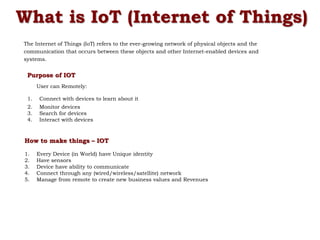
Purpose of IOT
User can Remotely:
1. Connect with devices to learn about it
2. Monitor devices
3. Search for devices
4. Interact with devices
How to make things – IOT
1. Every Device (in World) have Unique identity
2. Have sensors
3. Device have ability to communicate
4. Connect through any (wired/wireless/satellite) network
5. Manage from remote to create new business values and Revenues
The Internet of Things (IoT) refers to the ever-growing network of physical objects and the
communication that occurs between these objects and other Internet-enabled devices and
systems.
What is IoT (Internet of Things)
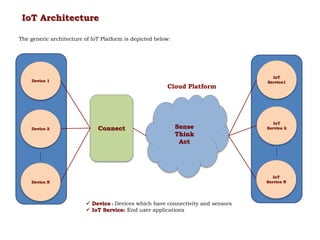
Device 1
Device 2
Device N
IoT
Service1
IoT
Service 2
IoT
Service N
Connect Sense
Think
Act
Cloud Platform
IoT Architecture
The generic architecture of IoT Platform is depicted below:
 Device : Devices which have connectivity and sensors
 IoT Service: End user applications
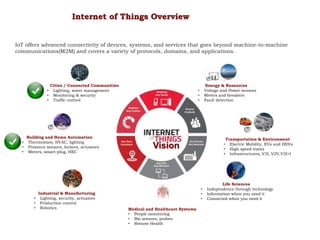
Internet of Things Overview
Energy & Resources
• Voltage and Power sensors
• Meters and breakers
• Fault detection
Transportation & Environment
• Electric Mobility, EVs and HEVs
• High speed trains
• Infrastructures, V2I, V2V,V2I+I
Building and Home Automation
• Thermostats, HVAC, lighting
• Presence sensors, lockers, actuators
• Meters, smart-plug, HEC
Life Sciences
• Independence through technology
• Information when you need it
• Connected when you need it
Medical and Healthcare Systems
• People monitoring
• Bio sensors, probes
• Remote Health
Industrial & Manufacturing
• Lighting, security, actuators
• Production control
• Robotics
Cities / Connected Communities
• Lighting, water management
• Monitoring & security
• Traffic control
Vision
IoT offers advanced connectivity of devices, systems, and services that goes beyond machine-to-machine
communications(M2M) and covers a variety of protocols, domains, and applications.
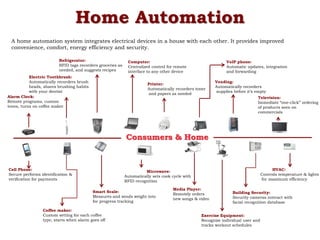
Home Automation
Electric Toothbrush:
Automatically recorders brush
heads, shares brushing habits
with your dentist
Refrigerator:
RFID tags recorders groceries as
needed, and suggests recipes
VoIP phone:
Automatic updates, integration
and forwarding
Computer:
Centralized control for remote
interface to any other device
Alarm Clock:
Remote programs, custom
tones, turns on coffee maker
Coffee maker:
Custom setting for each coffee
type, starts when alarm goes off
Smart Scale:
Measures and sends weight into
for progress tracking
Printer:
Automatically recorders toner
and papers as needed
Microwave:
Automatically sets cook cycle with
RFID recognition
Cell Phone:
Secure performs identification &
verification for payments
HVAC:
Controls temperature & lights
for maximum efficiency
Vending:
Automatically recorders
supplies before it’s empty
Building Security:
Security cameras interact with
facial recognition database
Exercise Equipment:
Recognize individual user and
tracks workout schedules
Television:
Immediate “one-click” ordering
of products seen on
commercials
Media Player:
Remotely orders
new songs & video
Consumers & Home
A home automation system integrates electrical devices in a house with each other. It provides improved
convenience, comfort, energy efficiency and security.
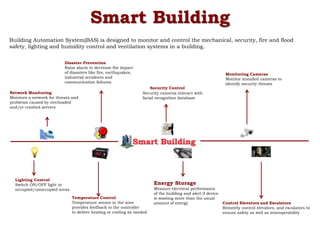
Smart Building
Smart Building
Disaster Prevention
Raise alarm to decrease the impact
of disasters like fire, earthquakes,
industrial accidents and
communication failures.
Network Monitoring
Monitors a network for threats and
problems caused by overloaded
and/or crashed servers
Security Control
Security cameras interact with
facial recognition database
Monitoring Cameras
Monitor installed cameras to
identify security threats
Lighting Control
Switch ON/OFF light in
occupied/unoccupied areas
Energy Storage
Measure electrical performance
of the building and alert if device
is wasting more than the usual
amount of energy
Temperature Control
Temperature sensor in the zone
provides feedback to the controller
to deliver heating or cooling as needed
Control Elevators and Escalators
Remotely control elevators, and escalators to
ensure safety as well as interoperability
Building Automation System(BAS) is designed to monitor and control the mechanical, security, fire and flood
safety, lighting and humidity control and ventilation systems in a building.
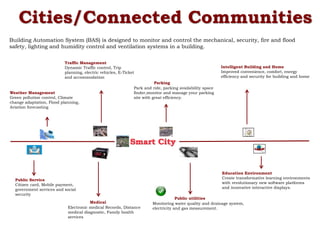
Cities/Connected Communities
Smart City
Traffic Management
Dynamic Traffic control, Trip
planning, electric vehicles, E-Ticket
and accommodation
Weather Management
Green pollution control, Climate
change adaptation, Flood planning,
Aviation forecasting
Parking
Park and ride, parking availability space
finder,monitor and manage your parking
site with great efficiency.
Intelligent Building and Home
Improved convenience, comfort, energy
efficiency and security for building and home
Public Service
Citizen card, Mobile payment,
government services and social
security
Public utilities
Monitoring water quality and drainage system,
electricity and gas measurement.
Education Environment
Create transformative learning environments
with revolutionary new software platforms
and innovative interactive displays.
Building Automation System (BAS) is designed to monitor and control the mechanical, security, fire and flood
safety, lighting and humidity control and ventilation systems in a building.
Medical
Electronic medical Records, Distance
medical diagnostic, Family health
services
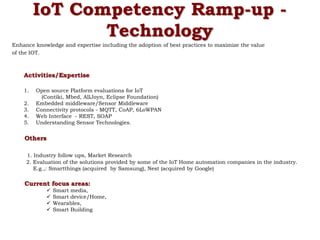
Activities/Expertise
1. Open source Platform evaluations for IoT
(Contiki, Mbed, AllJoyn, Eclipse Foundation)
2. Embedded middleware/Sensor Middleware
3. Connectivity protocols - MQTT, CoAP, 6LoWPAN
4. Web Interface - REST, SOAP
5. Understanding Sensor Technologies.
Others
1. Industry follow ups, Market Research
2. Evaluation of the solutions provided by some of the IoT Home automation companies in the industry.
E.g.,: Smartthings (acquired by Samsung), Nest (acquired by Google)
Enhance knowledge and expertise including the adoption of best practices to maximize the value
of the IOT.
IoT Competency Ramp-up -
Technology
Current focus areas:
 Smart media,
 Smart device/Home,
 Wearables,
 Smart Building
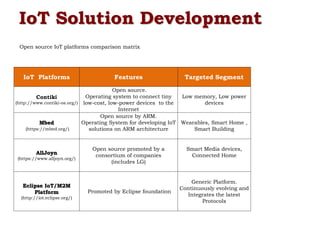
IoT Solution Development
IoT Platforms Features Targeted Segment
Contiki
(http://www.contiki-os.org/)
Open source.
Operating system to connect tiny
low-cost, low-power devices to the
Internet
Low memory, Low power
devices
Mbed
(https://mbed.org/)
Open source by ARM.
Operating System for developing IoT
solutions on ARM architecture
Wearables, Smart Home ,
Smart Building
AllJoyn
(https://www.alljoyn.org/)
Open source promoted by a
consortium of companies
(includes LG)
Smart Media devices,
Connected Home
Eclipse IoT/M2M
Platform
(http://iot.eclipse.org/)
Promoted by Eclipse foundation
Generic Platform.
Continuously evolving and
Integrates the latest
Protocols
Open source IoT platforms comparison matrix
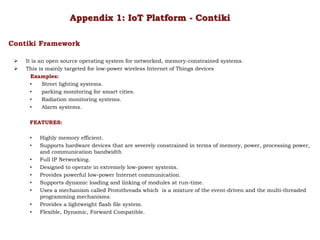
 It is an open source operating system for networked, memory-constrained systems.
 This is mainly targeted for low-power wireless Internet of Things devices
Examples:
• Street lighting systems.
• parking monitoring for smart cities.
• Radiation monitoring systems.
• Alarm systems.
FEATURES:
• Highly memory efficient.
• Supports hardware devices that are severely constrained in terms of memory, power, processing power,
and communication bandwidth
• Full IP Networking.
• Designed to operate in extremely low-power systems.
• Provides powerful low-power Internet communication.
• Supports dynamic loading and linking of modules at run-time.
• Uses a mechanism called Protothreads which is a mixture of the event-driven and the multi-threaded
programming mechanisms.
• Provides a lightweight flash file system.
• Flexible, Dynamic, Forward Compatible.
Appendix 1: IoT Platform - Contiki
Contiki Framework
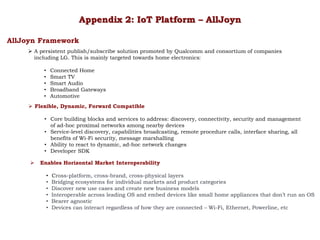
Appendix 2: IoT Platform – AllJoyn
AllJoyn Framework
 A persistent publish/subscribe solution promoted by Qualcomm and consortium of companies
including LG. This is mainly targeted towards home electronics:
• Connected Home
• Smart TV
• Smart Audio
• Broadband Gateways
• Automotive
 Flexible, Dynamic, Forward Compatible
• Core building blocks and services to address: discovery, connectivity, security and management
of ad-hoc proximal networks among nearby devices
• Service-level discovery, capabilities broadcasting, remote procedure calls, interface sharing, all
benefits of Wi-Fi security, message marshalling
• Ability to react to dynamic, ad-hoc network changes
• Developer SDK
 Enables Horizontal Market Interoperability
• Cross-platform, cross-brand, cross-physical layers
• Bridging ecosystems for individual markets and product categories
• Discover new use cases and create new business models
• Interoperable across leading OS and embed devices like small home appliances that don’t run an OS
• Bearer agnostic
• Devices can interact regardless of how they are connected – Wi-Fi, Ethernet, Powerline, etc
Oracle’s IoT Platform
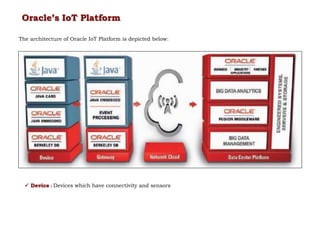
The architecture of Oracle IoT Platform is depicted below:
 Device : Devices which have connectivity and sensors
• Oracle Provides a suit of solutions for the connected world. (Oracle IoT/M2M solution suits). From small
device like sensors to servers, Oracle promotes and refines Java as the tool for Building IoT ecosystem.
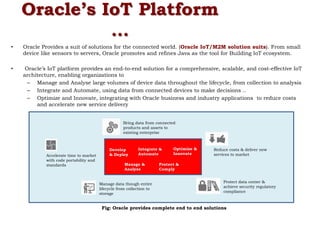
• Oracle’s IoT platform provides an end-to-end solution for a comprehensive, scalable, and cost-effective IoT
architecture, enabling organizations to
– Manage and Analyse large volumes of device data throughout the lifecycle, from collection to analysis
– Integrate and Automate, using data from connected devices to make decisions ..
– Optimize and Innovate, integrating with Oracle business and industry applications to reduce costs
and accelerate new service delivery
Oracle’s IoT Platform
…
Bring data from connected
products and assets to
existing enterprise
Accelerate time to market
with code portability and
standards
Manage data though entire
lifecycle from collection to
storage
Protect data center &
achieve security regulatory
compliance
Reduce costs & deliver new
services to market
Develop
& Deploy
Optimize &
Innovate
Integrate &
Automate
Manage &
Analyze
Protect &
Comply
Fig: Oracle provides complete end to end solutions

IOT basics

  • 1.
  • 2.
    Table of Contents  Whatis IoT  IoT Architecture  IoT Overview  Home Automation  Smart Building  Cities/Connected Communities  IoT Competency Ramp-up  IoT Platforms for Vertical Markets  IoT Solution Development  Appendix 1: IoT Platform - Contiki  Appendix 2: IoT Platform – AllJoyn  Oracle’s Internet of Thing Platform
  • 3.
    Purpose of IOT Usercan Remotely: 1. Connect with devices to learn about it 2. Monitor devices 3. Search for devices 4. Interact with devices How to make things – IOT 1. Every Device (in World) have Unique identity 2. Have sensors 3. Device have ability to communicate 4. Connect through any (wired/wireless/satellite) network 5. Manage from remote to create new business values and Revenues The Internet of Things (IoT) refers to the ever-growing network of physical objects and the communication that occurs between these objects and other Internet-enabled devices and systems. What is IoT (Internet of Things)
  • 4.
    Device 1 Device 2 DeviceN IoT Service1 IoT Service 2 IoT Service N Connect Sense Think Act Cloud Platform IoT Architecture The generic architecture of IoT Platform is depicted below:  Device : Devices which have connectivity and sensors  IoT Service: End user applications
  • 5.
    Internet of ThingsOverview Energy & Resources • Voltage and Power sensors • Meters and breakers • Fault detection Transportation & Environment • Electric Mobility, EVs and HEVs • High speed trains • Infrastructures, V2I, V2V,V2I+I Building and Home Automation • Thermostats, HVAC, lighting • Presence sensors, lockers, actuators • Meters, smart-plug, HEC Life Sciences • Independence through technology • Information when you need it • Connected when you need it Medical and Healthcare Systems • People monitoring • Bio sensors, probes • Remote Health Industrial & Manufacturing • Lighting, security, actuators • Production control • Robotics Cities / Connected Communities • Lighting, water management • Monitoring & security • Traffic control Vision IoT offers advanced connectivity of devices, systems, and services that goes beyond machine-to-machine communications(M2M) and covers a variety of protocols, domains, and applications.
  • 6.
    Home Automation Electric Toothbrush: Automaticallyrecorders brush heads, shares brushing habits with your dentist Refrigerator: RFID tags recorders groceries as needed, and suggests recipes VoIP phone: Automatic updates, integration and forwarding Computer: Centralized control for remote interface to any other device Alarm Clock: Remote programs, custom tones, turns on coffee maker Coffee maker: Custom setting for each coffee type, starts when alarm goes off Smart Scale: Measures and sends weight into for progress tracking Printer: Automatically recorders toner and papers as needed Microwave: Automatically sets cook cycle with RFID recognition Cell Phone: Secure performs identification & verification for payments HVAC: Controls temperature & lights for maximum efficiency Vending: Automatically recorders supplies before it’s empty Building Security: Security cameras interact with facial recognition database Exercise Equipment: Recognize individual user and tracks workout schedules Television: Immediate “one-click” ordering of products seen on commercials Media Player: Remotely orders new songs & video Consumers & Home A home automation system integrates electrical devices in a house with each other. It provides improved convenience, comfort, energy efficiency and security.
  • 7.
    Smart Building Smart Building DisasterPrevention Raise alarm to decrease the impact of disasters like fire, earthquakes, industrial accidents and communication failures. Network Monitoring Monitors a network for threats and problems caused by overloaded and/or crashed servers Security Control Security cameras interact with facial recognition database Monitoring Cameras Monitor installed cameras to identify security threats Lighting Control Switch ON/OFF light in occupied/unoccupied areas Energy Storage Measure electrical performance of the building and alert if device is wasting more than the usual amount of energy Temperature Control Temperature sensor in the zone provides feedback to the controller to deliver heating or cooling as needed Control Elevators and Escalators Remotely control elevators, and escalators to ensure safety as well as interoperability Building Automation System(BAS) is designed to monitor and control the mechanical, security, fire and flood safety, lighting and humidity control and ventilation systems in a building.
  • 8.
    Cities/Connected Communities Smart City TrafficManagement Dynamic Traffic control, Trip planning, electric vehicles, E-Ticket and accommodation Weather Management Green pollution control, Climate change adaptation, Flood planning, Aviation forecasting Parking Park and ride, parking availability space finder,monitor and manage your parking site with great efficiency. Intelligent Building and Home Improved convenience, comfort, energy efficiency and security for building and home Public Service Citizen card, Mobile payment, government services and social security Public utilities Monitoring water quality and drainage system, electricity and gas measurement. Education Environment Create transformative learning environments with revolutionary new software platforms and innovative interactive displays. Building Automation System (BAS) is designed to monitor and control the mechanical, security, fire and flood safety, lighting and humidity control and ventilation systems in a building. Medical Electronic medical Records, Distance medical diagnostic, Family health services
  • 9.
    Activities/Expertise 1. Open sourcePlatform evaluations for IoT (Contiki, Mbed, AllJoyn, Eclipse Foundation) 2. Embedded middleware/Sensor Middleware 3. Connectivity protocols - MQTT, CoAP, 6LoWPAN 4. Web Interface - REST, SOAP 5. Understanding Sensor Technologies. Others 1. Industry follow ups, Market Research 2. Evaluation of the solutions provided by some of the IoT Home automation companies in the industry. E.g.,: Smartthings (acquired by Samsung), Nest (acquired by Google) Enhance knowledge and expertise including the adoption of best practices to maximize the value of the IOT. IoT Competency Ramp-up - Technology Current focus areas:  Smart media,  Smart device/Home,  Wearables,  Smart Building
  • 10.
    IoT Solution Development IoTPlatforms Features Targeted Segment Contiki (http://www.contiki-os.org/) Open source. Operating system to connect tiny low-cost, low-power devices to the Internet Low memory, Low power devices Mbed (https://mbed.org/) Open source by ARM. Operating System for developing IoT solutions on ARM architecture Wearables, Smart Home , Smart Building AllJoyn (https://www.alljoyn.org/) Open source promoted by a consortium of companies (includes LG) Smart Media devices, Connected Home Eclipse IoT/M2M Platform (http://iot.eclipse.org/) Promoted by Eclipse foundation Generic Platform. Continuously evolving and Integrates the latest Protocols Open source IoT platforms comparison matrix
  • 11.
     It isan open source operating system for networked, memory-constrained systems.  This is mainly targeted for low-power wireless Internet of Things devices Examples: • Street lighting systems. • parking monitoring for smart cities. • Radiation monitoring systems. • Alarm systems. FEATURES: • Highly memory efficient. • Supports hardware devices that are severely constrained in terms of memory, power, processing power, and communication bandwidth • Full IP Networking. • Designed to operate in extremely low-power systems. • Provides powerful low-power Internet communication. • Supports dynamic loading and linking of modules at run-time. • Uses a mechanism called Protothreads which is a mixture of the event-driven and the multi-threaded programming mechanisms. • Provides a lightweight flash file system. • Flexible, Dynamic, Forward Compatible. Appendix 1: IoT Platform - Contiki Contiki Framework
  • 12.
    Appendix 2: IoTPlatform – AllJoyn AllJoyn Framework  A persistent publish/subscribe solution promoted by Qualcomm and consortium of companies including LG. This is mainly targeted towards home electronics: • Connected Home • Smart TV • Smart Audio • Broadband Gateways • Automotive  Flexible, Dynamic, Forward Compatible • Core building blocks and services to address: discovery, connectivity, security and management of ad-hoc proximal networks among nearby devices • Service-level discovery, capabilities broadcasting, remote procedure calls, interface sharing, all benefits of Wi-Fi security, message marshalling • Ability to react to dynamic, ad-hoc network changes • Developer SDK  Enables Horizontal Market Interoperability • Cross-platform, cross-brand, cross-physical layers • Bridging ecosystems for individual markets and product categories • Discover new use cases and create new business models • Interoperable across leading OS and embed devices like small home appliances that don’t run an OS • Bearer agnostic • Devices can interact regardless of how they are connected – Wi-Fi, Ethernet, Powerline, etc
  • 13.
    Oracle’s IoT Platform Thearchitecture of Oracle IoT Platform is depicted below:  Device : Devices which have connectivity and sensors
  • 14.
    • Oracle Providesa suit of solutions for the connected world. (Oracle IoT/M2M solution suits). From small device like sensors to servers, Oracle promotes and refines Java as the tool for Building IoT ecosystem. • Oracle’s IoT platform provides an end-to-end solution for a comprehensive, scalable, and cost-effective IoT architecture, enabling organizations to – Manage and Analyse large volumes of device data throughout the lifecycle, from collection to analysis – Integrate and Automate, using data from connected devices to make decisions .. – Optimize and Innovate, integrating with Oracle business and industry applications to reduce costs and accelerate new service delivery Oracle’s IoT Platform … Bring data from connected products and assets to existing enterprise Accelerate time to market with code portability and standards Manage data though entire lifecycle from collection to storage Protect data center & achieve security regulatory compliance Reduce costs & deliver new services to market Develop & Deploy Optimize & Innovate Integrate & Automate Manage & Analyze Protect & Comply Fig: Oracle provides complete end to end solutions