International Research Journal of Engineering and Technology (IRJET) e-ISSN: 2395-0056
Volume: 06 Issue: 06 | June 2019 www.irjet.net p-ISSN: 2395-0072
© 2019, IRJET | Impact Factor value: 7.211 | ISO 9001:2008 Certified Journal | Page 125
WI-FI BASED SMART HOME AUTOMATION
Akshay Mahadar1, Navnath Kolhatkar2, Atul Londhe3,Vaibhav Shelake4
1,2,3,4Department of Electrical Engineering, S.B.Patil College of Engineering, Indapur, Pune.
---------------------------------------------------------------------***---------------------------------------------------------------------
Abstract - Automation of the devices, appliances at home
and office is having wide scope of research with the
advancement of technology in communication era. Misuse of
power energy can be curtailed by automating the devices
and appliances. Mobile communication is playing a vital role
in the domain of automation. The process of controlling or
operating various equipment, machinery, industrial
processes, and other applications using various control
systems and also with less or no human intervention is
termed as automation.
Index Terms- Arduino nano,ESP8266 WI-FI module etc.
1. INTRODUCTION
Generally ,when we go out of the house we switch off the
light or the electrical equipment’s to avoid accidents such
as short circuit, firing etc. but sometimes we forget to
switched them off, we have to come back home to do so.
Home automation is the process of controlling home
appliances automatically using various control system
techniques. The electrical and electronic appliances in the
home such as fan, lights, outdoor lights, fire alarm TV, etc.
can be controlled using various control techniques.
Home automation can quickly bring the future into our
homes by incorporating security climate and house hold
gadgets and transforms our regular home futuristic smart
home. There are various techniques to control home
appliances such as IOT based home automation over the
cloud, home automation under Wi-Fi through android apps
from any smartphone, Arduino based home automation,
home automation by android application, remote control,
home automation using digital control, RF based home
automation system and touch screen based home
automation.
Smart home is one in which all electrical equipment
around the home technologically smart or intelligent or
automated with highly advanced automatic system for
security in other system. Smart home is useful for
everyone and can also be used in everyday life at home.
Smart home is consisting of three parts- network,
controlling device and home automation.
2. METHODOLOGY
In this project, result the system becomes stable and
efficiency of the system as well as of the apparatus
increases.
1. Start Mode Activity
In this mode, all the rooms of the home are displayed. The
user can select the Necessary room from the option to
control the appliances connected to specified room.
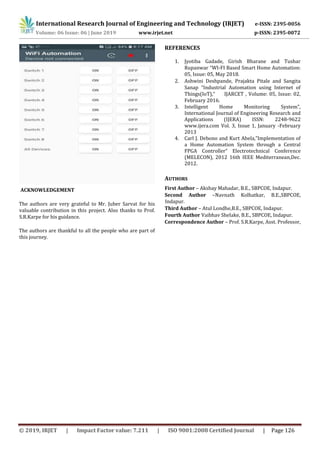
2 Switch Mode Activities
This mode provides the user with on/off buttons to control
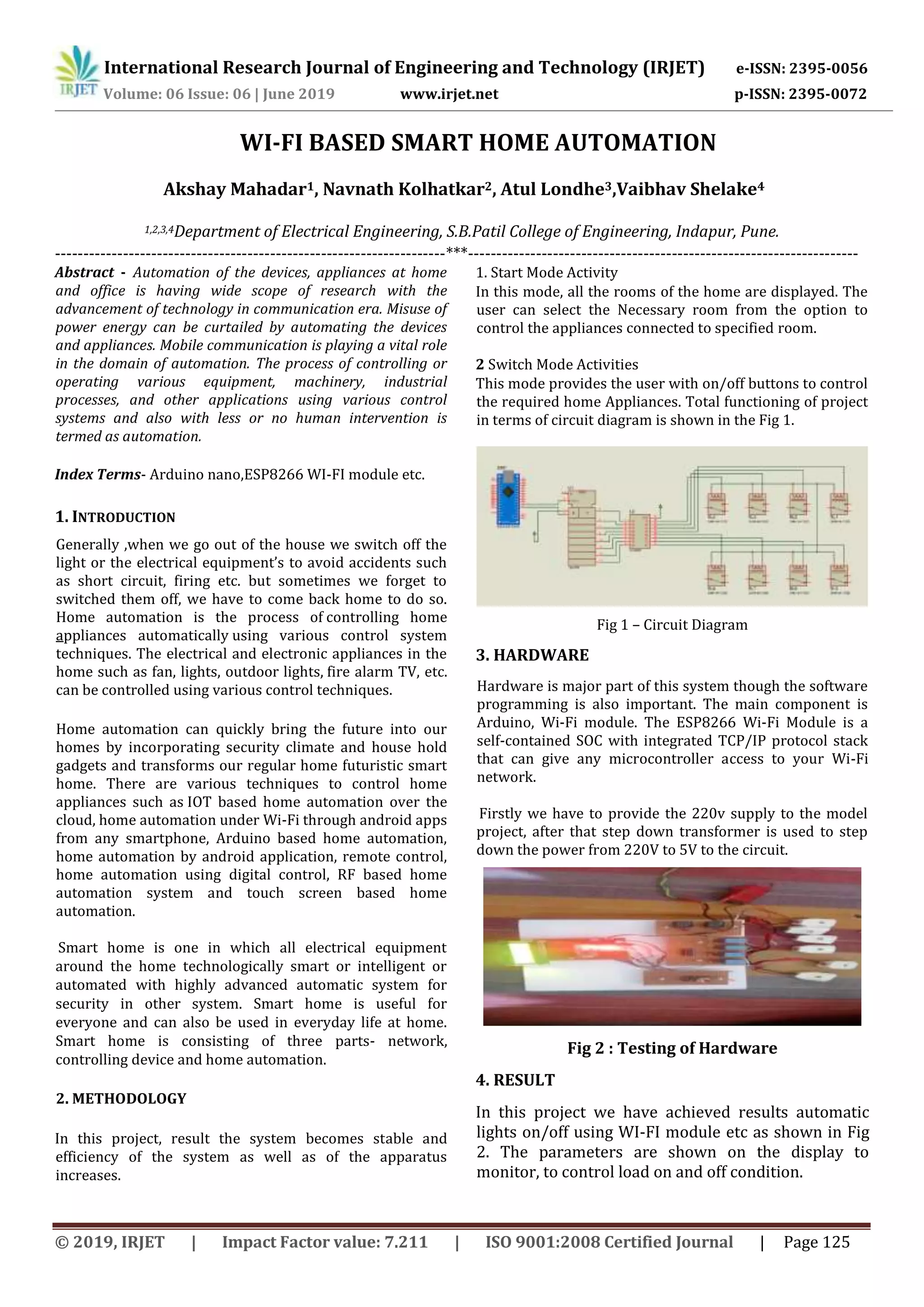
the required home Appliances. Total functioning of project
in terms of circuit diagram is shown in the Fig 1.
Fig 1 – Circuit Diagram
3. HARDWARE
Hardware is major part of this system though the software
programming is also important. The main component is
Arduino, Wi-Fi module. The ESP8266 Wi-Fi Module is a
self-contained SOC with integrated TCP/IP protocol stack
that can give any microcontroller access to your Wi-Fi
network.
Firstly we have to provide the 220v supply to the model
project, after that step down transformer is used to step
down the power from 220V to 5V to the circuit.
Fig 2 : Testing of Hardware
4. RESULT
In this project we have achieved results automatic
lights on/off using WI-FI module etc as shown in Fig
2. The parameters are shown on the display to
monitor, to control load on and off condition.
International Research Journal of Engineering and Technology (IRJET) e-ISSN: 2395-0056
Volume: 06 Issue: 06 | June 2019 www.irjet.net p-ISSN: 2395-0072
© 2019, IRJET | Impact Factor value: 7.211 | ISO 9001:2008 Certified Journal | Page 126
ACKNOWLEDGEMENT
The authors are very grateful to Mr. Juber Sarvat for his
valuable contribution in this project. Also thanks to Prof.
S.R.Karpe for his guidance.
The authors are thankful to all the people who are part of
this journey.
REFERENCES
1. Jyotiba Gadade, Girish Bharane and Tushar
Rupanwar “WI-FI Based Smart Home Automation:
05, Issue: 05, May 2018.
2. Ashwini Deshpande, Prajakta Pitale and Sangita
Sanap “Industrial Automation using Internet of
Things(IoT),” IJARCET , Volume: 05, Issue: 02,
February 2016.
3. Intelligent Home Monitoring System”,
International Journal of Engineering Research and
Applications (IJERA) ISSN: 2248-9622
www.ijera.com Vol. 3, Issue 1, January -February
2013
4. Carl J. Debono and Kurt Abela,”Implementation of
a Home Automation System through a Central
FPGA Controller” Electrotechnical Conference
(MELECON), 2012 16th IEEE Mediterranean,Dec.
2012.
AUTHORS
First Author – Akshay Mahadar, B.E., SBPCOE, Indapur.
Second Author –Navnath Kolhatkar, B.E.,SBPCOE,
Indapur.
Third Author – Atul Londhe,B.E., SBPCOE, Indapur.
Fourth Author Vaibhav Shelake, B.E., SBPCOE, Indapur.
Correspondence Author – Prof. S.R.Karpe, Asst. Professor,

IRJET- Wi-Fi based Smart Home Automation

  • 1.
    International Research Journalof Engineering and Technology (IRJET) e-ISSN: 2395-0056 Volume: 06 Issue: 06 | June 2019 www.irjet.net p-ISSN: 2395-0072 © 2019, IRJET | Impact Factor value: 7.211 | ISO 9001:2008 Certified Journal | Page 125 WI-FI BASED SMART HOME AUTOMATION Akshay Mahadar1, Navnath Kolhatkar2, Atul Londhe3,Vaibhav Shelake4 1,2,3,4Department of Electrical Engineering, S.B.Patil College of Engineering, Indapur, Pune. ---------------------------------------------------------------------***--------------------------------------------------------------------- Abstract - Automation of the devices, appliances at home and office is having wide scope of research with the advancement of technology in communication era. Misuse of power energy can be curtailed by automating the devices and appliances. Mobile communication is playing a vital role in the domain of automation. The process of controlling or operating various equipment, machinery, industrial processes, and other applications using various control systems and also with less or no human intervention is termed as automation. Index Terms- Arduino nano,ESP8266 WI-FI module etc. 1. INTRODUCTION Generally ,when we go out of the house we switch off the light or the electrical equipment’s to avoid accidents such as short circuit, firing etc. but sometimes we forget to switched them off, we have to come back home to do so. Home automation is the process of controlling home appliances automatically using various control system techniques. The electrical and electronic appliances in the home such as fan, lights, outdoor lights, fire alarm TV, etc. can be controlled using various control techniques. Home automation can quickly bring the future into our homes by incorporating security climate and house hold gadgets and transforms our regular home futuristic smart home. There are various techniques to control home appliances such as IOT based home automation over the cloud, home automation under Wi-Fi through android apps from any smartphone, Arduino based home automation, home automation by android application, remote control, home automation using digital control, RF based home automation system and touch screen based home automation. Smart home is one in which all electrical equipment around the home technologically smart or intelligent or automated with highly advanced automatic system for security in other system. Smart home is useful for everyone and can also be used in everyday life at home. Smart home is consisting of three parts- network, controlling device and home automation. 2. METHODOLOGY In this project, result the system becomes stable and efficiency of the system as well as of the apparatus increases. 1. Start Mode Activity In this mode, all the rooms of the home are displayed. The user can select the Necessary room from the option to control the appliances connected to specified room. 2 Switch Mode Activities This mode provides the user with on/off buttons to control the required home Appliances. Total functioning of project in terms of circuit diagram is shown in the Fig 1. Fig 1 – Circuit Diagram 3. HARDWARE Hardware is major part of this system though the software programming is also important. The main component is Arduino, Wi-Fi module. The ESP8266 Wi-Fi Module is a self-contained SOC with integrated TCP/IP protocol stack that can give any microcontroller access to your Wi-Fi network. Firstly we have to provide the 220v supply to the model project, after that step down transformer is used to step down the power from 220V to 5V to the circuit. Fig 2 : Testing of Hardware 4. RESULT In this project we have achieved results automatic lights on/off using WI-FI module etc as shown in Fig 2. The parameters are shown on the display to monitor, to control load on and off condition.
  • 2.
    International Research Journalof Engineering and Technology (IRJET) e-ISSN: 2395-0056 Volume: 06 Issue: 06 | June 2019 www.irjet.net p-ISSN: 2395-0072 © 2019, IRJET | Impact Factor value: 7.211 | ISO 9001:2008 Certified Journal | Page 126 ACKNOWLEDGEMENT The authors are very grateful to Mr. Juber Sarvat for his valuable contribution in this project. Also thanks to Prof. S.R.Karpe for his guidance. The authors are thankful to all the people who are part of this journey. REFERENCES 1. Jyotiba Gadade, Girish Bharane and Tushar Rupanwar “WI-FI Based Smart Home Automation: 05, Issue: 05, May 2018. 2. Ashwini Deshpande, Prajakta Pitale and Sangita Sanap “Industrial Automation using Internet of Things(IoT),” IJARCET , Volume: 05, Issue: 02, February 2016. 3. Intelligent Home Monitoring System”, International Journal of Engineering Research and Applications (IJERA) ISSN: 2248-9622 www.ijera.com Vol. 3, Issue 1, January -February 2013 4. Carl J. Debono and Kurt Abela,”Implementation of a Home Automation System through a Central FPGA Controller” Electrotechnical Conference (MELECON), 2012 16th IEEE Mediterranean,Dec. 2012. AUTHORS First Author – Akshay Mahadar, B.E., SBPCOE, Indapur. Second Author –Navnath Kolhatkar, B.E.,SBPCOE, Indapur. Third Author – Atul Londhe,B.E., SBPCOE, Indapur. Fourth Author Vaibhav Shelake, B.E., SBPCOE, Indapur. Correspondence Author – Prof. S.R.Karpe, Asst. Professor,