“SHRI SHANKARACHARYA INSTITUTE OF PROFESSIONAL MANAGEMENT AND
TECHNOLOGY, RAIPUR (C.G)”
Session: 2015-2019
Presented By:
M.Surya Sourabh
Semester:7th Sem
(3333315017)
 What is Internet of Things?
 How IoT Works?
 Structure of IoT
 Life Cycle of IoT
 Scope of IoT
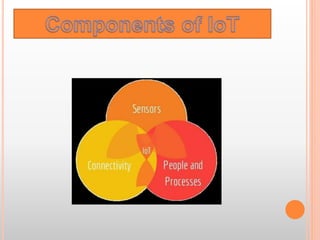
 Components of IoT
 IoT in Agriculture
 Implemented Methods
1.Moisture Sensor
2.PIR Sensor
3.Arduino
 Conclusion
 The Internet of Things (IoT) refers to the ever-growing
network of physical objects that feature an IP address for
internet connectivity, and the communication that occurs
between these objects and other Internet-enabled devices
and systems.
 In simple words, Internet of Things (IoT) is an ecosystem
 of connected physical objects that are accessible through
the internet.
 It is also referred to as Machine-to-Machine (M2M),
Skynet or Internet of Everything.
 The Internet of Things (IoT), also sometimes
referred to as the Internet of Everything (IoE),
consists of all the web-enabled devices that
collect, send and act on data they acquire from their
surrounding environments using embedded
sensors, processors and communication hardware.
 Humans can interact with the gadgets to set them
up, give them instructions or access the data, but
the devices do most of the work on their own
without human intervention.
 The IoT can be viewed as a gigantic network consisting of networks
of devices and computers connected through a series of intermediate
technologies where numerous technologies like RFIDs, wireless
connections may act as enablers of this connectivity.
 Tagging Things : Real-time item traceability and addressability by
RFIDs.
 Feeling Things : Sensors act as primary devices to collect data
from the environment.
 Shrinking Things : Miniaturization and Nanotechnology has
provoked the ability of smaller things to interact and connect within
the “things” or “smart devices.”
 Thinking Things : Embedded intelligence in devices through
sensors has formed the network connection to the Internet. It can
make the “things” realizing the intelligent control.
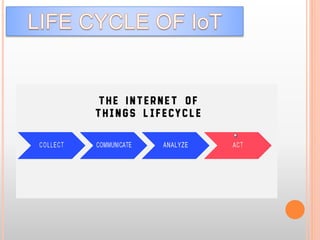
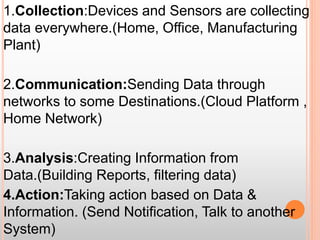
1.Collection:Devices and Sensors are collecting
data everywhere.(Home, Office, Manufacturing
Plant)
2.Communication:Sending Data through
networks to some Destinations.(Cloud Platform ,
Home Network)
3.Analysis:Creating Information from
Data.(Building Reports, filtering data)
4.Action:Taking action based on Data &
Information. (Send Notification, Talk to another
System)
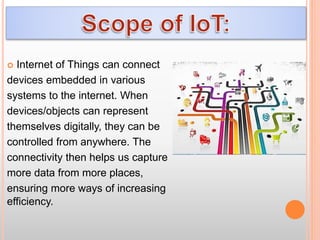
 Internet of Things can connect
devices embedded in various
systems to the internet. When
devices/objects can represent
themselves digitally, they can be
controlled from anywhere. The
connectivity then helps us capture
more data from more places,
ensuring more ways of increasing
efficiency.
 With the continuous increase in world’s population,
demand for food supply is extremely raised.
Governments are helping farmers to use advanced
techniques and research to increase food
production. Smart farming is one of the fastest
growing field in IOT.
 Farmers are using meaningful insights from the
data to yield better return on investment. Sensing
for soil moisture and nutrients, controlling water
usage for plant growth and determining custom
fertilizer are some simple uses of IOT.
IOT IN AGRICULTURE
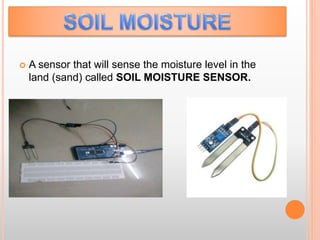
 A sensor that will sense the moisture level in the
land (sand) called SOIL MOISTURE SENSOR.
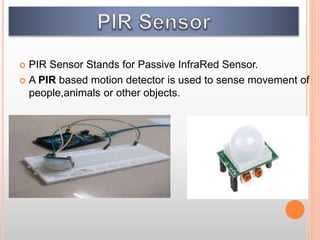
 PIR Sensor Stands for Passive InfraRed Sensor.
 A PIR based motion detector is used to sense movement of
people,animals or other objects.
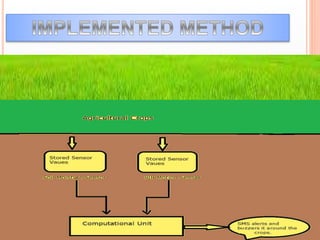
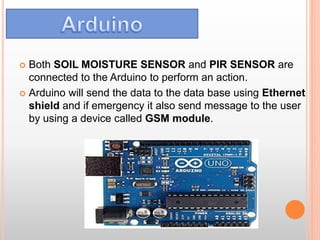
 Both SOIL MOISTURE SENSOR and PIR SENSOR are
connected to the Arduino to perform an action.
 Arduino will send the data to the data base using Ethernet
shield and if emergency it also send message to the user
by using a device called GSM module.
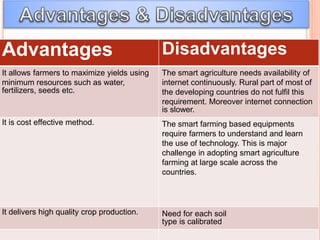
Advantages Disadvantages
It allows farmers to maximize yields using
minimum resources such as water,
fertilizers, seeds etc.
The smart agriculture needs availability of
internet continuously. Rural part of most of
the developing countries do not fulfil this
requirement. Moreover internet connection
is slower.
It is cost effective method. The smart farming based equipments
require farmers to understand and learn
the use of technology. This is major
challenge in adopting smart agriculture
farming at large scale across the
countries.
It delivers high quality crop production. Need for each soil
type is calibrated
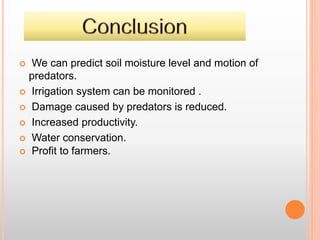
 We can predict soil moisture level and motion of
predators.
 Irrigation system can be monitored .
 Damage caused by predators is reduced.
 Increased productivity.
 Water conservation.
 Profit to farmers.
 http://www.rfwireless-
world.com/Terminology/Advantages-and-
Disadvantages-of-Smart-Agriculture-Farming.html
 https://www.iotforall.com/iot-applications-in-
agriculture
 https://www.slideshare.net/swethavennapusa1/iot-
based-smart-agriculture
Io t

Io t

  • 1.
    “SHRI SHANKARACHARYA INSTITUTEOF PROFESSIONAL MANAGEMENT AND TECHNOLOGY, RAIPUR (C.G)” Session: 2015-2019 Presented By: M.Surya Sourabh Semester:7th Sem (3333315017)
  • 4.
     What isInternet of Things?  How IoT Works?  Structure of IoT  Life Cycle of IoT  Scope of IoT  Components of IoT  IoT in Agriculture  Implemented Methods 1.Moisture Sensor 2.PIR Sensor 3.Arduino  Conclusion
  • 5.
     The Internetof Things (IoT) refers to the ever-growing network of physical objects that feature an IP address for internet connectivity, and the communication that occurs between these objects and other Internet-enabled devices and systems.  In simple words, Internet of Things (IoT) is an ecosystem  of connected physical objects that are accessible through the internet.  It is also referred to as Machine-to-Machine (M2M), Skynet or Internet of Everything.
  • 6.
     The Internetof Things (IoT), also sometimes referred to as the Internet of Everything (IoE), consists of all the web-enabled devices that collect, send and act on data they acquire from their surrounding environments using embedded sensors, processors and communication hardware.  Humans can interact with the gadgets to set them up, give them instructions or access the data, but the devices do most of the work on their own without human intervention.
  • 8.
     The IoTcan be viewed as a gigantic network consisting of networks of devices and computers connected through a series of intermediate technologies where numerous technologies like RFIDs, wireless connections may act as enablers of this connectivity.  Tagging Things : Real-time item traceability and addressability by RFIDs.  Feeling Things : Sensors act as primary devices to collect data from the environment.  Shrinking Things : Miniaturization and Nanotechnology has provoked the ability of smaller things to interact and connect within the “things” or “smart devices.”  Thinking Things : Embedded intelligence in devices through sensors has formed the network connection to the Internet. It can make the “things” realizing the intelligent control.
  • 10.
    1.Collection:Devices and Sensorsare collecting data everywhere.(Home, Office, Manufacturing Plant) 2.Communication:Sending Data through networks to some Destinations.(Cloud Platform , Home Network) 3.Analysis:Creating Information from Data.(Building Reports, filtering data) 4.Action:Taking action based on Data & Information. (Send Notification, Talk to another System)
  • 11.
     Internet ofThings can connect devices embedded in various systems to the internet. When devices/objects can represent themselves digitally, they can be controlled from anywhere. The connectivity then helps us capture more data from more places, ensuring more ways of increasing efficiency.
  • 12.
     With thecontinuous increase in world’s population, demand for food supply is extremely raised. Governments are helping farmers to use advanced techniques and research to increase food production. Smart farming is one of the fastest growing field in IOT.  Farmers are using meaningful insights from the data to yield better return on investment. Sensing for soil moisture and nutrients, controlling water usage for plant growth and determining custom fertilizer are some simple uses of IOT. IOT IN AGRICULTURE
  • 14.
     A sensorthat will sense the moisture level in the land (sand) called SOIL MOISTURE SENSOR.
  • 15.
     PIR SensorStands for Passive InfraRed Sensor.  A PIR based motion detector is used to sense movement of people,animals or other objects.
  • 16.
     Both SOILMOISTURE SENSOR and PIR SENSOR are connected to the Arduino to perform an action.  Arduino will send the data to the data base using Ethernet shield and if emergency it also send message to the user by using a device called GSM module.
  • 17.
    Advantages Disadvantages It allowsfarmers to maximize yields using minimum resources such as water, fertilizers, seeds etc. The smart agriculture needs availability of internet continuously. Rural part of most of the developing countries do not fulfil this requirement. Moreover internet connection is slower. It is cost effective method. The smart farming based equipments require farmers to understand and learn the use of technology. This is major challenge in adopting smart agriculture farming at large scale across the countries. It delivers high quality crop production. Need for each soil type is calibrated
  • 18.
     We canpredict soil moisture level and motion of predators.  Irrigation system can be monitored .  Damage caused by predators is reduced.  Increased productivity.  Water conservation.  Profit to farmers.
  • 19.