NAME : NURUL HUSNA BINTI NAFFI
MATRIC NUM : BTCL15041579
PROGRAM : BACHELOR OF COMPUTER
SCIENCE (INTERNET COMPUTING)
SUPERVISOR : PROF. MADYA DR. ENGKU
FADZLI HASAN B. SYED ABDULLAH
CONTEXT
◉1) PROJECT BACKGROUND
◉2) PROBLEM STATEMENT
◉3) OBJECTIVE
◉4) SCOPE OF PROJECT
◉5) LIMITATION OF WORK
◉6) EXPECTED RESULT
◉7) CONCLUSION
◉8) REFERENCES
BACKGROUND
◉ Nowadays, people are more and more frequent to dine-in at restaurant for their meals. Especially in Besut,
it has roughly 1 thousands to 2 thousands of citizens staying in this small town. Therefore, it will have a
lot of people especially staffs and students of UniSZA (University Sultan Zainal Abidin) looking for
restaurant that they prefer as their meals such as breakfast, lunch and dinner. With the coming of
information and communication technology (ICT),web based system has become more and more popular.
With the existing of this online home made food selling system, it is where homemade food delivery
platforms add personalization to those services by making healthy food affordable & accessible to
everyone and to get healthy & delicious meals right at your doorsteps but only in Besut. Users can order
food for themselves with just a click of a button. The most interesting thing is that food is delivered fresh
and hot.This system allows the user to browse the upcoming menu options along with current day menu
and it also allow admin to alter menu options to keep the foodies hooked. At the end of the online home
made food selling system project, it will be very useful and did a huge contribution for people which are
located in Besut.
PROBLEM STATEMENT
• Saves your time
Women nowadays have their own career so they have erratic work
schedules making it impossible to cook for their family. So this online
homemade food system will ease them because they just have to order
online from their home without have to go out to restaurant.
• Saves your money
With the economy in a recession, people nowadays just order
homemade food because it is cheaper than going to a restaurant or
buying pre-cooked meals besides home cooked meals ensure healthy
and delicious meals
”
There are 3 main objectives for this proposal.
The objectives are:
1) To implement the food ordering on a
system
2) To design and develop a system that can
help people save their time but can get
healthy food at the same time
3) To test and evaluate the functionality of
the system
OBJECTIVE
PROJECT SCOPE
OHFSS will be used by 3 main actor which are customer , staffs and delivery person :
Customer
1. Customers have to register and log in to update their information.
2. Customers can choose their meal from the menu consist of categories and cuisines then add to
cart.
3. Customers can see recommended food that customers often orders.
4. Customer can choose to pick up or delivery in front of the door but they have to pay cash on
delivery only.
5. Customer can review their order before confirming their order.
6. Customer can rated the foods after trying it.
”
1. Staff have to register first and login as staff
every time they want to login.
2. Staff will be able to add or update food menus
everyday to attract customer’s attention.
3. Staff will also be able to delete the menus if
there occurs any change.
4. Staff have to update the orders from customer
to delivery persons in charge.
5. Staff will altering menu options to keep the
foodies hooked.
6. Staff have to allow the customer to browse the
upcoming menu options along with current
day menu
STAFF
Delivery person
1. Delivery person have to login as delivery person in charge. Before that they have to
register as a delivery person.
2. Having part time delivery persons who deliver meals to customers.
3. Delivery person have to update in system every time they finish delivering meals to
customers
 https://www.fatbit.com/fab/build-advanced-food-ordering-delivery-
website-with-best-features/
 http://www.ijeert.org/pdf/v2-i7/10.pdf
 http://staff.ustc.edu.cn/~waterzhj/files/documents/cos.pdf
 https://pdfs.semanticscholar.org/ee9c/d43c9705bdaaaa34b9532493c
079041fc2ac.pdf
REFERENCES
CHAPTER 3
METHODOLOGY
◉ The software methodology that chosen to develop this system is V- model
◉ V-model is especially useful when the project is small because it works well for
small project where requirements are easily understood
◉ The reason to choose V-model to develop this system is due to it can develop a new
system in a short time compare with other software methodology because it is
simple and easy to use.
◉ This model also considered as proactive defect tracking because that is defects are
found at early stage. So this will save our time a lot.
◉ V-model is where the objective to develop the system rapidly and to understand the
user’s requirements and hence develop a better requirements definition for the
system
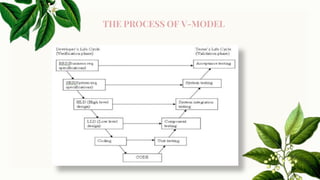
THE PROCESS OF V-MODEL
◉ Requirement analysis: In this phase the requirements are collected, analyzed and studied. Here
how the system is implemented, is not important but, what the system is supposed to do, is
important. Brain storming sessions/walkthrough, interviews are done to have the objectives
clear.
Verification activities: Requirements reviews.
Validation activities: Creation of UAT (User acceptance test) test cases
◉ System requirements / High level design: In this phase a high level design of the software is
build. The team studies and investigates on how the requirements could be implemented. The
technical feasibility of the requirements is also studied. The team also comes up with the
modules that would be created/ dependencies, Hardware / software needs
Verification activities: Design reviews
Validation activities: Creation of System test plan and cases, Creation of traceability metrics
.
◉ Architectural design: In this phase, based on the high level design, software architecture is
created. The modules, their relationships and dependencies, architectural diagrams, database
tables, technology details are all finalized in this phase.
Verification activities: Design reviews
Validation activities: Integration test plan and test cases.
◉ Module design/ Low level Design: In this phase each and every module or the software
components are designed individually. Methods, classes, interfaces, data types etc are all
finalized in this phase.
Verification activities: Design reviews
Validation activities: Creation and review of unit test cases
◉ Implementation / Code: In this phase, actual coding is done.
Verification activities: Code review, test cases review
Validation activities: Creation of functional test cases
◉ Unit Testing: In this phase all the unit test case, created in the Low level design phase are
executed.
*Unit testing is a white box testing technique, where a piece of code is written which invokes a
method (or any other piece of code) to test whether the code snippet is giving the expected output or
not. This testing is basically performed by the development team. In case of any anomaly, defects are
logged and tracked.
◉ Integration Testing: In this phase the integration test cases are executed which were created in
the Architectural design phase. In case of any anomalies, defects are logged and tracked.
*Integration Testing: Integration testing is a technique where the unit tested modules are integrated
and tested whether the integrated modules are rendering the expected results. In simpler words, It
validates whether the components of the application work together as expected.
◉ Systems testing: In this phase all the system test cases, functional test cases and
nonfunctional test cases are executed. In other words, the actual and full fledge
testing of the application takes place here. Defects are logged and tracked for its
closure. Progress reporting is also a major part in this phase. The traceability
metrics are updated to check the coverage and risk mitigated.
◉ User acceptance Testing: Acceptance testing is basically related to the business
requirements testing. Here testing is done to validate that the business requirements
are met in the user environment. Compatibility testing and sometimes nonfunctional
testing (Load, stress and volume) testing are also done in this phase.
.
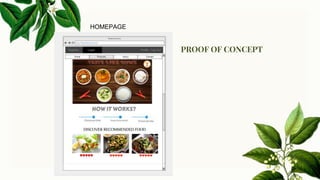
PROOF OF CONCEPT
HOMEPAGE
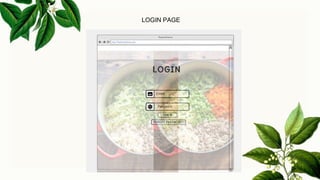
LOGIN PAGE
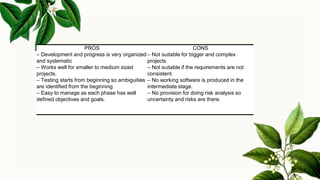
PROS CONS
– Development and progress is very organized
and systematic
– Works well for smaller to medium sized
projects.
– Testing starts from beginning so ambiguities
are identified from the beginning.
– Easy to manage as each phase has well
defined objectives and goals.
– Not suitable for bigger and complex
projects
– Not suitable if the requirements are not
consistent.
– No working software is produced in the
intermediate stage.
– No provision for doing risk analysis so
uncertainty and risks are there.
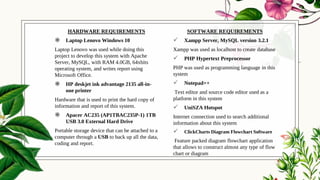
HARDWARE REQUIREMENTS
◉ Laptop Lenovo Windows 10
Laptop Lenovo was used while doing this
project to develop this system with Apache
Server, MySQL, with RAM 4.0GB, 64xbits
operating system, and writes report using
Microsoft Office.
◉ HP deskjet ink advantage 2135 all-in-
one printer
Hardware that is used to print the hard copy of
information and report of this system.
◉ Apacer AC235 (AP1TBAC235P-1) 1TB
USB 3.0 External Hard Drive
Portable storage device that can be attached to a
computer through a USB to back up all the data,
coding and report.
SOFTWARE REQUIREMENTS
 Xampp Server, MySQL version 3.2.1
Xampp was used as localhost to create database
 PHP Hypertext Preprocessor
PHP was used as programming language in this
system
 Notepad++
Text editor and source code editor used as a
platform in this system
 UniSZA Hotspot
Internet connection used to search additional
information about this system
 ClickCharts Diagram Flowchart Software
Feature packed diagram flowchart application
that allows to construct almost any type of flow
chart or diagram
”
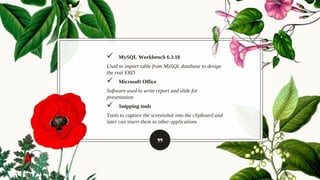
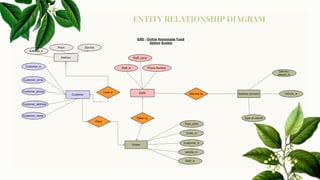
 MySQL Workbench 6.3.10
Used to import table from MySQL database to design
the real ERD
 Microsoft Office
Software used to write report and slide for
presentation
 Snipping tools
Tools to capture the screenshot into the clipboard and
later can insert them to other applications
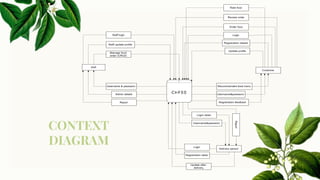
CONTEXT
DIAGRAM
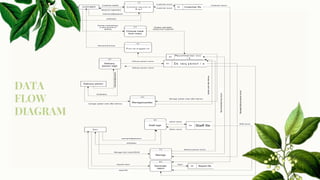
DATA
FLOW
DIAGRAM
ENTITY RELATIONSHIP DIAGRAM
Thanks!

Husnafyp

  • 2.
    NAME : NURULHUSNA BINTI NAFFI MATRIC NUM : BTCL15041579 PROGRAM : BACHELOR OF COMPUTER SCIENCE (INTERNET COMPUTING) SUPERVISOR : PROF. MADYA DR. ENGKU FADZLI HASAN B. SYED ABDULLAH
  • 3.
    CONTEXT ◉1) PROJECT BACKGROUND ◉2)PROBLEM STATEMENT ◉3) OBJECTIVE ◉4) SCOPE OF PROJECT ◉5) LIMITATION OF WORK ◉6) EXPECTED RESULT ◉7) CONCLUSION ◉8) REFERENCES
  • 4.
    BACKGROUND ◉ Nowadays, peopleare more and more frequent to dine-in at restaurant for their meals. Especially in Besut, it has roughly 1 thousands to 2 thousands of citizens staying in this small town. Therefore, it will have a lot of people especially staffs and students of UniSZA (University Sultan Zainal Abidin) looking for restaurant that they prefer as their meals such as breakfast, lunch and dinner. With the coming of information and communication technology (ICT),web based system has become more and more popular. With the existing of this online home made food selling system, it is where homemade food delivery platforms add personalization to those services by making healthy food affordable & accessible to everyone and to get healthy & delicious meals right at your doorsteps but only in Besut. Users can order food for themselves with just a click of a button. The most interesting thing is that food is delivered fresh and hot.This system allows the user to browse the upcoming menu options along with current day menu and it also allow admin to alter menu options to keep the foodies hooked. At the end of the online home made food selling system project, it will be very useful and did a huge contribution for people which are located in Besut.
  • 5.
    PROBLEM STATEMENT • Savesyour time Women nowadays have their own career so they have erratic work schedules making it impossible to cook for their family. So this online homemade food system will ease them because they just have to order online from their home without have to go out to restaurant. • Saves your money With the economy in a recession, people nowadays just order homemade food because it is cheaper than going to a restaurant or buying pre-cooked meals besides home cooked meals ensure healthy and delicious meals
  • 6.
    ” There are 3main objectives for this proposal. The objectives are: 1) To implement the food ordering on a system 2) To design and develop a system that can help people save their time but can get healthy food at the same time 3) To test and evaluate the functionality of the system OBJECTIVE
  • 7.
    PROJECT SCOPE OHFSS willbe used by 3 main actor which are customer , staffs and delivery person : Customer 1. Customers have to register and log in to update their information. 2. Customers can choose their meal from the menu consist of categories and cuisines then add to cart. 3. Customers can see recommended food that customers often orders. 4. Customer can choose to pick up or delivery in front of the door but they have to pay cash on delivery only. 5. Customer can review their order before confirming their order. 6. Customer can rated the foods after trying it.
  • 8.
    ” 1. Staff haveto register first and login as staff every time they want to login. 2. Staff will be able to add or update food menus everyday to attract customer’s attention. 3. Staff will also be able to delete the menus if there occurs any change. 4. Staff have to update the orders from customer to delivery persons in charge. 5. Staff will altering menu options to keep the foodies hooked. 6. Staff have to allow the customer to browse the upcoming menu options along with current day menu STAFF
  • 9.
    Delivery person 1. Deliveryperson have to login as delivery person in charge. Before that they have to register as a delivery person. 2. Having part time delivery persons who deliver meals to customers. 3. Delivery person have to update in system every time they finish delivering meals to customers
  • 10.
     https://www.fatbit.com/fab/build-advanced-food-ordering-delivery- website-with-best-features/  http://www.ijeert.org/pdf/v2-i7/10.pdf http://staff.ustc.edu.cn/~waterzhj/files/documents/cos.pdf  https://pdfs.semanticscholar.org/ee9c/d43c9705bdaaaa34b9532493c 079041fc2ac.pdf REFERENCES
  • 11.
  • 12.
    ◉ The softwaremethodology that chosen to develop this system is V- model ◉ V-model is especially useful when the project is small because it works well for small project where requirements are easily understood ◉ The reason to choose V-model to develop this system is due to it can develop a new system in a short time compare with other software methodology because it is simple and easy to use. ◉ This model also considered as proactive defect tracking because that is defects are found at early stage. So this will save our time a lot. ◉ V-model is where the objective to develop the system rapidly and to understand the user’s requirements and hence develop a better requirements definition for the system
  • 13.
  • 14.
    ◉ Requirement analysis:In this phase the requirements are collected, analyzed and studied. Here how the system is implemented, is not important but, what the system is supposed to do, is important. Brain storming sessions/walkthrough, interviews are done to have the objectives clear. Verification activities: Requirements reviews. Validation activities: Creation of UAT (User acceptance test) test cases ◉ System requirements / High level design: In this phase a high level design of the software is build. The team studies and investigates on how the requirements could be implemented. The technical feasibility of the requirements is also studied. The team also comes up with the modules that would be created/ dependencies, Hardware / software needs Verification activities: Design reviews Validation activities: Creation of System test plan and cases, Creation of traceability metrics .
  • 15.
    ◉ Architectural design:In this phase, based on the high level design, software architecture is created. The modules, their relationships and dependencies, architectural diagrams, database tables, technology details are all finalized in this phase. Verification activities: Design reviews Validation activities: Integration test plan and test cases. ◉ Module design/ Low level Design: In this phase each and every module or the software components are designed individually. Methods, classes, interfaces, data types etc are all finalized in this phase. Verification activities: Design reviews Validation activities: Creation and review of unit test cases ◉ Implementation / Code: In this phase, actual coding is done. Verification activities: Code review, test cases review Validation activities: Creation of functional test cases
  • 16.
    ◉ Unit Testing:In this phase all the unit test case, created in the Low level design phase are executed. *Unit testing is a white box testing technique, where a piece of code is written which invokes a method (or any other piece of code) to test whether the code snippet is giving the expected output or not. This testing is basically performed by the development team. In case of any anomaly, defects are logged and tracked. ◉ Integration Testing: In this phase the integration test cases are executed which were created in the Architectural design phase. In case of any anomalies, defects are logged and tracked. *Integration Testing: Integration testing is a technique where the unit tested modules are integrated and tested whether the integrated modules are rendering the expected results. In simpler words, It validates whether the components of the application work together as expected.
  • 17.
    ◉ Systems testing:In this phase all the system test cases, functional test cases and nonfunctional test cases are executed. In other words, the actual and full fledge testing of the application takes place here. Defects are logged and tracked for its closure. Progress reporting is also a major part in this phase. The traceability metrics are updated to check the coverage and risk mitigated. ◉ User acceptance Testing: Acceptance testing is basically related to the business requirements testing. Here testing is done to validate that the business requirements are met in the user environment. Compatibility testing and sometimes nonfunctional testing (Load, stress and volume) testing are also done in this phase. .
  • 18.
  • 19.
  • 20.
    PROS CONS – Developmentand progress is very organized and systematic – Works well for smaller to medium sized projects. – Testing starts from beginning so ambiguities are identified from the beginning. – Easy to manage as each phase has well defined objectives and goals. – Not suitable for bigger and complex projects – Not suitable if the requirements are not consistent. – No working software is produced in the intermediate stage. – No provision for doing risk analysis so uncertainty and risks are there.
  • 21.
    HARDWARE REQUIREMENTS ◉ LaptopLenovo Windows 10 Laptop Lenovo was used while doing this project to develop this system with Apache Server, MySQL, with RAM 4.0GB, 64xbits operating system, and writes report using Microsoft Office. ◉ HP deskjet ink advantage 2135 all-in- one printer Hardware that is used to print the hard copy of information and report of this system. ◉ Apacer AC235 (AP1TBAC235P-1) 1TB USB 3.0 External Hard Drive Portable storage device that can be attached to a computer through a USB to back up all the data, coding and report. SOFTWARE REQUIREMENTS  Xampp Server, MySQL version 3.2.1 Xampp was used as localhost to create database  PHP Hypertext Preprocessor PHP was used as programming language in this system  Notepad++ Text editor and source code editor used as a platform in this system  UniSZA Hotspot Internet connection used to search additional information about this system  ClickCharts Diagram Flowchart Software Feature packed diagram flowchart application that allows to construct almost any type of flow chart or diagram
  • 22.
    ”  MySQL Workbench6.3.10 Used to import table from MySQL database to design the real ERD  Microsoft Office Software used to write report and slide for presentation  Snipping tools Tools to capture the screenshot into the clipboard and later can insert them to other applications
  • 23.
  • 24.
  • 25.
  • 26.