Investment Issues
David Bach
The Bach Group
ebach1@sbcglobal.net
Linkedin.com/in/david-bach-53581724
Concerns
• #1 fear of investors: Outliving their money.
• Only 1 in 25 Americans are financially independent in
retirement.
• A financial literacy survey reveals that 45 percent of adults
gave themselves grades C, D or F regarding their personal
financial knowledge.
• Excessive fees charged investors total $17 billion annually.
• The government gives investors a false sense of security.
• Individual investors are on their own. CYA
Divergence of Opinions
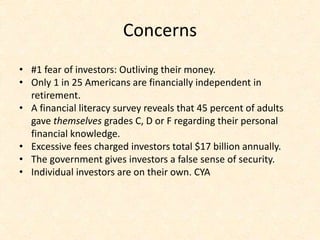
• In the case above, the Human Resources department feels the participants are
responsible for avoiding excessive fees.
• However, lawsuits involving excessive fees in deferred compensation plans have
been filed against sponsors (employers), not the participants (Google “Adidas
America lawsuit”).
• Employers have had to pay millions of dollars in judgments.
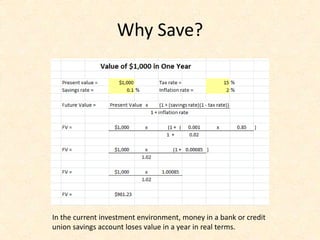
Why Save?
In the current investment environment, money in a bank or credit
union savings account loses value in a year in real terms.
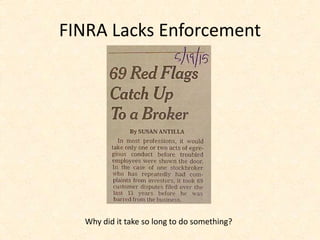
FINRA Lacks Enforcement
Why did it take so long to do something?
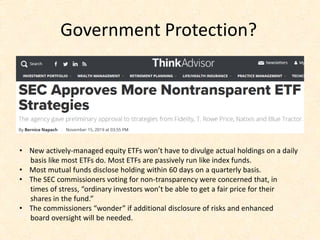
Government Protection?
• New actively-managed equity ETFs won’t have to divulge actual holdings on a daily
basis like most ETFs do. Most ETFs are passively run like index funds.
• Most mutual funds disclose holding within 60 days on a quarterly basis.
• The SEC commissioners voting for non-transparency were concerned that, in
times of stress, “ordinary investors won’t be able to get a fair price for their
shares in the fund.”
• The commissioners “wonder” if additional disclosure of risks and enhanced
board oversight will be needed.
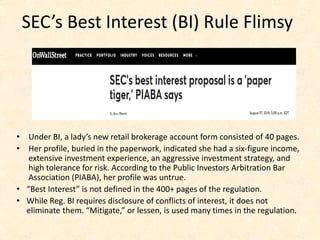
SEC’s Best Interest (BI) Rule Flimsy
• Under BI, a lady’s new retail brokerage account form consisted of 40 pages.
• Her profile, buried in the paperwork, indicated she had a six-figure income,
extensive investment experience, an aggressive investment strategy, and
high tolerance for risk. According to the Public Investors Arbitration Bar
Association (PIABA), her profile was untrue.
• “Best Interest” is not defined in the 400+ pages of the regulation.
• While Reg. BI requires disclosure of conflicts of interest, it does not
eliminate them. “Mitigate,” or lessen, is used many times in the regulation.
Financial Illiteracy Can Be Costly
The man’s wife died. He revised
his beneficiary form incorrectly
for his kids, invalidating the new
one.
He re-marries, then dies.
The new wife gets the money, not
his kids.
Beneficiary forms outrank wills
98% of the time. Keep beneficiary
forms with banks accounts,
mutual funds, retirement
accounts, life Insurance policies,
CDs and brokerage firms current
and accurate.
Question: Why didn’t the financial institution
inform the man the new form was invalid?
Financial Literacy Helps
• Wharton study:
– The financially literate generate 13% better annual returns
than financial novices.
– Over a 30-year period, their retirement portfolios are 25%
larger than those lacking financial knowledge.
• Reasons for the better performance by financially
savvy investors:
– They find the same service at lower fees.
– They own more stocks in their portfolio that generate
better returns.
– They can avoid scams better.
Avoid Financial Illiteracy
Get educated. Basic investment knowledge from
these sources:
– SEC regulates investment advisers and corporations:
www.investor.gov.
• Check out investment advisers:
https://adviserinfo.sec.gov/IAPD/Default.aspx.
• See holdings of mutual funds:
www.sec.gov/edgar/searchedgar/mutualsearch.htm
– FINRA regulates brokers: www.finra.org
• Check out brokers: https://brokercheck.finra.org.
– State regulators: www.nasaa.org/investor-education.
Avoid Financial Illiteracy (cont.)
• Review your credit reports annually:
– 1 in 5 credit reports have errors.
– Request them via www.AnnualCreditReport.com.
• There are four credit agencies:
– Equifax (equifax.com)
– Experian (experian.com)
– Transunion (transunion.com)
– The National Consumer Telecom and Utilities Exchange,
which provides credit information to cellphone, pay TV and
utility companies (nctue.com).
The Investment Objective
• The seven factors of an investment objective:
– Time horizon
– Return
– Risk
– Liquidity
– Tax issues
– Legal issues
– Personal constraints
• At least one question in the Chartered Financial
Analyst (CFA) exams requires an investment
objective be made for a prospective client.
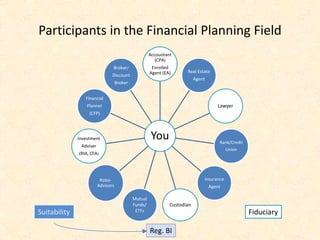
Participants in the Financial Planning Field
You
Accountant
(CPA)
Enrolled
Agent (EA) Real Estate
Agent
Lawyer
Bank/Credit
Union
Insurance
Agent
Custodian
Mutual
Funds/
ETFs
Robo-
Advisors
Investment
Adviser
(RIA, CFA)
Financial
Planner
(CFP)
Broker/
Discount
Broker
FiduciarySuitability
Reg. BI
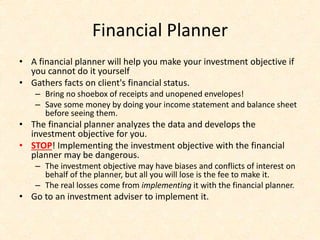
Financial Planner
• A financial planner will help you make your investment objective if
you cannot do it yourself
• Gathers facts on client's financial status.
– Bring no shoebox of receipts and unopened envelopes!
– Save some money by doing your income statement and balance sheet
before seeing them.
• The financial planner analyzes the data and develops the
investment objective for you.
• STOP! Implementing the investment objective with the financial
planner may be dangerous.
– The investment objective may have biases and conflicts of interest on
behalf of the planner, but all you will lose is the fee to make it.
– The real losses come from implementing it with the financial planner.
• Go to an investment adviser to implement it.
Investment Advisers (I.A.)
• Other names: Investment counselor, investment manager, portfolio
manager, money manager.
• Suitability: For investors lacking the time, patience, understanding, or
resources to invest on their own.
• Background: Usually has an MBA and years of experience. They may be a
Registered Investment Adviser (RIA) and a Chartered Financial Analyst
(CFA).
• Advantages:
– Focuses on investments, not taxes, legal issues or insurance products.
– Provides custom service: They invest according to the client’s investment
objective.
– Investment objective is similar to client’s: make the account grow in value.
– Has access to more timely and comprehensive information than stockbrokers
or their clients.
– Far more accessible to the client than a portfolio manager at a mutual fund.
Investment Advisers (cont.)
• Disadvantages:
– Minimum account size generally must be at least $100,000. The larger
the portfolio, the lower the rate.
– Like a mutual fund, they have full discretion on the account to act in a
timely manner.
• Myth: They are expensive.
• Fact: They are reasonably priced.
– The commissions selling a house could pay for at least three years of
investment advisory service.
– A house sale is a one-time event while the IA manages the client’s
portfolio 365 days a year.
– A bank trust department will charge similarly for less customized
service. A bank trust representative will be in charge of about 500
clients and may be a newly-minted MBA. Like a brokerage firm, the
bank trust department can only invest in securities recommended by
that bank’s research department.
Mutual Fund Performance
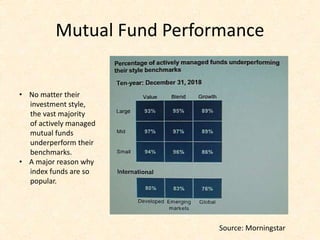
Source: Morningstar
• No matter their
investment style,
the vast majority
of actively managed
mutual funds
underperform their
benchmarks.
• A major reason why
index funds are so
popular.
Diversification Reduces Risk
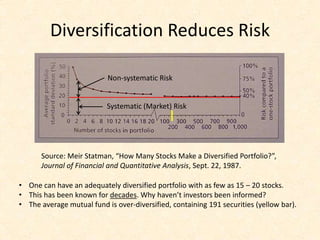
Source: Meir Statman, “How Many Stocks Make a Diversified Portfolio?”,
Journal of Financial and Quantitative Analysis, Sept. 22, 1987.
Non-systematic Risk
Systematic (Market) Risk
• One can have an adequately diversified portfolio with as few as 15 – 20 stocks.
• This has been known for decades. Why haven’t investors been informed?
• The average mutual fund is over-diversified, containing 191 securities (yellow bar).
Compound Interest
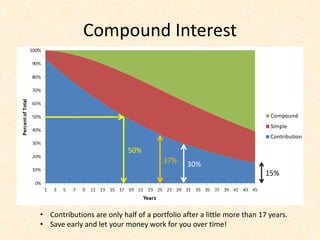
37% 30%
15%
• Contributions are only half of a portfolio after a little more than 17 years.
• Save early and let your money work for you over time!
50%
Impact of Insidious Fees
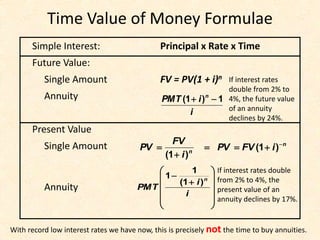
Time Value of Money Formulae
Simple Interest: Principal x Rate x Time
Future Value:
Single Amount FV = PV(1 + i)n
Annuity
Present Value
Single Amount
i
iPMT n
1)1( 
n
n
iFVPV
i
FV
PV 


 )1(
)1(














i
i
PMT
n
)1(
1
1
With record low interest rates we have now, this is precisely not the time to buy annuities.
Annuity
If interest rates double
from 2% to 4%, the
present value of an
annuity declines by 17%.
If interest rates
double from 2% to
4%, the future value
of an annuity
declines by 24%.

Investment Issues

  • 1.
    Investment Issues David Bach TheBach Group ebach1@sbcglobal.net Linkedin.com/in/david-bach-53581724
  • 2.
    Concerns • #1 fearof investors: Outliving their money. • Only 1 in 25 Americans are financially independent in retirement. • A financial literacy survey reveals that 45 percent of adults gave themselves grades C, D or F regarding their personal financial knowledge. • Excessive fees charged investors total $17 billion annually. • The government gives investors a false sense of security. • Individual investors are on their own. CYA
  • 3.
    Divergence of Opinions •In the case above, the Human Resources department feels the participants are responsible for avoiding excessive fees. • However, lawsuits involving excessive fees in deferred compensation plans have been filed against sponsors (employers), not the participants (Google “Adidas America lawsuit”). • Employers have had to pay millions of dollars in judgments.
  • 4.
    Why Save? In thecurrent investment environment, money in a bank or credit union savings account loses value in a year in real terms.
  • 5.
    FINRA Lacks Enforcement Whydid it take so long to do something?
  • 6.
    Government Protection? • Newactively-managed equity ETFs won’t have to divulge actual holdings on a daily basis like most ETFs do. Most ETFs are passively run like index funds. • Most mutual funds disclose holding within 60 days on a quarterly basis. • The SEC commissioners voting for non-transparency were concerned that, in times of stress, “ordinary investors won’t be able to get a fair price for their shares in the fund.” • The commissioners “wonder” if additional disclosure of risks and enhanced board oversight will be needed.
  • 7.
    SEC’s Best Interest(BI) Rule Flimsy • Under BI, a lady’s new retail brokerage account form consisted of 40 pages. • Her profile, buried in the paperwork, indicated she had a six-figure income, extensive investment experience, an aggressive investment strategy, and high tolerance for risk. According to the Public Investors Arbitration Bar Association (PIABA), her profile was untrue. • “Best Interest” is not defined in the 400+ pages of the regulation. • While Reg. BI requires disclosure of conflicts of interest, it does not eliminate them. “Mitigate,” or lessen, is used many times in the regulation.
  • 8.
    Financial Illiteracy CanBe Costly The man’s wife died. He revised his beneficiary form incorrectly for his kids, invalidating the new one. He re-marries, then dies. The new wife gets the money, not his kids. Beneficiary forms outrank wills 98% of the time. Keep beneficiary forms with banks accounts, mutual funds, retirement accounts, life Insurance policies, CDs and brokerage firms current and accurate. Question: Why didn’t the financial institution inform the man the new form was invalid?
  • 9.
    Financial Literacy Helps •Wharton study: – The financially literate generate 13% better annual returns than financial novices. – Over a 30-year period, their retirement portfolios are 25% larger than those lacking financial knowledge. • Reasons for the better performance by financially savvy investors: – They find the same service at lower fees. – They own more stocks in their portfolio that generate better returns. – They can avoid scams better.
  • 10.
    Avoid Financial Illiteracy Geteducated. Basic investment knowledge from these sources: – SEC regulates investment advisers and corporations: www.investor.gov. • Check out investment advisers: https://adviserinfo.sec.gov/IAPD/Default.aspx. • See holdings of mutual funds: www.sec.gov/edgar/searchedgar/mutualsearch.htm – FINRA regulates brokers: www.finra.org • Check out brokers: https://brokercheck.finra.org. – State regulators: www.nasaa.org/investor-education.
  • 11.
    Avoid Financial Illiteracy(cont.) • Review your credit reports annually: – 1 in 5 credit reports have errors. – Request them via www.AnnualCreditReport.com. • There are four credit agencies: – Equifax (equifax.com) – Experian (experian.com) – Transunion (transunion.com) – The National Consumer Telecom and Utilities Exchange, which provides credit information to cellphone, pay TV and utility companies (nctue.com).
  • 12.
    The Investment Objective •The seven factors of an investment objective: – Time horizon – Return – Risk – Liquidity – Tax issues – Legal issues – Personal constraints • At least one question in the Chartered Financial Analyst (CFA) exams requires an investment objective be made for a prospective client.
  • 13.
    Participants in theFinancial Planning Field You Accountant (CPA) Enrolled Agent (EA) Real Estate Agent Lawyer Bank/Credit Union Insurance Agent Custodian Mutual Funds/ ETFs Robo- Advisors Investment Adviser (RIA, CFA) Financial Planner (CFP) Broker/ Discount Broker FiduciarySuitability Reg. BI
  • 14.
    Financial Planner • Afinancial planner will help you make your investment objective if you cannot do it yourself • Gathers facts on client's financial status. – Bring no shoebox of receipts and unopened envelopes! – Save some money by doing your income statement and balance sheet before seeing them. • The financial planner analyzes the data and develops the investment objective for you. • STOP! Implementing the investment objective with the financial planner may be dangerous. – The investment objective may have biases and conflicts of interest on behalf of the planner, but all you will lose is the fee to make it. – The real losses come from implementing it with the financial planner. • Go to an investment adviser to implement it.
  • 15.
    Investment Advisers (I.A.) •Other names: Investment counselor, investment manager, portfolio manager, money manager. • Suitability: For investors lacking the time, patience, understanding, or resources to invest on their own. • Background: Usually has an MBA and years of experience. They may be a Registered Investment Adviser (RIA) and a Chartered Financial Analyst (CFA). • Advantages: – Focuses on investments, not taxes, legal issues or insurance products. – Provides custom service: They invest according to the client’s investment objective. – Investment objective is similar to client’s: make the account grow in value. – Has access to more timely and comprehensive information than stockbrokers or their clients. – Far more accessible to the client than a portfolio manager at a mutual fund.
  • 16.
    Investment Advisers (cont.) •Disadvantages: – Minimum account size generally must be at least $100,000. The larger the portfolio, the lower the rate. – Like a mutual fund, they have full discretion on the account to act in a timely manner. • Myth: They are expensive. • Fact: They are reasonably priced. – The commissions selling a house could pay for at least three years of investment advisory service. – A house sale is a one-time event while the IA manages the client’s portfolio 365 days a year. – A bank trust department will charge similarly for less customized service. A bank trust representative will be in charge of about 500 clients and may be a newly-minted MBA. Like a brokerage firm, the bank trust department can only invest in securities recommended by that bank’s research department.
  • 17.
    Mutual Fund Performance Source:Morningstar • No matter their investment style, the vast majority of actively managed mutual funds underperform their benchmarks. • A major reason why index funds are so popular.
  • 18.
    Diversification Reduces Risk Source:Meir Statman, “How Many Stocks Make a Diversified Portfolio?”, Journal of Financial and Quantitative Analysis, Sept. 22, 1987. Non-systematic Risk Systematic (Market) Risk • One can have an adequately diversified portfolio with as few as 15 – 20 stocks. • This has been known for decades. Why haven’t investors been informed? • The average mutual fund is over-diversified, containing 191 securities (yellow bar).
  • 19.
    Compound Interest 37% 30% 15% •Contributions are only half of a portfolio after a little more than 17 years. • Save early and let your money work for you over time! 50%
  • 20.
  • 21.
    Time Value ofMoney Formulae Simple Interest: Principal x Rate x Time Future Value: Single Amount FV = PV(1 + i)n Annuity Present Value Single Amount i iPMT n 1)1(  n n iFVPV i FV PV     )1( )1(               i i PMT n )1( 1 1 With record low interest rates we have now, this is precisely not the time to buy annuities. Annuity If interest rates double from 2% to 4%, the present value of an annuity declines by 17%. If interest rates double from 2% to 4%, the future value of an annuity declines by 24%.

Editor's Notes

  • #3 Read more at http://www.kiplinger.com/slideshow/investing/T052-S003-10-reasons-millennials-need-to-own-stocks/index.html#cYEOl0UJH9LlrT54.99; http://www.kiplinger.com/slideshow/investing/T052-S003-10-reasons-millennials-need-to-own-stocks/index.html?rid=SYN-yahoo&rpageid=13579; viewed 6/4/15; “New assessment has CalSTRS’ benefits only 63.7% funded,” Adam Ashton, Sacramento Bee, 3/31/17; https://www.yahoo.com/finance/news/no-1-reason-people-don-121500257.html, viewed 9/30/18; https://www.marketwatch.com/story/forget-the-social-security-increase-this-is-why-seniors-are-in-trouble-2018-10-16?siteid=yhoof2&yptr=yahoo, viewed 10/17/18;
  • #4 https://www.fa-mag.com/news/american-workers-say-they-dread-outliving-their-money-50814.html?section=43&utm_source=FA+Subscribers&utm_campaign=2c959fad6e-FAN_FA_News_CE_Credit_073019&utm_medium=email&utm_term=0_6bebc79291-2c959fad6e-222053949, viewed 10/24/2019;
  • #6 Source: The New York Times, Tuesday, May 19, 2015, page B1.
  • #7 https://www.thinkadvisor.com/2019/11/15/sec-approves-more-nontransparent-etf-strategies/?kw=SEC%20Approves%20More%20Nontransparent%20ETF%20Strategies&utm_source=email&utm_medium=enl&utm_campaign=portfoliobuilder&utm_content=20191118&utm_term=tadv, viewed 11/18/2019;
  • #8 https://onwallstreet.financial-planning.com/news/sec-urged-to-improve-best-interest-standard-by-piaba?utm_campaign=daybreak-aug%208%202018&utm_medium=email&utm_source=newsletter&eid=b2e5cc91022ea36e8c011434a69e567f, viewed 8/8/2018;
  • #9 http://finance.yahoo.com/news/man-s-mistake-cost-his-children--400-000-of-an-ira-inheritance-152712809.html; viewed 6/27/2014.
  • #10 http://www.fa-mag.com/news/financially-literacy-helps-boost-annual-returns-13-18228.html?section=43; viewed 6/19/2014.
  • #19 Essentials of Investments, 9th Edition, Bodie, Kane and Marcus, p. 150.
  • #21 http://www.fa-mag.com/news/fiduciary-rule-fight-brews-while-bad-financial-advisors-multiply-33122.html?section=3&page=2, viewed 7/14/17;