1) The document analyzes how different investment horizons and herding behavior impact investor returns over multiple market cycles from 2001-2008.
2) It tracks sales volatility and changes in investor herding to identify phases where returns were most impacted by shifts in sentiment.
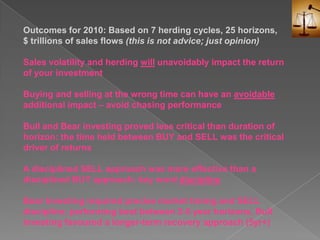
3) The analysis finds that discipline around selling, rather than buying, had a greater impact on returns. Investors with medium-term horizons of 2-5 years tended to perform best when taking a bearish stance, while bullish investors favored longer horizons of 5+ years.
![InvestmentHorizon [Def] The lifecycle (or holding period) of an investment held by a particular investor, often categorised as short, medium or long-term. Horizons are holding periods specific to the investor, differing from the headline returns quoted by the media. The timing and duration of these horizons typifies different types of investing, and both bulls and bears will vacillate (move back and forth) between these strategies through a market cycle.‘Bull versus Bear Investing; versus Herding’On behalf and for the CCC; not to be used as investment adviceJon Beckett, ASCI, Ronin ResearchCCC](https://image.slidesharecdn.com/investmenthorizons2008-12614969970515-phpapp01/85/Investment-Horizons-2008-1-320.jpg)
![InvestmentHorizon [Def] The lifecycle (or holding period) of an investment held by a particular investor, often categorised as short, medium or long-term. Horizons are holding periods specific to the investor, differing from the headline returns quoted by the media. The timing and duration of these horizons typifies different types of investing, and both bulls and bears will vacillate (move back and forth) between these strategies through a market cycle.‘Bull versus Bear Investing; versus Herding’On behalf and for the CCC; not to be used as investment adviceJon Beckett, ASCI, Ronin ResearchCCC](https://image.slidesharecdn.com/investmenthorizons2008-12614969970515-phpapp01/75/Investment-Horizons-2008-1-2048.jpg)
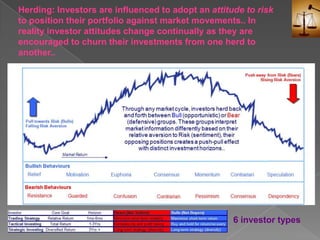
![7 recorded ‘herding’ cycles between 2002-08 – the aggregated attitude to risk changed depending on the volume of flows and what people were buying in response to influences..Investor Risk Premium [Def] An indicator if investor risk aversion most commonly illustrated by surveys and quantitative modelling. However buying behaviours can be directly correlated with market sentiment. Large sales flows and changes in buying patterns can therefore have a direct impact on market liquidity, expansion/retraction, fund turnover and hence volatility.](https://image.slidesharecdn.com/investmenthorizons2008-12614969970515-phpapp01/85/Investment-Horizons-2008-4-320.jpg)
![In 2008 sentiment volatility was far greater than price volatility; (perhaps up to 50x) . Sales flow volatility jumped suddenly from $0,000s p/mth to $000,000,000s... Managers were passengers!Investor Risk Premium [Def] An indicator if investor risk aversion most commonly illustrated by surveys and quantitative modelling. However buying behaviours can be directly correlated with market sentiment. Large sales flows and changes in buying patterns can therefore have a direct impact on market liquidity, expansion/retraction, fund turnover and hence volatility.](https://image.slidesharecdn.com/investmenthorizons2008-12614969970515-phpapp01/85/Investment-Horizons-2008-5-320.jpg)
![Herding cycles have impacted net returns. Within the Bull and Bear camps some investors trade less rationally than others. 2 opposing positions (net BUYs v SELLS).. Investor Risk Premium [Def] An indicator if investor risk aversion most commonly illustrated by surveys and quantitative modelling. However buying behaviours can be directly correlated with market sentiment. Large sales flows and changes in buying patterns can therefore have a direct impact on market liquidity, expansion/retraction, fund turnover and hence volatility.](https://image.slidesharecdn.com/investmenthorizons2008-12614969970515-phpapp01/85/Investment-Horizons-2008-6-320.jpg)
![Appendix: my definition of terms usedTotal Return Investing [Def] An investor who buys and holds an investment through a market cycle(s), normally holding for the medium-long term. A total return investor will often choose investments based on asset allocation and investment horizon. When matched with an objective that includes a specific return then this often known as 'target-return' investing. Total Return investors are often highly risk aware, disciplined, opportunistic and regularly contrarian to the 'herd'. Given the cyclical nature of markets, total return investors who hold for 3 years or more normally invest strategically into diversified portfolios and combine strategies together to provide superior risk-adjusted returns over the longer-term.Tactical Investing [Def] An investor who buys/sells an investment either opportunistically or defensively based on a short-term view on markets, often near the end of a cycle peak or trough. Tactical Investing requires an element of market timing and therefore considered higher risk. Those investing over short-term periods and sell during a drawdown or buy into the peak of a market are typified as 'trading strategy' investors. Those whom buy during periods of falling market returns or sell during a momentum market are grouped as 'contrarian' investors. The level of market timing risk is then directly related to both the duration of the holding period and the timing of the investment. Some 'trading strategy' investors buy and sell based on relative performance to benchmarks or peer groups, chasing past returns, netting quick profits and generally displaying a high turnover in their positions; (known as 'relative return investors) and the most likely group to follow consensus. At the other tactical investors who change their holding period in response to market conditions (i.e. shortening or lengthening their horizon to maximise profit) are most likely to be considered 'contrarian'.Investment Horizon [Def] The lifecycle (or holding period) of an investment held by a particular investor, often categorised as short, medium or long-term. Horizons are holding periods specific to the investor, differing from the headline returns quoted by the media. The timing and duration of these horizons typifies different types of investing, and both bulls and bears will vacillate (move back and forth) between these strategies through a market cycle.Herding [Def] Emotive investors who buy and sell investments based on influences of consensus, market outlook and risk. It implies that investors stop buying or selling based on disciplined investment strategy by defaulting to move with the majority.Investor Risk Premium [Def] An indicator if investor risk aversion most commonly illustrated by surveys and quantitative modelling. However buying behaviours can be directly correlated with market sentiment. Large sales flows and changes in buying patterns can therefore have a direct impact on market liquidity, expansion/retraction, fund turnover and hence volatility.](https://image.slidesharecdn.com/investmenthorizons2008-12614969970515-phpapp01/85/Investment-Horizons-2008-8-320.jpg)


![Investment ppt[1].pptx [autosaved]](https://cdn.slidesharecdn.com/ss_thumbnails/investmentppt1-pptxautosaved-120507003432-phpapp02-thumbnail.jpg?width=640&height=640&fit=bounds)


![Dgae [mec] 2012 abertura do concurso de mobilidade interna](https://cdn.slidesharecdn.com/ss_thumbnails/dgaemec2012aberturadoconcursodemobilidadeinterna-120713044409-phpapp01-thumbnail.jpg?width=640&height=640&fit=bounds)


![Getting Started with Apache Spark: Big Data Made Simple [Free Meetup]](https://cdn.slidesharecdn.com/ss_thumbnails/apachesparkgettingstarted-260203175547-8361bcc3-thumbnail.jpg?width=640&height=640&fit=bounds)


