

Inventory Management
A Key to Success
Terms
• distributor / vendor / supplier are used
interchangeably. It is the entity that you are
purchasing drugs and supplies from. It can be the
manufacturer or a distributing company
• Inventory / supplies is used interchangeably. It is
the actual item that is purchased.
• Inventory management is a critical
component of practice profitability
• It is the second largest cost of operation of
the veterinary practice
• Remember, the first largest cost is staffing
• Lack of effective inventory systems is a
common cause of poor cash flow in a
veterinary practice
• In most practices a veterinary technician is
put in charge of all or parts of the inventory
management system
• Inventory is specifically defined as all the
goods owned and held for sale or use in the
regular course of business
• This includes:
• Drugs and supplies purchased to resell to
clients (dispensing items)
• All inventory items used to provide medical
and surgical services
• Office and computer supplies
• Cleaning and janitorial supplies
• Maintenance supplies
• Inventory control is the process whereby
the need to maintain sufficient inventory to
meet the hospitals needs is weighed against
the cost of carrying the inventory
• Tax definitions of inventory may be
different
• Optimum inventory control ensures that the
practice will never be out of a needed item
and that the cost of purchasing and carrying
inventory is kept to the lowest possible
level
3 Costs Associated With Inventory
• Unit Cost
• Ordering Cost
• Holding Cost
Unit Cost
• The cost for each item of inventory
purchased must be calculated for the unit it
is used or dispensed in.
• This is called the unit price
• The unit price of the item includes:
• Sales tax charged to the practice by the vendor
on each item sold to the practice (not charged
by vendor in all states, but it is charged in New
York State)
• Shipping costs
Ordering Cost
• Most ordering costs are labor-related expenses:
• Hourly wage paid to the employee performing the work
• Associated payroll taxes
• Employee benefit programs
Labor Cost Includes the Following
Tasks
• Determining the amount needed
• Shopping for the best price
• Placing the order
• Meeting with the manufacturing representatives
Labor Cost Includes the Following
Tasks
• Accounting for back orders
• Receiving and unpacking the orders
• Comparing the purchase order with the shipping
invoice
• Pricing and placing the items on the shelf
Labor Cost Includes the Following
Tasks
• Posting the costs of the items in the practices
disbursement register
• Providing statements to be paid to the appropriate
person (bookkeeper, practice manager, etc)
• Logging the appropriate Controlled substance
items
Labor Cost Includes the Following
Tasks
• The entire inventory ordering activity
expends quite a bit of employee time
• Ordering costs can account for a much as
15-20% of the total unit cost
Holding Costs
• Holding costs are the costs of owning and
keeping inventory on the premises in
anticipation of use.
• The largest holding cost is the capital tied
up in purchasing the inventory
Holding Costs Also Include
• Personal property taxes paid on the
inventory value as of a specific valuation
date. (usually end of year to the IRS)
• Insurance premiums paid on the average
value of the inventory to protect against the
risk of loss in the event of a disaster, theft,
or damage
Holding Costs Also Include
• The cost of protecting inventory from heat,
cold, humidity
• Costs associated with outdating and
spoilage, especially if inventory is not used
or sold immediately
Holding Costs Also Include
• Pharmacy licensing fees in states where
applicable (In NYS there is no licensing
fees, but a veterinary pharmacy is under the
same regulations as the human pharmacies)
• The cost of maintaining OSHA regulation
compliance
Holding Costs
• The proceeding holding costs range from 8-
15% of the unit cost
• The holding and ordering costs, combined,
comprise 25-40% of the total unit cost
depending upon:
•
Combined Holding & Ordering
Costs
• The holding and ordering costs, combined,
comprise 25-40% of the total unit cost
depending upon:
• Amount of time inventory is held (on the shelf)
• Success of discouraging pilferage (theft)
• efficiency of purchasing
• Inventory costs amount to much more than what is
paid to the vendor
• Optimum inventory control includes an astute
purchasing policy that minimizes ordering and
holding costs while at the same time ensuring that
the items required to operate the hospital are
available when needed
Goals of Inventory Control and
Management
• If inventory control and management are
effective, the following should be true:
• Medications and supplies are available to treat
patients when needed
• Clients can obtain refills and other items when
requested
• Quantities of drugs and supplies are
controlled to minimize hospital
expenditures to the lowest practical level.
Large stock quantities that tie up cash are
avoided unless discount savings can be
shown to adequately offset the dollars tied
up in idle inventory amounts on the practice
shelves
• Staff can efficiently order, stock, and dispense the
needed items
• Controlled drugs are properly monitored and
secured
• Appropriate security systems and safeguards exist
to insure that drugs and supplies will be used as
intended
• Staff is trained to correctly handle supplies that
represent potential health and safety hazards
• Fees charged for pharmaceuticals and supplies are
adjusted on a regular basis and price increases are
appropriately passed on to the client
• The desired level of profit is achieved
• To accomplish this, a workable hospital
inventory system must be:
• Planned
• Organized
• Directed
• Evaluated
• Adapted as needed
Effective Inventory System
Functions
• Ensures that all items used in the hospital
are available when needed
• Signals the manager when an item needs to
be reordered to avoid running out of stock
Effective Inventory System
Functions
• Accounts for the estimated delay between
placing and receiving an order
• Should keep supply levels that do not
unnecessarily tie up capital
• The accounting and reporting system should
be flexible
Effective Inventory System
Functions
• Provide accurate detail of inventory on
hand and it’s value at any given time.
(perpetual inventory)
• Act as a contact management tool – names,
phone numbers, account numbers of
vendors, log of prior orders
Effective Inventory System
Functions
• Should readily identify where each item is
available at the least cost, how to order, and
any quantity discounts if applicable
• Identify and track backorders and when
they will arrive
Effective Inventory System
Functions
• Track expiration dates so product can be
returned for refunds and taken out of
quantity on hand stock
• Identifying factors such as seasonal usage,
to better help with projecting ordering
quantities
Effective Inventory System
Functions
• Should help verify that received orders
agree with purchase orders
• Should allow for price increases by vendors
to automatically adjust dispensing price to
client
Effective Inventory System
Functions
• Should reduce pilferage and theft by
employees
• Should easily identify wastage and other
forms of loss
Pareto’s Law
• The 80/20 rule
• States that 20% of the inventory items
account for 80% of the annual inventory
expenses
• This should be taken into account when
determining the ideal turnover rate for the
item
Inventory Management Systems
• Can be either a manual card system or
computerized
Inventory Management Systems
• They must contain the following item
information:
• Item – size, color, strength, dispensing format
(pill, capsule, liquid, paste, can, case, etc)
• Supplier – company name, phone #, hospital
account #, discount information, billing policy
Inventory Management Systems
• Quantity – amount of each item ordered, price
quoted, date ordered, number of each item
received, date received and invoice price
• Reorder point – maximum and minimum level
of stock at which reordering should occur
Inventory Management Systems
• Invoice costs – price per item or unit, sales
taxes, shipping, handling and freight charges
• Storage location in hospital – in hospital use
and/or dispensed, areas where kept, at what
levels should restocking of secondary locations
take place (ie. Treatment area, surgery, exam
rooms, display shelves, pharmacy)
Inventory Management Systems
• Price to client – formula for determining price
to be charged client, including dispensing fees,
minimum price, bulk purchase price, markup
over unit cost
With this amount of information, abbreviations
are frequently used, information is customized
and organized by the user
• See handout on manual inventory system
• Separate lists would have to be kept for
vendors, contact #, account #, etc
• Computerized inventory system will be
shown later
• Whomever is selected as an inventory manager
must be able to maintain a working relationship
with the vendors, but can not develop unfair biases
for or against a particular vendor.
• It is best to price shop vendors and deal with a
small group of vendors instead of a large number
of them
Determining What, How, When and
How Much to Order
• Remember the “80-20 rule” – that 20% of
the products account for 80% of sales or use
• Figure out which products make up the 20%
and pay special attention to them.
• Make sure not to overstock products that
make up the other 80%
• The key to an efficient and effective
ordering policy is being familiar with the
suppliers and a good knowledge of how the
items are used in the practice
• This knowledge will make it possible to
order the right amount of goods at the least
expensive rate
Determining quantities and timing
• Know when drug representatives will be
visiting the hospital. Being prepared saves
lives.
• Keep a list of the items that need to be
reordered from each supplier prepared
Determining quantities and timing
• Deal with as few suppliers as possible
• Anticipate seasonal needs for some supplies
• Most vendors “close their books” between
the 25th
and 30th
of the month. Try to order
large amounts after that date so you will not
be billed till the next month
Determining quantities and timing
• Try to take advantage of vendor discounts
(ie.) 1% discount if statement is paid within
10 days
• Try to avoid ordering small quantities that
may bear additional shipping charges
• Avoid late payment finance charges
Determining quantities and timing
• To properly plan for proper inventory
levels, you should periodically analyze each
item or class of items to:
• Forecast demand for the next month, quarter, or
year, including seasonal trends
Determining quantities and timing
• Estimate the lead time
• Plan usage during the lead time
• Establish and monitor quantity on hand
• Determine safe reserve of stock requirements
• Place items on order
Inventory Turnover
• The higher the inventory turnover for a
given period of time, the more efficient the
inventory control
• Best to try for 8-10 times per year. This
averages 35-45 days on the shelf
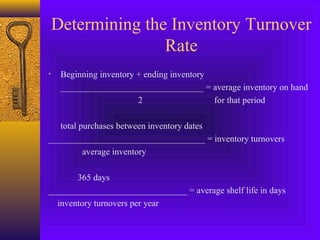
Determining the Inventory Turnover
Rate
• Beginning inventory + ending inventory
________________________________ = average inventory on hand
2 for that period
total purchases between inventory dates
___________________________________ = inventory turnovers
average inventory
365 days
_______________________________ = average shelf life in days
inventory turnovers per year
Determining the Inventory Turnover
Rate
• For whole inventory annual turnover and
single item annual turnover
• see handout
Determining When to Order
• 3 factors control the timing of orders:
• The time needed for delivery
• The rate of inventory usage
• The safe stock levels
Example
• Assume that an inventory turnover rate is 6
(average inventory is used up in 60 days)
• If you have 30 days to sell the item before you
need to pay for it, and if the selling price is double
the purchase price.
• From the sale of a 30 day supply(1/2 of the order)
you have taken in in revenue the amount of money
you need to pay for the whole order
Product Pricing
• Inventory is an asset to the practice
• It is nonproductive until it is used or sold
• Until that happens, it costs the practice
money
Product Pricing
• An adequate charge needs to be assessed
and collected from the client
• Otherwise, no matter how well the expense
side of inventory is managed, there is no
profitability to the practice
Product Markup
• Adequate and timely product markup is
necessary
• 100% = 2 X cost
• 200% = 3 X cost
• 300% = 4 X cost
Product Markup
• Markup can range from a low of 40% to a
high of 400%
• A 40% markup prices the product very
close to the break even point
Product Markup
• Some inventory items have a recommended
dispensing price by the manufacturer. This
can range from 40-45% markup.
• Example : prescription dog foods
Product Markup
• High cost items are usually given a low
markup % to keep the pricing reasonable
• Many times flea/tick products and
heartworm preventative is given a low
markup to keep competitive with the online
pharmacies
Product Markup Example
• A bottle of 500 amoxicillin 500mg capsules
costs: $54.95
• Sales tax: 4.47
• --------------------------
• Total cost: 59.42 for bottle of 500 caps
• cost per capsule $0.12
Product Markup Example
• At $ 0.12 per capsule
• 100% markup = .24 dispensing price
• 200% markup = .36
• 300% markup = .48
Product Markup
• A dispensing fee is usually added to items
that have to be counted out and put in other
containers
Sales Tax
• In New York State we pay sales tax on all
the products we purchase from the vendors.
• We add sales tax we pay into our
calculation of product unit cost
Sales Tax
• The state tells every type of business which
items they must charge sales tax on when
they are purchased by the client
• Fortunately in veterinary medicine, we have
a very few items we need to charge sales
tax on
Sales Tax
• Examples:
• Boarding and grooming
• Cremations
• Collars, leashes
• Pet toys
A copy can be obtained from NYS Dept of
Taxation
• Reference materials from:
Practice Made Perfect by Marsha Heinke,
DVM, EA, CPA, CVPM and John Mc
Carthy, DVM, MBA

Hospital Inventorymanagement

  • 1.
  • 2.
    A Key toSuccess
  • 3.
    Terms • distributor /vendor / supplier are used interchangeably. It is the entity that you are purchasing drugs and supplies from. It can be the manufacturer or a distributing company • Inventory / supplies is used interchangeably. It is the actual item that is purchased.
  • 4.
    • Inventory managementis a critical component of practice profitability • It is the second largest cost of operation of the veterinary practice • Remember, the first largest cost is staffing
  • 5.
    • Lack ofeffective inventory systems is a common cause of poor cash flow in a veterinary practice • In most practices a veterinary technician is put in charge of all or parts of the inventory management system
  • 6.
    • Inventory isspecifically defined as all the goods owned and held for sale or use in the regular course of business
  • 7.
    • This includes: •Drugs and supplies purchased to resell to clients (dispensing items) • All inventory items used to provide medical and surgical services • Office and computer supplies • Cleaning and janitorial supplies • Maintenance supplies
  • 8.
    • Inventory controlis the process whereby the need to maintain sufficient inventory to meet the hospitals needs is weighed against the cost of carrying the inventory • Tax definitions of inventory may be different
  • 9.
    • Optimum inventorycontrol ensures that the practice will never be out of a needed item and that the cost of purchasing and carrying inventory is kept to the lowest possible level
  • 10.
    3 Costs AssociatedWith Inventory • Unit Cost • Ordering Cost • Holding Cost
  • 11.
    Unit Cost • Thecost for each item of inventory purchased must be calculated for the unit it is used or dispensed in. • This is called the unit price
  • 12.
    • The unitprice of the item includes: • Sales tax charged to the practice by the vendor on each item sold to the practice (not charged by vendor in all states, but it is charged in New York State) • Shipping costs
  • 13.
    Ordering Cost • Mostordering costs are labor-related expenses: • Hourly wage paid to the employee performing the work • Associated payroll taxes • Employee benefit programs
  • 14.
    Labor Cost Includesthe Following Tasks • Determining the amount needed • Shopping for the best price • Placing the order • Meeting with the manufacturing representatives
  • 15.
    Labor Cost Includesthe Following Tasks • Accounting for back orders • Receiving and unpacking the orders • Comparing the purchase order with the shipping invoice • Pricing and placing the items on the shelf
  • 16.
    Labor Cost Includesthe Following Tasks • Posting the costs of the items in the practices disbursement register • Providing statements to be paid to the appropriate person (bookkeeper, practice manager, etc) • Logging the appropriate Controlled substance items
  • 17.
    Labor Cost Includesthe Following Tasks • The entire inventory ordering activity expends quite a bit of employee time • Ordering costs can account for a much as 15-20% of the total unit cost
  • 18.
    Holding Costs • Holdingcosts are the costs of owning and keeping inventory on the premises in anticipation of use. • The largest holding cost is the capital tied up in purchasing the inventory
  • 19.
    Holding Costs AlsoInclude • Personal property taxes paid on the inventory value as of a specific valuation date. (usually end of year to the IRS) • Insurance premiums paid on the average value of the inventory to protect against the risk of loss in the event of a disaster, theft, or damage
  • 20.
    Holding Costs AlsoInclude • The cost of protecting inventory from heat, cold, humidity • Costs associated with outdating and spoilage, especially if inventory is not used or sold immediately
  • 21.
    Holding Costs AlsoInclude • Pharmacy licensing fees in states where applicable (In NYS there is no licensing fees, but a veterinary pharmacy is under the same regulations as the human pharmacies) • The cost of maintaining OSHA regulation compliance
  • 22.
    Holding Costs • Theproceeding holding costs range from 8- 15% of the unit cost • The holding and ordering costs, combined, comprise 25-40% of the total unit cost depending upon: •
  • 23.
    Combined Holding &Ordering Costs • The holding and ordering costs, combined, comprise 25-40% of the total unit cost depending upon: • Amount of time inventory is held (on the shelf) • Success of discouraging pilferage (theft) • efficiency of purchasing
  • 24.
    • Inventory costsamount to much more than what is paid to the vendor • Optimum inventory control includes an astute purchasing policy that minimizes ordering and holding costs while at the same time ensuring that the items required to operate the hospital are available when needed
  • 25.
    Goals of InventoryControl and Management • If inventory control and management are effective, the following should be true: • Medications and supplies are available to treat patients when needed • Clients can obtain refills and other items when requested
  • 26.
    • Quantities ofdrugs and supplies are controlled to minimize hospital expenditures to the lowest practical level. Large stock quantities that tie up cash are avoided unless discount savings can be shown to adequately offset the dollars tied up in idle inventory amounts on the practice shelves
  • 27.
    • Staff canefficiently order, stock, and dispense the needed items • Controlled drugs are properly monitored and secured • Appropriate security systems and safeguards exist to insure that drugs and supplies will be used as intended
  • 28.
    • Staff istrained to correctly handle supplies that represent potential health and safety hazards • Fees charged for pharmaceuticals and supplies are adjusted on a regular basis and price increases are appropriately passed on to the client • The desired level of profit is achieved
  • 29.
    • To accomplishthis, a workable hospital inventory system must be: • Planned • Organized • Directed • Evaluated • Adapted as needed
  • 30.
    Effective Inventory System Functions •Ensures that all items used in the hospital are available when needed • Signals the manager when an item needs to be reordered to avoid running out of stock
  • 31.
    Effective Inventory System Functions •Accounts for the estimated delay between placing and receiving an order • Should keep supply levels that do not unnecessarily tie up capital • The accounting and reporting system should be flexible
  • 32.
    Effective Inventory System Functions •Provide accurate detail of inventory on hand and it’s value at any given time. (perpetual inventory) • Act as a contact management tool – names, phone numbers, account numbers of vendors, log of prior orders
  • 33.
    Effective Inventory System Functions •Should readily identify where each item is available at the least cost, how to order, and any quantity discounts if applicable • Identify and track backorders and when they will arrive
  • 34.
    Effective Inventory System Functions •Track expiration dates so product can be returned for refunds and taken out of quantity on hand stock • Identifying factors such as seasonal usage, to better help with projecting ordering quantities
  • 35.
    Effective Inventory System Functions •Should help verify that received orders agree with purchase orders • Should allow for price increases by vendors to automatically adjust dispensing price to client
  • 36.
    Effective Inventory System Functions •Should reduce pilferage and theft by employees • Should easily identify wastage and other forms of loss
  • 37.
    Pareto’s Law • The80/20 rule • States that 20% of the inventory items account for 80% of the annual inventory expenses • This should be taken into account when determining the ideal turnover rate for the item
  • 38.
    Inventory Management Systems •Can be either a manual card system or computerized
  • 39.
    Inventory Management Systems •They must contain the following item information: • Item – size, color, strength, dispensing format (pill, capsule, liquid, paste, can, case, etc) • Supplier – company name, phone #, hospital account #, discount information, billing policy
  • 40.
    Inventory Management Systems •Quantity – amount of each item ordered, price quoted, date ordered, number of each item received, date received and invoice price • Reorder point – maximum and minimum level of stock at which reordering should occur
  • 41.
    Inventory Management Systems •Invoice costs – price per item or unit, sales taxes, shipping, handling and freight charges • Storage location in hospital – in hospital use and/or dispensed, areas where kept, at what levels should restocking of secondary locations take place (ie. Treatment area, surgery, exam rooms, display shelves, pharmacy)
  • 42.
    Inventory Management Systems •Price to client – formula for determining price to be charged client, including dispensing fees, minimum price, bulk purchase price, markup over unit cost With this amount of information, abbreviations are frequently used, information is customized and organized by the user
  • 43.
    • See handouton manual inventory system • Separate lists would have to be kept for vendors, contact #, account #, etc • Computerized inventory system will be shown later
  • 44.
    • Whomever isselected as an inventory manager must be able to maintain a working relationship with the vendors, but can not develop unfair biases for or against a particular vendor. • It is best to price shop vendors and deal with a small group of vendors instead of a large number of them
  • 45.
    Determining What, How,When and How Much to Order • Remember the “80-20 rule” – that 20% of the products account for 80% of sales or use • Figure out which products make up the 20% and pay special attention to them. • Make sure not to overstock products that make up the other 80%
  • 46.
    • The keyto an efficient and effective ordering policy is being familiar with the suppliers and a good knowledge of how the items are used in the practice • This knowledge will make it possible to order the right amount of goods at the least expensive rate
  • 47.
    Determining quantities andtiming • Know when drug representatives will be visiting the hospital. Being prepared saves lives. • Keep a list of the items that need to be reordered from each supplier prepared
  • 48.
    Determining quantities andtiming • Deal with as few suppliers as possible • Anticipate seasonal needs for some supplies • Most vendors “close their books” between the 25th and 30th of the month. Try to order large amounts after that date so you will not be billed till the next month
  • 49.
    Determining quantities andtiming • Try to take advantage of vendor discounts (ie.) 1% discount if statement is paid within 10 days • Try to avoid ordering small quantities that may bear additional shipping charges • Avoid late payment finance charges
  • 50.
    Determining quantities andtiming • To properly plan for proper inventory levels, you should periodically analyze each item or class of items to: • Forecast demand for the next month, quarter, or year, including seasonal trends
  • 51.
    Determining quantities andtiming • Estimate the lead time • Plan usage during the lead time • Establish and monitor quantity on hand • Determine safe reserve of stock requirements • Place items on order
  • 52.
    Inventory Turnover • Thehigher the inventory turnover for a given period of time, the more efficient the inventory control • Best to try for 8-10 times per year. This averages 35-45 days on the shelf
  • 53.
    Determining the InventoryTurnover Rate • Beginning inventory + ending inventory ________________________________ = average inventory on hand 2 for that period total purchases between inventory dates ___________________________________ = inventory turnovers average inventory 365 days _______________________________ = average shelf life in days inventory turnovers per year
  • 54.
    Determining the InventoryTurnover Rate • For whole inventory annual turnover and single item annual turnover • see handout
  • 55.
    Determining When toOrder • 3 factors control the timing of orders: • The time needed for delivery • The rate of inventory usage • The safe stock levels
  • 56.
    Example • Assume thatan inventory turnover rate is 6 (average inventory is used up in 60 days) • If you have 30 days to sell the item before you need to pay for it, and if the selling price is double the purchase price. • From the sale of a 30 day supply(1/2 of the order) you have taken in in revenue the amount of money you need to pay for the whole order
  • 57.
    Product Pricing • Inventoryis an asset to the practice • It is nonproductive until it is used or sold • Until that happens, it costs the practice money
  • 58.
    Product Pricing • Anadequate charge needs to be assessed and collected from the client • Otherwise, no matter how well the expense side of inventory is managed, there is no profitability to the practice
  • 59.
    Product Markup • Adequateand timely product markup is necessary • 100% = 2 X cost • 200% = 3 X cost • 300% = 4 X cost
  • 60.
    Product Markup • Markupcan range from a low of 40% to a high of 400% • A 40% markup prices the product very close to the break even point
  • 61.
    Product Markup • Someinventory items have a recommended dispensing price by the manufacturer. This can range from 40-45% markup. • Example : prescription dog foods
  • 62.
    Product Markup • Highcost items are usually given a low markup % to keep the pricing reasonable • Many times flea/tick products and heartworm preventative is given a low markup to keep competitive with the online pharmacies
  • 63.
    Product Markup Example •A bottle of 500 amoxicillin 500mg capsules costs: $54.95 • Sales tax: 4.47 • -------------------------- • Total cost: 59.42 for bottle of 500 caps • cost per capsule $0.12
  • 64.
    Product Markup Example •At $ 0.12 per capsule • 100% markup = .24 dispensing price • 200% markup = .36 • 300% markup = .48
  • 65.
    Product Markup • Adispensing fee is usually added to items that have to be counted out and put in other containers
  • 66.
    Sales Tax • InNew York State we pay sales tax on all the products we purchase from the vendors. • We add sales tax we pay into our calculation of product unit cost
  • 67.
    Sales Tax • Thestate tells every type of business which items they must charge sales tax on when they are purchased by the client • Fortunately in veterinary medicine, we have a very few items we need to charge sales tax on
  • 68.
    Sales Tax • Examples: •Boarding and grooming • Cremations • Collars, leashes • Pet toys A copy can be obtained from NYS Dept of Taxation
  • 69.
    • Reference materialsfrom: Practice Made Perfect by Marsha Heinke, DVM, EA, CPA, CVPM and John Mc Carthy, DVM, MBA