Inventory Management
What Is Inventory Management?
• Inventory management helps companies identify which and
how much stock to order at what time. It tracks inventory from
purchase to the sale of goods. The practice identifies and
responds to trends to ensure there's always enough stock to
fulfil customer orders and proper warning of a shortage. Once
sold, inventory becomes revenue. Before it sells, inventory
(although reported as an asset on the balance sheet) ties up
cash. Therefore, too much stock costs money and reduces cash
flow.
Importance of inventory management
• For any goods-based businesses, the value of inventory cannot
be overstated, which is why inventory management benefits
your operational efficiency and longevity. From SMBs to
companies already using enterprise resource planning (ERP),
without a smart approach, you'll face an army of challenges,
including blown-out costs, loss of profits, poor customer service,
and even outright failure.
Inventory management definition
• As a part of your supply chain, inventory management includes
aspects such as controlling and overseeing purchases - from
suppliers as well as customers- maintaining the storage of stock,
controlling the amount of product for sale, and order fulfilment.
Naturally, your company's precise inventory management meaning
will vary based on the types of products you sell and the channels
you sell them through. But as long as those basic ingredients are
present, you'll have a solid foundation to build upon. Small-to-
medium businesses (SMBs) often use Excel, Google Sheets, or other
manual tools to keep track of inventory databases and make
decisions about ordering.
Retail inventory management
• Retail is the broadest catch-all term to describe business-to-
consumer (B2C) selling. There are essentially two types of retail
separated by how and where a sale takes place.
• First, online retail (eCommerce) where the purchase takes place
digitally.
• Second, offline retail where the purchase. is physical through a
brick-and-mortar storefront or a salesperson.
• Wholesale, on the other hand, refers to business-to-business (B2B)
selling. Knowing the differences and best practices of retail and
wholesale is critical to success.
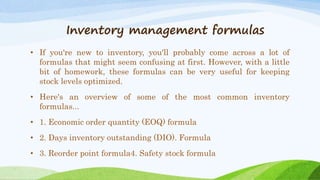
Inventory management formulas
• If you're new to inventory, you'll probably come across a lot of
formulas that might seem confusing at first. However, with a little
bit of homework, these formulas can be very useful for keeping
stock levels optimized.
• Here's an overview of some of the most common inventory
formulas...
• 1. Economic order quantity (EOQ) formula
• 2. Days inventory outstanding (DIO). Formula
• 3. Reorder point formula4. Safety stock formula
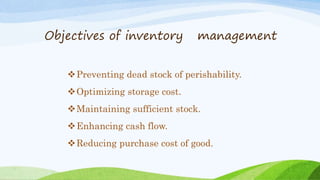
Objectives of inventory management
Preventing dead stock of perishability.
Optimizing storage cost.
Maintaining sufficient stock.
Enhancing cash flow.
Reducing purchase cost of good.
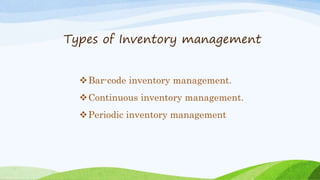
Types of Inventory management
Bar-code inventory management.
Continuous inventory management.
Periodic inventory management
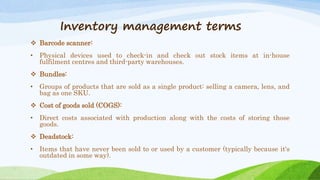
Inventory management terms
 Barcode scanner:
• Physical devices used to check-in and check out stock items at in-house
fulfilment centres and third-party warehouses.
 Bundles:
• Groups of products that are sold as a single product: selling a camera, lens, and
bag as one SKU.
 Cost of goods sold (COGS):
• Direct costs associated with production along with the costs of storing those
goods.
 Deadstock:
• Items that have never been sold to or used by a customer (typically because it's
outdated in some way).
Inventory management terms (Cont.)
 Decoupling inventory
• Also known as safety stock or decoupling stock; refers to inventory that's set aside as
a safety net to mitigate the risk of a complete halt in production if one or more
components are unavailable.
 Economic order quantity (EOQ)
• EOQ refers to how much you should reorder, taking into account demand and your
inventory holding costs.
 Holding costs
• Also known as carrying costs; the costs your business incurs to store and hold stock
in a warehouse until it's sold to the customer.
 Landed costs
• These are the costs of shipping, storing, import fees, duties, taxes and other expenses
associated with transporting and buying inventory.
Reorder point formula
 The reorder point formula answers the age old question:
When is the right time to order more stock?
Calculating your reorder point takes three steps:
1. Determine your lead time demand in days
2. Calculate your safety stock in days
3. Sum your lead time demand and yoursafety stock
Safety stock formula
 As we touched upon earlier, safety stock acts as an emergency buffer
you can break out when it looks like you're on the verge of selling
out. You want to have enough safety stock to meet demand, but not
so much that increased carrying costs end up straining your
finances.
 While this sounds like common sense, the trick is to decide on how
much safety stock to carry:
1. Multiply your maximum daily usage by your maximum lead time in
days
2. Multiply your average daily usage by your average lead time in
days
3. Calculate the difference between the two to determine your safety
stock
Demand Planning & Inventory Management
 Demand planning is an important part of successful
inventory management. It is the process of determining how
much of each item you anticipate selling, and when. Once
demand is determined, inventory management follows the
flow of goods from the supplier through production and
ultimately fulfilling customer orders.
 Find out more about how demand planning and inventory
management work together in the "Essential Guide to
Inventory Planning."
How Is Inventory Management Different
From Other Processes?
• People sometimes confuse inventory management with
related practices. Inventory management controls all stock
within a company. Supply chain management manages the
process from supplier to delivering the product to the
customer. Warehouse management is a part of inventory
control and focuses on stock in a specific location.
 Inventory Management vs. Inventory Control
• Inventory control is a part of the overall inventory
management process. Inventory control manages the
movement of items within the warehouse.
Manufacturing Inventory Management
• Manufacturing inventory management is
the practice of keeping enough stock on
hand so production lines can fulfil orders.
The process helps managers see stock levels
at a glance and tracks raw materials, parts,
work-in-progress and finished goods.
THANK YOU

Inventory Management

  • 1.
  • 2.
    What Is InventoryManagement? • Inventory management helps companies identify which and how much stock to order at what time. It tracks inventory from purchase to the sale of goods. The practice identifies and responds to trends to ensure there's always enough stock to fulfil customer orders and proper warning of a shortage. Once sold, inventory becomes revenue. Before it sells, inventory (although reported as an asset on the balance sheet) ties up cash. Therefore, too much stock costs money and reduces cash flow.
  • 3.
    Importance of inventorymanagement • For any goods-based businesses, the value of inventory cannot be overstated, which is why inventory management benefits your operational efficiency and longevity. From SMBs to companies already using enterprise resource planning (ERP), without a smart approach, you'll face an army of challenges, including blown-out costs, loss of profits, poor customer service, and even outright failure.
  • 4.
    Inventory management definition •As a part of your supply chain, inventory management includes aspects such as controlling and overseeing purchases - from suppliers as well as customers- maintaining the storage of stock, controlling the amount of product for sale, and order fulfilment. Naturally, your company's precise inventory management meaning will vary based on the types of products you sell and the channels you sell them through. But as long as those basic ingredients are present, you'll have a solid foundation to build upon. Small-to- medium businesses (SMBs) often use Excel, Google Sheets, or other manual tools to keep track of inventory databases and make decisions about ordering.
  • 5.
    Retail inventory management •Retail is the broadest catch-all term to describe business-to- consumer (B2C) selling. There are essentially two types of retail separated by how and where a sale takes place. • First, online retail (eCommerce) where the purchase takes place digitally. • Second, offline retail where the purchase. is physical through a brick-and-mortar storefront or a salesperson. • Wholesale, on the other hand, refers to business-to-business (B2B) selling. Knowing the differences and best practices of retail and wholesale is critical to success.
  • 6.
    Inventory management formulas •If you're new to inventory, you'll probably come across a lot of formulas that might seem confusing at first. However, with a little bit of homework, these formulas can be very useful for keeping stock levels optimized. • Here's an overview of some of the most common inventory formulas... • 1. Economic order quantity (EOQ) formula • 2. Days inventory outstanding (DIO). Formula • 3. Reorder point formula4. Safety stock formula
  • 7.
    Objectives of inventorymanagement Preventing dead stock of perishability. Optimizing storage cost. Maintaining sufficient stock. Enhancing cash flow. Reducing purchase cost of good.
  • 8.
    Types of Inventorymanagement Bar-code inventory management. Continuous inventory management. Periodic inventory management
  • 9.
    Inventory management terms Barcode scanner: • Physical devices used to check-in and check out stock items at in-house fulfilment centres and third-party warehouses.  Bundles: • Groups of products that are sold as a single product: selling a camera, lens, and bag as one SKU.  Cost of goods sold (COGS): • Direct costs associated with production along with the costs of storing those goods.  Deadstock: • Items that have never been sold to or used by a customer (typically because it's outdated in some way).
  • 10.
    Inventory management terms(Cont.)  Decoupling inventory • Also known as safety stock or decoupling stock; refers to inventory that's set aside as a safety net to mitigate the risk of a complete halt in production if one or more components are unavailable.  Economic order quantity (EOQ) • EOQ refers to how much you should reorder, taking into account demand and your inventory holding costs.  Holding costs • Also known as carrying costs; the costs your business incurs to store and hold stock in a warehouse until it's sold to the customer.  Landed costs • These are the costs of shipping, storing, import fees, duties, taxes and other expenses associated with transporting and buying inventory.
  • 11.
    Reorder point formula The reorder point formula answers the age old question: When is the right time to order more stock? Calculating your reorder point takes three steps: 1. Determine your lead time demand in days 2. Calculate your safety stock in days 3. Sum your lead time demand and yoursafety stock
  • 12.
    Safety stock formula As we touched upon earlier, safety stock acts as an emergency buffer you can break out when it looks like you're on the verge of selling out. You want to have enough safety stock to meet demand, but not so much that increased carrying costs end up straining your finances.  While this sounds like common sense, the trick is to decide on how much safety stock to carry: 1. Multiply your maximum daily usage by your maximum lead time in days 2. Multiply your average daily usage by your average lead time in days 3. Calculate the difference between the two to determine your safety stock
  • 13.
    Demand Planning &Inventory Management  Demand planning is an important part of successful inventory management. It is the process of determining how much of each item you anticipate selling, and when. Once demand is determined, inventory management follows the flow of goods from the supplier through production and ultimately fulfilling customer orders.  Find out more about how demand planning and inventory management work together in the "Essential Guide to Inventory Planning."
  • 14.
    How Is InventoryManagement Different From Other Processes? • People sometimes confuse inventory management with related practices. Inventory management controls all stock within a company. Supply chain management manages the process from supplier to delivering the product to the customer. Warehouse management is a part of inventory control and focuses on stock in a specific location.  Inventory Management vs. Inventory Control • Inventory control is a part of the overall inventory management process. Inventory control manages the movement of items within the warehouse.
  • 15.
    Manufacturing Inventory Management •Manufacturing inventory management is the practice of keeping enough stock on hand so production lines can fulfil orders. The process helps managers see stock levels at a glance and tracks raw materials, parts, work-in-progress and finished goods.
  • 16.