Ashley Fraley
Ms. Zimmerman
English 102
1 December 2018
Fraley 1
The Differences and Similarities
Why it is important to
learn
• People are uneducated about
differences and similarities
between the two.
• Some do not fall under any
category.
• To be aware of other’s
preferences
• Self awareness
2
Where does introvert and extrovert
come from?
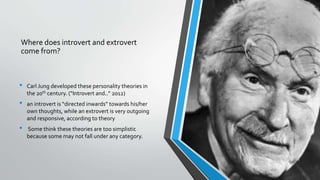
• Carl Jung developed these personality theories in
the 20th century. (“Introvert and..” 2012)
• an introvert is “directed inwards” towards his/her
own thoughts, while an extrovert is very outgoing
and responsive, according to theory
• Some think these theories are too simplistic
because some may not fall under any category.
3
Introverts
• comfortable socializing in small groups
• fewer friends and associates
• strong relationships
• “receives stimulation from within”
(“Extraversion and..” 2018)
• mind constantly racing.
4
What factors
contribute to
introversion?
• Increased cortical
arousal lowers the need
to engage with external
stimuli. (“Extraversion
and..” 2018)
• Differences in the brain
structure
• Genetic factors
5
Summary
In summary, introverts are typically..
• Quiet and reserved
• Extremely thoughtful
• Uncomfortable around large amounts of people
6
Extroverts
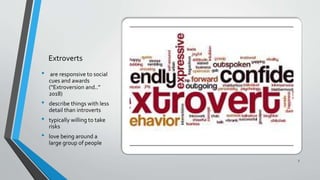
• are responsive to social
cues and awards
(“Extroversion and..”
2018)
• describe things with less
detail than introverts
• typically willing to take
risks
• love being around a
large group of people
7
What factors contribute
to extroversion?
• increased cortical thickness
(“Extraversion and..” 2018)
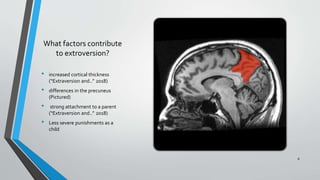
• differences in the precuneus
(Pictured)
• strong attachment to a parent
(“Extraversion and..” 2018)
• Less severe punishments as a
child
8
Summary
In summary extroverts are..
• Outgoing and sociable
• Dependent on others for stimulation
• Risk-takers
• conversational
9
Differences
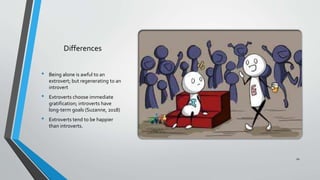
• Being alone is awful to an
extrovert; but regenerating to an
introvert
• Extroverts choose immediate
gratification; introverts have
long-term goals (Suzanne, 2018)
• Extroverts tend to be happier
than introverts.
10
Similarities
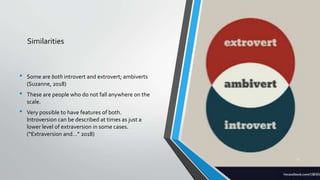
• Some are both introvert and extrovert; ambiverts
(Suzanne, 2018)
• These are people who do not fall anywhere on the
scale.
• Very possible to have features of both.
Introversion can be described at times as just a
lower level of extraversion in some cases.
(“Extraversion and…” 2018)
11
Conclusion
• extroverts and introverts are generally opposites.
• Some people may fall as “in between” on the scale
• People could have traits of both, depending on how
introverted to extroverted they are.
• There are many life factors that can contribute to
both personality theories.
12
Works Cited
• "Extraversion and Introversion." PsychologistWorld, 2018, www.psychologistworld.com/influence-
personality/extraversion-introversion#references. Accessed 25 Nov. 2018.
• Introvert and Extrovert." ,The editors of encyclopedia britannica, 2 Mar. 2012,
www.britannica.com/science/introvert. Accessed 1 Dec. 2018.
• Suzanne, KateT. "Introvert vs. Extrovert." , Diffen, 2018,
www.diffen.com/difference/Extrovert_vs_Introvert. Accessed 27 Nov. 2018.
13

Introvert extrovert compare and contrast powerpoint

  • 1.
    Ashley Fraley Ms. Zimmerman English102 1 December 2018 Fraley 1 The Differences and Similarities
  • 2.
    Why it isimportant to learn • People are uneducated about differences and similarities between the two. • Some do not fall under any category. • To be aware of other’s preferences • Self awareness 2
  • 3.
    Where does introvertand extrovert come from? • Carl Jung developed these personality theories in the 20th century. (“Introvert and..” 2012) • an introvert is “directed inwards” towards his/her own thoughts, while an extrovert is very outgoing and responsive, according to theory • Some think these theories are too simplistic because some may not fall under any category. 3
  • 4.
    Introverts • comfortable socializingin small groups • fewer friends and associates • strong relationships • “receives stimulation from within” (“Extraversion and..” 2018) • mind constantly racing. 4
  • 5.
    What factors contribute to introversion? •Increased cortical arousal lowers the need to engage with external stimuli. (“Extraversion and..” 2018) • Differences in the brain structure • Genetic factors 5
  • 6.
    Summary In summary, introvertsare typically.. • Quiet and reserved • Extremely thoughtful • Uncomfortable around large amounts of people 6
  • 7.
    Extroverts • are responsiveto social cues and awards (“Extroversion and..” 2018) • describe things with less detail than introverts • typically willing to take risks • love being around a large group of people 7
  • 8.
    What factors contribute toextroversion? • increased cortical thickness (“Extraversion and..” 2018) • differences in the precuneus (Pictured) • strong attachment to a parent (“Extraversion and..” 2018) • Less severe punishments as a child 8
  • 9.
    Summary In summary extrovertsare.. • Outgoing and sociable • Dependent on others for stimulation • Risk-takers • conversational 9
  • 10.
    Differences • Being aloneis awful to an extrovert; but regenerating to an introvert • Extroverts choose immediate gratification; introverts have long-term goals (Suzanne, 2018) • Extroverts tend to be happier than introverts. 10
  • 11.
    Similarities • Some areboth introvert and extrovert; ambiverts (Suzanne, 2018) • These are people who do not fall anywhere on the scale. • Very possible to have features of both. Introversion can be described at times as just a lower level of extraversion in some cases. (“Extraversion and…” 2018) 11
  • 12.
    Conclusion • extroverts andintroverts are generally opposites. • Some people may fall as “in between” on the scale • People could have traits of both, depending on how introverted to extroverted they are. • There are many life factors that can contribute to both personality theories. 12
  • 13.
    Works Cited • "Extraversionand Introversion." PsychologistWorld, 2018, www.psychologistworld.com/influence- personality/extraversion-introversion#references. Accessed 25 Nov. 2018. • Introvert and Extrovert." ,The editors of encyclopedia britannica, 2 Mar. 2012, www.britannica.com/science/introvert. Accessed 1 Dec. 2018. • Suzanne, KateT. "Introvert vs. Extrovert." , Diffen, 2018, www.diffen.com/difference/Extrovert_vs_Introvert. Accessed 27 Nov. 2018. 13

Editor's Notes

  • #3 Many people are not educated on the similarities and differences between introverts and extroverts. It is a good idea to learn the differences and similarities so one can be aware of others and their comfort levels. For example, some introverts are not comfortable around large crowds of unfamiliar people; if one were aware of this, they would not take their introvert friend to a dinner party they know would overwhelm them, or perhaps they would be more sensitive towards them and try to accommodate them. It is also a good idea to learn for self awareness. It is helpful to find out if one is an introvert, and extrovert, or somewhere on the scale between the two. Being aware may is a good step to putting anxieties behind oneself.
  • #4 Psychiatrist Carl Jung developed these personality types in the 20th century. According to his theory, introverts are generally “directed inwards” towards their own thoughts. Extroverts are “directed outwards” towards others and love to be outgoing and are typically very responsive. Some believe Carl Jung’s personality theories are too simple, and that some do not fall under any specific category, but somewhere along the spectrum.
  • #5 Introverts are comfortable in small groups of people that they are familiar with. They tend to form strong relationships with those they care about, and as a result, they may have fewer friends and associates then an extrovert. While an extrovert seeks stimulation from others during socialization, introverts receive this reward from within. They may be constantly thinking, while an extrovert may constantly be talking.
  • #6 Scientists have found that introverts have higher cortical arousal levels, which lowers their need to seek stimulation and satisfaction from others. They have also found evidence of different brain structures between extroverts and introverts. Biological factors may also affect a person's introversion, such as a long line of introverts.
  • #7 In conclusion, introverts are usually considered to be the quiet and reserved types of people. They are extremely thoughtful, and their minds are consistently full of thoughts. Introverts are uncomfortable around large amounts of people and prefer to be around small groups of people who they are familiar with.
  • #8 Extroverts are responsive to social cues and awards, while an introvert finds these awards from within. They may describe things more abstractly than an introvert, while an introvert may describe things high in detail. Extroverts are typically willing to take risks and like to engage in risky behavior, typically in a social setting. They love being around large groups of people and can easily be comfortable like this.
  • #9 Those that are found to be extroverts typically have an increased cortical thickness. They also show actual differences in the precuneus, a part of the parietal lobe of the brain. Most extroverts have formed a strong attachment to at least one parent, and also have received less severe punishments as a child as opposed to introverts.
  • #10 In conclusion, extroverts are outgoing and sociable, always wanting to be around others. They very much enjoy company and are dependent on other people for internal stimulation. They usually like to take risks and love to conversate.
  • #11 Extroverts and introverts are different in many ways as they are quite the opposite in personality. Extroverts are drained by being alone, while an introvert recharges while alone. In terms of goal setting, extroverts will choose the option that gives them immediate gratification over a long-term goal, unlike an introvert who would rather wait. Extroverts are typically happier than introverts, but some experts are not sure if this is because they are less happy or if they are less declarative of their happiness.
  • #12 Introverts and extroverts may be more similar than some think. Some people are somewhere in between on the scale, these people are ambiverts. Therefore it is possible for both introverts and extroverts to share some features, depending on the severity of their personality traits.
  • #13 In conclusion, extroverts and introverts, are, for the most part, opposites. Some people may be described as ambiverts depending on how introverted and extroverted they are. There are many life factors that contribute to extroversion and introversion, and many could have traits of both personality types.