RDF
Pedro Szekely
University of Southern California/ISI
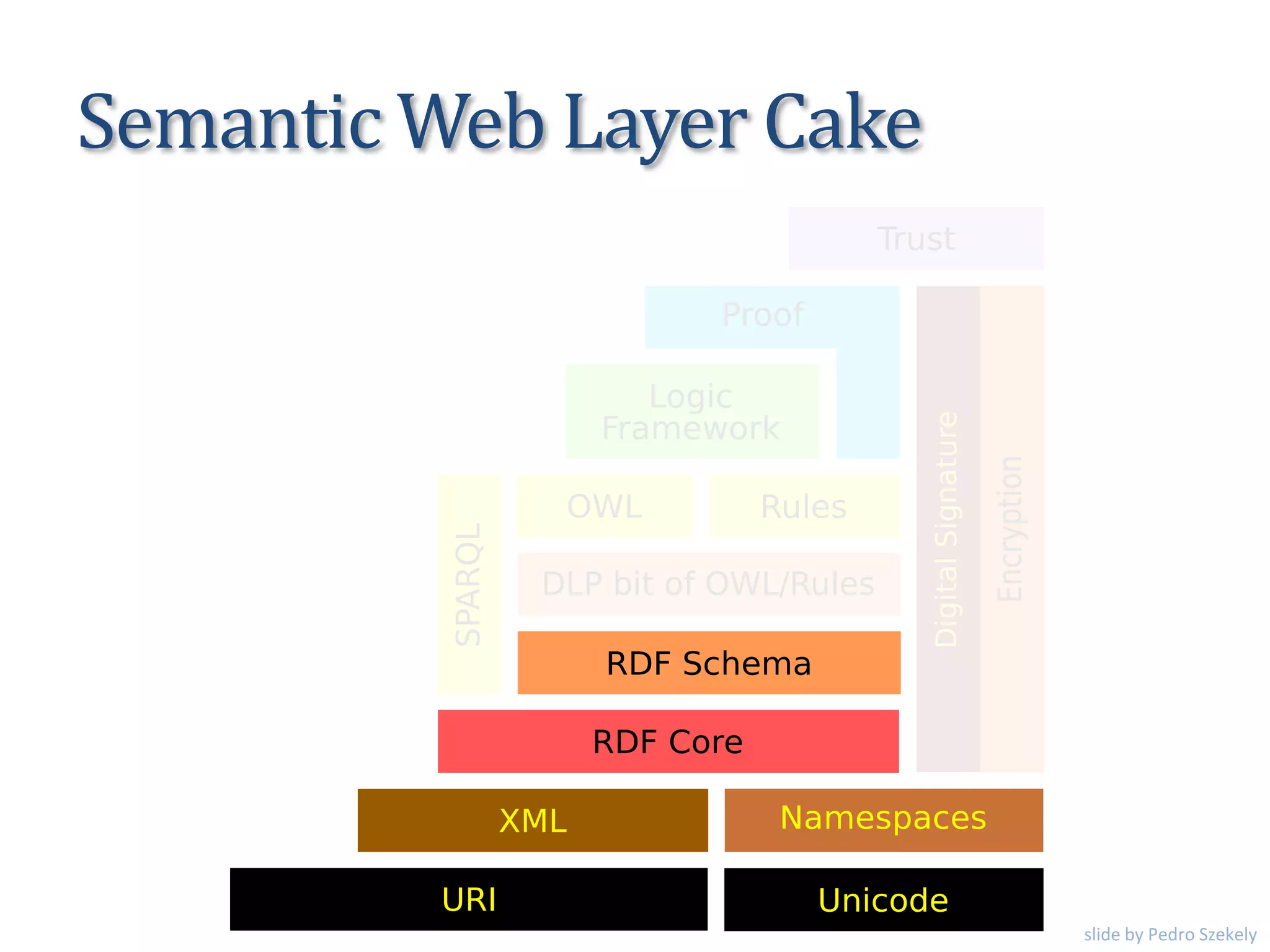
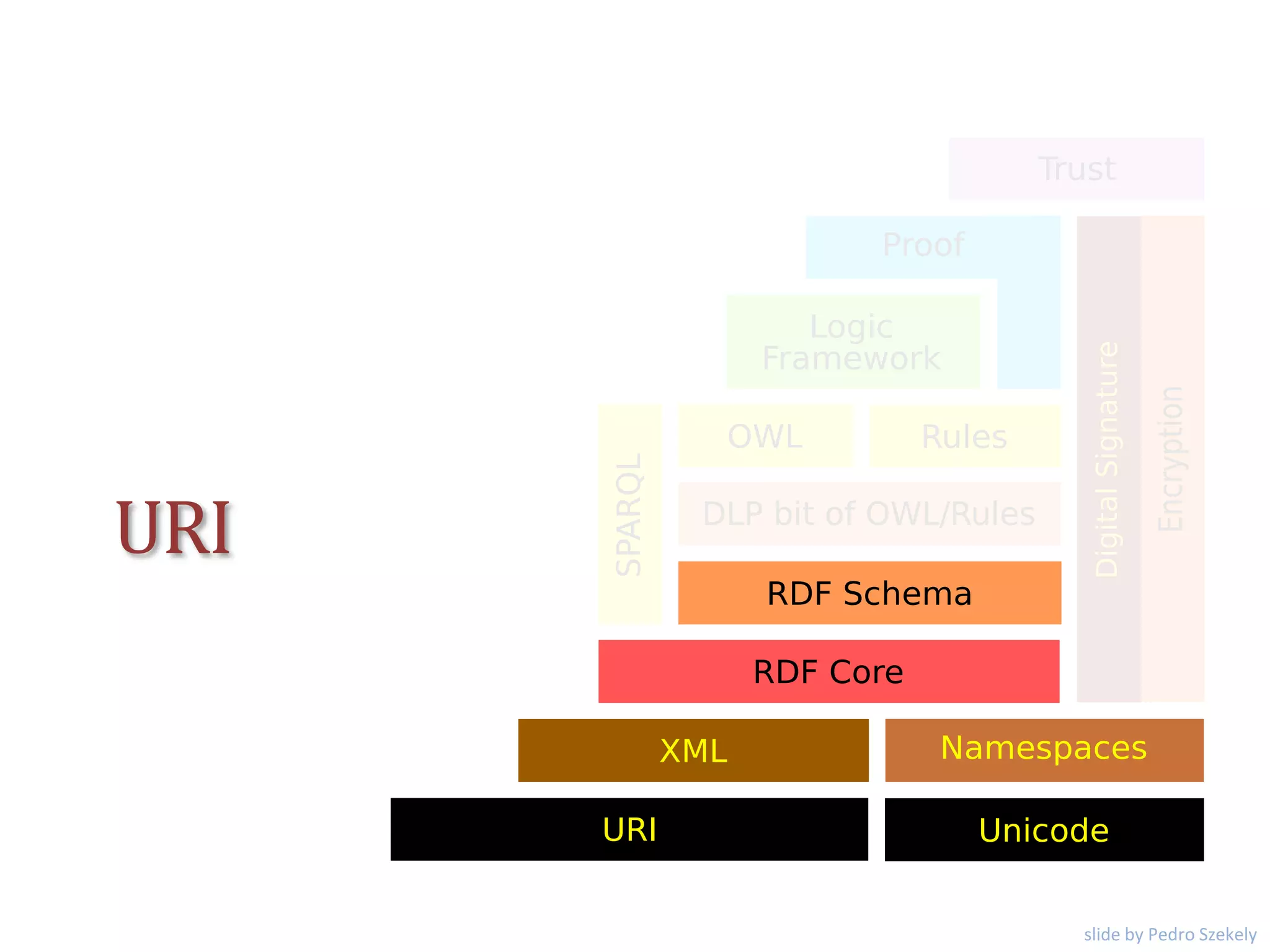
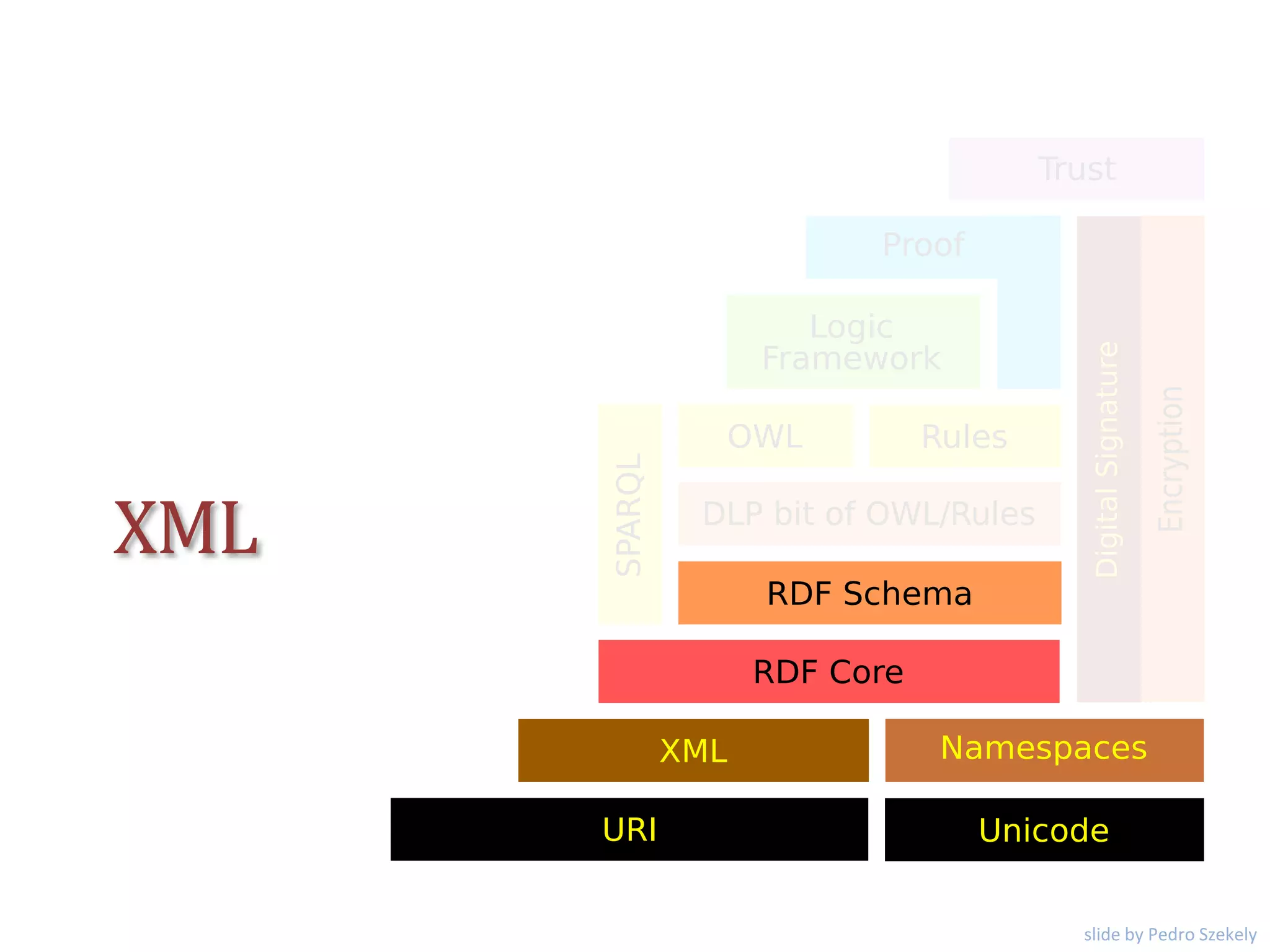
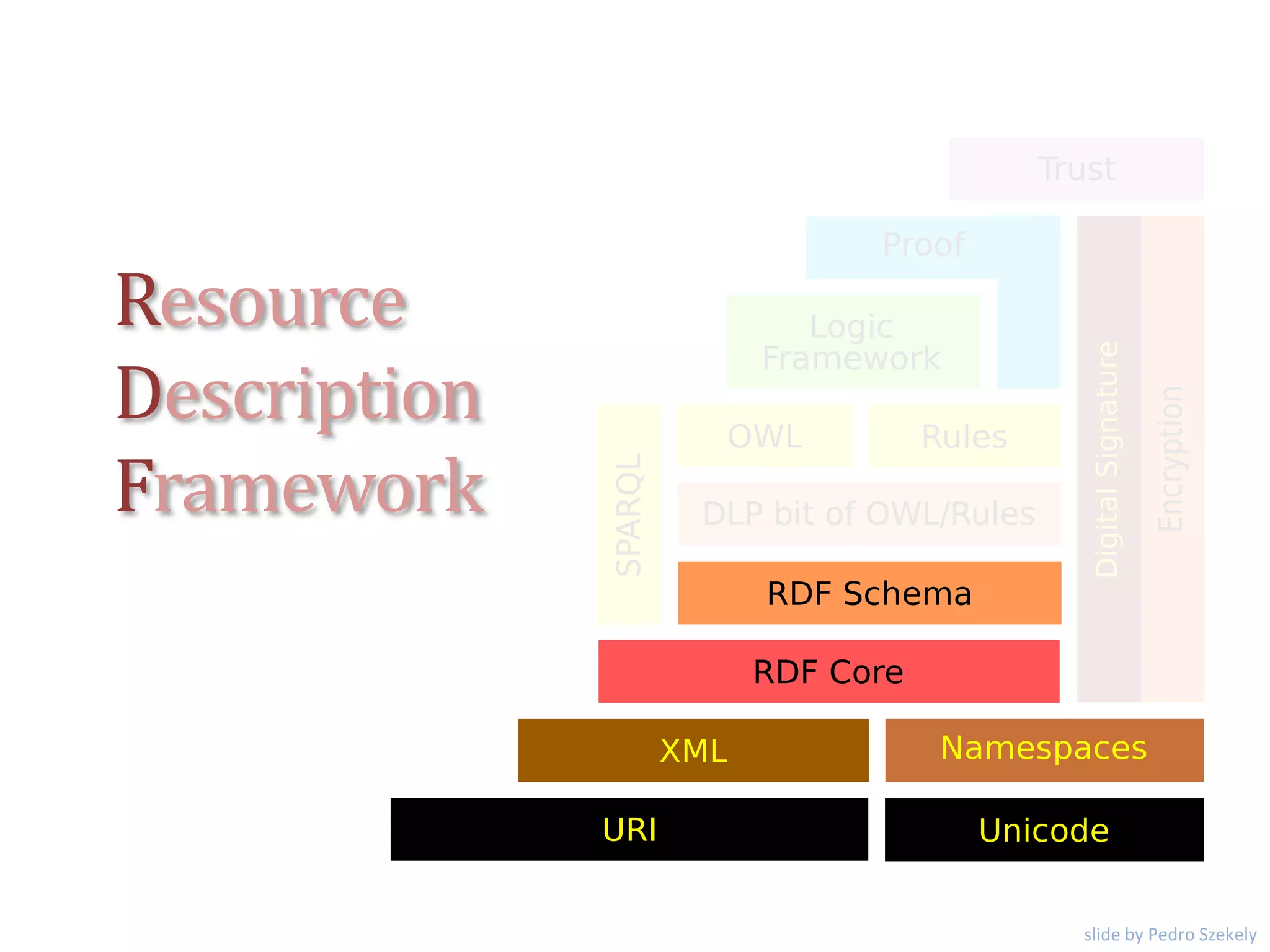
Semantic Web Layer Cake
slide by Pedro Szekely
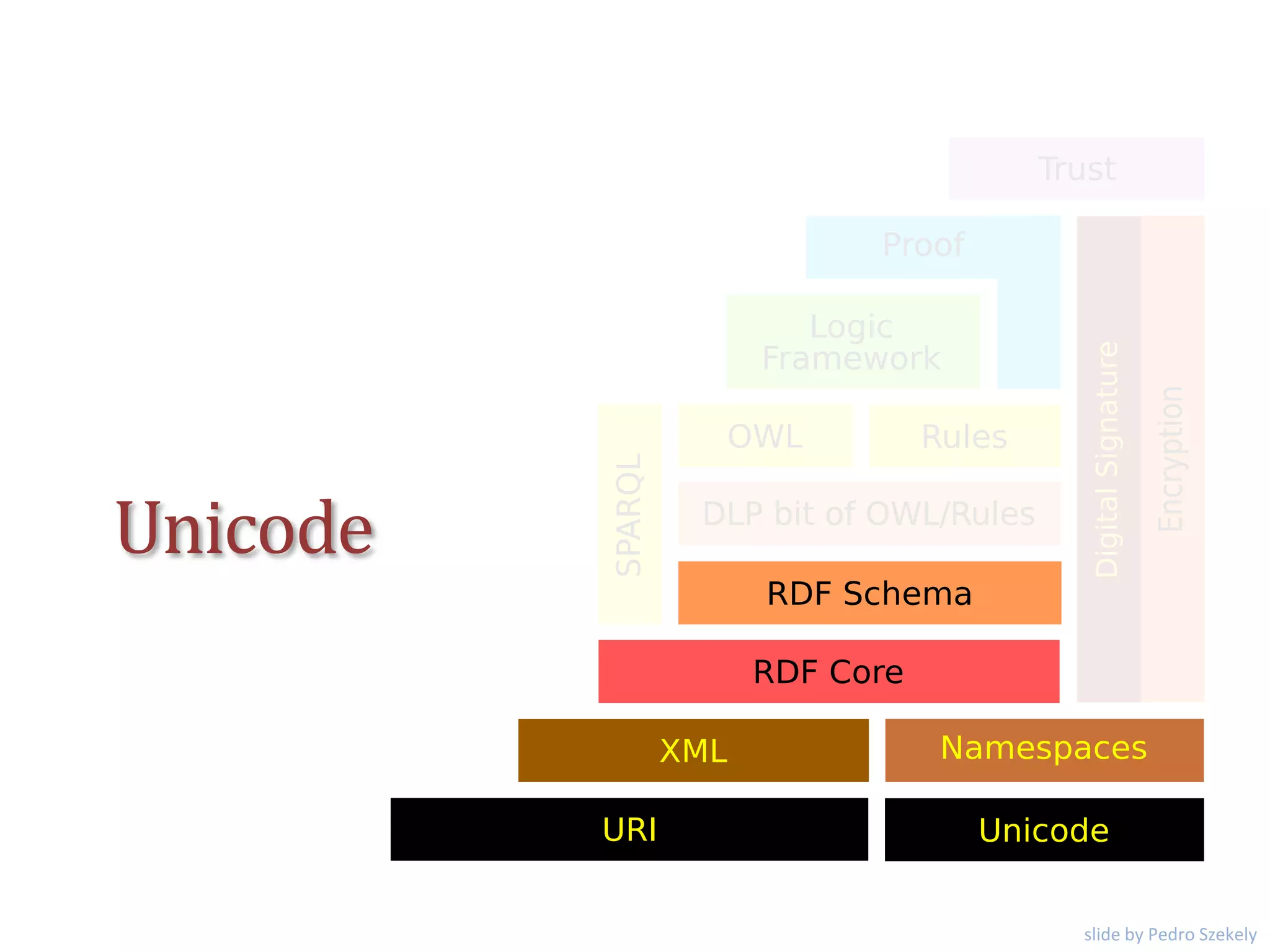
Unicode
slide by Pedro Szekely
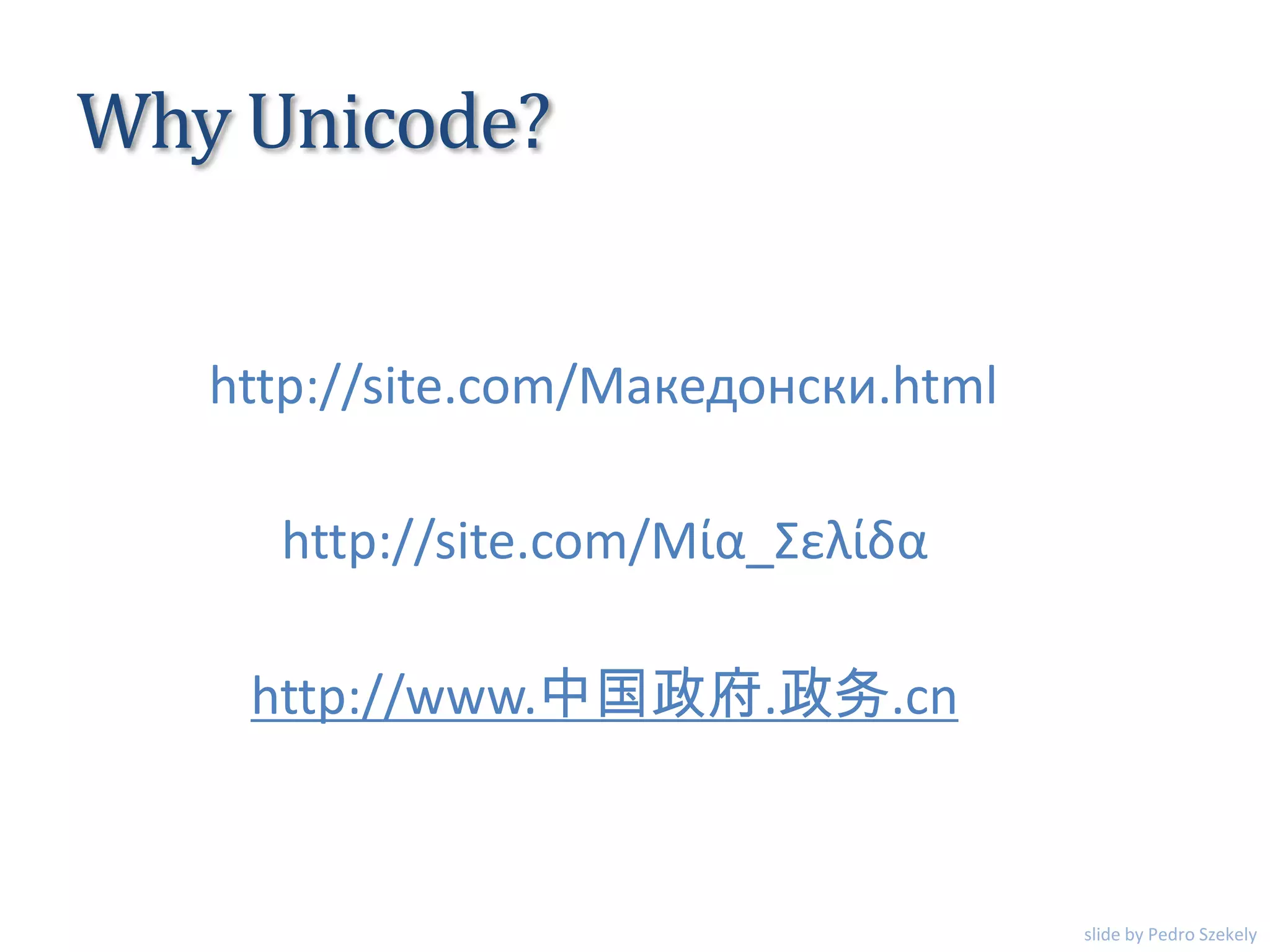
Why Unicode?
http://site.com/Μία_Σελίδα
http://site.com/Македонски.html
http://www.中国政府.政务.cn
slide by Pedro Szekely
Unicode is a computing industry standard for
the consistent encoding, representation and
handling of text expressed in most of the
world's writing systems.
… the latest version of Unicode consists of a
repertoire of more than 110,000 characters
covering 100 scripts
Unicode
Wikipedia
slide by Pedro Szekely
URI
slide by Pedro Szekely
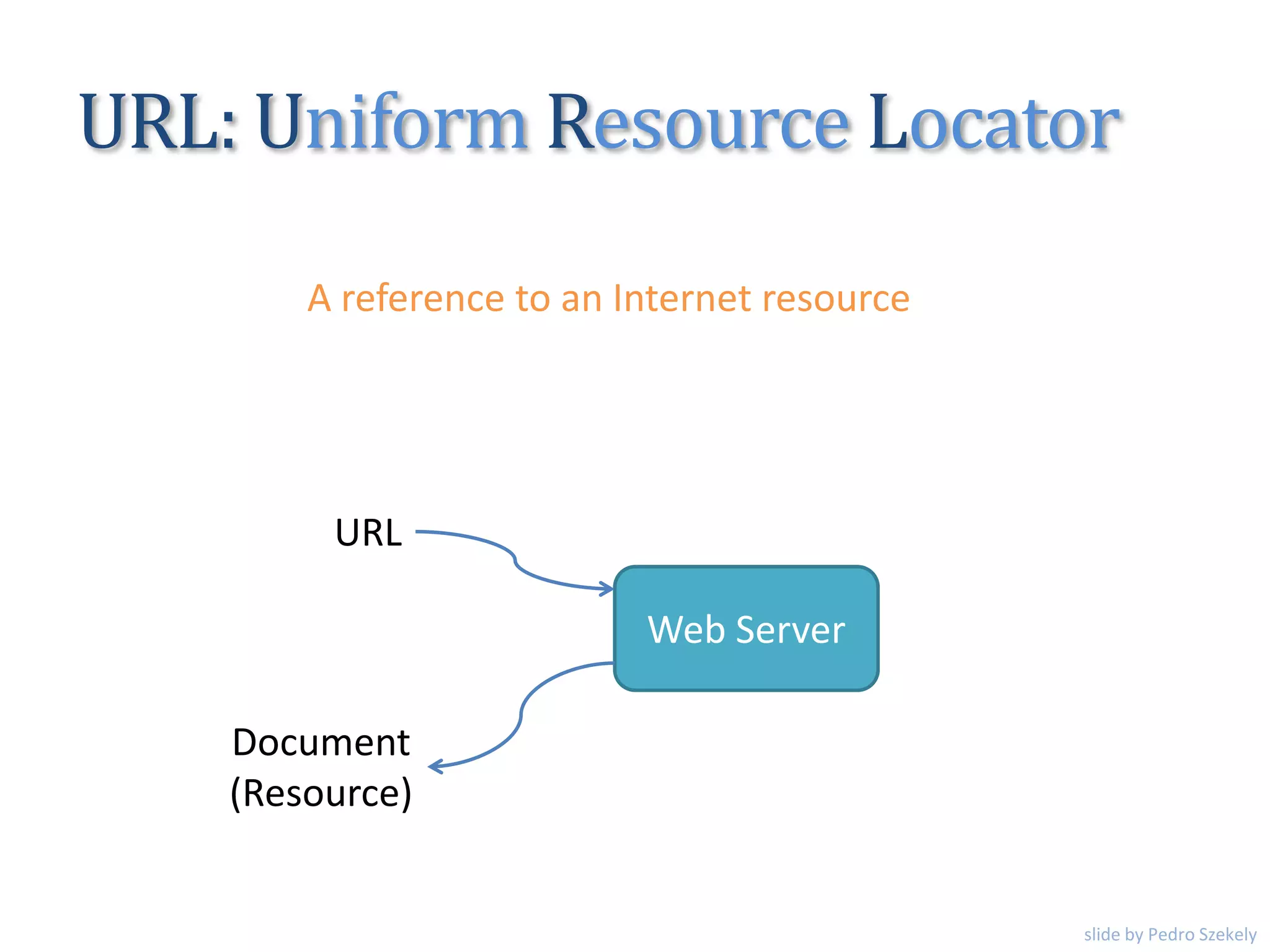
URL: Uniform Resource Locator
A reference to an Internet resource
Web Server
URL
Document
(Resource)
slide by Pedro Szekely
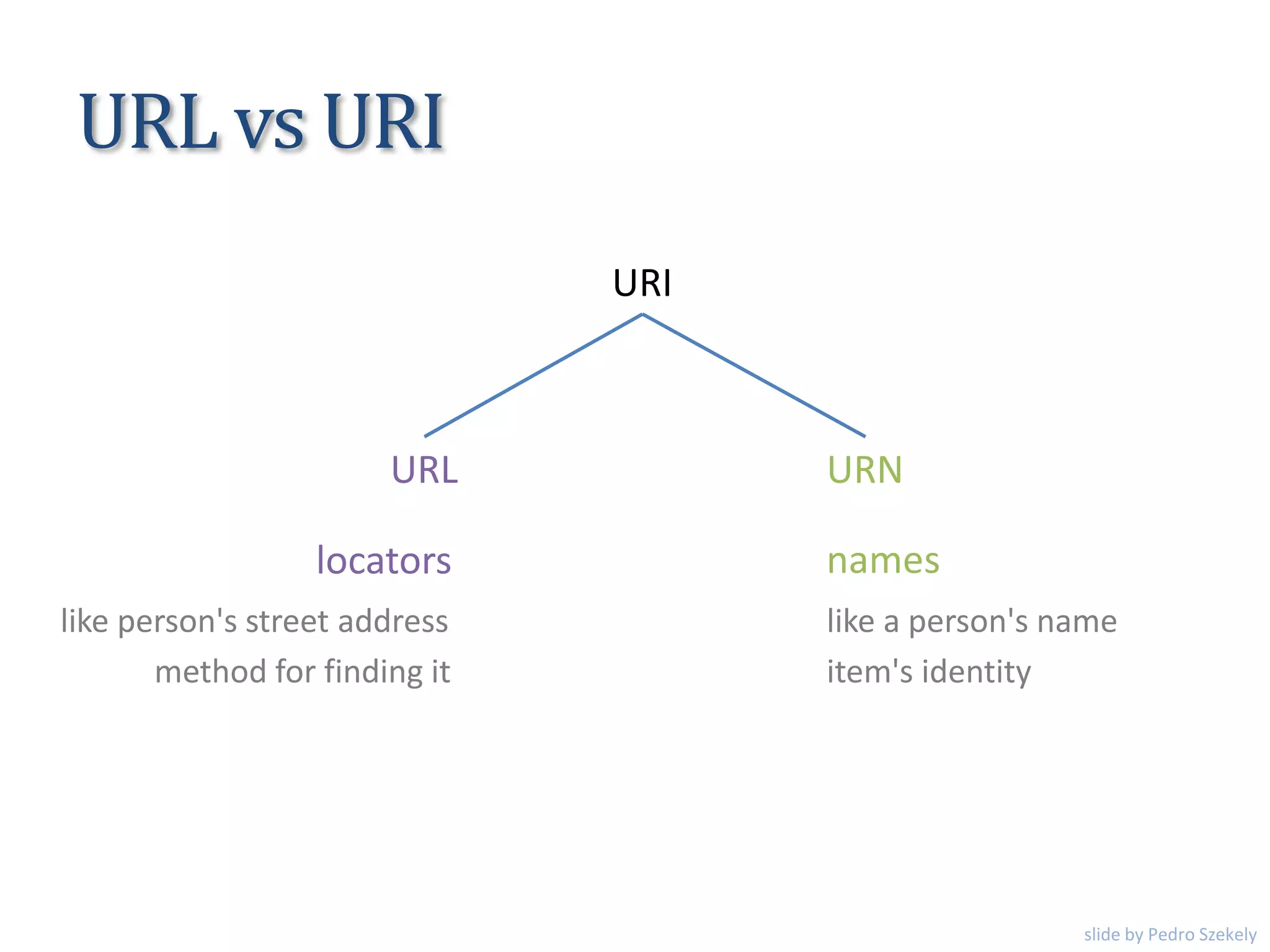
URL vs URI
URI
URL URN
nameslocators
like a person's namelike person's street address
item's identitymethod for finding it
slide by Pedro Szekely
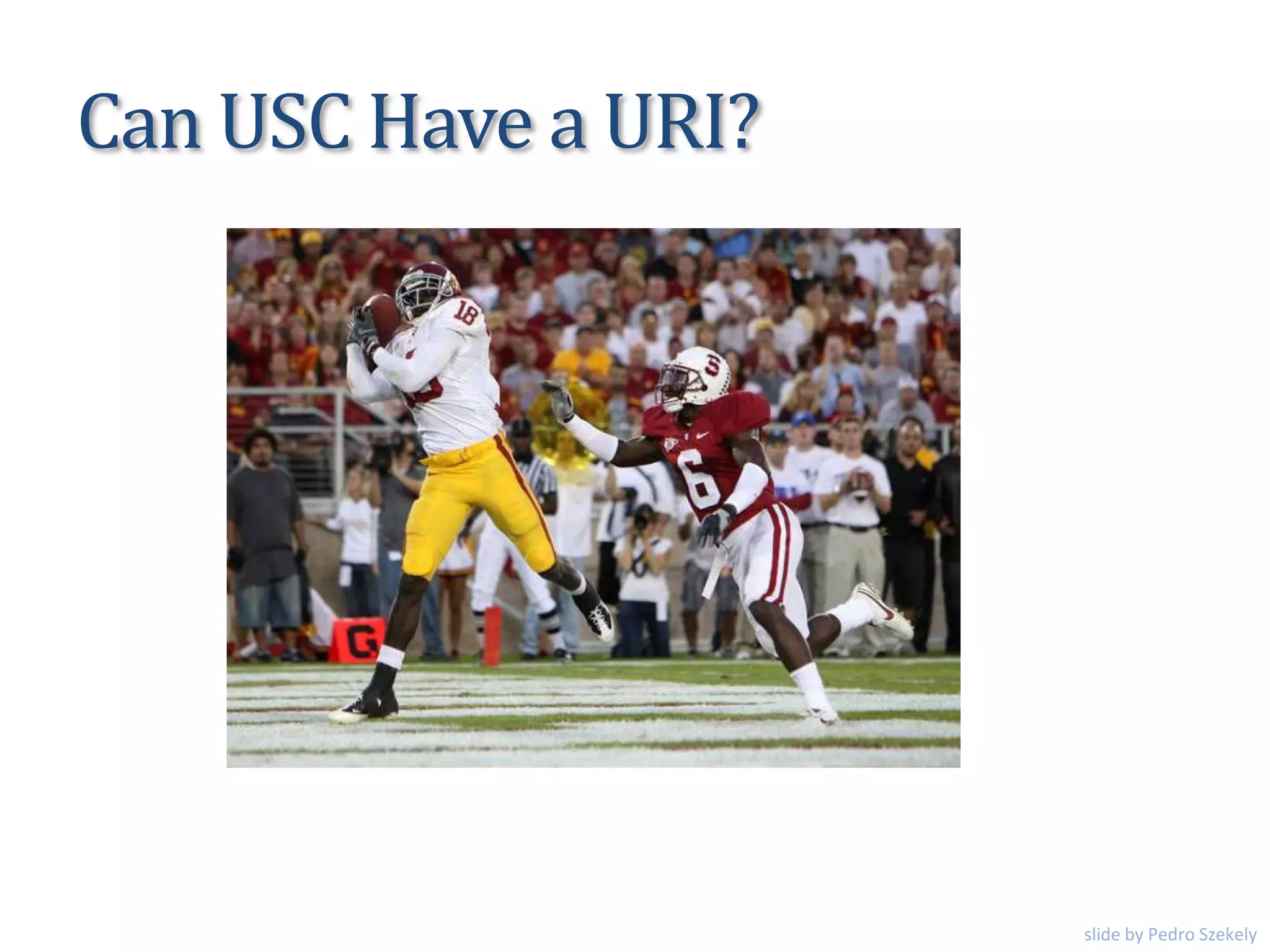
Can USC Have a URI?
slide by Pedro Szekely
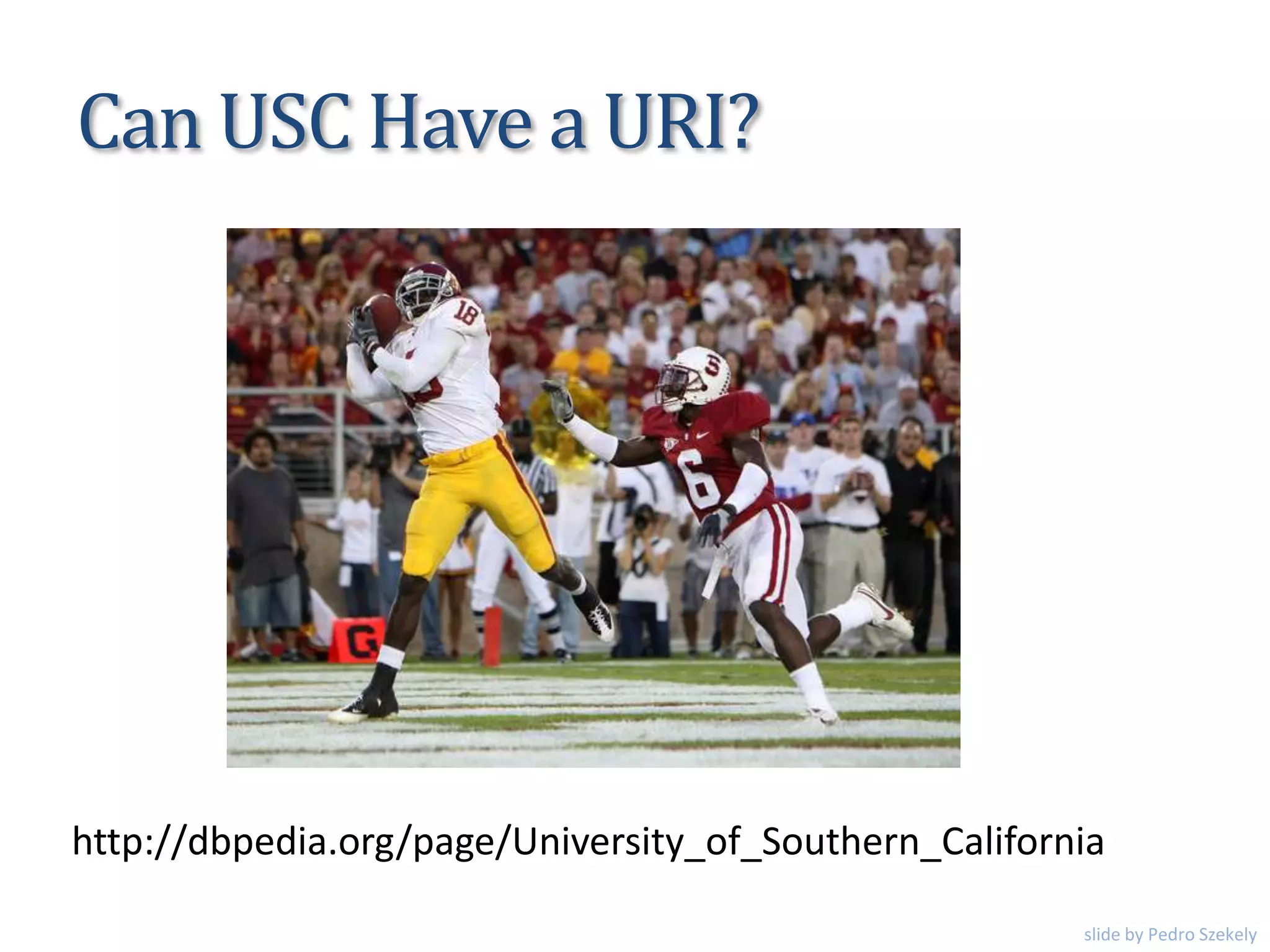
Can USC Have a URI?
http://dbpedia.org/page/University_of_Southern_California
slide by Pedro Szekely
Things can have URIs
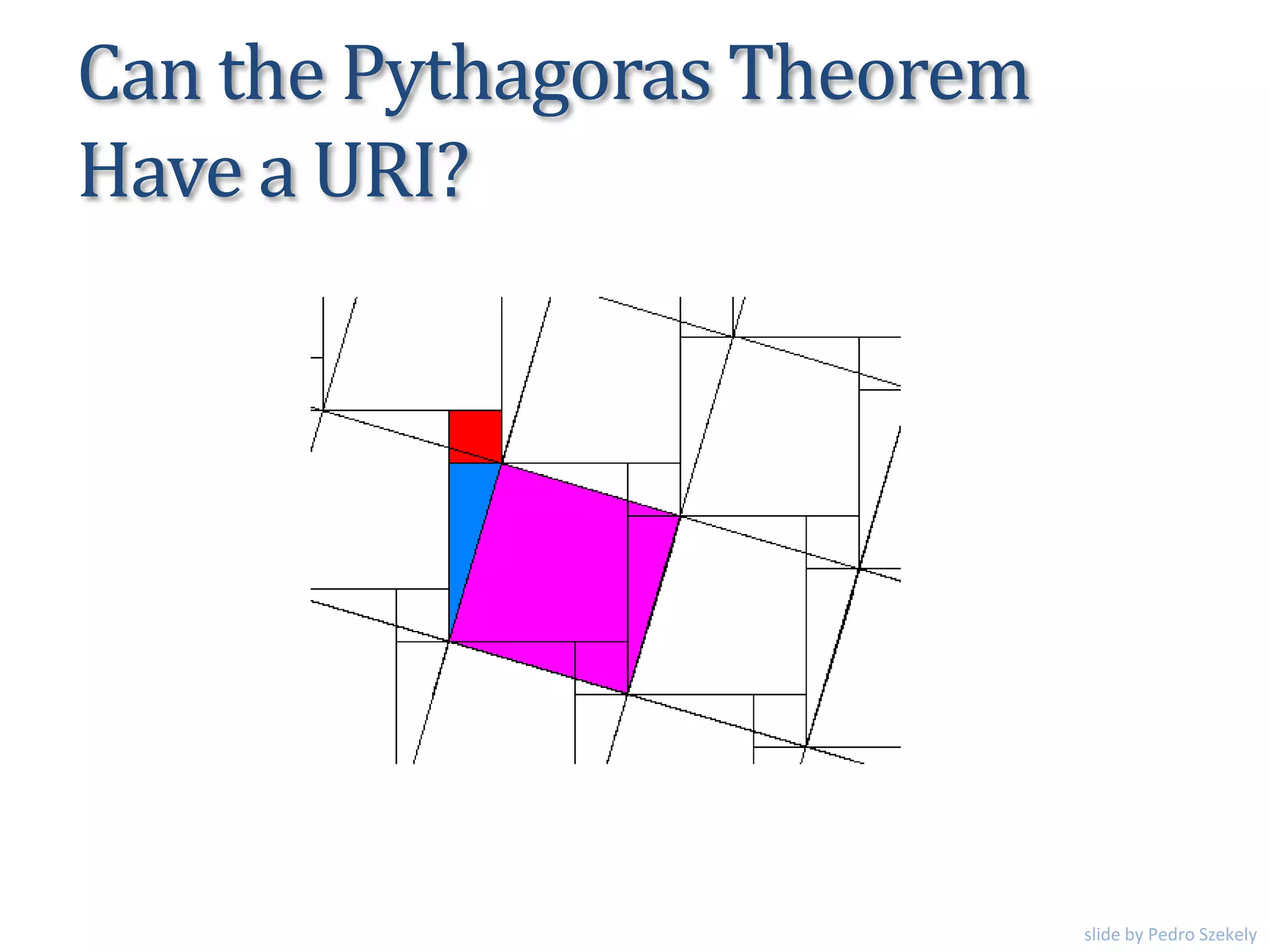
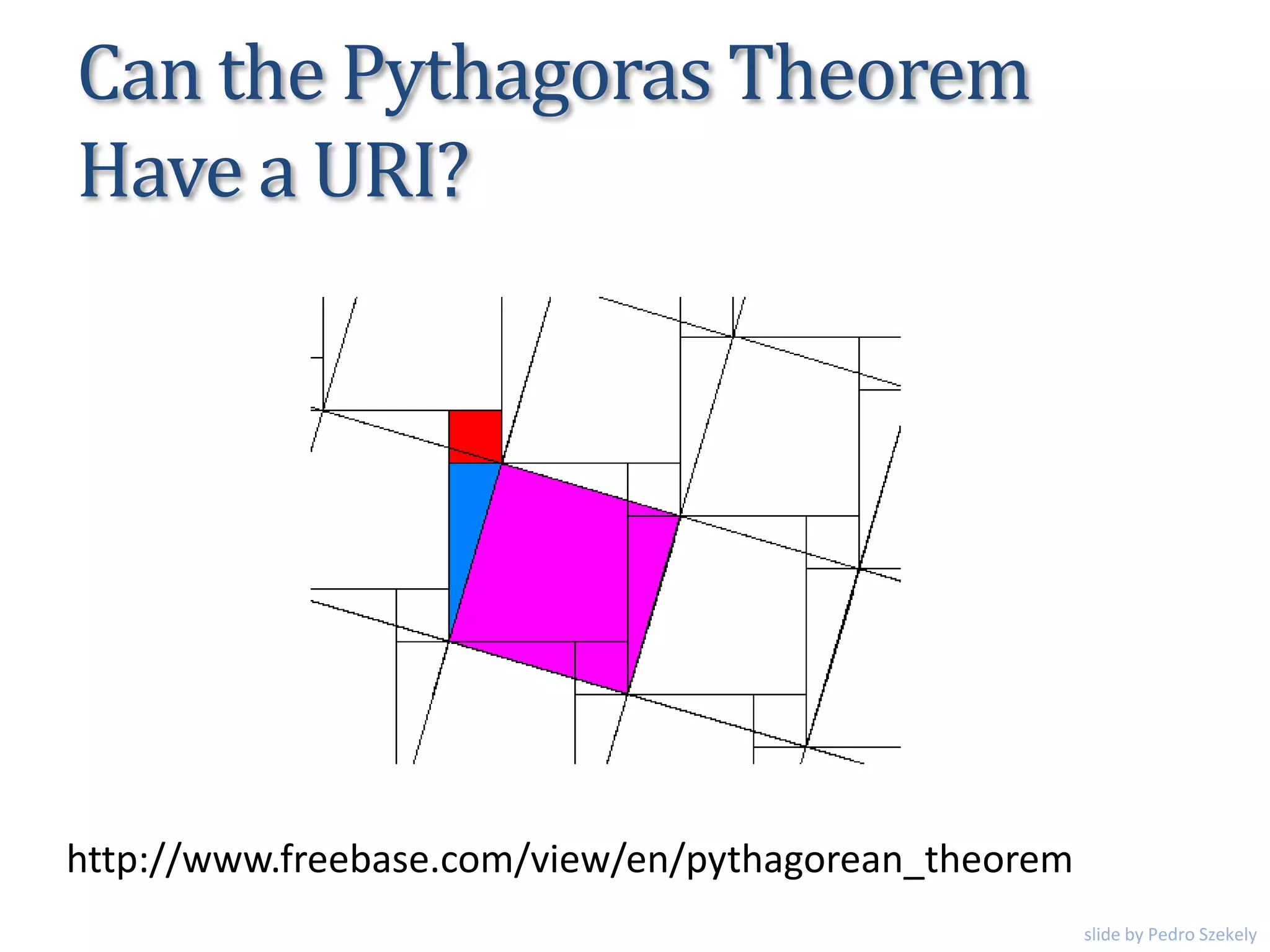
Can the Pythagoras Theorem
Have a URI?
slide by Pedro Szekely
Can the Pythagoras Theorem
Have a URI?
http://www.freebase.com/view/en/pythagorean_theorem
slide by Pedro Szekely
Ideas can have URIs
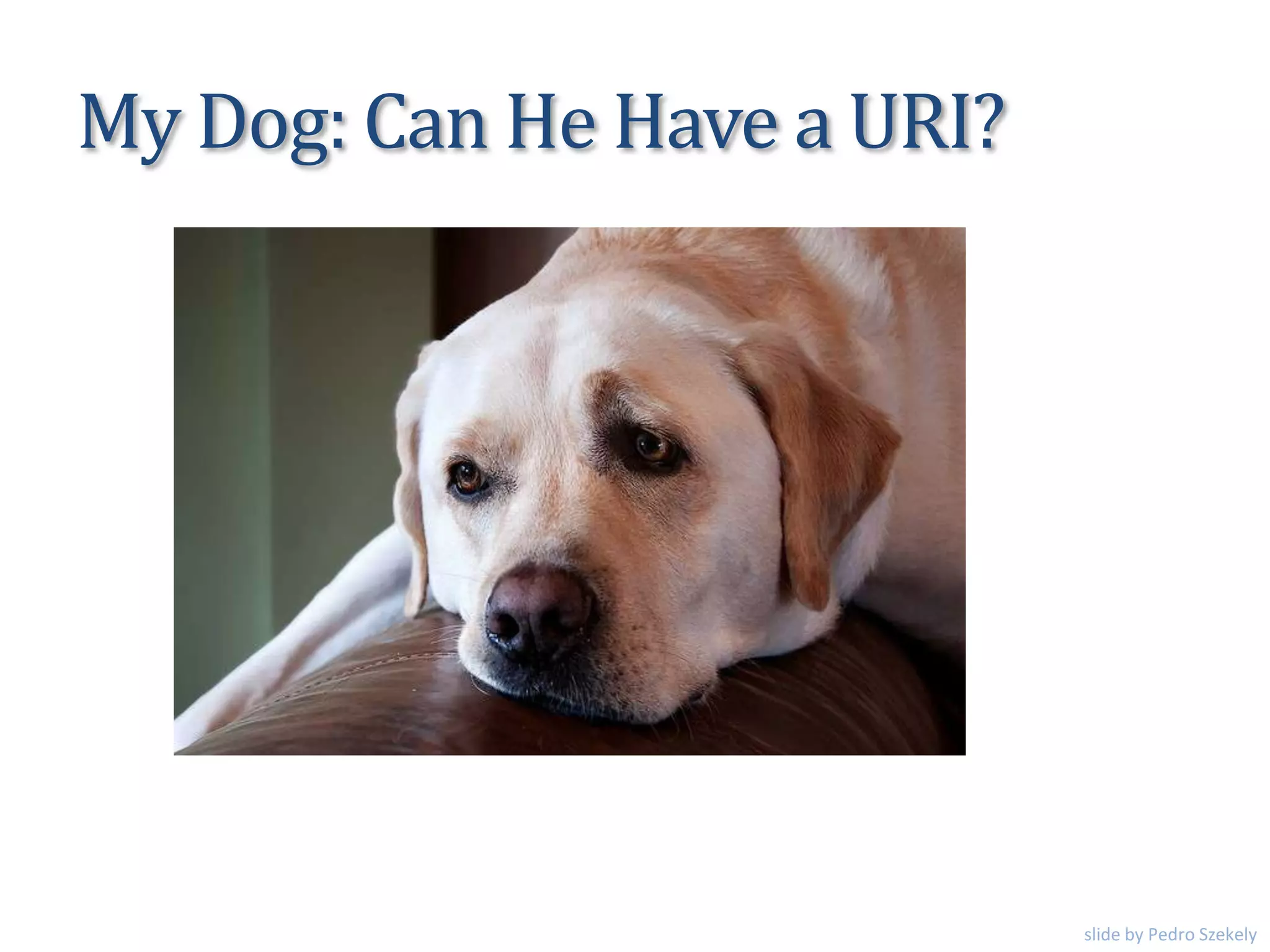
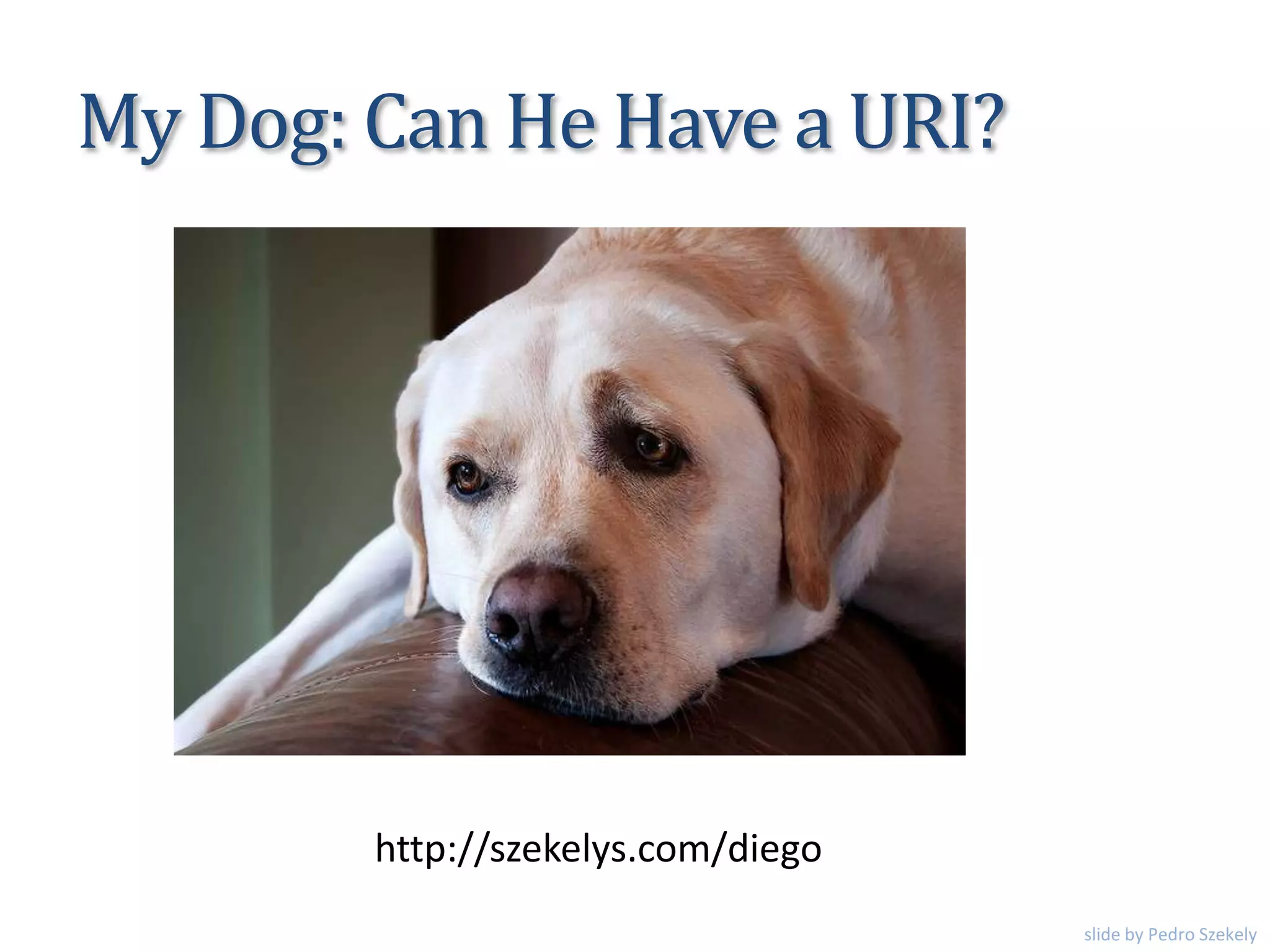
My Dog: Can He Have a URI?
slide by Pedro Szekely
My Dog: Can He Have a URI?
http://szekelys.com/diego
slide by Pedro Szekely
It does not have to be “important” to have a URI
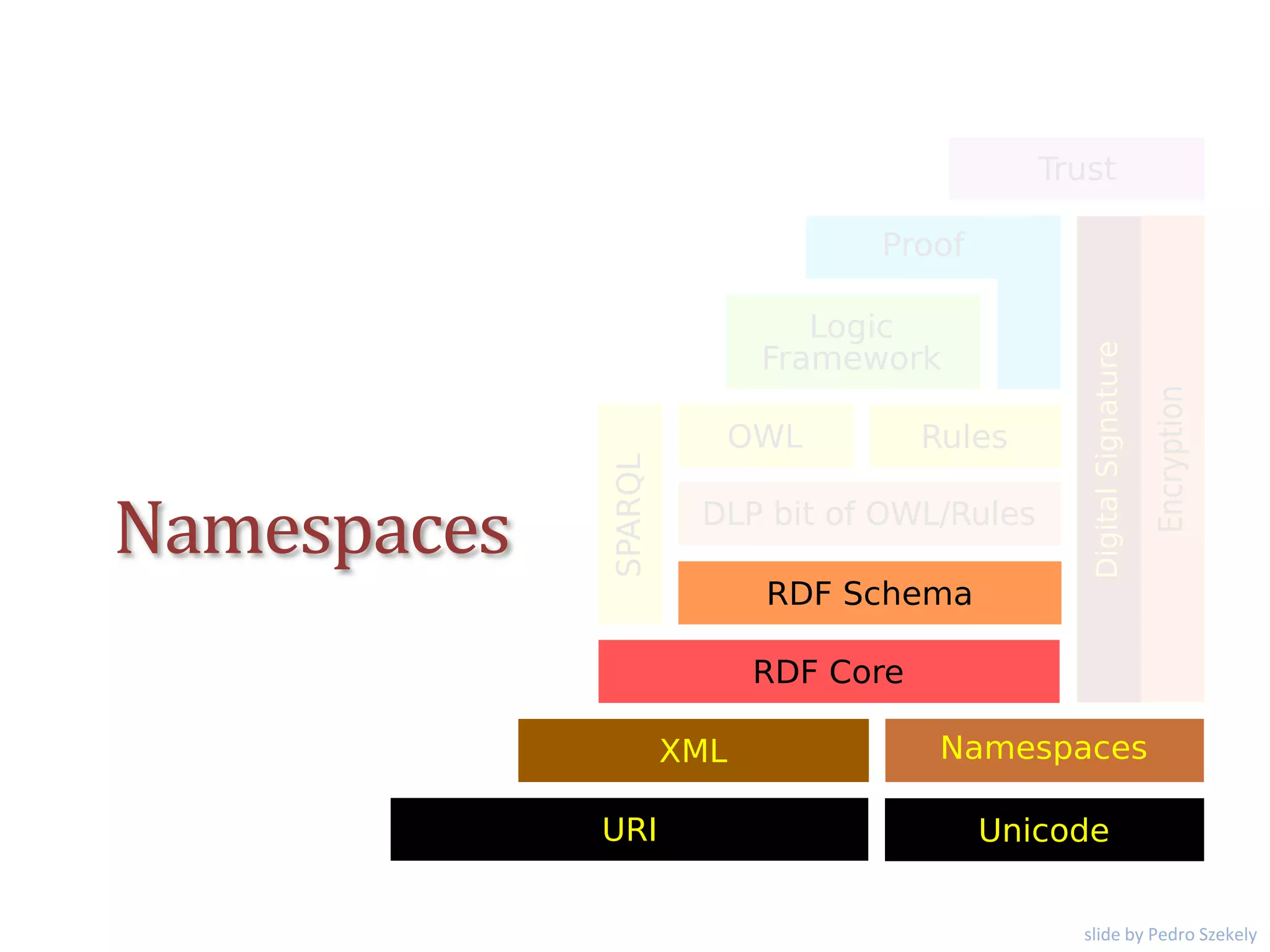
Namespaces
slide by Pedro Szekely
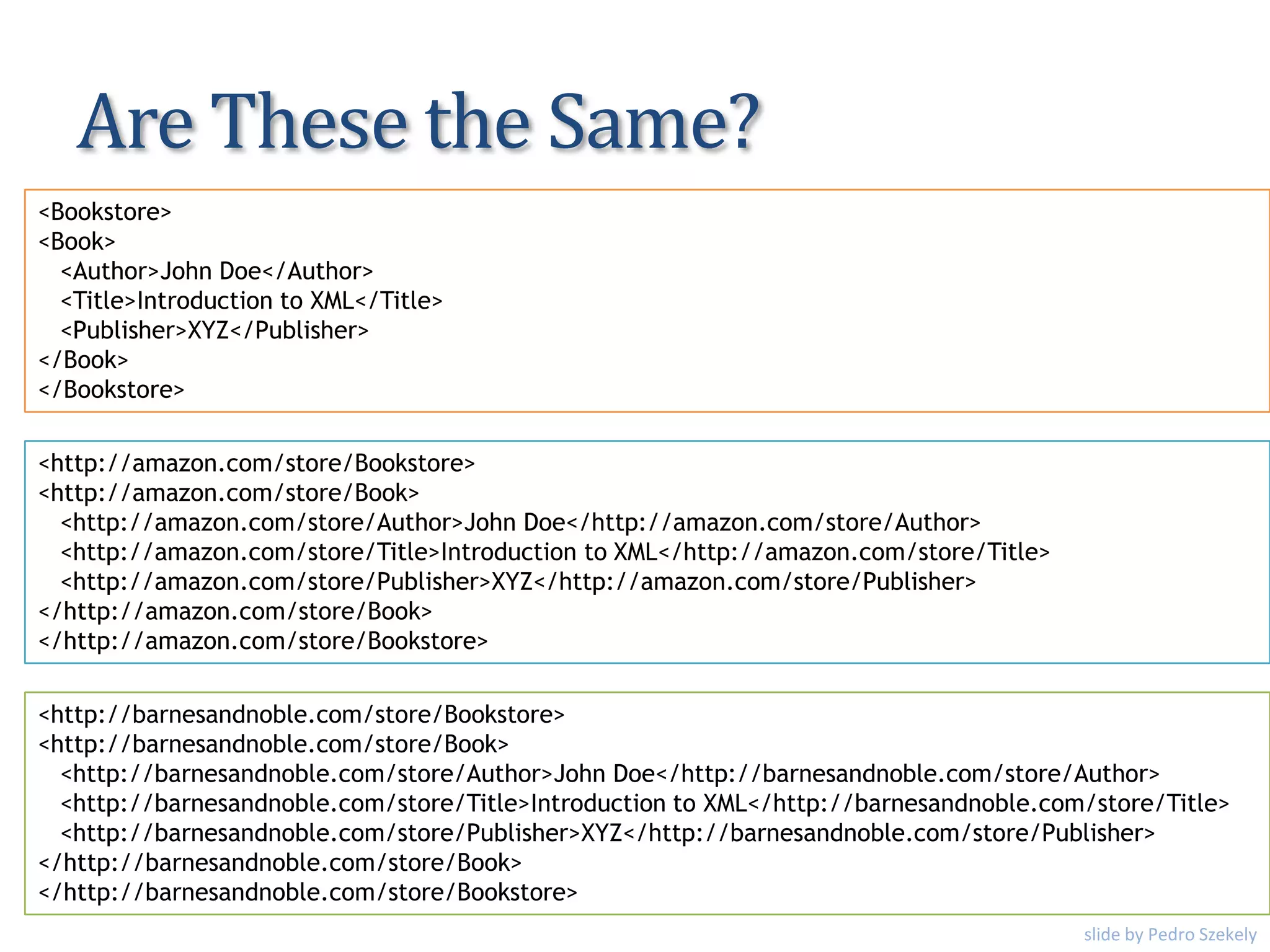
Are These the Same?
<http://amazon.com/store/Bookstore>
<http://amazon.com/store/Book>
<http://amazon.com/store/Author>John Doe</http://amazon.com/store/Author>
<http://amazon.com/store/Title>Introduction to XML</http://amazon.com/store/Title>
<http://amazon.com/store/Publisher>XYZ</http://amazon.com/store/Publisher>
</http://amazon.com/store/Book>
</http://amazon.com/store/Bookstore>
<http://barnesandnoble.com/store/Bookstore>
<http://barnesandnoble.com/store/Book>
<http://barnesandnoble.com/store/Author>John Doe</http://barnesandnoble.com/store/Author>
<http://barnesandnoble.com/store/Title>Introduction to XML</http://barnesandnoble.com/store/Title>
<http://barnesandnoble.com/store/Publisher>XYZ</http://barnesandnoble.com/store/Publisher>
</http://barnesandnoble.com/store/Book>
</http://barnesandnoble.com/store/Bookstore>
<Bookstore>
<Book>
<Author>John Doe</Author>
<Title>Introduction to XML</Title>
<Publisher>XYZ</Publisher>
</Book>
</Bookstore>
slide by Pedro Szekely
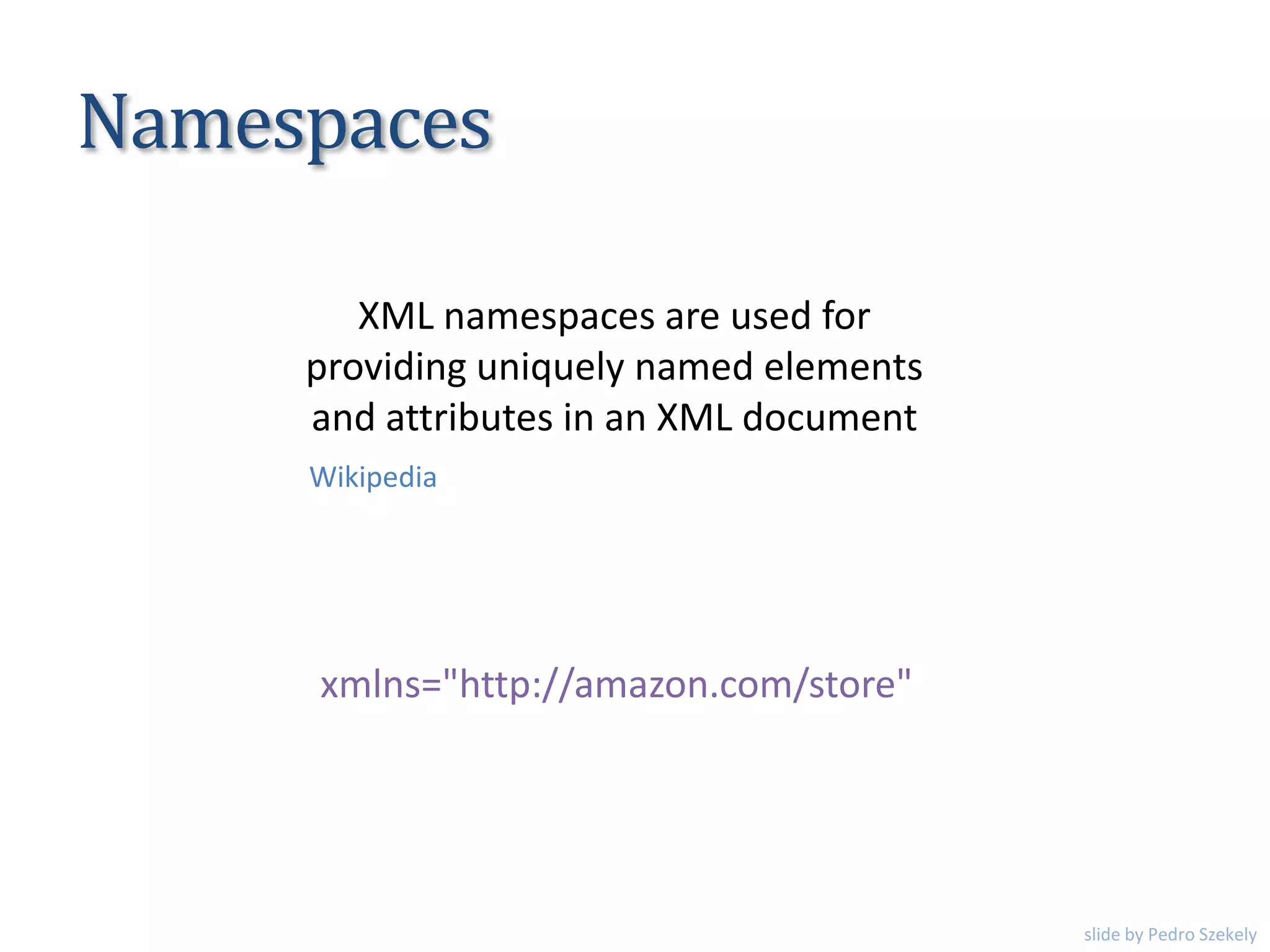
Namespaces
XML namespaces are used for
providing uniquely named elements
and attributes in an XML document
xmlns="http://amazon.com/store"
Wikipedia
slide by Pedro Szekely
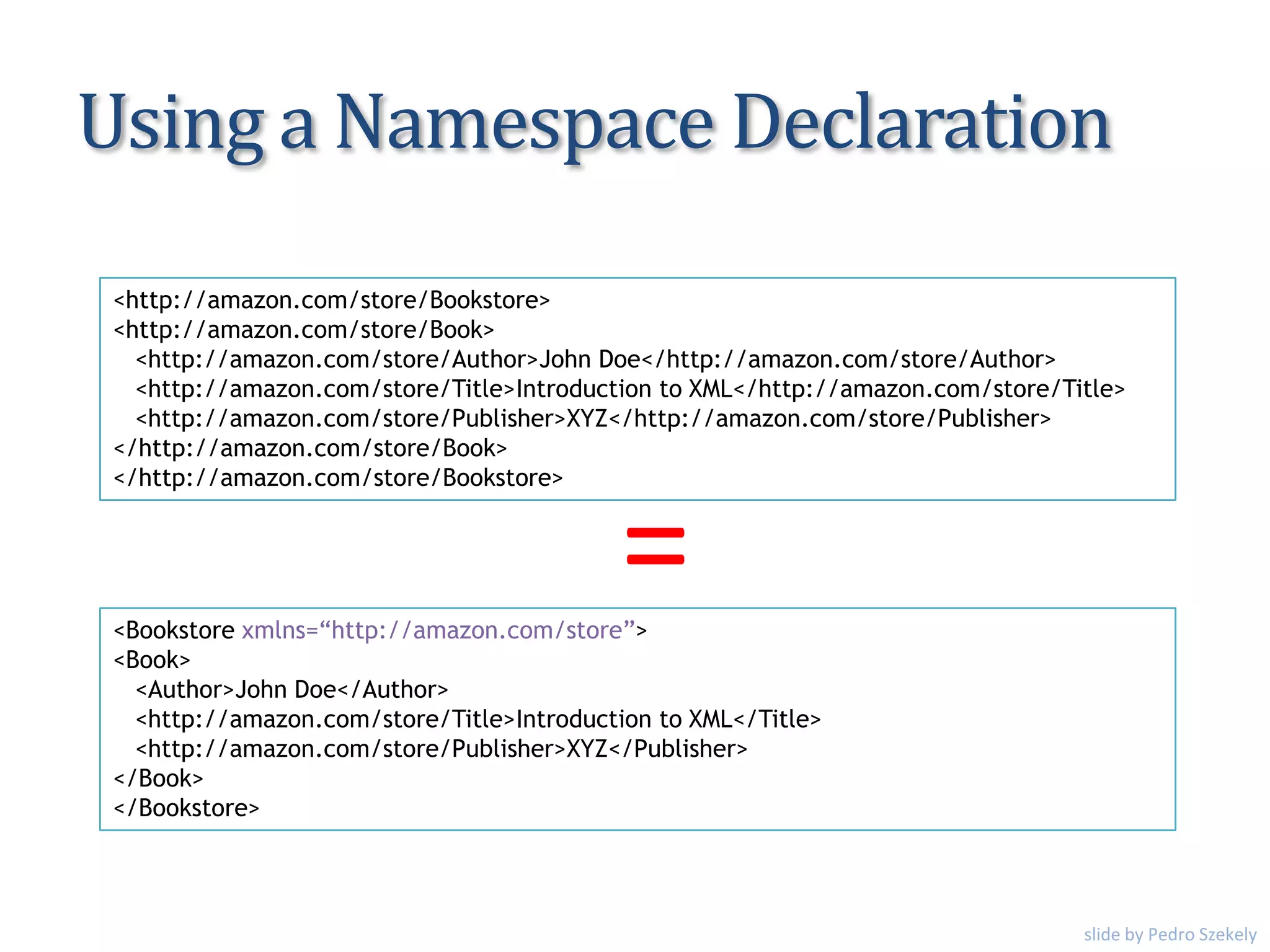
Using a Namespace Declaration
<http://amazon.com/store/Bookstore>
<http://amazon.com/store/Book>
<http://amazon.com/store/Author>John Doe</http://amazon.com/store/Author>
<http://amazon.com/store/Title>Introduction to XML</http://amazon.com/store/Title>
<http://amazon.com/store/Publisher>XYZ</http://amazon.com/store/Publisher>
</http://amazon.com/store/Book>
</http://amazon.com/store/Bookstore>
<Bookstore xmlns=“http://amazon.com/store”>
<Book>
<Author>John Doe</Author>
<http://amazon.com/store/Title>Introduction to XML</Title>
<http://amazon.com/store/Publisher>XYZ</Publisher>
</Book>
</Bookstore>
=
slide by Pedro Szekely
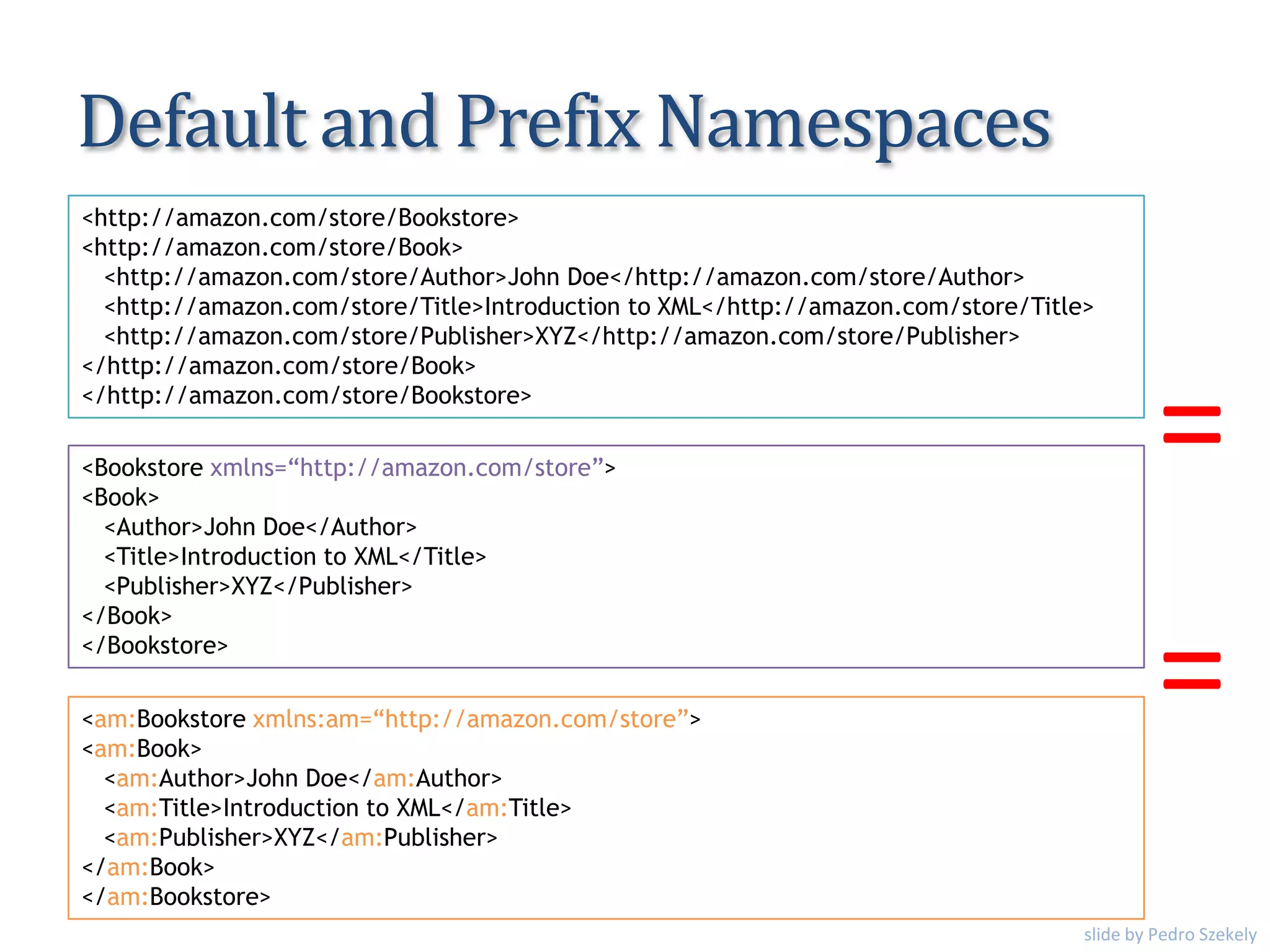
Default and Prefix Namespaces
<http://amazon.com/store/Bookstore>
<http://amazon.com/store/Book>
<http://amazon.com/store/Author>John Doe</http://amazon.com/store/Author>
<http://amazon.com/store/Title>Introduction to XML</http://amazon.com/store/Title>
<http://amazon.com/store/Publisher>XYZ</http://amazon.com/store/Publisher>
</http://amazon.com/store/Book>
</http://amazon.com/store/Bookstore>
<Bookstore xmlns=“http://amazon.com/store”>
<Book>
<Author>John Doe</Author>
<Title>Introduction to XML</Title>
<Publisher>XYZ</Publisher>
</Book>
</Bookstore>
=
<am:Bookstore xmlns:am=“http://amazon.com/store”>
<am:Book>
<am:Author>John Doe</am:Author>
<am:Title>Introduction to XML</am:Title>
<am:Publisher>XYZ</am:Publisher>
</am:Book>
</am:Bookstore>
=
slide by Pedro Szekely
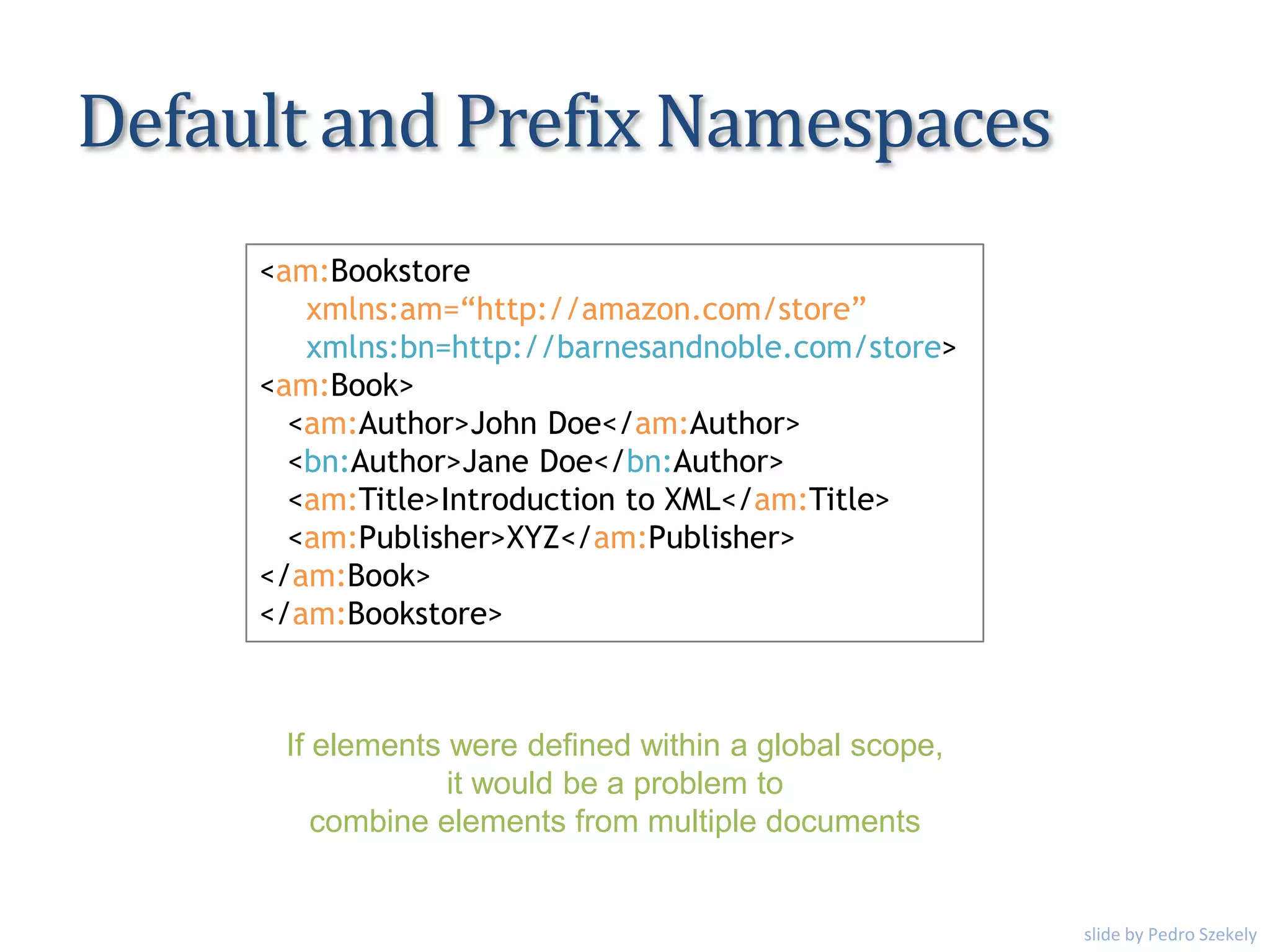
Default and Prefix Namespaces
<am:Bookstore
xmlns:am=“http://amazon.com/store”
xmlns:bn=http://barnesandnoble.com/store>
<am:Book>
<am:Author>John Doe</am:Author>
<bn:Author>Jane Doe</bn:Author>
<am:Title>Introduction to XML</am:Title>
<am:Publisher>XYZ</am:Publisher>
</am:Book>
</am:Bookstore>
If elements were defined within a global scope,
it would be a problem to
combine elements from multiple documents
slide by Pedro Szekely
XML
slide by Pedro Szekely
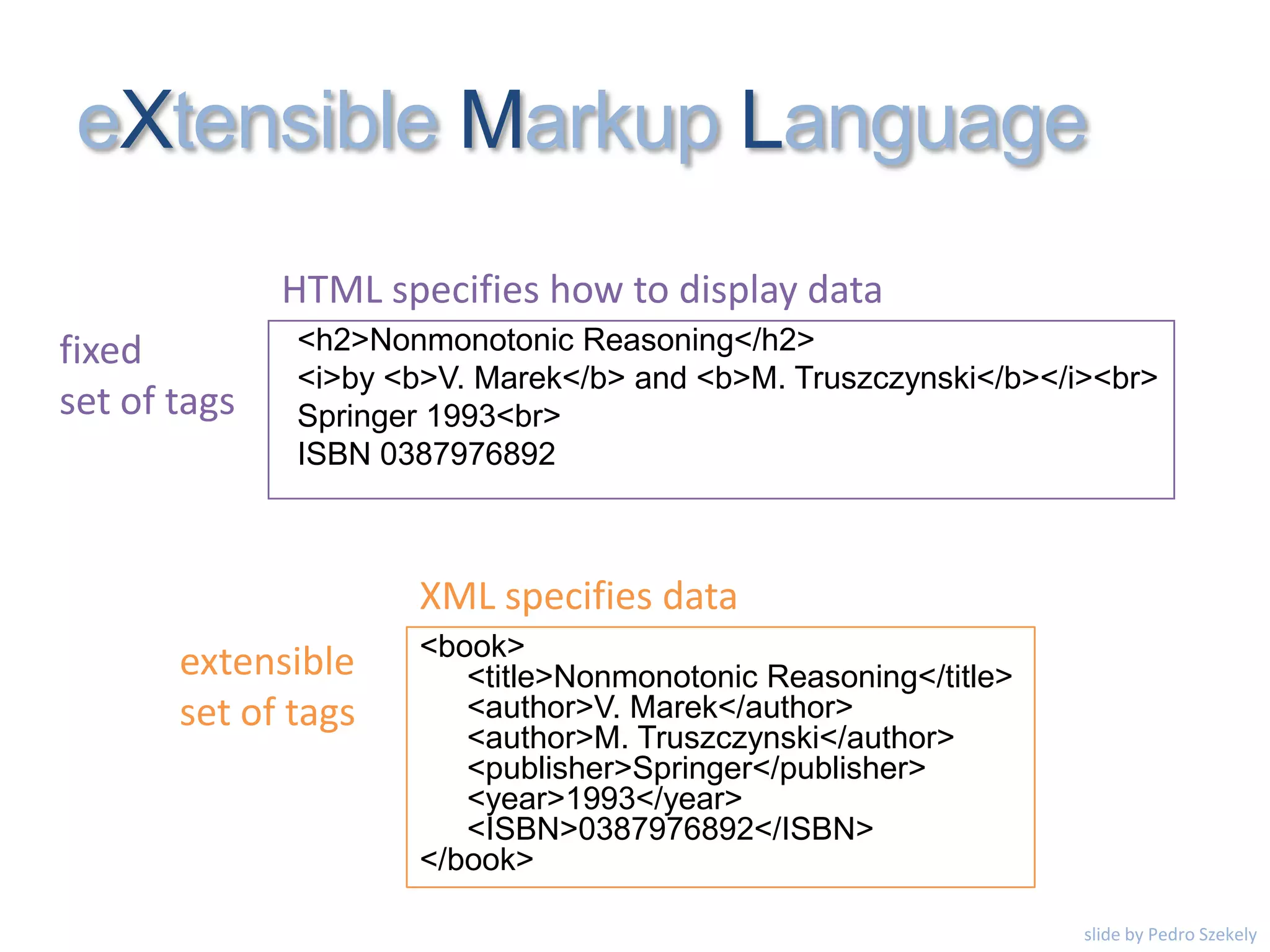
eXtensible Markup Language
<h2>Nonmonotonic Reasoning</h2>
<i>by <b>V. Marek</b> and <b>M. Truszczynski</b></i><br>
Springer 1993<br>
ISBN 0387976892
<book>
<title>Nonmonotonic Reasoning</title>
<author>V. Marek</author>
<author>M. Truszczynski</author>
<publisher>Springer</publisher>
<year>1993</year>
<ISBN>0387976892</ISBN>
</book>
HTML specifies how to display data
XML specifies data
extensible
set of tags
fixed
set of tags
slide by Pedro Szekely
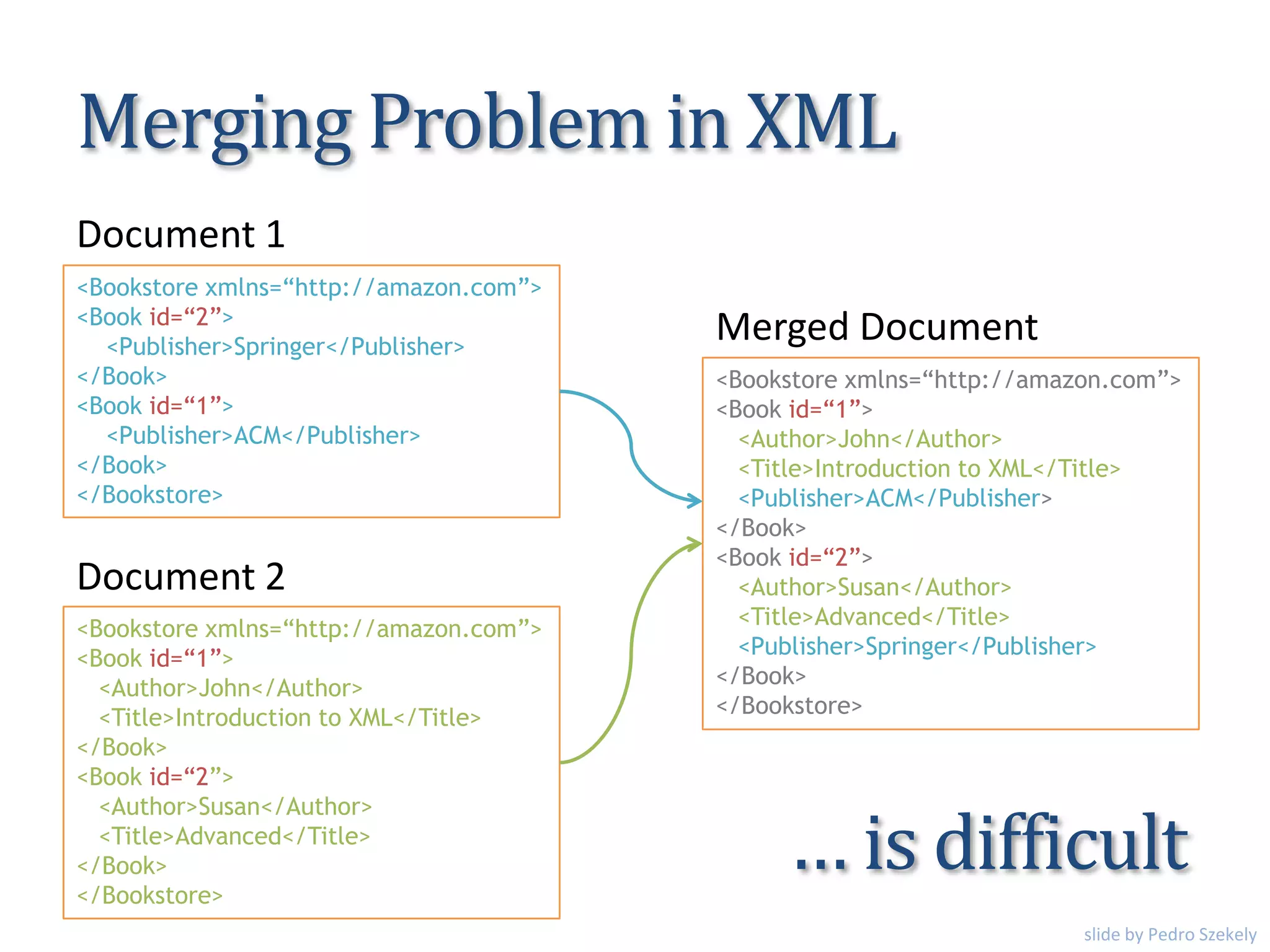
Merging Problem in XML
<Bookstore xmlns=“http://amazon.com”>
<Book id=“1”>
<Author>John</Author>
<Title>Introduction to XML</Title>
<Publisher>ACM</Publisher>
</Book>
<Book id=“2”>
<Author>Susan</Author>
<Title>Advanced</Title>
<Publisher>Springer</Publisher>
</Book>
</Bookstore>
<Bookstore xmlns=“http://amazon.com”>
<Book id=“1”>
<Author>John</Author>
<Title>Introduction to XML</Title>
</Book>
<Book id=“2”>
<Author>Susan</Author>
<Title>Advanced</Title>
</Book>
</Bookstore>
<Bookstore xmlns=“http://amazon.com”>
<Book id=“2”>
<Publisher>Springer</Publisher>
</Book>
<Book id=“1”>
<Publisher>ACM</Publisher>
</Book>
</Bookstore>
… is difficult
Document 1
Document 2
Merged Document
slide by Pedro Szekely
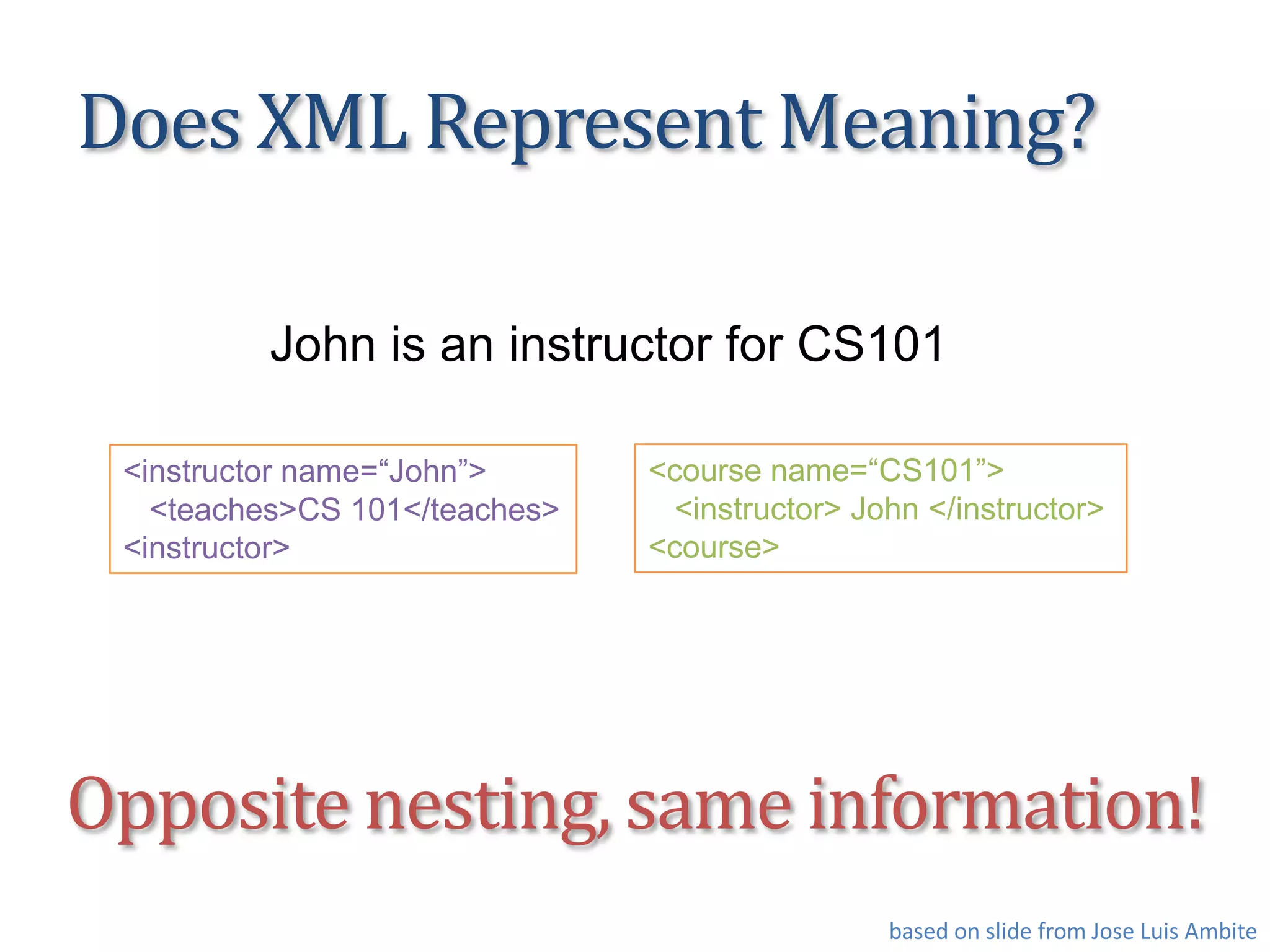
Does XML Represent Meaning?
<course name=“CS101”>
<instructor> John </instructor>
<course>
<instructor name=“John”>
<teaches>CS 101</teaches>
<instructor>
John is an instructor for CS101
Opposite nesting, same information!
based on slide from Jose Luis Ambite
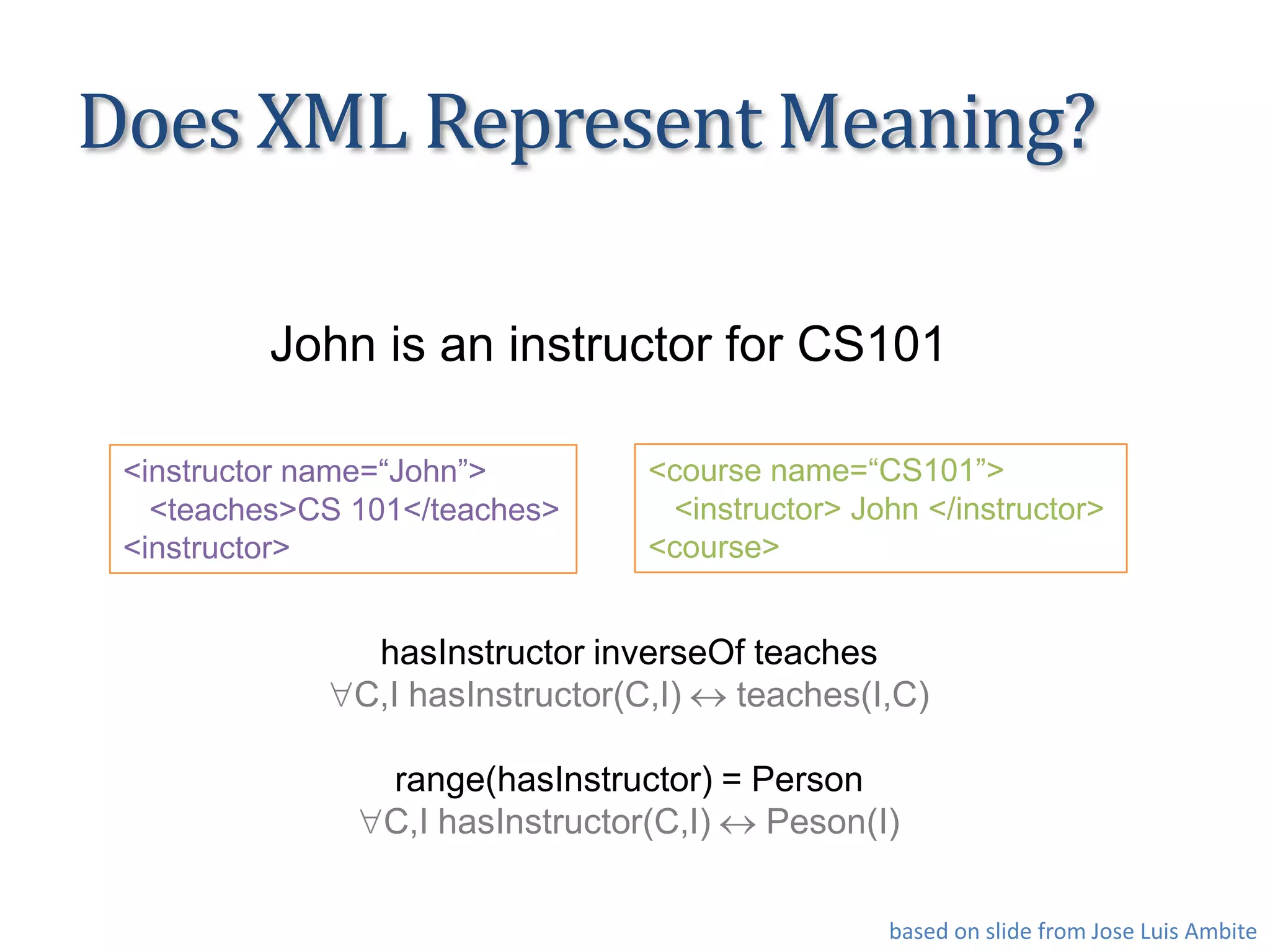
Does XML Represent Meaning?
<course name=“CS101”>
<instructor> John </instructor>
<course>
<instructor name=“John”>
<teaches>CS 101</teaches>
<instructor>
John is an instructor for CS101
hasInstructor inverseOf teaches
C,I hasInstructor(C,I) teaches(I,C)
range(hasInstructor) = Person
C,I hasInstructor(C,I) Peson(I)
based on slide from Jose Luis Ambite
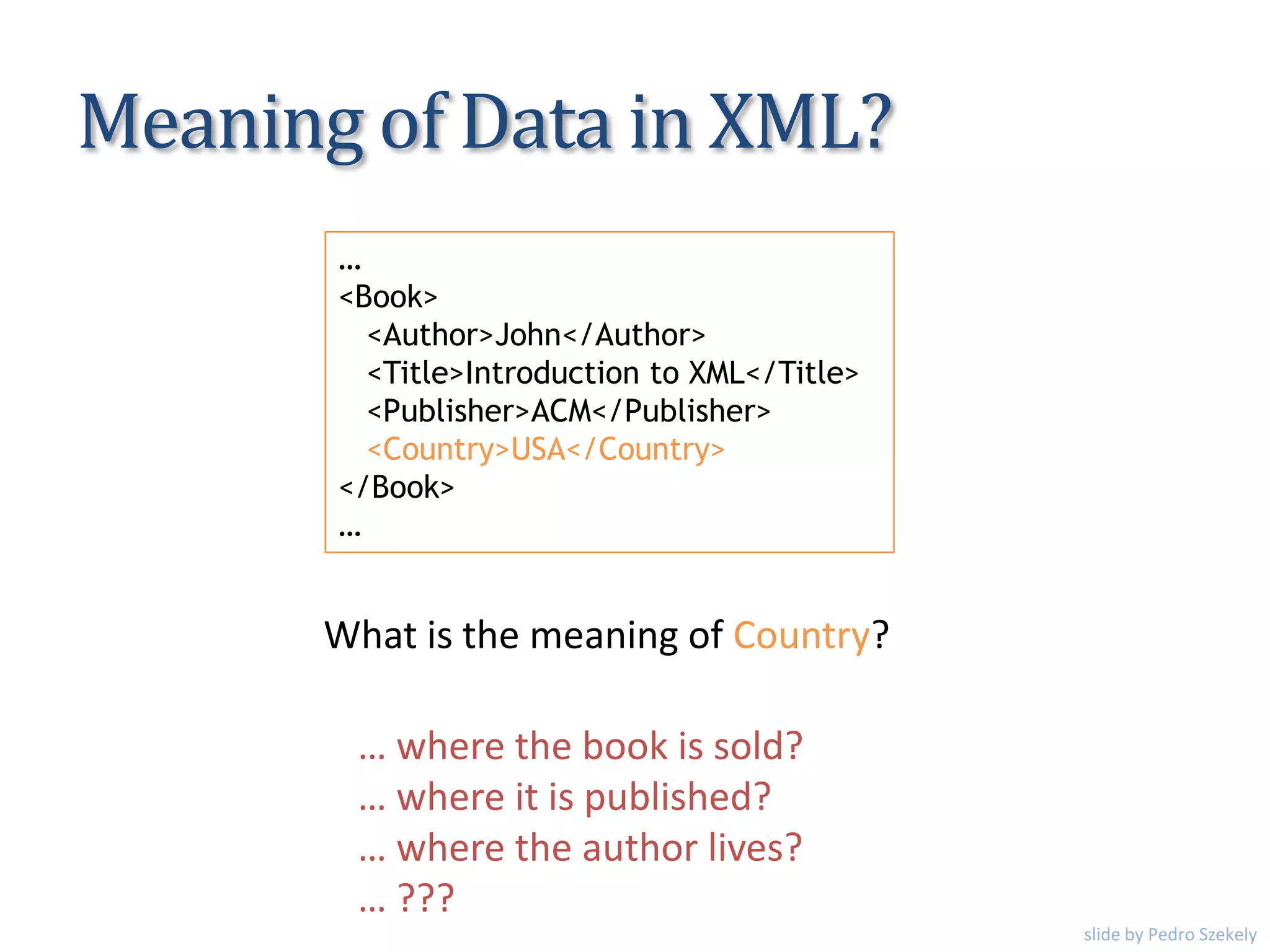
Meaning of Data in XML?
…
<Book>
<Author>John</Author>
<Title>Introduction to XML</Title>
<Publisher>ACM</Publisher>
<Country>USA</Country>
</Book>
…
What is the meaning of Country?
… where the book is sold?
… where it is published?
… where the author lives?
… ???
slide by Pedro Szekely
XML Schema
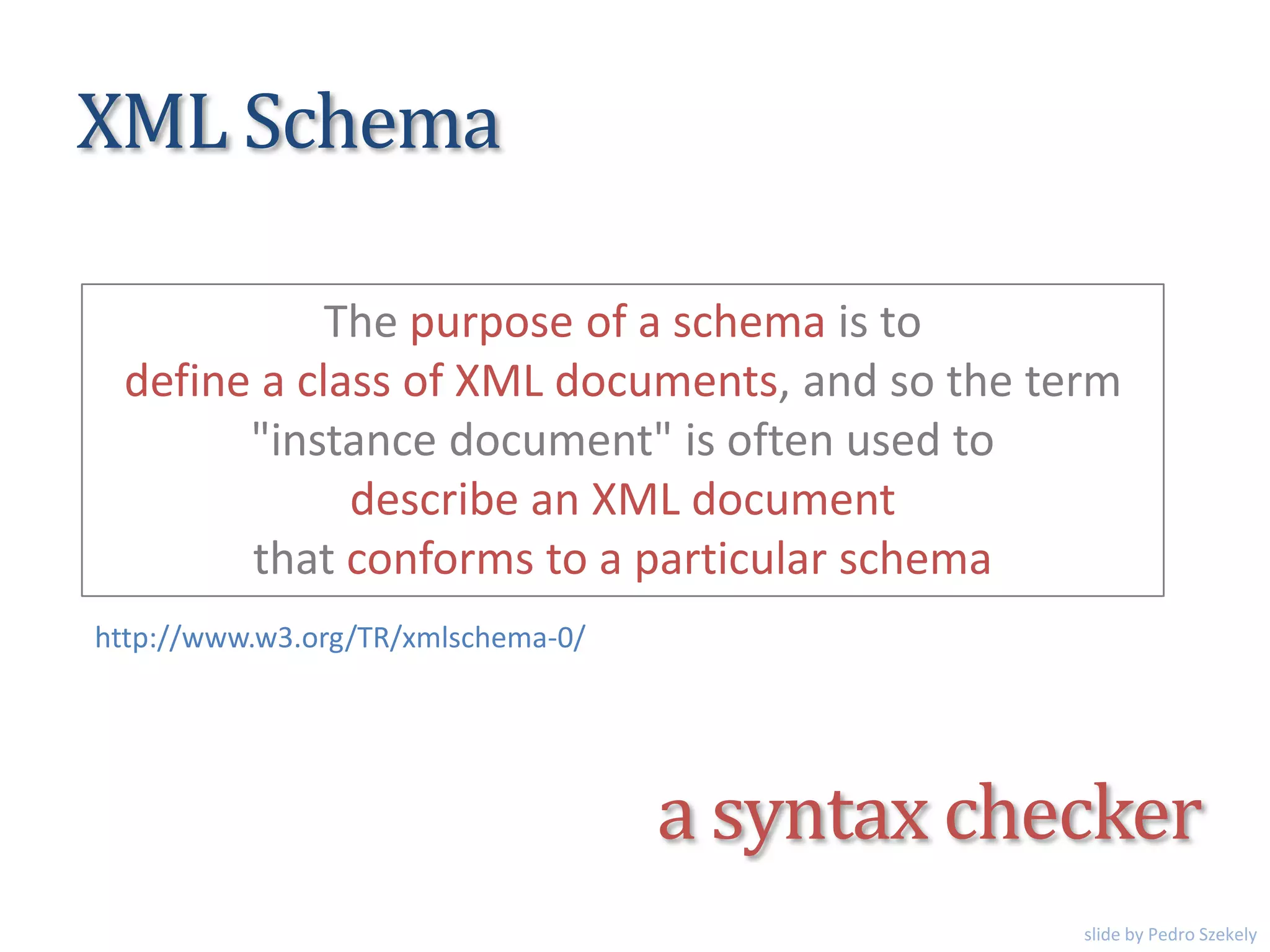
The purpose of a schema is to
define a class of XML documents, and so the term
"instance document" is often used to
describe an XML document
that conforms to a particular schema
http://www.w3.org/TR/xmlschema-0/
a syntax checker
slide by Pedro Szekely
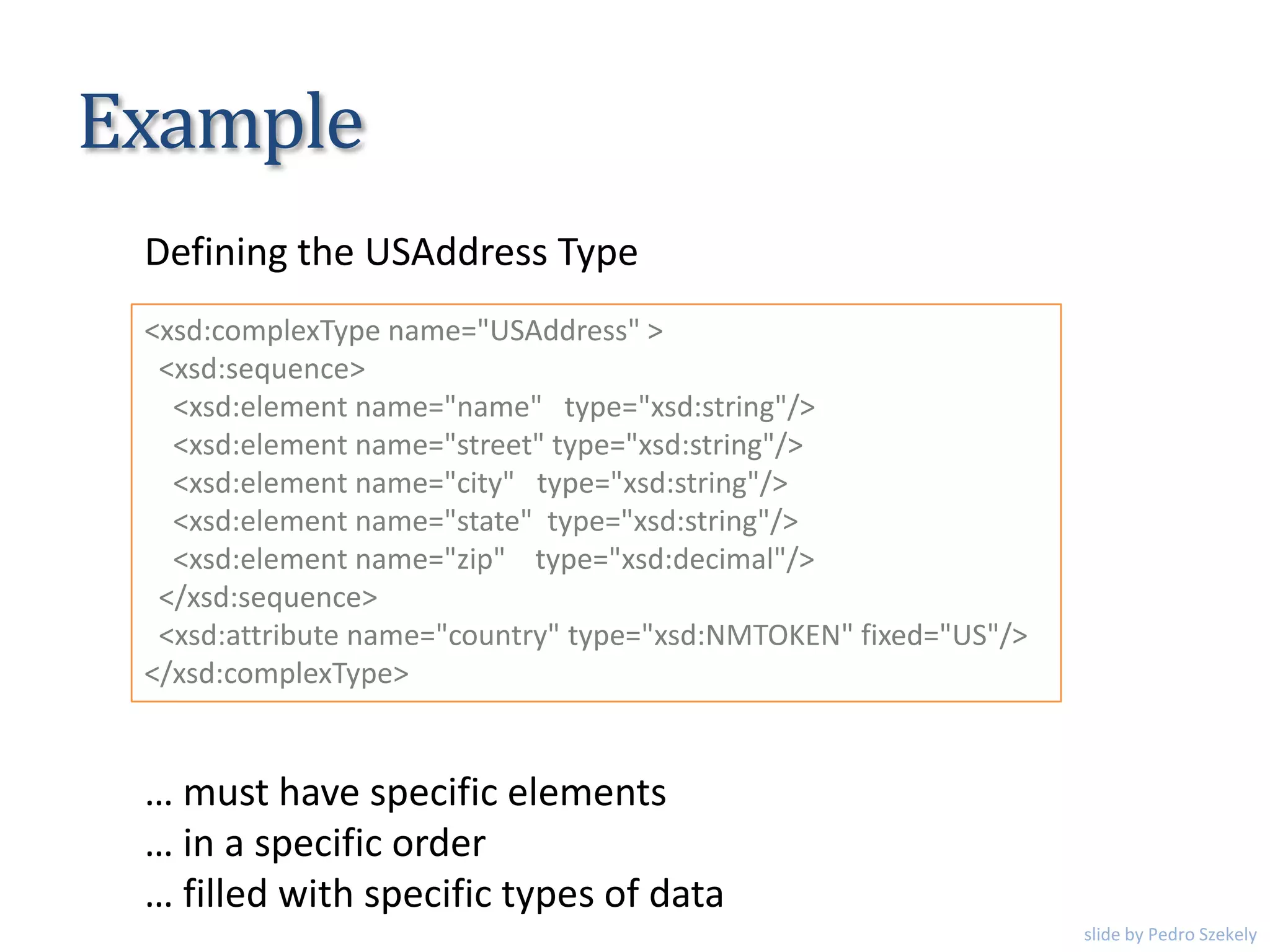
Example
<xsd:complexType name="USAddress" >
<xsd:sequence>
<xsd:element name="name" type="xsd:string"/>
<xsd:element name="street" type="xsd:string"/>
<xsd:element name="city" type="xsd:string"/>
<xsd:element name="state" type="xsd:string"/>
<xsd:element name="zip" type="xsd:decimal"/>
</xsd:sequence>
<xsd:attribute name="country" type="xsd:NMTOKEN" fixed="US"/>
</xsd:complexType>
Defining the USAddress Type
… must have specific elements
… in a specific order
… filled with specific types of data
slide by Pedro Szekely
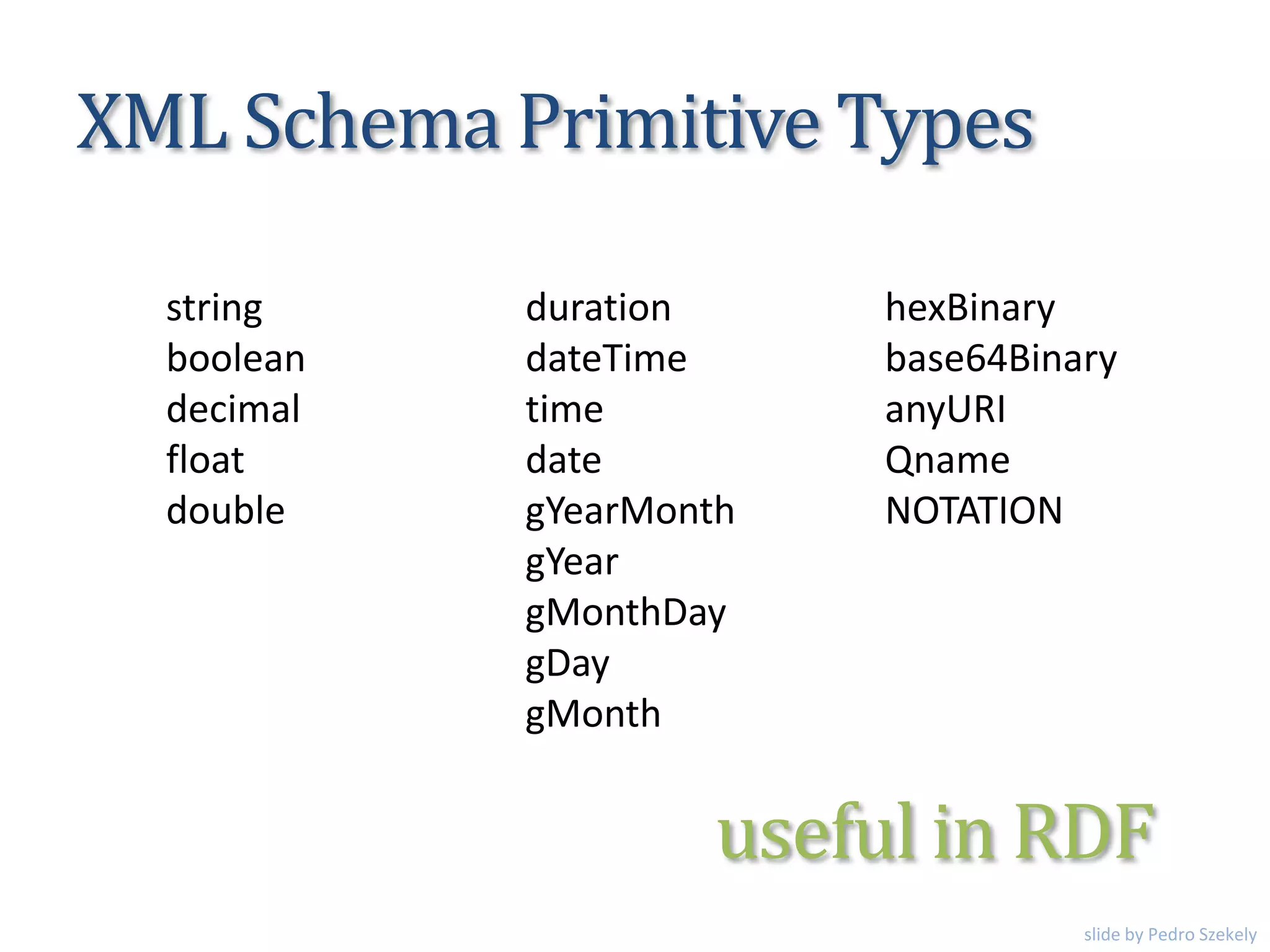
XML Schema Primitive Types
string
boolean
decimal
float
double
duration
dateTime
time
date
gYearMonth
gYear
gMonthDay
gDay
gMonth
hexBinary
base64Binary
anyURI
Qname
NOTATION
useful in RDF
slide by Pedro Szekely
Resource
Description
Framework
slide by Pedro Szekely
The Resource Description Framework (RDF)
is a language for
representing information about resources
in the World Wide Web
http://www.w3.org/TR/rdf-primer/
slide by Pedro Szekely
Intended for representing metadata about Web
resources, such as the title, author, and modification date
of a Web document
… also be used to represent information about
things that can be identified on the Web,
even when they cannot be directly retrieved on the Web
examples include information about items available from on-line
shopping facilities (e.g., prices and availability)
Resource Description Framework
slide by Pedro Szekely
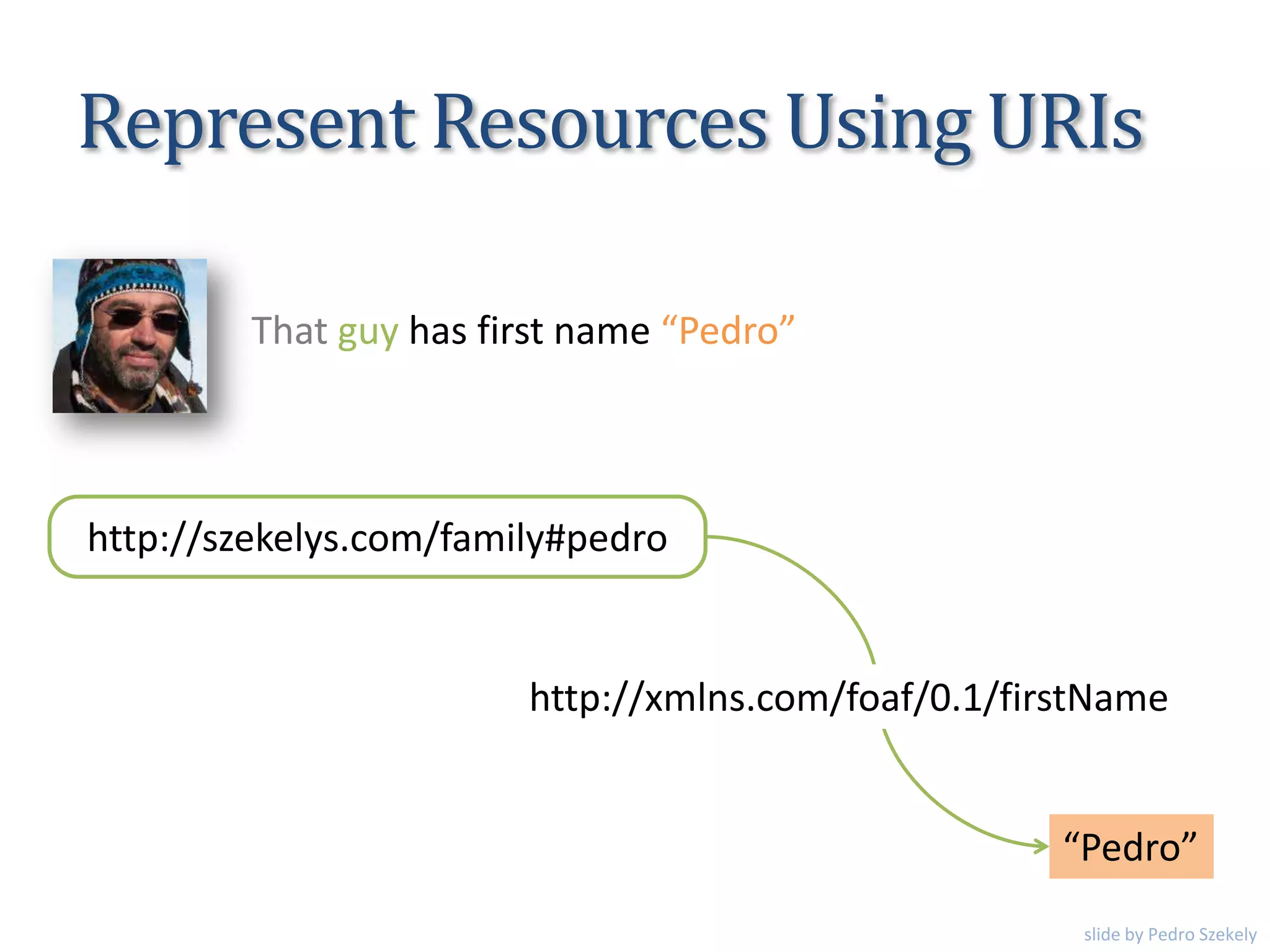
Represent Resources Using URIs
http://szekelys.com/family#pedro
“Pedro”
http://xmlns.com/foaf/0.1/firstName
That guy has first name “Pedro”
slide by Pedro Szekely
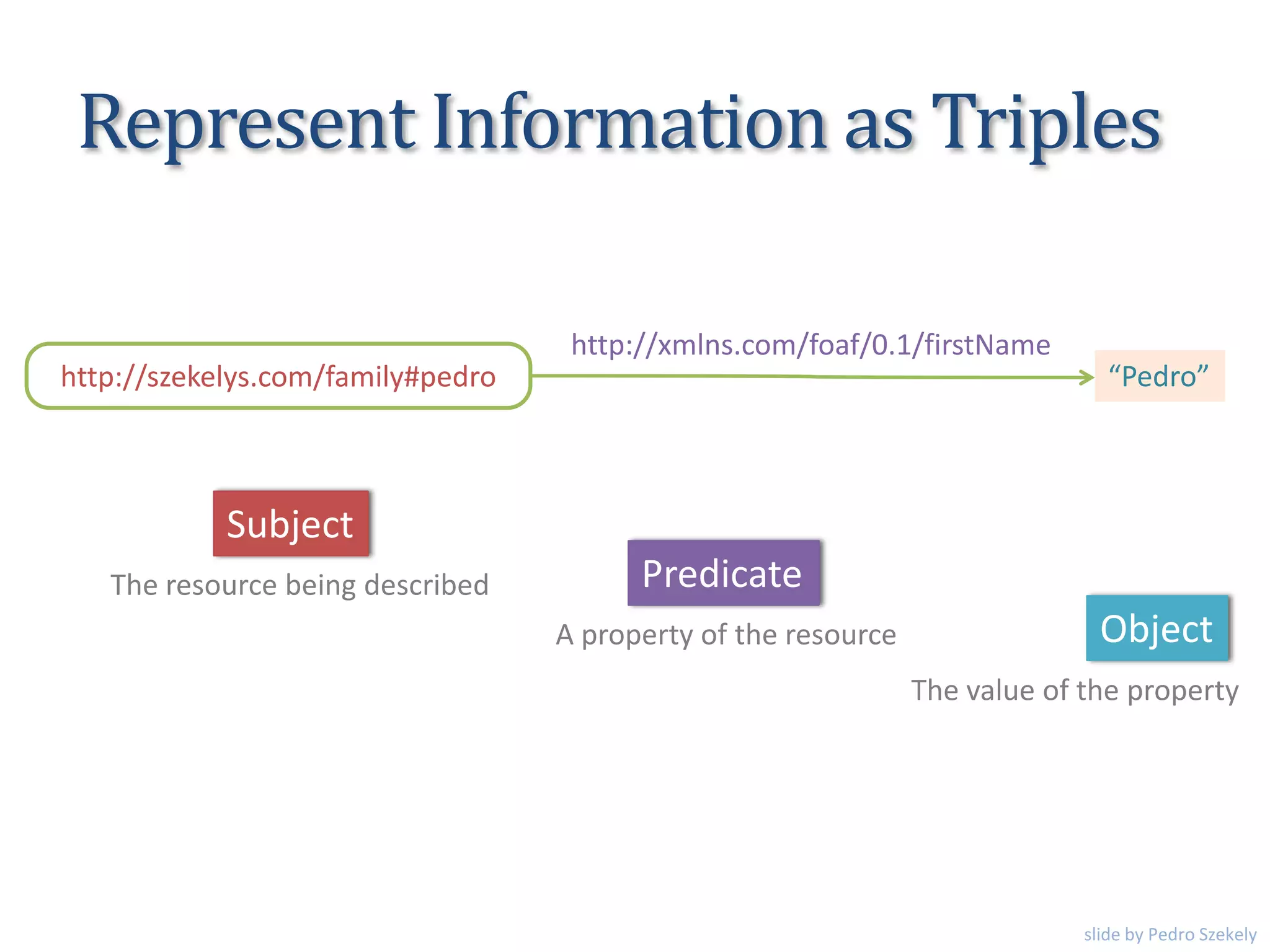
Represent Information as Triples
http://szekelys.com/family#pedro “Pedro”
http://xmlns.com/foaf/0.1/firstName
Subject
Predicate
Object
The resource being described
A property of the resource
The value of the property
slide by Pedro Szekely
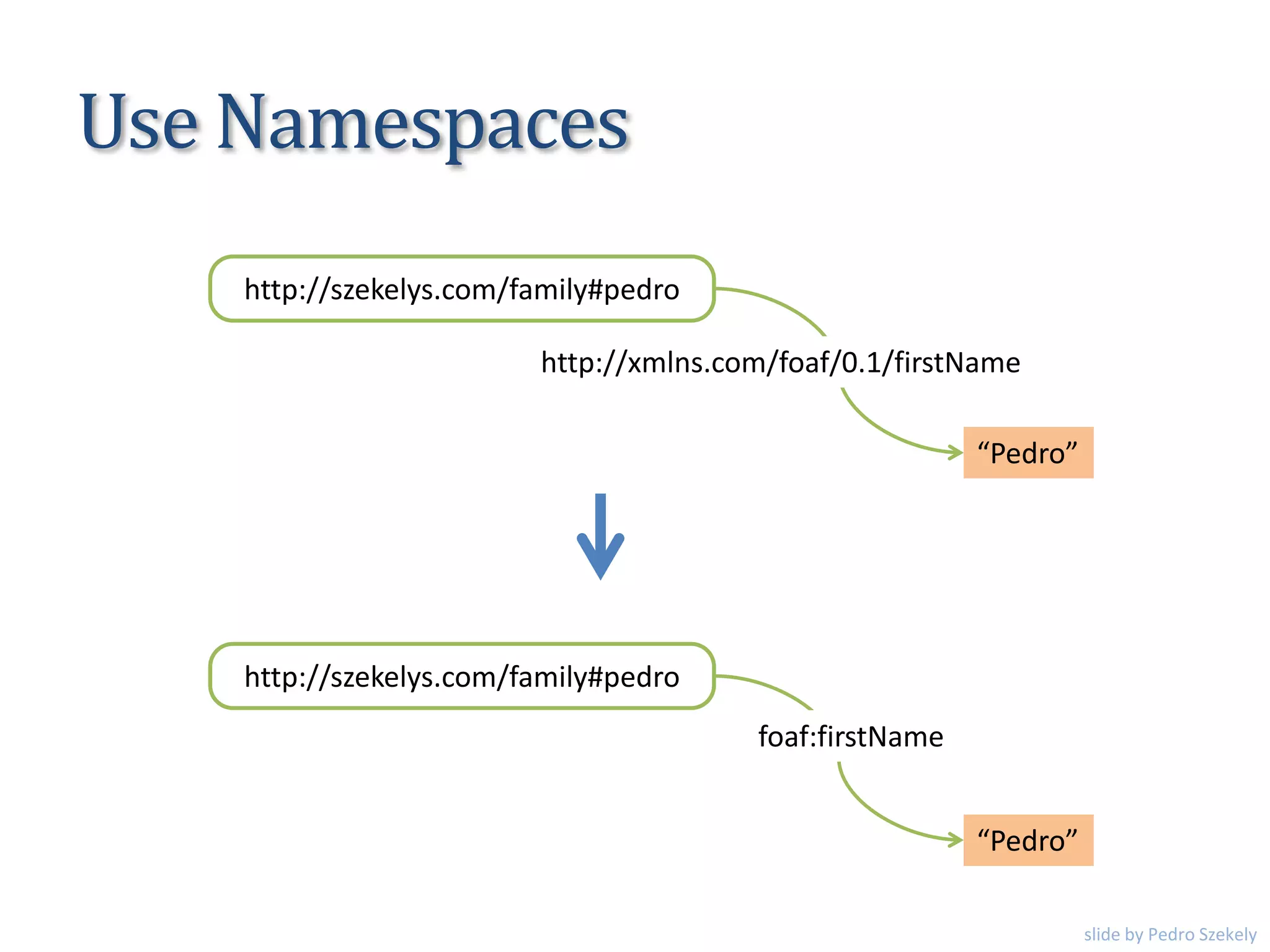
Use Namespaces
http://szekelys.com/family#pedro
“Pedro”
foaf:firstName
http://szekelys.com/family#pedro
“Pedro”
http://xmlns.com/foaf/0.1/firstName
slide by Pedro Szekely
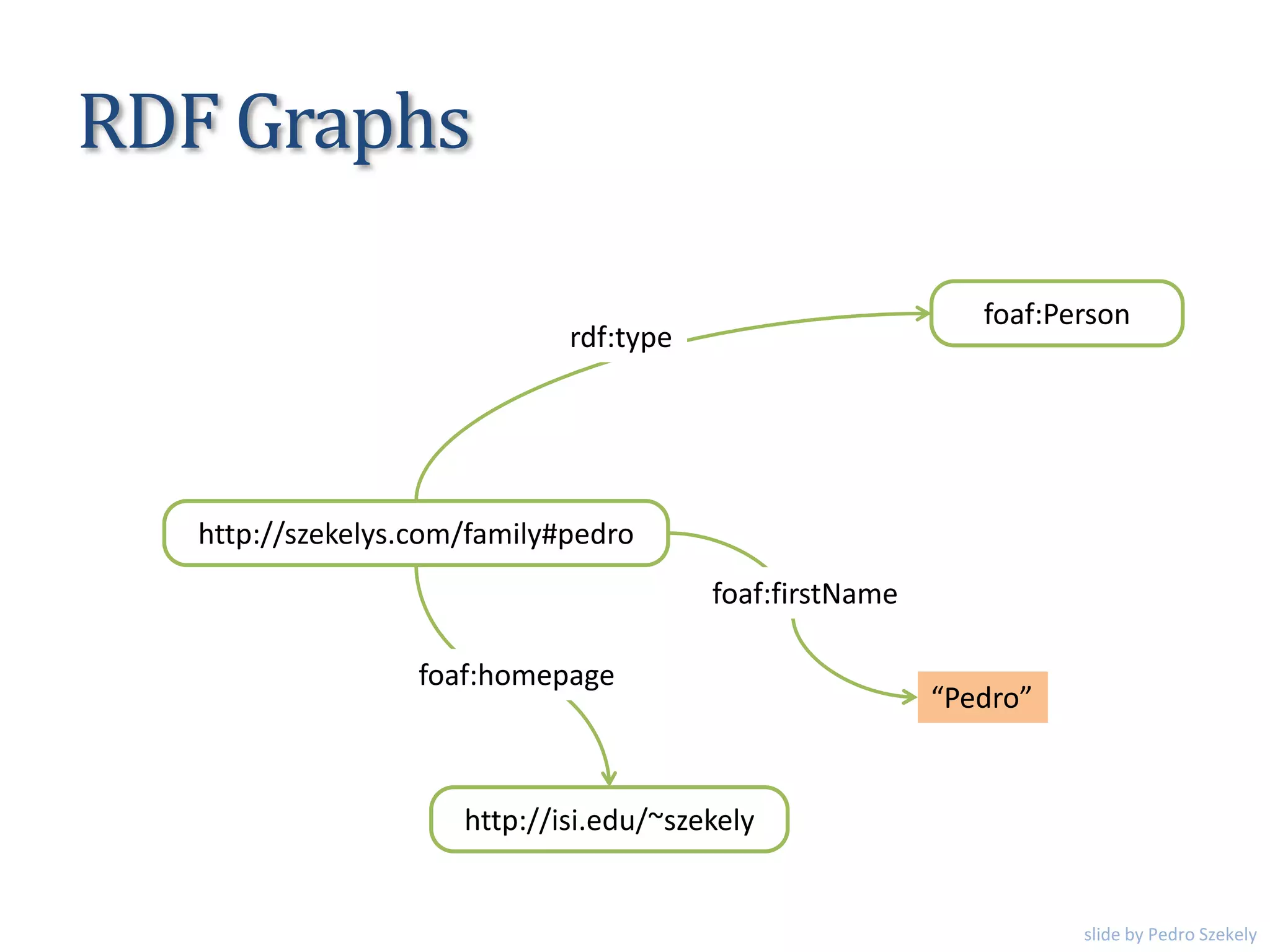
RDF Graphs
http://szekelys.com/family#pedro
“Pedro”
foaf:firstName
foaf:Person
rdf:type
http://isi.edu/~szekely
foaf:homepage
slide by Pedro Szekely
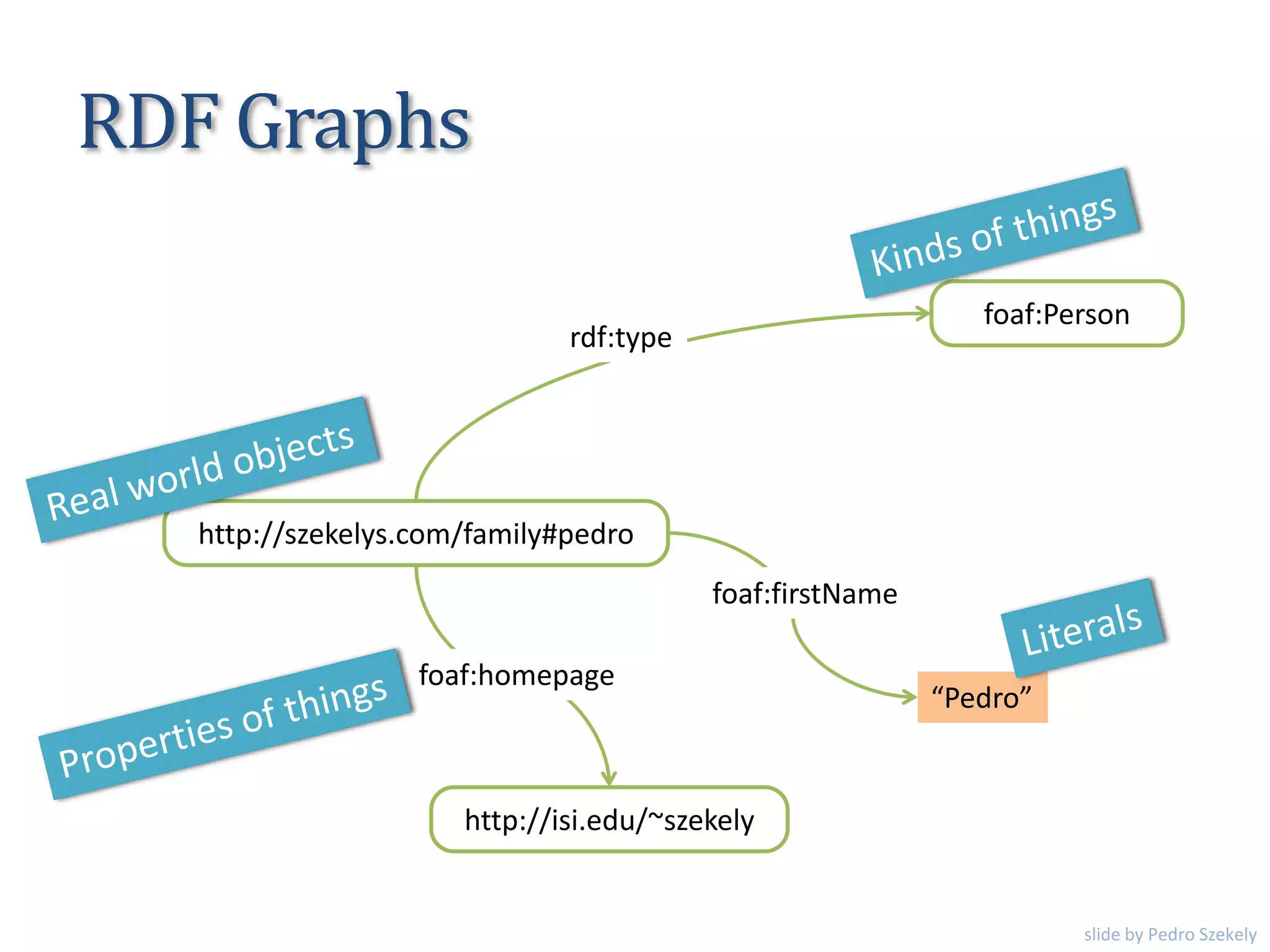
RDF Graphs
http://szekelys.com/family#pedro
“Pedro”
foaf:firstName
foaf:Person
rdf:type
http://isi.edu/~szekely
foaf:homepage
slide by Pedro Szekely
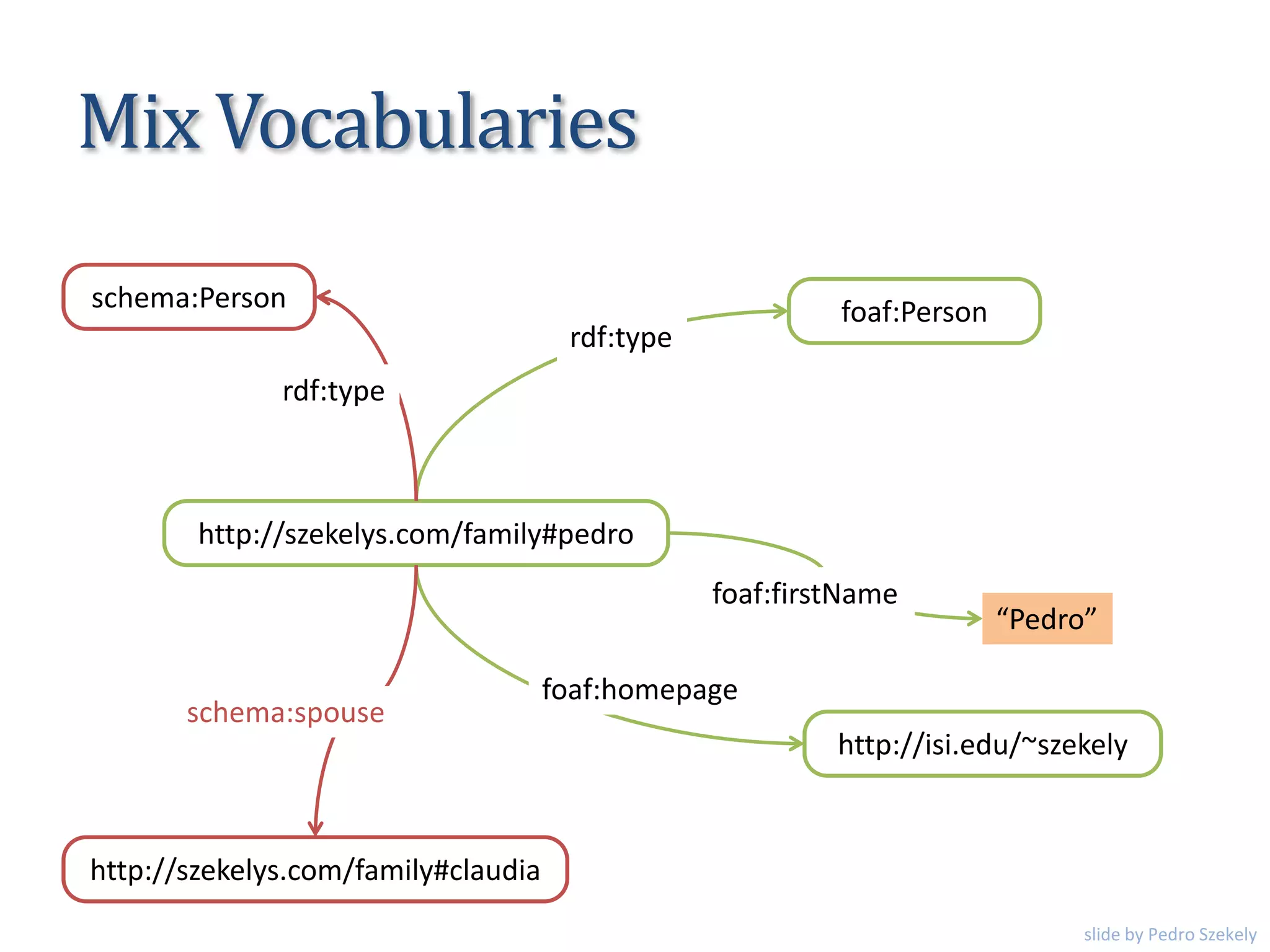
Mix Vocabularies
http://szekelys.com/family#pedro
“Pedro”
foaf:firstName
foaf:Person
rdf:type
http://isi.edu/~szekely
foaf:homepage
schema:Person
rdf:type
http://szekelys.com/family#claudia
schema:spouse
slide by Pedro Szekely
Why Use URIs?
 URIs look cool
slide by Pedro Szekely
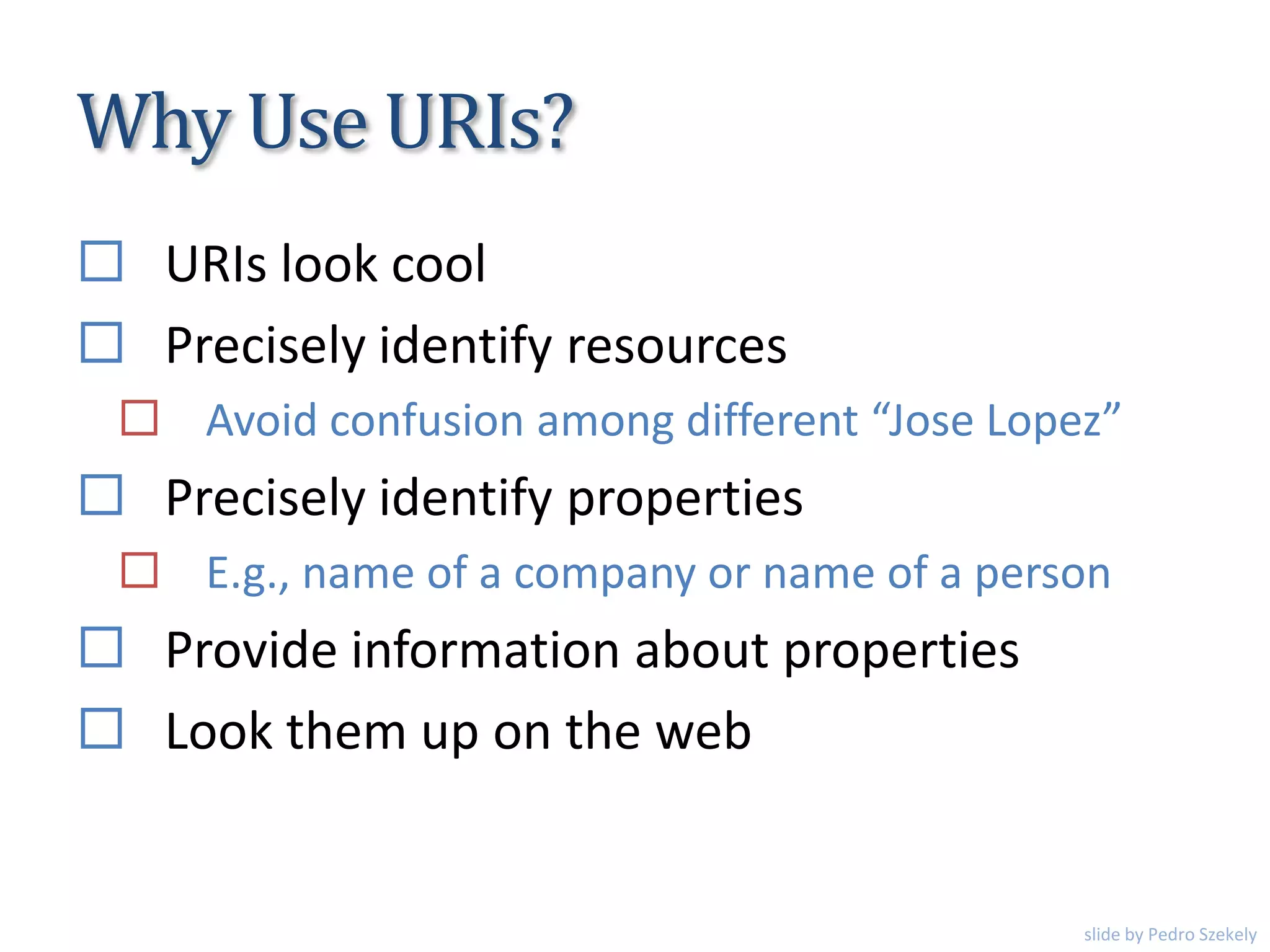
Why Use URIs?
 URIs look cool
 Precisely identify resources
 Avoid confusion among different “Jose Lopez”
 Precisely identify properties
 E.g., name of a company or name of a person
 Provide information about properties
 Look them up on the web
slide by Pedro Szekely
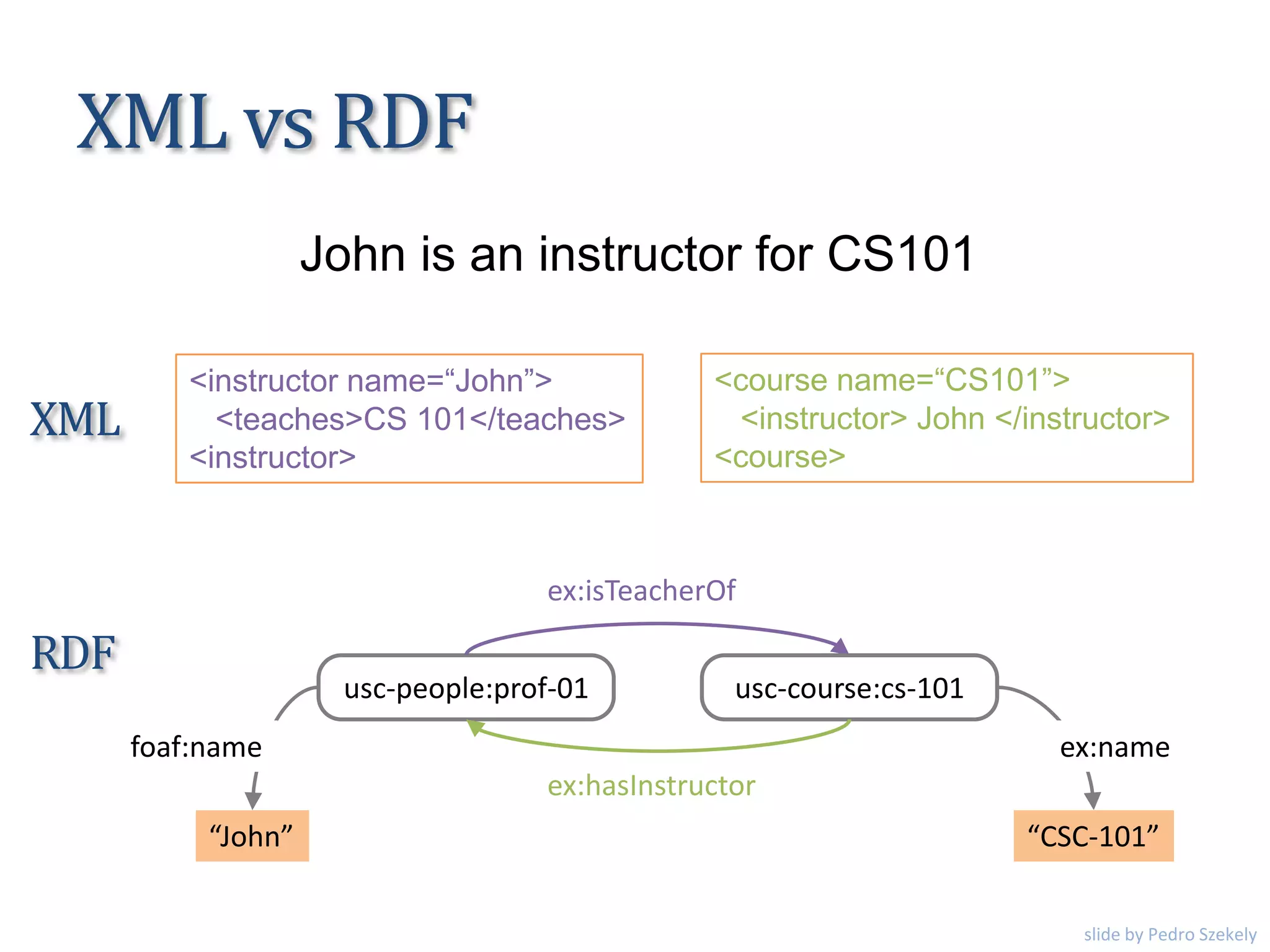
XML vs RDF
<course name=“CS101”>
<instructor> John </instructor>
<course>
<instructor name=“John”>
<teaches>CS 101</teaches>
<instructor>
John is an instructor for CS101
usc-people:prof-01
“John”
ex:isTeacherOf
usc-course:cs-101
ex:hasInstructor
foaf:name
“CSC-101”
ex:name
XML
RDF
slide by Pedro Szekely
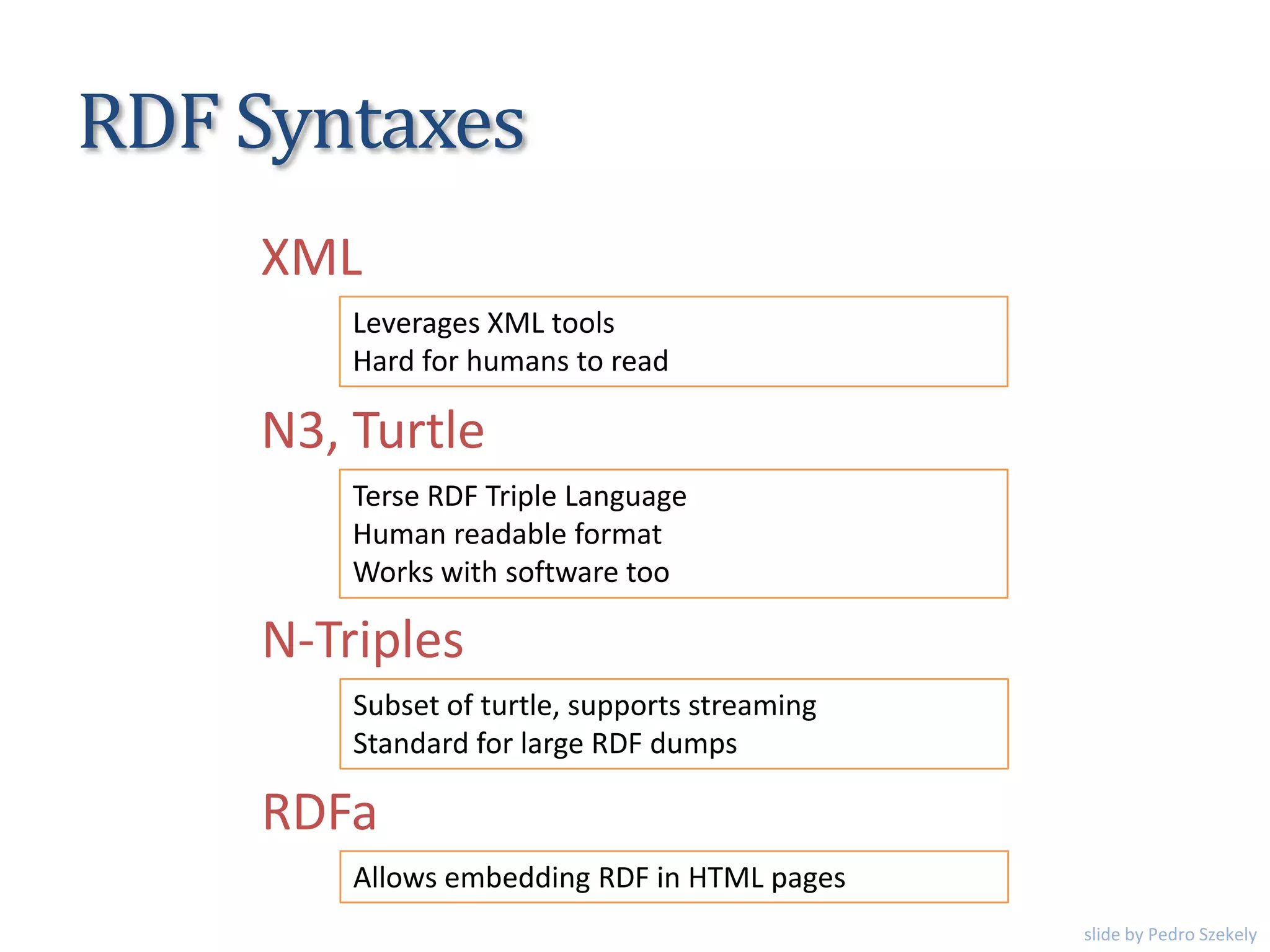
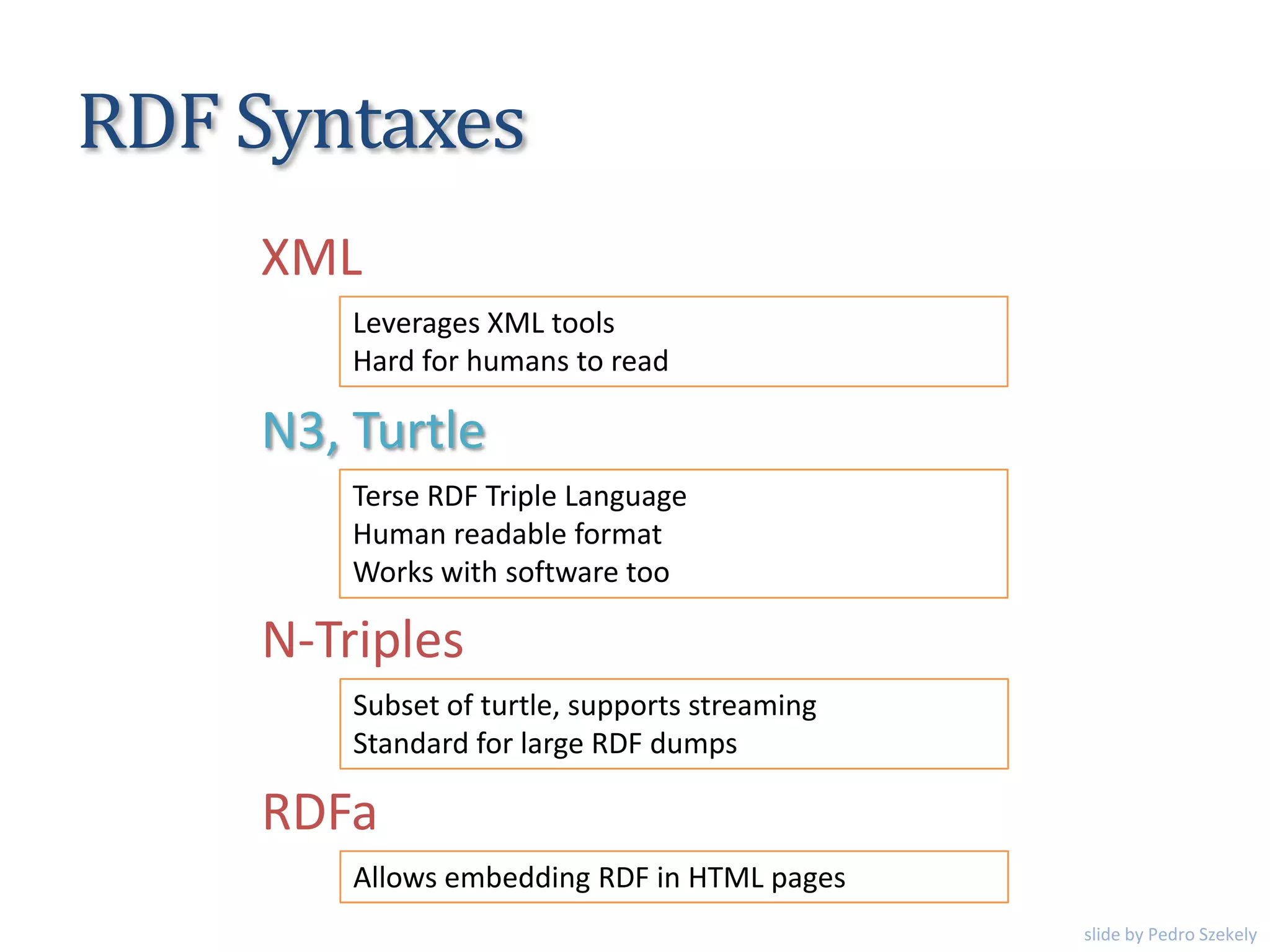
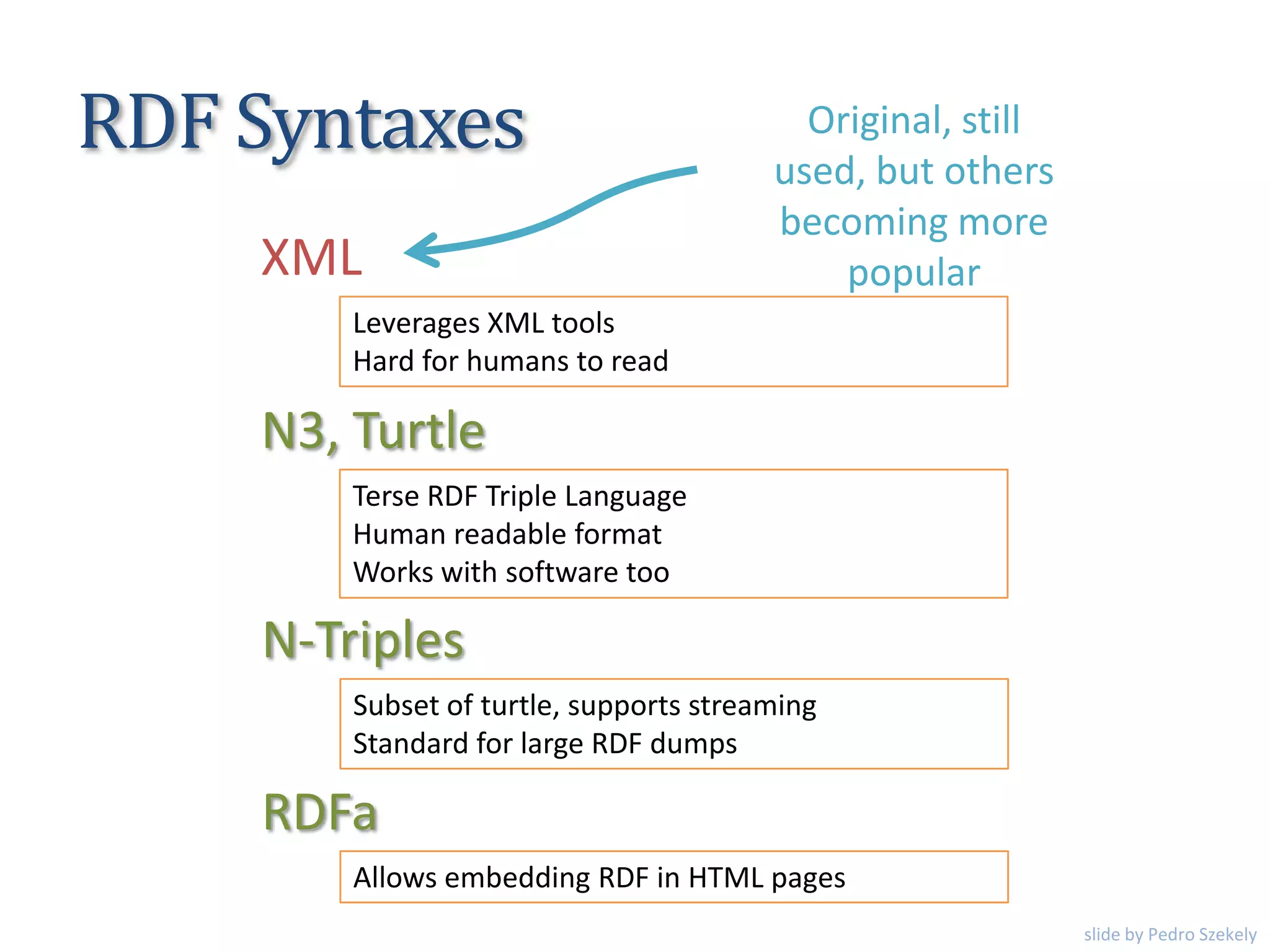
RDF Syntaxes
Leverages XML tools
Hard for humans to read
XML
N3, Turtle
N-Triples
Terse RDF Triple Language
Human readable format
Works with software too
Subset of turtle, supports streaming
Standard for large RDF dumps
RDFa
Allows embedding RDF in HTML pages
slide by Pedro Szekely
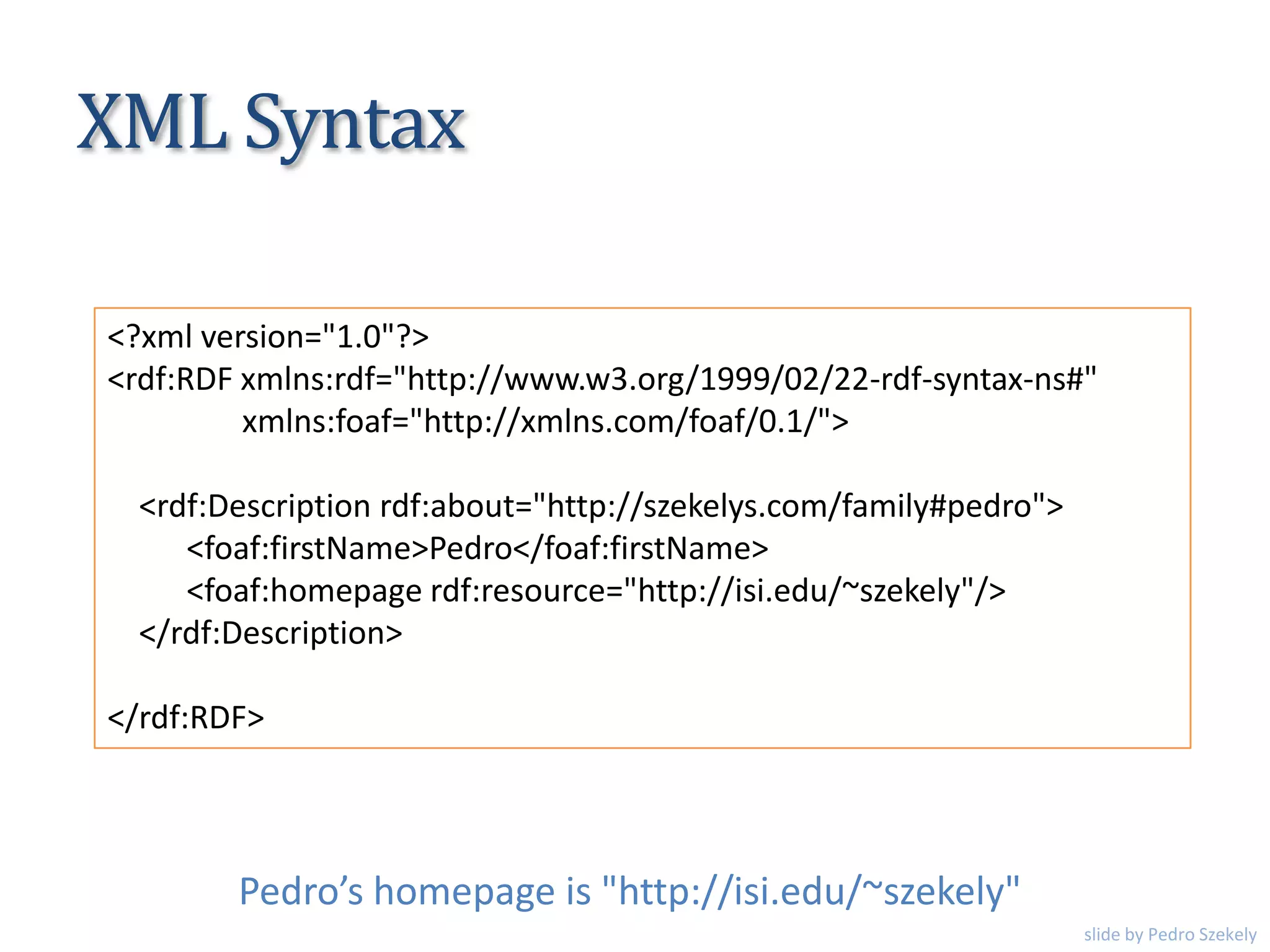
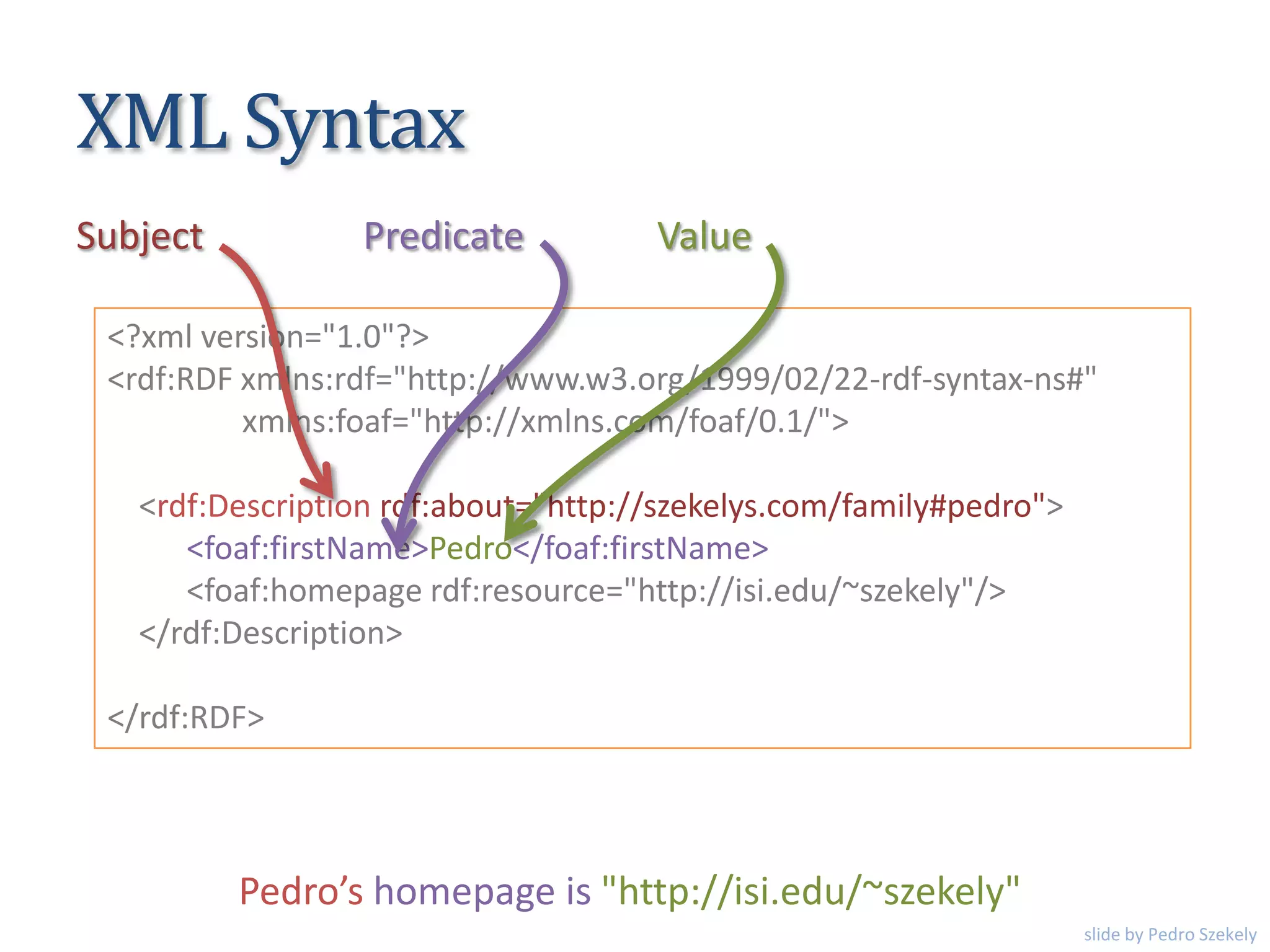
XML Syntax
<?xml version="1.0"?>
<rdf:RDF xmlns:rdf="http://www.w3.org/1999/02/22-rdf-syntax-ns#"
xmlns:foaf="http://xmlns.com/foaf/0.1/">
<rdf:Description rdf:about="http://szekelys.com/family#pedro">
<foaf:firstName>Pedro</foaf:firstName>
<foaf:homepage rdf:resource="http://isi.edu/~szekely"/>
</rdf:Description>
</rdf:RDF>
Pedro’s homepage is "http://isi.edu/~szekely"
slide by Pedro Szekely
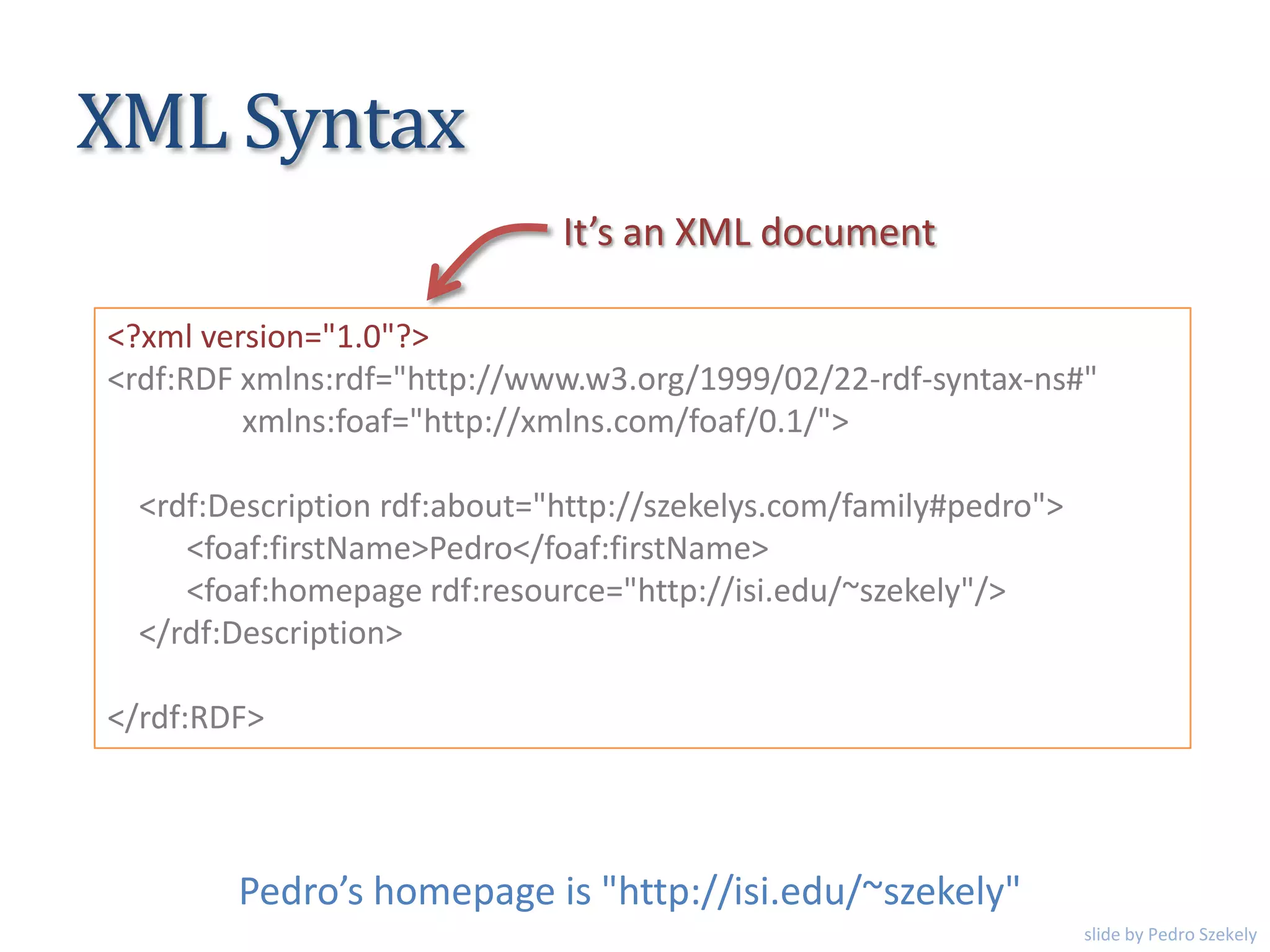
XML Syntax
<?xml version="1.0"?>
<rdf:RDF xmlns:rdf="http://www.w3.org/1999/02/22-rdf-syntax-ns#"
xmlns:foaf="http://xmlns.com/foaf/0.1/">
<rdf:Description rdf:about="http://szekelys.com/family#pedro">
<foaf:firstName>Pedro</foaf:firstName>
<foaf:homepage rdf:resource="http://isi.edu/~szekely"/>
</rdf:Description>
</rdf:RDF>
It’s an XML document
Pedro’s homepage is "http://isi.edu/~szekely"
slide by Pedro Szekely
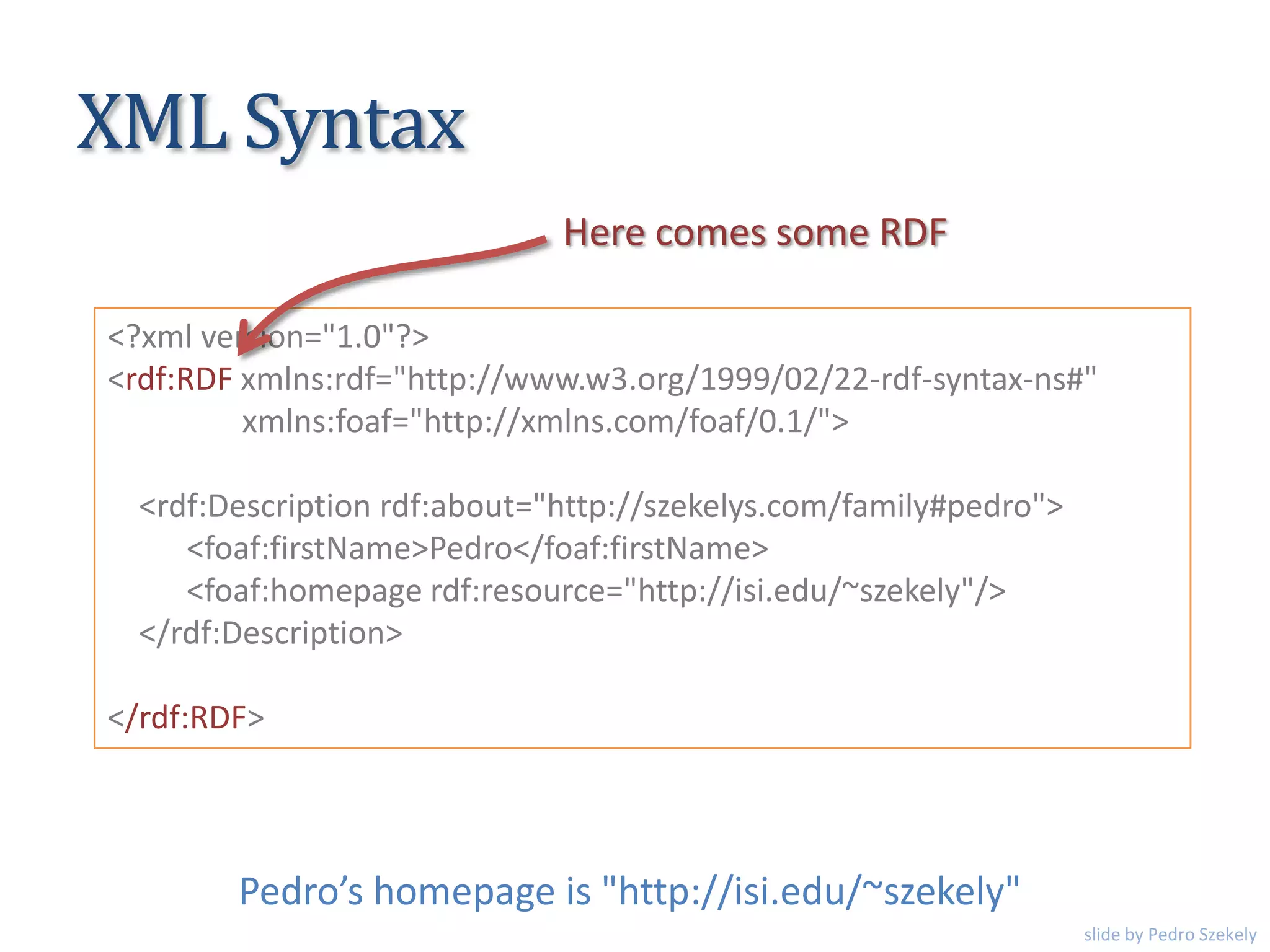
XML Syntax
<?xml version="1.0"?>
<rdf:RDF xmlns:rdf="http://www.w3.org/1999/02/22-rdf-syntax-ns#"
xmlns:foaf="http://xmlns.com/foaf/0.1/">
<rdf:Description rdf:about="http://szekelys.com/family#pedro">
<foaf:firstName>Pedro</foaf:firstName>
<foaf:homepage rdf:resource="http://isi.edu/~szekely"/>
</rdf:Description>
</rdf:RDF>
Here comes some RDF
Pedro’s homepage is "http://isi.edu/~szekely"
slide by Pedro Szekely
XML Syntax
<?xml version="1.0"?>
<rdf:RDF xmlns:rdf="http://www.w3.org/1999/02/22-rdf-syntax-ns#"
xmlns:foaf="http://xmlns.com/foaf/0.1/">
<rdf:Description rdf:about="http://szekelys.com/family#pedro">
<foaf:firstName>Pedro</foaf:firstName>
<foaf:homepage rdf:resource="http://isi.edu/~szekely"/>
</rdf:Description>
</rdf:RDF>
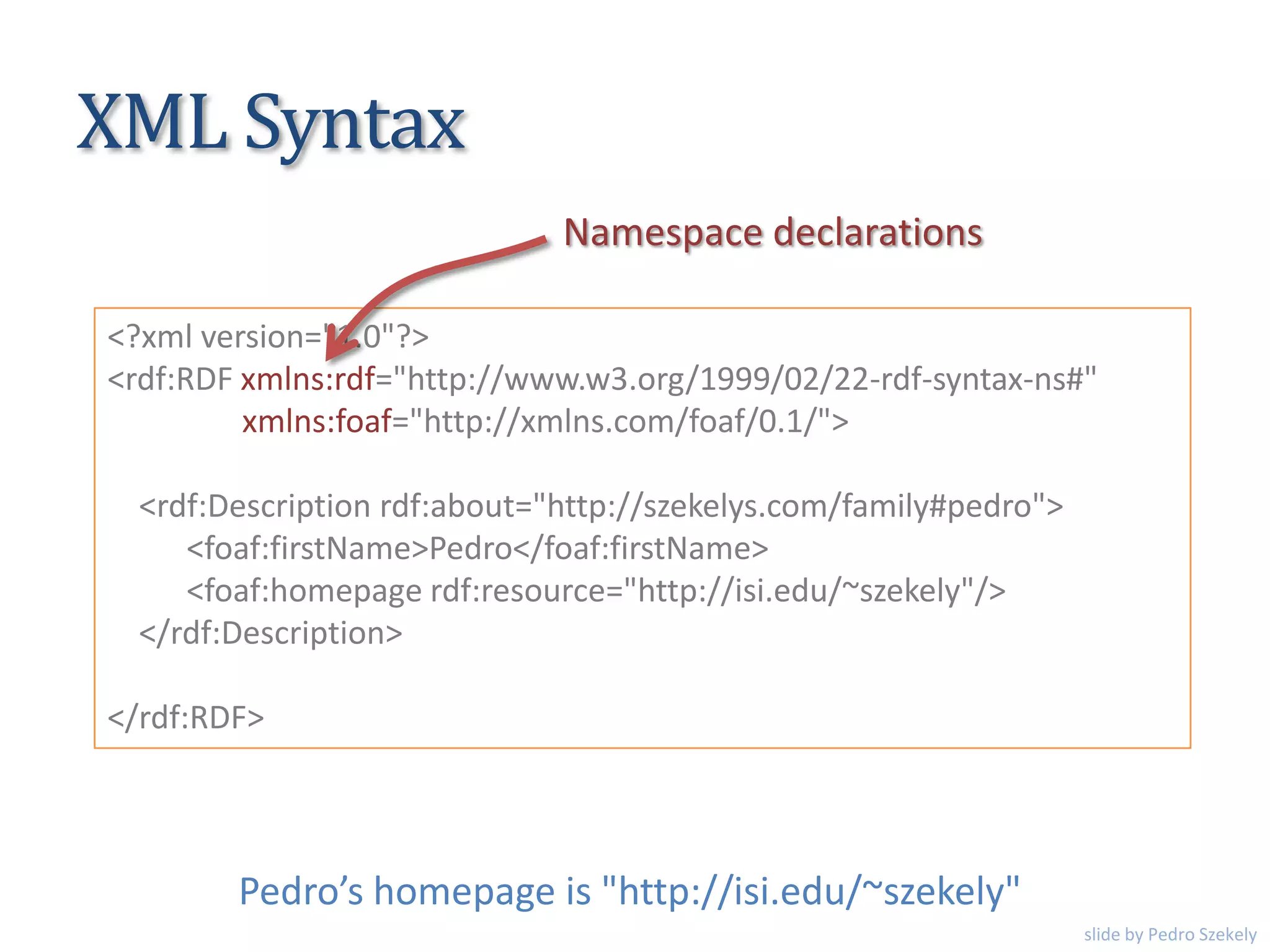
Namespace declarations
Pedro’s homepage is "http://isi.edu/~szekely"
slide by Pedro Szekely
XML Syntax
<?xml version="1.0"?>
<rdf:RDF xmlns:rdf="http://www.w3.org/1999/02/22-rdf-syntax-ns#"
xmlns:foaf="http://xmlns.com/foaf/0.1/">
<rdf:Description rdf:about="http://szekelys.com/family#pedro">
<foaf:firstName>Pedro</foaf:firstName>
<foaf:homepage rdf:resource="http://isi.edu/~szekely"/>
</rdf:Description>
</rdf:RDF>
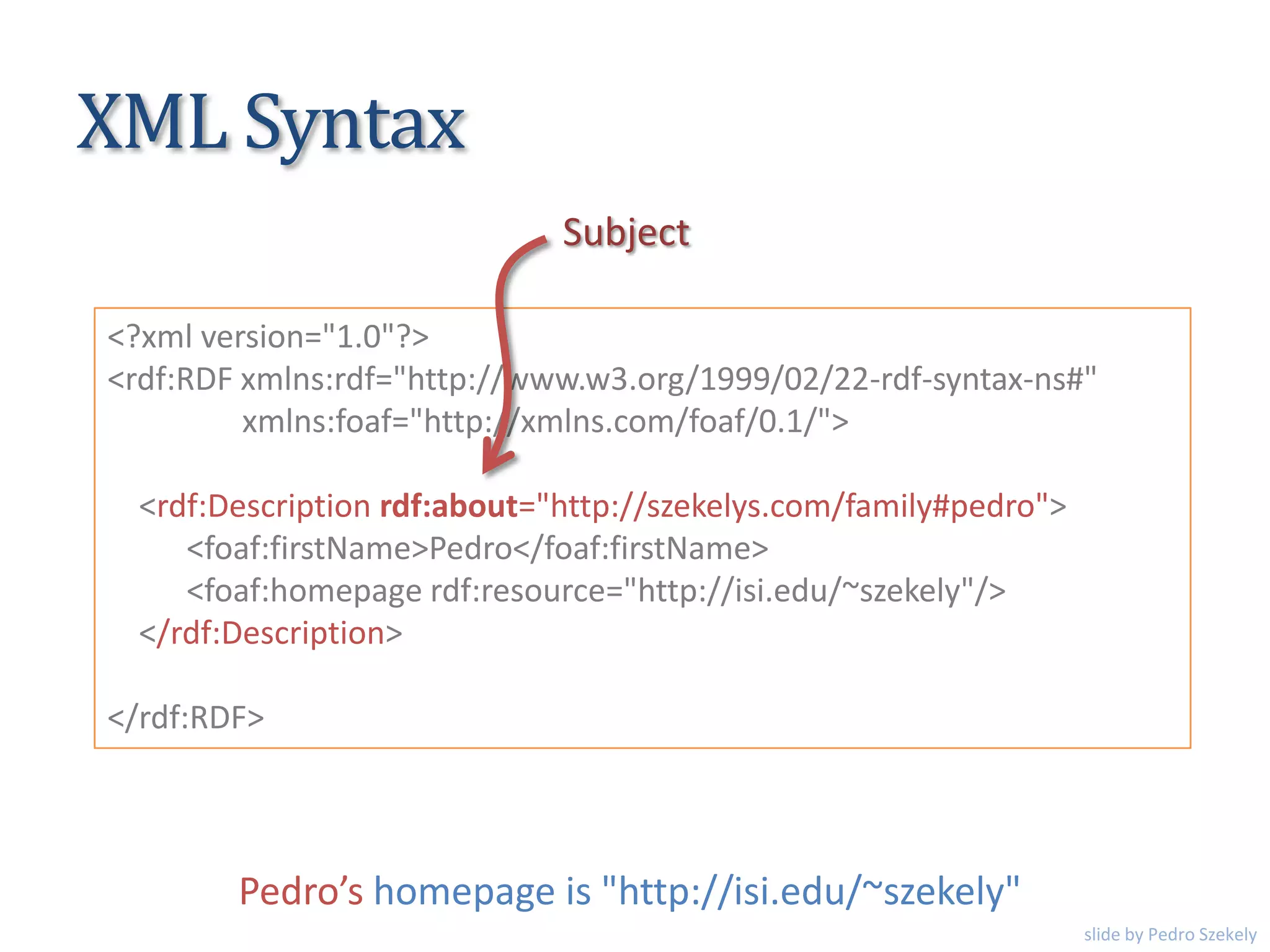
Subject
Pedro’s homepage is "http://isi.edu/~szekely"
slide by Pedro Szekely
XML Syntax
<?xml version="1.0"?>
<rdf:RDF xmlns:rdf="http://www.w3.org/1999/02/22-rdf-syntax-ns#"
xmlns:foaf="http://xmlns.com/foaf/0.1/">
<rdf:Description rdf:about="http://szekelys.com/family#pedro">
<foaf:firstName>Pedro</foaf:firstName>
<foaf:homepage rdf:resource="http://isi.edu/~szekely"/>
</rdf:Description>
</rdf:RDF>
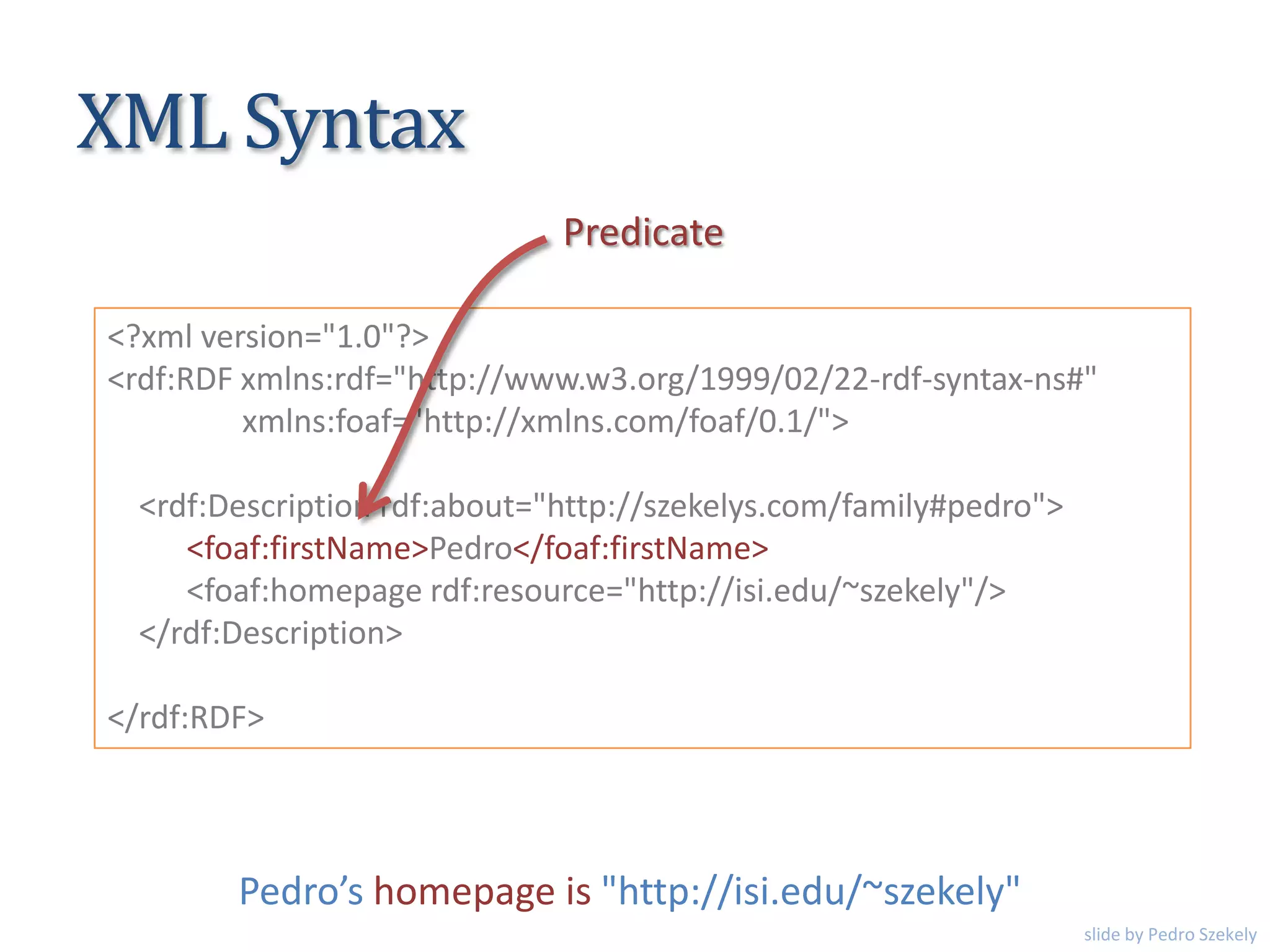
Predicate
Pedro’s homepage is "http://isi.edu/~szekely"
slide by Pedro Szekely
XML Syntax
<?xml version="1.0"?>
<rdf:RDF xmlns:rdf="http://www.w3.org/1999/02/22-rdf-syntax-ns#"
xmlns:foaf="http://xmlns.com/foaf/0.1/">
<rdf:Description rdf:about="http://szekelys.com/family#pedro">
<foaf:firstName>Pedro</foaf:firstName>
<foaf:homepage rdf:resource="http://isi.edu/~szekely"/>
</rdf:Description>
</rdf:RDF>
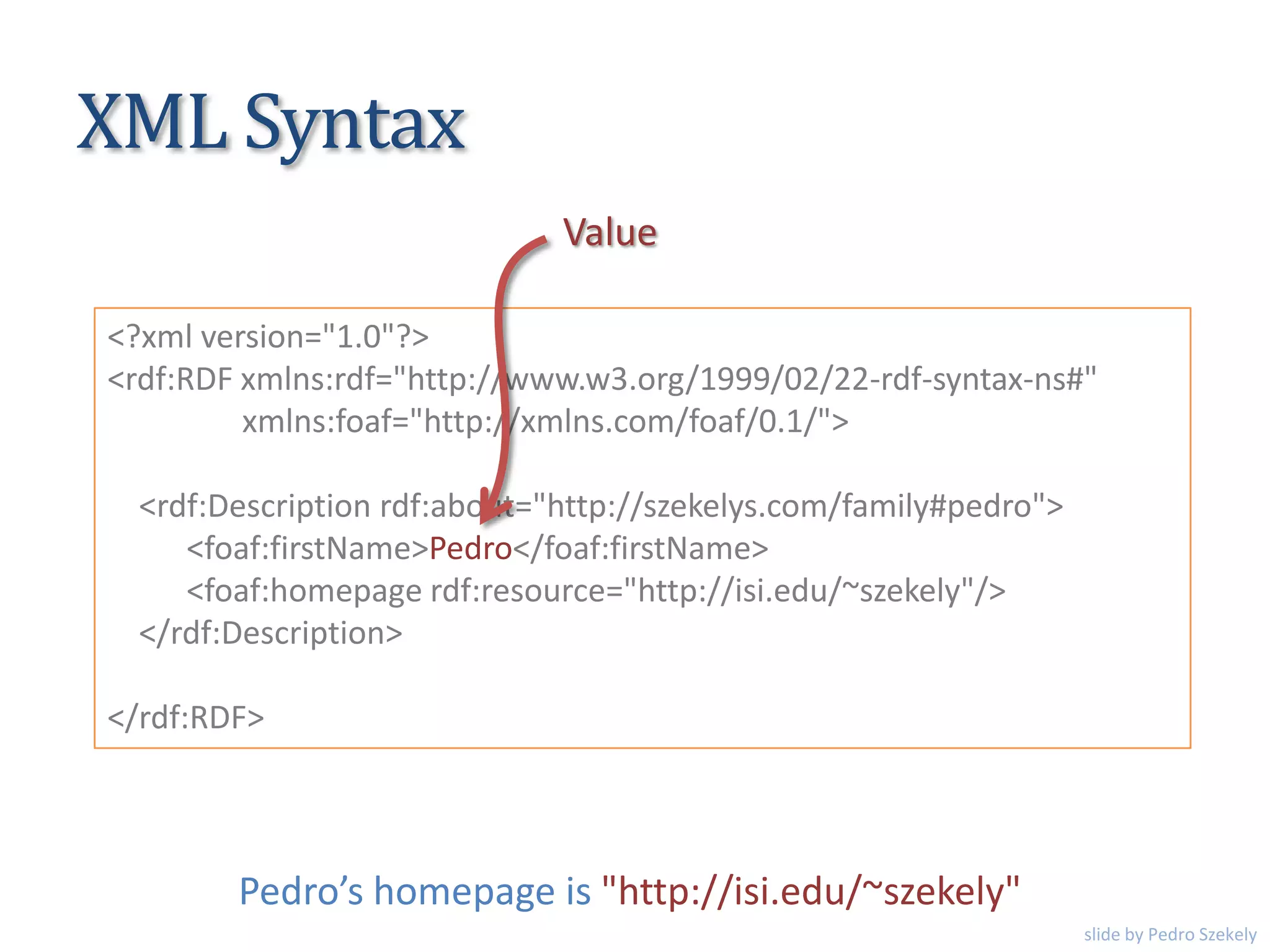
Value
Pedro’s homepage is "http://isi.edu/~szekely"
slide by Pedro Szekely
XML Syntax
<?xml version="1.0"?>
<rdf:RDF xmlns:rdf="http://www.w3.org/1999/02/22-rdf-syntax-ns#"
xmlns:foaf="http://xmlns.com/foaf/0.1/">
<rdf:Description rdf:about="http://szekelys.com/family#pedro">
<foaf:firstName>Pedro</foaf:firstName>
<foaf:homepage rdf:resource="http://isi.edu/~szekely"/>
</rdf:Description>
</rdf:RDF>
Value
Pedro’s homepage is "http://isi.edu/~szekely"
Subject Predicate
slide by Pedro Szekely
XML Syntax
<?xml version="1.0"?>
<rdf:RDF xmlns:rdf="http://www.w3.org/1999/02/22-rdf-syntax-ns#"
xmlns:foaf="http://xmlns.com/foaf/0.1/">
<rdf:Description rdf:about="http://szekelys.com/family#pedro">
<foaf:firstName>Pedro</foaf:firstName>
<foaf:homepage rdf:resource="http://isi.edu/~szekely"/>
</rdf:Description>
</rdf:RDF>
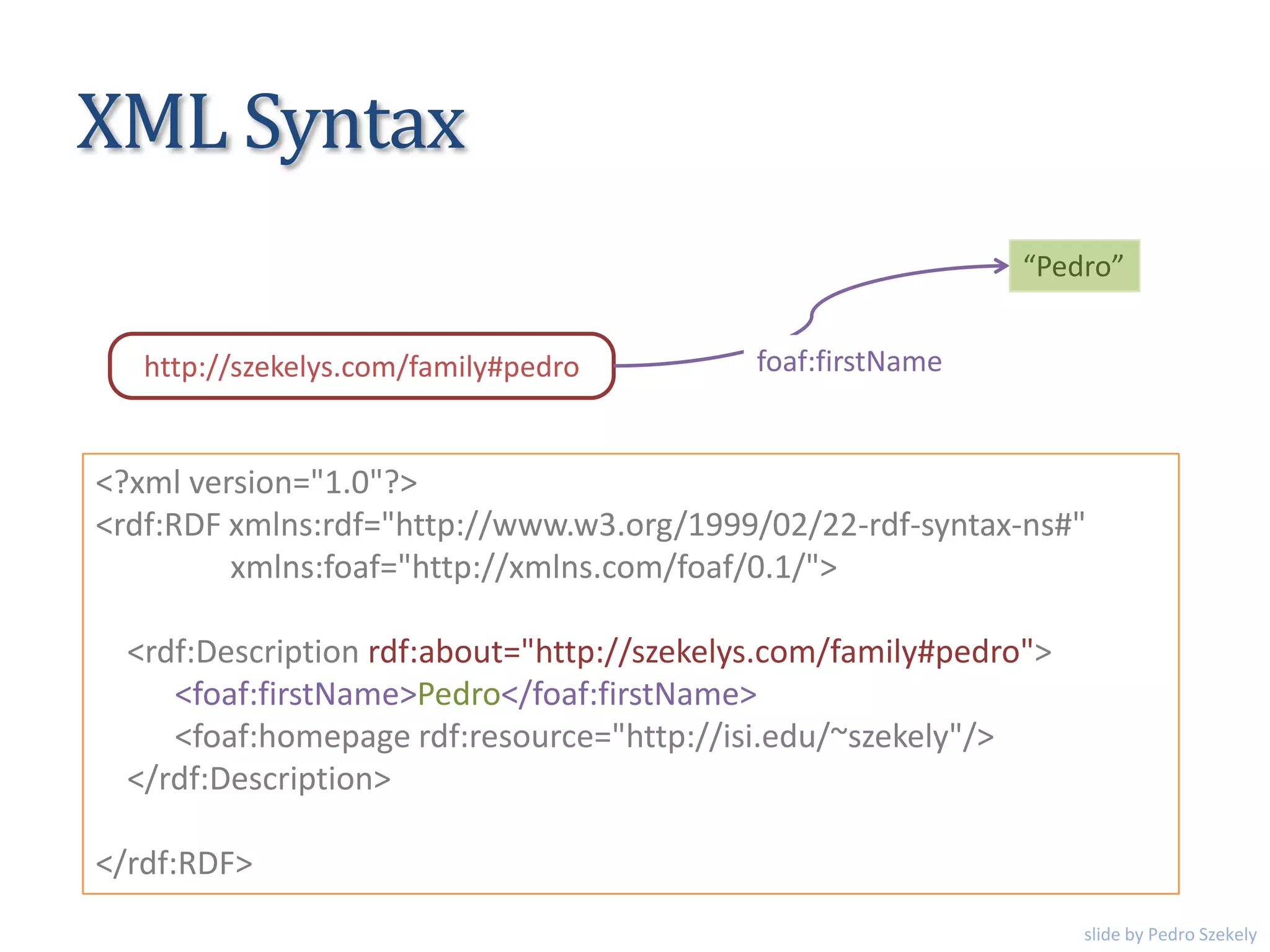
http://szekelys.com/family#pedro foaf:firstName
“Pedro”
slide by Pedro Szekely
XML Syntax
<?xml version="1.0"?>
<rdf:RDF xmlns:rdf="http://www.w3.org/1999/02/22-rdf-syntax-ns#"
xmlns:foaf="http://xmlns.com/foaf/0.1/">
<foaf:Person rdf:about="http://szekelys.com/family#pedro">
<foaf:firstName>Pedro</foaf:firstName>
<foaf:homepage rdf:resource="http://isi.edu/~szekely"/>
</foaf:Person>
</rdf:RDF>
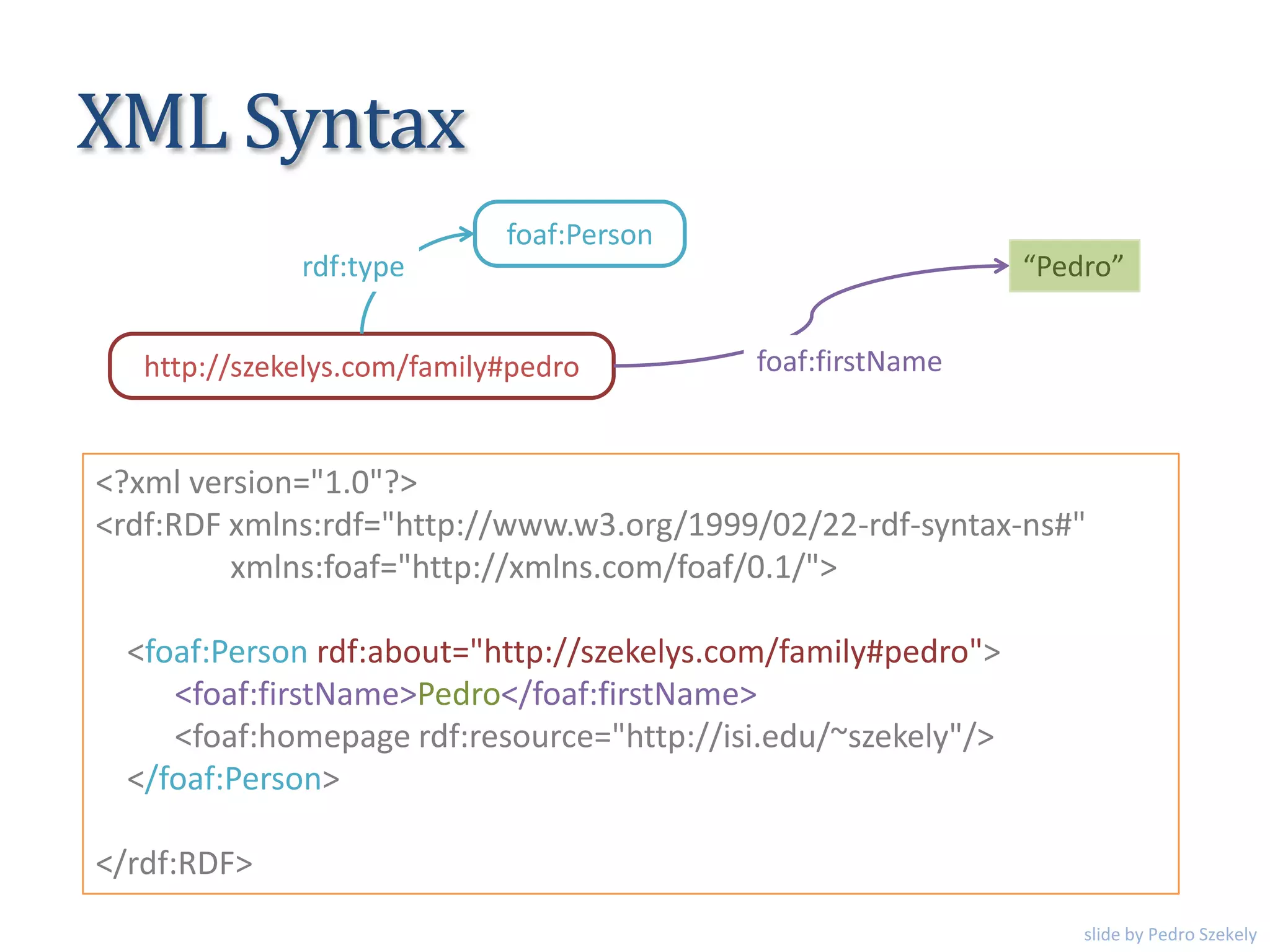
http://szekelys.com/family#pedro
foaf:Person
foaf:firstName
“Pedro”rdf:type
slide by Pedro Szekely
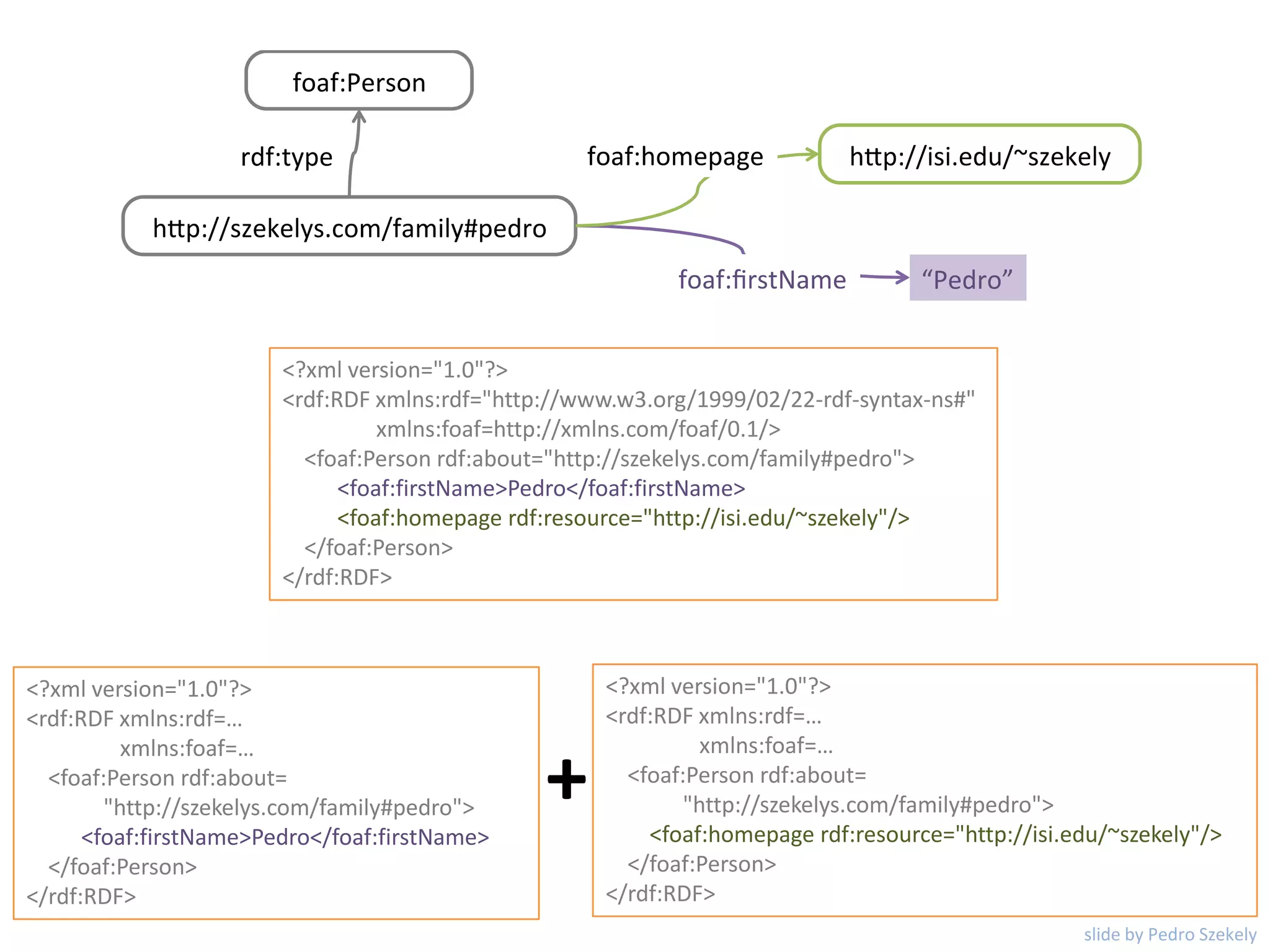
<?xml version="1.0"?>
<rdf:RDF xmlns:rdf="http://www.w3.org/1999/02/22-rdf-syntax-ns#"
xmlns:foaf=http://xmlns.com/foaf/0.1/>
<foaf:Person rdf:about="http://szekelys.com/family#pedro">
<foaf:firstName>Pedro</foaf:firstName>
<foaf:homepage rdf:resource="http://isi.edu/~szekely"/>
</foaf:Person>
</rdf:RDF>
<?xml version="1.0"?>
<rdf:RDF xmlns:rdf=…
xmlns:foaf=…
<foaf:Person rdf:about=
"http://szekelys.com/family#pedro">
<foaf:firstName>Pedro</foaf:firstName>
</foaf:Person>
</rdf:RDF>
<?xml version="1.0"?>
<rdf:RDF xmlns:rdf=…
xmlns:foaf=…
<foaf:Person rdf:about=
"http://szekelys.com/family#pedro">
<foaf:homepage rdf:resource="http://isi.edu/~szekely"/>
</foaf:Person>
</rdf:RDF>
+
slide by Pedro Szekely
RDF Syntaxes
Leverages XML tools
Hard for humans to read
XML
N3, Turtle
N-Triples
Terse RDF Triple Language
Human readable format
Works with software too
Subset of turtle, supports streaming
Standard for large RDF dumps
RDFa
Allows embedding RDF in HTML pages
slide by Pedro Szekely
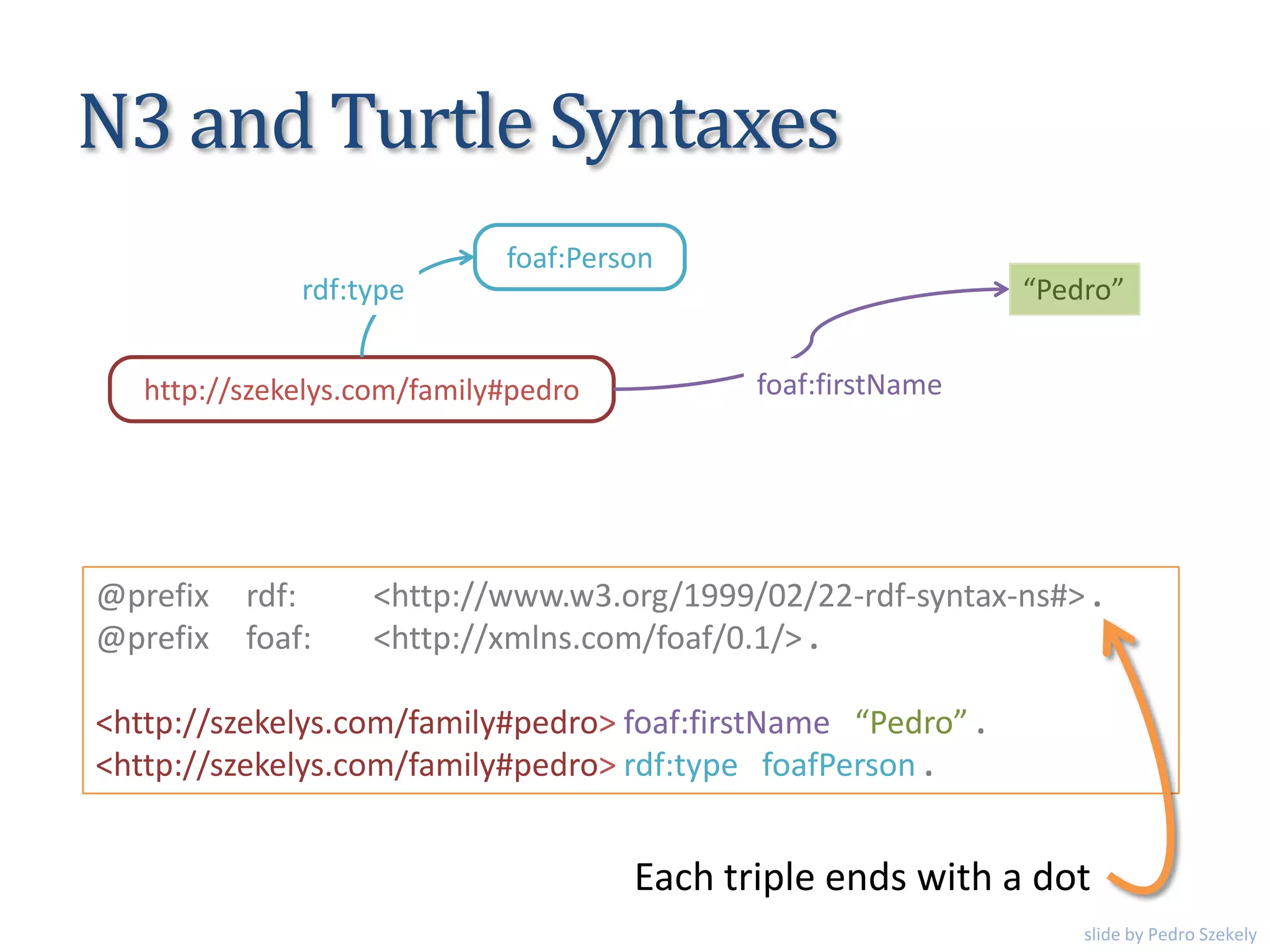
N3 and Turtle Syntaxes
@prefix rdf: <http://www.w3.org/1999/02/22-rdf-syntax-ns#> .
@prefix foaf: <http://xmlns.com/foaf/0.1/> .
<http://szekelys.com/family#pedro> foaf:firstName “Pedro” .
<http://szekelys.com/family#pedro> rdf:type foafPerson .
http://szekelys.com/family#pedro
foaf:Person
foaf:firstName
“Pedro”rdf:type
Each triple ends with a dot
slide by Pedro Szekely
More Complex Structures
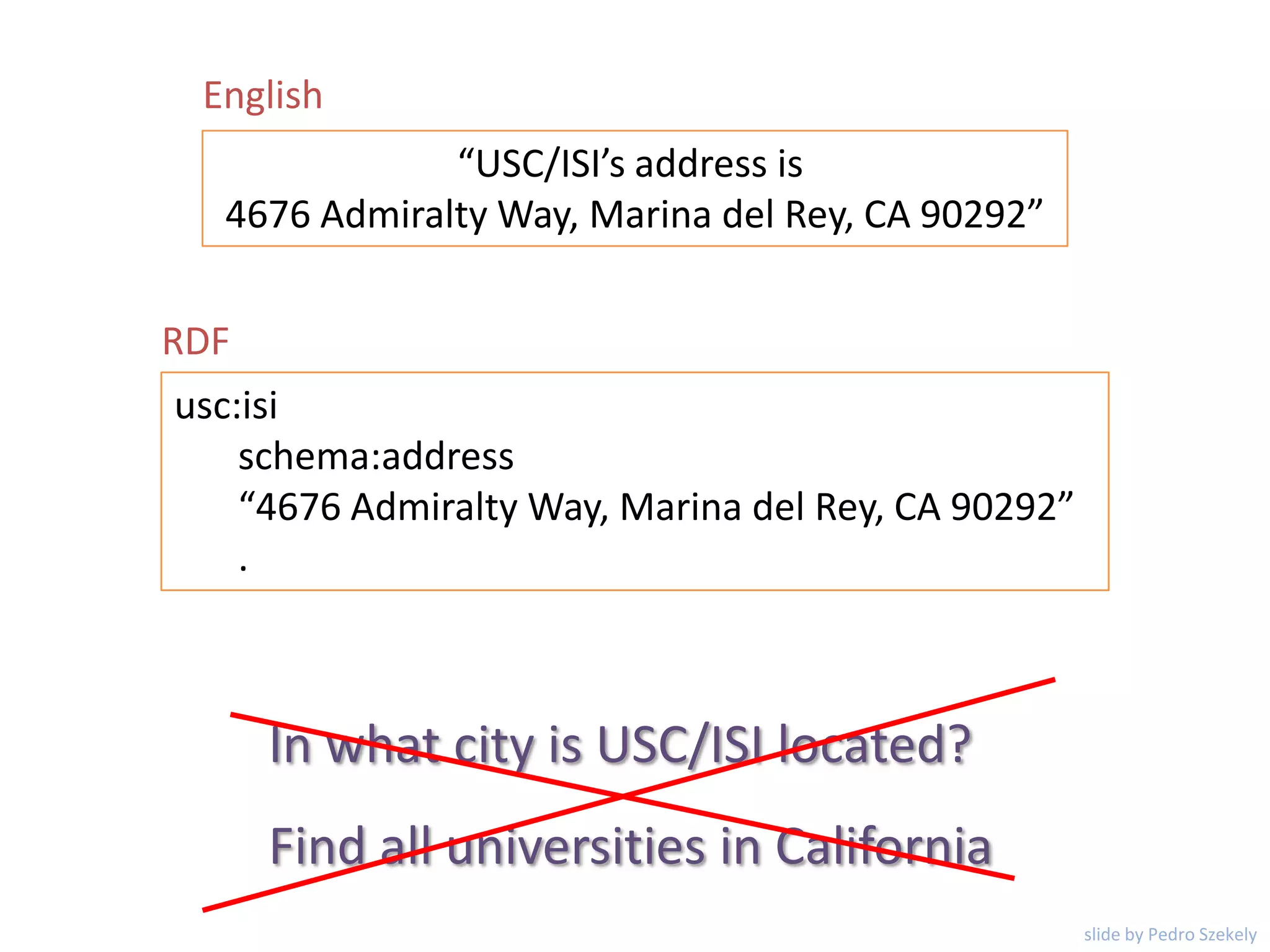
“USC/ISI’s address is
4676 Admiralty Way, Marina del Rey, CA 90292”
usc:isi
schema:address
“4676 Admiralty Way, Marina del Rey, CA 90292”
.
English
RDF
In what city is USC/ISI located?
Find all universities in California
slide by Pedro Szekely
“USC/ISI’s address is
4676 Admiralty Way, Marina del Rey, CA 90292”
usc:isi
schema:address
“4676 Admiralty Way, Marina del Rey, CA 90292”
.
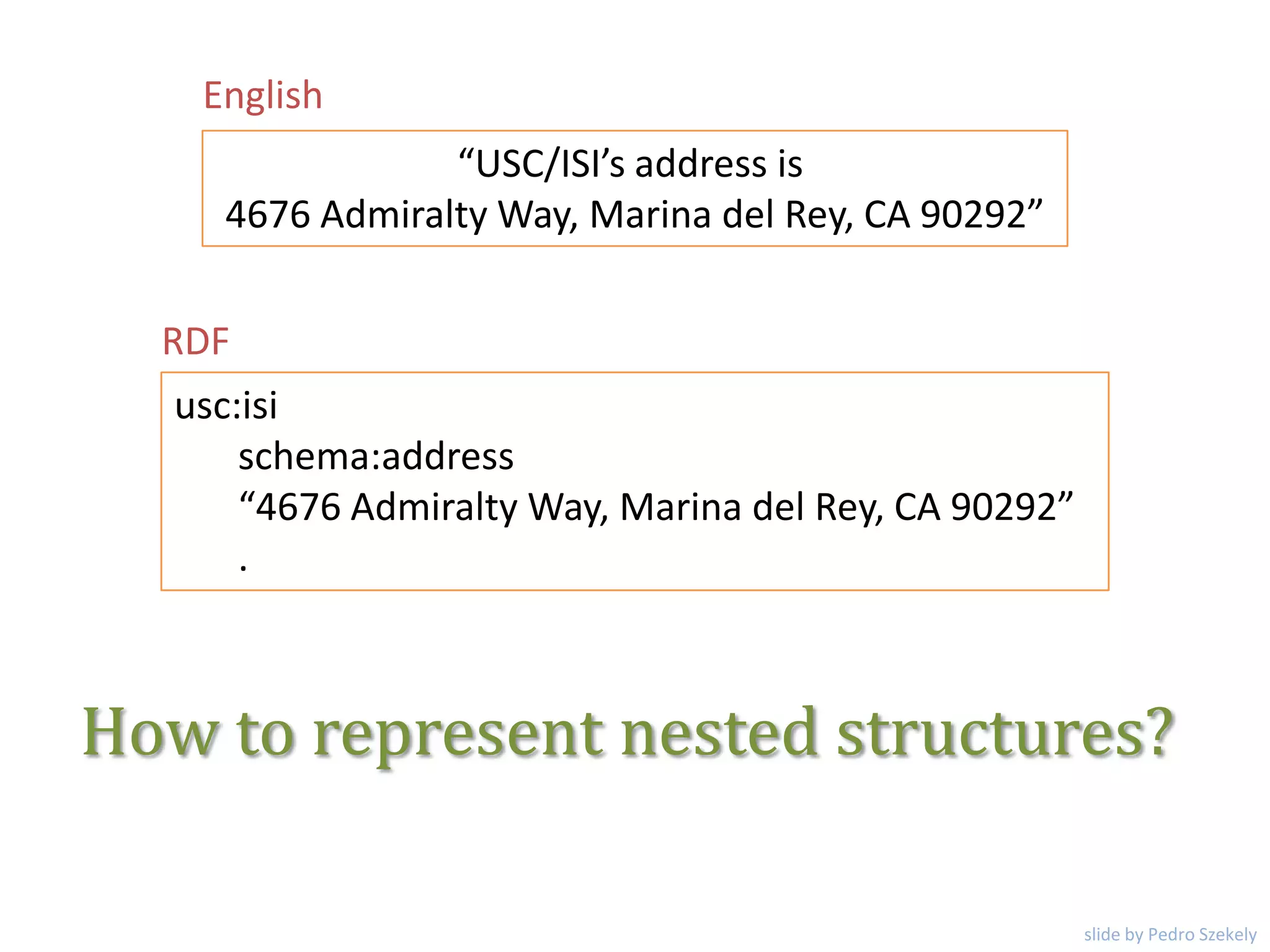
English
RDF
How to represent nested structures?
slide by Pedro Szekely
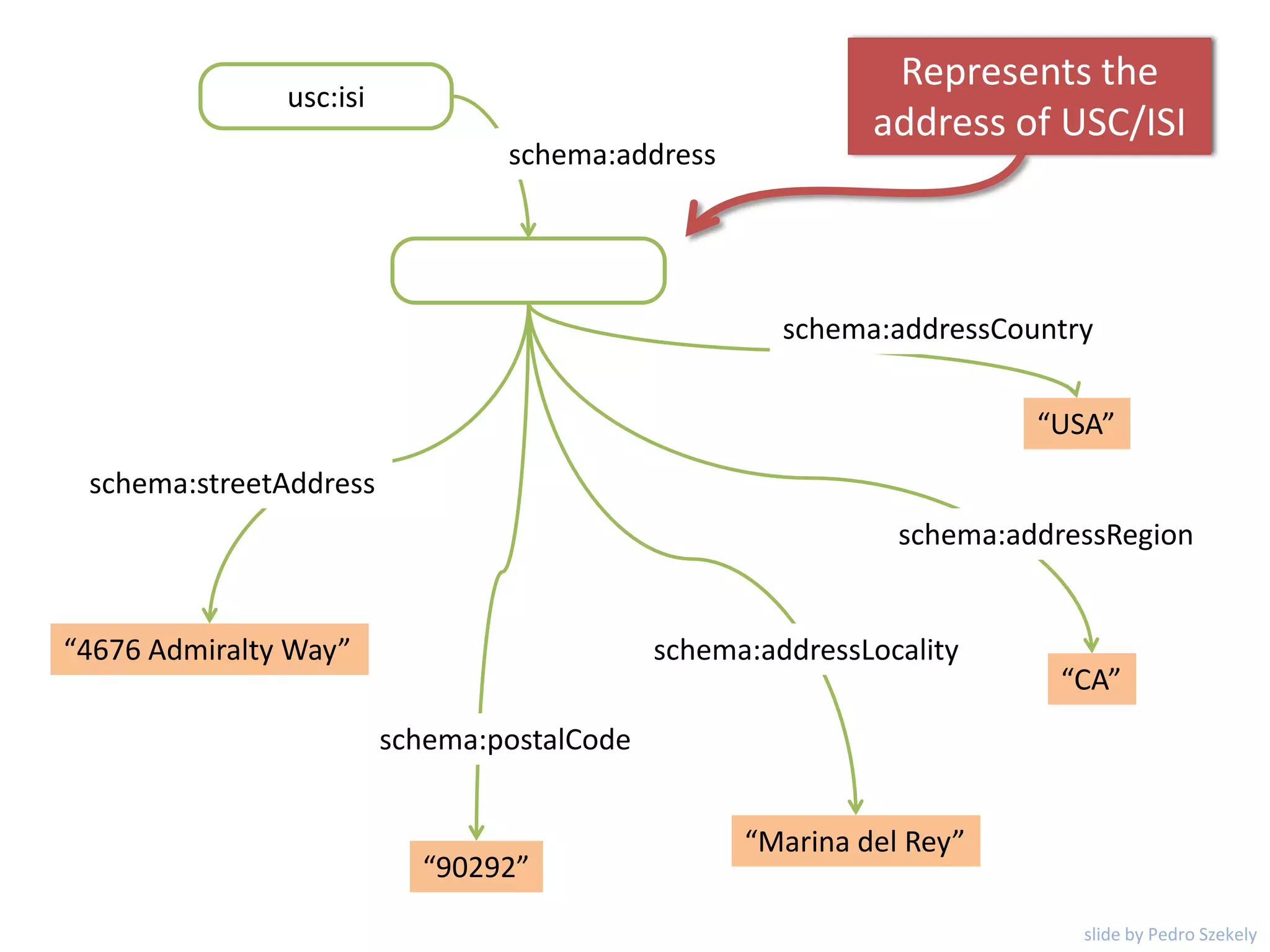
“USA”
usc:isi
schema:addressCountry
schema:address
“CA”
“Marina del Rey”
“90292”
“4676 Admiralty Way” schema:addressLocality
schema:postalCode
schema:addressRegion
schema:streetAddress
Represents the
address of USC/ISI
slide by Pedro Szekely
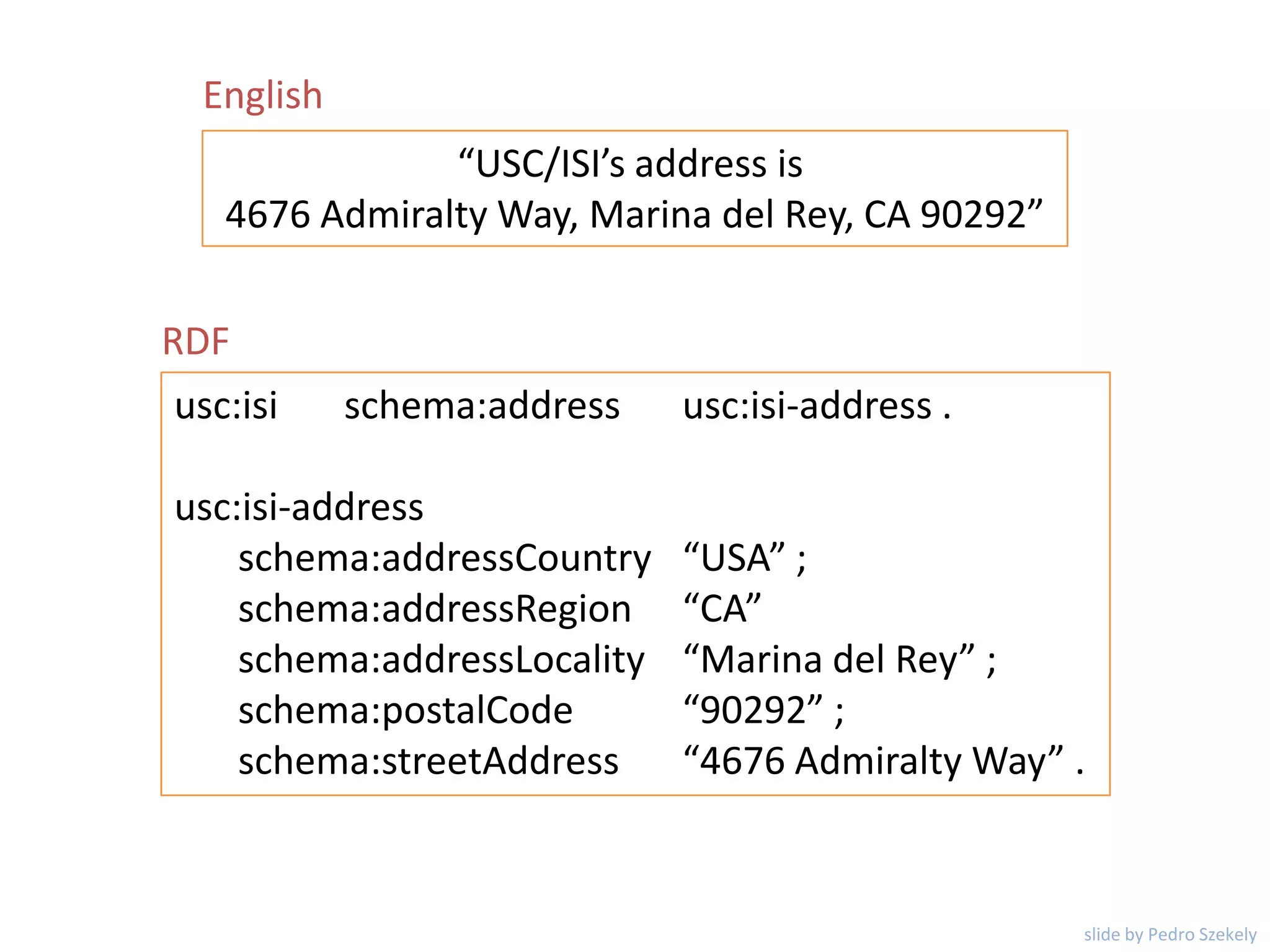
“USC/ISI’s address is
4676 Admiralty Way, Marina del Rey, CA 90292”
usc:isi schema:address usc:isi-address .
usc:isi-address
schema:addressCountry “USA” ;
schema:addressRegion “CA”
schema:addressLocality “Marina del Rey” ;
schema:postalCode “90292” ;
schema:streetAddress “4676 Admiralty Way” .
English
RDF
slide by Pedro Szekely
usc:isi schema:address usc:isi-address .
usc:isi-address
schema:addressCountry “USA” ;
schema:addressRegion “CA”
schema:addressLocality “Marina del Rey” ;
schema:postalCode “90292” ;
schema:streetAddress “4676 Admiralty Way” .
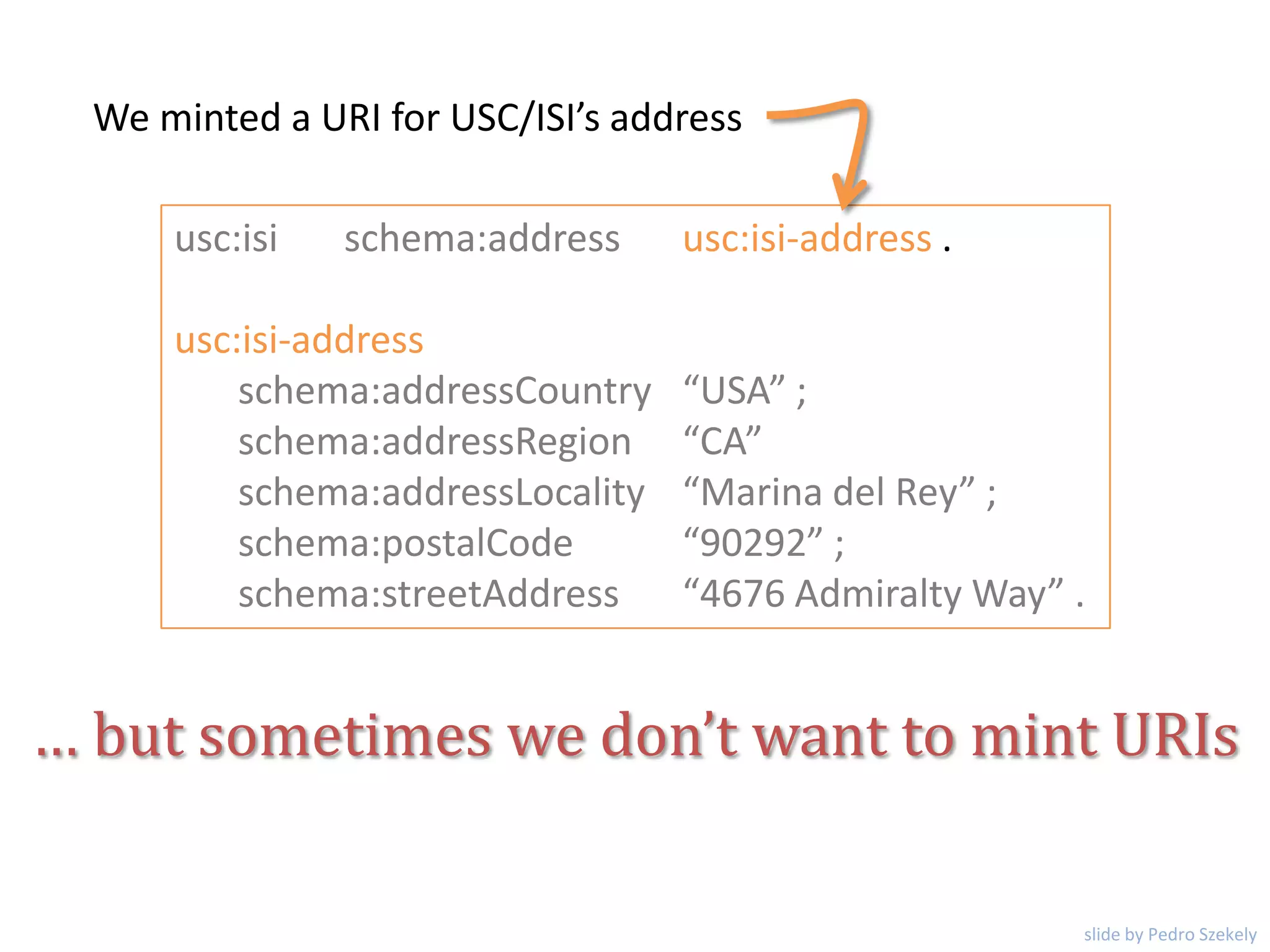
We minted a URI for USC/ISI’s address
… but sometimes we don’t want to mint URIs
slide by Pedro Szekely
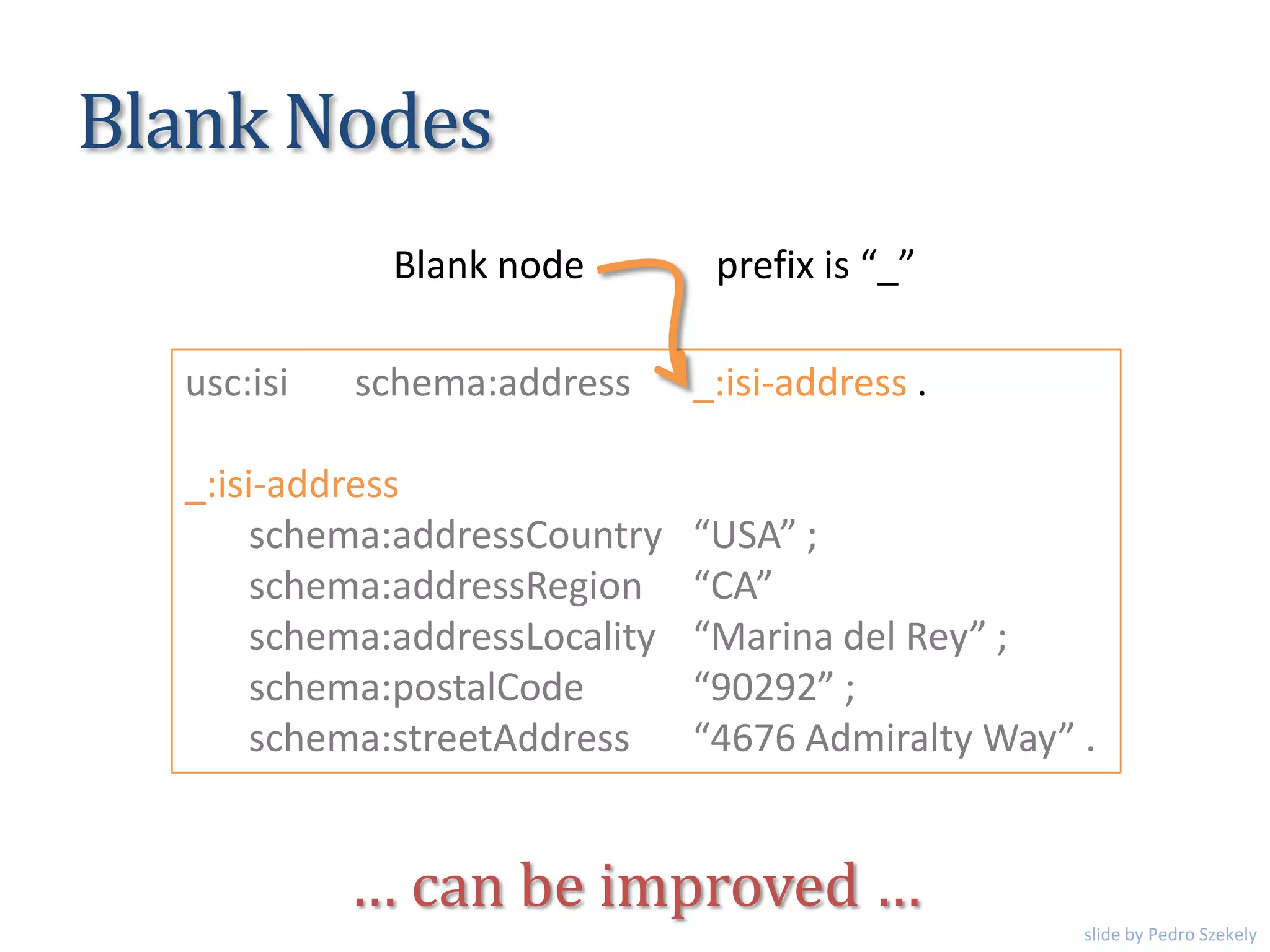
usc:isi schema:address _:isi-address .
_:isi-address
schema:addressCountry “USA” ;
schema:addressRegion “CA”
schema:addressLocality “Marina del Rey” ;
schema:postalCode “90292” ;
schema:streetAddress “4676 Admiralty Way” .
Blank node
Blank Nodes
prefix is “_”
… can be improved …
slide by Pedro Szekely
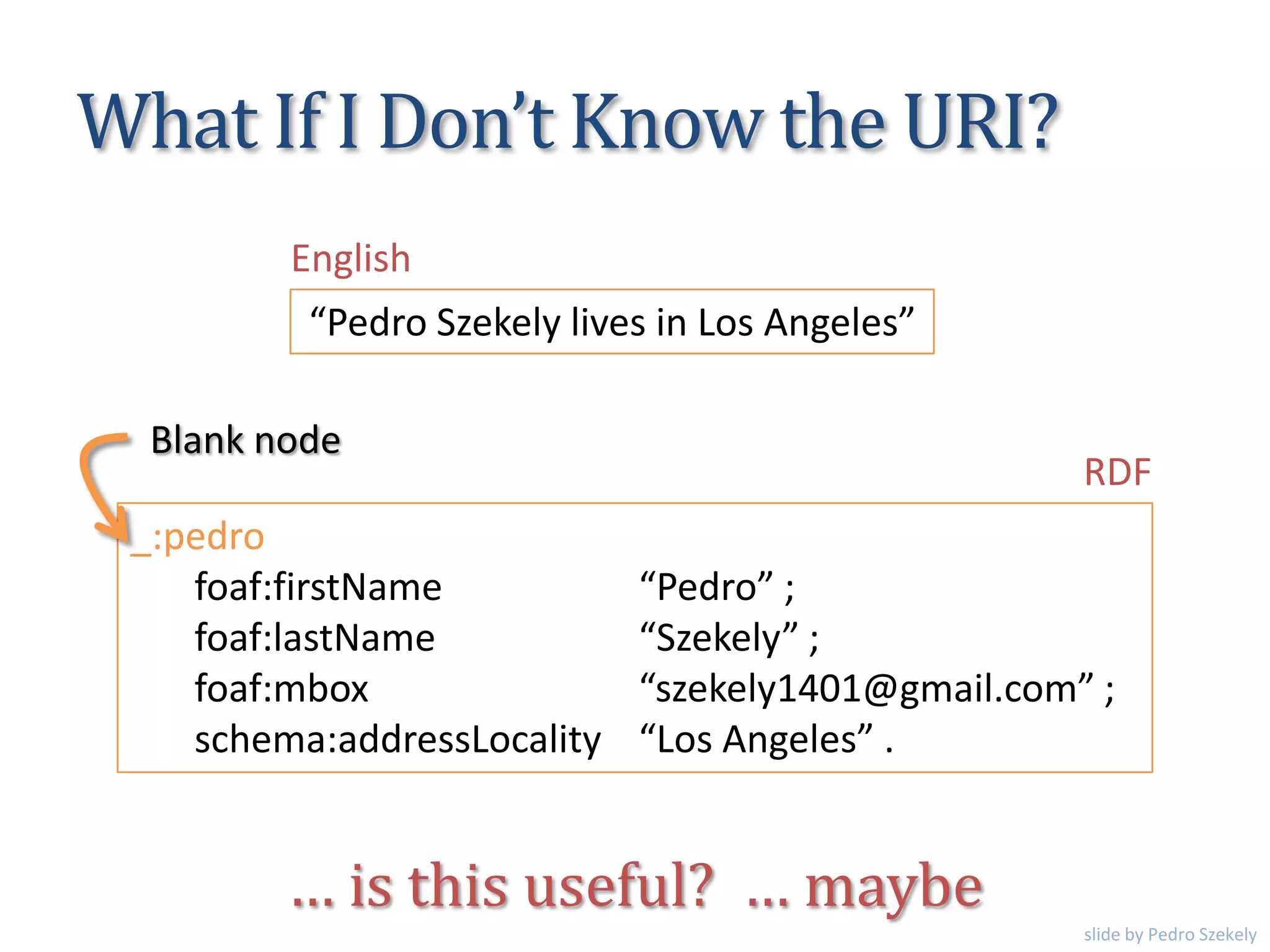
What If I Don’t Know the URI?
“Pedro Szekely lives in Los Angeles”
English
_:pedro
foaf:firstName “Pedro” ;
foaf:lastName “Szekely” ;
foaf:mbox “szekely1401@gmail.com” ;
schema:addressLocality “Los Angeles” .
RDF
Blank node
… is this useful? … maybe
slide by Pedro Szekely
Typed Literals
gn:bogota weather:event [
weather:temperature “10” ;
weather:date ”18 June 2012”
] .
… what is the meaning of the strings?
… how do I specify numbers?
… how about dates?
… how do I specify 10 degrees centigrade?
Compact blank
node syntax
slide by Pedro Szekely
Typed Literals
gn:bogota weather:event [
weather:temperature “10”
^^<http://www.w3.org/2001/XMLSchema#integer> ;
weather:date ”18 June 2012” ;
] .
URI specifies the type
slide by Pedro Szekely
Typed Literals
gn:bogota weather:event [
weather:temperature “10”
^^<http://www.w3.org/2001/XMLSchema#integer> ;
weather:date ”18 June 2012” ;
weather:date ”2012-06-18” ^^xsd:date ;
] .
… No set of predefined types defined in RDF
… Software that consumes RDF must process types
… XSD types commonly used
URI from the XML Schema
namespace are popular
slide by Pedro Szekely
Containers and Collections
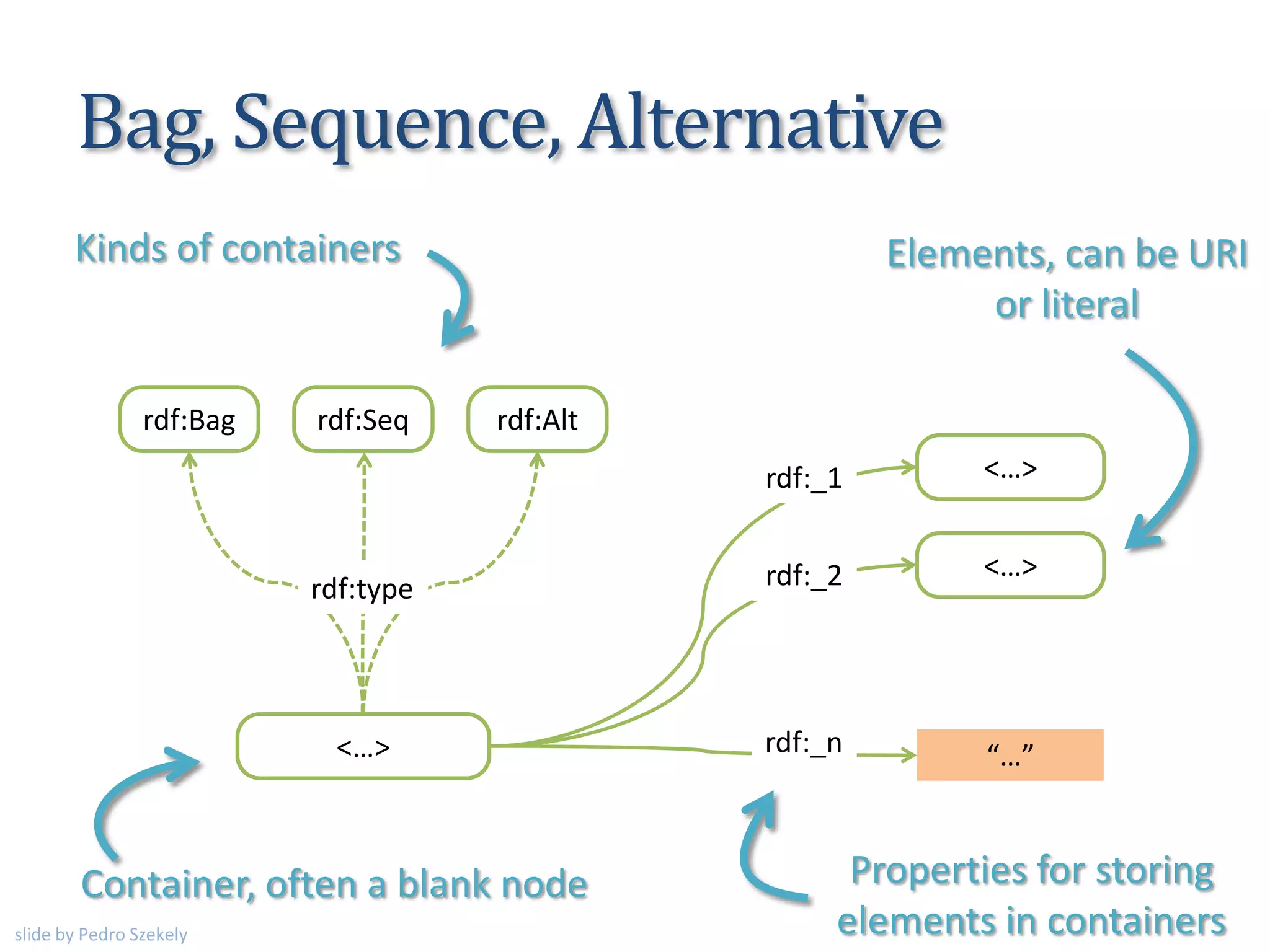
Bag, Sequence, Alternative
<…> “…”
rdf:Bag
<…>
<…>rdf:_1
rdf:_2
rdf:_n
rdf:Seq rdf:Alt
rdf:type
Elements, can be URI
or literal
Container, often a blank node
Kinds of containers
Properties for storing
elements in containersslide by Pedro Szekely
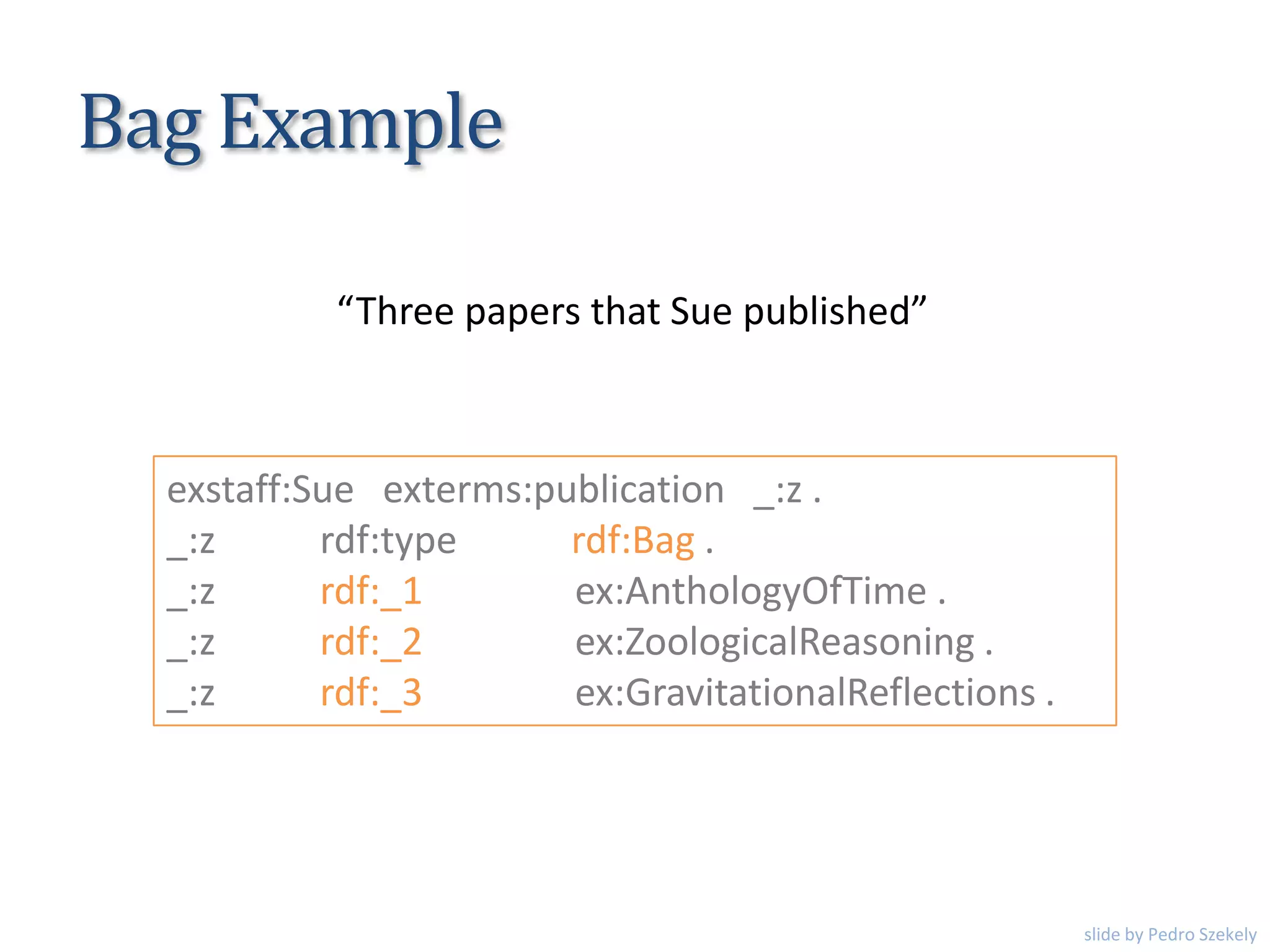
Bag Example
exstaff:Sue exterms:publication _:z .
_:z rdf:type rdf:Bag .
_:z rdf:_1 ex:AnthologyOfTime .
_:z rdf:_2 ex:ZoologicalReasoning .
_:z rdf:_3 ex:GravitationalReflections .
“Three papers that Sue published”
slide by Pedro Szekely
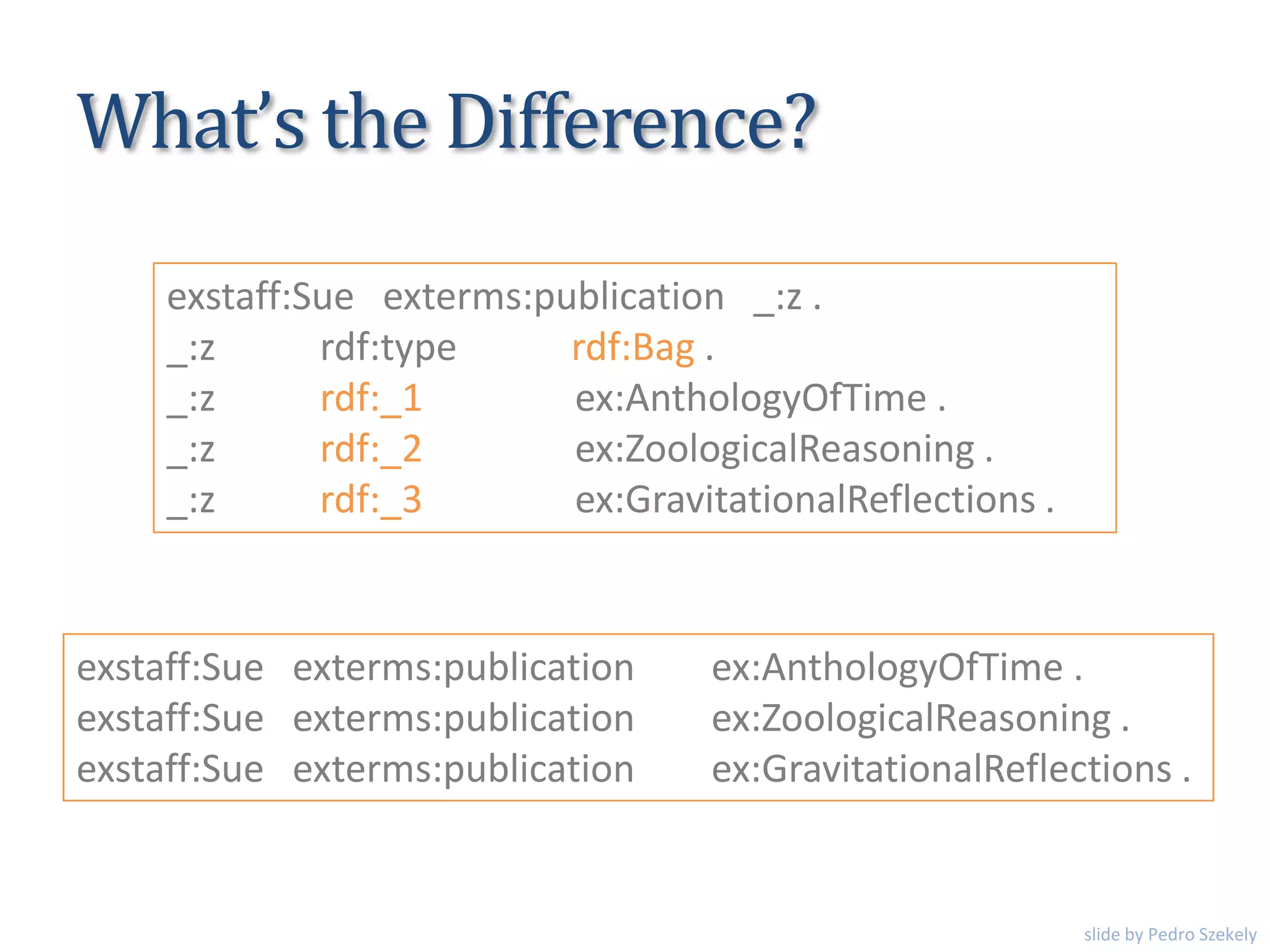
What’s the Difference?
exstaff:Sue exterms:publication _:z .
_:z rdf:type rdf:Bag .
_:z rdf:_1 ex:AnthologyOfTime .
_:z rdf:_2 ex:ZoologicalReasoning .
_:z rdf:_3 ex:GravitationalReflections .
exstaff:Sue exterms:publication ex:AnthologyOfTime .
exstaff:Sue exterms:publication ex:ZoologicalReasoning .
exstaff:Sue exterms:publication ex:GravitationalReflections .
slide by Pedro Szekely
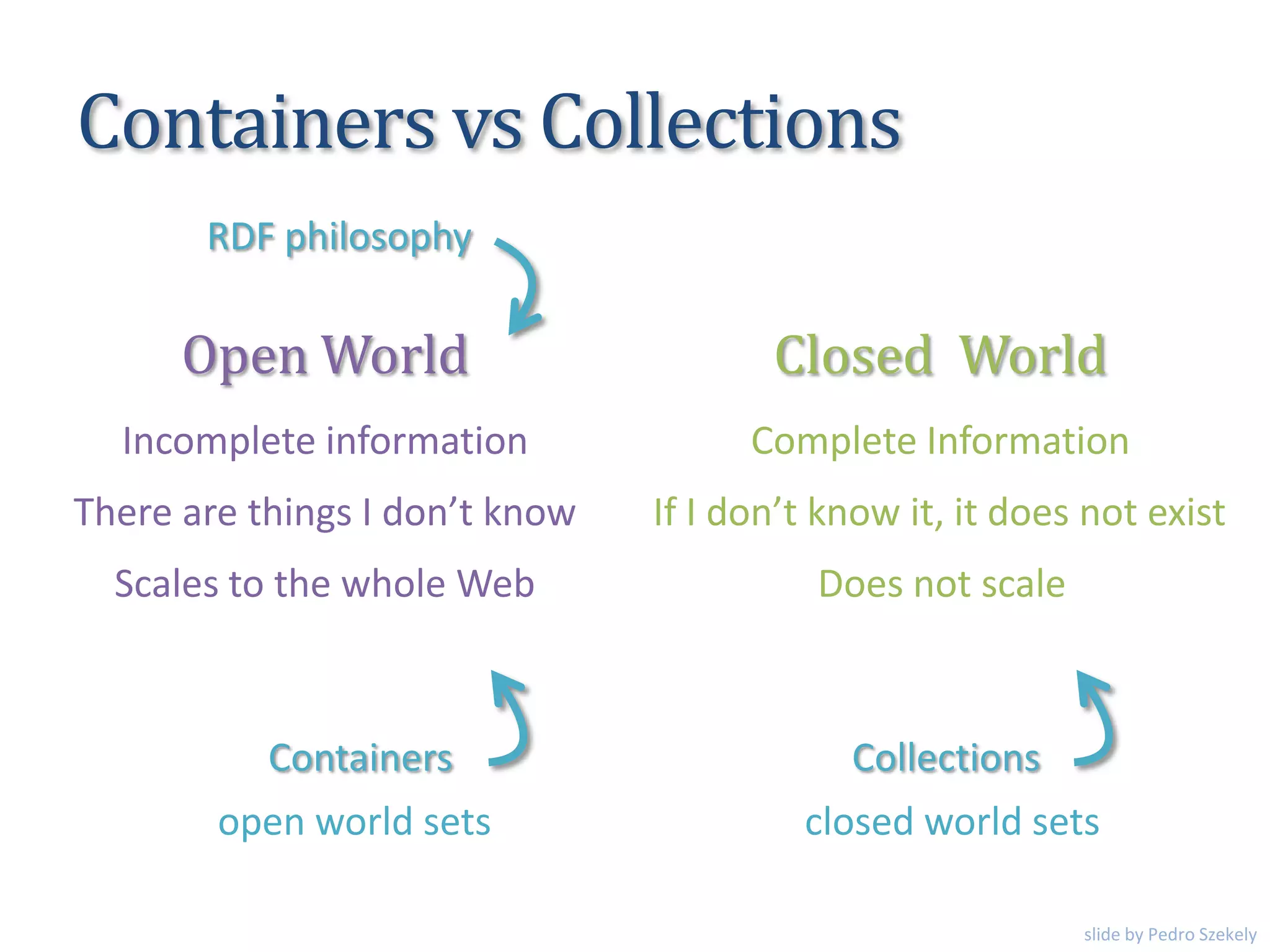
Containers vs Collections
Open World Closed World
Incomplete information Complete Information
There are things I don’t know If I don’t know it, it does not exist
Scales to the whole Web Does not scale
RDF philosophy
Containers Collections
open world sets closed world sets
slide by Pedro Szekely
Reification
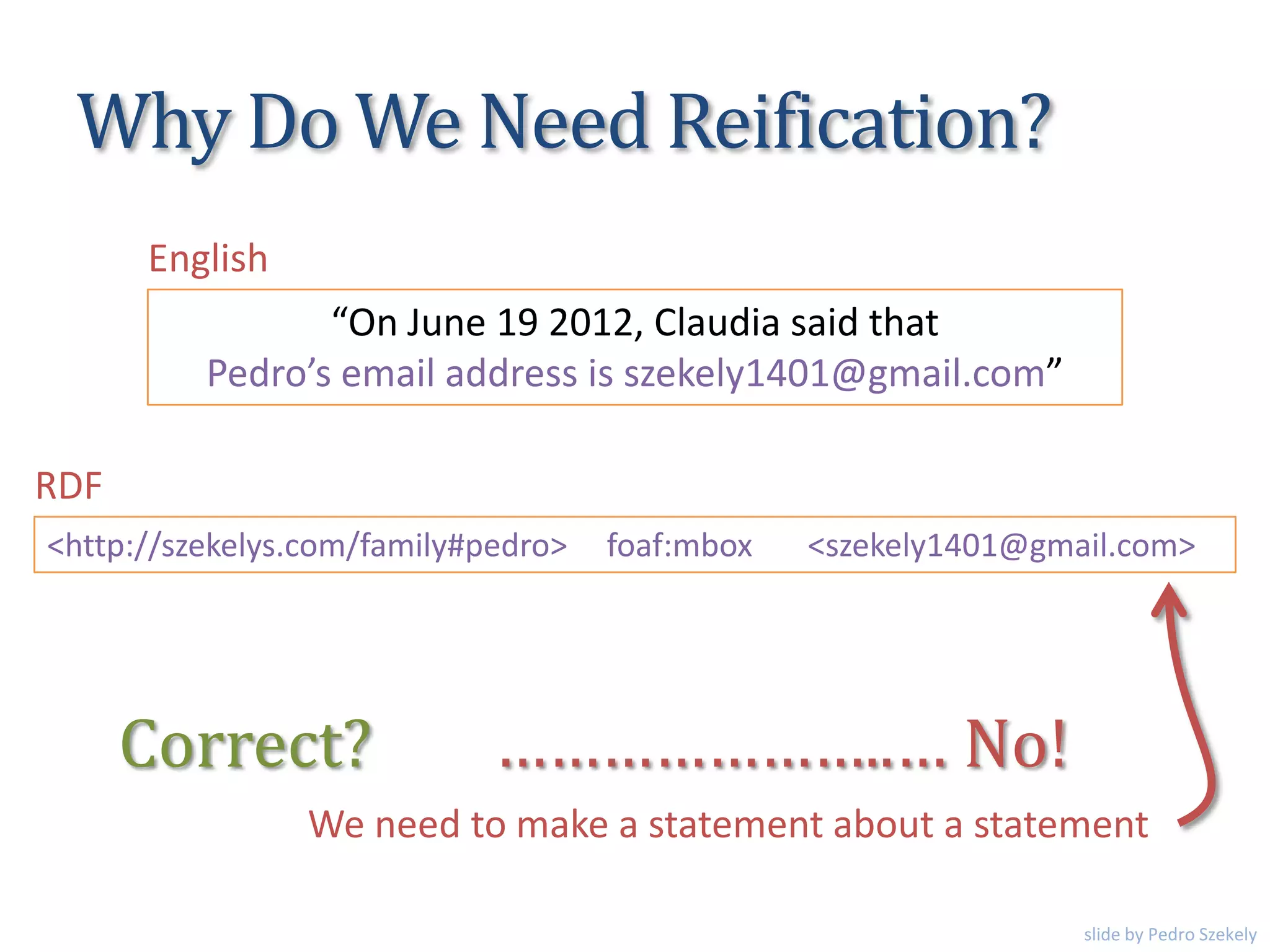
Why Do We Need Reification?
“On June 19 2012, Claudia said that
Pedro’s email address is szekely1401@gmail.com”
English
<http://szekelys.com/family#pedro> foaf:mbox <szekely1401@gmail.com>
RDF
Correct? …………………..… No!
We need to make a statement about a statement
slide by Pedro Szekely
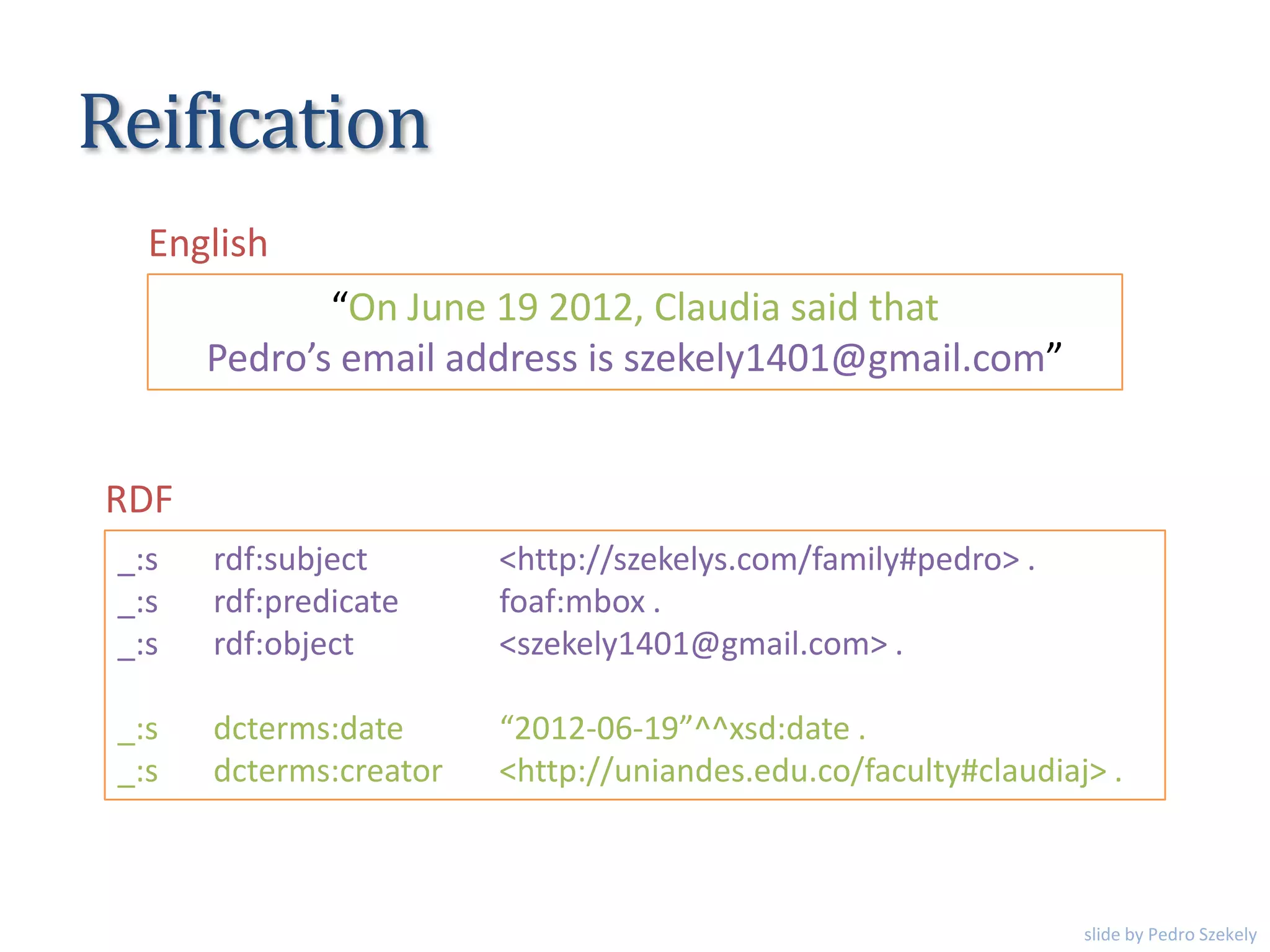
Reification
“On June 19 2012, Claudia said that
Pedro’s email address is szekely1401@gmail.com”
English
_:s rdf:subject <http://szekelys.com/family#pedro> .
_:s rdf:predicate foaf:mbox .
_:s rdf:object <szekely1401@gmail.com> .
_:s dcterms:date “2012-06-19”^^xsd:date .
_:s dcterms:creator <http://uniandes.edu.co/faculty#claudiaj> .
RDF
slide by Pedro Szekely
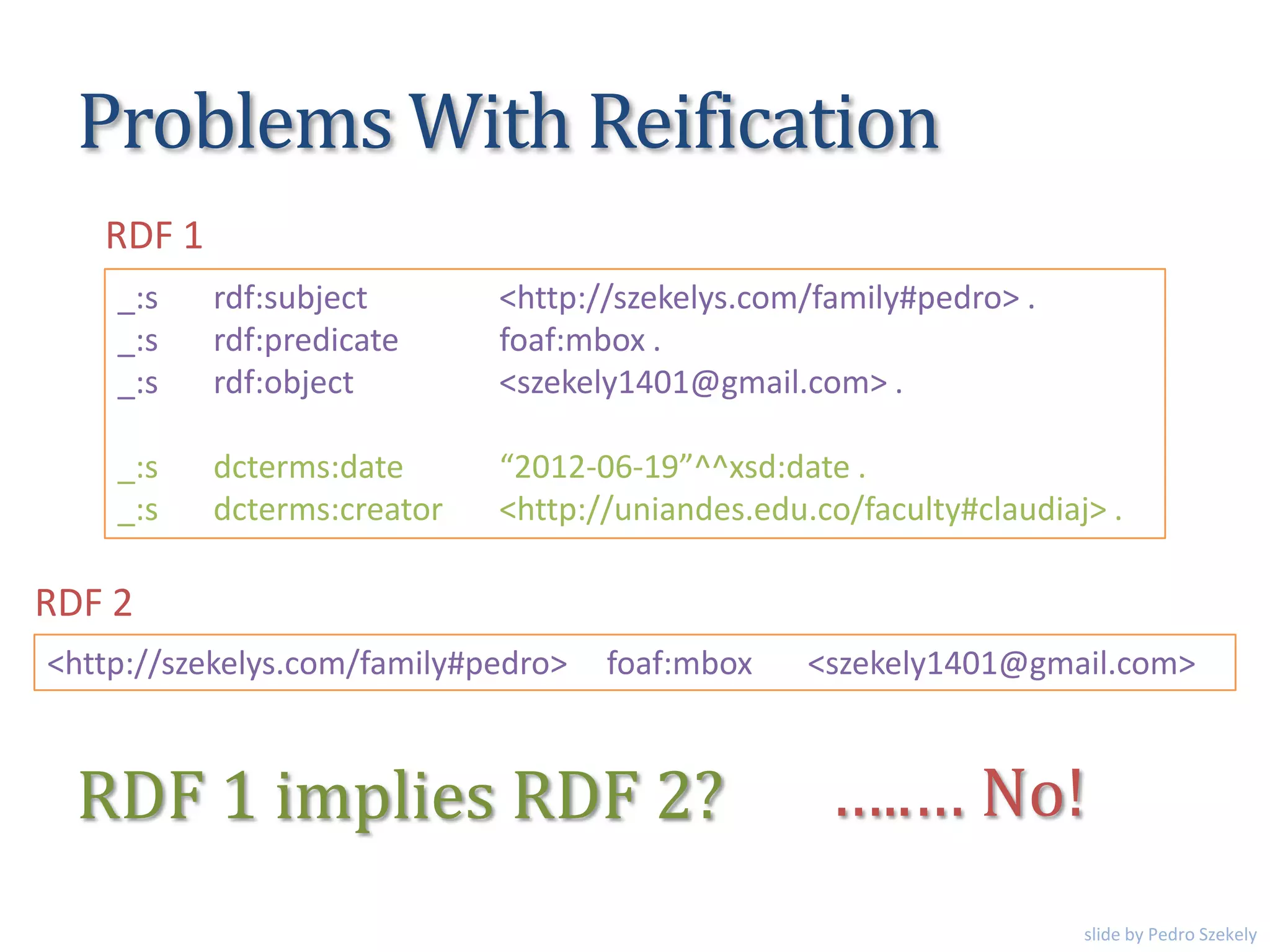
Problems With Reification
_:s rdf:subject <http://szekelys.com/family#pedro> .
_:s rdf:predicate foaf:mbox .
_:s rdf:object <szekely1401@gmail.com> .
_:s dcterms:date “2012-06-19”^^xsd:date .
_:s dcterms:creator <http://uniandes.edu.co/faculty#claudiaj> .
<http://szekelys.com/family#pedro> foaf:mbox <szekely1401@gmail.com>
RDF 1 implies RDF 2?
RDF 1
RDF 2
…..… No!
slide by Pedro Szekely
Problems With Reification
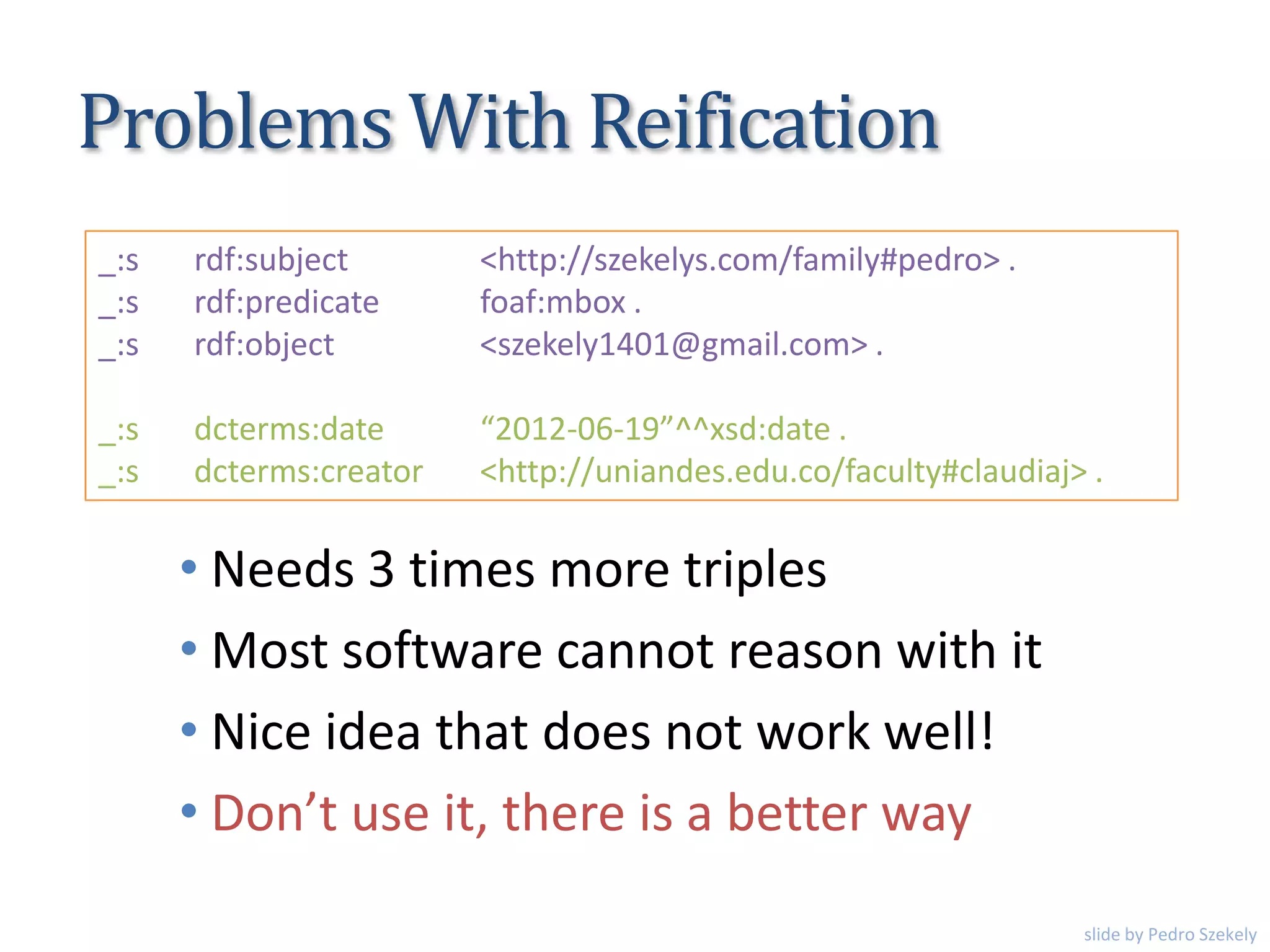
• Needs 3 times more triples
• Most software cannot reason with it
• Nice idea that does not work well!
• Don’t use it, there is a better way
_:s rdf:subject <http://szekelys.com/family#pedro> .
_:s rdf:predicate foaf:mbox .
_:s rdf:object <szekely1401@gmail.com> .
_:s dcterms:date “2012-06-19”^^xsd:date .
_:s dcterms:creator <http://uniandes.edu.co/faculty#claudiaj> .
slide by Pedro Szekely
RDF Syntax
RDF Syntaxes
Leverages XML tools
Hard for humans to read
XML
N3, Turtle
N-Triples
Terse RDF Triple Language
Human readable format
Works with software too
Subset of turtle, supports streaming
Standard for large RDF dumps
RDFa
Allows embedding RDF in HTML pages
Original, still
used, but others
becoming more
popular
slide by Pedro Szekely
Turtle Syntax
http://www.w3.org/TR/2011/WD-turtle-20110809/
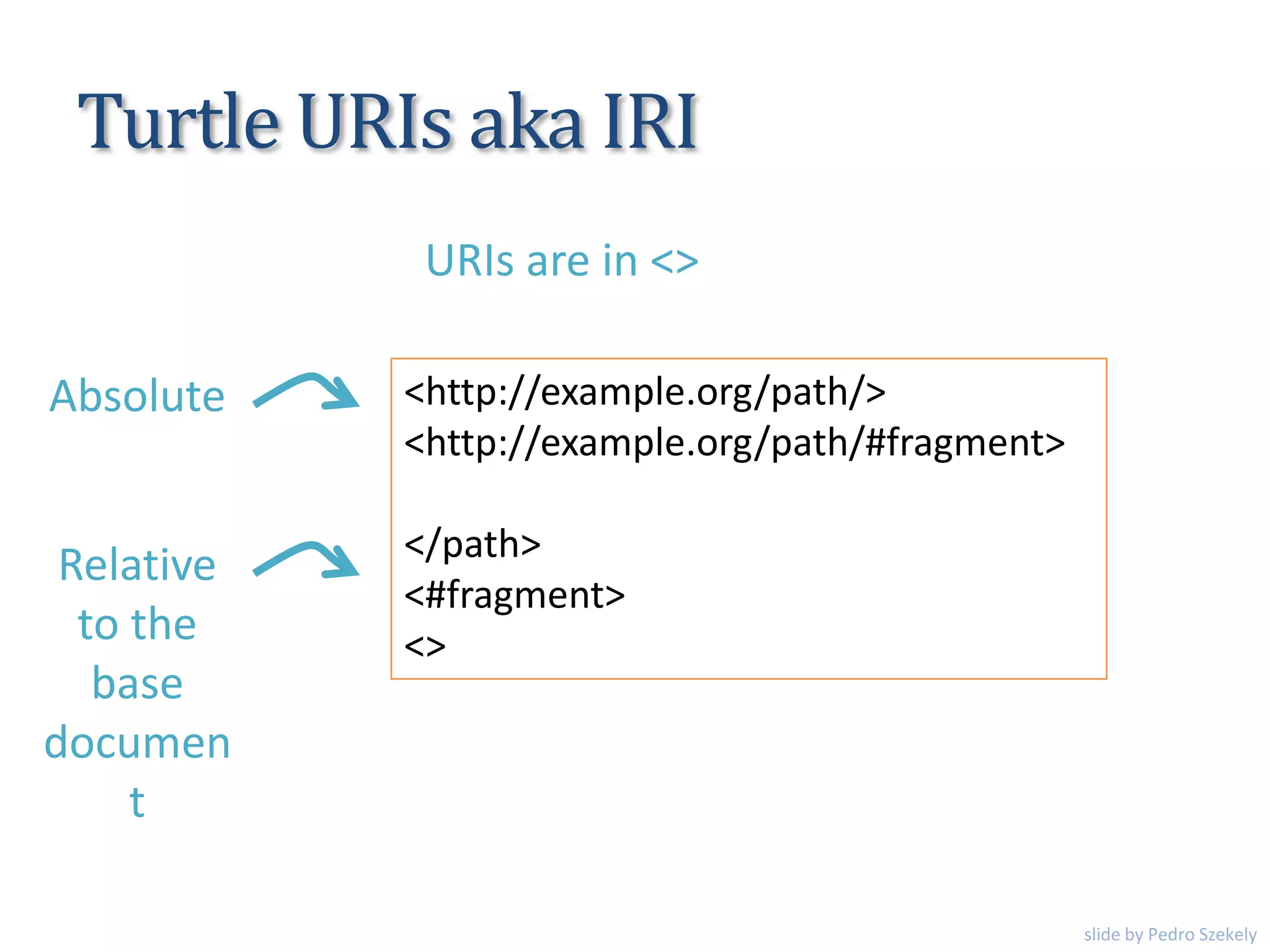
Turtle URIs aka IRI
<http://example.org/path/>
<http://example.org/path/#fragment>
</path>
<#fragment>
<>
URIs are in <>
Absolute
Relative
to the
base
documen
t
slide by Pedro Szekely
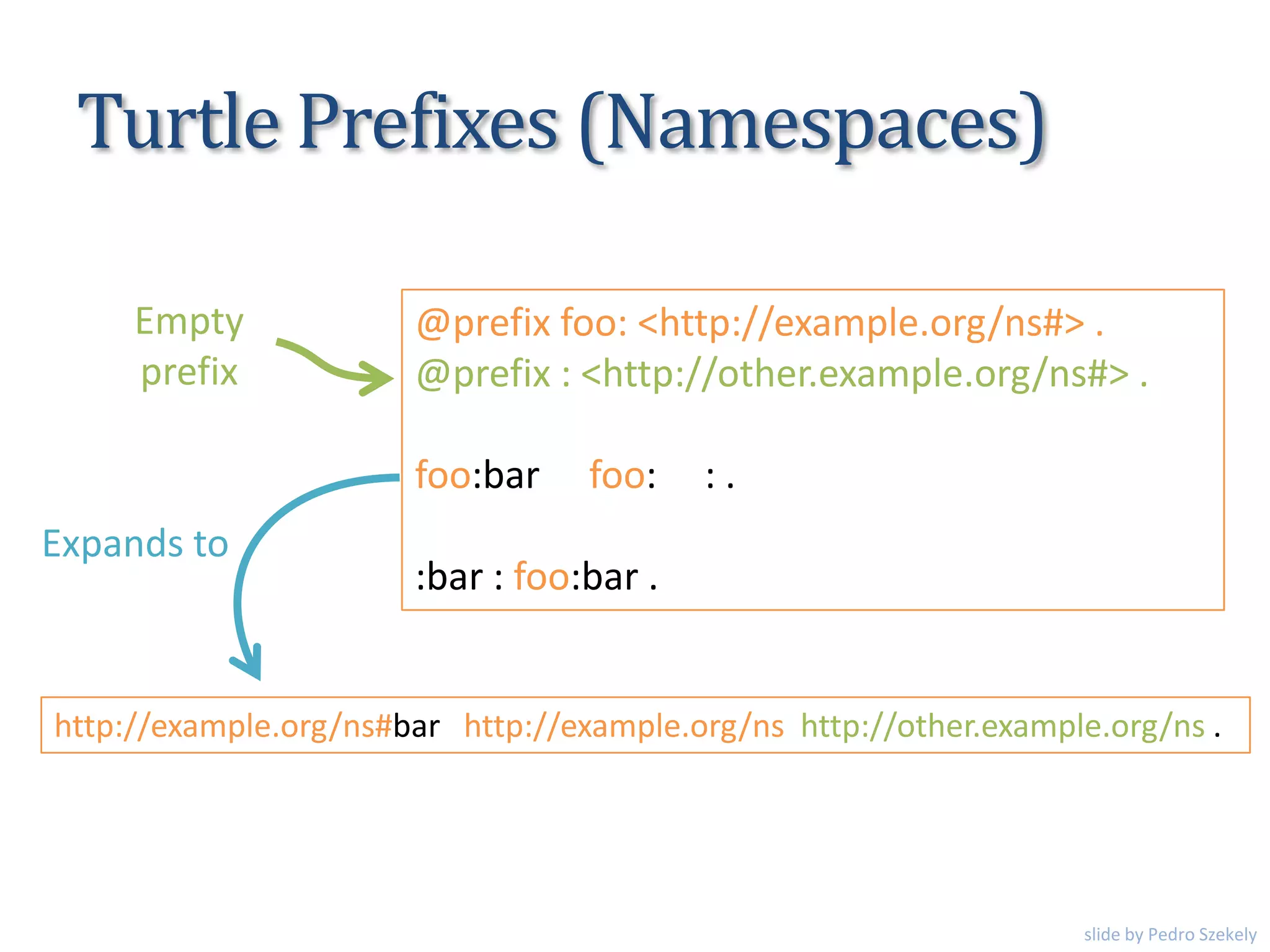
Turtle Prefixes (Namespaces)
@prefix foo: <http://example.org/ns#> .
@prefix : <http://other.example.org/ns#> .
foo:bar foo: : .
:bar : foo:bar .
Expands to
Empty
prefix
http://example.org/ns#bar http://example.org/ns http://other.example.org/ns .
slide by Pedro Szekely
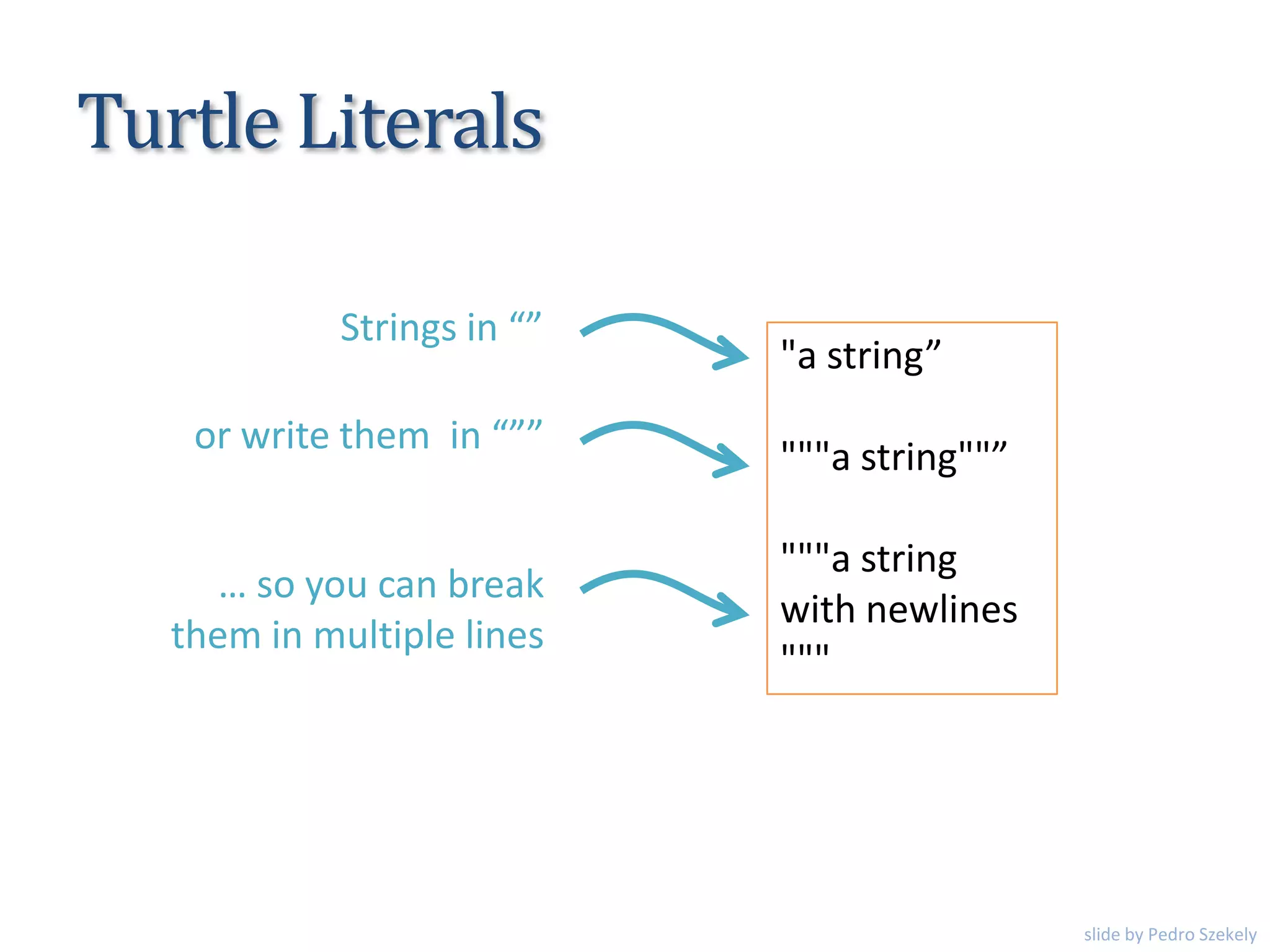
Turtle Literals
"a string”
"""a string""”
"""a string
with newlines
"""
Strings in “”
or write them in “””
… so you can break
them in multiple lines
slide by Pedro Szekely
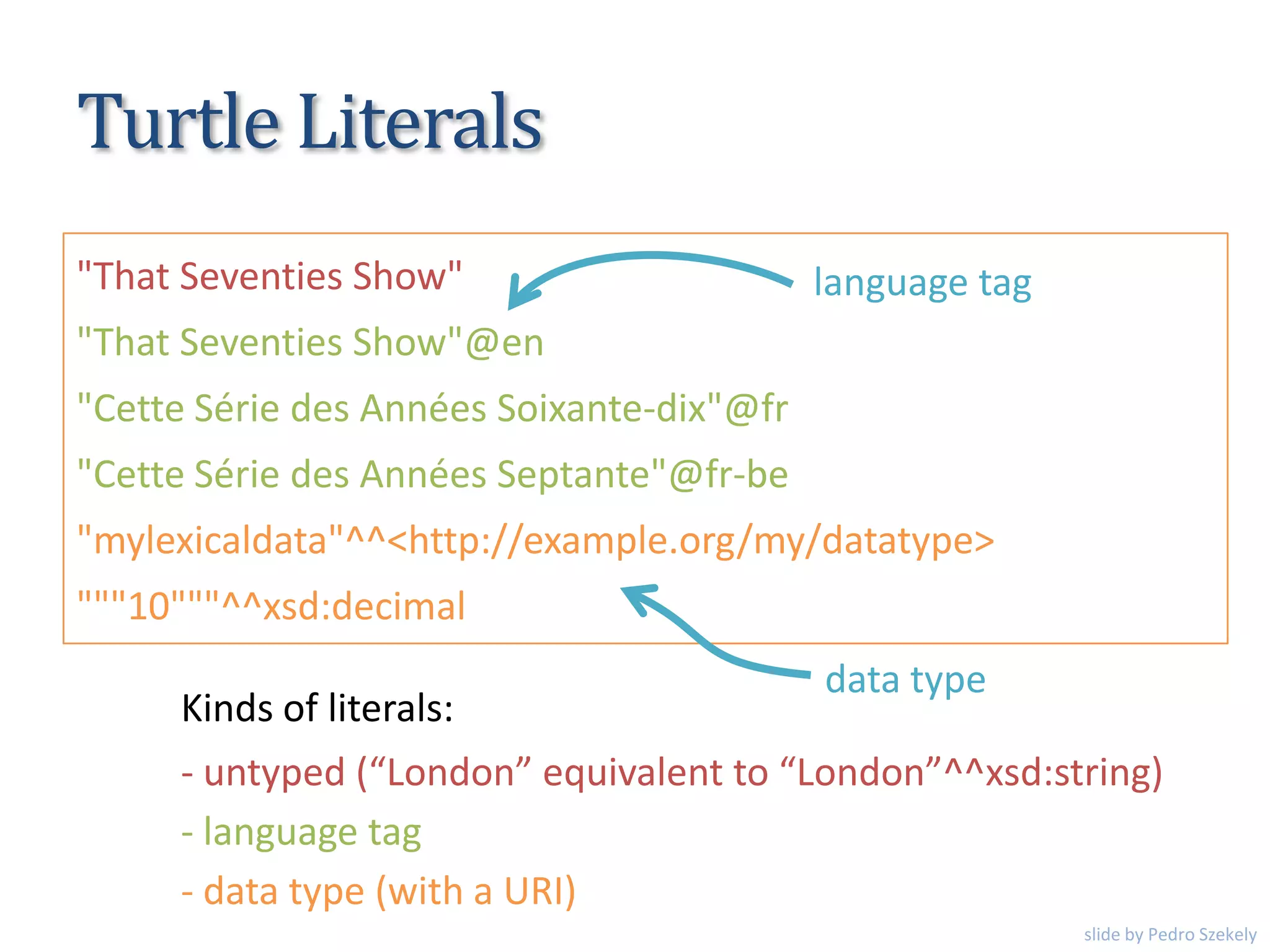
Turtle Literals
"That Seventies Show"
"That Seventies Show"@en
"Cette Série des Années Soixante-dix"@fr
"Cette Série des Années Septante"@fr-be
"mylexicaldata"^^<http://example.org/my/datatype>
"""10"""^^xsd:decimal
- untyped (“London” equivalent to “London”^^xsd:string)
language tag
data type
- language tag
- data type (with a URI)
Kinds of literals:
slide by Pedro Szekely
Turtle Blank Nodes
_:me
_:a1234
[]
two blank nodes
Blank nodes
_:me foaf:firstName “Pedro” .
_:me foaf:lastName “Szekely” .
[] foaf:firstName “Pedro” .
[] foaf:lastName “Szekely” .
[ foaf:firstName “Pedro” ;
foaf:lastName “Szekely” ;
]
Examples
slide by Pedro Szekely
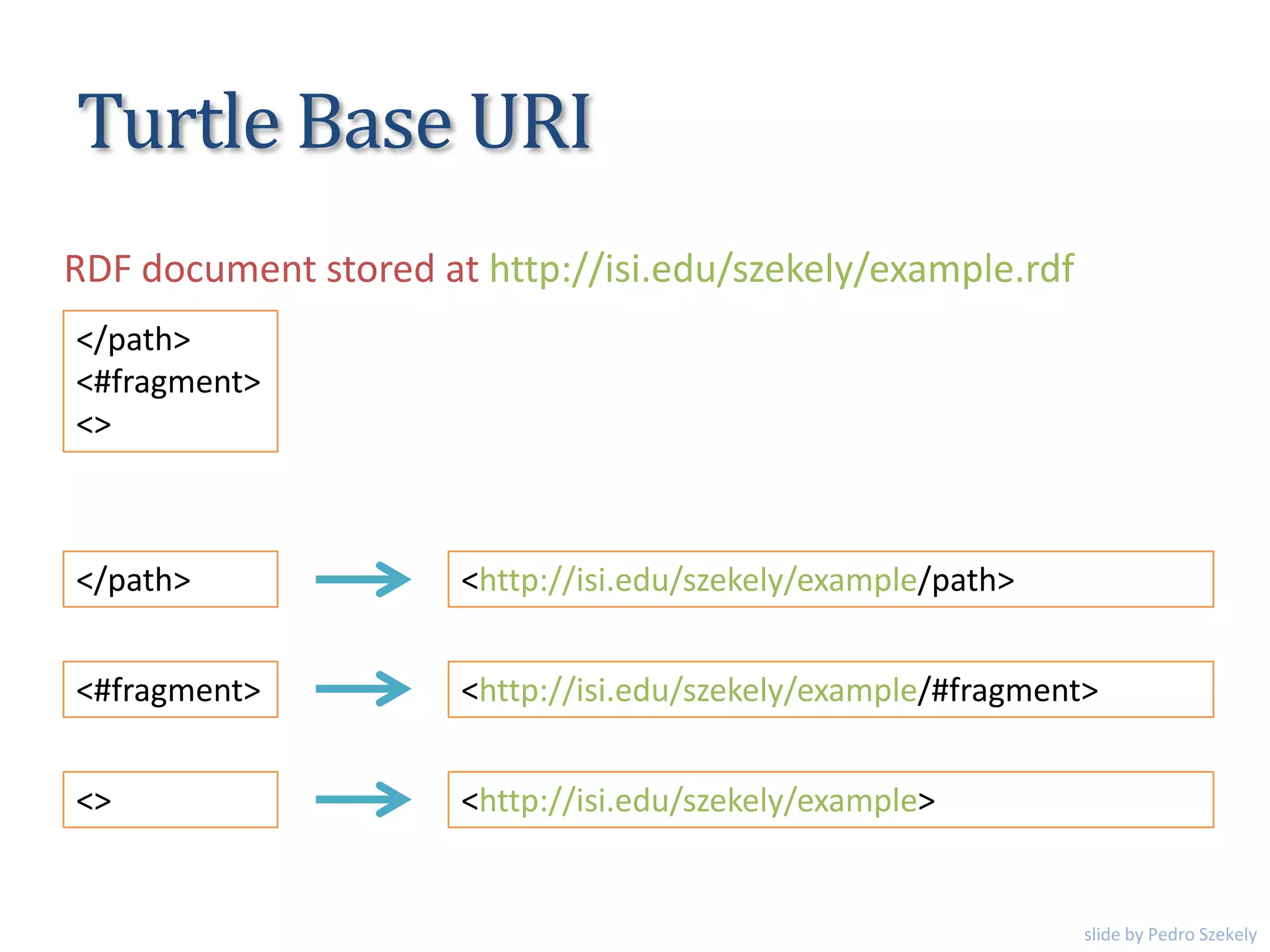
Turtle Base URI
</path>
<#fragment>
<>
RDF document stored at http://isi.edu/szekely/example.rdf
</path>
<#fragment>
<>
<http://isi.edu/szekely/example/path>
<http://isi.edu/szekely/example/#fragment>
<http://isi.edu/szekely/example>
slide by Pedro Szekely
Turtle Base URI
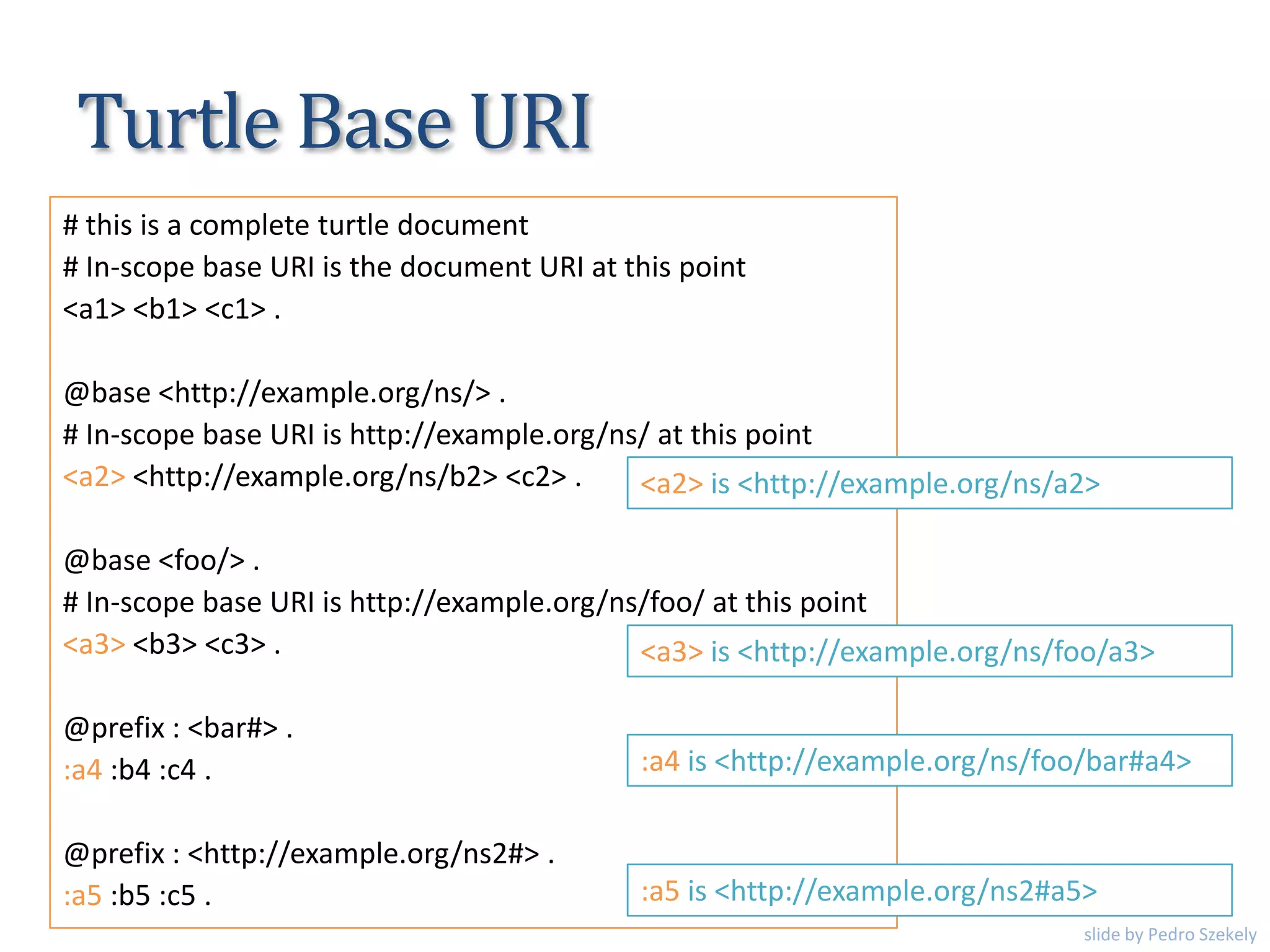
# this is a complete turtle document
# In-scope base URI is the document URI at this point
<a1> <b1> <c1> .
@base <http://example.org/ns/> .
# In-scope base URI is http://example.org/ns/ at this point
<a2> <http://example.org/ns/b2> <c2> .
@base <foo/> .
# In-scope base URI is http://example.org/ns/foo/ at this point
<a3> <b3> <c3> .
@prefix : <bar#> .
:a4 :b4 :c4 .
@prefix : <http://example.org/ns2#> .
:a5 :b5 :c5 .
<a2> is <http://example.org/ns/a2>
<a3> is <http://example.org/ns/foo/a3>
:a4 is <http://example.org/ns/foo/bar#a4>
:a5 is <http://example.org/ns2#a5>
slide by Pedro Szekely
Turtle “Type” Shortcut
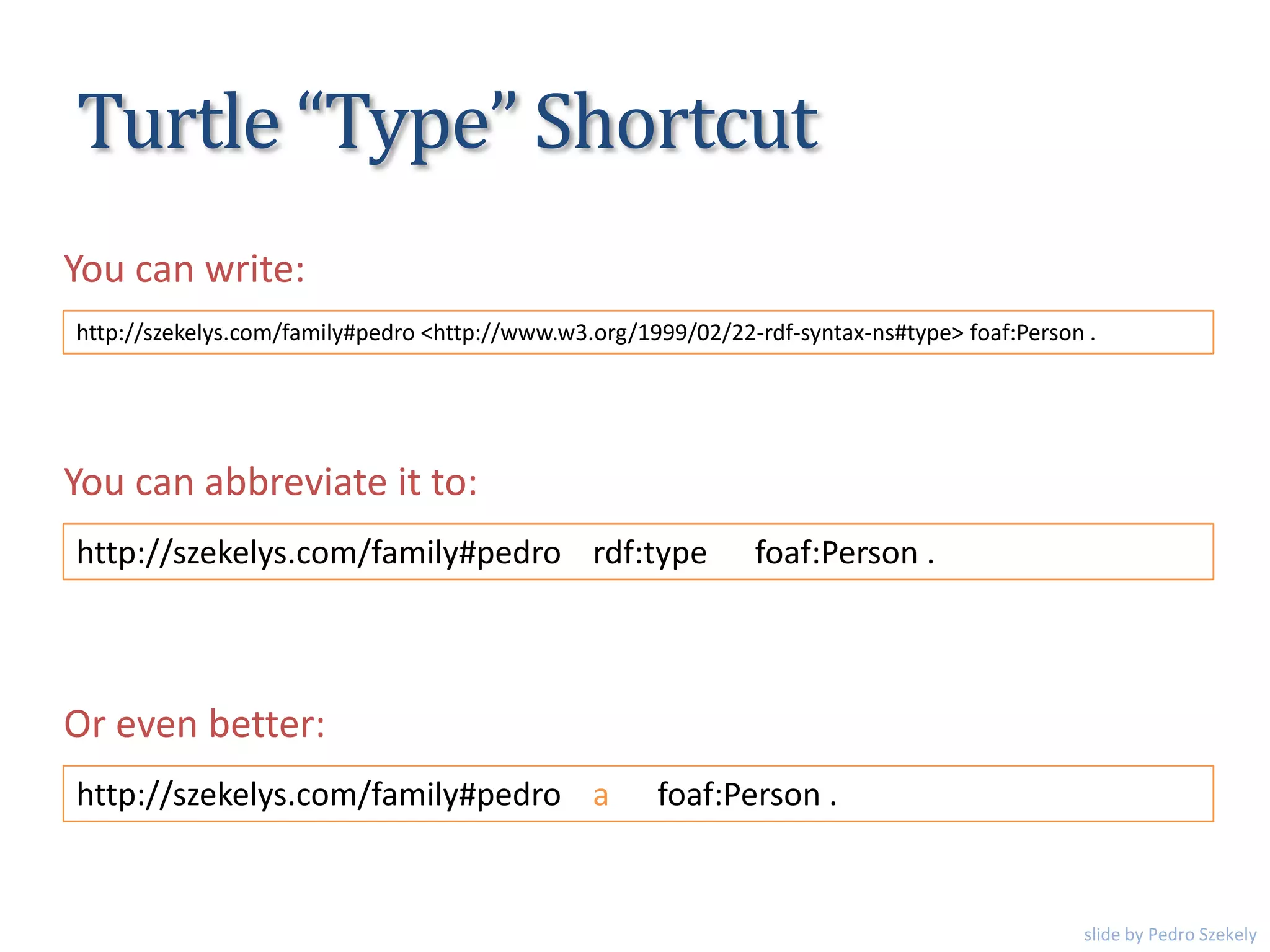
http://szekelys.com/family#pedro <http://www.w3.org/1999/02/22-rdf-syntax-ns#type> foaf:Person .
You can write:
http://szekelys.com/family#pedro rdf:type foaf:Person .
You can abbreviate it to:
http://szekelys.com/family#pedro a foaf:Person .
Or even better:
slide by Pedro Szekely
Turtle Literals Revisited
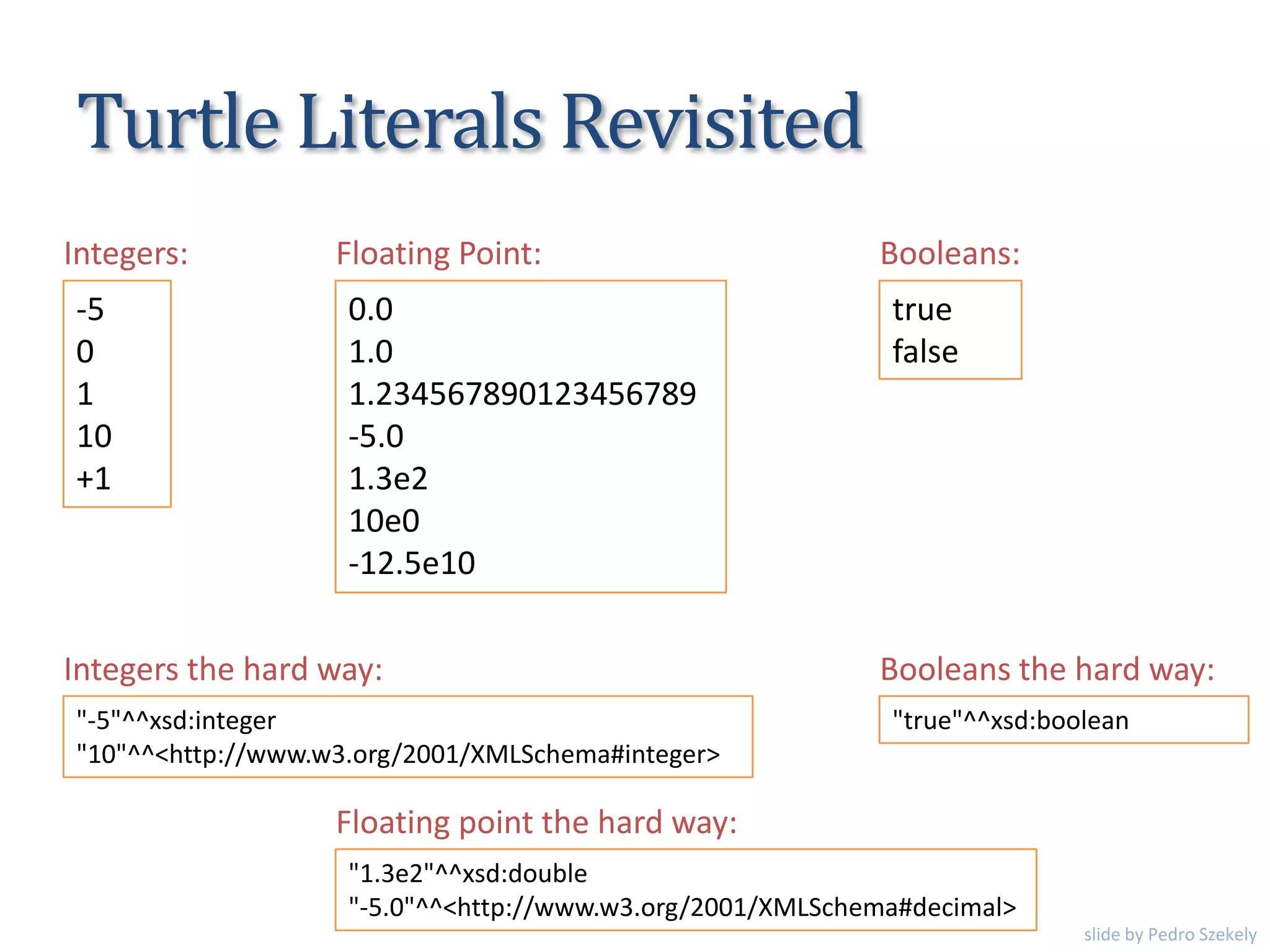
-5
0
1
10
+1
Integers:
"-5"^^xsd:integer
"10"^^<http://www.w3.org/2001/XMLSchema#integer>
Integers the hard way:
0.0
1.0
1.234567890123456789
-5.0
1.3e2
10e0
-12.5e10
Floating Point:
"1.3e2"^^xsd:double
"-5.0"^^<http://www.w3.org/2001/XMLSchema#decimal>
Floating point the hard way:
true
false
Booleans:
"true"^^xsd:boolean
Booleans the hard way:
slide by Pedro Szekely
Turtle Triple Abbreviations
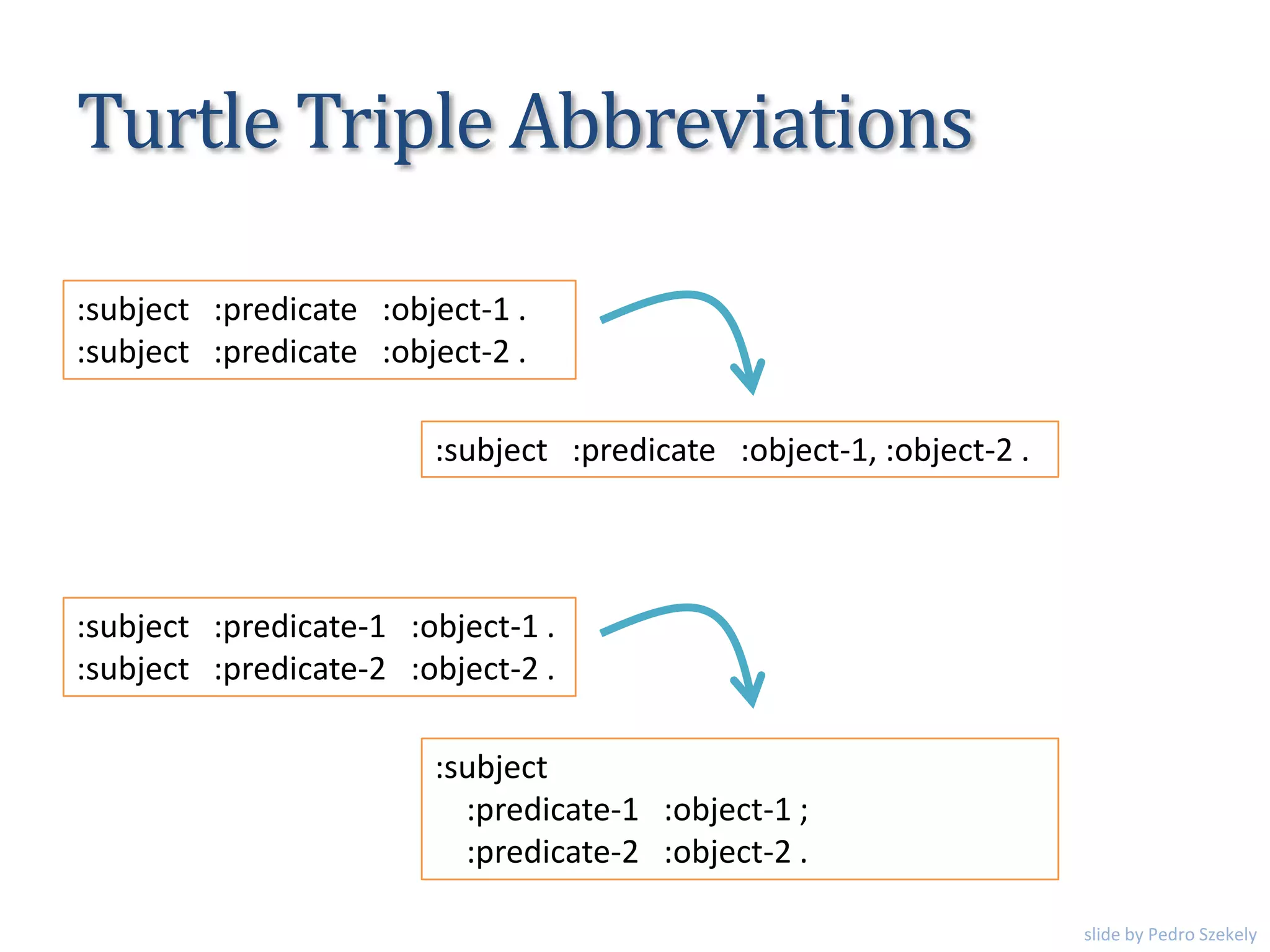
:subject :predicate :object-1 .
:subject :predicate :object-2 .
:subject :predicate :object-1, :object-2 .
:subject :predicate-1 :object-1 .
:subject :predicate-2 :object-2 .
:subject
:predicate-1 :object-1 ;
:predicate-2 :object-2 .
slide by Pedro Szekely
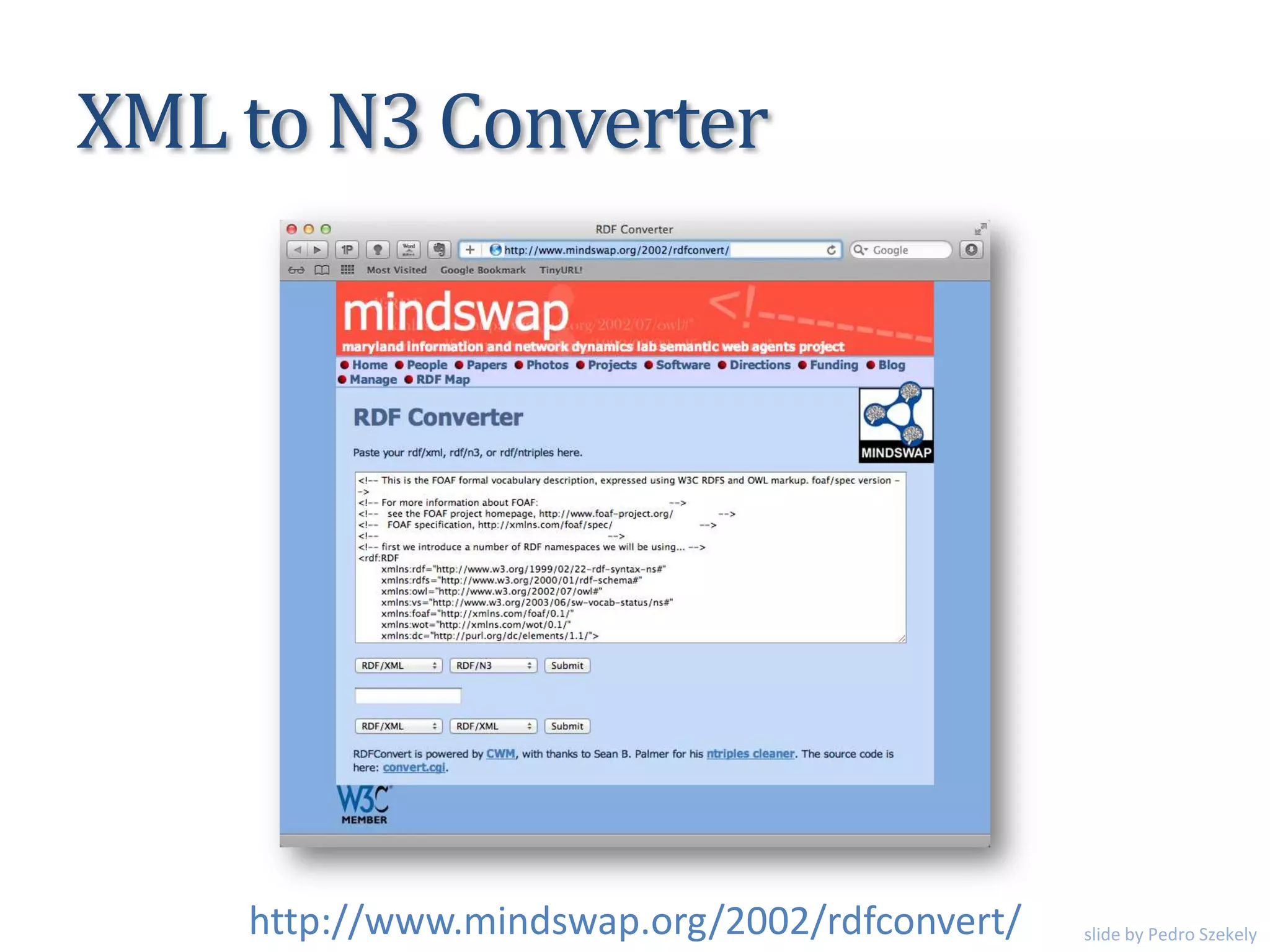
XML to N3 Converter
http://www.mindswap.org/2002/rdfconvert/ slide by Pedro Szekely

Introduction to RDF

  • 1.
    RDF Pedro Szekely University ofSouthern California/ISI
  • 2.
    Semantic Web LayerCake slide by Pedro Szekely
  • 3.
  • 4.
  • 5.
    Unicode is acomputing industry standard for the consistent encoding, representation and handling of text expressed in most of the world's writing systems. … the latest version of Unicode consists of a repertoire of more than 110,000 characters covering 100 scripts Unicode Wikipedia slide by Pedro Szekely
  • 6.
  • 7.
    URL: Uniform ResourceLocator A reference to an Internet resource Web Server URL Document (Resource) slide by Pedro Szekely
  • 8.
    URL vs URI URI URLURN nameslocators like a person's namelike person's street address item's identitymethod for finding it slide by Pedro Szekely
  • 9.
    Can USC Havea URI? slide by Pedro Szekely
  • 10.
    Can USC Havea URI? http://dbpedia.org/page/University_of_Southern_California slide by Pedro Szekely
  • 11.
  • 12.
    Can the PythagorasTheorem Have a URI? slide by Pedro Szekely
  • 13.
    Can the PythagorasTheorem Have a URI? http://www.freebase.com/view/en/pythagorean_theorem slide by Pedro Szekely
  • 14.
  • 15.
    My Dog: CanHe Have a URI? slide by Pedro Szekely
  • 16.
    My Dog: CanHe Have a URI? http://szekelys.com/diego slide by Pedro Szekely
  • 17.
    It does nothave to be “important” to have a URI
  • 18.
  • 19.
    Are These theSame? <http://amazon.com/store/Bookstore> <http://amazon.com/store/Book> <http://amazon.com/store/Author>John Doe</http://amazon.com/store/Author> <http://amazon.com/store/Title>Introduction to XML</http://amazon.com/store/Title> <http://amazon.com/store/Publisher>XYZ</http://amazon.com/store/Publisher> </http://amazon.com/store/Book> </http://amazon.com/store/Bookstore> <http://barnesandnoble.com/store/Bookstore> <http://barnesandnoble.com/store/Book> <http://barnesandnoble.com/store/Author>John Doe</http://barnesandnoble.com/store/Author> <http://barnesandnoble.com/store/Title>Introduction to XML</http://barnesandnoble.com/store/Title> <http://barnesandnoble.com/store/Publisher>XYZ</http://barnesandnoble.com/store/Publisher> </http://barnesandnoble.com/store/Book> </http://barnesandnoble.com/store/Bookstore> <Bookstore> <Book> <Author>John Doe</Author> <Title>Introduction to XML</Title> <Publisher>XYZ</Publisher> </Book> </Bookstore> slide by Pedro Szekely
  • 20.
    Namespaces XML namespaces areused for providing uniquely named elements and attributes in an XML document xmlns="http://amazon.com/store" Wikipedia slide by Pedro Szekely
  • 21.
    Using a NamespaceDeclaration <http://amazon.com/store/Bookstore> <http://amazon.com/store/Book> <http://amazon.com/store/Author>John Doe</http://amazon.com/store/Author> <http://amazon.com/store/Title>Introduction to XML</http://amazon.com/store/Title> <http://amazon.com/store/Publisher>XYZ</http://amazon.com/store/Publisher> </http://amazon.com/store/Book> </http://amazon.com/store/Bookstore> <Bookstore xmlns=“http://amazon.com/store”> <Book> <Author>John Doe</Author> <http://amazon.com/store/Title>Introduction to XML</Title> <http://amazon.com/store/Publisher>XYZ</Publisher> </Book> </Bookstore> = slide by Pedro Szekely
  • 22.
    Default and PrefixNamespaces <http://amazon.com/store/Bookstore> <http://amazon.com/store/Book> <http://amazon.com/store/Author>John Doe</http://amazon.com/store/Author> <http://amazon.com/store/Title>Introduction to XML</http://amazon.com/store/Title> <http://amazon.com/store/Publisher>XYZ</http://amazon.com/store/Publisher> </http://amazon.com/store/Book> </http://amazon.com/store/Bookstore> <Bookstore xmlns=“http://amazon.com/store”> <Book> <Author>John Doe</Author> <Title>Introduction to XML</Title> <Publisher>XYZ</Publisher> </Book> </Bookstore> = <am:Bookstore xmlns:am=“http://amazon.com/store”> <am:Book> <am:Author>John Doe</am:Author> <am:Title>Introduction to XML</am:Title> <am:Publisher>XYZ</am:Publisher> </am:Book> </am:Bookstore> = slide by Pedro Szekely
  • 23.
    Default and PrefixNamespaces <am:Bookstore xmlns:am=“http://amazon.com/store” xmlns:bn=http://barnesandnoble.com/store> <am:Book> <am:Author>John Doe</am:Author> <bn:Author>Jane Doe</bn:Author> <am:Title>Introduction to XML</am:Title> <am:Publisher>XYZ</am:Publisher> </am:Book> </am:Bookstore> If elements were defined within a global scope, it would be a problem to combine elements from multiple documents slide by Pedro Szekely
  • 24.
  • 25.
    eXtensible Markup Language <h2>NonmonotonicReasoning</h2> <i>by <b>V. Marek</b> and <b>M. Truszczynski</b></i><br> Springer 1993<br> ISBN 0387976892 <book> <title>Nonmonotonic Reasoning</title> <author>V. Marek</author> <author>M. Truszczynski</author> <publisher>Springer</publisher> <year>1993</year> <ISBN>0387976892</ISBN> </book> HTML specifies how to display data XML specifies data extensible set of tags fixed set of tags slide by Pedro Szekely
  • 26.
    Merging Problem inXML <Bookstore xmlns=“http://amazon.com”> <Book id=“1”> <Author>John</Author> <Title>Introduction to XML</Title> <Publisher>ACM</Publisher> </Book> <Book id=“2”> <Author>Susan</Author> <Title>Advanced</Title> <Publisher>Springer</Publisher> </Book> </Bookstore> <Bookstore xmlns=“http://amazon.com”> <Book id=“1”> <Author>John</Author> <Title>Introduction to XML</Title> </Book> <Book id=“2”> <Author>Susan</Author> <Title>Advanced</Title> </Book> </Bookstore> <Bookstore xmlns=“http://amazon.com”> <Book id=“2”> <Publisher>Springer</Publisher> </Book> <Book id=“1”> <Publisher>ACM</Publisher> </Book> </Bookstore> … is difficult Document 1 Document 2 Merged Document slide by Pedro Szekely
  • 27.
    Does XML RepresentMeaning? <course name=“CS101”> <instructor> John </instructor> <course> <instructor name=“John”> <teaches>CS 101</teaches> <instructor> John is an instructor for CS101 Opposite nesting, same information! based on slide from Jose Luis Ambite
  • 28.
    Does XML RepresentMeaning? <course name=“CS101”> <instructor> John </instructor> <course> <instructor name=“John”> <teaches>CS 101</teaches> <instructor> John is an instructor for CS101 hasInstructor inverseOf teaches C,I hasInstructor(C,I) teaches(I,C) range(hasInstructor) = Person C,I hasInstructor(C,I) Peson(I) based on slide from Jose Luis Ambite
  • 29.
    Meaning of Datain XML? … <Book> <Author>John</Author> <Title>Introduction to XML</Title> <Publisher>ACM</Publisher> <Country>USA</Country> </Book> … What is the meaning of Country? … where the book is sold? … where it is published? … where the author lives? … ??? slide by Pedro Szekely
  • 30.
    XML Schema The purposeof a schema is to define a class of XML documents, and so the term "instance document" is often used to describe an XML document that conforms to a particular schema http://www.w3.org/TR/xmlschema-0/ a syntax checker slide by Pedro Szekely
  • 31.
    Example <xsd:complexType name="USAddress" > <xsd:sequence> <xsd:elementname="name" type="xsd:string"/> <xsd:element name="street" type="xsd:string"/> <xsd:element name="city" type="xsd:string"/> <xsd:element name="state" type="xsd:string"/> <xsd:element name="zip" type="xsd:decimal"/> </xsd:sequence> <xsd:attribute name="country" type="xsd:NMTOKEN" fixed="US"/> </xsd:complexType> Defining the USAddress Type … must have specific elements … in a specific order … filled with specific types of data slide by Pedro Szekely
  • 32.
    XML Schema PrimitiveTypes string boolean decimal float double duration dateTime time date gYearMonth gYear gMonthDay gDay gMonth hexBinary base64Binary anyURI Qname NOTATION useful in RDF slide by Pedro Szekely
  • 33.
  • 34.
    The Resource DescriptionFramework (RDF) is a language for representing information about resources in the World Wide Web http://www.w3.org/TR/rdf-primer/ slide by Pedro Szekely
  • 35.
    Intended for representingmetadata about Web resources, such as the title, author, and modification date of a Web document … also be used to represent information about things that can be identified on the Web, even when they cannot be directly retrieved on the Web examples include information about items available from on-line shopping facilities (e.g., prices and availability) Resource Description Framework slide by Pedro Szekely
  • 36.
    Represent Resources UsingURIs http://szekelys.com/family#pedro “Pedro” http://xmlns.com/foaf/0.1/firstName That guy has first name “Pedro” slide by Pedro Szekely
  • 37.
    Represent Information asTriples http://szekelys.com/family#pedro “Pedro” http://xmlns.com/foaf/0.1/firstName Subject Predicate Object The resource being described A property of the resource The value of the property slide by Pedro Szekely
  • 38.
  • 39.
  • 40.
  • 41.
  • 42.
    Why Use URIs? URIs look cool slide by Pedro Szekely
  • 43.
    Why Use URIs? URIs look cool  Precisely identify resources  Avoid confusion among different “Jose Lopez”  Precisely identify properties  E.g., name of a company or name of a person  Provide information about properties  Look them up on the web slide by Pedro Szekely
  • 44.
    XML vs RDF <coursename=“CS101”> <instructor> John </instructor> <course> <instructor name=“John”> <teaches>CS 101</teaches> <instructor> John is an instructor for CS101 usc-people:prof-01 “John” ex:isTeacherOf usc-course:cs-101 ex:hasInstructor foaf:name “CSC-101” ex:name XML RDF slide by Pedro Szekely
  • 45.
    RDF Syntaxes Leverages XMLtools Hard for humans to read XML N3, Turtle N-Triples Terse RDF Triple Language Human readable format Works with software too Subset of turtle, supports streaming Standard for large RDF dumps RDFa Allows embedding RDF in HTML pages slide by Pedro Szekely
  • 46.
    XML Syntax <?xml version="1.0"?> <rdf:RDFxmlns:rdf="http://www.w3.org/1999/02/22-rdf-syntax-ns#" xmlns:foaf="http://xmlns.com/foaf/0.1/"> <rdf:Description rdf:about="http://szekelys.com/family#pedro"> <foaf:firstName>Pedro</foaf:firstName> <foaf:homepage rdf:resource="http://isi.edu/~szekely"/> </rdf:Description> </rdf:RDF> Pedro’s homepage is "http://isi.edu/~szekely" slide by Pedro Szekely
  • 47.
    XML Syntax <?xml version="1.0"?> <rdf:RDFxmlns:rdf="http://www.w3.org/1999/02/22-rdf-syntax-ns#" xmlns:foaf="http://xmlns.com/foaf/0.1/"> <rdf:Description rdf:about="http://szekelys.com/family#pedro"> <foaf:firstName>Pedro</foaf:firstName> <foaf:homepage rdf:resource="http://isi.edu/~szekely"/> </rdf:Description> </rdf:RDF> It’s an XML document Pedro’s homepage is "http://isi.edu/~szekely" slide by Pedro Szekely
  • 48.
    XML Syntax <?xml version="1.0"?> <rdf:RDFxmlns:rdf="http://www.w3.org/1999/02/22-rdf-syntax-ns#" xmlns:foaf="http://xmlns.com/foaf/0.1/"> <rdf:Description rdf:about="http://szekelys.com/family#pedro"> <foaf:firstName>Pedro</foaf:firstName> <foaf:homepage rdf:resource="http://isi.edu/~szekely"/> </rdf:Description> </rdf:RDF> Here comes some RDF Pedro’s homepage is "http://isi.edu/~szekely" slide by Pedro Szekely
  • 49.
    XML Syntax <?xml version="1.0"?> <rdf:RDFxmlns:rdf="http://www.w3.org/1999/02/22-rdf-syntax-ns#" xmlns:foaf="http://xmlns.com/foaf/0.1/"> <rdf:Description rdf:about="http://szekelys.com/family#pedro"> <foaf:firstName>Pedro</foaf:firstName> <foaf:homepage rdf:resource="http://isi.edu/~szekely"/> </rdf:Description> </rdf:RDF> Namespace declarations Pedro’s homepage is "http://isi.edu/~szekely" slide by Pedro Szekely
  • 50.
    XML Syntax <?xml version="1.0"?> <rdf:RDFxmlns:rdf="http://www.w3.org/1999/02/22-rdf-syntax-ns#" xmlns:foaf="http://xmlns.com/foaf/0.1/"> <rdf:Description rdf:about="http://szekelys.com/family#pedro"> <foaf:firstName>Pedro</foaf:firstName> <foaf:homepage rdf:resource="http://isi.edu/~szekely"/> </rdf:Description> </rdf:RDF> Subject Pedro’s homepage is "http://isi.edu/~szekely" slide by Pedro Szekely
  • 51.
    XML Syntax <?xml version="1.0"?> <rdf:RDFxmlns:rdf="http://www.w3.org/1999/02/22-rdf-syntax-ns#" xmlns:foaf="http://xmlns.com/foaf/0.1/"> <rdf:Description rdf:about="http://szekelys.com/family#pedro"> <foaf:firstName>Pedro</foaf:firstName> <foaf:homepage rdf:resource="http://isi.edu/~szekely"/> </rdf:Description> </rdf:RDF> Predicate Pedro’s homepage is "http://isi.edu/~szekely" slide by Pedro Szekely
  • 52.
    XML Syntax <?xml version="1.0"?> <rdf:RDFxmlns:rdf="http://www.w3.org/1999/02/22-rdf-syntax-ns#" xmlns:foaf="http://xmlns.com/foaf/0.1/"> <rdf:Description rdf:about="http://szekelys.com/family#pedro"> <foaf:firstName>Pedro</foaf:firstName> <foaf:homepage rdf:resource="http://isi.edu/~szekely"/> </rdf:Description> </rdf:RDF> Value Pedro’s homepage is "http://isi.edu/~szekely" slide by Pedro Szekely
  • 53.
    XML Syntax <?xml version="1.0"?> <rdf:RDFxmlns:rdf="http://www.w3.org/1999/02/22-rdf-syntax-ns#" xmlns:foaf="http://xmlns.com/foaf/0.1/"> <rdf:Description rdf:about="http://szekelys.com/family#pedro"> <foaf:firstName>Pedro</foaf:firstName> <foaf:homepage rdf:resource="http://isi.edu/~szekely"/> </rdf:Description> </rdf:RDF> Value Pedro’s homepage is "http://isi.edu/~szekely" Subject Predicate slide by Pedro Szekely
  • 54.
    XML Syntax <?xml version="1.0"?> <rdf:RDFxmlns:rdf="http://www.w3.org/1999/02/22-rdf-syntax-ns#" xmlns:foaf="http://xmlns.com/foaf/0.1/"> <rdf:Description rdf:about="http://szekelys.com/family#pedro"> <foaf:firstName>Pedro</foaf:firstName> <foaf:homepage rdf:resource="http://isi.edu/~szekely"/> </rdf:Description> </rdf:RDF> http://szekelys.com/family#pedro foaf:firstName “Pedro” slide by Pedro Szekely
  • 55.
    XML Syntax <?xml version="1.0"?> <rdf:RDFxmlns:rdf="http://www.w3.org/1999/02/22-rdf-syntax-ns#" xmlns:foaf="http://xmlns.com/foaf/0.1/"> <foaf:Person rdf:about="http://szekelys.com/family#pedro"> <foaf:firstName>Pedro</foaf:firstName> <foaf:homepage rdf:resource="http://isi.edu/~szekely"/> </foaf:Person> </rdf:RDF> http://szekelys.com/family#pedro foaf:Person foaf:firstName “Pedro”rdf:type slide by Pedro Szekely
  • 56.
    <?xml version="1.0"?> <rdf:RDF xmlns:rdf="http://www.w3.org/1999/02/22-rdf-syntax-ns#" xmlns:foaf=http://xmlns.com/foaf/0.1/> <foaf:Personrdf:about="http://szekelys.com/family#pedro"> <foaf:firstName>Pedro</foaf:firstName> <foaf:homepage rdf:resource="http://isi.edu/~szekely"/> </foaf:Person> </rdf:RDF> <?xml version="1.0"?> <rdf:RDF xmlns:rdf=… xmlns:foaf=… <foaf:Person rdf:about= "http://szekelys.com/family#pedro"> <foaf:firstName>Pedro</foaf:firstName> </foaf:Person> </rdf:RDF> <?xml version="1.0"?> <rdf:RDF xmlns:rdf=… xmlns:foaf=… <foaf:Person rdf:about= "http://szekelys.com/family#pedro"> <foaf:homepage rdf:resource="http://isi.edu/~szekely"/> </foaf:Person> </rdf:RDF> + slide by Pedro Szekely
  • 57.
    RDF Syntaxes Leverages XMLtools Hard for humans to read XML N3, Turtle N-Triples Terse RDF Triple Language Human readable format Works with software too Subset of turtle, supports streaming Standard for large RDF dumps RDFa Allows embedding RDF in HTML pages slide by Pedro Szekely
  • 58.
    N3 and TurtleSyntaxes @prefix rdf: <http://www.w3.org/1999/02/22-rdf-syntax-ns#> . @prefix foaf: <http://xmlns.com/foaf/0.1/> . <http://szekelys.com/family#pedro> foaf:firstName “Pedro” . <http://szekelys.com/family#pedro> rdf:type foafPerson . http://szekelys.com/family#pedro foaf:Person foaf:firstName “Pedro”rdf:type Each triple ends with a dot slide by Pedro Szekely
  • 59.
  • 60.
    “USC/ISI’s address is 4676Admiralty Way, Marina del Rey, CA 90292” usc:isi schema:address “4676 Admiralty Way, Marina del Rey, CA 90292” . English RDF In what city is USC/ISI located? Find all universities in California slide by Pedro Szekely
  • 61.
    “USC/ISI’s address is 4676Admiralty Way, Marina del Rey, CA 90292” usc:isi schema:address “4676 Admiralty Way, Marina del Rey, CA 90292” . English RDF How to represent nested structures? slide by Pedro Szekely
  • 62.
    “USA” usc:isi schema:addressCountry schema:address “CA” “Marina del Rey” “90292” “4676Admiralty Way” schema:addressLocality schema:postalCode schema:addressRegion schema:streetAddress Represents the address of USC/ISI slide by Pedro Szekely
  • 63.
    “USC/ISI’s address is 4676Admiralty Way, Marina del Rey, CA 90292” usc:isi schema:address usc:isi-address . usc:isi-address schema:addressCountry “USA” ; schema:addressRegion “CA” schema:addressLocality “Marina del Rey” ; schema:postalCode “90292” ; schema:streetAddress “4676 Admiralty Way” . English RDF slide by Pedro Szekely
  • 64.
    usc:isi schema:address usc:isi-address. usc:isi-address schema:addressCountry “USA” ; schema:addressRegion “CA” schema:addressLocality “Marina del Rey” ; schema:postalCode “90292” ; schema:streetAddress “4676 Admiralty Way” . We minted a URI for USC/ISI’s address … but sometimes we don’t want to mint URIs slide by Pedro Szekely
  • 65.
    usc:isi schema:address _:isi-address. _:isi-address schema:addressCountry “USA” ; schema:addressRegion “CA” schema:addressLocality “Marina del Rey” ; schema:postalCode “90292” ; schema:streetAddress “4676 Admiralty Way” . Blank node Blank Nodes prefix is “_” … can be improved … slide by Pedro Szekely
  • 66.
    What If IDon’t Know the URI? “Pedro Szekely lives in Los Angeles” English _:pedro foaf:firstName “Pedro” ; foaf:lastName “Szekely” ; foaf:mbox “szekely1401@gmail.com” ; schema:addressLocality “Los Angeles” . RDF Blank node … is this useful? … maybe slide by Pedro Szekely
  • 67.
    Typed Literals gn:bogota weather:event[ weather:temperature “10” ; weather:date ”18 June 2012” ] . … what is the meaning of the strings? … how do I specify numbers? … how about dates? … how do I specify 10 degrees centigrade? Compact blank node syntax slide by Pedro Szekely
  • 68.
    Typed Literals gn:bogota weather:event[ weather:temperature “10” ^^<http://www.w3.org/2001/XMLSchema#integer> ; weather:date ”18 June 2012” ; ] . URI specifies the type slide by Pedro Szekely
  • 69.
    Typed Literals gn:bogota weather:event[ weather:temperature “10” ^^<http://www.w3.org/2001/XMLSchema#integer> ; weather:date ”18 June 2012” ; weather:date ”2012-06-18” ^^xsd:date ; ] . … No set of predefined types defined in RDF … Software that consumes RDF must process types … XSD types commonly used URI from the XML Schema namespace are popular slide by Pedro Szekely
  • 70.
  • 71.
    Bag, Sequence, Alternative <…>“…” rdf:Bag <…> <…>rdf:_1 rdf:_2 rdf:_n rdf:Seq rdf:Alt rdf:type Elements, can be URI or literal Container, often a blank node Kinds of containers Properties for storing elements in containersslide by Pedro Szekely
  • 72.
    Bag Example exstaff:Sue exterms:publication_:z . _:z rdf:type rdf:Bag . _:z rdf:_1 ex:AnthologyOfTime . _:z rdf:_2 ex:ZoologicalReasoning . _:z rdf:_3 ex:GravitationalReflections . “Three papers that Sue published” slide by Pedro Szekely
  • 73.
    What’s the Difference? exstaff:Sueexterms:publication _:z . _:z rdf:type rdf:Bag . _:z rdf:_1 ex:AnthologyOfTime . _:z rdf:_2 ex:ZoologicalReasoning . _:z rdf:_3 ex:GravitationalReflections . exstaff:Sue exterms:publication ex:AnthologyOfTime . exstaff:Sue exterms:publication ex:ZoologicalReasoning . exstaff:Sue exterms:publication ex:GravitationalReflections . slide by Pedro Szekely
  • 74.
    Containers vs Collections OpenWorld Closed World Incomplete information Complete Information There are things I don’t know If I don’t know it, it does not exist Scales to the whole Web Does not scale RDF philosophy Containers Collections open world sets closed world sets slide by Pedro Szekely
  • 75.
  • 76.
    Why Do WeNeed Reification? “On June 19 2012, Claudia said that Pedro’s email address is szekely1401@gmail.com” English <http://szekelys.com/family#pedro> foaf:mbox <szekely1401@gmail.com> RDF Correct? …………………..… No! We need to make a statement about a statement slide by Pedro Szekely
  • 77.
    Reification “On June 192012, Claudia said that Pedro’s email address is szekely1401@gmail.com” English _:s rdf:subject <http://szekelys.com/family#pedro> . _:s rdf:predicate foaf:mbox . _:s rdf:object <szekely1401@gmail.com> . _:s dcterms:date “2012-06-19”^^xsd:date . _:s dcterms:creator <http://uniandes.edu.co/faculty#claudiaj> . RDF slide by Pedro Szekely
  • 78.
    Problems With Reification _:srdf:subject <http://szekelys.com/family#pedro> . _:s rdf:predicate foaf:mbox . _:s rdf:object <szekely1401@gmail.com> . _:s dcterms:date “2012-06-19”^^xsd:date . _:s dcterms:creator <http://uniandes.edu.co/faculty#claudiaj> . <http://szekelys.com/family#pedro> foaf:mbox <szekely1401@gmail.com> RDF 1 implies RDF 2? RDF 1 RDF 2 …..… No! slide by Pedro Szekely
  • 79.
    Problems With Reification •Needs 3 times more triples • Most software cannot reason with it • Nice idea that does not work well! • Don’t use it, there is a better way _:s rdf:subject <http://szekelys.com/family#pedro> . _:s rdf:predicate foaf:mbox . _:s rdf:object <szekely1401@gmail.com> . _:s dcterms:date “2012-06-19”^^xsd:date . _:s dcterms:creator <http://uniandes.edu.co/faculty#claudiaj> . slide by Pedro Szekely
  • 80.
  • 81.
    RDF Syntaxes Leverages XMLtools Hard for humans to read XML N3, Turtle N-Triples Terse RDF Triple Language Human readable format Works with software too Subset of turtle, supports streaming Standard for large RDF dumps RDFa Allows embedding RDF in HTML pages Original, still used, but others becoming more popular slide by Pedro Szekely
  • 82.
  • 83.
    Turtle URIs akaIRI <http://example.org/path/> <http://example.org/path/#fragment> </path> <#fragment> <> URIs are in <> Absolute Relative to the base documen t slide by Pedro Szekely
  • 84.
    Turtle Prefixes (Namespaces) @prefixfoo: <http://example.org/ns#> . @prefix : <http://other.example.org/ns#> . foo:bar foo: : . :bar : foo:bar . Expands to Empty prefix http://example.org/ns#bar http://example.org/ns http://other.example.org/ns . slide by Pedro Szekely
  • 85.
    Turtle Literals "a string” """astring""” """a string with newlines """ Strings in “” or write them in “”” … so you can break them in multiple lines slide by Pedro Szekely
  • 86.
    Turtle Literals "That SeventiesShow" "That Seventies Show"@en "Cette Série des Années Soixante-dix"@fr "Cette Série des Années Septante"@fr-be "mylexicaldata"^^<http://example.org/my/datatype> """10"""^^xsd:decimal - untyped (“London” equivalent to “London”^^xsd:string) language tag data type - language tag - data type (with a URI) Kinds of literals: slide by Pedro Szekely
  • 87.
    Turtle Blank Nodes _:me _:a1234 [] twoblank nodes Blank nodes _:me foaf:firstName “Pedro” . _:me foaf:lastName “Szekely” . [] foaf:firstName “Pedro” . [] foaf:lastName “Szekely” . [ foaf:firstName “Pedro” ; foaf:lastName “Szekely” ; ] Examples slide by Pedro Szekely
  • 88.
    Turtle Base URI </path> <#fragment> <> RDFdocument stored at http://isi.edu/szekely/example.rdf </path> <#fragment> <> <http://isi.edu/szekely/example/path> <http://isi.edu/szekely/example/#fragment> <http://isi.edu/szekely/example> slide by Pedro Szekely
  • 89.
    Turtle Base URI #this is a complete turtle document # In-scope base URI is the document URI at this point <a1> <b1> <c1> . @base <http://example.org/ns/> . # In-scope base URI is http://example.org/ns/ at this point <a2> <http://example.org/ns/b2> <c2> . @base <foo/> . # In-scope base URI is http://example.org/ns/foo/ at this point <a3> <b3> <c3> . @prefix : <bar#> . :a4 :b4 :c4 . @prefix : <http://example.org/ns2#> . :a5 :b5 :c5 . <a2> is <http://example.org/ns/a2> <a3> is <http://example.org/ns/foo/a3> :a4 is <http://example.org/ns/foo/bar#a4> :a5 is <http://example.org/ns2#a5> slide by Pedro Szekely
  • 90.
    Turtle “Type” Shortcut http://szekelys.com/family#pedro<http://www.w3.org/1999/02/22-rdf-syntax-ns#type> foaf:Person . You can write: http://szekelys.com/family#pedro rdf:type foaf:Person . You can abbreviate it to: http://szekelys.com/family#pedro a foaf:Person . Or even better: slide by Pedro Szekely
  • 91.
    Turtle Literals Revisited -5 0 1 10 +1 Integers: "-5"^^xsd:integer "10"^^<http://www.w3.org/2001/XMLSchema#integer> Integersthe hard way: 0.0 1.0 1.234567890123456789 -5.0 1.3e2 10e0 -12.5e10 Floating Point: "1.3e2"^^xsd:double "-5.0"^^<http://www.w3.org/2001/XMLSchema#decimal> Floating point the hard way: true false Booleans: "true"^^xsd:boolean Booleans the hard way: slide by Pedro Szekely
  • 92.
    Turtle Triple Abbreviations :subject:predicate :object-1 . :subject :predicate :object-2 . :subject :predicate :object-1, :object-2 . :subject :predicate-1 :object-1 . :subject :predicate-2 :object-2 . :subject :predicate-1 :object-1 ; :predicate-2 :object-2 . slide by Pedro Szekely
  • 93.
    XML to N3Converter http://www.mindswap.org/2002/rdfconvert/ slide by Pedro Szekely