Allan Chao
Startup Consultant
Startup V8
allan@startupv8.com

UC Berkeley Extension, Summer 2012
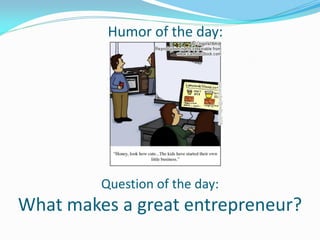
Humor of the day:


         Question of the day:
What makes a great entrepreneur?
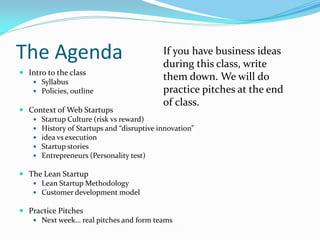
The Agenda                                If you have business ideas
                                          during this class, write
 Intro to the class
    Syllabus
                                          them down. We will do
    Policies, outline                    practice pitches at the end
                                          of class.
 Context of Web Startups
    Startup Culture (risk vs reward)
    History of Startups and “disruptive innovation”
    idea vs execution
    Startup stories
    Entrepreneurs (Personality test)

 The Lean Startup
    Lean Startup Methodology
    Customer development model

 Practice Pitches
    Next week… real pitches and form teams
What is this class?
 Fast paced… lots to cover
 Hands on… all about tools and using them
 A real trial… build your own mini-startup

Who is it for?
 Entrepreneurs… serious about starting startups
 The curious… have an idea but not sure what it takes
Syllabus Important Points
 Grading
    60% = daily quizzes over reading material (8 of them)
    40% = Final project and presentation
 Mondays and Wednesdays 6-9 pm. Last day is July 9th
    No class July 4th
    If you miss a session, you will fall behind. We move fast.
 Other notes
    Textbook (“The Lean Startup”) is great, but not required
    Weekly reading is for the quizzes
    Best time to talk to me is before/after class, or by email
Course Outline
 1: Today… context of web startups and the Lean Startup
 2: Next session, immediately start building a startup
    Pitches and teams
    Business planning
    Intro to Websites
 3: Market research and web tools
 4-7: Four sessions on web product development
 8: Marketing your product
 9: Finance and Legal
 10: Final project presentations
The Context of Web Startups
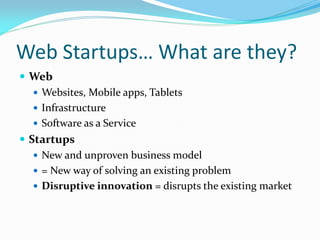
Web Startups… What are they?
 Web
    Websites, Mobile apps, Tablets
    Infrastructure
    Software as a Service
 Startups
    New and unproven business model
    = New way of solving an existing problem
    Disruptive innovation = disrupts the existing market
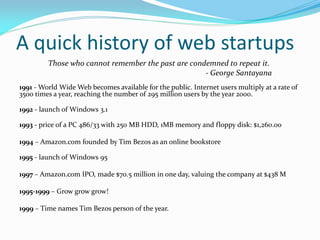
A quick history of web startups
         Those who cannot remember the past are condemned to repeat it.
                                                    - George Santayana
1991 - World Wide Web becomes available for the public. Internet users multiply at a rate of
3500 times a year, reaching the number of 295 million users by the year 2000.

1992 - launch of Windows 3.1

1993 - price of a PC 486/33 with 250 MB HDD, 1MB memory and floppy disk: $1,260.00

1994 – Amazon.com founded by Tim Bezos as an online bookstore

1995 - launch of Windows 95

1997 – Amazon.com IPO, made $70.5 million in one day, valuing the company at $438 M

1995-1999 – Grow grow grow!

1999 – Time names Tim Bezos person of the year.
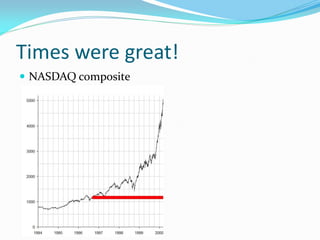
Times were great!
 NASDAQ composite
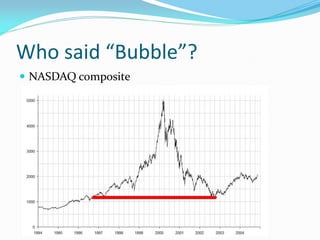
Who said “Bubble”?
 NASDAQ composite
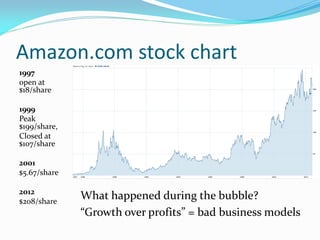
Amazon.com stock chart
1997
open at
$18/share

1999
Peak
$199/share,
Closed at
$107/share

2001
$5.67/share

2012
$208/share
              What happened during the bubble?
              “Growth over profits” = bad business models
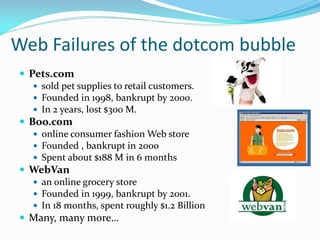
Web Failures of the dotcom bubble
 Pets.com
    sold pet supplies to retail customers.
    Founded in 1998, bankrupt by 2000.
    In 2 years, lost $300 M.
 Boo.com
    online consumer fashion Web store
    Founded , bankrupt in 2000
    Spent about $188 M in 6 months
 WebVan
    an online grocery store
    Founded in 1999, bankrupt by 2001.
    In 18 months, spent roughly $1.2 Billion
 Many, many more…
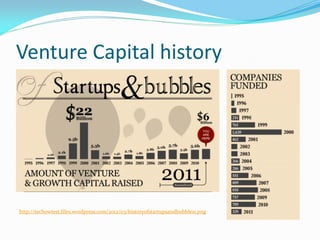
Venture Capital history


http://techowtest.files.wordpress.com/2012/03/historyofstartupsandbubbles1.png
Silicon Valley history
 “South Bay”, Especially Palo Alto, Santa Clara, San Jose
 Named for the number of silicon chip (semiconductor)
  manufacturers, back in 1971

 A very special place in the world
    Today, SV accounts for 1/3 of all venture capital in the USA
    A 2006 The Wall Street Journal story found that 12 of the 20
     most inventive towns in America were in California, and 10 of
     those were in Silicon Valley

 Culture of risk tolerance, of trying high risk ventures
 The “entrepreneurial spirit”
That’s all for history and context,
         back to startups
Web Startups… What are they?
 Web
    Websites, Mobile apps, Tablets
    Infrastructure
    Software as a Service
 Startups
    New and unproven business model
    = New way of solving an existing problem
    Disruptive innovation = disrupts the existing market
What is “disruptive innovation”?
 Let’s use the law firms industry as an example
 “Standard Process”
    College student with good grades goes to law school
    Studies for 3 years, graduates with law degree
    Joins or starts a law firm
    You need legal forms, so you go to this person.
 The result of this “standard process”?
    Costs $$$ hourly
    Requires in-person meetings
    Non-standardized
Disrupt it!
 Enter LegalZoom.com
    An online website with pre-made forms that consumers fill
     out via questionnaires
 New Process
    You need legal forms, but don’t have the $$$ for an attorney
    Go to the website, fill out questionnaire, pay $ fee, done!
 The result?
    Mostly automated = minimal human interaction = low cost
    Online = flexible hours and geographic location
    Standardized forms = consistency
 Is it better?
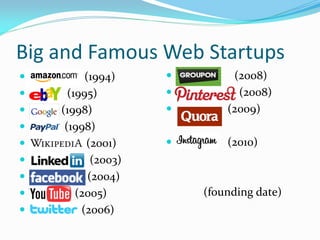
Big and Famous Web Startups
 Amazon.c (1994)        Groupon    (2008)
 Ebay      (1995)                   (2008)
   Googl (1998)                   (2009)
   Paypal (1998)
   Wikipedia (2001)               (2010)
   LinkedIn ( (2003)
   Facebook (2004)
   YouTube (2005)            (founding date)
   Twitter (2006)
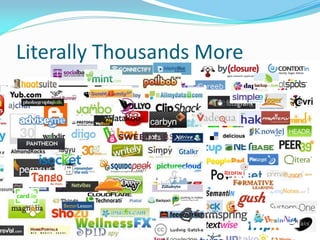
Literally Thousands More
High Risk
 Literally thousands of web startups…
 Lots of direct competitors…
 Very few startups break even…
 Even fewer become profitable…


 The default future for any new startup is to die


 What’s the statistic? Depends on how you count…
 http://www.quora.com/What-is-the-truth-behind-9-out-of-10-startups-fail
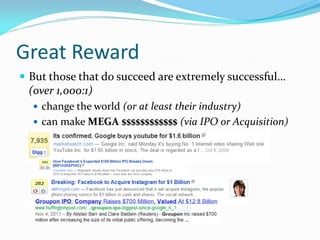
Great Reward
 But those that do succeed are extremely successful…
 (over 1,000:1)
   change the world (or at least their industry)
   can make MEGA $$$$$$$$$$$$ (via IPO or Acquisition)
Back up… what about a small reward?
 That’s fine. Actually there’s 3 ways to exit a company.
 Option 1: IPO = Initial public offering
    Makes the most money ($1 billion +)
    Hardest to do (very few companies make it this far)
    Notables: Facebook, Groupon, LinkedIN
 Option 2: Acquisition
    Usually makes less money ($10 million - $1 billion)
    “Easier” to do
    Notables: YouTube (Google), Skype (Microsoft), Instagram (FB)
 Option 3: “Lifestyle business”
    Makes the least money (recurring “passive” income of <$1 M)
    “Easiest” to do
    No angel or VC investor will invest in a lifestyle business. 
    Notables: 4-hour workweek
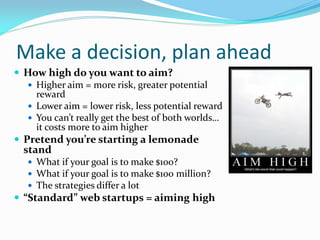
Make a decision, plan ahead
 How high do you want to aim?
    Higher aim = more risk, greater potential
     reward
    Lower aim = lower risk, less potential reward
    You can’t really get the best of both worlds…
     it costs more to aim higher
 Pretend you’re starting a lemonade
  stand
    What if your goal is to make $100?
    What if your goal is to make $100 million?
    The strategies differ a lot
 “Standard” web startups = aiming high
High Risk, Great Reward
 It’s playing the “Startup lottery”
 Assume financial loss, with the small possibility of
  great reward
 It’s done for the experience and the potential


 It’s NOT random.
    You have control over many of the factors for success.
        Skill
        Hard Work
        Luck
So then, how to Be Successful?

      The idea is worth $0.00 = nothing
If you leave with nothing else from this class,
                   leave with this:


The idea has virtually no value.


             (it’s entirely in execution)
The fallacy of the idea
 The idea is only a seed.
    Bags of seeds are cheap. Growing actual plants takes work
    We will prove this later, with practice pitches


 Investors who bet on “ideas” are not betting on “ideas”
    They are betting on the team behind the idea


 No one buys an “idea”
    The closest you get to an idea being valuable is a patent,
     trademark, or copyright which is a lot more involved
How to Be Successful?
 The idea is worth $0.00 = nothing
 Execution is everything!!
 What does that mean? What is “Execution”?
    Planning
    Marketing              Here's the truth of the matter: ideas are
                            pretty much worth zilch. What IS
    Design
                            valuable is the ability to implement an
    Development            idea, turn it into a product, and then sell
    Sales                  that product in the marketplace and
    Fundraising            make money. That's the real work, and
    Legal                  the real reward should go to the people
                            who do that, not the fools who pretend
    Accounting             that they should be rewarded for the
    Partnerships           product of their divine creativity.
Better Execution
 Business Plans vs. The Lean Startup
    Business Plans = Plan and Pray
       Like planning a rocket ship. Every little detail planned ahead.
   Lean Startup = Release and React
       Like driving a car. Just go, and make adjustments on the way
 Lean Startup
    Low overhead, low costs
    Agile Software Development
    Rapid customer-centric development
Break time before section 2
                  …
               A fun activity while we’re on break:
                  Entrepreneur personality quiz
http://www.forbes.com/2010/08/02/entrepreneur-personality-quiz-thomas-
      harrison-entrepreneurs-management-serial-startups-10-quiz.html

                   …
      Section 2: The Lean Startup
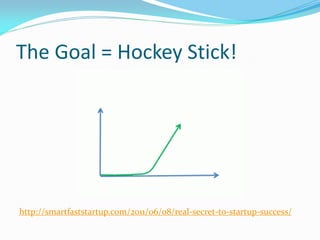
The Goal = Hockey Stick!


http://smartfaststartup.com/2011/06/08/real-secret-to-startup-success/
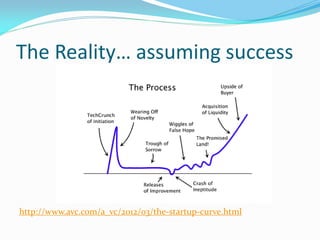
The Reality… assuming success


http://www.avc.com/a_vc/2012/03/the-startup-curve.html
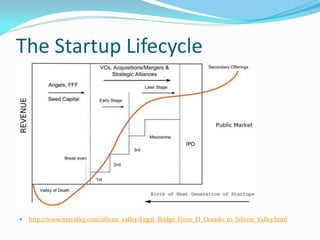
The Startup Lifecycle


   http://www.netvalley.com/silicon_valley/Legal_Bridge_From_El_Dorado_to_Silicon_Valley.html
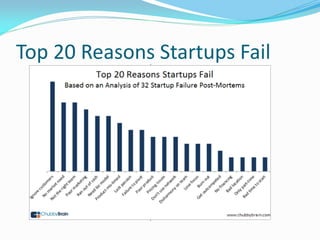
Top 20 Reasons Startups Fail
The Lean Startup (Eric Ries)
 A methodology/philosophy of building
  startups
 1. Use of free and open source software
    Groupon was started as a wordpress blog
 2. Agile Software Development
    Release as frequently as possible
    Iterate development as quickly as possible
 3. Ferocious customer-centric rapid
  iteration
    Customer Development Process
    Build a minimum viable product – launch fast!
    Learn from your users/customers
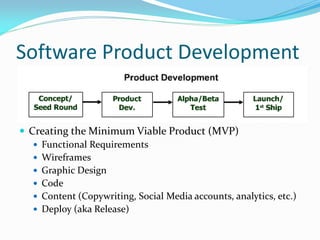
Software Product Development


 Creating the Minimum Viable Product (MVP)
    Functional Requirements
    Wireframes
    Graphic Design
    Code
    Content (Copywriting, Social Media accounts, analytics, etc.)
    Deploy (aka Release)
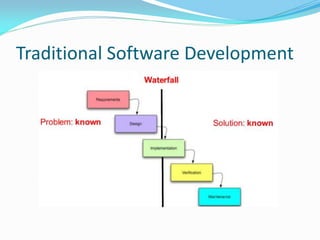
Traditional Software Development
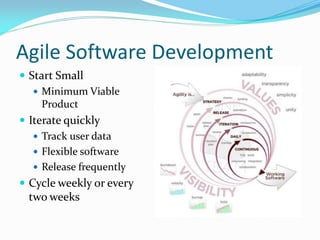
Agile Software Development
 Start Small
    Minimum Viable
     Product
 Iterate quickly
    Track user data
    Flexible software
    Release frequently
 Cycle weekly or every
 two weeks
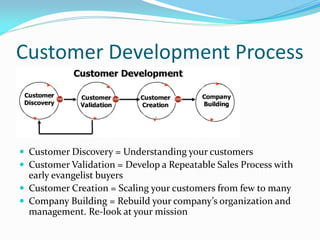
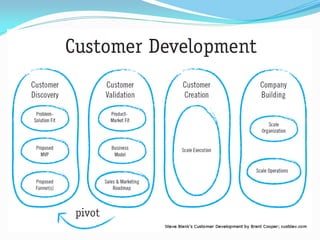
Customer Development Process


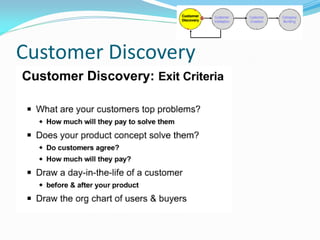
 Customer Discovery = Understanding your customers
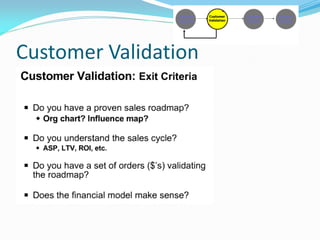
 Customer Validation = Develop a Repeatable Sales Process with
  early evangelist buyers
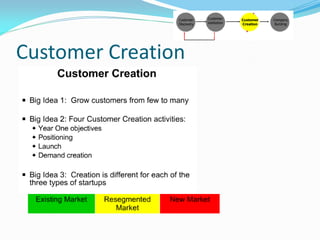
 Customer Creation = Scaling your customers from few to many
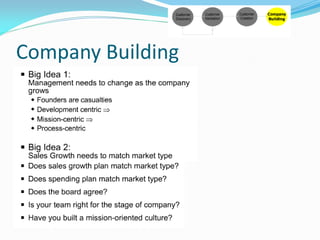
 Company Building = Rebuild your company’s organization and
  management. Re-look at your mission
Customer Discovery
Customer Validation
Customer Creation
Company Building
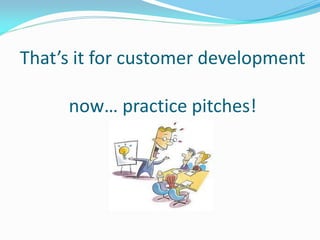
That’s it for customer development

     now… practice pitches!
Homework
 Think about what project you actually want to work on
    Pitches next week to form teams


 Reading material
    Fantasies vs Realities of a Startup infocomic
        http://grasshopper.com/assets/blog/2011/03/fantasy-vs-
         reality-infocomic-v2.jpg
    Steve Blank’s slides on customer development
        http://www.slideshare.net/venturehacks/customer-
         development-methodology-presentation

Class 1: Introduction to web technology entrepreneurship

  • 1.
    Allan Chao Startup Consultant StartupV8 allan@startupv8.com UC Berkeley Extension, Summer 2012
  • 2.
    Humor of theday: Question of the day: What makes a great entrepreneur?
  • 3.
    The Agenda If you have business ideas during this class, write  Intro to the class  Syllabus them down. We will do  Policies, outline practice pitches at the end of class.  Context of Web Startups  Startup Culture (risk vs reward)  History of Startups and “disruptive innovation”  idea vs execution  Startup stories  Entrepreneurs (Personality test)  The Lean Startup  Lean Startup Methodology  Customer development model  Practice Pitches  Next week… real pitches and form teams
  • 4.
    What is thisclass?  Fast paced… lots to cover  Hands on… all about tools and using them  A real trial… build your own mini-startup Who is it for?  Entrepreneurs… serious about starting startups  The curious… have an idea but not sure what it takes
  • 5.
    Syllabus Important Points Grading  60% = daily quizzes over reading material (8 of them)  40% = Final project and presentation  Mondays and Wednesdays 6-9 pm. Last day is July 9th  No class July 4th  If you miss a session, you will fall behind. We move fast.  Other notes  Textbook (“The Lean Startup”) is great, but not required  Weekly reading is for the quizzes  Best time to talk to me is before/after class, or by email
  • 6.
    Course Outline  1:Today… context of web startups and the Lean Startup  2: Next session, immediately start building a startup  Pitches and teams  Business planning  Intro to Websites  3: Market research and web tools  4-7: Four sessions on web product development  8: Marketing your product  9: Finance and Legal  10: Final project presentations
  • 7.
    The Context ofWeb Startups
  • 8.
    Web Startups… Whatare they?  Web  Websites, Mobile apps, Tablets  Infrastructure  Software as a Service  Startups  New and unproven business model  = New way of solving an existing problem  Disruptive innovation = disrupts the existing market
  • 9.
    A quick historyof web startups Those who cannot remember the past are condemned to repeat it. - George Santayana 1991 - World Wide Web becomes available for the public. Internet users multiply at a rate of 3500 times a year, reaching the number of 295 million users by the year 2000. 1992 - launch of Windows 3.1 1993 - price of a PC 486/33 with 250 MB HDD, 1MB memory and floppy disk: $1,260.00 1994 – Amazon.com founded by Tim Bezos as an online bookstore 1995 - launch of Windows 95 1997 – Amazon.com IPO, made $70.5 million in one day, valuing the company at $438 M 1995-1999 – Grow grow grow! 1999 – Time names Tim Bezos person of the year.
  • 10.
    Times were great! NASDAQ composite
  • 11.
  • 12.
    Amazon.com stock chart 1997 openat $18/share 1999 Peak $199/share, Closed at $107/share 2001 $5.67/share 2012 $208/share What happened during the bubble? “Growth over profits” = bad business models
  • 13.
    Web Failures ofthe dotcom bubble  Pets.com  sold pet supplies to retail customers.  Founded in 1998, bankrupt by 2000.  In 2 years, lost $300 M.  Boo.com  online consumer fashion Web store  Founded , bankrupt in 2000  Spent about $188 M in 6 months  WebVan  an online grocery store  Founded in 1999, bankrupt by 2001.  In 18 months, spent roughly $1.2 Billion  Many, many more…
  • 14.
  • 15.
    Silicon Valley history “South Bay”, Especially Palo Alto, Santa Clara, San Jose  Named for the number of silicon chip (semiconductor) manufacturers, back in 1971  A very special place in the world  Today, SV accounts for 1/3 of all venture capital in the USA  A 2006 The Wall Street Journal story found that 12 of the 20 most inventive towns in America were in California, and 10 of those were in Silicon Valley  Culture of risk tolerance, of trying high risk ventures  The “entrepreneurial spirit”
  • 16.
    That’s all forhistory and context, back to startups
  • 17.
    Web Startups… Whatare they?  Web  Websites, Mobile apps, Tablets  Infrastructure  Software as a Service  Startups  New and unproven business model  = New way of solving an existing problem  Disruptive innovation = disrupts the existing market
  • 18.
    What is “disruptiveinnovation”?  Let’s use the law firms industry as an example  “Standard Process”  College student with good grades goes to law school  Studies for 3 years, graduates with law degree  Joins or starts a law firm  You need legal forms, so you go to this person.  The result of this “standard process”?  Costs $$$ hourly  Requires in-person meetings  Non-standardized
  • 19.
    Disrupt it!  EnterLegalZoom.com  An online website with pre-made forms that consumers fill out via questionnaires  New Process  You need legal forms, but don’t have the $$$ for an attorney  Go to the website, fill out questionnaire, pay $ fee, done!  The result?  Mostly automated = minimal human interaction = low cost  Online = flexible hours and geographic location  Standardized forms = consistency  Is it better?
  • 20.
    Big and FamousWeb Startups  Amazon.c (1994)  Groupon (2008)  Ebay (1995)  (2008)  Googl (1998)  (2009)  Paypal (1998)  Wikipedia (2001)  (2010)  LinkedIn ( (2003)  Facebook (2004)  YouTube (2005) (founding date)  Twitter (2006)
  • 21.
  • 22.
    High Risk  Literallythousands of web startups…  Lots of direct competitors…  Very few startups break even…  Even fewer become profitable…  The default future for any new startup is to die  What’s the statistic? Depends on how you count… http://www.quora.com/What-is-the-truth-behind-9-out-of-10-startups-fail
  • 23.
    Great Reward  Butthose that do succeed are extremely successful… (over 1,000:1)  change the world (or at least their industry)  can make MEGA $$$$$$$$$$$$ (via IPO or Acquisition)
  • 24.
    Back up… whatabout a small reward?  That’s fine. Actually there’s 3 ways to exit a company.  Option 1: IPO = Initial public offering  Makes the most money ($1 billion +)  Hardest to do (very few companies make it this far)  Notables: Facebook, Groupon, LinkedIN  Option 2: Acquisition  Usually makes less money ($10 million - $1 billion)  “Easier” to do  Notables: YouTube (Google), Skype (Microsoft), Instagram (FB)  Option 3: “Lifestyle business”  Makes the least money (recurring “passive” income of <$1 M)  “Easiest” to do  No angel or VC investor will invest in a lifestyle business.   Notables: 4-hour workweek
  • 25.
    Make a decision,plan ahead  How high do you want to aim?  Higher aim = more risk, greater potential reward  Lower aim = lower risk, less potential reward  You can’t really get the best of both worlds… it costs more to aim higher  Pretend you’re starting a lemonade stand  What if your goal is to make $100?  What if your goal is to make $100 million?  The strategies differ a lot  “Standard” web startups = aiming high
  • 26.
    High Risk, GreatReward  It’s playing the “Startup lottery”  Assume financial loss, with the small possibility of great reward  It’s done for the experience and the potential  It’s NOT random.  You have control over many of the factors for success.  Skill  Hard Work  Luck
  • 27.
    So then, howto Be Successful?  The idea is worth $0.00 = nothing
  • 28.
    If you leavewith nothing else from this class, leave with this: The idea has virtually no value. (it’s entirely in execution)
  • 29.
    The fallacy ofthe idea  The idea is only a seed.  Bags of seeds are cheap. Growing actual plants takes work  We will prove this later, with practice pitches  Investors who bet on “ideas” are not betting on “ideas”  They are betting on the team behind the idea  No one buys an “idea”  The closest you get to an idea being valuable is a patent, trademark, or copyright which is a lot more involved
  • 30.
    How to BeSuccessful?  The idea is worth $0.00 = nothing  Execution is everything!!  What does that mean? What is “Execution”?  Planning  Marketing Here's the truth of the matter: ideas are pretty much worth zilch. What IS  Design valuable is the ability to implement an  Development idea, turn it into a product, and then sell  Sales that product in the marketplace and  Fundraising make money. That's the real work, and  Legal the real reward should go to the people who do that, not the fools who pretend  Accounting that they should be rewarded for the  Partnerships product of their divine creativity.
  • 31.
    Better Execution  BusinessPlans vs. The Lean Startup  Business Plans = Plan and Pray  Like planning a rocket ship. Every little detail planned ahead.  Lean Startup = Release and React  Like driving a car. Just go, and make adjustments on the way  Lean Startup  Low overhead, low costs  Agile Software Development  Rapid customer-centric development
  • 32.
    Break time beforesection 2 … A fun activity while we’re on break: Entrepreneur personality quiz http://www.forbes.com/2010/08/02/entrepreneur-personality-quiz-thomas- harrison-entrepreneurs-management-serial-startups-10-quiz.html … Section 2: The Lean Startup
  • 33.
    The Goal =Hockey Stick! http://smartfaststartup.com/2011/06/08/real-secret-to-startup-success/
  • 34.
    The Reality… assumingsuccess http://www.avc.com/a_vc/2012/03/the-startup-curve.html
  • 35.
    The Startup Lifecycle  http://www.netvalley.com/silicon_valley/Legal_Bridge_From_El_Dorado_to_Silicon_Valley.html
  • 36.
    Top 20 ReasonsStartups Fail
  • 37.
    The Lean Startup(Eric Ries)  A methodology/philosophy of building startups  1. Use of free and open source software  Groupon was started as a wordpress blog  2. Agile Software Development  Release as frequently as possible  Iterate development as quickly as possible  3. Ferocious customer-centric rapid iteration  Customer Development Process  Build a minimum viable product – launch fast!  Learn from your users/customers
  • 38.
    Software Product Development Creating the Minimum Viable Product (MVP)  Functional Requirements  Wireframes  Graphic Design  Code  Content (Copywriting, Social Media accounts, analytics, etc.)  Deploy (aka Release)
  • 39.
  • 40.
    Agile Software Development Start Small  Minimum Viable Product  Iterate quickly  Track user data  Flexible software  Release frequently  Cycle weekly or every two weeks
  • 41.
    Customer Development Process Customer Discovery = Understanding your customers  Customer Validation = Develop a Repeatable Sales Process with early evangelist buyers  Customer Creation = Scaling your customers from few to many  Company Building = Rebuild your company’s organization and management. Re-look at your mission
  • 42.
  • 43.
  • 44.
  • 45.
  • 47.
    That’s it forcustomer development now… practice pitches!
  • 48.
    Homework  Think aboutwhat project you actually want to work on  Pitches next week to form teams  Reading material  Fantasies vs Realities of a Startup infocomic  http://grasshopper.com/assets/blog/2011/03/fantasy-vs- reality-infocomic-v2.jpg  Steve Blank’s slides on customer development  http://www.slideshare.net/venturehacks/customer- development-methodology-presentation