Allan Chao
Startup V8
allan@StartupV8.com

San Francisco SBA 2011
Introductions
 Who you are
 What you do
 What’s your Startup Idea?
The Agenda
 Why?
    Defining “Web Startups”?
    Risk and Reward
 Lean Startup Methodology
    A new kind of model
    Customer Development
    Agile Software Development
 Web Application Product Development
    Web apps
    Mobile apps
 Equity Financing and Incubation
    Angel Investors and Venture Capitalists
    The pitch system
 Startup Marketing
    Pre-alpha, alpha, closed beta, beta, launch
Web Startups… What are they?
 Web
    Websites, Mobile apps, Tablets
    Infrastructure
    Software as a Service
 Startups
    New and unproven business model
    = New way of solving an existing problem
    Disruptive innovation = disrupts the existing market
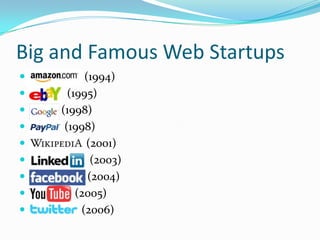
Big and Famous Web Startups
 Amazon.c (1994)
 Ebay      (1995)
   Googl (1998)
   Paypal (1998)
   Wikipedia (2001)
   LinkedIn ( (2003)
   Facebook (2004)
   YouTube (2005)
   Twitter (2006)
Literally Thousands More
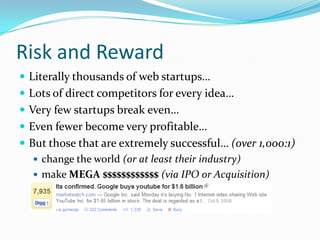
Risk and Reward
 Literally thousands of web startups…
 Lots of direct competitors for every idea…
 Very few startups break even…
 Even fewer become very profitable…
 But those that are extremely successful… (over 1,000:1)
    change the world (or at least their industry)
    make MEGA $$$$$$$$$$$$ (via IPO or Acquisition)
How to Be Successful?
   The idea is worth $0.00 = nothing
   Execution is everything!!
   What does that mean? How do you “Execute”?
   Business Plans vs. The Lean Startup
     Business Plans = Plan and Pray
     Lean Startup = Release and React
 Lean Startup
    Low overhead, low costs
    Agile Software Development
    Rapid customer-centric development
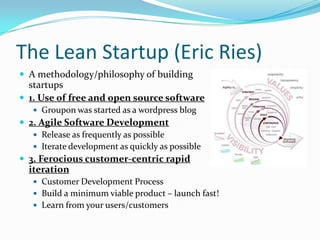
The Lean Startup (Eric Ries)
 A methodology/philosophy of building
  startups
 1. Use of free and open source software
    Groupon was started as a wordpress blog
 2. Agile Software Development
    Release as frequently as possible
    Iterate development as quickly as possible
 3. Ferocious customer-centric rapid
  iteration
    Customer Development Process
    Build a minimum viable product – launch fast!
    Learn from your users/customers
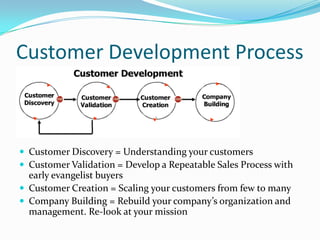
Customer Development Process


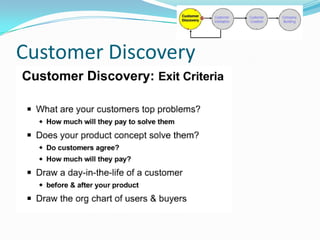
 Customer Discovery = Understanding your customers
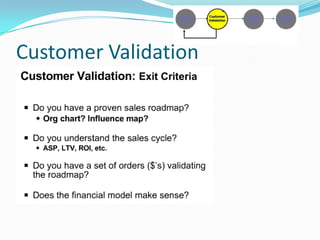
 Customer Validation = Develop a Repeatable Sales Process with
  early evangelist buyers
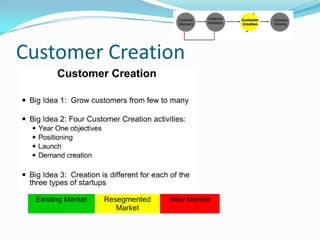
 Customer Creation = Scaling your customers from few to many
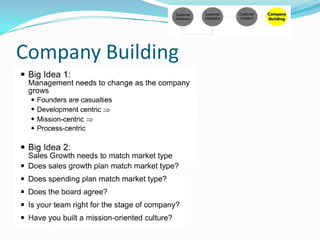
 Company Building = Rebuild your company’s organization and
  management. Re-look at your mission
Customer Discovery
Customer Validation
Customer Creation
Company Building
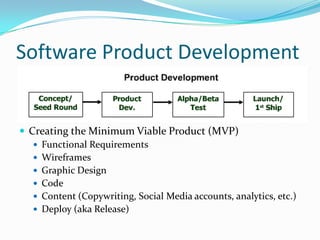
Software Product Development


 Creating the Minimum Viable Product (MVP)
    Functional Requirements
    Wireframes
    Graphic Design
    Code
    Content (Copywriting, Social Media accounts, analytics, etc.)
    Deploy (aka Release)
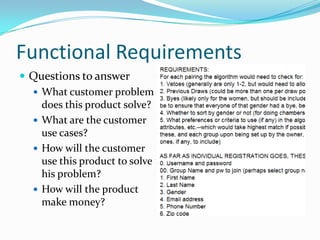
Functional Requirements
 Questions to answer
   What customer problem
    does this product solve?
   What are the customer
    use cases?
   How will the customer
    use this product to solve
    his problem?
   How will the product
    make money?
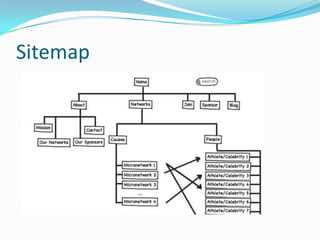
Sitemap
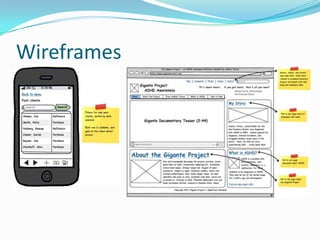
Wireframes
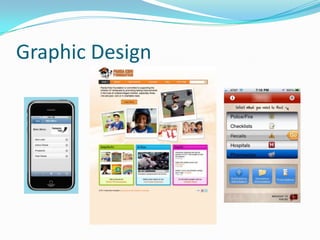
Graphic Design
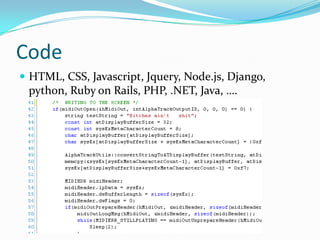
Code
 HTML, CSS, Javascript, Jquery, Node.js, Django,
 python, Ruby on Rails, PHP, .NET, Java, ….
Content
 Every single screen
 Instructions to the user
 Search-Engine-friendly content
    Long tail keywords
    Content Uniqueness
 Any emails that are sent?
 Blog posts?
 PR releases?
 Analytics tools
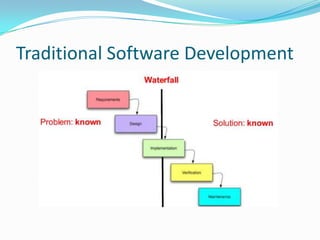
Traditional Software Development
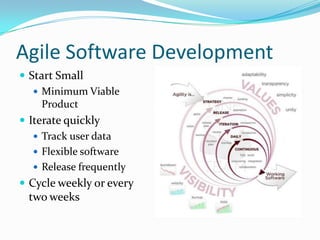
Agile Software Development
 Start Small
    Minimum Viable
     Product
 Iterate quickly
    Track user data
    Flexible software
    Release frequently
 Cycle weekly or every
 two weeks
WebApp Product Development
 Scale development with your business
    Do *NOT* invest $ thousands up-front without customers
 Initial MVP: Something **Very Simple** = $5000 - $15,000
    Groupon started with a Wordpress blog
    Orders were done by email (no online form)
 After market is validated, invest in custom software
    Expensive and time consuming
    Specialist coders
 Nearly infinite depth of programming skills required
    HTML, CSS, Javascript
    Node.js, php, python, .NET, Java, AJAX, Ruby on Rails, etc.
MobileApp Product Development
 Similar process to Web application development
 Costs more: average prototype costs
    1-3 screens: $5,000-$10,000
    5-15 screens: $10,000-$20,000
    “fully featured” app: $20,000+
 Each platform is independent:
    iOS (iPhone)
    Android
    BlackBerry
    Windows Mobile
 Cheap hack: build a web-app that looks like a native app
Equity Financing
 Goal = Give away significant ownership of your
  company to raise money and bring on talent.
 Founders
   Very generally, founders start with an equal split 50-50
    or 33-33-33
   More complicated ways to calculate… google “founder
    equity calculator”
   Experienced co-founders will laugh at you if you think
    the “idea” is worth significantly more: e.g. 80-20.
 Capitalization tables to predict effects of dilution
 Employees expect to get vesting stock
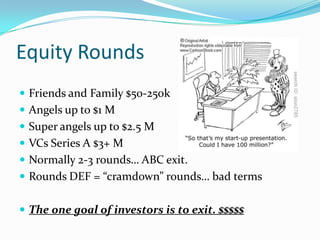
Equity Rounds
 Friends and Family $50-250k
 Angels up to $1 M
 Super angels up to $2.5 M
 VCs Series A $3+ M
 Normally 2-3 rounds… ABC exit.
 Rounds DEF = “cramdown” rounds… bad terms


 The one goal of investors is to exit. $$$$$
Equity Financing caveats
 Takes a long, long, long time to raise money.
 Very involved process
 Prepare to spend money to raise money
    Preparation workshops
    Preparing Presentations
    Flights to investors
    Dinner
 Beware of losing your company
 Term sheets must be reviewed by your lawyer!
Alternative Financing
 Crowd Funding
    Kickstarter.com
    Rockethub
 Competitions / Grants
 Solo Funding
    Bank loans unlikely
    Second mortgage
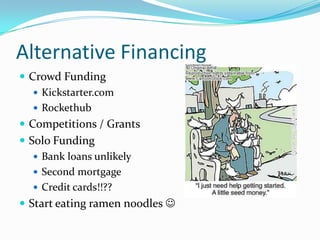
    Credit cards!!??
 Start eating ramen noodles 
Incubation
 Programs that help entrepreneurs get started on their
 projects in exchange for 5-10% equity
   Very small seed capital ($20,000)
   Networking and relationship building
   Presentations to angel investors
 Application based… very competitive (internationally)
Incubator Examples
 Incubators
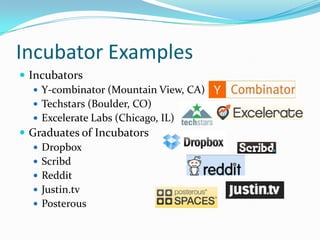
    Y-combinator (Mountain View, CA)
    Techstars (Boulder, CO)
    Excelerate Labs (Chicago, IL)
 Graduates of Incubators
    Dropbox
    Scribd
    Reddit
    Justin.tv
    Posterous
Startup Marketing
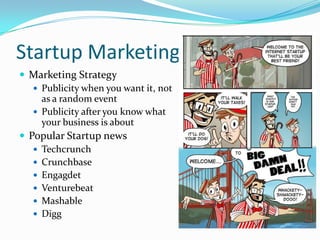
 Marketing Strategy
    Publicity when you want it, not
     as a random event
    Publicity after you know what
     your business is about
 Popular Startup news
    Techcrunch
    Crunchbase
    Engagdet
    Venturebeat
    Mashable
    Digg
Thank you!
 After you complete the evaluation forms,
 please pick up my business card at the back of the room.


Allan Chao
Startup V8
allan@StartupV8.com

Sba 20111003b - starting your own web startup

  • 1.
  • 2.
    Introductions  Who youare  What you do  What’s your Startup Idea?
  • 3.
    The Agenda  Why?  Defining “Web Startups”?  Risk and Reward  Lean Startup Methodology  A new kind of model  Customer Development  Agile Software Development  Web Application Product Development  Web apps  Mobile apps  Equity Financing and Incubation  Angel Investors and Venture Capitalists  The pitch system  Startup Marketing  Pre-alpha, alpha, closed beta, beta, launch
  • 4.
    Web Startups… Whatare they?  Web  Websites, Mobile apps, Tablets  Infrastructure  Software as a Service  Startups  New and unproven business model  = New way of solving an existing problem  Disruptive innovation = disrupts the existing market
  • 5.
    Big and FamousWeb Startups  Amazon.c (1994)  Ebay (1995)  Googl (1998)  Paypal (1998)  Wikipedia (2001)  LinkedIn ( (2003)  Facebook (2004)  YouTube (2005)  Twitter (2006)
  • 6.
  • 7.
    Risk and Reward Literally thousands of web startups…  Lots of direct competitors for every idea…  Very few startups break even…  Even fewer become very profitable…  But those that are extremely successful… (over 1,000:1)  change the world (or at least their industry)  make MEGA $$$$$$$$$$$$ (via IPO or Acquisition)
  • 8.
    How to BeSuccessful?  The idea is worth $0.00 = nothing  Execution is everything!!  What does that mean? How do you “Execute”?  Business Plans vs. The Lean Startup  Business Plans = Plan and Pray  Lean Startup = Release and React  Lean Startup  Low overhead, low costs  Agile Software Development  Rapid customer-centric development
  • 9.
    The Lean Startup(Eric Ries)  A methodology/philosophy of building startups  1. Use of free and open source software  Groupon was started as a wordpress blog  2. Agile Software Development  Release as frequently as possible  Iterate development as quickly as possible  3. Ferocious customer-centric rapid iteration  Customer Development Process  Build a minimum viable product – launch fast!  Learn from your users/customers
  • 10.
    Customer Development Process Customer Discovery = Understanding your customers  Customer Validation = Develop a Repeatable Sales Process with early evangelist buyers  Customer Creation = Scaling your customers from few to many  Company Building = Rebuild your company’s organization and management. Re-look at your mission
  • 11.
  • 12.
  • 13.
  • 14.
  • 15.
    Software Product Development Creating the Minimum Viable Product (MVP)  Functional Requirements  Wireframes  Graphic Design  Code  Content (Copywriting, Social Media accounts, analytics, etc.)  Deploy (aka Release)
  • 16.
    Functional Requirements  Questionsto answer  What customer problem does this product solve?  What are the customer use cases?  How will the customer use this product to solve his problem?  How will the product make money?
  • 17.
  • 18.
  • 19.
  • 20.
    Code  HTML, CSS,Javascript, Jquery, Node.js, Django, python, Ruby on Rails, PHP, .NET, Java, ….
  • 21.
    Content  Every singlescreen  Instructions to the user  Search-Engine-friendly content  Long tail keywords  Content Uniqueness  Any emails that are sent?  Blog posts?  PR releases?  Analytics tools
  • 22.
  • 23.
    Agile Software Development Start Small  Minimum Viable Product  Iterate quickly  Track user data  Flexible software  Release frequently  Cycle weekly or every two weeks
  • 24.
    WebApp Product Development Scale development with your business  Do *NOT* invest $ thousands up-front without customers  Initial MVP: Something **Very Simple** = $5000 - $15,000  Groupon started with a Wordpress blog  Orders were done by email (no online form)  After market is validated, invest in custom software  Expensive and time consuming  Specialist coders  Nearly infinite depth of programming skills required  HTML, CSS, Javascript  Node.js, php, python, .NET, Java, AJAX, Ruby on Rails, etc.
  • 25.
    MobileApp Product Development Similar process to Web application development  Costs more: average prototype costs  1-3 screens: $5,000-$10,000  5-15 screens: $10,000-$20,000  “fully featured” app: $20,000+  Each platform is independent:  iOS (iPhone)  Android  BlackBerry  Windows Mobile  Cheap hack: build a web-app that looks like a native app
  • 26.
    Equity Financing  Goal= Give away significant ownership of your company to raise money and bring on talent.  Founders  Very generally, founders start with an equal split 50-50 or 33-33-33  More complicated ways to calculate… google “founder equity calculator”  Experienced co-founders will laugh at you if you think the “idea” is worth significantly more: e.g. 80-20.  Capitalization tables to predict effects of dilution  Employees expect to get vesting stock
  • 27.
    Equity Rounds  Friendsand Family $50-250k  Angels up to $1 M  Super angels up to $2.5 M  VCs Series A $3+ M  Normally 2-3 rounds… ABC exit.  Rounds DEF = “cramdown” rounds… bad terms  The one goal of investors is to exit. $$$$$
  • 28.
    Equity Financing caveats Takes a long, long, long time to raise money.  Very involved process  Prepare to spend money to raise money  Preparation workshops  Preparing Presentations  Flights to investors  Dinner  Beware of losing your company  Term sheets must be reviewed by your lawyer!
  • 29.
    Alternative Financing  CrowdFunding  Kickstarter.com  Rockethub  Competitions / Grants  Solo Funding  Bank loans unlikely  Second mortgage  Credit cards!!??  Start eating ramen noodles 
  • 30.
    Incubation  Programs thathelp entrepreneurs get started on their projects in exchange for 5-10% equity  Very small seed capital ($20,000)  Networking and relationship building  Presentations to angel investors  Application based… very competitive (internationally)
  • 31.
    Incubator Examples  Incubators  Y-combinator (Mountain View, CA)  Techstars (Boulder, CO)  Excelerate Labs (Chicago, IL)  Graduates of Incubators  Dropbox  Scribd  Reddit  Justin.tv  Posterous
  • 32.
    Startup Marketing  MarketingStrategy  Publicity when you want it, not as a random event  Publicity after you know what your business is about  Popular Startup news  Techcrunch  Crunchbase  Engagdet  Venturebeat  Mashable  Digg
  • 33.
    Thank you!  Afteryou complete the evaluation forms,  please pick up my business card at the back of the room. Allan Chao Startup V8 allan@StartupV8.com