Introduction to video
editing
David Mansell, Belinda Scarlett, Kate
Turner
Team introduction
David
Manse
ll
Belind
a
Scarlet
t
Kate
Turne
r
9/4/20XX 2
Content
s
1. Introduction to video content
2. Planning your video projects
3. Jargon buster
4. Case study: OpenShot
fundamentals
5. Next steps
6. Q&A
3
Introduction-
audience
insights
1
4
User insights
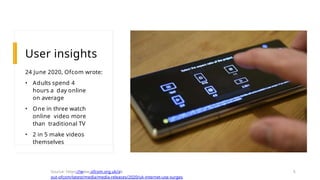
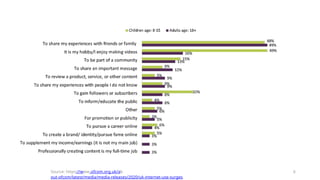
24 June 2020, Ofcom wrote:
• Adults spend 4
hours a day online
on average
• One in three watch
online video more
than traditional TV
• 2 in 5 make videos
themselves
Source: https://www.ofcom.org.uk/ab
out-ofcom/latest/media/media-releases/2020/uk-internet-use-surges
5
Source: https://www.ofcom.org.uk/ab
out-ofcom/latest/media/media-releases/2020/uk-internet-use-surges
6
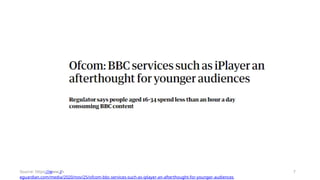
Source: https://www.th
eguardian.com/media/2020/nov/25/ofcom-bbc-services-such-as-iplayer-an-afterthought-for-younger-audiences
7
Planning your
video projects 2
8
“There’s nothing in the world
more powerful than a good
story”
What’s your story?
10
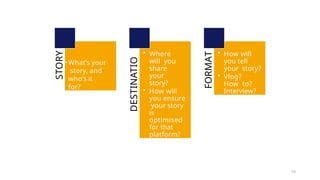
STORY• What’s your
story, and
who’s it
for?
DESTINATIO
N
• Where
will you
share
your
story?
• How will
you ensure
your story
is
optimised
for that
platform?
FORMAT
• How will
you tell
your story?
• Vlog?
How to?
Interview?
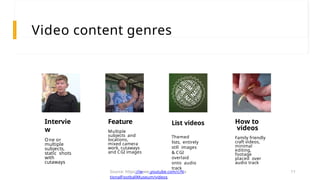
Video content genres
Source: https://www.youtube.com/c/Na
tionalFootballMuseum/videos
11
List videos
Themed
lists, entirely
still images
& CGI
overlaid
onto audio
track
How to
videos
Family friendly
craft videos,
minimal
editing,
footage
placed over
audio track
Intervie
w
One or
multiple
subjects,
static shots
with
cutaways
Feature
Multiple
subjects and
locations,
mixed camera
work, cutaways
and CGI images
Optimising content for social media
Know your (length) limits: Some social platforms impose limits on video length (Twitter = 140
seconds). Others are more likely to recommend longer videos (Youtube). It’s a good idea to
speak to your marketing team early to determine where video can enhance your online offer
Work out a great hook: The first 30 seconds of a video are the most important part. It’s useful to
communicate your message quickly before your audience moves onto another piece of content
Use subtitles & transcripts where possible: A significant amount of video is consumed without
sound- burning in subtitles can help you deliver your message. Transcripts on Youtube &
Facebook can also be used to improve accessibility & SEO
Think phone- aspect ratios & resolution: Experiment with vertical and square videos to take
advantage of an increasingly mobile centric audience. Use the aspect ration & resolution
settings of your NLE to set up content which is properly optimised for a mobile experience
12
Jargon buster
3
NLE: Non linear editor- a digital workspace for creating video files
OpenShot profile (project settings): The basic information of your video including: resolution
and frame rate
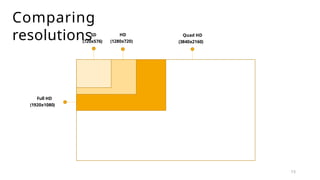
Video resolution (spatial resolution): The total amount of pixels in a video file, usually given as
a horizontal & vertical measurement e.g. 1920x1080 (HD video) 3840x1260 (4K Ultra HD)
7680x 4320 (8K). More pixels = more detail
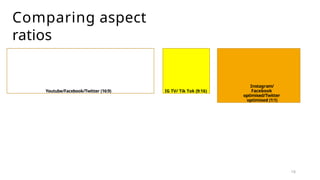
Aspect ratio: The relationship between a video’s height & width. Video displayed on modern
TVs/monitors will usually be 16:9. It is common to see aspect ratios of 1:1 and 3:2 on social
media
Pixel ratio: The relationship between the height and width of individual pixels in a video
frame. Most
NLE’s have the option to change this. 1:1 is commonly seen in web video
Frame rate (FPS): The amount of frames contained in a single second of video. Frame rates are
determined by artistic/technical requirements
Video encoding: The process of compressing a video into a single file. A codec allows the video
to be opened and played by a device. A common web codec is h.264
SD
(720x576)
15
HD
(1280x720)
Full HD
(1920x1080)
Quad HD
(3840x2160)
Comparing
resolutions
16
Youtube/Facebook/Twitter (16:9) IG TV/ Tik Tok (9:16)
Instagram/
Facebook
optimised/Twitter
optimised (1:1)
Comparing aspect
ratios
Using OpenShot
4
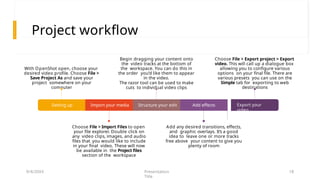
Project workflow
Setting up Import your media Structure your edit Add effects
With OpenShot open, choose your
desired video profile. Choose File >
Save Project As and save your
project somewhere on your
computer
Choose File > Import Files to open
your file explorer. Double click on
any video clips, images, and audio
files that you would like to include
in your final video. These will now
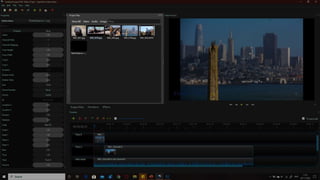
be available in the Project files
section of the workspace
Begin dragging your content onto
the video tracks at the bottom of
the workspace. You can do this in
the order you’d like them to appear
in the video.
The razor tool can be used to make
cuts to individual video clips
Add any desired transitions, effects,
and graphic overlays. It’s a good
idea to leave one or more tracks
free above your content to give you
plenty of room
Export your
video
Choose File > Export project > Export
video. This will call up a dialogue box
allowing you to configure various
options on your final file. There are
various presets you can use on the
Simple tab for exporting to web
destinations
9/4/20XX Presentation
Title
18
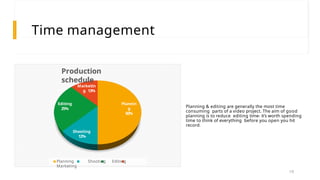
Time management
19
Plannin
g
50%
Shooting
12%
Editing
25%
Marketin
g 13%
Production
schedule
Planning Shooting Editing
Marketing
Planning & editing are generally the most time
consuming parts of a video project. The aim of good
planning is to reduce editing time- it’s worth spending
time to think of everything before you open you hit
record.
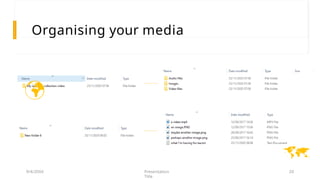
Organising your media
9/4/20XX Presentation
Title

20

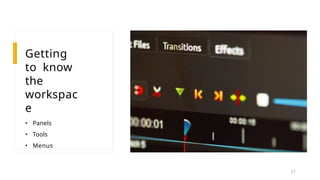
Getting
to know
the
workspac
e
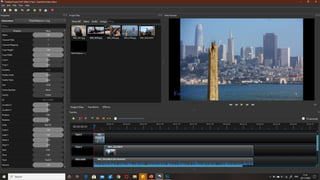
• Panels
• Tools
• Menus
21
Getting to know the
workspace
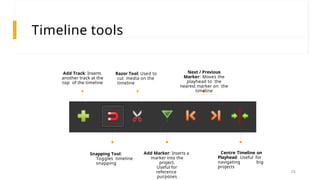
Timeline tools
Add Track: Inserts
another track at the
top of the timeline
26
Next / Previous
Marker: Moves the
playhead to the
nearest marker on the
timeline
Add Marker: Inserts a
marker into the
project.
Useful for
reference
purposes
Centre Timeline on
Playhead: Useful for
navigating big
projects
Snapping Tool:
Toggles timeline
snapping
Razor Tool: Used to
cut media on the
timeline
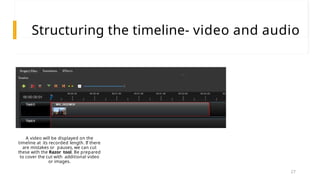
Structuring the timeline- video and audio
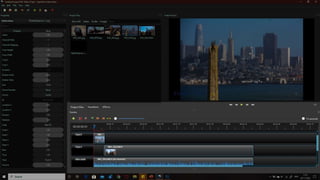
A video will be displayed on the
timeline at its recorded length. If there
are mistakes or pauses, we can cut
these with the Razor tool. Be prepared
to cover the cut with additional video
or images.
27
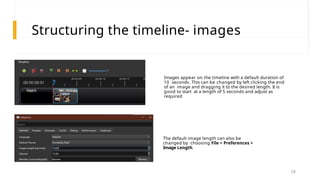
Structuring the timeline- images
Images appear on the timeline with a default duration of
10 seconds. This can be changed by left clicking the end
of an image and dragging it to the desired length. It is
good to start at a length of 5 seconds and adjust as
required
The default image length can also be
changed by choosing File > Preferences >
Image Length.
28
29
9/4/20XX Presentation
Title
30
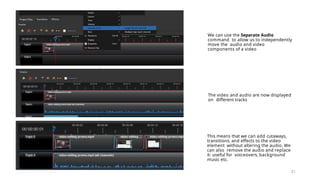
We can use the Separate Audio
command to allow us to independently
move the audio and video
components of a video
31
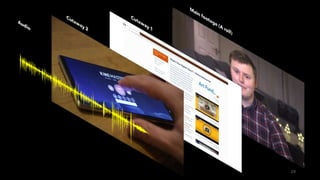
The video and audio are now displayed
on different tracks
This means that we can add cutaways,
transitions, and effects to the video
element without altering the audio. We
can also remove the audio and replace
it- useful for voiceovers, background
music etc.
Structuring advice
32
Keep your mind on your message: Stick to your main message and cut anything that doesn’t
support it.
It’s useful to keep a copy of your script to hand when you’re editing
Use your B roll: Keep your edit varied with cutaways. If you don’t have additional footage, use
images.
Strong visuals can often speak for themselves without vocalised explanations
Get a second opinion: Let somebody else watch your edit without commentary. Ask them if it
made sense, and what the main points were. This is a good indication on whether your
video is easy to understand of it needs more work
Applying effects and animations
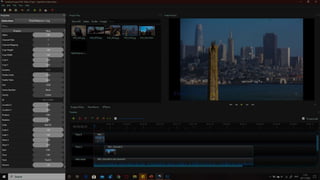
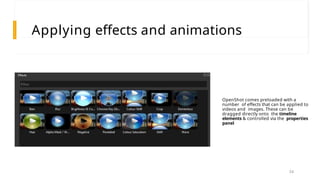
OpenShot comes preloaded with a
number of effects that can be applied to
videos and images. These can be
dragged directly onto the timeline
elements & controlled via the properties
panel
34
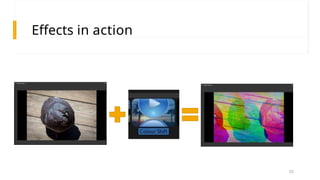
Effects in action
35
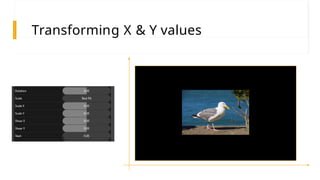
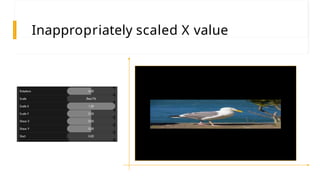
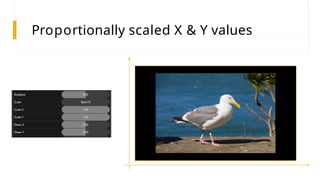
Transforming X & Y values
Inappropriately scaled X value
Proportionally scaled X & Y values
9/4/20XX Presentation
Title
39
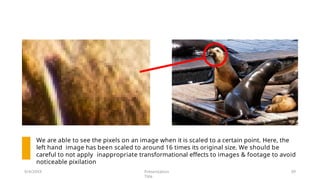
We are able to see the pixels on an image when it is scaled to a certain point. Here, the
left hand image has been scaled to around 16 times its original size. We should be
careful to not apply inappropriate transformational effects to images & footage to avoid
noticeable pixilation
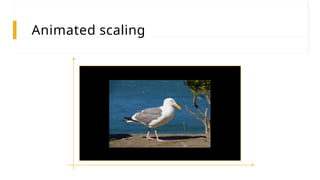
Animated scaling
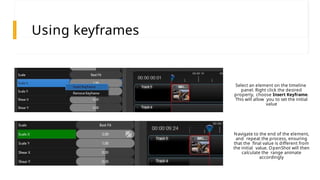
Using keyframes
Select an element on the timeline
panel. Right click the desired
property, choose Insert Keyframe.
This will allow you to set the initial
value
Navigate to the end of the element,
and repeat the process, ensuring
that the final value is different from
the initial value. OpenShot will then
calculate the range animate
accordingly
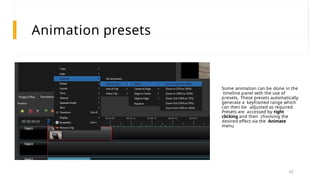
Animation presets
Some animation can be done in the
timeline panel with the use of
presets. These presets automatically
generate a keyframed range which
can then be adjusted as required.
Presets are accessed by right
clicking and then choosing the
desired effect via the Animate
menu
42
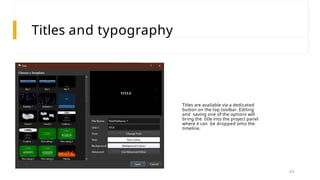
Titles and typography
Titles are available via a dedicated
button on the top toolbar. Editing
and saving one of the options will
bring the title into the project panel
where it can be dropped onto the
timeline.
43
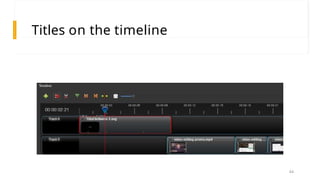
Titles on the timeline
44
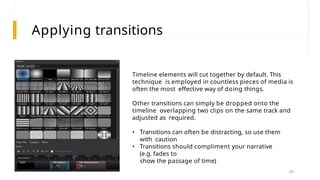
Applying transitions
Timeline elements will cut together by default. This
technique is employed in countless pieces of media is
often the most effective way of doing things.
Other transitions can simply be dropped onto the
timeline overlapping two clips on the same track and
adjusted as required.
• Transitions can often be distracting, so use them
with caution
• Transitions should compliment your narrative
(e.g. fades to
show the passage of time)
45
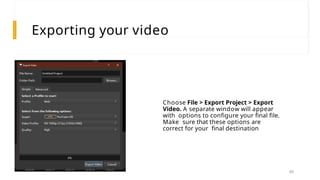
Exporting your video
Choose File > Export Project > Export
Video. A separate window will appear
with options to configure your final file.
Make sure that these options are
correct for your final destination
46
Next steps
47
5
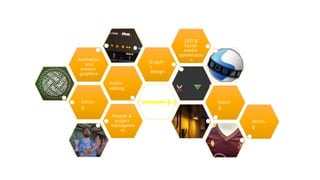
Filmin
g
Audio
editing
Animation
and
motion
graphics
Graphi
c
design
SEO &
Social
media
optimisatio
n
Editin
g
People &
project
manageme
nt
Writin
g
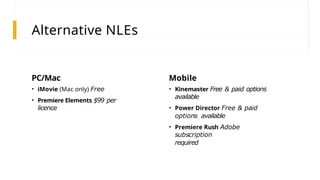
Alternative NLEs
PC/Mac
• iMovie (Mac only) Free
• Premiere Elements $99 per
licence
Mobile
• Kinemaster Free & paid options
available
• Power Director Free & paid
options available
• Premiere Rush Adobe
subscription
required
Download Sporting Heritage’s online resources:
https://www.sportingheritage.org.uk/content/what-
we-do/projects/whats-your-digital-story/whats-your-digital-sporting-story-online-resources
Past Webinars: Film making with Si Gamble
https://www.youtube.com/watch?v=Ed_J8XCSyMQ&list=PLo4dOSLqKYaiwkQbGD2KAlk0fowsFteX
v&in
dex=2
Sharing your collection online: https://www.youtube.com/watch?v=MSYGjxQeFS4
Download OpenShot: https://www.openshot.org/
Resources to look at
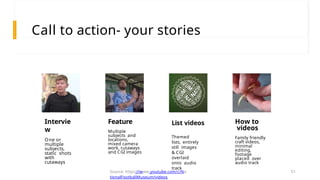
Call to action- your stories
Source: https://www.youtube.com/c/Na
tionalFootballMuseum/videos
51
List videos
Themed
lists, entirely
still images
& CGI
overlaid
onto audio
track
How to
videos
Family friendly
craft videos,
minimal
editing,
footage
placed over
audio track
Intervie
w
One or
multiple
subjects,
static shots
with
cutaways
Feature
Multiple
subjects and
locations,
mixed camera
work, cutaways
and CGI images
FAQs/Q&A
6
52
What style should I go for in my videos? I
s it appropriate to take cues from
vloggers/Youtubers?
How long does an edit take? How do I break down my time for a video project?
How do I measure success?
What’s the best way to advocate for doing more video in my
organisation? I’m a one person team, but really keen to do more
video. Any advice?
Who’s doing a good job of video that I can be inspired by?
Are there any good resources available that’ll help me produce
videos?

Introduction-to-video-audio-editing-1.pptx

  • 1.
    Introduction to video editing DavidMansell, Belinda Scarlett, Kate Turner
  • 2.
  • 3.
    Content s 1. Introduction tovideo content 2. Planning your video projects 3. Jargon buster 4. Case study: OpenShot fundamentals 5. Next steps 6. Q&A 3
  • 4.
  • 5.
    User insights 24 June2020, Ofcom wrote: • Adults spend 4 hours a day online on average • One in three watch online video more than traditional TV • 2 in 5 make videos themselves Source: https://www.ofcom.org.uk/ab out-ofcom/latest/media/media-releases/2020/uk-internet-use-surges 5
  • 6.
  • 7.
  • 8.
  • 9.
    “There’s nothing inthe world more powerful than a good story” What’s your story?
  • 10.
    10 STORY• What’s your story,and who’s it for? DESTINATIO N • Where will you share your story? • How will you ensure your story is optimised for that platform? FORMAT • How will you tell your story? • Vlog? How to? Interview?
  • 11.
    Video content genres Source:https://www.youtube.com/c/Na tionalFootballMuseum/videos 11 List videos Themed lists, entirely still images & CGI overlaid onto audio track How to videos Family friendly craft videos, minimal editing, footage placed over audio track Intervie w One or multiple subjects, static shots with cutaways Feature Multiple subjects and locations, mixed camera work, cutaways and CGI images
  • 12.
    Optimising content forsocial media Know your (length) limits: Some social platforms impose limits on video length (Twitter = 140 seconds). Others are more likely to recommend longer videos (Youtube). It’s a good idea to speak to your marketing team early to determine where video can enhance your online offer Work out a great hook: The first 30 seconds of a video are the most important part. It’s useful to communicate your message quickly before your audience moves onto another piece of content Use subtitles & transcripts where possible: A significant amount of video is consumed without sound- burning in subtitles can help you deliver your message. Transcripts on Youtube & Facebook can also be used to improve accessibility & SEO Think phone- aspect ratios & resolution: Experiment with vertical and square videos to take advantage of an increasingly mobile centric audience. Use the aspect ration & resolution settings of your NLE to set up content which is properly optimised for a mobile experience 12
  • 13.
  • 14.
    NLE: Non lineareditor- a digital workspace for creating video files OpenShot profile (project settings): The basic information of your video including: resolution and frame rate Video resolution (spatial resolution): The total amount of pixels in a video file, usually given as a horizontal & vertical measurement e.g. 1920x1080 (HD video) 3840x1260 (4K Ultra HD) 7680x 4320 (8K). More pixels = more detail Aspect ratio: The relationship between a video’s height & width. Video displayed on modern TVs/monitors will usually be 16:9. It is common to see aspect ratios of 1:1 and 3:2 on social media Pixel ratio: The relationship between the height and width of individual pixels in a video frame. Most NLE’s have the option to change this. 1:1 is commonly seen in web video Frame rate (FPS): The amount of frames contained in a single second of video. Frame rates are determined by artistic/technical requirements Video encoding: The process of compressing a video into a single file. A codec allows the video to be opened and played by a device. A common web codec is h.264
  • 15.
  • 16.
    16 Youtube/Facebook/Twitter (16:9) IGTV/ Tik Tok (9:16) Instagram/ Facebook optimised/Twitter optimised (1:1) Comparing aspect ratios
  • 17.
  • 18.
    Project workflow Setting upImport your media Structure your edit Add effects With OpenShot open, choose your desired video profile. Choose File > Save Project As and save your project somewhere on your computer Choose File > Import Files to open your file explorer. Double click on any video clips, images, and audio files that you would like to include in your final video. These will now be available in the Project files section of the workspace Begin dragging your content onto the video tracks at the bottom of the workspace. You can do this in the order you’d like them to appear in the video. The razor tool can be used to make cuts to individual video clips Add any desired transitions, effects, and graphic overlays. It’s a good idea to leave one or more tracks free above your content to give you plenty of room Export your video Choose File > Export project > Export video. This will call up a dialogue box allowing you to configure various options on your final file. There are various presets you can use on the Simple tab for exporting to web destinations 9/4/20XX Presentation Title 18
  • 19.
    Time management 19 Plannin g 50% Shooting 12% Editing 25% Marketin g 13% Production schedule PlanningShooting Editing Marketing Planning & editing are generally the most time consuming parts of a video project. The aim of good planning is to reduce editing time- it’s worth spending time to think of everything before you open you hit record.
  • 20.
    Organising your media 9/4/20XXPresentation Title  20 
  • 21.
  • 22.
    Getting to knowthe workspace
  • 26.
    Timeline tools Add Track:Inserts another track at the top of the timeline 26 Next / Previous Marker: Moves the playhead to the nearest marker on the timeline Add Marker: Inserts a marker into the project. Useful for reference purposes Centre Timeline on Playhead: Useful for navigating big projects Snapping Tool: Toggles timeline snapping Razor Tool: Used to cut media on the timeline
  • 27.
    Structuring the timeline-video and audio A video will be displayed on the timeline at its recorded length. If there are mistakes or pauses, we can cut these with the Razor tool. Be prepared to cover the cut with additional video or images. 27
  • 28.
    Structuring the timeline-images Images appear on the timeline with a default duration of 10 seconds. This can be changed by left clicking the end of an image and dragging it to the desired length. It is good to start at a length of 5 seconds and adjust as required The default image length can also be changed by choosing File > Preferences > Image Length. 28
  • 29.
  • 30.
  • 31.
    We can usethe Separate Audio command to allow us to independently move the audio and video components of a video 31 The video and audio are now displayed on different tracks This means that we can add cutaways, transitions, and effects to the video element without altering the audio. We can also remove the audio and replace it- useful for voiceovers, background music etc.
  • 32.
    Structuring advice 32 Keep yourmind on your message: Stick to your main message and cut anything that doesn’t support it. It’s useful to keep a copy of your script to hand when you’re editing Use your B roll: Keep your edit varied with cutaways. If you don’t have additional footage, use images. Strong visuals can often speak for themselves without vocalised explanations Get a second opinion: Let somebody else watch your edit without commentary. Ask them if it made sense, and what the main points were. This is a good indication on whether your video is easy to understand of it needs more work
  • 34.
    Applying effects andanimations OpenShot comes preloaded with a number of effects that can be applied to videos and images. These can be dragged directly onto the timeline elements & controlled via the properties panel 34
  • 35.
  • 36.
  • 37.
  • 38.
  • 39.
    9/4/20XX Presentation Title 39 We areable to see the pixels on an image when it is scaled to a certain point. Here, the left hand image has been scaled to around 16 times its original size. We should be careful to not apply inappropriate transformational effects to images & footage to avoid noticeable pixilation
  • 40.
  • 41.
    Using keyframes Select anelement on the timeline panel. Right click the desired property, choose Insert Keyframe. This will allow you to set the initial value Navigate to the end of the element, and repeat the process, ensuring that the final value is different from the initial value. OpenShot will then calculate the range animate accordingly
  • 42.
    Animation presets Some animationcan be done in the timeline panel with the use of presets. These presets automatically generate a keyframed range which can then be adjusted as required. Presets are accessed by right clicking and then choosing the desired effect via the Animate menu 42
  • 43.
    Titles and typography Titlesare available via a dedicated button on the top toolbar. Editing and saving one of the options will bring the title into the project panel where it can be dropped onto the timeline. 43
  • 44.
    Titles on thetimeline 44
  • 45.
    Applying transitions Timeline elementswill cut together by default. This technique is employed in countless pieces of media is often the most effective way of doing things. Other transitions can simply be dropped onto the timeline overlapping two clips on the same track and adjusted as required. • Transitions can often be distracting, so use them with caution • Transitions should compliment your narrative (e.g. fades to show the passage of time) 45
  • 46.
    Exporting your video ChooseFile > Export Project > Export Video. A separate window will appear with options to configure your final file. Make sure that these options are correct for your final destination 46
  • 47.
  • 48.
  • 49.
    Alternative NLEs PC/Mac • iMovie(Mac only) Free • Premiere Elements $99 per licence Mobile • Kinemaster Free & paid options available • Power Director Free & paid options available • Premiere Rush Adobe subscription required
  • 50.
    Download Sporting Heritage’sonline resources: https://www.sportingheritage.org.uk/content/what- we-do/projects/whats-your-digital-story/whats-your-digital-sporting-story-online-resources Past Webinars: Film making with Si Gamble https://www.youtube.com/watch?v=Ed_J8XCSyMQ&list=PLo4dOSLqKYaiwkQbGD2KAlk0fowsFteX v&in dex=2 Sharing your collection online: https://www.youtube.com/watch?v=MSYGjxQeFS4 Download OpenShot: https://www.openshot.org/ Resources to look at
  • 51.
    Call to action-your stories Source: https://www.youtube.com/c/Na tionalFootballMuseum/videos 51 List videos Themed lists, entirely still images & CGI overlaid onto audio track How to videos Family friendly craft videos, minimal editing, footage placed over audio track Intervie w One or multiple subjects, static shots with cutaways Feature Multiple subjects and locations, mixed camera work, cutaways and CGI images
  • 52.
  • 53.
    What style shouldI go for in my videos? I s it appropriate to take cues from vloggers/Youtubers? How long does an edit take? How do I break down my time for a video project? How do I measure success? What’s the best way to advocate for doing more video in my organisation? I’m a one person team, but really keen to do more video. Any advice? Who’s doing a good job of video that I can be inspired by? Are there any good resources available that’ll help me produce videos?