Introduction to
UML Diagramming
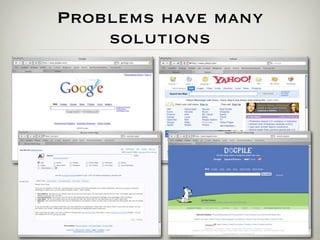
Problems have many
    solutions
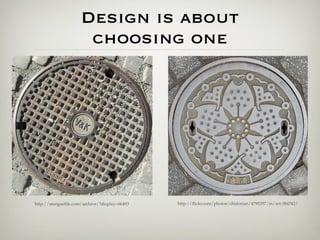
Design is about
                      choosing one


http://morguefile.com/archive/?display=66493   http://flickr.com/photos/chidorian/4795357/in/set-384742/
Why model?
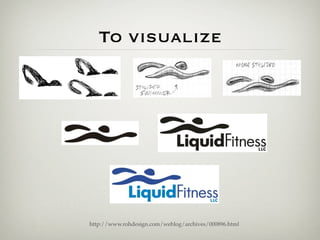
To visualize


http://www.rohdesign.com/weblog/archives/000896.html
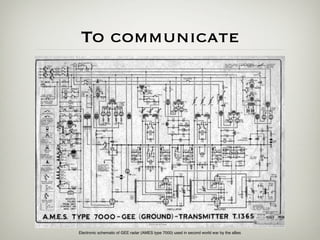
To communicate


Electronic schematic of GEE radar (AMES type 7000) used in second world war by the allies
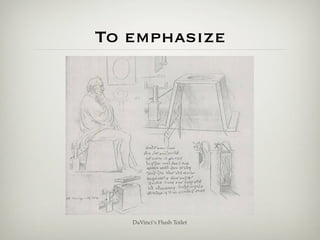
To emphasize


   DaVinci’s Flush Toilet
The UML is a standard
  graphical notation for
describing object-oriented
    software systems
Use UML to visualize,
  communicate, and
emphasize your choices
1           Library
                                      checkout         1                             Membership
                                      return                                        start : Date
                                                                                    renewal : Date

                  *                        due : Date
                                                      LendRecord
          Lendable
                                  1        returned : Boolean
  id
  newArrival : Boolean                 *   LendRecord(lendable, member, date)
  calcDueDate(member): Date                isDue() : Boolean
                                           renew(Date)

                                                                 *
   Book                CD                                                1
                                                                                    *
                                                                                Member
            DVD


Goal: Understand this
: Library            aMember            aLendable
  checkout(lendable, member)

                                     canBorrow(lendable)

                                       numOut(member)


      opt                                       calcDueDate(member)

     { canBorrow == true }
                                                dueDate


                                           record
                                                                      new
                                                                                   aLendRecord


And this
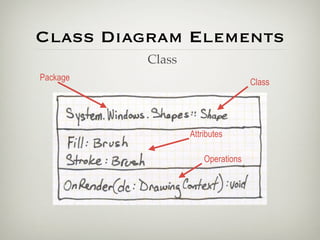
Class Diagram Elements
          Class
Package                            Class


                  Attributes

                      Operations
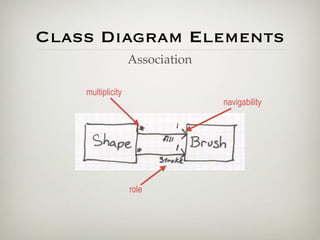
Class Diagram Elements
                   Association

    multiplicity
                                 navigability


                   role
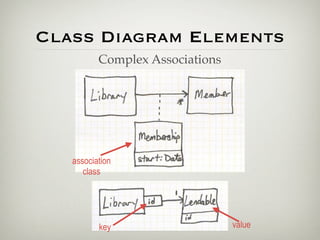
Class Diagram Elements
          Complex Associations


   association
      class


          key                    value
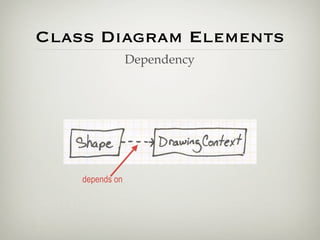
Class Diagram Elements
                 Dependency


    depends on
Class Diagram Elements
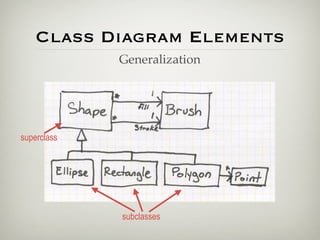
             Generalization


superclass


             subclasses
Class Diagram Elements
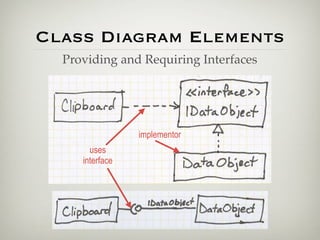
  Providing and Requiring Interfaces


                 implementor
       uses
     interface
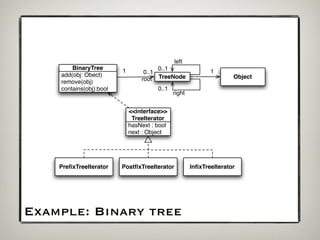
left
        BinaryTree       1             0..1
                                  0..1                       1
    add(obj: Obect)
    remove(obj)                  root TreeNode                       Object

    contains(obj):bool                 0..1
                                              right


                             <<interface>>
                              TreeIterator
                             hasNext : bool
                             next : Object


    PrefixTreeIterator    PostfixTreeIterator           InfixTreeIterator


Example: Binary tree
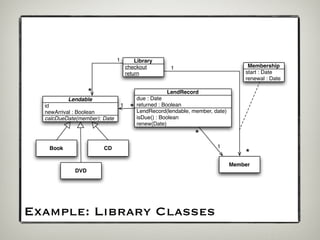
1           Library
                                      checkout         1                             Membership
                                      return                                        start : Date
                                                                                    renewal : Date

                  *                        due : Date
                                                      LendRecord
          Lendable
                                  1        returned : Boolean
  id
  newArrival : Boolean                 *   LendRecord(lendable, member, date)
  calcDueDate(member): Date                isDue() : Boolean
                                           renew(Date)

                                                                 *
   Book                CD                                                1
                                                                                    *
                                                                                Member
            DVD


Example: Library Classes
Sequence Diagram
    Elements
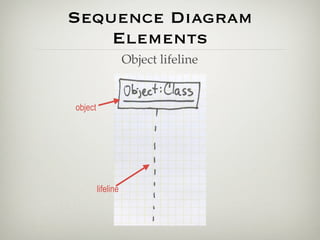
                    Object lifeline


object


         lifeline
Sequence diagram
      elements
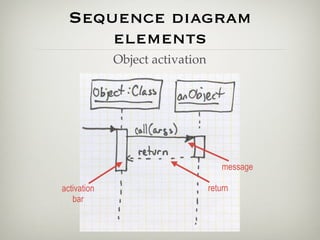
             Object activation


                                     message

activation                       return
   bar
Sequence diagram
    elements
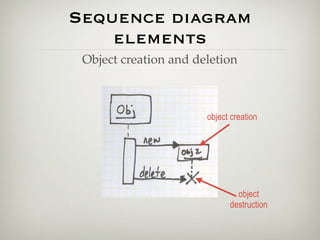
 Object creation and deletion


                       object creation


                               object
                             destruction
Sequence diagram
    elements
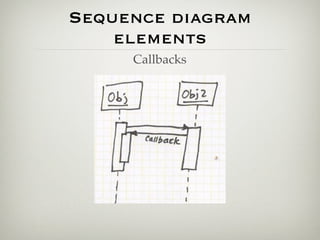
     Callbacks
Sequence diagram
    elements
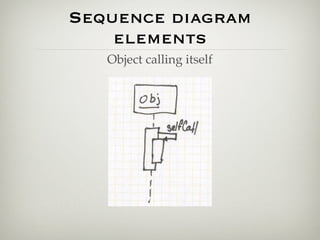
   Object calling itself
Sequence diagram
                   elements
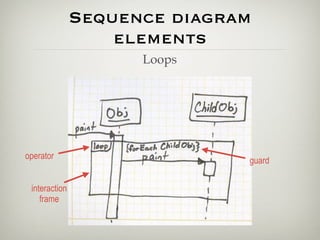
                     Loops


operator                      guard

 interaction
    frame
Sequence diagram
                  elements
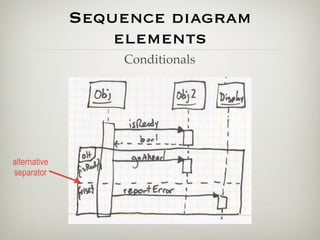
                  Conditionals


alternative
separator
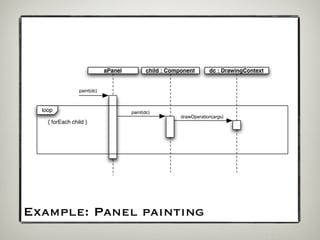
aPanel          child : Component       dc : DrawingContext


                 paint(dc)


  loop                                paint(dc)
                                                         drawOperation(args)
    { forEach child }


Example: Panel painting
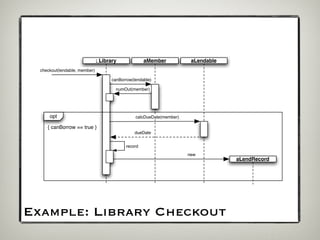
: Library            aMember            aLendable
  checkout(lendable, member)

                                     canBorrow(lendable)

                                       numOut(member)


      opt                                       calcDueDate(member)

     { canBorrow == true }
                                                dueDate


                                           record
                                                                      new
                                                                                   aLendRecord


Example: Library Checkout
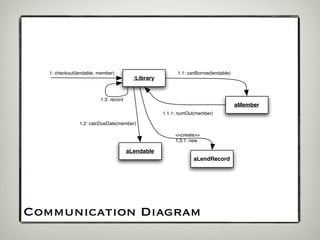
1: checkout(lendable, member)                          1.1: canBorrow(lendable)
                                         :Library


                         1.3: record
                                                                                     aMember
                                                    1.1.1: numOut(member)

                1.2: calcDueDate(member)

                                                         <<create>>
                                                         1.3.1: new

                                       aLendable
                                                                 aLendRecord


Communication Diagram
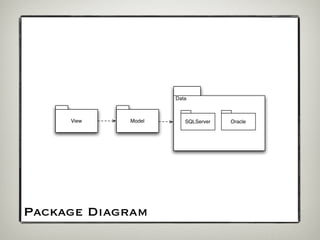
Data


     View   Model      SQLServer   Oracle


Package Diagram
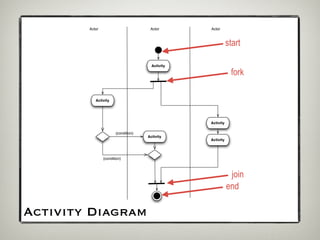
Actor                         Actor       Actor


                                                             start

                                       Activity

                                                              fork

           Activity


                                                  Activity

                       {condition}
                                     Activity
                                                  Activity


                {condition}


                                                              join
                                                             end

Activity Diagram
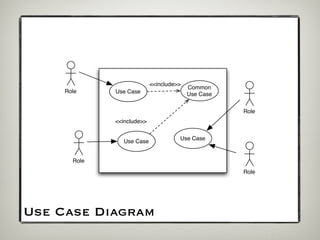
<<include>>
                                          Common
     Role     Use Case                    Use Case


                                                     Role
              <<include>>

                                      Use Case
                Use Case


       Role
                                                     Role


Use Case Diagram
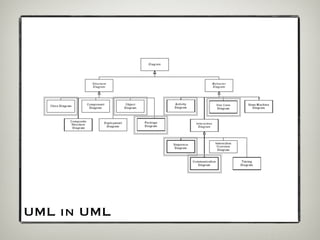
UML in UML
Resources


• UML Distilled by Martin Fowler
• http://bdn.borland.com/article/
  0,1410,31863,00.html
• http://www.uml.org
• http://www.agilemodeling.com
(cc) 2006 Lou Franco
Released under the following creative commons license

     Attribution-NonCommercial-ShareAlike 2.0
 http://creativecommons.org/licenses/by-nc-sa/2.0

Each photograph used has a URL for attribution. Please
      see the original site for the photo’s license.

Introduction to UML

  • 1.
  • 2.
  • 3.
    Design is about choosing one http://morguefile.com/archive/?display=66493 http://flickr.com/photos/chidorian/4795357/in/set-384742/
  • 4.
  • 5.
  • 6.
    To communicate Electronic schematicof GEE radar (AMES type 7000) used in second world war by the allies
  • 7.
    To emphasize DaVinci’s Flush Toilet
  • 8.
    The UML isa standard graphical notation for describing object-oriented software systems
  • 9.
    Use UML tovisualize, communicate, and emphasize your choices
  • 10.
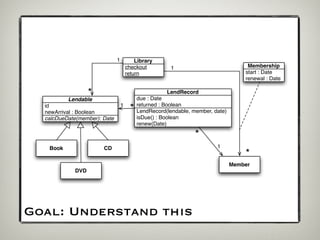
    1 Library checkout 1 Membership return start : Date renewal : Date * due : Date LendRecord Lendable 1 returned : Boolean id newArrival : Boolean * LendRecord(lendable, member, date) calcDueDate(member): Date isDue() : Boolean renew(Date) * Book CD 1 * Member DVD Goal: Understand this
  • 11.
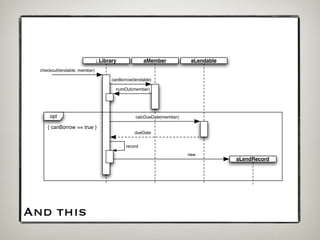
    : Library aMember aLendable checkout(lendable, member) canBorrow(lendable) numOut(member) opt calcDueDate(member) { canBorrow == true } dueDate record new aLendRecord And this
  • 12.
    Class Diagram Elements Class Package Class Attributes Operations
  • 13.
    Class Diagram Elements Association multiplicity navigability role
  • 14.
    Class Diagram Elements Complex Associations association class key value
  • 15.
    Class Diagram Elements Dependency depends on
  • 16.
    Class Diagram Elements Generalization superclass subclasses
  • 17.
    Class Diagram Elements Providing and Requiring Interfaces implementor uses interface
  • 18.
    left BinaryTree 1 0..1 0..1 1 add(obj: Obect) remove(obj) root TreeNode Object contains(obj):bool 0..1 right <<interface>> TreeIterator hasNext : bool next : Object PrefixTreeIterator PostfixTreeIterator InfixTreeIterator Example: Binary tree
  • 19.
    1 Library checkout 1 Membership return start : Date renewal : Date * due : Date LendRecord Lendable 1 returned : Boolean id newArrival : Boolean * LendRecord(lendable, member, date) calcDueDate(member): Date isDue() : Boolean renew(Date) * Book CD 1 * Member DVD Example: Library Classes
  • 20.
    Sequence Diagram Elements Object lifeline object lifeline
  • 21.
    Sequence diagram elements Object activation message activation return bar
  • 22.
    Sequence diagram elements Object creation and deletion object creation object destruction
  • 23.
    Sequence diagram elements Callbacks
  • 24.
    Sequence diagram elements Object calling itself
  • 25.
    Sequence diagram elements Loops operator guard interaction frame
  • 26.
    Sequence diagram elements Conditionals alternative separator
  • 27.
    aPanel child : Component dc : DrawingContext paint(dc) loop paint(dc) drawOperation(args) { forEach child } Example: Panel painting
  • 28.
    : Library aMember aLendable checkout(lendable, member) canBorrow(lendable) numOut(member) opt calcDueDate(member) { canBorrow == true } dueDate record new aLendRecord Example: Library Checkout
  • 29.
    1: checkout(lendable, member) 1.1: canBorrow(lendable) :Library 1.3: record aMember 1.1.1: numOut(member) 1.2: calcDueDate(member) <<create>> 1.3.1: new aLendable aLendRecord Communication Diagram
  • 30.
    Data View Model SQLServer Oracle Package Diagram
  • 31.
    Actor Actor Actor start Activity fork Activity Activity {condition} Activity Activity {condition} join end Activity Diagram
  • 32.
    <<include>> Common Role Use Case Use Case Role <<include>> Use Case Use Case Role Role Use Case Diagram
  • 33.
  • 34.
    Resources • UML Distilledby Martin Fowler • http://bdn.borland.com/article/ 0,1410,31863,00.html • http://www.uml.org • http://www.agilemodeling.com
  • 35.
    (cc) 2006 LouFranco Released under the following creative commons license Attribution-NonCommercial-ShareAlike 2.0 http://creativecommons.org/licenses/by-nc-sa/2.0 Each photograph used has a URL for attribution. Please see the original site for the photo’s license.

Editor's Notes

  • #2 UML is used to model OO design, but what is design?
  • #3 First there are problems, and problems have many solutions. Each solution has its own trade-offs between benefits and drawbacks.
  • #4 Design is choosing the combination of tradeoffs that best solves our problem
  • #6 1. Faster to model than to implement 2. Helps us choose 3. Try different approaches (to compare) 4. Finish the most promising ones
  • #7 1. Communicate to yourself 2. Communicate to implementors 3. Communicate to domain experts
  • #8 1. Models show the important choices 2. Leave out details to emphasize 3. Several different views on same structure
  • #9 UNIFIED MODELING LANGUAGE Unifies: Booch, Rumbaugh, Jacobson Language: Can be used to implement a software system -- equivalent to code omg (uml.org) &amp;#x201C;A specification defining a graphical language for visualizing, specifying, constructing, and documenting the artifacts of distributed object systems.&amp;#xA0;&amp;#x201C; Unifies 50+ OO modeling systems
  • #10 Main point
  • #13 Class name could be just the Name or Package::Name attribute spec is attribute:Type[multiplicity] = default value operation spec is operation : (arg: ArgType, arg2: Arg2Type=default) : Type
  • #14 1. Everything is optional (name could be class name) 2. Multiplicity 3. Bidirectional
  • #15 Top is an association class, where each pairing of Library and Member is represented in a Membership class Bottom is a qualified association where Library has a map of id to Lendable. The Multiplicity is per id. Don&amp;#x2019;t show datastructures, unless ...
  • #16 call, create, permit (friend), use
  • #17 The word generalization emphasizes the role of the base class. Don&amp;#x2019;t think is-a -- think substitutability.
  • #18 Top one emphasizes that Clipboard uses an interface and DataObject is just one of those Bottom one emphasizes that DataObject provides an interface and Clipboard is a class that would use it
  • #19 Only time to show datastructures is if that&amp;#x2019;s specifically what you&amp;#x2019;re monitoring
  • #21 Objects are underlined, either the object name or the class name is optional. If just showing class, keep the colon. The lifeline is the lifetime of the object -- sequence diagrams are read top-down with time passing as we go down.
  • #22 messages are shown with arrows, returns are dashed arrows. Line arrow heads are asynch calls (but you will see half arrows used instead -- old convention). During the bar, the class is active (the message is in the stack frame)
  • #30 m calls m.1, m.2, etc. m.n calls m.n.1, m.n.2, etc. Order is 1, 1.1, 1.1.1, 1.2, 1.3, 1.3.1
  • #31 All classes in each package need to follow this dependency, classes in view can depend on classes in model, but not vice versa.
  • #32 each swim lane has an actor (who is doing the activity) diamond is a branch There are also symbols for sending and receiving signals