


Introduction to the
Witchcraft Compiler Collection
Jonathan Brossard
5th of August 2016 DEFCON 24, Las Vegas, USA
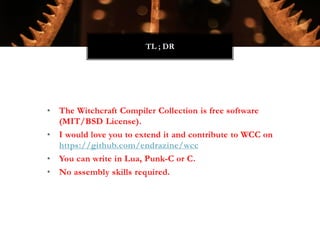
• The Witchcraft Compiler Collection is free software
(MIT/BSD License).
• I would love you to extend it and contribute to WCC on
https://github.com/endrazine/wcc
• You can write in Lua, Punk-C or C.
• No assembly skills required.
TL ; DR
Who am I ?
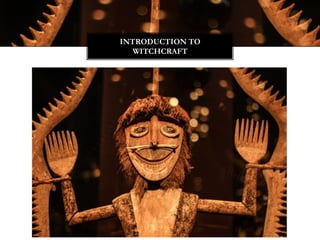
Image courtesy of Pixabay (https://pixabay.com/en/museum-mask-africa-african-cult-953595/)
License : CC0 Public Domain
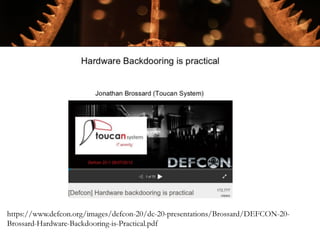
https://www.defcon.org/images/defcon-20/dc-20-presentations/Brossard/DEFCON-20-
Brossard-Hardware-Backdooring-is-Practical.pdf
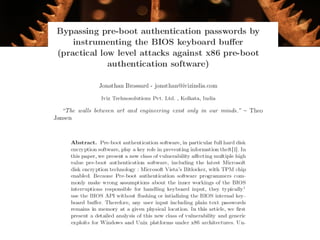
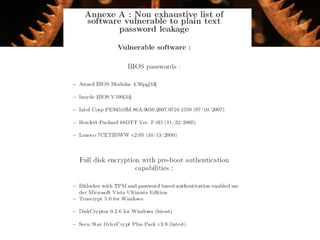
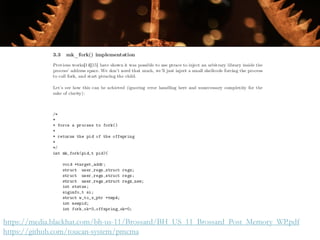
https://media.blackhat.com/bh-us-11/Brossard/BH_US_11_Brossard_Post_Memory_WP.pdf
https://github.com/toucan-system/pmcma
+ Nullcon Goa, which is awesome :)
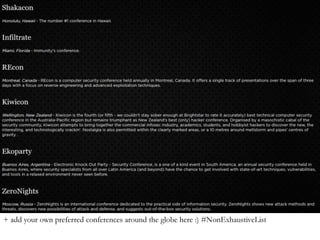
+ add your own preferred conferences around the globe here :) #NonExhaustiveList
DISCLAIMERS
• My employers are not associated with this talk in any way.
• This is my personal research.
DISCLAIMER
• This talk received help from the EFF.
• Warmest thank you to Nate Cardozo, Andrew Crocker and
Mitch Stoltz
Free legal advising to security researchers :
https://www.eff.org/
https://www.eff.org/issues/coders/reverse-engineering-faq
LEGAL HELP
Fcrnx gb bhe fravbe frphevgl UE:
Wnzrf Fnyr
wfnyr@fnyrfsbepr.pbz
uggc://jjj.yvaxrqva.pbz/va/wnzrftfnyr
Tbbq yhpx !
WE’RE RECRUITING
• Motivation
• WCC components
• “Libifying” a binary
• Unlinking binaries
• Crossing a Fish and a Rabbit
• Introduction to Witchcraft
• Binary “reflection” without a VM
• Towards binary self awareness
• Future work
AGENDA
Prerequisites: A binary you have the right to reverse engineer. No source code.
Case studies:
1) You would like to verify the results of a static analysis
2) You know a way to crash an application but don’t want to work on the
entire binary (eg: remote fuzzing).
Let’s work on the ELF 64b version of smbserver-1.5.32.
MOTIVATION
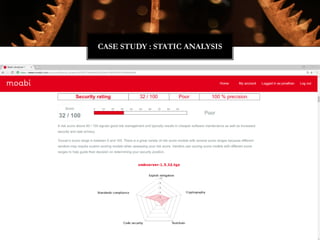
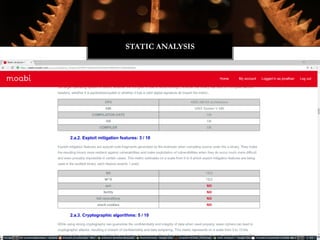
CASE STUDY : STATIC ANALYSIS
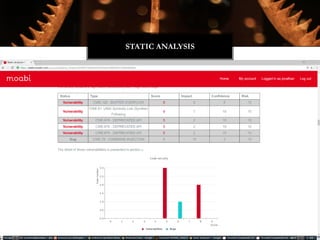
STATIC ANALYSIS
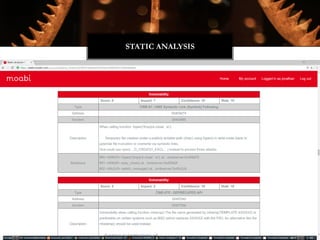
STATIC ANALYSIS
STATIC ANALYSIS
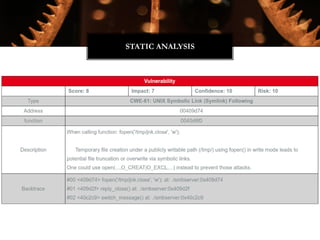
STATIC ANALYSIS
We have only a partial symbolic stack trace.
How to verify if this vulnerability exists ?
Wouldn’t it be nice if we could call reply_close() with arbitrary
arguments directly ?
STATIC ANALYSIS
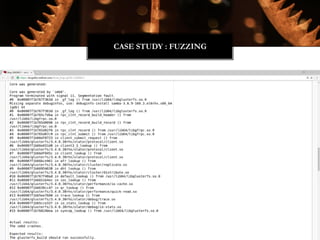
You are fuzzing a complex server (smbd) over the network.
CASE STUDY : FUZZING
We have only a partial symbolic stack trace.
This could be a worker thread (note: smbd is linked with libpthread).
I don’t want to resend new packets or restart threads when analyzing !
Bonus points if you triggered it via instrumentation/concolic execution and
don’t actually have a trigger either.
Can we verify if this vulnerability is exploitable ?
Wouldn’t it be nice to call rpc_clnt_record_build_header() or any
function in client.so with arbitrary arguments directly ?
CASE STUDY : FUZZING
You can do the later with some work (exported functions from shared
libraries) but in theory, not the former ever ever (function directly within a
binary).
Let’s make both possible with 0 code nor reverse engineering.
PROBLEM STATEMENT
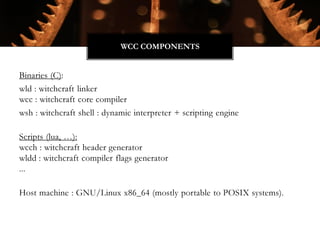
Binaries (C):
wld : witchcraft linker
wcc : witchcraft core compiler
wsh : witchcraft shell : dynamic interpreter + scripting engine
Scripts (lua, …):
wcch : witchcraft header generator
wldd : witchcraft compiler flags generator
...
Host machine : GNU/Linux x86_64 (mostly portable to POSIX systems).
WCC COMPONENTS
Transforming an ELF executable binary into an ELF shared library.
WLD : “LIBIFICATION”
A word on decompiling
DEMOS
typedef struct
{
unsigned char e_ident[EI_NIDENT]; /* Magic number and other info */
Elf64_Half e_type; /* Object file type */
Elf64_Half e_machine; /* Architecture */
Elf64_Word e_version; /* Object file version */
Elf64_Addr e_entry; /* Entry point virtual address */
Elf64_Off e_phoff; /* Program header table file offset */
Elf64_Off e_shoff; /* Section header table file offset */
Elf64_Word e_flags; /* Processor-specific flags */
Elf64_Half e_ehsize; /* ELF header size in bytes */
Elf64_Half e_phentsize; /* Program header table entry size */
Elf64_Half e_phnum; /* Program header table entry count */
Elf64_Half e_shentsize; /* Section header table entry size */
Elf64_Half e_shnum; /* Section header table entry count */
Elf64_Half e_shstrndx; /* Section header string table index */
} Elf64_Ehdr;
LIBIFICATION
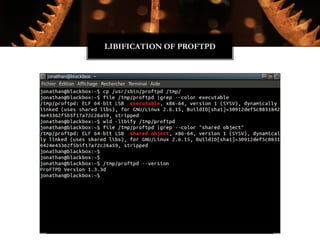
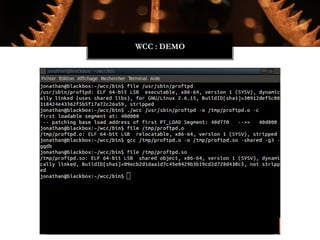
Libification of proftpd
DEMOS
LIBIFICATION OF PROFTPD
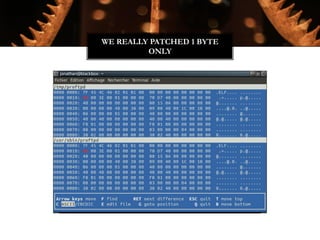
WE REALLY PATCHED 1 BYTE
ONLY
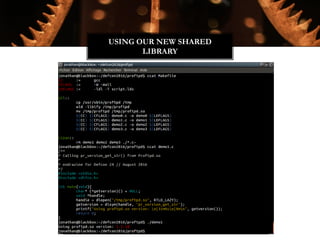
USING OUR NEW SHARED
LIBRARY
We’re really creating a “non relocatable” shared library.
ET_DYN and ET_EXEC ELF files are both executable (ASLR support in the
kernel)
This is equivalent to creating a shared library with a non NULL base address
(equivalent to prelinking)
Note: Amazingly, this shared library is still a valid executable too.
HOW COMES THIS WORKS ?
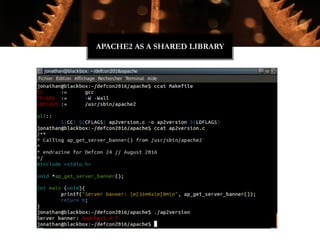
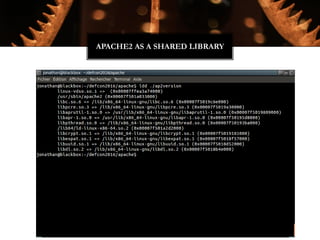
Linking against apache2
DEMOS
APACHE2 AS A SHARED LIBRARY
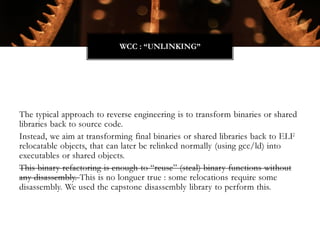
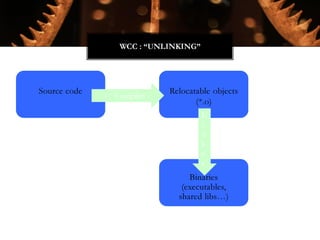
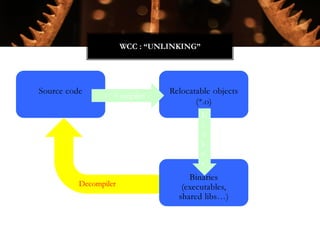
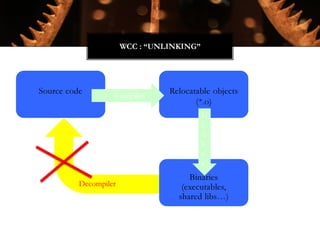
The typical approach to reverse engineering is to transform binaries or shared
libraries back to source code.
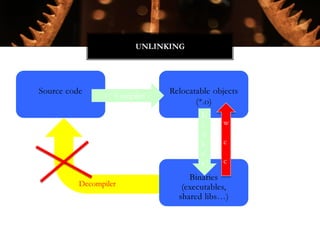
Instead, we aim at transforming final binaries or shared libraries back to ELF
relocatable objects, that can later be relinked normally (using gcc/ld) into
executables or shared objects.
This binary refactoring is enough to “reuse” (steal) binary functions without
any disassembly. This is no longuer true : some relocations require some
disassembly. We used the capstone disassembly library to perform this.
WCC : “UNLINKING”
Source code
WCC : “UNLINKING”
Relocatable objects
(*.o)
Binaries
(executables,
shared libs…)
Compiler
L
i
n
k
e
r
Source code
WCC : “UNLINKING”
Relocatable objects
(*.o)
Binaries
(executables,
shared libs…)
Compiler
L
i
n
k
e
r
Decompiler
Source code
WCC : “UNLINKING”
Relocatable objects
(*.o)
Binaries
(executables,
shared libs…)
Compiler
L
i
n
k
e
r
Decompiler
Source code
UNLINKING
Relocatable objects
(*.o)
Binaries
(executables,
shared libs…)
Compiler
L
i
n
k
e
r
Decompiler
w
c
c
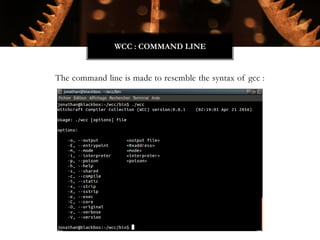
The command line is made to resemble the syntax of gcc :
WCC : COMMAND LINE
The front end is build around libbfd. The backend is trivial C to copy each
mapped section of the binary, handle symbols and relocations.
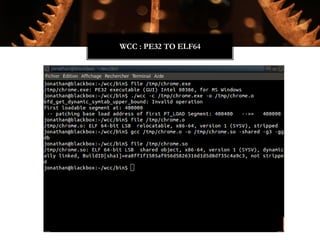
Benefit of using libbfd : the input binary doesn’t need to be an ELF !
=> We can for instance transform a Win64 executable into ELF 64b
relocatable objects…
WCC : INTERNALS
(Binary to object file to relocatable to
unstripped library)
DEMO
WCC : DEMO
(Crossing a Fish and a Rabbit)
DEMO
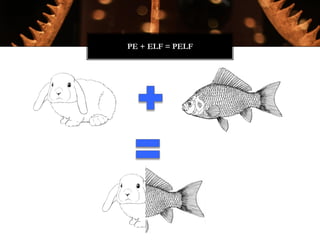
PE + ELF = PELF
WCC : PE32 TO ELF64
Native OpenBSD on linux
DEMO
(Punk-C/Punxie)
WITCHCRAFT
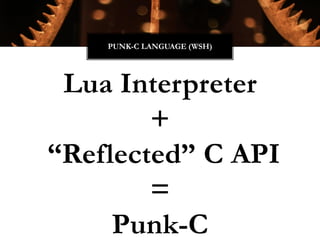
Lua Interpreter
+
“Reflected” C API
=
Punk-C
PUNK-C LANGUAGE (WSH)
INTRODUCTION TO
WITCHCRAFT
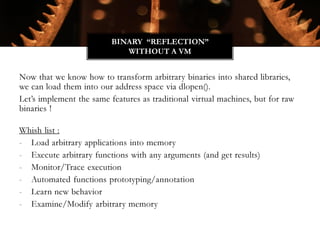
Now that we know how to transform arbitrary binaries into shared libraries,
we can load them into our address space via dlopen().
Let’s implement the same features as traditional virtual machines, but for raw
binaries !
Whish list :
- Load arbitrary applications into memory
- Execute arbitrary functions with any arguments (and get results)
- Monitor/Trace execution
- Automated functions prototyping/annotation
- Learn new behavior
- Examine/Modify arbitrary memory
BINARY “REFLECTION”
WITHOUT A VM
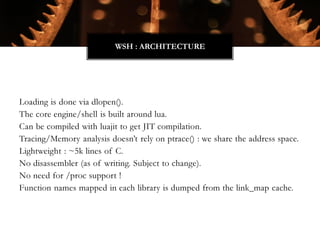
Loading is done via dlopen().
The core engine/shell is built around lua.
Can be compiled with luajit to get JIT compilation.
Tracing/Memory analysis doesn’t rely on ptrace() : we share the address space.
Lightweight : ~5k lines of C.
No disassembler (as of writing. Subject to change).
No need for /proc support !
Function names mapped in each library is dumped from the link_map cache.
WSH : ARCHITECTURE
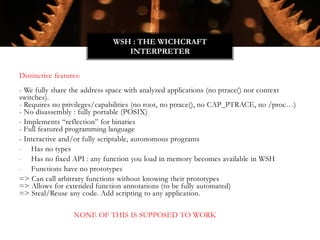
Distinctive features:
- We fully share the address space with analyzed applications (no ptrace() nor context
switches).
- Requires no privileges/capabilities (no root, no ptrace(), no CAP_PTRACE, no /proc…)
- No disassembly : fully portable (POSIX)
- Implements “reflection” for binaries
- Full featured programming language
- Interactive and/or fully scriptable, autonomous programs
- Has no types
- Has no fixed API : any function you load in memory becomes available in WSH
- Functions have no prototypes
=> Can call arbitrary functions without knowing their prototypes
=> Allows for extended function annotations (to be fully automated)
=> Steal/Reuse any code. Add scripting to any application.
NONE OF THIS IS SUPPOSED TO WORK
WSH : THE WICHCRAFT
INTERPRETER
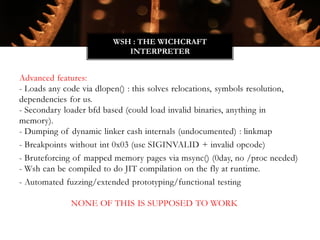
Advanced features:
- Loads any code via dlopen() : this solves relocations, symbols resolution,
dependencies for us.
- Secondary loader bfd based (could load invalid binaries, anything in
memory).
- Dumping of dynamic linker cash internals (undocumented) : linkmap
- Breakpoints without int 0x03 (use SIGINVALID + invalid opcode)
- Bruteforcing of mapped memory pages via msync() (0day, no /proc needed)
- Wsh can be compiled to do JIT compilation on the fly at runtime.
- Automated fuzzing/extended prototyping/functional testing
NONE OF THIS IS SUPPOSED TO WORK
WSH : THE WICHCRAFT
INTERPRETER
DEMO
WITCHCRAFT
Consciousness 1.0
TOWARDS BINARY SELF
AWARENESS
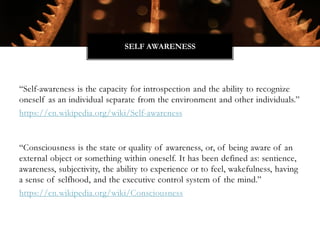
“Self-awareness is the capacity for introspection and the ability to recognize
oneself as an individual separate from the environment and other individuals.”
https://en.wikipedia.org/wiki/Self-awareness
“Consciousness is the state or quality of awareness, or, of being aware of an
external object or something within oneself. It has been defined as: sentience,
awareness, subjectivity, the ability to experience or to feel, wakefulness, having
a sense of selfhood, and the executive control system of the mind.”
https://en.wikipedia.org/wiki/Consciousness
SELF AWARENESS
Numerical solutions
WITCHCRAFT
FUTURE WORK
WITCHCRAFT
- Hyde our own presence better in memory (second heap)
- Remote debugging, running process injection
- Shadow mapping, internal libraries tracing (recursive ltrace)
- ltrace/strace to valid scripts
- system call tracing
FUTURE WORK
Questions ?
TO BE CONTINUED

[Defcon24] Introduction to the Witchcraft Compiler Collection

  • 1.
    Introduction to the WitchcraftCompiler Collection Jonathan Brossard 5th of August 2016 DEFCON 24, Las Vegas, USA
  • 2.
    • The WitchcraftCompiler Collection is free software (MIT/BSD License). • I would love you to extend it and contribute to WCC on https://github.com/endrazine/wcc • You can write in Lua, Punk-C or C. • No assembly skills required. TL ; DR
  • 3.
    Who am I? Image courtesy of Pixabay (https://pixabay.com/en/museum-mask-africa-african-cult-953595/) License : CC0 Public Domain
  • 6.
  • 9.
  • 11.
    + Nullcon Goa,which is awesome :)
  • 12.
    + add yourown preferred conferences around the globe here :) #NonExhaustiveList
  • 13.
  • 14.
    • My employersare not associated with this talk in any way. • This is my personal research. DISCLAIMER
  • 15.
    • This talkreceived help from the EFF. • Warmest thank you to Nate Cardozo, Andrew Crocker and Mitch Stoltz Free legal advising to security researchers : https://www.eff.org/ https://www.eff.org/issues/coders/reverse-engineering-faq LEGAL HELP
  • 16.
    Fcrnx gb bhefravbe frphevgl UE: Wnzrf Fnyr wfnyr@fnyrfsbepr.pbz uggc://jjj.yvaxrqva.pbz/va/wnzrftfnyr Tbbq yhpx ! WE’RE RECRUITING
  • 17.
    • Motivation • WCCcomponents • “Libifying” a binary • Unlinking binaries • Crossing a Fish and a Rabbit • Introduction to Witchcraft • Binary “reflection” without a VM • Towards binary self awareness • Future work AGENDA
  • 18.
    Prerequisites: A binaryyou have the right to reverse engineer. No source code. Case studies: 1) You would like to verify the results of a static analysis 2) You know a way to crash an application but don’t want to work on the entire binary (eg: remote fuzzing). Let’s work on the ELF 64b version of smbserver-1.5.32. MOTIVATION
  • 19.
    CASE STUDY :STATIC ANALYSIS
  • 20.
  • 21.
  • 22.
  • 23.
  • 24.
    We have onlya partial symbolic stack trace. How to verify if this vulnerability exists ? Wouldn’t it be nice if we could call reply_close() with arbitrary arguments directly ? STATIC ANALYSIS
  • 25.
    You are fuzzinga complex server (smbd) over the network. CASE STUDY : FUZZING
  • 26.
    We have onlya partial symbolic stack trace. This could be a worker thread (note: smbd is linked with libpthread). I don’t want to resend new packets or restart threads when analyzing ! Bonus points if you triggered it via instrumentation/concolic execution and don’t actually have a trigger either. Can we verify if this vulnerability is exploitable ? Wouldn’t it be nice to call rpc_clnt_record_build_header() or any function in client.so with arbitrary arguments directly ? CASE STUDY : FUZZING
  • 27.
    You can dothe later with some work (exported functions from shared libraries) but in theory, not the former ever ever (function directly within a binary). Let’s make both possible with 0 code nor reverse engineering. PROBLEM STATEMENT
  • 29.
    Binaries (C): wld :witchcraft linker wcc : witchcraft core compiler wsh : witchcraft shell : dynamic interpreter + scripting engine Scripts (lua, …): wcch : witchcraft header generator wldd : witchcraft compiler flags generator ... Host machine : GNU/Linux x86_64 (mostly portable to POSIX systems). WCC COMPONENTS
  • 30.
    Transforming an ELFexecutable binary into an ELF shared library. WLD : “LIBIFICATION”
  • 31.
    A word ondecompiling DEMOS
  • 32.
    typedef struct { unsigned chare_ident[EI_NIDENT]; /* Magic number and other info */ Elf64_Half e_type; /* Object file type */ Elf64_Half e_machine; /* Architecture */ Elf64_Word e_version; /* Object file version */ Elf64_Addr e_entry; /* Entry point virtual address */ Elf64_Off e_phoff; /* Program header table file offset */ Elf64_Off e_shoff; /* Section header table file offset */ Elf64_Word e_flags; /* Processor-specific flags */ Elf64_Half e_ehsize; /* ELF header size in bytes */ Elf64_Half e_phentsize; /* Program header table entry size */ Elf64_Half e_phnum; /* Program header table entry count */ Elf64_Half e_shentsize; /* Section header table entry size */ Elf64_Half e_shnum; /* Section header table entry count */ Elf64_Half e_shstrndx; /* Section header string table index */ } Elf64_Ehdr; LIBIFICATION
  • 33.
  • 34.
  • 35.
    WE REALLY PATCHED1 BYTE ONLY
  • 36.
    USING OUR NEWSHARED LIBRARY
  • 37.
    We’re really creatinga “non relocatable” shared library. ET_DYN and ET_EXEC ELF files are both executable (ASLR support in the kernel) This is equivalent to creating a shared library with a non NULL base address (equivalent to prelinking) Note: Amazingly, this shared library is still a valid executable too. HOW COMES THIS WORKS ?
  • 38.
  • 39.
    APACHE2 AS ASHARED LIBRARY
  • 40.
    APACHE2 AS ASHARED LIBRARY
  • 41.
    The typical approachto reverse engineering is to transform binaries or shared libraries back to source code. Instead, we aim at transforming final binaries or shared libraries back to ELF relocatable objects, that can later be relinked normally (using gcc/ld) into executables or shared objects. This binary refactoring is enough to “reuse” (steal) binary functions without any disassembly. This is no longuer true : some relocations require some disassembly. We used the capstone disassembly library to perform this. WCC : “UNLINKING”
  • 42.
    Source code WCC :“UNLINKING” Relocatable objects (*.o) Binaries (executables, shared libs…) Compiler L i n k e r
  • 43.
    Source code WCC :“UNLINKING” Relocatable objects (*.o) Binaries (executables, shared libs…) Compiler L i n k e r Decompiler
  • 44.
    Source code WCC :“UNLINKING” Relocatable objects (*.o) Binaries (executables, shared libs…) Compiler L i n k e r Decompiler
  • 45.
  • 46.
    The command lineis made to resemble the syntax of gcc : WCC : COMMAND LINE
  • 47.
    The front endis build around libbfd. The backend is trivial C to copy each mapped section of the binary, handle symbols and relocations. Benefit of using libbfd : the input binary doesn’t need to be an ELF ! => We can for instance transform a Win64 executable into ELF 64b relocatable objects… WCC : INTERNALS
  • 48.
    (Binary to objectfile to relocatable to unstripped library) DEMO
  • 49.
  • 50.
    (Crossing a Fishand a Rabbit) DEMO
  • 51.
    PE + ELF= PELF
  • 52.
    WCC : PE32TO ELF64
  • 53.
  • 54.
  • 55.
    Lua Interpreter + “Reflected” CAPI = Punk-C PUNK-C LANGUAGE (WSH)
  • 56.
  • 57.
    Now that weknow how to transform arbitrary binaries into shared libraries, we can load them into our address space via dlopen(). Let’s implement the same features as traditional virtual machines, but for raw binaries ! Whish list : - Load arbitrary applications into memory - Execute arbitrary functions with any arguments (and get results) - Monitor/Trace execution - Automated functions prototyping/annotation - Learn new behavior - Examine/Modify arbitrary memory BINARY “REFLECTION” WITHOUT A VM
  • 58.
    Loading is donevia dlopen(). The core engine/shell is built around lua. Can be compiled with luajit to get JIT compilation. Tracing/Memory analysis doesn’t rely on ptrace() : we share the address space. Lightweight : ~5k lines of C. No disassembler (as of writing. Subject to change). No need for /proc support ! Function names mapped in each library is dumped from the link_map cache. WSH : ARCHITECTURE
  • 59.
    Distinctive features: - Wefully share the address space with analyzed applications (no ptrace() nor context switches). - Requires no privileges/capabilities (no root, no ptrace(), no CAP_PTRACE, no /proc…) - No disassembly : fully portable (POSIX) - Implements “reflection” for binaries - Full featured programming language - Interactive and/or fully scriptable, autonomous programs - Has no types - Has no fixed API : any function you load in memory becomes available in WSH - Functions have no prototypes => Can call arbitrary functions without knowing their prototypes => Allows for extended function annotations (to be fully automated) => Steal/Reuse any code. Add scripting to any application. NONE OF THIS IS SUPPOSED TO WORK WSH : THE WICHCRAFT INTERPRETER
  • 60.
    Advanced features: - Loadsany code via dlopen() : this solves relocations, symbols resolution, dependencies for us. - Secondary loader bfd based (could load invalid binaries, anything in memory). - Dumping of dynamic linker cash internals (undocumented) : linkmap - Breakpoints without int 0x03 (use SIGINVALID + invalid opcode) - Bruteforcing of mapped memory pages via msync() (0day, no /proc needed) - Wsh can be compiled to do JIT compilation on the fly at runtime. - Automated fuzzing/extended prototyping/functional testing NONE OF THIS IS SUPPOSED TO WORK WSH : THE WICHCRAFT INTERPRETER
  • 61.
  • 62.
  • 63.
    “Self-awareness is thecapacity for introspection and the ability to recognize oneself as an individual separate from the environment and other individuals.” https://en.wikipedia.org/wiki/Self-awareness “Consciousness is the state or quality of awareness, or, of being aware of an external object or something within oneself. It has been defined as: sentience, awareness, subjectivity, the ability to experience or to feel, wakefulness, having a sense of selfhood, and the executive control system of the mind.” https://en.wikipedia.org/wiki/Consciousness SELF AWARENESS
  • 64.
  • 65.
  • 66.
    - Hyde ourown presence better in memory (second heap) - Remote debugging, running process injection - Shadow mapping, internal libraries tracing (recursive ltrace) - ltrace/strace to valid scripts - system call tracing FUTURE WORK
  • 67.