Dr. Biswanath Dutta
Associate Professor
Documentation Research and Training Centre (DRTC)
Indian Statistical Institute
Bangalore 56059 (INDIA)
dutta2005@gmail.com, bisu@drtc.isibang.ac.in, bisu@isibang.ac.in
Tutorial on
SPARQL: SPARQL Protocol
and RDF Query Language
Workshop on "Ontology," KSAWU, Vijayapura, Karnataka, 4-8 Jan 2021
1
Outline
• Introduction to SPARQL
• SPARQL Query Forms
• SELECT Query form
• Simple query
• Multiple match
• Optional Clause
• Filter Clause (string, arithmatic)
• Matching alternatives
• Algebra
• Query for properties and schema
Workshop on "Ontology," KSAWU, Vijayapura, Karnataka, 4-8
Jan 2021
2
Introduction
• SPARQL is a query language for RDF graph traversal
• SPARQL query language specification
• A protocol* for using SPARQL via HTTP
• SPARQL Protocol for RDF Specification
• SPARQL queries and manipulates RDF graph content on the web or in the RDF store
• SPARQL is independent of any particular serialization format (e.g., RDF/XML, N3,
Turtle)
• Inspired by SQL
• SPARQL 1.0: W3C Recommendation (15th January 2008) (https://www.w3.org/TR/rdf-
sparql-query/)
• SPARQL 1.1: W3C Recommendation (21st March 2013)
(https://www.w3.org/TR/sparql11-query/)
*a means of conveying SPARQL queries from query clients to query processors.
Workshop on "Ontology," KSAWU, Vijayapura, Karnataka, 4-8
Jan 2021
3
Introduction (contd…2)
• The SPARQL query result is usually displayed in Tabular form.
• SPARQL query results can be exchanged using any of the following formats:
• Extensible Markup Language (XML)
• JavaScript Object Notation (JSON)
• Comma Separated Value (CSV)
• Tab Separated Value (TSV)
Workshop on "Ontology," KSAWU, Vijayapura, Karnataka, 4-8
Jan 2021
4
SPARQL Four Query Forms
• These query forms use the solutions from pattern matching to form result sets or RDF graphs.
• SELECT query
• Returns all, or a subset of, the variables bound in a query pattern match.
• Extract raw values, the results are returned in a table format.
• CONSTRUCT query
• Returns an RDF graph constructed by substituting variables in a set of triple templates.
• Extract information and transform the results into valid RDF.
• ASK query
• Returns a boolean indicating whether a query pattern matches or not.
• Provides a simple True/False result for a query.
• DESCRIBE query
• Returns an RDF graph that describes the resources found.
• Extract an RDF graph from the SPARQL endpoint, the content of which is left to the endpoint to decide based on
what the maintainer deems as useful information.
Workshop on "Ontology," KSAWU, Vijayapura, Karnataka, 4-8
Jan 2021
5
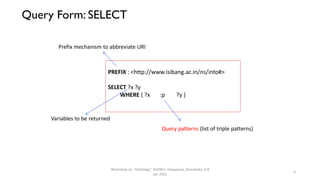
Query Form: SELECT
PREFIX : <http://www.isibang.ac.in/ns/into#>
SELECT ?x ?y
WHERE { ?x :p ?y }
Prefix mechanism to abbreviate URI
Variables to be returned
Query patterns (list of triple patterns)
Workshop on "Ontology," KSAWU, Vijayapura, Karnataka, 4-8
Jan 2021
6
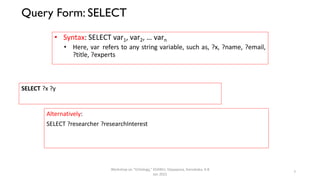
• Syntax: SELECT var1, var2, … varn
• Here, var refers to any string variable, such as, ?x, ?name, ?email,
?title, ?experts
Query Form: SELECT
SELECT ?x ?y
Alternatively:
SELECT ?researcher ?researchInterest
Workshop on "Ontology," KSAWU, Vijayapura, Karnataka, 4-8
Jan 2021
7
WHERE
• Graph patterns to match a set of triples
• Syntax: WHERE {
subject predicate object .
}
Alternative query:
SELECT ?researcher ?researchInterest
WHERE { ?researcher <http://www.isibang.ac.in/ns/into#hasResearchInterest> ?researchInterest}
Workshop on "Ontology," KSAWU, Vijayapura, Karnataka, 4-8
Jan 2021
PREFIX : <http://www.isibang.ac.in/ns/into#hasResearchInterest#>
SELECT ?x ?y
WHERE { ?x : hasResearchInterest ?y }
8
### http://www.isibang.ac.in/ns/into#ADIS
:ADIS rdf:type owl:Class ;
rdfs:subClassOf :CourseSchedule ;
rdfs:comment "This course is equivalent to MLISc
degree"^^xsd:string .
### http://www.isibang.ac.in/ns/into#AcademicProgramme
:AcademicProgramme rdf:type owl:Class .
### http://www.isibang.ac.in/ns/into#AdministrativeStaff
:AdministrativeStaff rdf:type owl:Class ;
rdfs:subClassOf :Employee .
### http://www.isibang.ac.in/ns/into#Agent
:Agent rdf:type owl:Class .
Class inf. of Institutional Ontology (excerpt) (Turtle format)
Workshop on "Ontology," KSAWU, Vijayapura, Karnataka, 4-8
Jan 2021
### http://www.isibang.ac.in/ns/into#Article
:Article rdf:type owl:Class ;
rdfs:subClassOf :Publication .
### http://www.isibang.ac.in/ns/into#Assistant
:Assistant rdf:type owl:Class ;
rdfs:subClassOf :Employee .
### http://www.isibang.ac.in/ns/into#AssistantProfessor
:AssistantProfessor rdf:type owl:Class ;
rdfs:subClassOf :Faculty ,
[ rdf:type owl:Restriction ;
owl:onProperty :supervise ;
owl:maxQualifiedCardinality
"4"^^xsd:nonNegativeInteger ;
owl:onClass :ResearchFellow
] . 9
A Simple Query and Result
SELECT ?class ?sub_class
WHERE { ?class rdfs:subClassOf ?sub_class}
Workshop on "Ontology," KSAWU, Vijayapura, Karnataka, 4-8
Jan 2021
10
Data in Institutional Ontology
Data in Turtle (1):
### http://www.isibang.ac.in/ns/into#KiranKanta
:BiswanathDutta rdf:type owl:NamedIndividual ,
:SeniorResearchFellow ;
:hasAffiliation :DRTC ,
:ISIBC ;
:hasGender :male ;
:hasQualification :BSc ,
:MLISc ;
:hasResearchInterest :Ontology ,
:SWS ,
:SemanticWebBased-eGovernance ;
foaf:age 26 ;
foaf:email “kiran@drtc.isibang.ac.in"^^xsd:string ;
:firstName “Kiran"^^xsd:string ;
:homepage
"http://drtc.isibang.ac.in/~kiran"^^xsd:anyURI ;
:lastName “Kanta"^^xsd:string ;
:rollNo "RS039"^^xsd:string .
............
Workshop on "Ontology," KSAWU, Vijayapura, Karnataka, 4-8
Jan 2021
Data in Turtle (2):
### http://www.isibang.ac.in/ns/into#DebeshDas
:DebeshDas rdf:type owl:NamedIndividual ,
:AssociateProfessor ;
:editorOfEvents :DL2005 ,
:ICSD2007 ;
:hasAffiliation :DRTC ,
:ISIBC ;
:hasGender :male ;
:hasQualification :MLISc ,
:MPhil ;
:hasResearchInterest :AI ,
:DigitalLibrary ,
:NLP ,
:Ontology ;
:supervise :BiswanathDutta ,
:NGuha ,
:SKSunny ;
foaf:age "57"^^xsd:int ;
:firstName "Debesh"^^xsd:string ;
:hasTeachingExperience 10 ;
:homepage "http://drtc.isibang.ac.in/~ard"^^xsd:anyURI ;
:lastName "Das"^^xsd:string ;
:rollNo "ASSP039"^^xsd:string .
............
11
A Simple Query and Result
Workshop on "Ontology," KSAWU, Vijayapura, Karnataka, 4-8
Jan 2021
PREFIX : <http://www.isibang.ac.in/ns/into#>
SELECT ?researcher ?topic
WHERE {?researcher :hasResearchInterest ?topic}
12
Multiple Match
• The above query involves two
triple patterns, each triple ends
with a '.'
– the dot (‘.’) after the last
triple can be omitted. Workshop on "Ontology," KSAWU, Vijayapura, Karnataka, 4-8
Jan 2021
Graph patterns to match a set of triples
Syntax: WHERE {
subject predicate object .
}
E.g.,
PREFIX : <http://www.isibang.ac.in/ns/into#>
PREFIX foaf:<http://xmlns.com/foaf/0.1/>
SELECT ?firstname ?lastname ?age
WHERE {?p :firstName ?firstname .
?p :lastName ?lastname .
?p foaf:age ?age .}
LIMIT 10
13
Optional Clause
• SPARQL also allows to define OPTIONAL blocks.
• They offer the ability to query for data but not to fail query when that data does
not exist.
• Optional blocks define additional graph patterns that do bind to the graph when
they can be matched, but do not cause solutions to be rejected if they are not
matched.
Workshop on "Ontology," KSAWU, Vijayapura, Karnataka, 4-8
Jan 2021
14
Optional Pattern Matching
PREFIX : <http://www.isibang.ac.in/ns/into#>
PREFIX foaf:<http://xmlns.com/foaf/0.1/>
SELECT ?firstname ?lastname ?age
WHERE {?p :firstName ?firstname .
?p :lastName ?lastname .
OPTIONAL {?p foaf:age ?age .} }
Workshop on "Ontology," KSAWU, Vijayapura, Karnataka, 4-8
Jan 2021
15
OFFSET causes the solutions generated to start after the
specified number of solutions.
Filter Clause
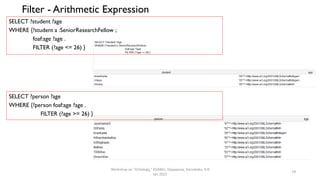
• SPARQL allows to pose restrictions on the values in query solutions.
• These restrictions are defined in FILTER clauses.
• These clauses are, to some extent, similar to WHERE clause of an SQL query.
• SPARQL filters can be used to restrict:
• String values (using REGEX function),
• Numeric values (using <, >, =, <=, >= and != operators).
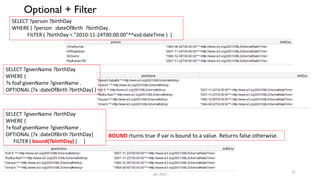
• SPARQL also provides test functions:
• BOUND, isURI, isBLANK, isLITERAL
Workshop on "Ontology," KSAWU, Vijayapura, Karnataka, 4-8
Jan 2021
16
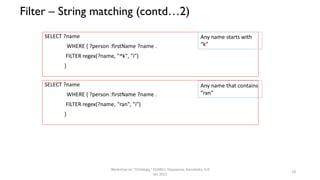
Filter – String matching
SPARQL provides an operation to test strings, based on regular expressions
This allows to ask SQL "LIKE" style tests, although the syntax of the regular
expression is different from SQL.
Syntax:
FILTER regex(?x, "pattern" [, "flags"])
*Regex invokes the XPath fn:matches function to match text against a
regular expression pattern.The regular expression language is defined
in XQuery 1.0 and XPath 2.0
**The flags argument is optional. The flag "i" means a case-insensitive
pattern match is done.
Workshop on "Ontology," KSAWU, Vijayapura, Karnataka, 4-8
Jan 2021
17
SELECT ?name
WHERE { ?person :firstName ?name .
FILTER regex(?name, "^k", "i")
}
Filter – String matching (contd…2)
Workshop on "Ontology," KSAWU, Vijayapura, Karnataka, 4-8
Jan 2021
18
SELECT ?name
WHERE { ?person :firstName ?name .
FILTER regex(?name, "ran", "i")
}
Any name starts with
“k”
Any name that contains
“ran”
Filter - Arithmetic Expression
Workshop on "Ontology," KSAWU, Vijayapura, Karnataka, 4-8
Jan 2021
19
SELECT ?student ?age
WHERE {?student a :SeniorResearchFellow ;
foaf:age ?age .
FILTER (?age <= 26) }
SELECT ?person ?age
WHERE {?person foaf:age ?age .
FILTER (?age >= 26) }
Optional + Filter
Workshop on "Ontology," KSAWU, Vijayapura, Karnataka, 4-8
Jan 2021
20
SELECT ?student ?age
WHERE { ?student a :SeniorResearchFellow .
OPTIONAL { ?student foaf:age ?age .
FILTER (?age != 26)
} }
SELECT ?student ?age
WHERE { ?student a :SeniorResearchFellow .
OPTIONAL { ?student foaf:age ?age .
FILTER (?age >= 26)
}
}
Optional + Filter
Workshop on "Ontology," KSAWU, Vijayapura, Karnataka, 4-8
Jan 2021
21
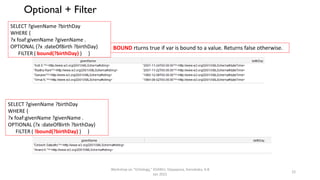
SELECT ?givenName ?birthDay
WHERE {
?x foaf:givenName ?givenName .
OPTIONAL {?x :dateOfBirth ?birthDay}
FILTER ( bound(?birthDay) ) }
SELECT ?givenName ?birthDay
WHERE {
?x foaf:givenName ?givenName .
OPTIONAL {?x :dateOfBirth ?birthDay} }
BOUND rturns true if var is bound to a value. Returns false otherwise.
SELECT ?person ?birthDay
WHERE { ?person :dateOfBirth ?birthDay .
FILTER ( ?birthDay < "2010-11-24T00:00:00"^^xsd:dateTime ) }
Optional + Filter
Workshop on "Ontology," KSAWU, Vijayapura, Karnataka, 4-8
Jan 2021
22
SELECT ?givenName ?birthDay
WHERE {
?x foaf:givenName ?givenName .
OPTIONAL {?x :dateOfBirth ?birthDay}
FILTER ( bound(?birthDay) ) }
BOUND rturns true if var is bound to a value. Returns false otherwise.
SELECT ?givenName ?birthDay
WHERE {
?x foaf:givenName ?givenName .
OPTIONAL {?x :dateOfBirth ?birthDay}
FILTER ( !bound(?birthDay) ) }
Matching Alternatives: UNION
• SPARQL supports combining graph patterns so that one of several
alternative graph patterns may match.
• If there is a match of more than one alternatives, all the possible
pattern solutions are found.
• Pattern alternatives are syntactically specified with the UNION
keyword.
Workshop on "Ontology," KSAWU, Vijayapura, Karnataka, 4-8
Jan 2021
23
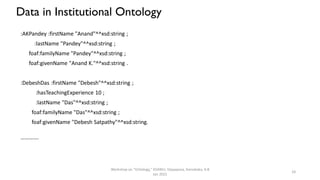
:AKPandey :firstName "Anand"^^xsd:string ;
:lastName "Pandey"^^xsd:string ;
foaf:familyName "Pandey"^^xsd:string ;
foaf:givenName "Anand K."^^xsd:string .
:DebeshDas :firstName "Debesh"^^xsd:string ;
:hasTeachingExperience 10 ;
:lastName "Das"^^xsd:string ;
foaf:familyName "Das"^^xsd:string ;
foaf:givenName "Debesh Satpathy"^^xsd:string.
………….
Data in Institutional Ontology
Workshop on "Ontology," KSAWU, Vijayapura, Karnataka, 4-8
Jan 2021
24
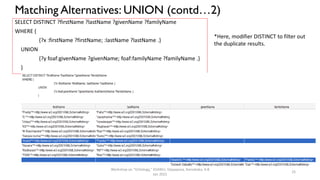
SELECT DISTINCT ?firstName ?lastName ?givenName ?familyName
WHERE {
{?x :firstName ?firstName; :lastName ?lastName .}
UNION
{?y foaf:givenName ?givenName; foaf:familyName ?familyName .}
}
Matching Alternatives: UNION (contd…2)
Workshop on "Ontology," KSAWU, Vijayapura, Karnataka, 4-8
Jan 2021
25
*Here, modifier DISTINCT to filter out
the duplicate results.
SELECT DISTINCT ?firstName
WHERE {
{?x :firstName ?firstName .}
UNION
{?y foaf:givenName ?firstName .}
} ORDER BY ?firstName
Matching Alternatives: UNION (contd…3)
Workshop on "Ontology," KSAWU, Vijayapura, Karnataka, 4-8
Jan 2021
26
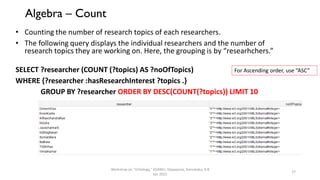
• Counting the number of research topics of each researchers.
• The following query displays the individual researchers and the number of
research topics they are working on. Here, the grouping is by “researhchers.”
SELECT ?researcher (COUNT (?topics) AS ?noOfTopics)
WHERE {?researcher :hasResearchInterest ?topics .}
GROUP BY ?researcher ORDER BY DESC(COUNT(?topics)) LIMIT 10
Algebra – Count
Workshop on "Ontology," KSAWU, Vijayapura, Karnataka, 4-8
Jan 2021
27
For Ascending order, use “ASC”
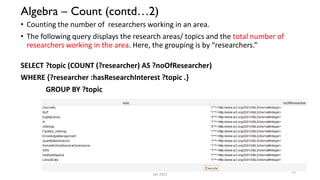
• Counting the number of researchers working in an area.
• The following query displays the research areas/ topics and the total number of
researchers working in the area. Here, the grouping is by “researchers.”
SELECT ?topic (COUNT (?researcher) AS ?noOfResearcher)
WHERE {?researcher :hasResearchInterest ?topic .}
GROUP BY ?topic
Algebra – Count (contd…2)
Workshop on "Ontology," KSAWU, Vijayapura, Karnataka, 4-8
Jan 2021
28
Query for properties and schema
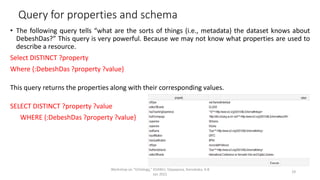
• The following query tells “what are the sorts of things (i.e., metadata) the dataset knows about
DebeshDas?” This query is very powerful. Because we may not know what properties are used to
describe a resource.
Select DISTINCT ?property
Where {:DebeshDas ?property ?value}
This query returns the properties along with their corresponding values.
SELECT DISTINCT ?property ?value
WHERE {:DebeshDas ?property ?value}
Workshop on "Ontology," KSAWU, Vijayapura, Karnataka, 4-8
Jan 2021
29
Query for properties and schema (Contd…2)
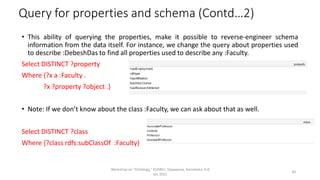
• This ability of querying the properties, make it possible to reverse-engineer schema
information from the data itself. For instance, we change the query about properties used
to describe :DebeshDas to find all properties used to describe any :Faculty.
Select DISTINCT ?property
Where {?x a :Faculty .
?x ?property ?object .}
• Note: If we don’t know about the class :Faculty, we can ask about that as well.
Select DISTINCT ?class
Where {?class rdfs:subClassOf :Faculty}
Workshop on "Ontology," KSAWU, Vijayapura, Karnataka, 4-8
Jan 2021
30
Query for properties and schema (Contd…3)
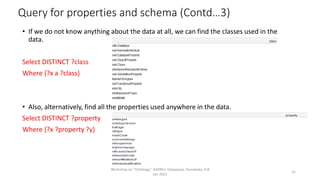
• If we do not know anything about the data at all, we can find the classes used in the
data.
Select DISTINCT ?class
Where {?x a ?class}
• Also, alternatively, find all the properties used anywhere in the data.
Select DISTINCT ?property
Where {?x ?property ?y}
Workshop on "Ontology," KSAWU, Vijayapura, Karnataka, 4-8
Jan 2021
31
References
1. SPARQL 1.1 Query Language (W3C Recommendation). http://www.w3.org/TR/sparql11-query/
2. Corno, Fulvio (2012). SPARQL and Linked Data. http://www.slideshare.net/
3. Ghaiwi, R. (2013). SPARQL.
4. SPARQL by example. https://www.w3.org/2009/Talks/0615-qbe/
5. DBPedia SPARQL Endpoint. http://dbpedia.org/sparql
Workshop on "Ontology," KSAWU, Vijayapura, Karnataka, 4-8
Jan 2021
32
Workshop on "Ontology," KSAWU, Vijayapura, Karnataka, 4-8
Jan 2021
Thank you!!!
Questions?
Contact:
Biswanath Dutta
dutta2005@gmail.com, bisu@drtc.isibang.ac.in, bisu@isibang.ac.in
Organized by
Documentation Research and Training Centre
Indian Statistical Institute (Bangalore)
https://drtc.isibang.ac.in/semtech/
Workshop on "Ontology," KSAWU, Vijayapura, Karnataka, 4-8
Jan 2021

Tutorial on SPARQL: SPARQL Protocol and RDF Query Language

  • 1.
    Dr. Biswanath Dutta AssociateProfessor Documentation Research and Training Centre (DRTC) Indian Statistical Institute Bangalore 56059 (INDIA) dutta2005@gmail.com, bisu@drtc.isibang.ac.in, bisu@isibang.ac.in Tutorial on SPARQL: SPARQL Protocol and RDF Query Language Workshop on "Ontology," KSAWU, Vijayapura, Karnataka, 4-8 Jan 2021 1
  • 2.
    Outline • Introduction toSPARQL • SPARQL Query Forms • SELECT Query form • Simple query • Multiple match • Optional Clause • Filter Clause (string, arithmatic) • Matching alternatives • Algebra • Query for properties and schema Workshop on "Ontology," KSAWU, Vijayapura, Karnataka, 4-8 Jan 2021 2
  • 3.
    Introduction • SPARQL isa query language for RDF graph traversal • SPARQL query language specification • A protocol* for using SPARQL via HTTP • SPARQL Protocol for RDF Specification • SPARQL queries and manipulates RDF graph content on the web or in the RDF store • SPARQL is independent of any particular serialization format (e.g., RDF/XML, N3, Turtle) • Inspired by SQL • SPARQL 1.0: W3C Recommendation (15th January 2008) (https://www.w3.org/TR/rdf- sparql-query/) • SPARQL 1.1: W3C Recommendation (21st March 2013) (https://www.w3.org/TR/sparql11-query/) *a means of conveying SPARQL queries from query clients to query processors. Workshop on "Ontology," KSAWU, Vijayapura, Karnataka, 4-8 Jan 2021 3
  • 4.
    Introduction (contd…2) • TheSPARQL query result is usually displayed in Tabular form. • SPARQL query results can be exchanged using any of the following formats: • Extensible Markup Language (XML) • JavaScript Object Notation (JSON) • Comma Separated Value (CSV) • Tab Separated Value (TSV) Workshop on "Ontology," KSAWU, Vijayapura, Karnataka, 4-8 Jan 2021 4
  • 5.
    SPARQL Four QueryForms • These query forms use the solutions from pattern matching to form result sets or RDF graphs. • SELECT query • Returns all, or a subset of, the variables bound in a query pattern match. • Extract raw values, the results are returned in a table format. • CONSTRUCT query • Returns an RDF graph constructed by substituting variables in a set of triple templates. • Extract information and transform the results into valid RDF. • ASK query • Returns a boolean indicating whether a query pattern matches or not. • Provides a simple True/False result for a query. • DESCRIBE query • Returns an RDF graph that describes the resources found. • Extract an RDF graph from the SPARQL endpoint, the content of which is left to the endpoint to decide based on what the maintainer deems as useful information. Workshop on "Ontology," KSAWU, Vijayapura, Karnataka, 4-8 Jan 2021 5
  • 6.
    Query Form: SELECT PREFIX: <http://www.isibang.ac.in/ns/into#> SELECT ?x ?y WHERE { ?x :p ?y } Prefix mechanism to abbreviate URI Variables to be returned Query patterns (list of triple patterns) Workshop on "Ontology," KSAWU, Vijayapura, Karnataka, 4-8 Jan 2021 6
  • 7.
    • Syntax: SELECTvar1, var2, … varn • Here, var refers to any string variable, such as, ?x, ?name, ?email, ?title, ?experts Query Form: SELECT SELECT ?x ?y Alternatively: SELECT ?researcher ?researchInterest Workshop on "Ontology," KSAWU, Vijayapura, Karnataka, 4-8 Jan 2021 7
  • 8.
    WHERE • Graph patternsto match a set of triples • Syntax: WHERE { subject predicate object . subject predicate object . } Alternative query: SELECT ?researcher ?researchInterest WHERE { ?researcher <http://www.isibang.ac.in/ns/into#hasResearchInterest> ?researchInterest} Workshop on "Ontology," KSAWU, Vijayapura, Karnataka, 4-8 Jan 2021 PREFIX : <http://www.isibang.ac.in/ns/into#hasResearchInterest#> SELECT ?x ?y WHERE { ?x : hasResearchInterest ?y } 8
  • 9.
    ### http://www.isibang.ac.in/ns/into#ADIS :ADIS rdf:typeowl:Class ; rdfs:subClassOf :CourseSchedule ; rdfs:comment "This course is equivalent to MLISc degree"^^xsd:string . ### http://www.isibang.ac.in/ns/into#AcademicProgramme :AcademicProgramme rdf:type owl:Class . ### http://www.isibang.ac.in/ns/into#AdministrativeStaff :AdministrativeStaff rdf:type owl:Class ; rdfs:subClassOf :Employee . ### http://www.isibang.ac.in/ns/into#Agent :Agent rdf:type owl:Class . Class inf. of Institutional Ontology (excerpt) (Turtle format) Workshop on "Ontology," KSAWU, Vijayapura, Karnataka, 4-8 Jan 2021 ### http://www.isibang.ac.in/ns/into#Article :Article rdf:type owl:Class ; rdfs:subClassOf :Publication . ### http://www.isibang.ac.in/ns/into#Assistant :Assistant rdf:type owl:Class ; rdfs:subClassOf :Employee . ### http://www.isibang.ac.in/ns/into#AssistantProfessor :AssistantProfessor rdf:type owl:Class ; rdfs:subClassOf :Faculty , [ rdf:type owl:Restriction ; owl:onProperty :supervise ; owl:maxQualifiedCardinality "4"^^xsd:nonNegativeInteger ; owl:onClass :ResearchFellow ] . 9
  • 10.
    A Simple Queryand Result SELECT ?class ?sub_class WHERE { ?class rdfs:subClassOf ?sub_class} Workshop on "Ontology," KSAWU, Vijayapura, Karnataka, 4-8 Jan 2021 10
  • 11.
    Data in InstitutionalOntology Data in Turtle (1): ### http://www.isibang.ac.in/ns/into#KiranKanta :BiswanathDutta rdf:type owl:NamedIndividual , :SeniorResearchFellow ; :hasAffiliation :DRTC , :ISIBC ; :hasGender :male ; :hasQualification :BSc , :MLISc ; :hasResearchInterest :Ontology , :SWS , :SemanticWebBased-eGovernance ; foaf:age 26 ; foaf:email “kiran@drtc.isibang.ac.in"^^xsd:string ; :firstName “Kiran"^^xsd:string ; :homepage "http://drtc.isibang.ac.in/~kiran"^^xsd:anyURI ; :lastName “Kanta"^^xsd:string ; :rollNo "RS039"^^xsd:string . ............ Workshop on "Ontology," KSAWU, Vijayapura, Karnataka, 4-8 Jan 2021 Data in Turtle (2): ### http://www.isibang.ac.in/ns/into#DebeshDas :DebeshDas rdf:type owl:NamedIndividual , :AssociateProfessor ; :editorOfEvents :DL2005 , :ICSD2007 ; :hasAffiliation :DRTC , :ISIBC ; :hasGender :male ; :hasQualification :MLISc , :MPhil ; :hasResearchInterest :AI , :DigitalLibrary , :NLP , :Ontology ; :supervise :BiswanathDutta , :NGuha , :SKSunny ; foaf:age "57"^^xsd:int ; :firstName "Debesh"^^xsd:string ; :hasTeachingExperience 10 ; :homepage "http://drtc.isibang.ac.in/~ard"^^xsd:anyURI ; :lastName "Das"^^xsd:string ; :rollNo "ASSP039"^^xsd:string . ............ 11
  • 12.
    A Simple Queryand Result Workshop on "Ontology," KSAWU, Vijayapura, Karnataka, 4-8 Jan 2021 PREFIX : <http://www.isibang.ac.in/ns/into#> SELECT ?researcher ?topic WHERE {?researcher :hasResearchInterest ?topic} 12
  • 13.
    Multiple Match • Theabove query involves two triple patterns, each triple ends with a '.' – the dot (‘.’) after the last triple can be omitted. Workshop on "Ontology," KSAWU, Vijayapura, Karnataka, 4-8 Jan 2021 Graph patterns to match a set of triples Syntax: WHERE { subject predicate object . subject predicate object . } E.g., PREFIX : <http://www.isibang.ac.in/ns/into#> PREFIX foaf:<http://xmlns.com/foaf/0.1/> SELECT ?firstname ?lastname ?age WHERE {?p :firstName ?firstname . ?p :lastName ?lastname . ?p foaf:age ?age .} LIMIT 10 13
  • 14.
    Optional Clause • SPARQLalso allows to define OPTIONAL blocks. • They offer the ability to query for data but not to fail query when that data does not exist. • Optional blocks define additional graph patterns that do bind to the graph when they can be matched, but do not cause solutions to be rejected if they are not matched. Workshop on "Ontology," KSAWU, Vijayapura, Karnataka, 4-8 Jan 2021 14
  • 15.
    Optional Pattern Matching PREFIX: <http://www.isibang.ac.in/ns/into#> PREFIX foaf:<http://xmlns.com/foaf/0.1/> SELECT ?firstname ?lastname ?age WHERE {?p :firstName ?firstname . ?p :lastName ?lastname . OPTIONAL {?p foaf:age ?age .} } Workshop on "Ontology," KSAWU, Vijayapura, Karnataka, 4-8 Jan 2021 15 OFFSET causes the solutions generated to start after the specified number of solutions.
  • 16.
    Filter Clause • SPARQLallows to pose restrictions on the values in query solutions. • These restrictions are defined in FILTER clauses. • These clauses are, to some extent, similar to WHERE clause of an SQL query. • SPARQL filters can be used to restrict: • String values (using REGEX function), • Numeric values (using <, >, =, <=, >= and != operators). • SPARQL also provides test functions: • BOUND, isURI, isBLANK, isLITERAL Workshop on "Ontology," KSAWU, Vijayapura, Karnataka, 4-8 Jan 2021 16
  • 17.
    Filter – Stringmatching SPARQL provides an operation to test strings, based on regular expressions This allows to ask SQL "LIKE" style tests, although the syntax of the regular expression is different from SQL. Syntax: FILTER regex(?x, "pattern" [, "flags"]) *Regex invokes the XPath fn:matches function to match text against a regular expression pattern.The regular expression language is defined in XQuery 1.0 and XPath 2.0 **The flags argument is optional. The flag "i" means a case-insensitive pattern match is done. Workshop on "Ontology," KSAWU, Vijayapura, Karnataka, 4-8 Jan 2021 17
  • 18.
    SELECT ?name WHERE {?person :firstName ?name . FILTER regex(?name, "^k", "i") } Filter – String matching (contd…2) Workshop on "Ontology," KSAWU, Vijayapura, Karnataka, 4-8 Jan 2021 18 SELECT ?name WHERE { ?person :firstName ?name . FILTER regex(?name, "ran", "i") } Any name starts with “k” Any name that contains “ran”
  • 19.
    Filter - ArithmeticExpression Workshop on "Ontology," KSAWU, Vijayapura, Karnataka, 4-8 Jan 2021 19 SELECT ?student ?age WHERE {?student a :SeniorResearchFellow ; foaf:age ?age . FILTER (?age <= 26) } SELECT ?person ?age WHERE {?person foaf:age ?age . FILTER (?age >= 26) }
  • 20.
    Optional + Filter Workshopon "Ontology," KSAWU, Vijayapura, Karnataka, 4-8 Jan 2021 20 SELECT ?student ?age WHERE { ?student a :SeniorResearchFellow . OPTIONAL { ?student foaf:age ?age . FILTER (?age != 26) } } SELECT ?student ?age WHERE { ?student a :SeniorResearchFellow . OPTIONAL { ?student foaf:age ?age . FILTER (?age >= 26) } }
  • 21.
    Optional + Filter Workshopon "Ontology," KSAWU, Vijayapura, Karnataka, 4-8 Jan 2021 21 SELECT ?givenName ?birthDay WHERE { ?x foaf:givenName ?givenName . OPTIONAL {?x :dateOfBirth ?birthDay} FILTER ( bound(?birthDay) ) } SELECT ?givenName ?birthDay WHERE { ?x foaf:givenName ?givenName . OPTIONAL {?x :dateOfBirth ?birthDay} } BOUND rturns true if var is bound to a value. Returns false otherwise. SELECT ?person ?birthDay WHERE { ?person :dateOfBirth ?birthDay . FILTER ( ?birthDay < "2010-11-24T00:00:00"^^xsd:dateTime ) }
  • 22.
    Optional + Filter Workshopon "Ontology," KSAWU, Vijayapura, Karnataka, 4-8 Jan 2021 22 SELECT ?givenName ?birthDay WHERE { ?x foaf:givenName ?givenName . OPTIONAL {?x :dateOfBirth ?birthDay} FILTER ( bound(?birthDay) ) } BOUND rturns true if var is bound to a value. Returns false otherwise. SELECT ?givenName ?birthDay WHERE { ?x foaf:givenName ?givenName . OPTIONAL {?x :dateOfBirth ?birthDay} FILTER ( !bound(?birthDay) ) }
  • 23.
    Matching Alternatives: UNION •SPARQL supports combining graph patterns so that one of several alternative graph patterns may match. • If there is a match of more than one alternatives, all the possible pattern solutions are found. • Pattern alternatives are syntactically specified with the UNION keyword. Workshop on "Ontology," KSAWU, Vijayapura, Karnataka, 4-8 Jan 2021 23
  • 24.
    :AKPandey :firstName "Anand"^^xsd:string; :lastName "Pandey"^^xsd:string ; foaf:familyName "Pandey"^^xsd:string ; foaf:givenName "Anand K."^^xsd:string . :DebeshDas :firstName "Debesh"^^xsd:string ; :hasTeachingExperience 10 ; :lastName "Das"^^xsd:string ; foaf:familyName "Das"^^xsd:string ; foaf:givenName "Debesh Satpathy"^^xsd:string. …………. Data in Institutional Ontology Workshop on "Ontology," KSAWU, Vijayapura, Karnataka, 4-8 Jan 2021 24
  • 25.
    SELECT DISTINCT ?firstName?lastName ?givenName ?familyName WHERE { {?x :firstName ?firstName; :lastName ?lastName .} UNION {?y foaf:givenName ?givenName; foaf:familyName ?familyName .} } Matching Alternatives: UNION (contd…2) Workshop on "Ontology," KSAWU, Vijayapura, Karnataka, 4-8 Jan 2021 25 *Here, modifier DISTINCT to filter out the duplicate results.
  • 26.
    SELECT DISTINCT ?firstName WHERE{ {?x :firstName ?firstName .} UNION {?y foaf:givenName ?firstName .} } ORDER BY ?firstName Matching Alternatives: UNION (contd…3) Workshop on "Ontology," KSAWU, Vijayapura, Karnataka, 4-8 Jan 2021 26
  • 27.
    • Counting thenumber of research topics of each researchers. • The following query displays the individual researchers and the number of research topics they are working on. Here, the grouping is by “researhchers.” SELECT ?researcher (COUNT (?topics) AS ?noOfTopics) WHERE {?researcher :hasResearchInterest ?topics .} GROUP BY ?researcher ORDER BY DESC(COUNT(?topics)) LIMIT 10 Algebra – Count Workshop on "Ontology," KSAWU, Vijayapura, Karnataka, 4-8 Jan 2021 27 For Ascending order, use “ASC”
  • 28.
    • Counting thenumber of researchers working in an area. • The following query displays the research areas/ topics and the total number of researchers working in the area. Here, the grouping is by “researchers.” SELECT ?topic (COUNT (?researcher) AS ?noOfResearcher) WHERE {?researcher :hasResearchInterest ?topic .} GROUP BY ?topic Algebra – Count (contd…2) Workshop on "Ontology," KSAWU, Vijayapura, Karnataka, 4-8 Jan 2021 28
  • 29.
    Query for propertiesand schema • The following query tells “what are the sorts of things (i.e., metadata) the dataset knows about DebeshDas?” This query is very powerful. Because we may not know what properties are used to describe a resource. Select DISTINCT ?property Where {:DebeshDas ?property ?value} This query returns the properties along with their corresponding values. SELECT DISTINCT ?property ?value WHERE {:DebeshDas ?property ?value} Workshop on "Ontology," KSAWU, Vijayapura, Karnataka, 4-8 Jan 2021 29
  • 30.
    Query for propertiesand schema (Contd…2) • This ability of querying the properties, make it possible to reverse-engineer schema information from the data itself. For instance, we change the query about properties used to describe :DebeshDas to find all properties used to describe any :Faculty. Select DISTINCT ?property Where {?x a :Faculty . ?x ?property ?object .} • Note: If we don’t know about the class :Faculty, we can ask about that as well. Select DISTINCT ?class Where {?class rdfs:subClassOf :Faculty} Workshop on "Ontology," KSAWU, Vijayapura, Karnataka, 4-8 Jan 2021 30
  • 31.
    Query for propertiesand schema (Contd…3) • If we do not know anything about the data at all, we can find the classes used in the data. Select DISTINCT ?class Where {?x a ?class} • Also, alternatively, find all the properties used anywhere in the data. Select DISTINCT ?property Where {?x ?property ?y} Workshop on "Ontology," KSAWU, Vijayapura, Karnataka, 4-8 Jan 2021 31
  • 32.
    References 1. SPARQL 1.1Query Language (W3C Recommendation). http://www.w3.org/TR/sparql11-query/ 2. Corno, Fulvio (2012). SPARQL and Linked Data. http://www.slideshare.net/ 3. Ghaiwi, R. (2013). SPARQL. 4. SPARQL by example. https://www.w3.org/2009/Talks/0615-qbe/ 5. DBPedia SPARQL Endpoint. http://dbpedia.org/sparql Workshop on "Ontology," KSAWU, Vijayapura, Karnataka, 4-8 Jan 2021 32
  • 33.
    Workshop on "Ontology,"KSAWU, Vijayapura, Karnataka, 4-8 Jan 2021 Thank you!!! Questions? Contact: Biswanath Dutta dutta2005@gmail.com, bisu@drtc.isibang.ac.in, bisu@isibang.ac.in
  • 34.
    Organized by Documentation Researchand Training Centre Indian Statistical Institute (Bangalore) https://drtc.isibang.ac.in/semtech/ Workshop on "Ontology," KSAWU, Vijayapura, Karnataka, 4-8 Jan 2021